Micah 7:12

Hebrew (Westminster Leningrad Codex) Micah 7:12 appears in the Hebrew Old Testament. The text above is from the Westminster Leningrad Codex. Each word links to its Strong’s number, a concise gloss, and parsing drawn from the Open Scriptures Hebrew Bible morphology. Click any word for its full Brown-Driver-Briggs (BDB) entry.
Download image
Cite this verse

Micah 7:12 (World English Bible). Public Domain. Lemma interlinear Bible study tool, https://lemma.gebible.app/v/micah/7/12.

Show BibTeX & RIS
BibTeX
RIS
English Translation
In that day they will come to you from Assyria and the cities of Egypt, And from Egypt even to the River, And from sea to sea, And mountain to mountain.
World English Bible · Public Domain
Download a study sheet

One document with this verse’s original text, its word-by-word gloss line, the meaning frame, cross-references with their text, attributed commentary, and full source and license credits — printable, and it pastes into notes with its structure intact.

This verse Autodidact and up

Study sheet (.html) Plain text (.txt)

A passage Seminary Student

Up to 50 verses in one chapter. A passage sheet keeps up to 6 commentary sources and 12 cross-references per verse, in the order this page ranks them, and says so on the sheet whenever that leaves anything out. Ask for a single verse and you get the Autodidact verse sheet above.

Everything on this page stays free to read, with no account — the sheet is a download of what is already on screen, not access to it.

Want to remove ads? Support Godless Engineer
Compare translations 3

The same verse in 3 English versions, stacked beneath the original-language interlinear above. Click any original word for its lexicon entry.

Each is an independent rendering of the whole verse — the interlinear is not word-aligned to these translations.

Highlighted words mark where these versions differ — a whole-verse word diff, not a word-by-word alignment.

  • World English Bible Public Domain
    In that day they will come to you from Assyria and the cities of Egypt, And from Egypt even to the River, And from sea to sea, And mountain to mountain.
  • King James Version Public Domain
    In that day also he shall come even to thee from Assyria, and from the fortified cities, and from the fortress even to the river, and from sea to sea, and from mountain to mountain.
  • unfoldingWord Literal Text CC BY-SA 4.0
    On that day your people will come to you, from Assyria and the cities in Egypt, from Egypt to the River, from sea to sea, and from mountain to mountain.

unfoldingWord Literal Text — © unfoldingWord, licensed CC BY-SA 4.0. Word-aligned USFM3 via Door43 (git.door43.org/unfoldingWord/en_ult).

Versions to compare (up to 4)

3 of 4 selected

Show all 18 translations

Every available English version of this verse, each an independent rendering of the whole verse.

  • World English Bible Public Domain
    In that day they will come to you from Assyria and the cities of Egypt, And from Egypt even to the River, And from sea to sea, And mountain to mountain.
  • Berean Standard Bible Public Domain
    On that day they will come to you from Assyria and the cities of Egypt, even from Egypt to the Euphrates, from sea to sea and mountain to mountain.
  • Majority Standard Bible Public Domain
    On that day they will come to you from Assyria and the cities of Egypt, even from Egypt to the Euphrates, from sea to sea and mountain to mountain.
  • King James Version Public Domain
    In that day also he shall come even to thee from Assyria, and from the fortified cities, and from the fortress even to the river, and from sea to sea, and from mountain to mountain.
  • American Standard Version (1901) Public Domain
    In that day shall they come unto thee from Assyria and the cities of Egypt, and from Egypt even to the River, and from sea to sea, and `from' mountain to mountain.
  • Revised Version (1885) Public Domain
    In that day shall they come unto thee, from Assyria and the cities of Egypt, and from Egypt even to the River, and from sea to sea, and from mountain to mountain.
  • Geneva Bible (1599) Public Domain
    In this day also they shall come vnto thee from Asshur, and from the strong cities, and from the strong holdes euen vnto the riuer, and from Sea to Sea, and from mountaine to mountaine.
  • Douay-Rheims (1899) Public Domain
    In that day they shall come even from Assyria to thee, and to the fortified cities: and from the fortified cities even to the river, and from sea to sea, and from mountain to mountain.
  • Young's Literal Translation Public Domain
    That day -- even unto thee it doth come in, From Asshur and the cities of the fortress, And from the fortress even unto the river, And from sea to sea, and mount to mount.
  • Literal Standard Version CC BY-SA 4.0
    That day—even to you it comes in, || From Asshur and the cities of the fortress, || And from the fortress even to the river, || And from sea to sea, and mountain to mountain.
  • Unlocked Literal Bible CC BY-SA 4.0
    On that day your people will come to you, from Assyria and the cities in Egypt, from Egypt to the River, from sea to sea, and from mountain to mountain.
  • unfoldingWord Literal Text CC BY-SA 4.0
    On that day your people will come to you, from Assyria and the cities in Egypt, from Egypt to the River, from sea to sea, and from mountain to mountain.
  • Darby Bible Public Domain
    In that day they shall come to thee from Assyria and the cities of Egypt, and from Egypt to the river, and from sea to sea, and from mountain to mountain.
  • World Messianic Bible Public Domain
    In that day they will come to you from Assyria and the cities of Egypt, and from Egypt even to the River, and from sea to sea, and mountain to mountain.
  • Webster's Bible Public Domain
    In that day also he shall come even to thee from Assyria, and from the fortified cities, and from the fortress even to the river, and from sea to sea, and from mountain to mountain.
  • Free Bible Version CC BY-SA 4.0
    On that day people will come from Assyria and the cities of Egypt, from Egypt to the Euphrates River, from sea to sea, from mountain to mountain.
  • Bible in Basic English Public Domain
    In that day they will come to you from Assyria and the towns of Egypt, and from Egypt even to the River, and from sea to sea and from mountain to mountain.
  • JPS Tanakh (1917) Public Domain
    There shall be a day when they shall come unto thee, from Assyria even to the cities of Egypt, and from Egypt even to the River, and from sea to sea, and from mountain to mountain.

Literal Standard Version (2020), Covenant Press — licensed CC BY-SA 4.0. Text via the HelloAO Bible API (eBible.org). Unlocked Literal Bible (unfoldingWord) — licensed CC BY-SA 4.0. Text via the HelloAO Bible API (eBible.org). unfoldingWord Literal Text — © unfoldingWord, licensed CC BY-SA 4.0. Word-aligned USFM3 via Door43 (git.door43.org/unfoldingWord/en_ult). Free Bible Version, Dr. Jonathan Gallagher — licensed CC BY-SA 4.0. Text via the HelloAO Bible API (eBible.org).

Word by word

More ways to search: Search by grammar → Find every occurrence → Compare this word →

Practice this passage: Drill this verse → Learn its vocabulary →

מָצוֹר֙
mâtsôwr
H4693
“siege”
Noun, Proper
Part of Speech
Noun
Type
Proper
Full BDB Definition

Origin: the same as H4692 in the sense of a limit

TWOT: 1898a

" Matsor" , a name for Egypt - (TWOT) siege, entrenchment
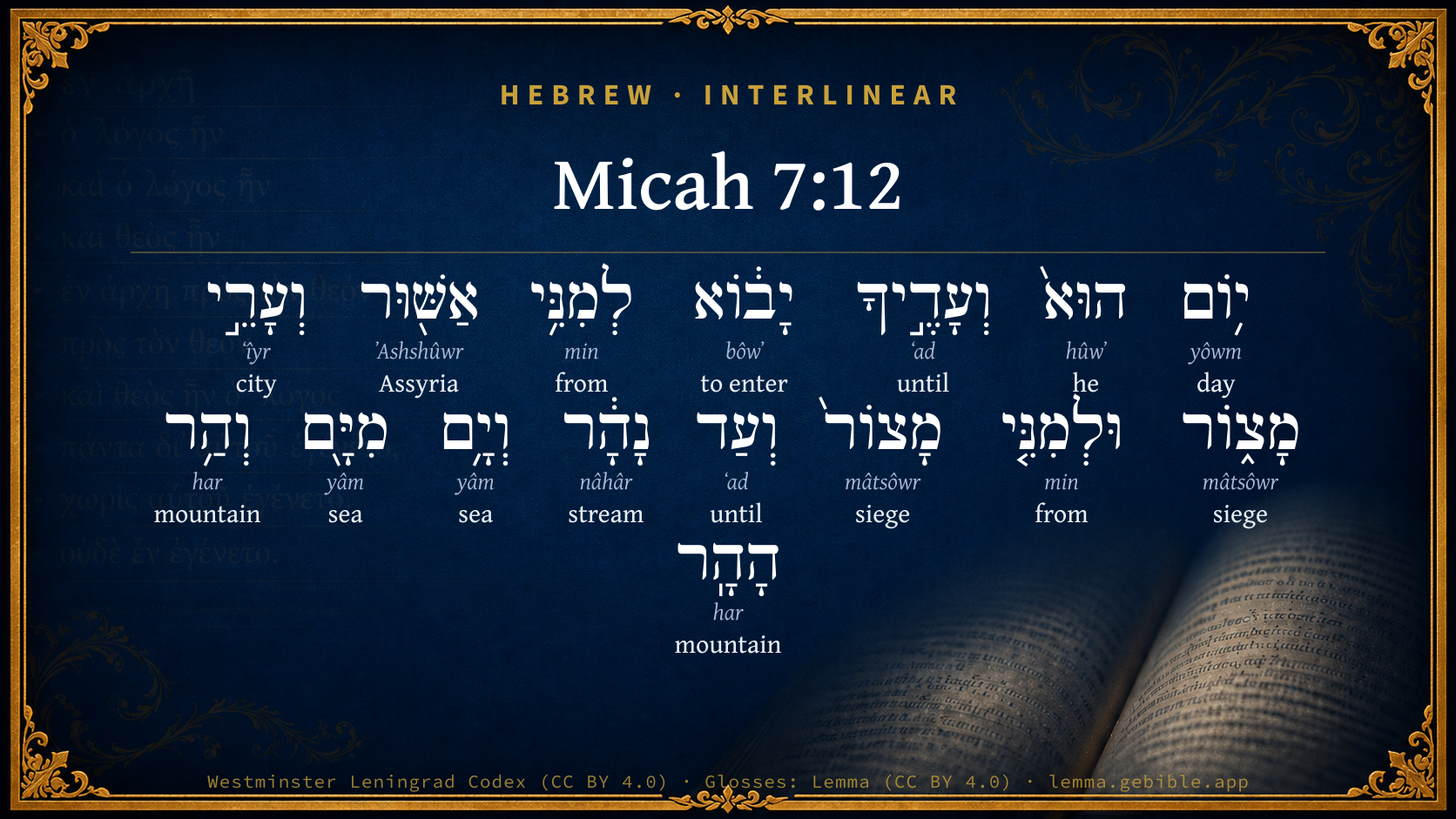
  1. י֥וֹם yôwm H3117 “day” Noun, Common, Masculine, Singular, Absolute
  2. הוּא֙ hûwʼ H1931 “he” Pronoun, Personal, 3rd Person, Masculine, Singular
  3. וְעָדֶ֣יךָ ʻad H5704 “and · until · you” Conjunction + Preposition + Suffix, Personal, 2nd Person, Masculine, Singular
  4. יָב֔וֹא bôwʼ H935 “to enter” Verb, Qal, Imperfect, 3rd Person, Masculine, Singular
  5. לְמִנִּ֥י min H4480 “to/for · from” Preposition + Preposition
  6. אַשּׁ֖וּר ʼAshshûwr H804 “Assyria” Noun, Proper
  7. וְעָרֵ֣י ʻîyr H5892 “and · cities of” Conjunction + Noun, Common, Feminine, Plural, Construct
  8. מָצ֑וֹר mâtsôwr H4692 “siege” Noun, Proper
  9. וּלְמִנִּ֤י min H4480 “and · to/for · from” Conjunction + Preposition + Preposition
  10. וְעַד ʻad H5704 “and · until” Conjunction + Preposition
  11. נָהָ֔ר nâhâr H5104 “stream” Noun, Common, Masculine, Singular, Absolute
  12. וְיָ֥ם yâm H3220 “and · sea” Conjunction + Noun, Common, Masculine, Singular, Absolute
  13. מִיָּ֖ם yâm H3220 “from · sea” Preposition + Noun, Common, Masculine, Singular, Absolute
  14. וְהַ֥ר har H2022 “and · mountain” Conjunction + Noun, Common, Masculine, Singular, Absolute
  15. הָהָֽר har H2022 “the · mountain” Particle, Definite Article + Noun, Common, Masculine, Singular, Absolute

About this verse

These counts appear in no published source. They are computed here, from the morphology-tagged text and Lemma’s own curated glosses. What Lemma adds →

16
words
12
distinct lemmas
Prophets
section

Notable vocabulary

The rarest word here is מָצוֹר֙ siege H4693 — appearing just 4 times in the whole Hebrew Bible.

Shared distinctive vocabulary

מָצוֹר֙ siege H4693 occurs in 4 verses of the Hebrew Bible. Also found in:

Grammatical profile

  • 1 verb
  • 10 nouns
  • 1 pronoun
  • 4 prepositions

Verb forms

  • יָב֔וֹא Qal · Imperfect

Repetition

Words recur within this verse — often emphatic in Hebrew:

  • וְעָדֶ֣יךָ until H5704 ×2
  • וְיָ֥ם sea H3220 ×2
  • וְהַ֥ר mountain H2022 ×2
  • לְמִנִּ֥י from H4480 ×2

Hebrew & Septuagint length

In English translation the verse runs 31 words from the Hebrew and 33 from the Septuagint (LXX English) — closely comparable.

A rough comparison of the two English renderings, which tokenize alike — not a word-level alignment.

Word counts can differ between the Hebrew and the Greek without any difference in meaning — e.g. the Hebrew direct-object marker אֵת has no separate Greek word, and Greek often adds the article ὁ.

Cross-references

13

Topical passages linked to Micah 7:12 in the Treasury of Scripture Knowledge — connected by theme and wording, ordered by reader-vote popularity; previews shown in the World English Bible.

  • Isaiah 19:23–25 In that day shall there be a highway out of Egypt to Assyria, and the Assyrian shall come into Egypt, and the Egyptian into Assyria; and the Egyptians shall worship with the Assyrians.
  • Isaiah 11:16 There shall be a highway for the remnant of his people, who shall remain, from Assyria; like as there was for Israel in the day that he came up out of the land of Egypt.
  • Hosea 11:11 They will come trembling like a bird out of Egypt, And like a dove out of the land of Assyria; And I will settle them in their houses," says Yahweh.
  • Isaiah 27:12–13 It shall happen in that day, that Yahweh will beat off [his fruit] from the flood of the River to the brook of Egypt; and you shall be gathered one by one, you children of Israel.
  • Isaiah 43:6 I will tell the north, Give up; and to the south, Don't keep back; bring my sons from far, and my daughters from the end of the earth;
  • Isaiah 49:12 Behold, these shall come from far; and, behold, these from the north and from the west; and these from the land of Sinim.
  • Isaiah 60:4–9 Lift up your eyes round about, and see: they all gather themselves together, they come to you; your sons shall come from far, and your daughters shall be carried in the arms.
  • Isaiah 66:19–20 I will set a sign among them, and I will send such as escape of them to the nations, to Tarshish, Pul, and Lud, who draw the bow, to Tubal and Javan, to the isles afar off, who have not heard my fame, neither have seen my glory; and they shall declare my glory among the nations.
  • Jeremiah 3:18 In those days the house of Judah shall walk with the house of Israel, and they shall come together out of the land of the north to the land that I gave for an inheritance to your fathers.
  • Jeremiah 23:3 I will gather the remnant of my flock out of all the countries where I have driven them, and will bring them again to their folds; and they shall be fruitful and multiply.
  • Jeremiah 31:8 Behold, I will bring them from the north country, and gather them from the uttermost parts of the earth, [and] with them the blind and the lame, the woman with child and her who travails with child together: a great company shall they return here.
  • Ezekiel 29:21 In that day will I cause a horn to bud forth to the house of Israel, and I will give you the opening of the mouth in the midst of them; and they shall know that I am Yahweh.
  • Ezekiel 37:21 Say to them, Thus says the Lord Yahweh: Behold, I will take the children of Israel from among the nations, where they are gone, and will gather them on every side, and bring them into their own land:

Cross-references courtesy of OpenBible.info (CC BY 4.0).

Hebrew and Greek witnesses Masoretic Hebrew ↔ Greek Septuagint

The same verse in the two great witnesses to the Old Testament, shown verse-for-verse.

These are two independent witnesses, not word-aligned to each other, and the Septuagint is shown in lemma (dictionary) form.

Hebrew Micah 7:12 Masoretic · Westminster Leningrad Codex

י֥וֹם הוּא֙ וְעָדֶ֣יךָ יָב֔וֹא לְמִנִּ֥י אַשּׁ֖וּר וְעָרֵ֣י מָצ֑וֹר וּלְמִנִּ֤י מָצוֹר֙ וְעַד נָהָ֔ר וְיָ֥ם מִיָּ֖ם וְהַ֥ר הָהָֽר

In that day they will come to you from Assyria and the cities of Egypt, And from Egypt even to the River, And from sea to sea, And mountain to mountain.

World English Bible · Public Domain

Greek LXX Micah 7:12 Septuagint · lemma form

ὁ ἡμέρα ἐκεῖνος καί ὁ πόλις σύ ἥκω εἰς ὁμαλισμός καί εἰς διαμερισμός ἀσσύριος καί ὁ πόλις σύ ὁ ὀχυρός εἰς διαμερισμός ἀπό τύρος ἕως ὁ ποταμός συρία ἡμέρα ὕδωρ καί θόρυβος

And your cities shall be levelled, and parted among the Assyrians; and your strong cities shall be parted from Tyre to the river, and from sea to sea, and from mountain to mountain.

LXX2012 (modern English Septuagint) · Public Domain

On this verse, The Pulpit Commentary discusses the Septuagint’s reading. Read the note in Commentary ↓

Hebrew: Westminster Leningrad Codex (CC BY 4.0). Greek: Septuagint (public domain); English from LXX2012 (modern English Septuagint) (Public Domain). How the Septuagint differs from the Hebrew →

Targum (Aramaic paraphrase)

1

The Targum is the ancient Jewish Aramaic paraphrase of the Hebrew Scriptures — an interpretive translation, not the Hebrew text itself. Onkelos (literal) and Pseudo-Jonathan (expansive) render the Torah, and Jonathan the Prophets. Coverage is partial: where no permissively-licensed English translation exists for a verse, only the Aramaic is shown. This is verse-level text, not a word-by-word alignment to the Hebrew.

  1. Targum Jonathan Prophets (Joshua–Malachi)
    בְּעִדָנָא הַהִיא יִתְכַּנְשׁוּן גַלְוָתָא דְמִן אַתּוּר וְקִרְוֵי תוּקְפָא וּדְמִן חוּרְמִינִי רַבְּתָא וְקִרְוֵי צְיָרָא וְעַד פְּרָת וְיַמָא מַעֲרָבָא וְטוּרֵי טוּרָא:

    (no public-domain English translation for this verse)

    Targum Jonathan — Aramaic: “Mikraot Gedolot” (public domain). English: “Sefaria Community Translation” (CC0 1.0 (public-domain dedication)); “London "Chaldee Paraphrase," 1871” (public domain). Text via Sefaria.

Commentary

Notes on Micah 7:12 from classic Christian and Jewish commentators (each source and its license shown beneath its notes). The classic Christian expositions comment on the surrounding passage and are grouped to its opening verse, so a note may address several verses; the Jewish commentaries on the Tanakh (Rashi and others) are per-verse, so they appear only where the commentator wrote on this verse.

Lemma curates 59 commentaries, every one of them public domain or Creative Commons licensed, each selected and text-cleaned for this edition rather than reprinted as found. About our sources →

Trapp's Complete Commentary

John Trapp

Mic 7:12 [In] that day [also] he shall come even to thee from Assyria, and [from] the fortified cities, and from the fortress even to the river, and from sea to sea, and [from] mountain to mountain.

Ver. 12. In that day also he shall come even to thee from Assyria] To thee, Jerusalem, in the type, shall recourse be had from all parts, as if thou wert the chief city of the world (Pliny saith, that in his time she was the most famous of all the cities of the East; and Titus himself is said to have wept at the last destruction of it by his soldiers, whom he could not restrain from firing the temple). To the new Jerusalem, the Church of the New Testament, in the antitype: from whence the gospel was sent out to "every creature which is under heaven," Col 1:23, and whereunto people of all sorts flowed, and many nations came, Mic 4:1-2, with highest acclamations, most vigorous affections, and utmost endeavours bestowing themselves upon the Lord Christ, Act 2:9. Jerusalem in the Hebrew tongue is of the dual number; in regard of the two parts of the city, the upper and the nether town. Or (as the Cabalists give the reason), in regard of a two-fold Jerusalem, the heavenly and the earthly; and the taking away of the earthly, they say, was signified by the taking away of the letter jod out of Jerushalajim, 2Sa 5:13. "But Jerusalem which is above is free," firm and full; "the desolate" (once so) "having many more children than she that hath a husband," Gal 4:26-27, "Whom the Lord of hosts also doth bless, saying" (as a father to them all), "Blessed be Egypt my people, and Assyria the work of my hands, and Israel mine inheritance," Isa 19:25.

And from the fortress even to the river] i.e. from all bounds and borders of the land, yea, of the world, {Psa 89:12, Tabor and Hermon are put for the east and west parts of the world} shall people come to the new Jerusalem, which hath "twelve gates: On the east three gates; on the north three gates; on the south three gates; and on the west three gates," Rev 21:12-13. {See Trapp on "Rev 21:12"} {See Trapp on "Rev 21:13"}

John Trapp, A Commentary or Exposition upon All the Books of the Old and New Testament (1647–1656) — public domain. Text from a community e-Sword module.

Geneva Bible (1599)

Geneva Bible translators

When the Church shall be restored, they that were enemies afore, shall come out of all the corners of the world unto her, so that neither holds, rivers, seas, nor mountains shall be able to let them.

Geneva Bible (1599) marginal notes — public domain. Text via Bolls.life.

Jamieson, Fausset & Brown

Robert Jamieson, A. R. Fausset & David Brown

In that day also--rather, an answer to the supposed question of Zion, When shall my walls be built? "The day (of thy walls being built) is the day when he (that is, many) shall come to thee from Assyria," &c. [LUDOVICUS DE DIEU]. The Assyrians (including the Babylonians) who spoiled thee shall come.

and from the fortified cities--rather, to suit the parallelism, "from Assyria even to Egypt." (Matzor may be so translated). So Assyria and Egypt are contrasted in Isa 19:23 [MAURER]. CALVIN agrees with English Version, "from all fortified cities."

from the fortress even to the river--"from Egypt even to the river" Euphrates (answering in parallelism to "Assyria") [MAURER]. Compare Isa 11:15-16; Isa 19:23-25; Isa 27:13; Hos 11:11; Zac 10:10.

Jamieson, Fausset & Brown — Commentary Critical and Explanatory on the Whole Bible (1871) — public domain (CC PDM 1.0). Text via the HelloAO Bible API.

Adam Clarke's Commentary

Verse 12. In that day also he shall come] Bp. Newcome translates: -

"And in that day they shall come unto thee

From Assyria and the fenced cities;

And from Egypt even unto the river."

Calmet translates: -

"They shall come to thee from Assyria even unto Egypt;

And from Egypt even to the river; (Euphrates;)

And from one sea to another, and from one mountain to

another."

This, says he, gives an easy sense; whereas we cannot tell where to find those fortified cities spoken of by other translators. The Israelites were to return from their captivity, and re-occupy their ancient country from Assyria to Egypt; that is, from the river Euphrates to the river Nile; and from the Mediterranean Sea to the Ocean, and from Mount Libanus to the mountains of Arabia Petraea, or Mount Seir. See Am 8:12. This prediction was literally fulfilled under the Asmoneans. The Jewish nation was greatly extended and very powerful under Herod, at the time that our Lord was born. See Calmet.

Adam Clarke's Commentary on the Bible (1810–1826) — public domain. Text from a community e-Sword/MySword module.

John Calvin's Commentaries

He afterwards adds, In that day also to thee shall they come from Asshur. There is some obscurity in the words; hence interpreters have regarded different words as being understood: but to me the meaning of the Prophet appears not doubtful. In that day, he says, to thee shall they come from Asshur, and cities of the fortress and from the fortress even to the river, and from sea to sea, and from mountain to mountain; but some think הר, er, to be a proper name, and render the last clause, “And from mount Hor:” and we know that Aaron was buried on this mount. But the Prophet, no doubt, alludes here to some other place; and to render it mount Hor is a strained version. I doubt not, therefore, but that the Prophet repeats a common name, as though he said, “From mountains to mountains.”

Let us now see what the Prophet means. With regard to the passage, as I have said, there is no ambiguity, provided we bear in mind the main subject. Now the Prophet had this in view, — That Jerusalem, when restored by God, would be in such honor along all nations that there would be flowing to her from all parts. He then says, that the state of the city would be very splendid, so that people from all quarters would come to it: and therefore the copulative vau is to be taken twice for even for the sake of emphasis, In that day, even to thee, and then, even to the river; for it was not believed that Jerusalem would have any dignity, after it had been entirely destroyed, together with the temple. It is no wonder then that the Prophet so distinctly confirms here what was by no means probable, at least according to the common sentiments of men, — that Jerusalem would attract to itself all nations, even those far away. Come, then, shall they, (for the verb יבוא, ibua, in the singular number must be taken indefinitely as having a plural meaning,) Come, then, shall they from Asshur even to thee. But the Assyrians had previously destroyed every land, overturned the kingdom of Israel, and almost blotted out its name; and they had also laid waste the kingdom of Judah; a small portion only remained. They came afterwards, we know, with the Chaldeans, after the seat of empire was translated to Babylon, and destroyed Nineveh. Therefore, by naming the Assyrians, he no doubt, taking a part for the whole, included the Babylonians. Come, then, shall they from Asshur, and then, from the cities of the fortress, that is, from every fortress. For they who take צור, tsur, for Tyre are mistaken; for מצור, metsur is mentioned twice, and it means citadels and strongholds. And then, even to the river, that is, to utmost borders of Euphrates; for many take Euphrates, by way of excellence, to be meant by the word river; as it is often the case in Scripture; though it might be not less fitly interpreted of any or every river, as though the Prophet had said, that there would be no obstacle to stop their course who would hasten to Jerusalem. Even to the river then, and from sea to sea, that is, they shall come in troops from remote countries, being led by the celebrity of the holy city; for when it shall be rebuilt by God’s command, it shall acquire new and unusual honor, so that all people from every part shall assemble there. And then, from mountain to mountain, that is, from regions far asunder. This is the sum of the whole.

The Prophet then promises what all men deemed as fabulous, — that the dignity of the city Jerusalem should be so great after the return of the Jews from exile, that it would become, as it were, the metropolis of the world. One thing must be added: They who confine this passage to Christ seem not indeed to be without a plausible reason; for there follows immediately a threatening as to the desolation of the land; and there seems to be some inconsistency, except we consider the Prophet here as comparing the Church collected from all nations with the ancient people. But these things will harmonize well together if we consider, that the Prophet denounces vengeance on the unbelieving who then lived, and that he yet declares that God will be merciful to his chosen people. But the restriction which they maintain is too rigid; for we know that it was usual with the Prophets to extend the favor of God from the return of the ancient people to the coming of Christ. Whenever, then, the Prophets make known God’s favor in the deliverance of his people, they make a transition to Christ, but included also the whole intermediate time. And this mode the Prophet now pursues, and it ought to be borne in mind by us. Let us go on —

John Calvin's Commentaries (1540-1563) — public domain. Text from the Calvin Translation Society English edition (1840s-50s) via the Christian Classics Ethereal Library (ccel.org). Calvin's coverage is partial (roughly two-thirds of the Bible); uncommented books and verses are honest gaps, never fabricated. The 19th-century editor's footnotes and remarks are omitted so the notes are faithfully Calvin's own voice.

Ellicott's Commentary for English Readers

(12) In that day also he shall come.—Rather translate, In that day shall they (impersonal) come even to thee from Assyria and (from) the cities of Matzor (i.e., Egypt), and from Matzor even to the river (Euphrates), and from sea to sea, and (from) mountain to mountain. The prophet beholds people coming from all parts of the earth to Jerusalem. Isaiah foresaw the like future, and spoke of Assyria, Egypt, and Israel being assembled together, “whom the Lord of Hosts shall bless, saying, Blessed be Egypt, my people, and Assyria, the work of my hands, and Israel, mine inheritance” (Isa_19:25). The Christian reader can hardly refrain from discerning on the horizon of Micah’s vision that marvellous assembly of the representatives of the nations in Jerusalem on the Day of Pentecost.

A Bible Commentary for English Readers, edited by Charles John Ellicott (1878–1897) — public domain. Text from a community e-Sword module.

The Cambridge Bible for Schools and Colleges

gen. ed. J. J. S. Perowne

12. Comp. the extent of the dispersion as described in Isa_11:11.

He shall come even to thee] Rather, men shall come to thee. It is a promise of the conversion of the heathen to the true religion.

and from the fortified cities] Rather, and from the cities of Egypt. ‘Egypt’ is here not Mizraim, but Mâzôr, an abnormal form, which occurs again in Isa_19:6; Isa_37:25. It is not an Egyptian word, but the Assyrians gave almost the same name to Egypt (Muçur). The phrase, ‘the cities of Egypt,’ reminds us how thickly peopled the Nile-valley was.

and from the fortress] Rather, and from Egypt.

even to the river] i.e. the Euphrates.

from sea to sea] i.e. from the Mediterranean Sea in the West to the Persian Gulf in the East (comp. Joe_2:20).

from mountain to mountain] i.e. from Sinai in the South to Lebanon in the North. The Peshito (Syriac) however reads this clause, ‘even to the sea on the west and to mount Hor.’

The Cambridge Bible for Schools and Colleges (gen. ed. J. J. S. Perowne; Cambridge University Press, 1878–1918) — public domain. Text from a community e-Sword module.

John Gill's Exposition

In that day also he shall come even to thee,.... Which words also are not directed to the enemy, as some interpret them; as to Chaldea or Babylon; and the sense be, that Cyrus should come thither, and take it; or any more remote enemy of the Jews in the latter day, to whom the day of the Lord should come, or his decree of vengeance or judgment upon them, or any enemy to waste and destroy them; but they are a continued address to Jerusalem or the church, signifying that "he", the people of the Jews, the body of them, with the proselyted Gentiles, should come from all parts to Jerusalem to rebuild it upon the decree of Cyrus; and that multitudes of all, or at least many nations, should flock to the church of Christ, upon the publication of the Gospel:

from Assyria: where many of the Jews, and even of the ten tribes, were, whither they were carried captive:

and from the fortified cities; in Assyria, and other countries, where the Jews might be placed, either as prisoners, or to do servile work, as repairing the fortifications; or for the defence of the country, from which they were to be and were released upon Cyrus taking of Babylon; and was a type of the redemption by Christ from greater bondage. It may be rendered the cities of Egypt, as Kimchi observes, here and in Kg2 19:24; and so Ben Melech: it is interpreted by some Matzor, being the same with Mitzraim, which is the name for Egypt; and the sense would be more easy, as well as the words run more smoothly, thus, "shall come from Assyria even to the cities of Egypt": and then it follows,

and from the fortress even to the river; or from Egypt, to the river Euphrates, which was one of the boundaries of the land of Israel:

and from sea to sea; from the Persian sea to the Mediterranean sea, or from the Red sea thither, and from the several maritime parts where they inhabited:

and from mountain to mountain; from Mount Taurus to Carmel, or Lebanon, or Hor; or from the several mountains to which they had fled to, safety, and where they had dwelt. It may respect the extent of the church and kingdom of Christ in the latter day, enlarged by the numerous conversions of Jews and Gentiles in all parts of the world. The Jews shall be gathered from all places where they are, and join themselves to the church of Christ; and these several places, particularly Assyria, Egypt and the islands of the sea from whence they shall be brought, are mentioned in other prophecies; see Isa 11:11; though this may respect, not barely the conversion and gathering of them to Christ and his church, but of the Gentiles also in those several countries, thus; they "shall come from Assyria, and the fortified cities"; that is, from the Turkish empire; the land of Assyria, and its fortified cities, being in the possession of the Turks, and in whose dominions many Jews at this day reside; and not only they, but multitudes in the Ottoman empire, shall be converted in the latter day, and become members of Christian churches; signified by the flocks of Kedar, and the rams of Nebaioth, that shall be gathered to the church, and minister there, Isa 60:7; and they shall come "from the fortress even to the river"; from everyone of the fortified cities before mentioned to the river Euphrates, which will be dried up to make way for the kings or kingdoms of the east, for their conversion to Christ, and embracing his Gospel; even the large kingdoms of Persia, Tartary, China, &c. Rev 16:12; or "from Egypt to the river Euphrates"; and so signifies the same as before, Egypt being part of the Turkish dominions; or else the Roman jurisdiction, spiritually called Egypt, may be meant, Rev 11:8; and in several Popish countries are many Jews, who will be called from thence; as well as many of the Papists themselves shall be called out of mystical Babylon, and embrace the true religion of Christ: "and from sea to sea"; this is a well known description of the amplitude of Christ's church and kingdom in Gospel times, especially in the latter day; see Psa 72:8; or, as it may be rendered, "the sea from the sea" (e); that is, the inhabitants of the sea, or of the islands of it, shall come from thence to the church, see Isa 11:11; these are the same with the abundance of the sea, that shall be converted to Christ, and join his people in the latter day, as in our isle and others, Isa 40:5; "and from mountain to mountain"; or rather, "and mountain shall come to the mountain" (f); that is, the inhabitants of the mountain, or of Rome, that is situated on seven mountains, of mystical Babylon, the great mountain; these shall be called from hence to Mount Zion, the church of the living God, where Christ with the 144,000 will be; and which shall then be established on the top of the mountains, and all nations shall flow unto it, Rev 14:1. The Targum is,

"at that time the captives shall be gathered from Assyria, and the strong cities, and from Churmini (or Armenia), the great and the fortified cities, even unto Euphrates, and the western sea, and the mountains of the mountain.''

(e) "et mare a mari", Montanus, Burkius. (f) "et mons veniet ad montem", Cocceius, Burkius.

John Gill's Exposition of the Whole Bible (1746–1763) — public domain (CC PDM 1.0). Text via the HelloAO Bible API.

Haydock's Catholic Bible Commentary

Fortified. Hebrew also, "Egypt, and from Egypt to the river Euphrates," &c. The Jews shall occupy their ancient limits, Amos viii. 12. (Calmet) --- The fenced cities may be Pelusium, Gaza, Tyre, &c. From all parts the captives shall return. (Haydock) --- They were very numerous under the Machabees, and in the time of Christ. (Calmet)

George Leo Haydock (1774–1849), Haydock's Catholic Family Bible and Commentary, 1859 edition — public domain. Excludes Psalms (Douay-Rheims chapter numbering differs from Protestant) and Deuterocanonical books (Catholic canon only).

Matthew Poole's English Annotations

In that day, after the Jews’ return out of captivity, and Jerusalem rebuilt, he who is of Jewish race, and proselyted Gentile,

shall come even to thee, O Jerusalem, seat of God’s solemn worship, type of the gospel church, restored to thy promised glory.

From Assyria; in which many Israelites were found captives when the Babylonian kingdom swallowed up the Assyrian, and were continued in that servitude by the Babylonians till the Medes and Persians overthrew the Babylonians, and proclaimed a release to all captive Jews; then from Assyria did captive Israel, i.e. some of them, go up to Jerusalem.

From the fortified cities; in which it is probable many Jews were kept for servile works: Shalmaneser did place the captivity of the ten tribes in the cities of the Medes, which, for aught I know, may be the cities here spoken of.

From the fortress: one mentioned for all the rest, and I suppose these fortresses might be frontier garrisons made for defence of the country, where the Jews were in policy placed by the Assyrian; from these places, and through all the country,

even to the river; to Euphrates or Chebar, where also were of the captive Jews.

From sea to sea; from the Caspian to the Persian and to the Midland Sea.

From mountain to mountain; on which many of the dispersed Jews did in all likelihood settle themselves in process of time for security and retirement, as the persecuted Waldenses and Albigenses settled in the mountainous parts bordering on France, Savoy, and Italy. Or from Mount Taurus to Mount Libanus or Carmel. In brief, from all parts of their captivity they shall return to their own country, a singular type of the redemption of the church by Christ, the bringing in the Gentiles, and enlarging the Messiah’s kingdom.

Matthew Poole's English Annotations on the Holy Bible (1683–1685) — public domain. Text from a community e-Sword/MySword module.

The Pulpit Commentary

He shall come; they shall come. Men shall flock to Zion as the metropolis of the new kingdom. (Mic_4:2) The countries named are those in which the Jews were dispersed. (see Isa_11:11) Micah embraces in one view the restoration of Israel and the conversion of the heathen. (comp. Isa_19:24 Isa_27:12, Isa_27:13) Assyria. The type of the greatest enemy of God. The fortified cities; rather, the cities of Mazor, the strong land, i.e. Egypt. The usual term for Egypt is Mizraim; but Mazor is found in 2Ki_19:24 Isa_19:6 Isa_37:25. Cheyne compares the Assyrian name for this country, Mucar. from the fortress; from Mazor; Septuagint, apo Turou , "from Tyre" or Tsor. Even to the river. From Egypt to the Euphrates, which was the river par excellence. (Gen_15:18) From sea to sea. Not necessarily from the Mediterranean to the Dead Sea or to the Persian Gulf, (as Joe_2:20) but generally, from one sea to another, from the earth as bounded by the seas; so, from mountain to mountain; i.e. not from Lebanon to Sinai, or from Hor (Num_20:22) to Hor, (Num_34:7) which is too limited, but from all lands situated between mountain barriers, which are the bounds of the world. (comp. Isa_60:3, etc.)

The Pulpit Commentary (1880–1919), ed. H.D.M. Spence-Jones & Joseph S. Exell — public domain. Text from a community e-Sword module.

John Wesley's Explanatory Notes

In that day - After the return out of captivity. He - He who is of Jewish race. To thee - O Jerusalem. The fortified cities - In which many Jews were kept for servile works. To the river - To Euphrates. To sea - From the Caspian to the Persian and to the Midland sea. From mountain - That is, from all parts of their captivity, they shall return to their own country.

John Wesley, Explanatory Notes Upon the Whole Bible (1754–1765) — public domain. Text via the GEBible commentary corpus.

Rashi

Rabbi Shlomo Yitzchaki (Rashi)

It is a day, and he shall come up to you—The prophet says: That day that you deride, saying that it has been nullified and gone away - that day is guarded and preserved, and has not become nullified. The enemy shall come up to you to destroy you.

from Assyria—which is the first of those who harmed us.

and the fortified cities—I.e., and until the fortified cities. And Jonathan renders (as follows): the great dark mountains.

and the sea from the west—And those dwelling near the Mediterranean Sea, which is in the west.

and the dwellers of the mountain Heb. וְהַר הָהָר, like יושְׁבֵי הָהָר. But Jonathan did not translate in that manner.

[11] The day to build your walls—The prophet informs Israel that there is a day preserved and prepared [for them] to build the walls of their ruins. on that day the decree shall distance itself—And the statute of the decrees of the nations shall be nullified from upon you.

[12] It is a day, and shall come up to you—At that time, the exiles of Israel shall be gathered in from Assyria.

Rashi on the Tanakh — English translations: “The Judaica Press complete Tanach with Rashi, translated by A. J. Rosenberg” (CC BY 4.0); “Pentateuch with Rashi's commentary by M. Rosenbaum and A.M. Silbermann, 1929-1934” (public domain); “The Metsudah Tanach series, Lakewood, N.J” (CC BY 4.0); and “The Book of Joshua, Metsudah Publications, 1997” (CC BY 4.0). Text via Sefaria.

Lesson kit

Teaching starters — assembled from the data on this page, not authored interpretation. Every prompt links to the verse data it draws on. Edit before teaching.

Micah, in the Prophets, opens this verse with 16 words (12 distinct Hebrew lemmas). Its most distinctive word is mâtsôwr (“siege”). A historical commentator’s framing appears above. Read the whole chapter for the surrounding context.

Discussion questions

  1. How does “siege” (mâtsôwr) shape what this verse is saying?
  2. 2 Kings 19:24 shares the word «siege» with this verse. How do the two illuminate each other?
  3. “until” occurs 2× in this one verse. What is the effect of the repetition?
  4. These translations render this verse differently; the difference is in the English rendering, not the original. What questions does that raise?
  5. The verb «יָב֔וֹא» is Qal Imperfect. How does its form color the action?
  6. Reading how Trapp's Complete Commentary and Geneva Bible (1599) read this verse, where do the two commentators agree and where do they part?

Things to notice

Reading settings

Reading text

Shown beneath each verse's original-language words.

Old Testament
Old Testament edition

Read the OT as the Masoretic Hebrew (MT) or the Greek Septuagint (LXX).

English shown for the Greek Septuagint (in the Hebrew ↔ Greek comparison).

Comparing translations? Open the Compare panel on any verse page to stack up to four side by side.