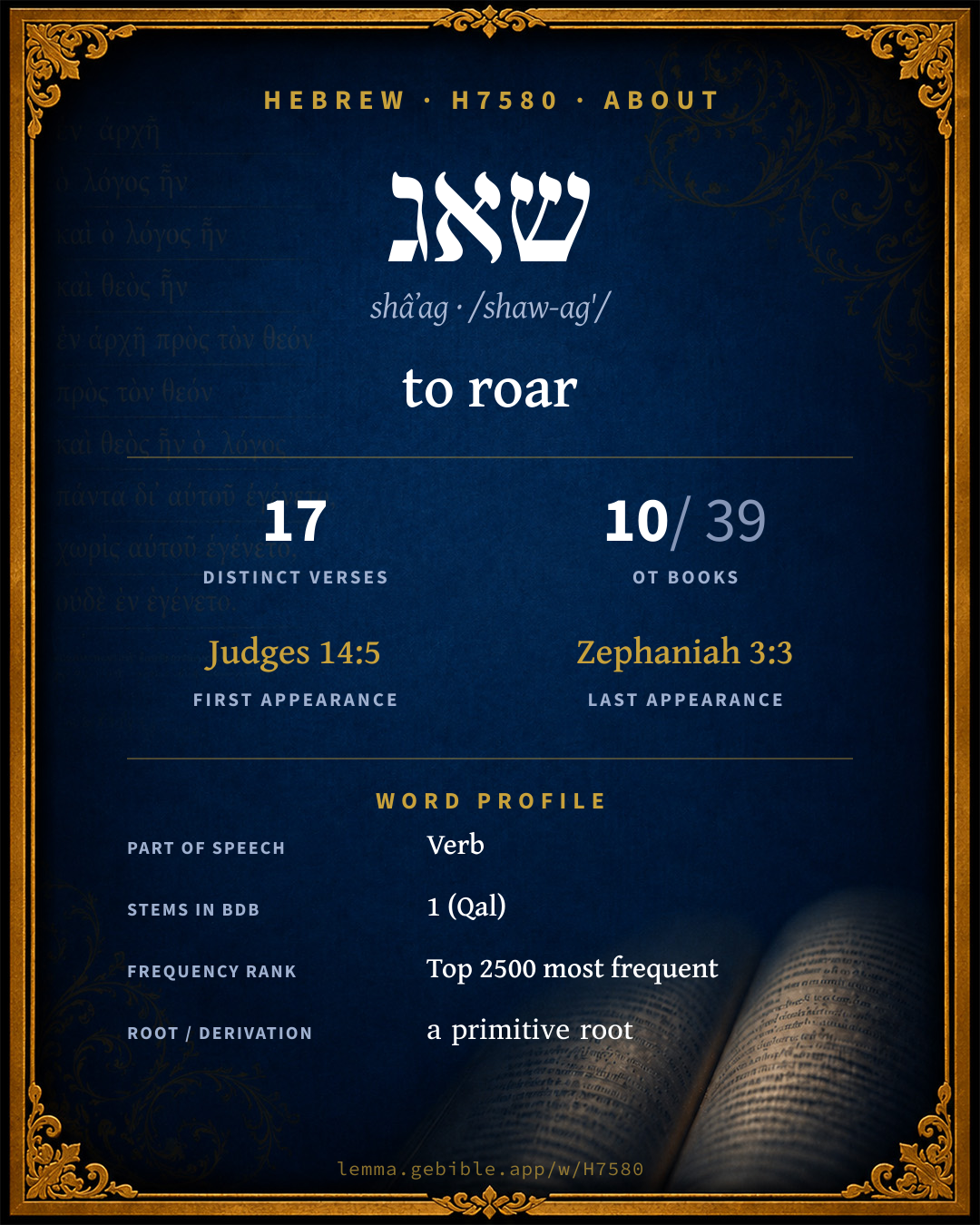
שָׁאַג
to roar
‘to roar’ is one of 2 main senses fuller range ↓
Full lexicon entry — Brown-Driver-Briggs (BDB)
From Brown-Driver-Briggs (BDB)
Where this word appears
Grammar key — what these labels mean
Part of speech
- Verb
- An action or state-of-being word.
Stem
- Qal
- The basic, simple active stem — the plain form of the verb (“he wrote”). Here: ‘roar’
Form
- Imperfect
- An incomplete, ongoing, or future action (“he will / would write”).
- Participle Active
- A verbal adjective expressing ongoing or characteristic action (“writing / one who writes”).
- Sequential Perfect
- A perfect with prefixed waw continuing a preceding imperfect or command (waw-consecutive perfect).
- Infinitive Absolute
- An unbound verbal noun, often intensifying or standing in for a finite verb.
- Perfect
- A completed action or state — Hebrew marks aspect (completeness) more than strict tense (“he wrote”).
State
- Absolute
- The independent form of a noun, not bound to a following word.
Person
- 3rd Person
- The one spoken about (“he / she / it / they”).
- 1st Person
- The speaker (“I / we”).
Gender
- Masculine
- Grammatically masculine.
- Common
- Either gender — not distinguished for this form.
Number
- Singular
- One.
- Plural
- More than one (in Hebrew, generally three or more).
Grammatical forms 9 distinct
- Verb, Qal, Imperfect, 3rd Person, Masculine, Singular 9 times (43%)
- Verb, Qal, Participle Active, Masculine, Singular, Absolute 3 times (14%)
- Verb, Qal, Imperfect, 3rd Person, Masculine, Plural 2 times (10%)
- Verb, Qal, Participle Active, Masculine, Plural, Absolute 2 times (10%)
- Verb, Qal, Sequential Perfect, 3rd Person, Masculine, Singular 1 time (5%)
- Verb, Qal, Infinitive Absolute 1 time (5%)
- Verb, Qal, Perfect, 1st Person, Common, Singular 1 time (5%)
- Verb, Qal, Perfect, 3rd Person, Common, Plural 1 time (5%)
+1 more form (1 occurrence)
Parsed forms decoded from the imported morphology (morphhb / Westminster Leningrad Codex — WLC text public domain, morphhb tagging CC BY 4.0), counted across 21 parsed occurrences — not distinct verses.
Every verse where H7580 appears — 17 distinct verses across 10 books. Click any verse to open its interlinear word-by-word view. Verse text shown in the World English Bible for context — . Each verse’s Hebrew form is shown with its reference; the English is not keyword-highlighted, since the data carries no word-level English alignment. Use “Compare translations” on any verse to read it across multiple English versions. This concordance covers the Hebrew Bible; Septuagint (Greek Old Testament) occurrences are not indexed here.
Judges 1 verse
Job 1 verse
Psalms 4 verses
- Psalms 22:13 וְ/שֹׁאֵֽג conj + Qal ptcp.act ms They open their mouths wide against me, Lions tearing prey and roaring.
- Psalms 38:8 שָׁ֝אַ֗גְתִּי Qal pf 1cs I am faint and severely bruised. I have groaned by reason of the anguish of my heart.
- Psalms 74:4 שָׁאֲג֣וּ Qal pf 3cp Your adversaries have roared in the midst of your assembly. They have set up their standards as signs.
- Psalms 104:21 שֹׁאֲגִ֣ים Qal ptcp.act mp The young lions roar after their prey, And seek their food from God.
Isaiah 1 verse
Jeremiah 3 verses
- Jeremiah 2:15 יִשְׁאֲג֣וּ Qal impf 3mp The young lions have roared on him, and yelled; and they have made his land waste: his cities are burned up, without inhabitant.
- Jeremiah 25:30 יִשְׁאָג֙ שָׁאֹ֤ג יִשְׁאַג֙ Qal impf 3ms Qal inf.abs Qal impf 3ms Therefore prophesy you against them all these words, and tell them, Yahweh will roar from on high, and utter his voice from his holy habitation; he will mightily roar against his fold; he will give a shout, as those who tread [the grapes], against all the inhabitants of the earth.
- Jeremiah 51:38 יִשְׁאָ֑גוּ Qal impf 3mp They shall roar together like young lions; they shall growl as lions' cubs.
Ezekiel 1 verse
Hosea 1 verse
Joel 1 verse
Amos 3 verses
- Amos 1:2 יִשְׁאָ֔ג Qal impf 3ms He said: "Yahweh will roar from Zion, And utter his voice from Jerusalem; And the pastures of the shepherds will mourn, And the top of Carmel will wither."
- Amos 3:4 הֲ/יִשְׁאַ֤ג ptcl inter + Qal impf 3ms Will a lion roar in the thicket, When he has no prey? Does a young lion cry out of his den, If he has caught nothing?
- Amos 3:8 שָׁאָ֖ג Qal pf 3ms The lion has roared. Who will not fear? The Lord Yahweh has spoken. Who can but prophesy?
Zephaniah 1 verse
About this entry
At a glance — auto-summarized from this page’s data, not written by a person. Every figure links to its source below. This summary describes the numbers; it doesn’t interpret them.
At its core, שאג (shâʼag) means “to roar.” It first appears in Judges 14:5. It turns up in 17 verses across 10 books, an uncommon footprint. Not a single-sense word: explore its full sense range. It clusters with שאגה under a shared root. Each statement above links to its evidence; the full detail follows below.
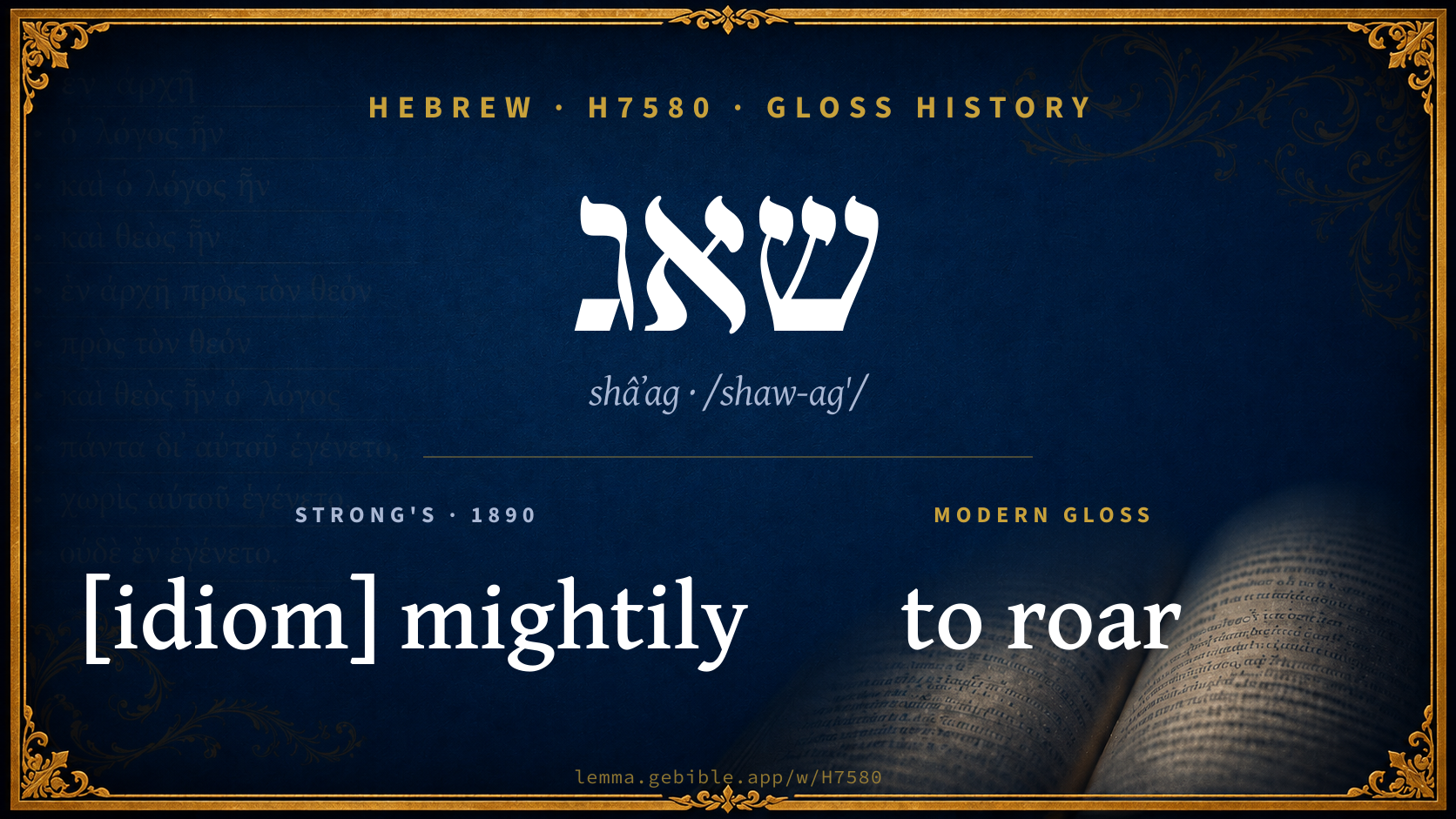
Gloss history
Strong's 1890 vs modern scholarship
About this word
Strong's H7580 catalogs a Hebrew word from the Hebrew Old Testament.
These counts are not copied from any lexicon or concordance. They are computed here, from the morphology-tagged Hebrew Old Testament. What Lemma adds →
- 17
- distinct verses
- The word appears in 17 distinct verses.
- 10 / 39
- OT books
- The word appears in 10 of 39 Old Testament books.
- #1,462
- by frequency
- Top 2500 most frequent Hebrew words (rank 1,462 of 8,640 Hebrew words by occurrence).
View all 17 occurrences in the concordance →
By section of the Old Testament
By traditional corpus
Conventional, traditional groupings — biblical authorship is debated, so this is a traditional corpus grouping, not an authorship claim. Each share is this word’s portion of its verses in that division of the Hebrew canon. Each figure is a share of the word’s 17 distinct verses.
- Prophets (Nevi'im) 12 verses · 71%
- Writings (Ketuvim) 5 verses · 29%
How translations render this word
Counts come from each version’s own published word-to-Strong’s tagging or interlinear alignment — an approximate guide to how each version renders this word, not a word-level alignment the data otherwise carries. Because each total is that version’s own tagged count, the per-version totals vary from one another and need not match the appearance or distinct-verse counts above. These counts may also differ from a printed concordance because Lemma counts each distinctly tagged rendering and does not collapse phrase taggings into a single head-word total. This is a fixed set of word-tagged versions (KJV, ASV, BSB, ULT) and does not change with the reading translation you choose elsewhere. Each version’s license is shown beside its name below (and on Sources).
- King James Version: Roar 4×, He shall roar 2×, Roared 2×
- American Standard Version: Roar 3×, Will roar 3×, Have roared 2×
- Berean Standard Bible: Roar 3×, Have roared 2×, Roars 2×
- unfoldingWord Literal Text: Roaring 5×, Will roar 3×, He will roar 2×
King James Version Public Domain
Renders H7580 across 20 tagged occurrences — most commonly:
Plus 8 renderings that appear only once — usually multi-word phrases or single function words the recovered tagging swept in, not distinct renderings. Not rendered by a distinct English word in 1 further occurrence.
American Standard Version Public Domain
Renders H7580 across 20 tagged occurrences — most commonly:
Plus 10 renderings that appear only once — usually multi-word phrases or single function words the recovered tagging swept in, not distinct renderings.
Berean Standard Bible Public Domain
Renders H7580 across 19 tagged occurrences — most commonly:
Plus 10 renderings that appear only once — usually multi-word phrases or single function words the recovered tagging swept in, not distinct renderings. Not rendered by a distinct English word in 1 further occurrence.
unfoldingWord Literal Text CC BY-SA 4.0
Renders H7580 across 20 tagged occurrences — most commonly:
Plus 6 renderings that appear only once — usually multi-word phrases or single function words the recovered tagging swept in, not distinct renderings.
Senses in the full BDB
What do BDB’s symbols mean?
BDB uses these scholarly abbreviations:
| Symbol | Meaning |
|---|---|
| 𝔊 | the Septuagint (the ancient Greek translation, LXX) |
| 𝔙 | the Vulgate (the Latin translation) |
| 𝔖 | the Syriac version (the Peshitta) |
| 𝔗 | the Targum (the Aramaic translation) |
| ψ | the Psalms |
| √ | root (the underlying root or stem) |
| ‖ | parallel passage (a synonymous or contrasted parallel) |
| † | the dagger: every passage where the word occurs is cited |
The 3 senses and sub-senses the full Brown-Driver-Briggs lexicon distinguishes for this word, in lexicon order (not ranked by frequency), with BDB’s own verbatim wording and sub-sense lettering. Shown in Hebrew script with BDB’s own scholarly abbreviations. The condensed entry is in the Lexicon Entry tab. See also the Forms in the corpus table below.
Qal
- Pf. 3 ms. וְשׁ׳ Is 5:29 Kt consec. (>Qr יִשְׁאַג), שָׁאָ֖ג Am 3:8, etc.; Impf. 3 ms. יִשְׁאַג Am 3:4 +, etc.; Inf. abs. שָׁאֹג Je 25:30; Pt. שֹׁאֵג Ju 14:5 ψ 22:14, שׁוֹאֵג Ez 22:25, שֹׁאֲגִים Zp 3:3 ψ 104:21;— e.g. Isaiah 5:29
- 1. roar, of lion Ju 14:5 (c. לִקְרָאתוֹ), Am 3:4, 8 ψ 104:21 (c. ל of prey), fig. of invaders and foes Je 2:15 (c. עַל pers.) ψ 22:14, cf. 74:4, sim. Is 5:29; Je 51:38; fig. of rapacious rulers Zp 3:3; Ez 22:25 (read נְשִׂיאֶיהָ for נְבִיאֶיהָ 𝔊 and mod.); of י׳ (like lion) calling scattered Isr. Ho 11:10(×2) (on text of v. see Now); of י׳ roaring in thunder Je 25:30a = Am 1:2 = Jo 3:16, also Je 25:30 (שָׁאֹג יִשְׁאַג, sq. עַל־נָוֵהוּ); cf. יִשְׁאַג־קוֹל Jb 37:4 (‖ יַרְעֵם). e.g. Judges 14:5
- 2. of human cry in distress ψ 38:9 (c. מִן causat.). e.g. Psalms 38:9
Senses from the full Brown-Driver-Briggs lexicon (Brown, Driver, Briggs; Oxford 1906 — public domain), digitized via Sefaria, supplemented by the OpenScriptures HebrewLexicon (CC BY 4.0). Full attribution on Sources.
Word origin
vb. roar (NH id.; Arabic ثَأَجَ low, bleat, Frey);—
— Brown-Driver-Briggs (Oxford 1906, public domain), digitized via Sefaria, supplemented by the OpenScriptures HebrewLexicon (CC BY 4.0). See Sources.
Origin: a primitive root
Jastrow Dictionary
A second Hebrew/Aramaic lexicon for comparison, covering Aramaic and post-biblical (Talmudic, Targumic, Midrashic) usage that the biblical-Hebrew BDB does not. Matched by lemma rather than by Strong’s number, so a lemma may carry more than one Jastrow headword (shown separately below), and the entries cover usage well beyond the Bible.
שָׁאַג
- [to be excited,] to roar, shout. Ber. 3ᵃ על כל … ושׁוֹאֵג כארי at the beginning of every watch the Lord sits and roars (in mourning) like a lion. Gen. R. s. 93 ושָׁאֲגוּ שניהם and both of them shouted; a. fr.
A Dictionary of the Targumim, the Talmud Babli and Yerushalmi, and the Midrashic Literature (Marcus Jastrow; London, Luzac, 1903) — Public Domain. Digitized via Sefaria. Digitized via Sefaria. Full attribution on Sources.
Forms in the corpus
The 21 distinct written forms H7580 takes in the Hebrew Bible, most frequent first — each parse links to that stem’s occurrences in the concordance. Hebrew forms include their vowel points and cantillation, so a single lemma takes many written forms.
| Form | Parsing | Example | Uses |
|---|---|---|---|
| הֲ/יִשְׁאַ֤ג | Verb, Qal, Imperfect, 3rd Person, Masculine, Singular | Amos 3:4 | 1 |
| ו/שאג | Verb, Qal, Sequential Perfect, 3rd Person, Masculine, Singular | Isaiah 5:29 | 1 |
| וְ/שֹׁאֵֽג | Verb, Qal, Participle Active, Masculine, Singular, Absolute | Psalms 22:13 | 1 |
| יִשְׁאֲג֣וּ | Verb, Qal, Imperfect, 3rd Person, Masculine, Plural | Jeremiah 2:15 | 1 |
| יִשְׁאַ֔ג | Verb, Qal, Imperfect, 3rd Person, Masculine, Singular | Hosea 11:10 | 1 |
| יִשְׁאַ֨ג | Verb, Qal, Imperfect, 3rd Person, Masculine, Singular | Isaiah 5:29 | 1 |
| יִשְׁאַג | Verb, Qal, Imperfect, 3rd Person, Masculine, Singular | Job 37:4 | 1 |
| יִשְׁאַג֙ | Verb, Qal, Imperfect, 3rd Person, Masculine, Singular | Jeremiah 25:30 | 1 |
| יִשְׁאָ֑ג | Verb, Qal, Imperfect, 3rd Person, Masculine, Singular | Hosea 11:10 | 1 |
| יִשְׁאָ֑גוּ | Verb, Qal, Imperfect, 3rd Person, Masculine, Plural | Jeremiah 51:38 | 1 |
| יִשְׁאָ֔ג | Verb, Qal, Imperfect, 3rd Person, Masculine, Singular | Amos 1:2 | 1 |
| יִשְׁאָ֗ג | Verb, Qal, Imperfect, 3rd Person, Masculine, Singular | Joel 3:16 | 1 |
| יִשְׁאָג֙ | Verb, Qal, Imperfect, 3rd Person, Masculine, Singular | Jeremiah 25:30 | 1 |
| שָׁ֝אַ֗גְתִּי | Verb, Qal, Perfect, 1st Person, Common, Singular | Psalms 38:8 | 1 |
| שָׁאֲג֣וּ | Verb, Qal, Perfect, 3rd Person, Common, Plural | Psalms 74:4 | 1 |
| שָׁאָ֖ג | Verb, Qal, Perfect, 3rd Person, Masculine, Singular | Amos 3:8 | 1 |
| שָׁאֹ֤ג | Verb, Qal, Infinitive Absolute | Jeremiah 25:30 | 1 |
| שֹֽׁאֲגִ֑ים | Verb, Qal, Participle Active, Masculine, Plural, Absolute | Zephaniah 3:3 | 1 |
| שֹׁאֲגִ֣ים | Verb, Qal, Participle Active, Masculine, Plural, Absolute | Psalms 104:21 | 1 |
| שֹׁאֵ֖ג | Verb, Qal, Participle Active, Masculine, Singular, Absolute | Judges 14:5 | 1 |
| שׁוֹאֵ֖ג | Verb, Qal, Participle Active, Masculine, Singular, Absolute | Ezekiel 22:25 | 1 |
Same root — word family
Other BDB entries built from the same root as H7580, grouped by Strong’s listed origin. These share a root / origin per the lexicon — not necessarily a shared meaning. Each links to that word’s own entry.
Derived from this word
Compare all same-root words → They share a root, not necessarily a meaning.
Septuagint verse parallels
This word appears in 13 verses that also exist in the Greek Old Testament (Septuagint), out of the 17 Hebrew verses it occurs in. You can read those verses in Greek by switching the Old Testament edition to the Septuagint.
Read these verses in the Septuagint
- Judges 14:5
- Job 37:4
- Psalms 38:8
- Isaiah 5:29
- Jeremiah 2:15
- Ezekiel 22:25
- Hosea 11:10
- Amos 1:2
- Zephaniah 3:3
This is a verse-level parallel only — the same verses exist in both the Hebrew and Greek Old Testaments. No word-level Hebrew↔Greek correspondence is claimed: the data carries no such alignment, so no Greek word is shown as this Hebrew word’s translation. Coverage is not total — the Septuagint omits the deuterocanon and renumbers the Psalms, so some Hebrew verses have no direct Greek parallel.