
Jeremiah 2:14

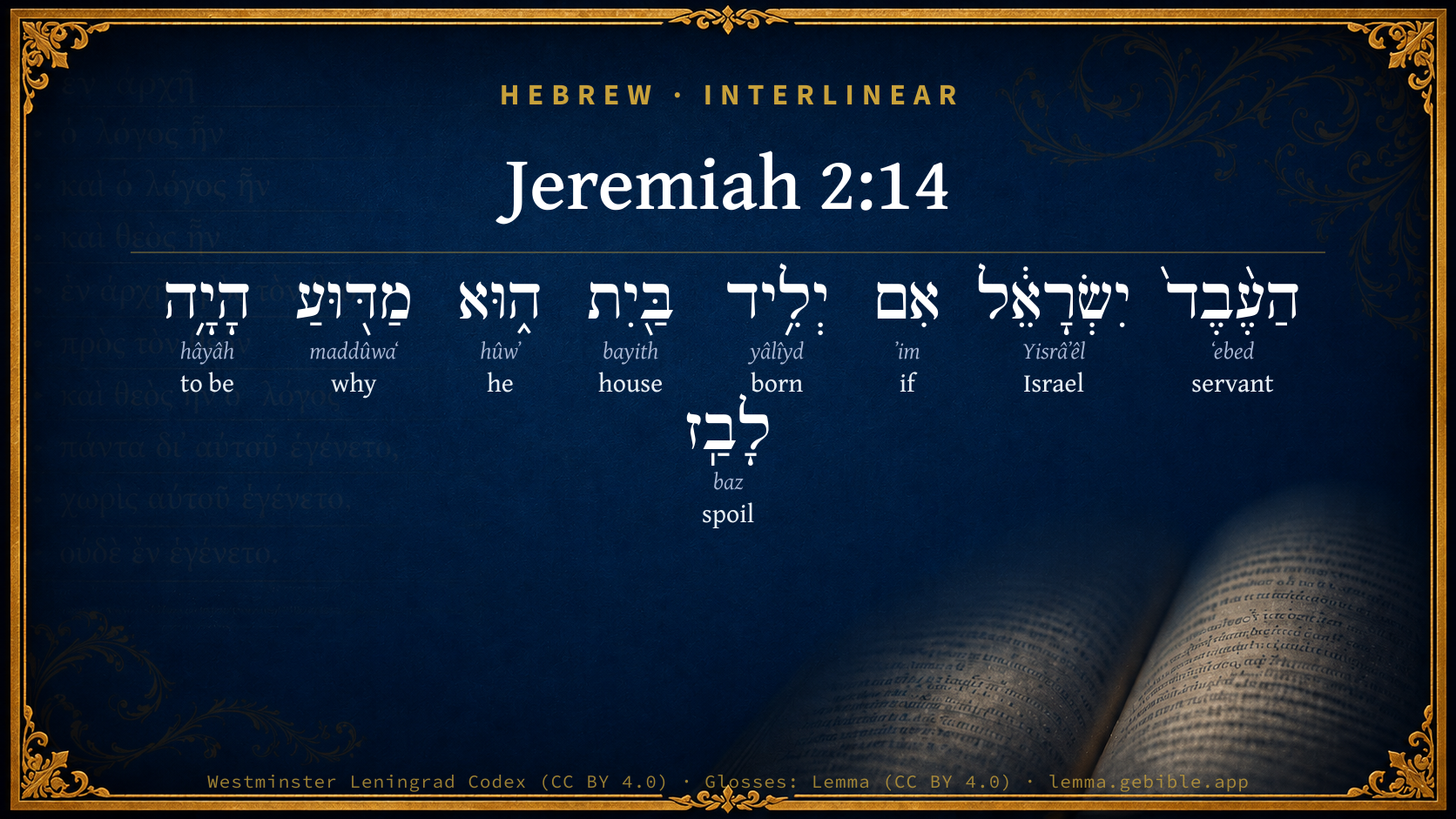
Hebrew (Westminster Leningrad Codex) Jeremiah 2:14 appears in the Hebrew Old Testament. The text above is from the Westminster Leningrad Codex. Each word links to its Strong’s number, a concise gloss, and parsing drawn from the Open Scriptures Hebrew Bible morphology. Click any word for its full Brown-Driver-Briggs (BDB) entry.
Download image
Cite this verse

Jeremiah 2:14 (World English Bible). Public Domain. Lemma interlinear Bible study tool, https://lemma.gebible.app/v/jeremiah/2/14.

Show BibTeX & RIS
BibTeX
RIS
English Translation
Is Israel a servant? is he a home-born [slave]? why is he become a prey?
World English Bible · Public Domain
Download a study sheet

One document with this verse’s original text, its word-by-word gloss line, the meaning frame, cross-references with their text, attributed commentary, and full source and license credits — printable, and it pastes into notes with its structure intact.

This verse Autodidact and up

Study sheet (.html) Plain text (.txt)

A passage Seminary Student

Up to 50 verses in one chapter. A passage sheet keeps up to 6 commentary sources and 12 cross-references per verse, in the order this page ranks them, and says so on the sheet whenever that leaves anything out. Ask for a single verse and you get the Autodidact verse sheet above.

Everything on this page stays free to read, with no account — the sheet is a download of what is already on screen, not access to it.

Want to remove ads? Support Godless Engineer
Compare translations 3

The same verse in 3 English versions, stacked beneath the original-language interlinear above. Click any original word for its lexicon entry.

Each is an independent rendering of the whole verse — the interlinear is not word-aligned to these translations.

Highlighted words mark where these versions differ — a whole-verse word diff, not a word-by-word alignment.

  • World English Bible Public Domain
    Is Israel a servant? is he a home-born [slave]? why is he become a prey?
  • King James Version Public Domain
    Is Israel a servant? is he a homeborn slave? why is he spoiled?
  • unfoldingWord Literal Text CC BY-SA 4.0
    Israel a servant? Is he homeborn? why has he become for plunder?

unfoldingWord Literal Text — © unfoldingWord, licensed CC BY-SA 4.0. Word-aligned USFM3 via Door43 (git.door43.org/unfoldingWord/en_ult).

Versions to compare (up to 4)

3 of 4 selected

Show all 18 translations

Every available English version of this verse, each an independent rendering of the whole verse.

  • World English Bible Public Domain
    Is Israel a servant? is he a home-born [slave]? why is he become a prey?
  • Berean Standard Bible Public Domain
    Is Israel a slave? Was he born into slavery? Why then has he become prey?
  • Majority Standard Bible Public Domain
    Is Israel a slave? Was he born into slavery? Why then has he become prey?
  • King James Version Public Domain
    Is Israel a servant? is he a homeborn slave? why is he spoiled?
  • American Standard Version (1901) Public Domain
    Is Israel a servant? is he a home-born `slave'? why is he become a prey?
  • Revised Version (1885) Public Domain
    Is Israel a servant? is he a homeborn slave? why is he become a prey?
  • Geneva Bible (1599) Public Domain
    Is Israel a seruaunt, or is hee borne in the house? why then is he spoiled?
  • Douay-Rheims (1899) Public Domain
    Is Israel a bondman, or a homeborn slave? why then is he become prey?
  • Young's Literal Translation Public Domain
    A servant `is' Israel? Is he a child of the house? Wherefore hath he been for a prey?
  • Literal Standard Version CC BY-SA 4.0
    [Is] Israel a servant? Is he a child of the house? Why has he been for a prey?
  • Unlocked Literal Bible CC BY-SA 4.0
    Is Israel a slave? Was he born in his master's home? So why has he become plunder?
  • unfoldingWord Literal Text CC BY-SA 4.0
    Israel a servant? Is he homeborn? why has he become for plunder?
  • Darby Bible Public Domain
    Is Israel a bondman? Is he a home-born [slave]? Why is he become a spoil?
  • World Messianic Bible Public Domain
    Is Israel a slave? Is he born into slavery? Why has he become a captive?
  • Webster's Bible Public Domain
    Is Israel a servant? is he a home-born slave? why is he laid waste?
  • Free Bible Version CC BY-SA 4.0
    Are Israelites slaves? Were they born into slavery? So why have they become victims?
  • Bible in Basic English Public Domain
    Is Israel a servant? has he been a house-servant from birth? why has he been made waste?
  • JPS Tanakh (1917) Public Domain
    Is Israel a servant? Is he a home-born slave? Why is he become a prey?

Literal Standard Version (2020), Covenant Press — licensed CC BY-SA 4.0. Text via the HelloAO Bible API (eBible.org). Unlocked Literal Bible (unfoldingWord) — licensed CC BY-SA 4.0. Text via the HelloAO Bible API (eBible.org). unfoldingWord Literal Text — © unfoldingWord, licensed CC BY-SA 4.0. Word-aligned USFM3 via Door43 (git.door43.org/unfoldingWord/en_ult). Free Bible Version, Dr. Jonathan Gallagher — licensed CC BY-SA 4.0. Text via the HelloAO Bible API (eBible.org).

Word by word

More ways to search: Search by grammar → Find every occurrence → Compare this word →

Practice this passage: Drill this verse → Learn its vocabulary →

About this verse

These counts appear in no published source. They are computed here, from the morphology-tagged text and Lemma’s own curated glosses. What Lemma adds →

9
words
9
distinct lemmas
Prophets
section

Notable vocabulary

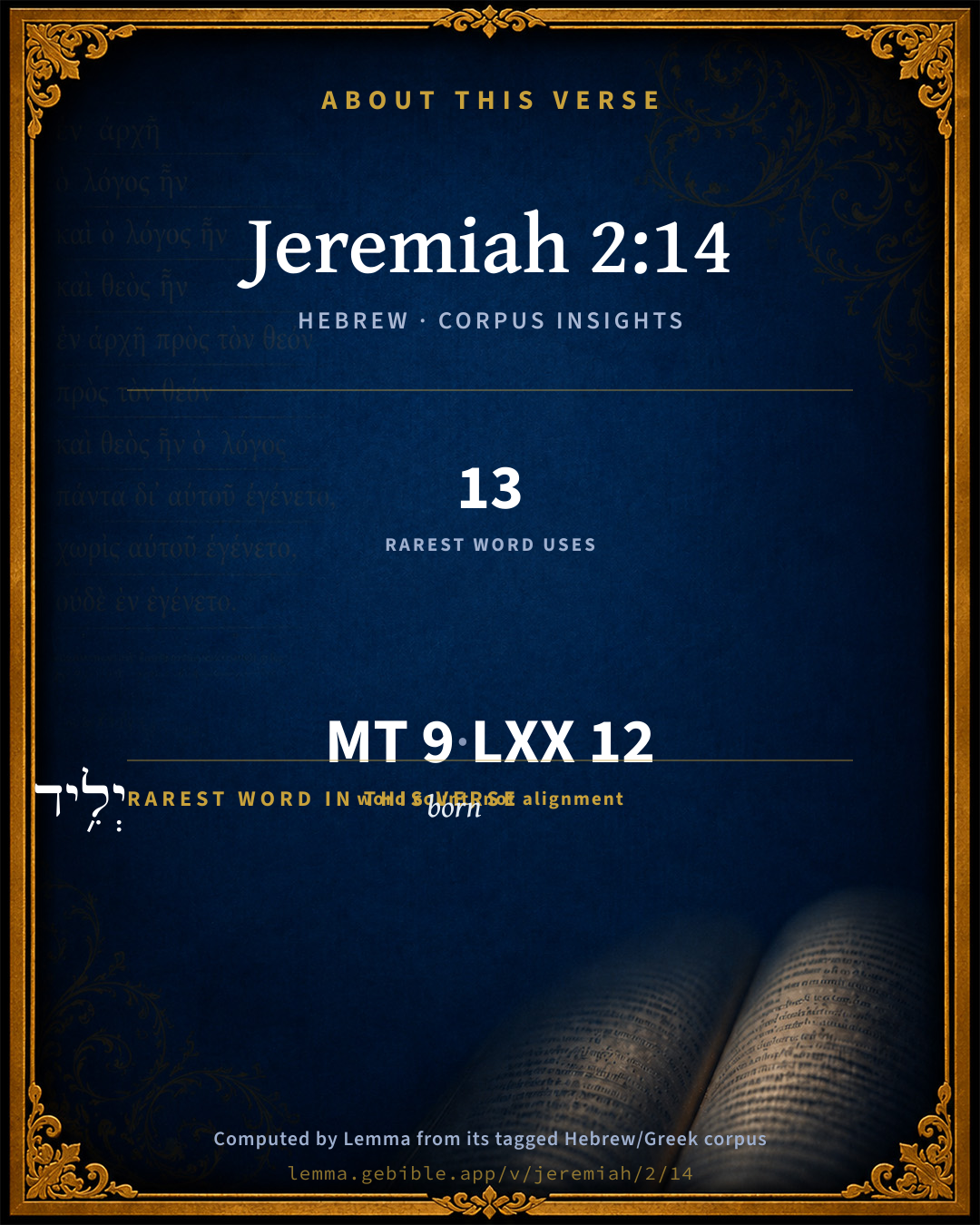
The rarest word here is יְלִ֥יד born H3211 — appearing just 13 times in the whole Hebrew Bible.

Shared distinctive vocabulary

יְלִ֥יד born H3211 occurs in 13 verses of the Hebrew Bible. Also found in:

Grammatical profile

  • 1 verb
  • 5 nouns
  • 1 pronoun
  • 1 conjunction
  • 1 particle

Verb forms

  • הָיָ֥ה Qal · Perfect

Hebrew & Septuagint length

In the original languages it is 9 Hebrew tokens and 12 Greek tokens — but the two are counted differently (Hebrew bundles its prefixes and suffixes into one token; the Greek is in lemma form), so that isn’t a like-for-like length.

Cross-references

4

Topical passages linked to Jeremiah 2:14 in the Treasury of Scripture Knowledge — connected by theme and wording, ordered by reader-vote popularity; previews shown in the World English Bible.

  • Exodus 4:22 You shall tell Pharaoh, 'Thus says Yahweh, Israel is my son, my firstborn,
  • Genesis 15:3 Abram said, "Behold, to me you have given no seed: and, behold, one born in my house is my heir."
  • Ecclesiastes 2:7 I bought men-servants and maid-servants, and had servants born in my house. I also had great possessions of herds and flocks, above all who were before me in Jerusalem;
  • Isaiah 50:1 Thus says Yahweh, Where is the bill of your mother's divorce, with which I have put her away? or which of my creditors is it to whom I have sold you? Behold, for your iniquities were you sold, and for your transgressions was your mother put away.

Cross-references courtesy of OpenBible.info (CC BY 4.0).

Hebrew and Greek witnesses Masoretic Hebrew ↔ Greek Septuagint

The same verse in the two great witnesses to the Old Testament, shown verse-for-verse.

These are two independent witnesses, not word-aligned to each other, and the Septuagint is shown in lemma (dictionary) form.

Hebrew Jeremiah 2:14 Masoretic · Westminster Leningrad Codex

הַעֶ֨בֶד֙ יִשְׂרָאֵ֔ל אִם יְלִ֥יד בַּ֖יִת ה֑וּא מַדּ֖וּעַ הָיָ֥ה לָבַֽז

Is Israel a servant? is he a home-born [slave]? why is he become a prey?

World English Bible · Public Domain

Greek LXX Structure differs

In the Septuagint, Jeremiah is about an eighth shorter than the Hebrew and arranges its material differently — the Oracles Against the Nations (Hebrew chapters 46–51) appear in the middle of the Greek book, after 25:13. Because the chapter and verse boundaries do not line up, a verse-for-verse comparison with the Hebrew is not shown.

A verse-for-verse comparison isn’t shown here because the chapters and verses don’t line up. Switch to the LXX edition with the MT / LXX toggle above to read the Greek directly.

On this verse, Keil & Delitzsch discusses the Septuagint’s reading. Read the note in Commentary ↓

Hebrew: Westminster Leningrad Codex (CC BY 4.0). Greek: Septuagint (public domain); English from a public-domain English Septuagint. How the Septuagint differs from the Hebrew →

Targum (Aramaic paraphrase)

1

The Targum is the ancient Jewish Aramaic paraphrase of the Hebrew Scriptures — an interpretive translation, not the Hebrew text itself. Onkelos (literal) and Pseudo-Jonathan (expansive) render the Torah, and Jonathan the Prophets. Coverage is partial: where no permissively-licensed English translation exists for a verse, only the Aramaic is shown. This is verse-level text, not a word-by-word alignment to the Hebrew.

  1. Targum Jonathan Prophets (Joshua–Malachi)
    הַכְעַבְדָא הֲוָה יִשְׂרָאֵל אִם יְלִיד בֵּיתָא הוּא מָדֵין אִתְמְסַר לְבָזוֹזִין:

    (no public-domain English translation for this verse)

    Targum Jonathan — Aramaic: “Mikraot Gedolot” (public domain). English: “Sefaria Community Translation” (CC0 1.0 (public-domain dedication)); “London "Chaldee Paraphrase," 1871” (public domain). Text via Sefaria.

Commentary

Notes on Jeremiah 2:14 from classic Christian and Jewish commentators (each source and its license shown beneath its notes). The classic Christian expositions comment on the surrounding passage and are grouped to its opening verse, so a note may address several verses; the Jewish commentaries on the Tanakh (Rashi and others) are per-verse, so they appear only where the commentator wrote on this verse.

Lemma curates 59 commentaries, every one of them public domain or Creative Commons licensed, each selected and text-cleaned for this edition rather than reprinted as found. About our sources →

Matthew Henry's Commentary

The prophet, further to evince the folly of their forsaking God, shows them what mischiefs they had already brought upon themselves by so doing; it had already cost them dear, for to this were owing all the calamities their country was now groaning under, which were but an earnest of more and greater if they repented not. See how they smarted for their folly.

I. Their neighbours, who were their professed enemies, prevailed against them, and this was owing to their sin. 1. They were enslaved and lost their liberty (Jer 2:14): Is Israel a servant? No; Israel is my son, my first-born, Exo 4:22. They are children; they are heirs. Nay, their extraction is noble; they are the seed of Abraham, God's friend, and of Jacob his chosen. Is he a home-born slave? No; he is not the son of the bond-woman, but of the free. They were designed for dominion, not for servitude. Every thing in their constitution carried about it the marks of freedom and honour. Why then is he spoiled of his liberty? Why is he used as a servant, as a home-born slave? Why does he make himself a slave to his lusts, to his idols, to that which does not profit? Jer 2:11. What a thing is this, that such a birthright should be sold for a mess of pottage, such a crown profaned and laid in the dust! Why is he made a slave to the oppressor? God provided that a Hebrew servant should be free the seventh year, and that their slaves should be of the heathen, not of their brethren, Lev 25:44, Lev 25:46. But, notwithstanding this, the princes made slaves of their subjects, and masters made slaves of their servants (Jer 34:11), and so made their country mean and miserable, which God had made happy and honourable. The neighbouring princes and powers broke in upon them, and made some of them slaves even in their own country, and perhaps sold others for slaves into foreign countries. And how came they thus to lose their liberties? For their iniquities they sold themselves, Isa 50:1. We may apply this spiritually. Is the soul of man a servant? Is it a home-born slave? No, it is not. Why then is it spoiled? It is because it has sold its own liberty and enslaved itself to divers lusts and passions, which is a lamentation, and should be for a lamentation. 2. They were impoverished and had lost their wealth. God brought them into a plentiful country (Jer 2:7), but all their neighbours made a prey of it (Jer 2:15): Young lions roar aloud over him and yell; they are a continual terror to him. Sometimes one potent enemy, and sometimes another, and sometimes many in confederacy, fall upon him, and triumph over him. They carry off the fruits of his land, and make that waste, and burn his cities, when first they have plundered them, so that they remain without inhabitant, either because there are no houses to dwell in or because those that should dwell in them are carried into captivity. 3. They were abused, and insulted over, and beaten by every body (Jer 2:16): "Even the children of Noph and Tahapanes, despicable people, not famed for military courage nor strength, have broken the crown of thy head, or fed upon it. In all their struggles with thee they have been too hard for thee, and thou hast always come off with a broken head. The principal part of thy country, that which lay next Jerusalem, has been and is a prey to them." How calamitous the condition of Judah had been of late in the reign of Manasseh we find, Ch2 33:11, and perhaps it had not now much recovered itself. 4. All this was owing to their sin (Jer 2:17): Hast thou not procured this unto thyself? By their sinful confederacies with the nations, and especially their conformity to them in their idolatrous customs and usages, they had made themselves very mean and contemptible, as all those do that have made a profession of religion and afterwards throw it off. Nothing now appeared of that which, by their constitution, made them both honourable and formidable, and therefore nobody either respected them or feared them. But this was not all; they had provoked God to give them up into the hands of their enemies, and to make them a scourge to them and give them success against them; and "thus thou hast procured it to thyself, in that thou hast forsaken the Lord thy God, revolted from thy allegiance to him and so thrown thyself out of his protection; for protection and allegiance go together." Whatever trouble we are in at any time we may thank ourselves for it; for we bring it upon our own head by our forsaking God: "Thou hast forsaken thy God at the time that he was leading thee by the way" (so it should be read); "Then when he was leading thee on to a happy peace and settlement, and thou wast within a step of it, then thou forsookest him, and so didst put a bar in thy own door."

II. Their neighbours, that were their pretended friends, deceived them, distressed them, and helped them not, and this also was owing to their sin. 1. They did in vain seek to Egypt and Assyria for help (Jer 2:18): "What hast thou to do in the way of Egypt? When thou art under apprehensions of danger thou art running to Egypt for help, Isa 30:1, Isa 30:2; Isa 31:1. Thou art for drinking the waters of Sihor," that is, Nilus. "Thou reliest upon their multitude, and refreshest thy self with the fair promises they make thee. At other times thou art in the way of Assyria, sending or going with all speed to fetch recruits thence, and thinkest to satisfy thyself with the waters of the river Euphrates; what hast thou to do there? What wilt thou get by applying to them? They shall help in vain, shall be broken reeds to thee, and what thou thoughtest would be to thee as a river will be but a broken cistern." 2. This also was because of their sin. The judgment shall unavoidably come upon them which their sin has deserved; and then to what purpose is it to call in help against it? Jer 2:19. "Thy own wickedness shall correct thee, and then it is impossible for them to save thee; know and see therefore, upon the whole matter, that it is an evil thing that thou hast forsaken God, for it is that which makes thy enemies enemies indeed, and thy friends friends in vain." Observe here, (1.) The nature of sin; it is forsaking the Lord as our God; it is the soul's alienation from him and aversion to him. Cleaving to sin is leaving God. (2.) The cause of sin; it is because his fear is not in us. It is for want of a good principle in us, particularly for want of the fear of God; this is at the bottom of our apostasy from him; men forsake their duty to God because they stand in no awe of him nor have any dread of his displeasure. (3.) The malignity of sin; it is an evil thing and a bitter. Sin is an evil thing, only evil, an evil that has no good in it, an evil that is the root and cause of all other evil; it is evil indeed, for it is not only the greatest contrariety to the divine nature, but the greatest corruption of the human nature. It is bitter; a state of sin is the gall of bitterness, and every sinful way will be bitterness in the latter end; the wages of it is death, and death is bitter. (4.) The fatal consequences of sin; as it is in itself evil and bitter, so it has a direct tendency to make us miserable: "Thy own wickedness shall correct thee, and thy backslidings shall reprove thee, not only destroy and ruin thee hereafter, but correct and reprove thee now; they will certainly bring trouble upon thee; and punishment will so inevitably follow the sin that the sin shall itself be said to punish thee. Nay, the punishment, in its kind and circumstances, shall so directly answer to the sin, that thou mayest read the sin in the punishment; and the justice of the punishment shall be so plain that thou shalt not have a word to say for thyself; thy own wickedness shall convince thee and stop thy mouth for ever and thou shalt be forced to own that the Lord is righteous." (5.) The use and application of all this: "Know therefore, and see it, and repent of thy sin, that so the iniquity which is thy correction may not be thy ruin."

Matthew Henry's Commentary on the Whole Bible (1708–1710) — public domain (CC PDM 1.0). Text via the HelloAO Bible API.

Trapp's Complete Commentary

John Trapp

Jer 2:14 [Is] Israel a servant? [is] he a homeborn [slave]? why is he spoiled?

Ver. 14. Is Israel a servant?] sc., Bought with money. {a}

Is he a homeborn slave?] Verna, a slave by birth; q.d., if he be either of the two, he may thank himself. He was my son, nay, my spouse, if he could have kept him so; but he hath sold himself to commit wickedness, and I have therefore sold him into the hands of the Chaldeans. Lo! this is the product of his forsaking me, the fountain of living waters, &c.

{a} Servus empticius, purchased slave.

John Trapp, A Commentary or Exposition upon All the Books of the Old and New Testament (1647–1656) — public domain. Text from a community e-Sword module.

The Biblical Illustrator

Joseph S. Exell

Jer_2:14

Is Israel a servant?

is he a home-born slave? why is he spoiled?

Israel a home-born slave

Is this a contemptuous inquiry?--Israel a servant, Israel a home-born slave. Is there not scorn underlying the interrogation, as who should say, Thou art a worm, a thing to be crushed by the foot, or a servile thing to be made no account of by the auditor of the universe? Nothing of the kind. There is a tone of tenderness in this inquiry. In Bible times to be a home-born slave was to be next the son of the family; there was a domestic interest in such a slave, full of pathos, and the condition brought with it its own advantages and rights; a slave born in the house took rank almost with the son, certainly immediately after the son; and the Lord seems to say, Is not Israel a servant, a home-born slave,--has he not rights at home, has he not domestic interests and family claims, a status which he can assert and maintain, and the fruit of which he is at liberty to enjoy? Why then is he spoiled; why has he thrown his inheritance away; why does he not seize the possessions to which he is entitled, and live within the light and the security of the privilege which belongs to him in his domestic relations? So there is no scorn in the words home-born slave. The Divine voice infused the pathos of emphasis into the word homeborn. Who can say home in a tone that is worthy of its music? Surely only He who has made the universe a home for His creatures, and offered them the hospitality of His infinite love. God comes after us, and says, Are ye not Mine; do you not belong to My house; are you not in the covenant of My love; is not your name upon the record of My memory; and goes not out after you all the solicitude of My heart? Why then have you spoiled your destiny, perverted your way, gone in a forbidden course, and exposed yourselves to the paw and the teeth of the lion? (J. Parker, D. D.)

The Biblical Illustrator, edited by Joseph S. Exell (c. 1880s–1900s) — public domain. Text from a community e-Sword module.

Joseph Benson's Commentary

Jer 2:14. Is Israel a servant? is he a home-born slave? — Is he of a condition to be delivered as a prey to his enemies? Is he of those people whom God regards as slaves and strangers? These interrogations imply, and have the force of, a negative. As if he had said, Is not Israel the son, the chosen and peculiar people of God? Why then hath the Lord treated him as a common slave, and given him up into the power of tyrannical lords and masters? The sense is, God redeemed Israel from the bondage of Egypt, and adopted him to be his son, Exo 4:22. So that the servitude he now undergoes, and his being made a prey to so many foreign enemies, cannot be owing to his birth, or primitive condition, but must be imputed to his sins, of which his slavery is the consequence. Compare Isa 50:1; Isa 52:3.

Joseph Benson's Commentary on the Old and New Testaments (1811–1818) — public domain. Text from a community e-Sword module.

Whedon's Commentary on the Bible

Daniel D. Whedon

ISRAEL’S PUNISHMENT, Jer_2:14-19.

14. Is Israel a servant… a home-born — Some, as Nagelsbach, make the interrogator in this place to be the prophet, but it is better to regard this as a continuation of the word of God. “Servant” and “homeborn” (slave) are used in a bad sense, and not, as R. Payne Smith and others hold, to call attention to his membership in Jehovah’s family, though in a low sense, which would involve a claim to protection and safety. The meaning is, Is Israel a servant? If not, why is he treated as though he were? Why is he spoiled?

Daniel D. Whedon (gen. ed.), Commentary on the Old and New Testaments (1874–1909) — public domain. Text from a community e-Sword module.

Keil & Delitzsch

C. F. Keil & F. Delitzsch

By this double sin Israel has drawn on its own head all the evil that has befallen it. Nevertheless it will not cease its intriguing with the heathen nations. Jer 2:14. "Is Israel a servant? is he a home-born slave? why is he become a booty? Jer 2:15. Against him roared the young lions, let their voice be heard, and made his land a waste; his cities were burnt up void of inhabitants. Jer 2:16. Also the sons of Noph and Tahpanes feed on the crown of thy head. Jer 2:17. Does not this bring it upon thee, thy forsaking Jahveh thy God, at the time when He led thee on the way? Jer 2:18. And now what hast thou to do with the way to Egypt, to drink the waters of the Nile? and what with the way to Assur, to drink the waters of the river? Jer 2:19. Thy wickedness chastises thee, and thy backslidings punish thee; then know and see that it is evil and bitter to forsake Jahveh thy God, and to have no fear of me, saith the Lord Jahveh of hosts." The thought from Jer 2:14-16 is this: Israel was plundered and abused by the nations like a slave. To characterize such a fate as in direct contradiction to its destiny is the aim of the question: Is Israel a servant? i.e., a slave or a house-born serf. עבד is he who has in any way fallen into slavery, יליד בּיתa slave born in the house of his master. The distinction between these two classes of salves does not consist in the superior value of the servant born in the house by reason of his attachment to the house. This peculiarity is not here thought of, but only the circumstance that the son of a salve, born in the house, remained a slave without any prospect of being set free; while the man who has been forced into slavery by one of the vicissitudes of life might hope again to acquire his freedom by some favourable turn of circumstances. Another failure is the attempt of Hitz. to interpret עבד as servant of Jahveh, worshipper of the true God; for this interpretation, even if we take no account of all the other arguments that make against it, is rendered impossible by .יליד That expression never means the son of the house, but by unfailing usage the slave born in the house of his master. Now the people of Israel had not been born as serf in the land of Jahveh, but had become עבד, i.e., slave, in Egypt (Deu 5:15); but Jahveh has redeemed it from this bondage and made it His people. The questions suppose a state of affairs that did not exist. This is shown by the next question, one expressing wonder: Why then is he it become a prey? Slaves are treated as a prey, but Israel was no slave; why then has such treatment fallen to his lot? Propheta per admirationem quasi de re nova et absurda sciscitatur. An servus est Israel? atqui erat liber prae cunctis gentibus, erat enim filius primogenitus Dei; necesse est igitur quaerere aliam causam, cur adeo miser sit (Calv.). Cf. the similar turn of the thought in Jer 2:31. How Israel became a prey is shown in Jer 2:15 and Jer 2:16. These verses do not treat of future events, but of what has already happened, and, according to Jer 2:18 and Jer 2:19, will still continue. The imperff. ישׁאגוּ and ירעוּך alternate consequently with the perff. נתנוּ and נצּתה, and are governed by היה לבז, so that they are utterances regarding events of the past, which have been and are still repeated. Lions are a figure that frequently stands for enemies thirsting for plunder, who burst in upon a people or land; cf. Mic 5:7; Isa 5:29, etc. Roared עליו, against him, not, over him: the lion roars when he is about to rush upon his prey, Amo 3:4, Amo 3:8; Psa 104:21; Jdg 14:5; when he has pounced upon it he growls or grumbles over it; cf. Isa 31:4. - In Jer 2:15 the figurative manner passes into plain statement. They made his land a waste; cf. Jer 4:7; Jer 18:16, etc., where instead of שׁית we have the more ordinary שׂוּם. The Cheth. נצּתה from יצת, not from the Ethiop. נצה (Graf, Hitz.), is to be retained; the Keri here, as in Jer 22:6, is an unnecessary correction; cf. Ew. 317, a. In this delineation Jeremiah has in his eye chiefly the land of the ten tribes, which had been ravaged and depopulated by the Assyrians, even although Judah had often suffered partial devastations by enemies; cf. Kg1 14:25.

Jer 2:16

Israel has had to submit to spoliation at the hands of the Egyptians too. The present reference to the Egyptians is explained by the circumstances of the prophet's times-from the fact, namely, that just as Israel and Judah had sought the help of Egypt against the Assyrians (cf. Hos 7:11; Kg2 17:4, and Isa 30:1-5) in the time of Hezekiah, so now in Jeremiah's times Judah was expecting and seeking help from the same quarter against the advancing power of the Chaldeans; cf. Jer 37:7. Noph and Tahpanes are two former capitals of Egypt, here put as representing the kingdom of the Pharaohs. nop נף, in Hos 9:6 mop מף contracted from מנף, Manoph or Menoph, is Memphis, the old metropolis of Lower Egypt, made by Psammetichus the capital of the whole kingdom. Its ruins lie on the western bank of the Nile, to the south of Old Cairo, close by the present village of Mitrahenny, which is built amongst the ruins; cf. Brugsch Reiseberichte aus Egypten, 60ff., and the remarks on Hos 9:6 and Isa 19:13. תחפנס, elsewhere spelt as here in the Keri תּחפּנחס - cf. Jer 43:7., Jer 44:1; Jer 46:14, Eze 30:18 -was a strong border city on the Pelusiac arm of the Nile, called by the Greeks Δάφναι (Herod. ii. 20), by the lxx Τάφναι; see in Eze 30:18. A part of the Jews who had remained in the land fled hither after the destruction of Jerusalem, Jer 43:7. ,ירעוּך קדקד feed upon thy crown (lit., feed on thee in respect of thy crown), is a trope for ignominious devastation; for to shave one bald is a token of disgrace and sorrow, cf. Jer 47:5; Jer 48:37, Isa 3:17; and with this Israel is threatened in Isa 7:20. רעה, to eat up by grazing, as in Job 20:26 and Job 24:21; in the latter passage in the sense of depopulari. We must then reject the conjectures of J. D. Mich., Hitz., and others, suggesting the sense: crush thy head for thee; a sense not at all suitable, since crushing the head would signify the utter destruction of Israel. - The land of Israel is personified as a woman, as is shown by the fem. suffix in ירעוּך. Like a land closely cropped by herds, so is Israel by the Egyptians. In Jer 6:3 also the enemies are represented as shepherds coming with their flocks against Jerusalem, and pitching their tents round about the city, while each flock crops its portion of ground. In Jer 12:10 shepherds lay the vineyard waste.

Jer 2:17-19

In Jer 2:17 the question as to the cause of the evil is answered. זאת is the above-mentioned evil, that Israel had become a prey to the foe. This thy forsaking of Jahveh makes or prepares for thee. תּעשׂה is neuter; the infin. עזבך is the subject of the clause, and it is construed as a neuter, as in Sa1 18:23. The fact that thou hast forsaken Jahveh thy God has brought this evil on thee. At the time when He led thee on the way. The participle מוליך is subordinated to עת in the stat. constr. as a partic. standing for the praeterit. durans; cf. Ew. 337, c. בּדּרך is understood by Ros. and Hitz. of the right way (Psa 25:8); but in this they forget that this acceptation is incompatible with the בּעת, which circumscribes the leading within a definite time. God will lead His people on the right way at all times. The way on which He led them at the particular time is the way through the Arabian desert, cf. Jer 2:6, and בּדּרך is to be understood as in Deu 1:33; Exo 18:8; Exo 23:20, etc. Even thus early their fathers forsook the Lord: At Sinai, by the worship of the golden calf; then when the people rose against Moses and Aaron in the desert of Paran, called a rejecting (נאץ) of Jahveh in Num 14:11; and at Shittim, where Israel joined himself to Baal Peor, Num 25:1-3. The forsaking of Jahveh is not to be limited to direct idolatry, but comprehends also the seeking of help from the heathen; this is shown by the following 18th verse, in which the reproaches are extended to the present bearing of the people. ' מה־לּך לדרך וגו, lit., what is to thee in reference to the way of Egypt (for the expression, see Hos 14:9), i.e., what hast thou to do with the way of Egypt? Why dost thou arise to go into Egypt, to drink the water of the Nile? שׁחור, the black, turbid stream, is a name for the Nile, taken from its dark-grey or black mud. The Nile is the life-giving artery of Egypt, on whose fertilizing waters the fruitfulness and the prosperity of the country depend. To drink the waters of the Nile is as much as to say to procure for oneself the sources of Egypt's life, to make the power of Egypt useful to oneself. Analogous to this is the drinking the waters of the river, i.e., the Euphrates. What is meant is seeking help from Egyptians and Assyrians. The water of the Nile and of the Euphrates was to be made to furnish them with that which the fountain of living water, i.e., Jahveh (Jer 2:14), supplied to them. This is an old sin, and with it Israel of the ten tribes is upbraided by Hosea (Hos 7:11; Hos 12:2). From this we are not to infer "that here we have nothing to do with the present, since the existing Israel, Judah, was surely no longer a suitor for the assistance of Assyria, already grown powerless" (Hitz.). The limitation of the reproach solely to the past is irreconcilable with the terms of the verse and with the context (Jer 2:19). מה־לּך לדרךcannot grammatically be translated: What hadst thou to do with the way; just as little can we make תּיסּרך hath chastised thee, since the following: know and see, is then utterly unsuitable to it. תּיסּרך and תּוכיחך are not futures, but imperfects, i.e., expressing what is wont to happen over again in each similar case; and so to be expressed in English by the present: thy wickedness, i.e., thy wicked work, chastises thee. The wickedness was shown in forsaking Jahveh, in the משׁבות, backslidings, the repeated defection from the living God; cf. Jer 3:22; Jer 5:6; Jer 14:7. As to the fact, we have no historical evidence that under Josiah political alliance with Egypt or Assyria was compassed; but even if no formal negotiations took place, the country was certainly even then not without a party to build its hopes on one or other of the great powers between which Judah lay, whenever a conflict arose with either of them. - וּדעי, with the Vav of consecution (see Ew. 347, a): Know then, and at last comprehend, that forsaking the Lord thy God is evil and bitter, i.e., bears evil and bitter fruit, prepares bitter misery for thee. "To have no fear of me" corresponds "to forsake," lit., thy forsaking, as second subject; lit.,: and the no fear of me in thee, i.e., the fact that thou hast no awe of me. פּחדּתי, awe of me, like פּחדּך in Deu 2:25.

Keil & Delitzsch — Biblical Commentary on the Old Testament (1861–1891) — public domain (CC PDM 1.0). Text via the HelloAO Bible API. (Old Testament only.)

Tyndale Open Study Notes

Tyndale Open Resources

2:14-22 This historical review of Israel’s sin further emphasizes the folly, violence, arrogance, and despair of turning away from the true God to worship false pagan gods.

2:14 The Israelites had been rescued from slavery in Egypt, but they became slaves again in Jeremiah’s time through their covenants with Egypt and Assyria (2:18).

Tyndale Open Study Notes — © Tyndale Open Resources, licensed CC BY-SA 4.0. Text via the HelloAO Bible API.

Geneva Bible (1599)

Geneva Bible translators

Have I ordered them like servants and not like dearly beloved children? Exod. 4:22, therefore it is their fault only, if the enemy spoil them.

Geneva Bible (1599) marginal notes — public domain. Text via Bolls.life.

Jamieson, Fausset & Brown

Robert Jamieson, A. R. Fausset & David Brown

is he a homeborn slave--No. "Israel is Jehovah's son, even His first-born" (Exo 4:22). Jer 2:16, Jer 2:18, Jer 2:36, and the absence of any express contrast of the two parts of the nation are against EICHORN'S view, that the prophet proposes to Judah, as yet spared, the case of Israel (the ten tribes) which had been carried away by Assyria as a warning of what they might expect if they should still put their trust in Egypt. "Were Israel's ten tribes of meaner birth than Judah? Certainly not. If, then, the former fell before Assyria, what can Judah hope from Egypt against Assyria? . . . Israel" is rather here the whole of the remnant still left in their own land, that is, Judah. "How comes it to pass that the nation which once was under God's special protection (Jer 2:3) is now left at the mercy of the foe as a worthless slave?" The prophet sees this event as if present, though it was still future to Judah (Jer 2:19).

Jamieson, Fausset & Brown — Commentary Critical and Explanatory on the Whole Bible (1871) — public domain (CC PDM 1.0). Text via the HelloAO Bible API.

Adam Clarke's Commentary

Verse 14. Is Israel a servant?] Is he a slave purchased with money, or a servant born in the family? He is a son himself. If so, then, why is he spoiled? Not because God has not shown him love and kindness; but because he forsook God, turned to and is joined with idols.

Adam Clarke's Commentary on the Bible (1810–1826) — public domain. Text from a community e-Sword/MySword module.

John Calvin's Commentaries

These verses are to be read together; for the Prophet first shews that Israel was not as to his original condition miserable, but that this happened through a new cause, and then he mentions the cause. He then first asks, whether Israel was a servant or a slave? God had adopted them as his people, and had promised to be so bountiful to them as to render them in every way happy; and what was more, as a proof of their happiness, he said, In thee shall all nations be blessed. (Genesis 12:3; Genesis 22:18; Genesis 26:4; Genesis 28:14.) We then see what was the original condition of Israel; they excelled all other nations, because they were God’s peculiar people, they were his heritage, they were a royal priesthood.

Hence the Prophet, as though astonished at something new and strange, asks this question, Is Israel a servant? He was free beyond all nations; for he was the first — born son of God: it was therefore necessary to inquire for the cause why he was so miserable; for he says afterwards, that lions roared against him, and sent forth their voice; he says, that their cities were burnt, or destroyed; he says, that their land was reduced to desolation; and at length he adds, Has not this done these things to thee? This again is put as a question, but it is doubly affirmative, for it takes away every doubt: “What do you say is the cause why you are so miserable? for all are hostile to you, and you are exposed to the wrongs of all: whence can you say has all this proceeded, except from your own wickedness?” We now see what the Prophet means.

But that what he says may be more clear, we must remember that he reminds the people, by way of reproach, of the benefits which God had conferred on them. As then the children of Abraham had been honored with so many singular favors that they had the preeminence over all the world, this dignity is now referred to, but only for the purpose of exposing their base conduct, as though he had said, “God did not deceive you, when he promised to be bountiful to you; his adoption is not deceptive nor in vain: hence you would have been happier than all other nations, had not your own wickedness rendered you miserable.” We now see for what end the Prophet asked, Is Israel a servant or a slave? They were indeed on an equality with other people, as they were by nature; but as they had been chosen by God, and as he had favored them with that peculiar privilege, the Prophet asks, whether they were servants, as though he had said, “What is it that prevents that blessedness to appear among you, which God has promised? for it was not God’s design to disappoint you: it then follows that you are miserable through your own fault.”

And by saying, Why is he become a prey, he intimates that except Israel had been deprived of God’s protection, they would not have been thus exposed to the caprice of their enemies. They were not then become a prey except for this reason, because God had forsaken them, according to what is said in the song of Moses,

“How should one chase a thousand, and ten should put to flight as many thousands, except God had given us up as captives, except we had been shut up by his hand.” (Deuteronomy 32:30.)

For Moses in that passage does also in an indirect manner remind the people how often and how wonderfully God had given them victories over their enemies, and thus he leaves it to their posterity, when in distress, to consider how the change came that one should chase a thousand; that is, how could it be, that they, possessing great forces, should yet be put to flight by their enemies; for they were not wont to turn their backs, but to conquer their enemies: it then follows, that they were made captives by God, and not by the men who chased them. So also here the Prophet shews, that Israel would not have been made a prey, had they not been deprived of God’s assistance.

John Calvin's Commentaries (1540-1563) — public domain. Text from the Calvin Translation Society English edition (1840s-50s) via the Christian Classics Ethereal Library (ccel.org). Calvin's coverage is partial (roughly two-thirds of the Bible); uncommented books and verses are honest gaps, never fabricated. The 19th-century editor's footnotes and remarks are omitted so the notes are faithfully Calvin's own voice.

Ellicott's Commentary for English Readers

(14) Is Israel a servant?—The word “servant,” we must remember, had become, through its frequent use in Isaiah (Isa_20:3; Isa_41:8, et al.), a word not of shame, but honour; and of all servants, he who was born in the house—as in the case of Eleazar (Gen_15:3)—occupied the most honourable place, nearest to a son. The point of the question is accordingly not “Is Israel become a slave,” kidnapped, as it were, and spoiled, but rather this: “Is Israel the servant of Jehovah, as one born in His house? Why, then, is he treated as one with no master to protect him?”

A Bible Commentary for English Readers, edited by Charles John Ellicott (1878–1897) — public domain. Text from a community e-Sword module.

The Cambridge Bible for Schools and Colleges

gen. ed. J. J. S. Perowne

14. Is Israel a servant? is he a homeborn slave?] An emphatic negative is the reply expected, as in Jer_2:31. Israel is not a slave but a son. Why then is he spoiled? If (which is however doubtful) the early legislation, as given in Exo_21:1-3, still held good, children born to a slave who married one of the slave girls in his master’s house, remained the permanent property of their owner. The meaning here will be, Is Israel permanently subjected to each whim of a cruel master? Cp. the somewhat similar passages, Jer_8:4, Jer_14:19; and specially Jer_22:28, Jer_49:1.

14–30. Israel’s sin and obstinacy under punishment

14–17. Co. points out that Jer_2:13 connects naturally with Jer_2:18. The cisterns from which Israel has sought water proving unavailable, she has tried the rivers of Egypt and Assyria. Accordingly, while holding that the vv. are genuine utterances of Jeremiah, he thinks with some considerable probability that they are misplaced here.

The Cambridge Bible for Schools and Colleges (gen. ed. J. J. S. Perowne; Cambridge University Press, 1878–1918) — public domain. Text from a community e-Sword module.

John Gill's Exposition

The young lions roared upon him, and yelled,.... Or, "gave out their voice" (e); meaning the kings of the nations, as the Targum, Jarchi, and Kimchi explain it; and are to be understood of the kings of Assyria and Babylon, and particularly of Nebuchadnezzar; see Jer 50:17 compared to lions for their strength and cruelty; their "roaring" and "yelling design" the bringing forth of their armies against Israel, the noise of the battle, the sound of the trumpet, the alarm of war, and the voice of the warrior:

and they made his land waste; all this is said as past, when it was yet to come, because of the certainty of it, and the sure accomplishment of these prophecies; for this respects the future desolation of the land of Israel at the Babylonish captivity:

his cities are burnt without inhabitant; not only Jerusalem was burnt with fire, Jer 52:13, but other cities in the land of Israel, so that they were not inhabited: or, "they were desolate or destroyed" (f) as the Septuagint version, so that none could dwell in them; and so the Targum,

"her cities are desolate, without inhabitant.''

Kimchi's father explains the word by "budded", or brought forth herbs or plants; for desolate places bring up plants; where there is no inhabitant, grass grows.

(e) "dederunt vocem suam", Montanus, Pagninus; "edunt rocem suam", Schmidt. (f) "desolatae sunt, sive destructae", Vatablus.

John Gill's Exposition of the Whole Bible (1746–1763) — public domain (CC PDM 1.0). Text via the HelloAO Bible API.

Albert Barnes' Notes on the Bible

It was Israel’s glory to be Yahweh’s servant Jer 30:10, and slaves born in the house were more prized than those bought with money as being more faithful Gen 14:14. Cannot Yahweh guard His own household? How happens it that a member of so powerful a family is spoiled? In the next verse the prophet gives the reason. Israel is a runaway slave, who has deserted the family to which he belongs by right of birth, and thereby brought upon himself trouble and misery.

Albert Barnes' Notes on the Bible (1834–1885) — public domain. Text from a community e-Sword/MySword module.

Haydock's Catholic Bible Commentary

Slave. From such, labour and tribute were required, Matthew xvii. 24., and John viii. 33.

George Leo Haydock (1774–1849), Haydock's Catholic Family Bible and Commentary, 1859 edition — public domain. Excludes Psalms (Douay-Rheims chapter numbering differs from Protestant) and Deuterocanonical books (Catholic canon only).

Matthew Poole's English Annotations

Is Israel a servant? is he a home-born slave? did I ever account him so? or did I not rather always reckon him my first-born? so some, as Jer 2:31. But it may better relate to his sad condition and abuses from others, as Jer 49:1, which God or the prophet doth here inquire into; and slave is here rightly added to

home-born, ( though not in the text,) to express the baseness of his service, because the master had power to make those slaves who were born of slaves in his house; which argues his condition very low, whether he were thus born, or had been forced to sell himself to be a slave.

Why is he spoiled? He speaks either of the thing that is to be as if it were already done, because of the certainty of it, as of that devastation made by the Assyrians and Chaldeans, who afflicted the remnant of the Jews; or of that havoc that was made of them formerly by Sennacherib, the Assyrians, and Egyptians. Why is he thus tyrannized over, Isa 42:24, as if strangers had the same right over him as owners over their slaves? He removes here the false causes of Israel’s misery, that he may the more aggravate and set home the true, as Jer 2:17,19. He was my son; if he now become a slave, he may thank himself:

Matthew Poole's English Annotations on the Holy Bible (1683–1685) — public domain. Text from a community e-Sword/MySword module.

The Pulpit Commentary

Vers. 14-19. Israel"s punishment and its cause.

Is Israel a servant? The speaker is evidently the prophet, who exclaims in surprise at the view which his prophetic insight opens to him: "quasi de re nova et absurda sciscitatur" (Calvin). For Israel is a member of Jehovah"s family; he is not a servant (except in the same high sense as in Isaiah 40-53, where "servant" is virtually equivalent to "representative"), but rather in the highest degree a free man, for he is Jehovah"s "firstborn. (Exo_4:22) How is it, then, that he is dragged away into captivity like a slave who has never known freedom? The view of some, that "servant" means "servant of Jehovah", (comp. Jer_30:10) and that the question therefore is to be answered in the affirmative, is less natural. "Servant," by itself, never has this turning; and there is a precisely similar term in the discourse at ver. 31, where the negative answer of the question does not admit of a doubt.

Vers. 14-19. The Divine ideal, how lost and regained.

The prophet has in his mind what was God"s original thought for Israel, the Divine ideal concerning him; and along with that the mournful and utter contrast of his actual condition. An indignant "No" is the answer which rises to the prophet"s lips as the questions, "Is Israel a slave? Is he a home born slave?" are asked. He thinks of God"s words. (Exo_4:22) But then there stares him in the face the most distressing but yet most unanswerable fact that Israel has become altogether such a one. "He is spoiled; the young lions roar over him," etc. (ver. 15). Applying the story of Israel to ourselves, we learn

I THE DIGNITY AND GLORY WHICH GOD DESIGNED FOR HIS REDEEMED. They were to be as his sons. (cf. Joh_1:12, and parallels) Think of the ideas which we associate with the relationship of sons. Take the story of Abraham and Isaac as setting forth in human form what these relationships are. What affection, what confidence, what sympathy, what affluence, what honor, were Isaac"s because he was Abraham"s son! All that appertained to him no doubt manifested his happy consciousness of the place he held in his father"s love. His looks, his tones, his dress, his demeanor, the respect paid to him, the freedom of his intercourse with Abraham, the influence he had with him, wall made manifest his honored and his happy position. Now, all that which was Isaac"s because he was Abraham"s son, God purposes should be ours because we are his. Were the Divine ideal fulfilled, all that appertains to us would reveal the terms on which we stand towards God. Our look, our voice, our demeanor, our freedom from care, the general brightness of our life, all would show our happy consciousness that we were the "sons" of our Father in heaven. The delight that Isaac had in Abraham, the delight that children have in their parents, (Pro_17:6) above all, as the supreme example of true sonship, the delight that Jesus had in God, we should increasingly realize. Such is God"s ideal for his redeemed.

II THE SAD CONTRAST WHICH ACTUAL FACTS TOO OFTEN PRESENT TO THIS IDEAL. This contrast Jeremiah presents in a series of vivid similitudes.

1. Israel is "spoiled." That is, he who had been a beloved son, happy, honored, and free in his father"s affluent home, is made a prey of, bound, beaten, abused, carried off as a slave.

2. Next he is likened to some unhappy traveler who, passing by a lion"s lair, has fallen a victim. The beast"s talons are fastened in his quivering flesh as he lies prostrate on the ground, and its fierce, exultant yells over him make the forest ring again.

3. The next is that of a wasted land, the desolated homesteads, the stripped fields, the torn-down vineyards, the flocks and herds all driven away.

4. The next, that of once goodly cities, their buildings now a heap of smoldering ruins.

5. And last, that of mocked and insulted captives in Egypt. Their captors have inflicted on them the indignity, so terrible in the eyes of a Hebrew, of shaving off their hair; the words "broken the crown of thy head" rather meaning "shorn the crown of thy head." Now, all these pictures which would call up vivid ideas of humiliation and suffering before the minds of Israel, the prophet suggests in these several sentences, in order to show the Contrast between what God proposed for Israel at the first, and that to which he had now fallen. But that which was true of Israel is true now, once and again, of those who should have continued as God"s sons. Does not that verse "Where is the happiness I knew?" etc., and the whole tone of that well-known hymn, describe a spiritual condition all too common? Our very familiarity with it shows how often there has been the sad experience of which it tells. One reason why we love the Psalms so much is that they clothe our own thoughts in the very words we need; they say what our hearts have often said, and not least do they thus speak for us when, as they so often do, they confess the smart, the shame, the pain, and the manifold distress which our sin has brought upon us.

III THE CAUSE OF ITS CONTRAST. (Ver. 17) Did not thy forsaking of Jehovah thy God procure thee this? Let conscience confess if this he not the true explanation of ver. 19. Let us beware of explaining away the true cause, and sheltering our sin beneath some convenient excuse.

IV THE REMEDY FOR THIS CONDITION OF THINGS.

1. There must be the clear perception of its true cause. Ver. 19, "Know therefore and see that," etc. To further this most salutary knowledge was the reason of so many distresses coming upon Israel, and for the same reason God will not suffer sin to be only pleasant, nor the cup of iniquity to be free from bitterness. To the riot and gaiety of the prodigal in the "far country," God added on the poverty, the swine-feeding, the rags and wretchedness, the husks for food, and the desertion by all his so-called friends, all that misery that he might "come to himself," which whilst his riches and riot lasted he never would. And this is God"s way still. He would have us know and see that it is an evil thing and hitter to forsake the Lord.

2. And when this has been thus known and seen, would we regain what we have lost, we must have done "with the way of Egypt and the waters of Sihor," that is, we must resolutely abandon those forbidden ways in which we have hitherto been walking. Ver. 18 is an earnest expostulation with such as have wandered flora God. It seems to say to such, "What hast thou to do to be going after the world"s sinful ways, or to be looking for help from her Sihor-like, her foul dark, waters? Oh, have not her ways harmed thee sufficiently already? will not the burnt child dread the fire? Wilt thou again belie thy name, and live rather as the devil"s slave than as God"s child? Was the one sorrow and shame which thy sin heaped upon thy Savior not sufficient, that thou must crucify the Son of God afresh, and put him anew to open shame? Shall the dove vie with the vulture in greed for foul food, or the lamb find satisfaction in the trough of the swine? As soon shouldest thou, child of God, love sin and its evil ways." Let us remember for our great comfort, when well-nigh despairing of deliverance from the dread power of sin, that Christ has as certainly promised to deliver us from this, the power of sin, as he has from its guilt. The earnest look of trust to him, pleading his promise herein, this repeated day by day, and especially when we know that "sin is nigh," will break its mastery, and win for us the freedom we need. C.

The Pulpit Commentary (1880–1919), ed. H.D.M. Spence-Jones & Joseph S. Exell — public domain. Text from a community e-Sword module.

John Wesley's Explanatory Notes

A slave - Slave is here added to home-born to express the baseness of his service, because the master had power to make those slaves who were born of slaves in his house. Why - Why is he thus tyrannized over, as if strangers had the same right over him as owners over their slaves?

John Wesley, Explanatory Notes Upon the Whole Bible (1754–1765) — public domain. Text via the GEBible commentary corpus.

Kretzmann's Popular Commentary

Paul E. Kretzmann

Israel’s Punishment and its Cause

v. 14. Is Israel a servant? Is he a home-born slave? Why is he spoiled? The question, whether asked by the prophet or directly by God, expresses surprise that the nation which was once God’s favorite should now be left at the mercy of the enemy like a worthless slave. Whence this change in fortunes? Whence this unhappy condition?

v. 15. The young lions roared upon him and yelled, raising their voices in a roar of triumph, and they made his land waste; his cities are burned without inhabitant. This is the condition of Israel which the prophet sees in spirit, the picture of the devastation wrought by beasts of prey being particularly fitting to describe the desolation of the land of Israel after the overthrow by the Chaldeans.

v. 16. Also the children of Noph, of Memphis, the capital of Lower Egypt at that time, and Tahapanes, of Daphne, a city on the frontier of Egypt toward Palestine, have broken the crown of thy head. The Egyptians also took the opportunity of spoiling Judah when the nation had become weak under the reign of Jehoiakim; for the taking away of the natural covering of the hair, to which reference is here made, was symbolic of an entire sweeping away of the people.

v. 17. Hast thou not procured this unto thyself, the Israelites having brought this calamity upon themselves, in that thou hast forsaken the Lord, thy God, when He led thee by the way? on the good path of His will, on the road of righteousness.

v. 18. And now, what hast thou to do in the way of Egypt to drink the waters of Sihor? For Israel had sent to Egypt for help against Assyria and Babylon. Or what hast thou to do in the way of Assyria to drink the waters of the river, Euphrates? in endeavoring, at times, to enter into a league with this heathen nation. This reliance upon the power of men was a mark of decay, of a lack of trust in God, of a denial of Jehovah.

v. 19. Thine own wickedness shall correct thee, their sin bearing with it its own punishment, and thy backslidings shall reprove thee, for the very allies whose help they sought became the instruments of Israel’s destruction. Know therefore and see that it is an evil thing and bitter that thou hast forsaken the Lord, thy God, this they were to find out to their cost, and that My fear, the reverence which the nation as such should have had toward Jehovah, is not in thee, saith the Lord God of hosts. Wherever the fear of God does not guide and direct the conduct of men, they are bound to pay for their defection and apostasy sooner or later.

Paul E. Kretzmann, Popular Commentary of the Bible (1921–1924) — public domain. Text from a community e-Sword module.

unfoldingWord translationNotes

Door43 World Missions Community

Is Israel a slave? Was he born in his master's home? So why has he become plunder?

Though Yahweh was speaking to the people of Israel, he used the third person as though he were talking to someone else about Israel. AT: "Israel, are you a slave? Were you born at home? So why have you become plunder?" (See: First, Second, or Third Person)

Is Israel a slave? Was he born in his master's home?

Yahweh uses these questions to tell why Israel should not have become plunder. AT: "Israel is not a slave. Israel was not born at home." (See: Rhetorical Question)

Was he born in his master's home

Here "born in his master's home" is metonym for being born into slavery. AT: "Was he born a slave" (See: Metonymy)

So why has he become plunder?

Yahweh uses this question to indicate that Israel should not have become plunder. AT: "So he should not have become plunder." (See: Rhetorical Question)

So why has he become plunder

Here "become plunder" represents being attacked and taken as captives to another country. AT: "So why has Israel been taken away as captives" or "So why have Israel's enemies taken Israel away as captives" (See: Metaphor)

Young lions roared against him. They made a lot of noise

God speaks of Israel's enemies attacking Israel as if the enemies were lions roaring and attacking Israel. (See: Metaphor)

made his land a horror

This represents destroying the land in such a way that people will feel horror when they see it. AT: "destroyed Israel's land" (See: Metonymy)

Young lions roared

A roar is a loud sound that a wild animal makes when it attacks.

His cities are destroyed without any inhabitants

This can be stated in active form. AT: "They have destroyed Israel's cities and now no one lives in them" (See: Active or Passive)

inhabitants

people who live in a certain place

Memphis and Tahpanhes

These are the names of two cities in Egypt. (See: How to Translate Names)

will shave your skull

The Egyptians shaved the head of their slaves to mark them as slaves.

will shave your skull

Some versions interpret the Hebrew text as "have cracked your skull."

Did you not do this to yourselves when you abandoned Yahweh your God, while he was leading you along the way?

Yahweh uses this question to remind Israel that it is their own fault that their enemies attacked them. AT: "You caused this yourselves by abandoning Yahweh your God while he was leading you along the way." (See: Rhetorical Question)

translationWords

Israel

servant

lions

skull

God

unfoldingWord translationNotes — © Distant Shores Media and the Door43 World Missions Community, licensed CC BY-SA 4.0. Source: git.door43.org/Door43/en_tn.

Rashi

Rabbi Shlomo Yitzchaki (Rashi)

Is he a home born slave? The son of a maidservant.

Rashi on the Tanakh — English translations: “The Judaica Press complete Tanach with Rashi, translated by A. J. Rosenberg” (CC BY 4.0); “Pentateuch with Rashi's commentary by M. Rosenbaum and A.M. Silbermann, 1929-1934” (public domain); “The Metsudah Tanach series, Lakewood, N.J” (CC BY 4.0); and “The Book of Joshua, Metsudah Publications, 1997” (CC BY 4.0). Text via Sefaria.

Lesson kit

Teaching starters — assembled from the data on this page, not authored interpretation. Every prompt links to the verse data it draws on. Edit before teaching.

Jeremiah, in the Prophets, opens this verse with 9 words (9 distinct Hebrew lemmas). Its most distinctive word is yâlîyd (“born”). A historical commentator’s framing appears above. Read the whole chapter for the surrounding context.

Discussion questions

  1. How does “born” (yâlîyd) shape what this verse is saying?
  2. Genesis 14:14 shares the word «born» with this verse. How do the two illuminate each other?
  3. These translations render this verse differently; the difference is in the English rendering, not the original. What questions does that raise?
  4. The verb «הָיָ֥ה» is Qal Perfect. How does its form color the action?
  5. Reading how Matthew Henry's Commentary and Trapp's Complete Commentary read this verse, where do the two commentators agree and where do they part?

Things to notice

Reading settings

Reading text

Shown beneath each verse's original-language words.

Old Testament
Old Testament edition

Read the OT as the Masoretic Hebrew (MT) or the Greek Septuagint (LXX).

English shown for the Greek Septuagint (in the Hebrew ↔ Greek comparison).

Comparing translations? Open the Compare panel on any verse page to stack up to four side by side.