
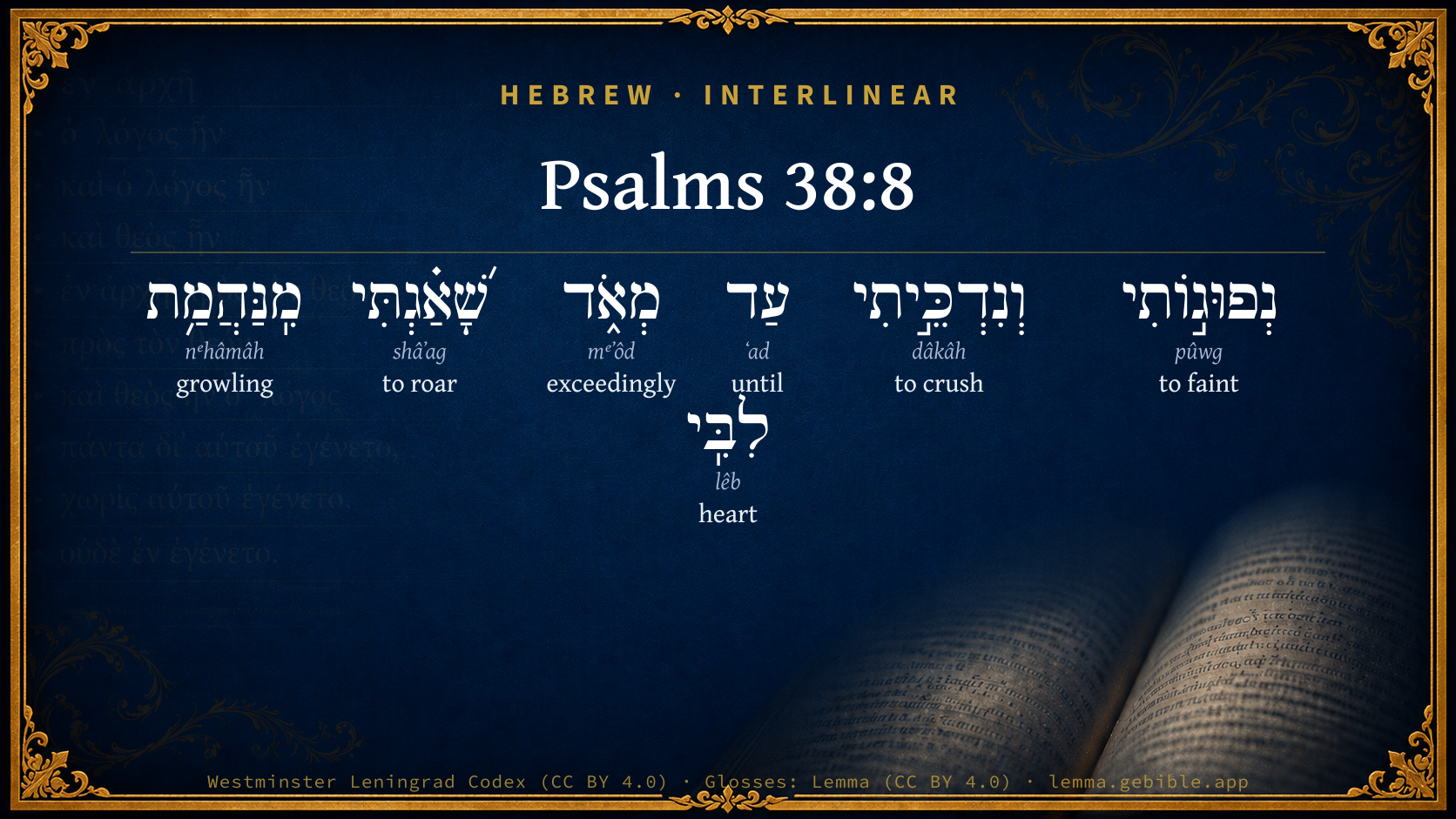
Psalms 38:8

Hebrew (Westminster Leningrad Codex) Psalms 38:8 appears in the Hebrew Old Testament. The text above is from the Westminster Leningrad Codex. Each word links to its Strong’s number, a concise gloss, and parsing drawn from the Open Scriptures Hebrew Bible morphology. Click any word for its full Brown-Driver-Briggs (BDB) entry.
Download image
Cite this verse

Psalms 38:8 (World English Bible). Public Domain. Lemma interlinear Bible study tool, https://lemma.gebible.app/v/psalms/38/8.

Show BibTeX & RIS
BibTeX
RIS
English Translation
I am faint and severely bruised. I have groaned by reason of the anguish of my heart.
World English Bible · Public Domain
Highlights
  • 1 first appearance in the Hebrew Bible
Full analysis ↓
Download a study sheet

One document with this verse’s original text, its word-by-word gloss line, the meaning frame, cross-references with their text, attributed commentary, and full source and license credits — printable, and it pastes into notes with its structure intact.

This verse Autodidact and up

Study sheet (.html) Plain text (.txt)

A passage Seminary Student

Up to 50 verses in one chapter. A passage sheet keeps up to 6 commentary sources and 12 cross-references per verse, in the order this page ranks them, and says so on the sheet whenever that leaves anything out. Ask for a single verse and you get the Autodidact verse sheet above.

Everything on this page stays free to read, with no account — the sheet is a download of what is already on screen, not access to it.

Want to remove ads? Support Godless Engineer
Compare translations 3

The same verse in 3 English versions, stacked beneath the original-language interlinear above. Click any original word for its lexicon entry.

Each is an independent rendering of the whole verse — the interlinear is not word-aligned to these translations.

Highlighted words mark where these versions differ — a whole-verse word diff, not a word-by-word alignment.

  • World English Bible Public Domain
    I am faint and severely bruised. I have groaned by reason of the anguish of my heart.
  • King James Version Public Domain
    I am feeble and sore broken: I have roared by reason of the disquietness of my heart.
  • unfoldingWord Literal Text CC BY-SA 4.0
    I am numb and crushed exceedingly; I roar from the groaning of my heart.

unfoldingWord Literal Text — © unfoldingWord, licensed CC BY-SA 4.0. Word-aligned USFM3 via Door43 (git.door43.org/unfoldingWord/en_ult).

Versions to compare (up to 4)

3 of 4 selected

Show all 18 translations

Every available English version of this verse, each an independent rendering of the whole verse.

  • World English Bible Public Domain
    I am faint and severely bruised. I have groaned by reason of the anguish of my heart.
  • Berean Standard Bible Public Domain
    I am numb and badly crushed; I groan in anguish of heart.
  • Majority Standard Bible Public Domain
    I am numb and badly crushed; I groan in anguish of heart.
  • King James Version Public Domain
    I am feeble and sore broken: I have roared by reason of the disquietness of my heart.
  • American Standard Version (1901) Public Domain
    I am faint and sore bruised: I have groaned by reason of the disquietness of my heart.
  • Revised Version (1885) Public Domain
    I am faint and sore bruised: I have roared by reason of the disquietness of my heart.
  • Geneva Bible (1599) Public Domain
    I am weakened and sore broken: I roare for the very griefe of mine heart.
  • Douay-Rheims (1899) Public Domain
    For my loins are filled with illusions; and there is no health in my flesh.
  • Young's Literal Translation Public Domain
    I have been feeble and smitten -- unto excess, I have roared from disquietude of heart.
  • Literal Standard Version CC BY-SA 4.0
    I have been feeble and struck—to excess, || I have roared from disquietude of heart.
  • Unlocked Literal Bible CC BY-SA 4.0
    I am numb and utterly crushed; I groan because of the anguish of my heart.
  • unfoldingWord Literal Text CC BY-SA 4.0
    I am numb and crushed exceedingly; I roar from the groaning of my heart.
  • Darby Bible Public Domain
    I am faint and broken beyond measure; I roar by reason of the agitation of my heart.
  • World Messianic Bible Public Domain
    I am faint and severely bruised. I have groaned by reason of the anguish of my heart.
  • Webster's Bible Public Domain
    \\38:7\\For my loins are filled with a lothsome disease: and there is no soundness in my flesh.
  • Free Bible Version CC BY-SA 4.0
    I'm worn out, totally down. I groan because of the anguish I feel in my heart.
  • Bible in Basic English Public Domain
    I am feeble and crushed down; I gave a cry like a lion because of the grief in my heart.
  • JPS Tanakh (1917) Public Domain
    (38-9) I am benumbed and sore crushed; I groan by reason of the moaning of my heart.

Literal Standard Version (2020), Covenant Press — licensed CC BY-SA 4.0. Text via the HelloAO Bible API (eBible.org). Unlocked Literal Bible (unfoldingWord) — licensed CC BY-SA 4.0. Text via the HelloAO Bible API (eBible.org). unfoldingWord Literal Text — © unfoldingWord, licensed CC BY-SA 4.0. Word-aligned USFM3 via Door43 (git.door43.org/unfoldingWord/en_ult). Free Bible Version, Dr. Jonathan Gallagher — licensed CC BY-SA 4.0. Text via the HelloAO Bible API (eBible.org).

Word by word

More ways to search: Search by grammar → Find every occurrence → Compare this word →

Practice this passage: Drill this verse → Learn its vocabulary →

About this verse

These counts appear in no published source. They are computed here, from the morphology-tagged text and Lemma’s own curated glosses. What Lemma adds →

7
words
7
distinct lemmas
Wisdom
section

Notable vocabulary

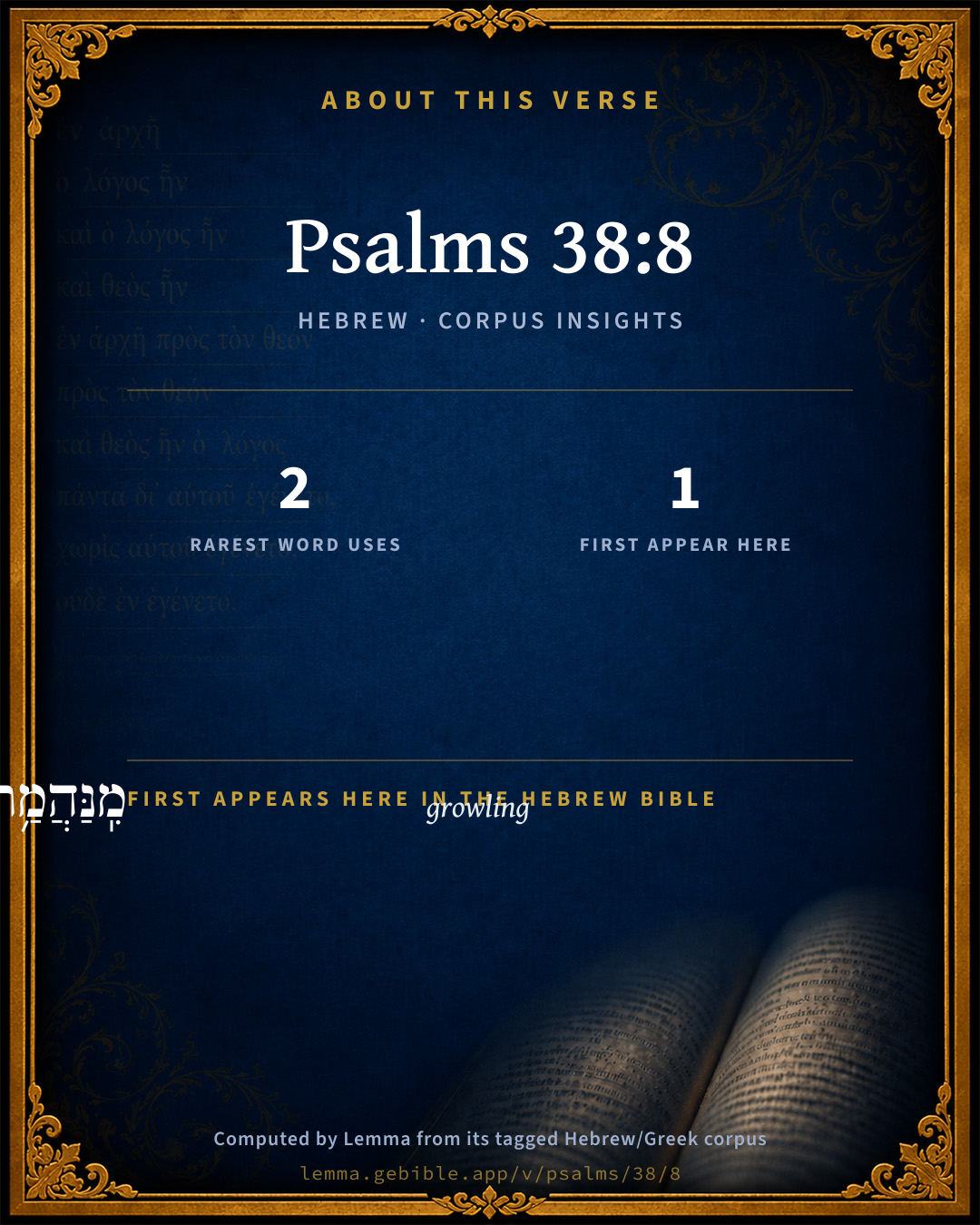
The rarest word here is מִֽנַּהֲמַ֥ת growling H5100 — appearing just 2 times in the whole Hebrew Bible.

First appearance in Scripture

This word makes its first canonical appearance in the Hebrew Bible here:

  • מִֽנַּהֲמַ֥ת growling H5100

Shared distinctive vocabulary

מִֽנַּהֲמַ֥ת growling H5100 occurs in 2 verses of the Hebrew Bible. Also found in:

Grammatical profile

  • 3 verbs
  • 2 nouns
  • 1 preposition
  • 1 adverb

Verb forms

  • נְפוּג֣וֹתִי Niphal · Perfect
  • וְנִדְכֵּ֣יתִי Niphal · Perfect
  • שָׁ֝אַ֗גְתִּי Qal · Perfect

Hebrew & Septuagint length

In English translation the verse runs 17 words from the Hebrew and 17 from the Septuagint (LXX English) — the same length.

A rough comparison of the two English renderings, which tokenize alike — not a word-level alignment.

Word counts can differ between the Hebrew and the Greek without any difference in meaning — e.g. the Hebrew direct-object marker אֵת has no separate Greek word, and Greek often adds the article ὁ.

Cross-references

5

Topical passages linked to Psalms 38:8 in the Treasury of Scripture Knowledge — connected by theme and wording, ordered by reader-vote popularity; previews shown in the World English Bible.

  • Job 3:24 For my sighing comes before I eat, My groanings are poured out like water.
  • Psalms 32:3 When I kept silence, my bones wasted away through my groaning all day long.
  • Job 30:28 I go mourning without the sun. I stand up in the assembly, and cry for help.
  • Isaiah 59:11 We roar all like bears, and moan sore like doves: we look for justice, but there is none; for salvation, but it is far off from us.
  • Psalms 22:1–2 My God, my God, why have you forsaken me? Why are you so far from helping me, and from the words of my groaning?

Cross-references courtesy of OpenBible.info (CC BY 4.0).

Hebrew and Greek witnesses Masoretic Hebrew ↔ Greek Septuagint

The same verse in the two great witnesses to the Old Testament, shown verse-for-verse.

You’re reading Greek Psalm 37 (Hebrew Psalm 38). The Septuagint counts the superscription, so verse numbers can differ from the Hebrew — chapter-level alignment, not verse-by-verse. Numbering follows Rahlfs.

These are two independent witnesses, not word-aligned to each other, and the Septuagint is shown in lemma (dictionary) form.

Hebrew Psalms 38:8 Masoretic · Westminster Leningrad Codex

נְפוּג֣וֹתִי וְנִדְכֵּ֣יתִי עַד מְאֹ֑ד שָׁ֝אַ֗גְתִּי מִֽנַּהֲמַ֥ת לִבִּֽי

I am faint and severely bruised. I have groaned by reason of the anguish of my heart.

World English Bible · Public Domain

Greek LXX Greek Psalm 37:8 Septuagint · lemma form

ὅτι ὁ ψύα ἐγώ πίμπλημι ἐμπαιγμός καί οὐ εἰμί ἴασις ἐν ὁ σάρξ ἐγώ

I have been afflicted and brought down exceedingly: I have roared for the groaning of my heart.

LXX2012 (modern English Septuagint) · Public Domain

Hebrew: Westminster Leningrad Codex (CC BY 4.0). Greek: Septuagint (public domain); English from LXX2012 (modern English Septuagint) (Public Domain). How the Septuagint differs from the Hebrew →

Commentary

Notes on Psalms 38:8 from classic Christian and Jewish commentators (each source and its license shown beneath its notes). The classic Christian expositions comment on the surrounding passage and are grouped to its opening verse, so a note may address several verses; the Jewish commentaries on the Tanakh (Rashi and others) are per-verse, so they appear only where the commentator wrote on this verse.

Lemma curates 59 commentaries, every one of them public domain or Creative Commons licensed, each selected and text-cleaned for this edition rather than reprinted as found. About our sources →

Trapp's Complete Commentary

John Trapp

Psa 38:8 I am feeble and sore broken: I have roared by reason of the disquietness of my heart.

Ver. 8. I am feeble and sore broken] Through the length and nature of my distemper, Isa 38:10; Isa 38:12. The same Hebrew word signifieth pining sickness and a thrum, because of the thinness and weakness of it.

I have roared] But not repined. This nature prompteth to, when we are in extremity; and grace is not against it.

John Trapp, A Commentary or Exposition upon All the Books of the Old and New Testament (1647–1656) — public domain. Text from a community e-Sword module.

Joseph Benson's Commentary

Psa 38:8-10. I have roared — Hebrew, שׁאגתי, sha-agti, roared like a lion, or a bear, namely, through extreme misery; by reason of the disquietness of my heart — For the great anxiety and torment of my mind, caused by the deep sense of my sins, and of God’s wrath, and of the sad issue of both. My groaning is not hid from thee — I do not utter all these complaints, nor roar out that thou mayest hear and know them, for thou hearest and knowest my lowest words, yea, the desires of my heart, and all my necessities. And, therefore, I pray thee, pity and deliver me, as I trust thou wilt. My heart panteth — סחרחר, secharchar, circumit, palpitat, goeth round, palpitates, through fear and grief; or, it is perplexed and tossed with many and various thoughts, not knowing what to do, nor whither to go. The light of mine eyes — Mine eyes are grown dim; either through grief and tears, or through weakness.

Joseph Benson's Commentary on the Old and New Testaments (1811–1818) — public domain. Text from a community e-Sword module.

J. A. Alexander on Psalms

Joseph Addison Alexander

9. (Psa 38:8). I am benumbed and bruised exceedingly: I have roared from the murmur of my heart. Benumbed, especially from cold, chilled, frozen, torpid. Bruised or broken. The same verb is used to express contrition or brokenness of heart in Psa 51:18 (17) below; but here it has its proper sense, and is descriptive of a bodily condition. See above, on Psa 10:10.—Exceedingly, the same phrase as in Psa 38:7 (6) above. In the last clause two words are employed, both denoting animal sounds, and nearly corresponding to our roar and growl. In Isa 5:29, both verbs are, applied to the lion, and both translated roar in the English Bible. For the use of such figures, see above, on Psa 22:2 (1). The idea here is that his audible complaints are not expressions of mere bodily distress, but of mental and spiritual anguish. The roaring of his voice is but an echo of the murmur in his heart.

Joseph Addison Alexander, The Psalms Translated and Explained (1850) — public domain. Text from a community e-Sword module.

Geneva Bible (1599)

Geneva Bible translators

This example warneth us never to despair, be the torment never so great: but always to cry unto God with sure trust for deliverance.

Geneva Bible (1599) marginal notes — public domain. Text via Bolls.life.

Adam Clarke's Commentary

Verse 8. I am feeble and sore broken] I am so exhausted with my disease that I feel as if on the brink of the grave, and unfit to appear before God; therefore "have I roared for the disquietness of my heart."

That David describes a natural disease here cannot reasonably be doubted; but what that disease was, who shall attempt to say? However, this is evident, that whatever it was, he most deeply deplored the cause of it; and as he worthily lamented it, so he found mercy at the hand of God. It would be easy to show a disease of which what he here enumerates are the very general symptoms; but I forbear, because in this I might attribute to one what, perhaps, in Judea would be more especially descriptive of another.

Adam Clarke's Commentary on the Bible (1810–1826) — public domain. Text from a community e-Sword/MySword module.

Ellicott's Commentary for English Readers

(8) I am feeble and sore broken.—Better, I am become deadly cold, and am quite worn out.

Disquietness.—Properly, roaring. Thus, of the sea (Isa_5:30), of lions (Pro_19:12; Pro_20:2). A very slight alteration once suggested by Hitzig, but since abandoned, would give here, “I roared more than the roaring of a lion.”

A Bible Commentary for English Readers, edited by Charles John Ellicott (1878–1897) — public domain. Text from a community e-Sword module.

The Cambridge Bible for Schools and Colleges

gen. ed. J. J. S. Perowne

8. I am faint and sore bruised (R.V.). Cp. Psa_51:8; Isa_53:5; Isa_53:10.

I have roared &c.] Lit. I have roared (Psa_22:1; Psa_32:3; Job_3:24) from the moaning of my heart. The inward moaning of his heart must needs find utterance in loud cries of distress.

The Cambridge Bible for Schools and Colleges (gen. ed. J. J. S. Perowne; Cambridge University Press, 1878–1918) — public domain. Text from a community e-Sword module.

John Gill's Exposition

Lord, all my desire is before thee,.... To be delivered from his afflictions, to have a discovery and application of pardoning grace, and to have communion with his God: the desire of his soul was unto these things; and it was some satisfaction to him that it was before the Lord, and known unto him, before whom all things are naked and open;

and my groaning is not hid from thee; under the weight of his affliction, the burden of his sin, and which he expressed in prayer to the Lord, and which is often done with groanings which cannot be uttered: but even these are known and understood by the Lord.

John Gill's Exposition of the Whole Bible (1746–1763) — public domain (CC PDM 1.0). Text via the HelloAO Bible API.

Albert Barnes' Notes on the Bible

I am feeble - The word used here means properly to be cold, or without warmth; and then, to be torpid or languid. Compare Gen 45:26. Would not this be well represented by the idea of a “chill?”

And sore broken - This word means to break in pieces; to beat small; to crush; and then it may be used to denote being broken in spirit, or crushed by pain and sorrow: Isa 57:15; Isa 53:5; Isa 19:10.

I have roared - I have cried out on account of my suffering. See the notes at Psa 22:1.

By reason of the disquietness of my heart - The word here rendered “disquietness” means properly “a roaring,” as of the sea: Isa 5:30; and then, a groaning, or roaring, as of the afflicted. Here the “heart” is represented as “roaring” or “crying out.” The lips only gave utterance to the deeper groanings of the heart.

Albert Barnes' Notes on the Bible (1834–1885) — public domain. Text from a community e-Sword/MySword module.

Matthew Poole's English Annotations

Roared, like a bear or a lion, through extreme pain and misery.

By reason of the disquietness of my heart; for the great anxiety and torment of my mind, caused by the deep sense of my sins, and of God’s wrath, and of the sad issue of my disease; which being added to my bodily pains, makes them more intolerable.

Matthew Poole's English Annotations on the Holy Bible (1683–1685) — public domain. Text from a community e-Sword/MySword module.

The Treasury of David

Charles H. Spurgeon

Ver. 8. I am feeble. The original is "benumbed, "or frozen, such strange incongruities and contradictions meet in a distracted mind and a sick bodyit appears to itself to be alternately parched with heat and pinched with cold. Like souls in the Popish fabled Purgatory, tossed from burning furnaces into thick ice, so tormented hearts rush from one extreme to the other, with equal torture in each. A heat of fear, a chill of horror, a flaming desire, a horrible insensibilityby these successive miseries a convinced sinner is brought to death's door. And sore broken. Crushed as in a mill, pounded as in a mortar. The body of the sick man appears to be all out of joint and smashed into a palpitating pulp, and the soul of the desponding is in an equally wretched case; as a victim crushed under the car of Juggernaut, such is a soul over whose conscience the wheels of divine wrath have forced their awful way. I have roared by reason of the disquietness of my heart. Deep and hoarse is the voice of sorrow, and often inarticulate and terrible. The heart learns groanings which cannot be uttered, and the voice fails to tone and tune itself to human speech. When our prayers appear to be rather animal than spiritual, they are none the less prevalent with the pitiful Father of mercy. He hears the murmur of the heart and the roaring of the soul because of sin, and in due time he comes to relieve his afflicted. The more closely the preceding portrait of an awakened soul is studied in the light of experience, the more will its striking accuracy appear. It cannot be a description of merely outward disorder, graphic as it might then be; it has a depth and pathos in it which only the soul's mysterious and awful agony can fully match.

Ver. 8. I am feeble, literally, I am benumbed. I have become deadly cold, cold as a corpse; possibly with reference to the burning inflammation in the previous verse, as marking the alternations in the fever fit. J. J. Stewart Perowne.

Ver. 8. I have roared by reason of the disquietness of my heart. Where sin is, there will never be but unquietness of heart; and an unquiet heart will always produce these miserable effects feebleness of body, dejectedness of mind, and roaring of voice. But how can roaring stand with feebleness, which seems to require a strength of spirits? Is it not, therefore, a roaring, perhaps not so much in loudness as in an inarticulate expressing? that having done actions more like a beast than a man, I am forced to use a voice not so much of a man as of a beast? Or is it perhaps a roaring in spirit, which the heart may send forth though the body be feeble; or rather then most, when it is most feeble; not unlike the blaze of a candle then greatest when going out? Howsoever it be, this is certain: the heart is that unhappy plot of ground, which, receiving into it the accursed seed of sin, brings forth in the body and soul of man these miserable fruits: and how, then, can I be free from these weeds of the fruits, since I have received into me so great a measure of the seed? Oh, vile sin, that I could as well avoid thee as I can see thee, or could as easily resist thee as I deadly hate thee, I should not then complain of either feebleness of body, or dejectedness of mind, or roaring of voice; but I should perfectly enjoy that happy quietness in all my parts, which thou, O God, didst graciously bestow as a blessed dowry on our first parents at their creation. Sir Richard Baker.

Ver. 8. I have roared, etc. It is difficult for a true penitent, in the bitterness of his soul, to go over the life which he has dragged on in sinfulness, without groaning and sighing from the bottom of his heart. But happy are these groans, happy these sighs, happy these sobs, since they flow from the influence of grace, and from the breath of the Holy Spirit, who himself in an ineffable manner groans in us and with us, and who forms these groans in our hearts by penitence and love! but as the violence of both, that is, of penitence and of love, cannot but burst the narrow limits of a penitent heart, it must make a vent for itself by the eyes and mouth. The eyes shed tears, and the mouth sends forth sighs and groans, which it can no longer restrain; because they are driven on by the fire of divine love, and so these lamentations frame themselves into words and intelligible sentences. Jean Baptiste Elias Avrillon, 1652-1729.

Ver. 8. The disquietness of my heart. David felt pains gather about his heart, and then he cried out. The heart is the mark that God principally aims at when a Christian hath turned aside from his upright course; other outward parts he may hit and deeply wound, but this is but to make holes in the heart, where the seat of unsoundness that principally offends him is. The fire which conscience kindles, it may flash forth into the eyes, and tongue, and hands, and make a man look fearfully, speak desperately, and do bloodily, against the body; but the heat of the fire is principally within, in the furnace, in the spirit; it is but some sparkles and flashes only that you see come forth at the lower holes of the furnace, which you behold in the eyes, words, and deeds of such men. Nicholas Lockyer.

None.

Psalms 38:9*

Charles H. Spurgeon's The Treasury of David (1869–1885) — public domain. Psalms only. Text from a community e-Sword/MySword module.

Whedon's Commentary on the Bible

Daniel D. Whedon

8. Feeble—The word means torpid, cold, without vital warmth. A natural reaction from the fever-heat of Psa_38:7.

Broken—Crushed. Here taken morally for a “broken heart,” Psa_51:19.

Roared… disquietness— Two words used in allusion to the habits of the lion, bearing the same relation to each other as growling and roaring. The meaning is, the low moaning of his heart had caused the loud wailing of his lips. Hitherto, in pouring out the bitterness of his complaint, David speaks only of himself, especially his physical sufferings, making no allusion to his enemies. Thrice he lays down the moral cause of his sufferings, “Because of thine anger,” “Because of my sin,” “Because of my foolishness.” Vers. 3, 5

Daniel D. Whedon (gen. ed.), Commentary on the Old and New Testaments (1874–1909) — public domain. Text from a community e-Sword module.

The Pulpit Commentary

I am feeble and sore broken: I have roared by reason of the disquietness of my heart. In concluding his accounts of his physical condition, the writer passes from details to more vague and general statements. He is "feeble," i.e. generally weak and wanting in vigour he is "sore broken," or "sore bruised" (Revised Version), i.e. full of aches and pains, as though he had been bruised all over and the "disquietness of his heart" causes him to vent his anguish in "roarings," or groanings.

The Pulpit Commentary (1880–1919), ed. H.D.M. Spence-Jones & Joseph S. Exell — public domain. Text from a community e-Sword module.

Rashi

Rabbi Shlomo Yitzchaki (Rashi)

For my loins are full of self-effacement In my thoughts, I am insignificant in my own eyes.

Rashi on the Tanakh — English translations: “The Judaica Press complete Tanach with Rashi, translated by A. J. Rosenberg” (CC BY 4.0); “Pentateuch with Rashi's commentary by M. Rosenbaum and A.M. Silbermann, 1929-1934” (public domain); “The Metsudah Tanach series, Lakewood, N.J” (CC BY 4.0); and “The Book of Joshua, Metsudah Publications, 1997” (CC BY 4.0). Text via Sefaria.

Lesson kit

Teaching starters — assembled from the data on this page, not authored interpretation. Every prompt links to the verse data it draws on. Edit before teaching.

Psalms, in the Wisdom, opens this verse with 7 words (7 distinct Hebrew lemmas). Its most distinctive word is nᵉhâmâh (“growling”). A historical commentator’s framing appears above. Read the whole chapter for the surrounding context.

Discussion questions

  1. The word nᵉhâmâh carries the sense “growling.” How does it shape the verse?
  2. This is the first place “growling” appears in Scripture (first appears here). What does its debut here establish?
  3. How does Isaiah 5:30, which shares the word «growling», read alongside this verse?
  4. The translations on this page render this verse differently — a whole-verse word diff, not a word-by-word alignment. What might account for the different wordings?
  5. «נְפוּג֣וֹתִי» is a Niphal Perfect verb. How does that grammatical form shape the action described?
  6. Compare how Trapp's Complete Commentary and Joseph Benson's Commentary read this verse. Where do they agree or differ?

Things to notice

Reading settings

Reading text

Shown beneath each verse's original-language words.

Old Testament
Old Testament edition

Read the OT as the Masoretic Hebrew (MT) or the Greek Septuagint (LXX).

English shown for the Greek Septuagint (in the Hebrew ↔ Greek comparison).

Comparing translations? Open the Compare panel on any verse page to stack up to four side by side.