Job 37:4

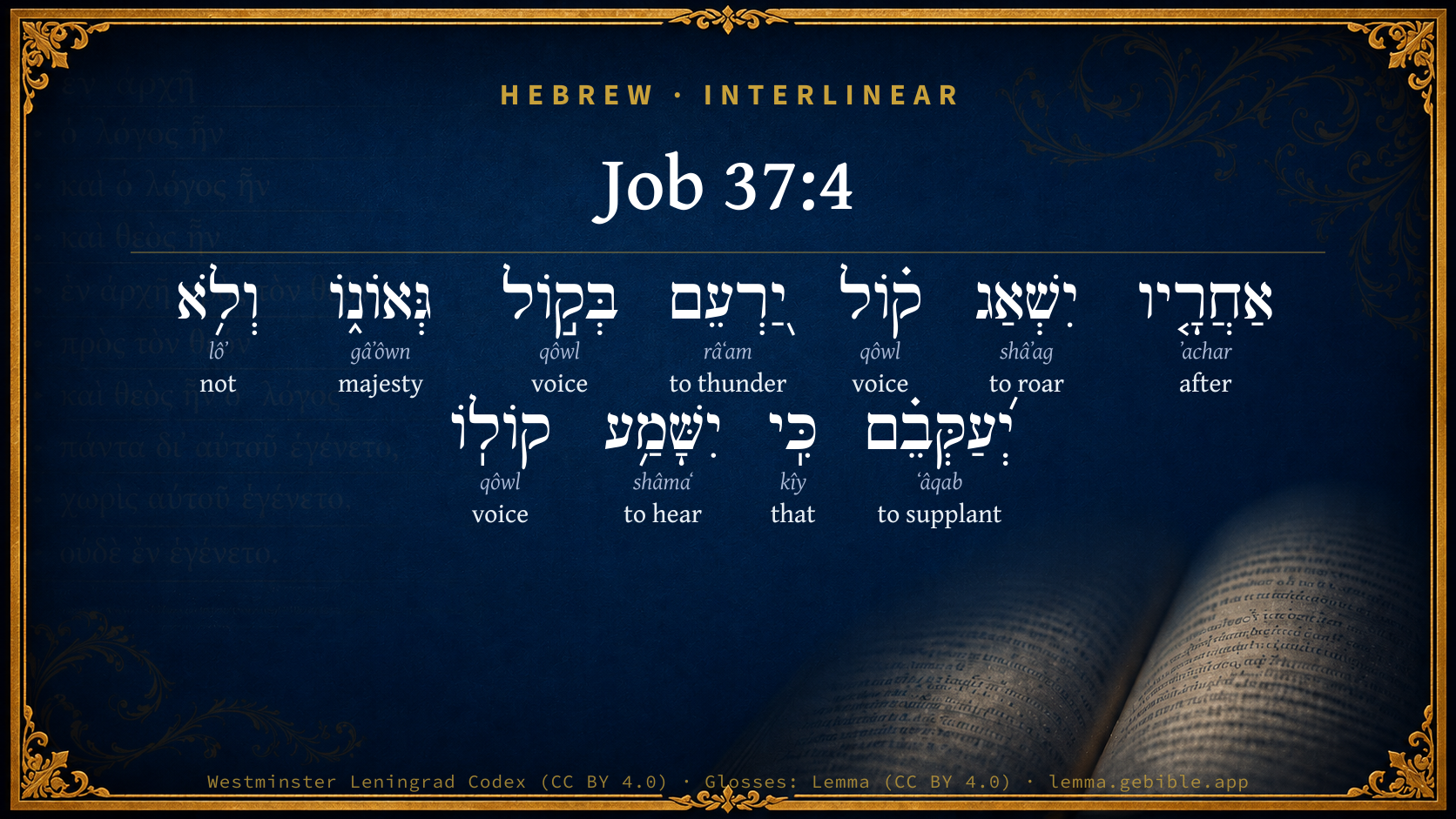
Hebrew (Westminster Leningrad Codex) Job 37:4 appears in the Hebrew Old Testament. The text above is from the Westminster Leningrad Codex. Each word links to its Strong’s number, a concise gloss, and parsing drawn from the Open Scriptures Hebrew Bible morphology. Click any word for its full Brown-Driver-Briggs (BDB) entry.
Download image
Cite this verse

Job 37:4 (World English Bible). Public Domain. Lemma interlinear Bible study tool, https://lemma.gebible.app/v/job/37/4.

Show BibTeX & RIS
BibTeX
RIS
English Translation
After it a voice roars. He thunders with the voice of his majesty; He doesn't hold back anything when his voice is heard.
World English Bible · Public Domain
Download a study sheet

One document with this verse’s original text, its word-by-word gloss line, the meaning frame, cross-references with their text, attributed commentary, and full source and license credits — printable, and it pastes into notes with its structure intact.

This verse Autodidact and up

Study sheet (.html) Plain text (.txt)

A passage Seminary Student

Up to 50 verses in one chapter. A passage sheet keeps up to 6 commentary sources and 12 cross-references per verse, in the order this page ranks them, and says so on the sheet whenever that leaves anything out. Ask for a single verse and you get the Autodidact verse sheet above.

Everything on this page stays free to read, with no account — the sheet is a download of what is already on screen, not access to it.

Want to remove ads? Support Godless Engineer
Compare translations 3

The same verse in 3 English versions, stacked beneath the original-language interlinear above. Click any original word for its lexicon entry.

Each is an independent rendering of the whole verse — the interlinear is not word-aligned to these translations.

Highlighted words mark where these versions differ — a whole-verse word diff, not a word-by-word alignment.

  • World English Bible Public Domain
    After it a voice roars. He thunders with the voice of his majesty; He doesn't hold back anything when his voice is heard.
  • King James Version Public Domain
    After it a voice roareth: he thundereth with the voice of his excellency; and he will not stay them when his voice is heard.
  • unfoldingWord Literal Text CC BY-SA 4.0
    A voice roars after it; he thunders with the voice of his majesty, and he does not restrain them when his voice is heard.

unfoldingWord Literal Text — © unfoldingWord, licensed CC BY-SA 4.0. Word-aligned USFM3 via Door43 (git.door43.org/unfoldingWord/en_ult).

Versions to compare (up to 4)

3 of 4 selected

Show all 18 translations

Every available English version of this verse, each an independent rendering of the whole verse.

  • World English Bible Public Domain
    After it a voice roars. He thunders with the voice of his majesty; He doesn't hold back anything when his voice is heard.
  • Berean Standard Bible Public Domain
    Then there comes a roaring sound; He thunders with His majestic voice. He does not restrain the lightning when His voice resounds.
  • Majority Standard Bible Public Domain
    Then there comes a roaring sound; He thunders with His majestic voice. He does not restrain the lightning when His voice resounds.
  • King James Version Public Domain
    After it a voice roareth: he thundereth with the voice of his excellency; and he will not stay them when his voice is heard.
  • American Standard Version (1901) Public Domain
    After it a voice roareth; He thundereth with the voice of his majesty; And he restraineth not `the lightnings' when his voice is heard.
  • Revised Version (1885) Public Domain
    After it a voice roareth; he thundereth with the voice of his majesty: and he stayeth them not when his voice is heard.
  • Geneva Bible (1599) Public Domain
    After it a noyse soundeth: hee thundereth with the voyce of his maiestie, and hee will not stay them when his voyce is heard.
  • Douay-Rheims (1899) Public Domain
    After it a noise shall roar, he shall thunder with the voice of his majesty, and shall not be found out, when his voice shall be heard.
  • Young's Literal Translation Public Domain
    After it roar doth a voice -- He thundereth with the voice of His excellency, And He doth not hold them back, When His voice is heard.
  • Literal Standard Version CC BY-SA 4.0
    A voice roars after it—He thunders with the voice of His excellence, || And He does not hold them back, || When His voice is heard.
  • Unlocked Literal Bible CC BY-SA 4.0
    A voice roars after it; he thunders with the voice of his majesty; he does not restrain the lightning bolts when his voice is heard.
  • unfoldingWord Literal Text CC BY-SA 4.0
    A voice roars after it; he thunders with the voice of his majesty, and he does not restrain them when his voice is heard.
  • Darby Bible Public Domain
    After it a voice roareth: he thundereth with the voice of his excellency, and holdeth not back the flashes when his voice is heard.
  • World Messianic Bible Public Domain
    After it a voice roars. He thunders with the voice of his majesty. He doesn’t hold back anything when his voice is heard.
  • Webster's Bible Public Domain
    After it a voice roareth: he thundereth with the voice of his excellence; and he will not stay them when his voice is heard.
  • Free Bible Version CC BY-SA 4.0
    Then comes the roar of thunder, his majestic voice holding nothing back when he speaks.
  • Bible in Basic English Public Domain
    After it a voice is sounding, thundering out the word of his power; he does not keep back his thunder-flames; from his mouth his voice is sounding.
  • JPS Tanakh (1917) Public Domain
    After it a voice roareth; He thundereth with the voice of His majesty; and He stayeth them not when His voice is heard.

Literal Standard Version (2020), Covenant Press — licensed CC BY-SA 4.0. Text via the HelloAO Bible API (eBible.org). Unlocked Literal Bible (unfoldingWord) — licensed CC BY-SA 4.0. Text via the HelloAO Bible API (eBible.org). unfoldingWord Literal Text — © unfoldingWord, licensed CC BY-SA 4.0. Word-aligned USFM3 via Door43 (git.door43.org/unfoldingWord/en_ult). Free Bible Version, Dr. Jonathan Gallagher — licensed CC BY-SA 4.0. Text via the HelloAO Bible API (eBible.org).

Word by word

More ways to search: Search by grammar → Find every occurrence → Compare this word →

Practice this passage: Drill this verse → Learn its vocabulary →

יְ֝עַקְּבֵ֗ם
ʻâqab
H6117
“to supplant · them”
Verb, Piel, Imperfect, 3rd Person, Masculine, Singular + Suffix, Personal, 3rd Person, Masculine, Plural
Part of Speech
Verb
Stem
Piel
Form
Imperfect
Person
3rd Person
Gender
Masculine
Number
Singular
Full BDB Definition

Origin: a primitive root

TWOT: 1676

to supplant, circumvent, take by the heel, follow at the heel, assail insidiously, overreach - (Qal) to supplant, overreach, attack at the heel - (Piel) to hold back
  1. אַחֲרָ֤יו ʼachar H310 “after · him” Preposition + Suffix, Personal, 3rd Person, Masculine, Singular
  2. יִשְׁאַג shâʼag H7580 “to roar” Verb, Qal, Imperfect, 3rd Person, Masculine, Singular
  3. ק֗וֹל qôwl H6963 “voice” Noun, Common, Masculine, Singular, Absolute
  4. יַ֭רְעֵם râʻam H7481 “to thunder” Verb, Hiphil, Imperfect, 3rd Person, Masculine, Singular
  5. בְּק֣וֹל qôwl H6963 “in/at · voice of” Preposition + Noun, Common, Masculine, Singular, Construct
  6. גְּאוֹנ֑וֹ gâʼôwn H1347 “majesty · his” Noun, Common, Masculine, Singular, Construct + Suffix, Personal, 3rd Person, Masculine, Singular
  7. וְלֹ֥א lôʼ H3808 “and · not” Conjunction + Particle, Negative
  8. כִּֽי kîy H3588 “that” Conjunction
  9. יִשָּׁמַ֥ע shâmaʻ H8085 “to hear” Verb, Niphal, Imperfect, 3rd Person, Masculine, Singular
  10. קוֹלֽוֹ qôwl H6963 “voice · his” Noun, Common, Masculine, Singular, Construct + Suffix, Personal, 3rd Person, Masculine, Singular

About this verse

These counts appear in no published source. They are computed here, from the morphology-tagged text and Lemma’s own curated glosses. What Lemma adds →

11
words
9
distinct lemmas
Wisdom
section

Notable vocabulary

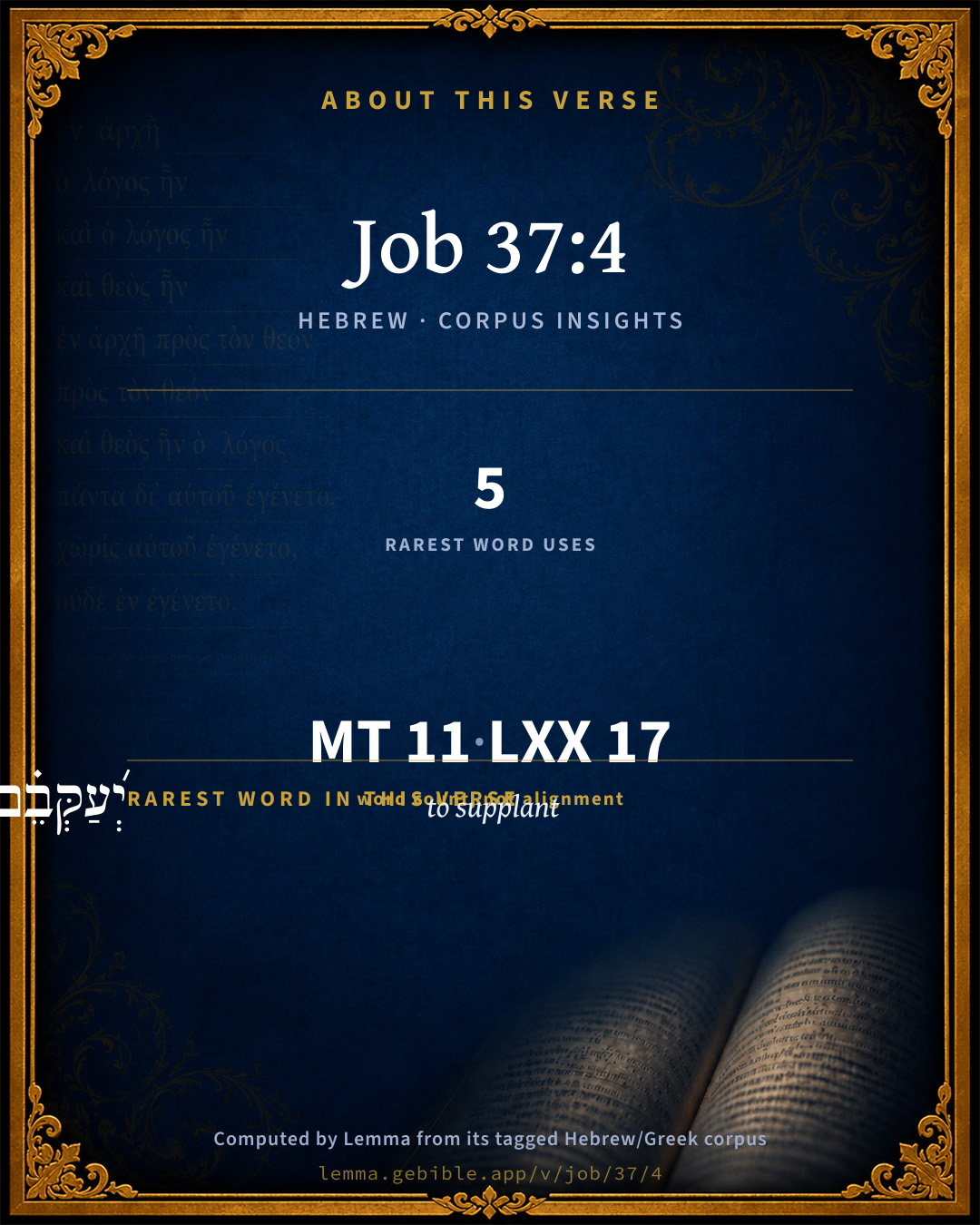
The rarest word here is יְ֝עַקְּבֵ֗ם to supplant H6117 — appearing just 5 times in the whole Hebrew Bible.

Shared distinctive vocabulary

יְ֝עַקְּבֵ֗ם to supplant H6117 occurs in 4 verses of the Hebrew Bible. Also found in:

Grammatical profile

  • 4 verbs
  • 4 nouns
  • 1 preposition
  • 1 conjunction
  • 1 particle

Verb forms

  • יִשְׁאַג Qal · Imperfect
  • יַ֭רְעֵם Hiphil · Imperfect
  • יְ֝עַקְּבֵ֗ם Piel · Imperfect
  • יִשָּׁמַ֥ע Niphal · Imperfect

Repetition

A word recurs within this verse — often emphatic in Hebrew:

  • ק֗וֹל voice H6963 ×3

Hebrew & Septuagint length

In English translation the verse runs 23 words from the Hebrew and 34 from the Septuagint (LXX English) — the Septuagint runs noticeably longer here. See the side-by-side →

A rough comparison of the two English renderings, which tokenize alike — not a word-level alignment.

Word counts can differ between the Hebrew and the Greek without any difference in meaning — e.g. the Hebrew direct-object marker אֵת has no separate Greek word, and Greek often adds the article ὁ.

In the original languages it is 11 Hebrew tokens and 17 Greek tokens — but the two are counted differently (Hebrew bundles its prefixes and suffixes into one token; the Greek is in lemma form), so that isn’t a like-for-like length.

Cross-references

5

Topical passages linked to Job 37:4 in the Treasury of Scripture Knowledge — connected by theme and wording, ordered by reader-vote popularity; previews shown in the World English Bible.

  • Psalms 29:3–9 Yahweh's voice is on the waters. The God of glory thunders, even Yahweh on many waters.
  • Psalms 68:33 To him who rides on the heaven of heavens, which are of old; Behold, he utters his voice, a mighty voice.
  • Exodus 15:7–8 In the greatness of your excellency, you overthrow those who rise up against you: You send forth your wrath. It consumes them as stubble.
  • Deuteronomy 33:26 There is none like God, Jeshurun, Who rides on the heavens for your help, In his excellency on the skies.
  • Job 36:27–33 For he draws up the drops of water, Which distill in rain from his vapor,

Cross-references courtesy of OpenBible.info (CC BY 4.0).

Hebrew and Greek witnesses Masoretic Hebrew ↔ Greek Septuagint

The same verse in the two great witnesses to the Old Testament, shown verse-for-verse.

Here the Septuagint runs noticeably longer than the Hebrew — LXX2012 (modern English Septuagint) 34 words vs World English Bible 23. A rough length comparison of the two English translations, not a word-level alignment — read both below.

These are two independent witnesses, not word-aligned to each other, and the Septuagint is shown in lemma (dictionary) form.

Hebrew Job 37:4 Masoretic · Westminster Leningrad Codex

אַחֲרָ֤יו יִשְׁאַג ק֗וֹל יַ֭רְעֵם בְּק֣וֹל גְּאוֹנ֑וֹ וְלֹ֥א יְ֝עַקְּבֵ֗ם כִּֽי יִשָּׁמַ֥ע קוֹלֽוֹ

After it a voice roars. He thunders with the voice of his majesty; He doesn't hold back anything when his voice is heard.

World English Bible · Public Domain

Greek LXX Job 37:4 Septuagint · lemma form

ὀπίσω αὐτός βοάω φωνή βροντάω ἐν φωνή ὕβρις αὐτός καί οὐ ἀντιἀλλάσσω αὐτός ὅτι ἀκούω φωνή αὐτός

After him shall be a cry with a loud voice; he shall thunder with the voice of his excellency, yet he shall not cause men to pass away, for one shall hear his voice.

LXX2012 (modern English Septuagint) · Public Domain

On this verse, Haydock's Catholic Bible Commentary discusses the Septuagint’s reading. Read the note in Commentary ↓

Hebrew: Westminster Leningrad Codex (CC BY 4.0). Greek: Septuagint (public domain); English from LXX2012 (modern English Septuagint) (Public Domain). How the Septuagint differs from the Hebrew →

Commentary

Notes on Job 37:4 from classic Christian and Jewish commentators (each source and its license shown beneath its notes). The classic Christian expositions comment on the surrounding passage and are grouped to its opening verse, so a note may address several verses; the Jewish commentaries on the Tanakh (Rashi and others) are per-verse, so they appear only where the commentator wrote on this verse.

Lemma curates 59 commentaries, every one of them public domain or Creative Commons licensed, each selected and text-cleaned for this edition rather than reprinted as found. About our sources →

Trapp's Complete Commentary

John Trapp

Job 37:4 After it a voice roareth: he thundereth with the voice of his excellency; and he will not stay them when his voice is heard.

Ver. 4. After it a voice roareth] After it, that is, after the lightning, it thundereth; indeed, before, or at least together with it; but the lightning is seen before the thunder is heard, because the sense of hearing is slower than the sense of seeing, thus fire is first seen in a gun ere the report is heard; the axe of the wood cutter is up for a second blow ere we hear the first, if any way distant, Segnius irritant animos demissa per aures (Horat.). And besides, as R. Levi well observeth here, that the sight of the lightning may come from heaven to us, there needeth no time; because our eyes reach up thither in an instant; but that a sound may come there hence to us (in regard to the distance, and because the air must be beaten and many times impressed as into so many circles) there must be some space of time; neither can it be done so suddenly.

He thundereth with the voice of his excellency] Or, of his height, or of his pride. Proud persons think themselves high, and use to speak big swollen words of vanity, bubbles of words, as St Peter calls them. If they be crossed never so little, verbis bacchantur, et cum quodam vocis impetu loquuntur, oh the tragedies, the blusters, the terrible thunderous cracks of fierce and furious language that follow thereupon. Some have been threatened to death, as Cornelius Gallus was by Augustus Caesar; and Sir Christopher Hatton, Lord Chancellor, by Queen Elizabeth. How much more should men quake and even expire before the thunder of the Most High, or wriggle as worms do into their holes, the corners of the earth!

And he will not stay them when his voice is heard] Them, that is, new flashes of lightning; or rain and hail, which usually break out either while it thundereth, or presently after, in a most vehement and impetuous manner.

John Trapp, A Commentary or Exposition upon All the Books of the Old and New Testament (1647–1656) — public domain. Text from a community e-Sword module.

Geneva Bible (1599)

Geneva Bible translators

Meaning, the rains and thunders.

Geneva Bible (1599) marginal notes — public domain. Text via Bolls.life.

Jamieson, Fausset & Brown

Robert Jamieson, A. R. Fausset & David Brown

The thunderclap follows at an interval after the flash.

stay them--He will not hold back the lightnings (Job 37:3), when the thunder is heard [MAURER]. Rather, take "them" as the usual concomitants of thunder, namely, rain and hail [UMBREIT] (Job 40:9).

Jamieson, Fausset & Brown — Commentary Critical and Explanatory on the Whole Bible (1871) — public domain (CC PDM 1.0). Text via the HelloAO Bible API.

Adam Clarke's Commentary

Verse 4. After it a voice roareth] After the flash has been seen, the peal is heard; and this will be more or fewer seconds after the peal, in proportion to the distance of the thunder cloud from the ear. Lightning traverses any space without any perceivable succession of time; nothing seems to be any obstacle to its progress. A multitude of persons taking hands, the first and the last connected with the electric machine, all feel the shock in the same instant; and were there a chain as conductor to go round the globe, the last would feel the shock in the same moment as the first. But as sound depends on the undulations of the air for its propagation, and is known to travel at the rate of only 1142 feet in a second; consequently, if the flash were only 1142 feet from the spectator, it would be seen in one second, or one swing of the pendulum, before the sound could reach the ear, though the clap and the flash take place in the same instant, and if twice this distance, two seconds, and so on. It is of some consequence to know that lightning, at a considerable distance, suppose six or eight seconds of time, is never known to burn, kill or do injury. When the flash and the clap immediately succeed each other, then there is strong ground for apprehension, as the thunder cloud is near. If the thunder cloud be a mile and a half distant, it is, I believe, never known to kill man or beast, or to do any damage to buildings, either by throwing them down or burning them. Now its distance may be easily known by means of a pendulum clock, or watch that has seconds. When the flash is seen, count the seconds till the clap is heard. Then compute: If only one second is counted, then the thunder cloud is within 1142 feet, or about 380 yards; if two seconds, then its distance is 2284 feet, or 761 yards; if three seconds, then 3426 feet, or 1142 yards; if four seconds, then the cloud is distant 4568 feet, or 1522 yards; if five seconds, then the distance is 5710 feet, or 1903 yards; if six seconds, then the distance is 6852 feet, or 2284 yards, one mile and nearly one-third; if seven seconds, then the distance of the cloud is 7994 feet, or 2665 yards, or one mile and a half, and 25 yards. Beyond this distance lightning has not been known to do any damage, the fluid being too much diffused, and partially absorbed, in its passage over electric bodies, i.e., those which are not fully impregnated by the electric matter, and which receive their full charge when they come within the electric attraction of the lightning. For more on the rain produced by thunder storms, see on Job 38:25. This scale may be carried on at pleasure, by adding to the last sum for every second 1142 feet, and reducing to yards and miles as above, allowing 1760 yards to one mile.

He thundereth with the voice of his excellency] גאונו geono, of his majesty: nor is there a sound in nature more descriptive of, or more becoming, the majesty of God, than that of THUNDER. We hear the breeze in its rustling, the rain in its pattering, the hail in its rattling, the wind in its hollow howlings, the cataract in its dash, the bull in his bellowing, the lion in his roar; but we hear GOD, the Almighty, the Omnipresent, in the continuous peal of THUNDER! This sound, and this sound only, becomes the majesty of Jehovah.

And he will not stay them] ולא יעקבם velo yeahkebem, and he hath not limited or circumscribed them. His lightnings light the world; literally, the whole world. The electric fluid is diffused through all nature, and everywhere art can exhibit it to view. To his thunder and lightning, therefore, he has assigned no limits. And when his voice soundeth, when the lightning goes forth, who shall assign its limits, and who can stop its progress? It is, like God, IRRESISTIBLE.

Adam Clarke's Commentary on the Bible (1810–1826) — public domain. Text from a community e-Sword/MySword module.

Ellicott's Commentary for English Readers

(4) After it a voice roareth—i.e., the thunderclap which follows the lightning-flash.

And he stayeth them not (or will not stay them) when his voice is heard.—What does this mean? We understand it, “Yet none can track them (i.e., the thunder and the lightning) when His voice is heard. They travel in paths which none can explore. Vivid as the lightning is, who shall pursue its course?”

A Bible Commentary for English Readers, edited by Charles John Ellicott (1878–1897) — public domain. Text from a community e-Sword module.

The Cambridge Bible for Schools and Colleges

gen. ed. J. J. S. Perowne

4. with the voice of his excellency] Rather, with his voice of majesty.

he will not stay them] Rather, he stayeth them not; He restrains not His lightnings. The words describe the play of the lightning, rapidly succeeding the thunder. When God’s presence is announced by His terrible voice, there also are His awful ministers, the lightnings, swift to do His commandments against His adversaries (ch. Job_36:32).

The Cambridge Bible for Schools and Colleges (gen. ed. J. J. S. Perowne; Cambridge University Press, 1878–1918) — public domain. Text from a community e-Sword module.

John Gill's Exposition

After it a voice roareth,.... After the lightning comes a violent crack or clap of thunder, which is like the roaring of a lion. Such is the order of thunder and lightning, according to our sense and apprehension of them; otherwise in nature they are together: but the reasons given why the lightning is seen before, and so the same in the flash and report of a gun, are, because the sense of seeing is quicker than the sense of hearing (y); and the motion of light is quicker than that of sound; which latter is the truest reason (z). The roaring voice of thunder may be an emblem of the thunder of the law; its dreadful volleys of curses, vengeance, and wrath on the breakers of it, as delivered out by Boanergeses, sons of thunder, Mar 3:17, or the loud proclamation of the Gospel, made by the ministers of it; and the alarming awakening sound of the word, when attended with the Spirit and power of God, to sinners asleep and dead in trespasses and sins; upon which they awake, hear, and live;

he thundereth with the voice of his excellency: that is, God thunders with such a voice, an excellent and majestic one; for his voice of thunder is full of majesty, Psa 29:4. So is the voice of Christ in the Gospel; he spake when on earth as one having authority, and he comes forth and appears in it now with majesty and glory; and speaks in it of the excellent things which he has done, of the excellent righteousness he has wrought out, of the excellent sacrifice he has offered up, and of the excellent salvation he is the author of;

and he will not stay them when his voice is heard; either the thunder and the lightning, as some; which he does not long defer after he has given out the decree concerning them, the order and disposition for them: or rather the rain and hail; these are not stayed, but quickly follow the flash of lightning and clap of thunder: "for when he utters his voice of thunder, there is a multitude of waters in the heavens"; and these quickly come down and are not stopped, Jer 10:13. The word for "stay" signifies "to supplant", or "act deceitfully"; the name of Jacob is derived from this root, because he supplanted his brother, Gen 25:26; and so it may be rendered here, "he will not supplant", or "deceive them (a), when his voice is heard": that is, either he does not subvert them, the heavens and earth, but preserves them; though he makes them to tremble with his voice of thunder (b): or he does not act the part of a secret, subtle, and deceitful enemy, when he thunders; but shows himself openly as a King, executing his decrees with authority (c): or rather he deceives none with his voice; none can mistake it; all know it to be the voice of thunder when it is heard: so Christ's sheep know his voice in the Gospel, and cannot be deceived; the voice of a stranger they will not follow, Joh 10:4.

(y) Senec. Nat. Quaest. l. 2. c. 12. so Aristot. Meteorolog. l. 2. c. 9. (z) The noise is commonly about seven or eight seconds after the flash, that is, about half a quarter of a minute; but sometimes much sooner, in a second or two, or less than so, and almost immediately upon the flash: this is when the explosion is very near us. Philosoph. Transact. abridged, vol. 2. p. 183. see vol. 4. p. 398. (a) "non supplantabit ea", Munster; so Schmidt, Michaelis, Gussetius, p. 633. (b) So Schmidt. (c) So Gussetius.

John Gill's Exposition of the Whole Bible (1746–1763) — public domain (CC PDM 1.0). Text via the HelloAO Bible API.

Albert Barnes' Notes on the Bible

After it a voice roareth - After the lightning; that is, the flash is seen before the thunder is heard. This is apparent to all, the interval between the lightning and the hearing of the thunder depending on the distance. Lucretius, who has referred to the same fact, compares this with what occurs when a woodman is seen at a distance to wield an axe. The glance of the axe is seen long before the sound of the blow is heard:

Sed tonitrum fit uti post antibus accipiamus,

Fulgere quam cernunt ocuil, quia semper ad aures

Tardius adveniunt, quam visum, guam moveant res.

Nunc etiam licet id cognoscere, caedere si quem

Ancipiti videas ferro procul arboris actum.

Ante fit, ut cernas ictum, quam plaga per aures

Det sonitum: Sic fulgorem quoque cernimus ante.

Lib. vi.

He thundereth with the voice of his excellency - That is, with a voice of majesty and grandeur.

And he will not stay them - That is, he will not hold back the rain, hail, and other things which accompany the storm, when he begins to thunder. “Rosenmuller.” Or, according to others, he will not hold back and restrain the lightnings when the thunder commences. But the connection seems rather to demand that we should understand it of the usual accompaniments of a storm - the wind, hail, rain, etc. Herder renders it, “We cannot explore his thunderings.” Prof. Lee, “And none can trace them, though their voice be heard.” According to him, the meaning is, that “great and terrific as this exhibition of God’s power is, still the progress of these, his ministers, cannot be followed by the mortal eye.” But the usual interpretation given to the Hebrew word is that of “holding back,” or “retarding,” and this idea accords well with the connection.

Albert Barnes' Notes on the Bible (1834–1885) — public domain. Text from a community e-Sword/MySword module.

Haydock's Catholic Bible Commentary

After. Light travels faster than sound, (Haydock) though thunder and lightning are produced at the same instant. (Calmet) --- Found out. Philosophers can only propose their conjectures on the cause of thunder. This sense is confirmed by the Greek, Chaldean, &c. Hebrew may be, "he delays not;" (Calmet) --- Protestants, "he will not stay them;" (Haydock) rain commonly falling soon after thunder. As the latter is occasioned by the collision of clouds, when they come to a certain distance from the earth, the heat causes them to dissolve into showers, which augments at each crack. (Calmet) --- Septuagint, "For he has done great things, which we have not understood." This is connected with chap. xxxvi. 24. Then we read, (ver. 7.) "that man may know his own weakness." All the intermediate verses have been supplied by Origen from Theodotion, or others. (Haydock)

George Leo Haydock (1774–1849), Haydock's Catholic Family Bible and Commentary, 1859 edition — public domain. Excludes Psalms (Douay-Rheims chapter numbering differs from Protestant) and Deuterocanonical books (Catholic canon only).

Matthew Poole's English Annotations

After it a voice, i.e. after the lightning. For though the thunder be in order of nature before the lightning, yet the lightning is seen before the thunder is heard.

With the voice of his excellency, or, with his excellent, or high, or lofted voice, both loud and full of majesty and awfulness.

He will not stay; or, delay. Heb. take them by the heel, as Jacob did Esau in the womb, to delay or stop him from entering into the world before him. Them; either,

1. The lightnings spoken of in the beginning of the verse. But these do not stay till his voice be heard, but come before it. Or rather,

2. The rains and storms, of which he spoke before, and will speak again, Job 37:6.

Matthew Poole's English Annotations on the Holy Bible (1683–1685) — public domain. Text from a community e-Sword/MySword module.

Whedon's Commentary on the Bible

Daniel D. Whedon

4. After it a voice roareth — The words of Lucretius furnish a good comment: —

The flash first strikes the eye, and then we hear

The clap, which does more slowly reach the ear.— 6:164, 165.

Compare Psalms 29, where the word voice also frequently appears.

The voice of his excellency — Of his majesty: nor is there a sound in nature more descriptive of, or more becoming, the majesty of God, than that of thunder, says Dr. Clarke, who gives here a dissertation on lightning.

He will not stay them — That is, the lightnings. Elihu paints with vivid colours the approaching thunder-storm. The lightnings become more vivid and frequent, flashing even unto the ends of the earth; the thunder follows more closely upon the flash, “after it a voice roareth!” and then we have the matchless swiftness of the lightning — so swift that none but God could “slay them.” The exclamations of astonishment and alarm, intermingling with the lightning flashes, point to a scene actually present to the senses.

Daniel D. Whedon (gen. ed.), Commentary on the Old and New Testaments (1874–1909) — public domain. Text from a community e-Sword module.

The Pulpit Commentary

After it a voice roareth. After the lightning-flash has been seen, the thunderclap comes. In their origin they are simultaneous; but, as light travels faster than sound, unless we are close to the flash, then is an interval, the thunder following on the lightning. He thundereth with the voice of his excellency (see the comment on ver. 2). And he will not stay them when his voice is heard. The words are plain, but the meaning is obscure. What will not God stay? His lightnings? His thunderings? His rain? His hail? There is no obvious antecedent. And in what sense will he not "stay" them? Some explain, "He will not slacken their speed; "others, "He will not cause them to Cease."

The Pulpit Commentary (1880–1919), ed. H.D.M. Spence-Jones & Joseph S. Exell — public domain. Text from a community e-Sword module.

John Wesley's Explanatory Notes

After - After the lightning, which is seen before the thunder is hard. Them - The lightnings spoken of in the beginning of the verse.

John Wesley, Explanatory Notes Upon the Whole Bible (1754–1765) — public domain. Text via the GEBible commentary corpus.

unfoldingWord translationNotes

Door43 World Missions Community

A voice roars after it ... the voice of his majesty

Elihu continues to speak of the thunder as if it is God's voice. (See: Metaphor)

roars after it

"roars after the lightning"

the voice of his majesty

"his majestic voice"

when his voice is heard

This can be stated in active form. AT: "when people hear his voice" (See: Active or Passive)

likewise to the rain shower

The verb may be supplied from the previous phrase. AT: "likewise, he says to the rain shower" (See: Ellipsis)

translationWords

majesty

amazed

snow

unfoldingWord translationNotes — © Distant Shores Media and the Door43 World Missions Community, licensed CC BY-SA 4.0. Source: git.door43.org/Door43/en_tn.

Rashi

Rabbi Shlomo Yitzchaki (Rashi)

In its wake [i.e., in the wake] of that light, the thunder roars, and it thunders with the voice of its pride. Those are the lightnings and the thunders, which bring the rain.

and He will not cut them off The Omnipresent [will not cut off the thunder and the lightning].

for...will be heard before Him the voice of the one who prays.

He will...cut them off Heb. יעקבם, He will cut them off, [and in the language of the Mishnah we learned (Sotah 16a): in three instances, the halachah supplants (עוקבת) the text].

Rashi on the Tanakh — English translations: “The Judaica Press complete Tanach with Rashi, translated by A. J. Rosenberg” (CC BY 4.0); “Pentateuch with Rashi's commentary by M. Rosenbaum and A.M. Silbermann, 1929-1934” (public domain); “The Metsudah Tanach series, Lakewood, N.J” (CC BY 4.0); and “The Book of Joshua, Metsudah Publications, 1997” (CC BY 4.0). Text via Sefaria.

Lesson kit

Teaching starters — assembled from the data on this page, not authored interpretation. Every prompt links to the verse data it draws on. Edit before teaching.

Job, in the Wisdom, opens this verse with 11 words (9 distinct Hebrew lemmas). Its most distinctive word is ʻâqab (“to supplant”). The Greek Septuagint runs longer here. A historical commentator’s framing appears above. Read the whole chapter for the surrounding context.

Discussion questions

  1. What does “to supplant” (ʻâqab) contribute to the verse as a whole?
  2. How does Genesis 27:36, which shares the word «to supplant», read alongside this verse?
  3. What does the repetition of “voice” (3× in this one verse) do in this verse?
  4. The Septuagint runs longer here than the Hebrew. What might account for the difference?
  5. These translations render this verse differently; the difference is in the English rendering, not the original. What questions does that raise?
  6. «יִשְׁאַג» is a Qal Imperfect verb. How does that grammatical form shape the action described?
  7. Compare how Trapp's Complete Commentary and Geneva Bible (1599) read this verse. Where do they agree or differ?

Things to notice

Reading settings

Reading text

Shown beneath each verse's original-language words.

Old Testament
Old Testament edition

Read the OT as the Masoretic Hebrew (MT) or the Greek Septuagint (LXX).

English shown for the Greek Septuagint (in the Hebrew ↔ Greek comparison).

Comparing translations? Open the Compare panel on any verse page to stack up to four side by side.