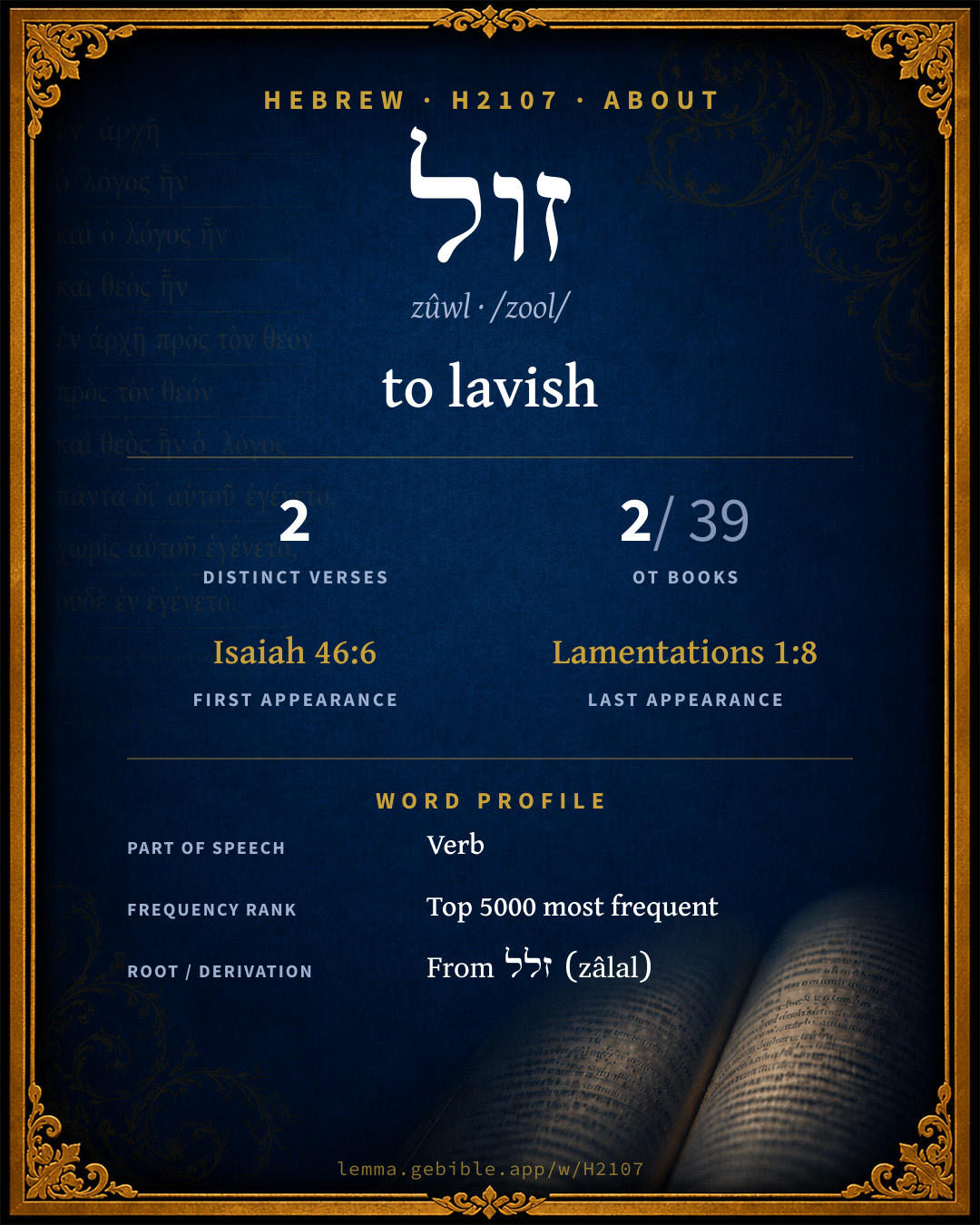
זוּל
to lavish
‘to lavish’ is one of 2 main senses fuller range ↓
Full lexicon entry — Brown-Driver-Briggs (BDB)
From Brown-Driver-Briggs (BDB)
Where this word appears
See every Hiphil verb in the Hebrew Bible →
Grammar key — what these labels mean
Part of speech
- Verb
- An action or state-of-being word.
Stem
- Qal
- The basic, simple active stem — the plain form of the verb (“he wrote”).
- Hiphil
- The causative active stem (“he caused / brought about”).
Form
- Participle Active
- A verbal adjective expressing ongoing or characteristic action (“writing / one who writes”).
- Perfect
- A completed action or state — Hebrew marks aspect (completeness) more than strict tense (“he wrote”).
State
- Absolute
- The independent form of a noun, not bound to a following word.
Person
- 3rd Person
- The one spoken about (“he / she / it / they”).
Gender
- Masculine
- Grammatically masculine.
- Common
- Either gender — not distinguished for this form.
Number
- Plural
- More than one (in Hebrew, generally three or more).
Grammatical forms
- Verb, Qal, Participle Active, Masculine, Plural, Absolute 1 time (50%)
- Verb, Hiphil, Perfect, 3rd Person, Common, Plural 1 time (50%)
Parsed forms decoded from the imported morphology (morphhb / Westminster Leningrad Codex — WLC text public domain, morphhb tagging CC BY 4.0), counted across 2 parsed occurrences — not distinct verses.
Every verse where H2107 appears — 2 distinct verses across 2 books. Click any verse to open its interlinear word-by-word view. Verse text shown in the World English Bible for context — . Each verse’s Hebrew form is shown with its reference; the English is not keyword-highlighted, since the data carries no word-level English alignment. Use “Compare translations” on any verse to read it across multiple English versions. This concordance covers the Hebrew Bible; Septuagint (Greek Old Testament) occurrences are not indexed here.
Isaiah 1 verse
Lamentations 1 verse
About this entry
At a glance — auto-summarized from this page’s data, not written by a person. Every figure links to its source below. This summary describes the numbers; it doesn’t interpret them.
זול (zûwl) is a Hebrew verb most often rendered “to lavish.” It is rare — just 2 verses in the entire Hebrew Bible. It clusters heavily in Isaiah, which alone accounts for 50% of its uses. It first appears in Isaiah 46:6. Ranging over 2 senses, it is not a single-sense word. The sections below give every sense, occurrence, and version rendering.
Gloss history
Strong's 1890 vs modern scholarship
About this word
Strong's H2107 catalogs a Hebrew word from the Hebrew Old Testament.
These counts are not copied from any lexicon or concordance. They are computed here, from the morphology-tagged Hebrew Old Testament. What Lemma adds →
- 2
- distinct verses
- The word appears in 2 distinct verses.
- 2 / 39
- OT books
- The word appears in 2 of 39 Old Testament books.
- #4,807
- by frequency
- Top 5000 most frequent Hebrew words (rank 4,807 of 8,640 Hebrew words by occurrence).
View all 2 occurrences in the concordance →
Most concentrated in
- Isaiah 1 verse 50%
- Lamentations 1 verse 50%
By section of the Old Testament
By traditional corpus
Conventional, traditional groupings — biblical authorship is debated, so this is a traditional corpus grouping, not an authorship claim. Each share is this word’s portion of its verses in that division of the Hebrew canon. Each figure is a share of the word’s 2 distinct verses.
- Prophets (Nevi'im) 1 verse · 50%
- Writings (Ketuvim) 1 verse · 50%
How translations render this word
Counts come from each version’s own published word-to-Strong’s tagging or interlinear alignment — an approximate guide to how each version renders this word, not a word-level alignment the data otherwise carries. Because each total is that version’s own tagged count, the per-version totals vary from one another and need not match the appearance or distinct-verse counts above. These counts may also differ from a printed concordance because Lemma counts each distinctly tagged rendering and does not collapse phrase taggings into a single head-word total. This is a fixed set of word-tagged versions (KJV, ASV, BSB, ULT) and does not change with the reading translation you choose elsewhere. Each version’s license is shown beside its name below (and on Sources).
- King James Version: Despise 1×, They lavish 1×
- American Standard Version: All that honored her despise 1×, Lavish 1×
- Berean Standard Bible: Now despise her 1×, They pour out 1×
- unfoldingWord Literal Text: Have despised her 1×, Ones dumping 1×
King James Version Public Domain
Renders H2107 across 2 tagged occurrences — most commonly:
American Standard Version Public Domain
Renders H2107 across 2 tagged occurrences — most commonly:
Berean Standard Bible Public Domain
Renders H2107 across 2 tagged occurrences — most commonly:
unfoldingWord Literal Text CC BY-SA 4.0
Renders H2107 across 2 tagged occurrences — most commonly:
Senses in BDB
The 2 senses BDB distinguishes for this word, in lexicon order (not ranked by frequency or importance). The full entry — with sub-senses — is in the Lexicon Entry tab.
- (Qal) to pour out, lavish
- (Hiphil) despise
Word origin
[ זוּל ] vb. lavish ( be cheap, of little value, lightly esteem )
— Brown-Driver-Briggs (Oxford 1906, public domain), digitized via Sefaria, supplemented by the OpenScriptures HebrewLexicon (CC BY 4.0). See Sources.
Derived from זלל (zâlal) (H2151) — to be worthless.
Jastrow Dictionary
A second Hebrew/Aramaic lexicon for comparison, covering Aramaic and post-biblical (Talmudic, Targumic, Midrashic) usage that the biblical-Hebrew BDB does not. Matched by lemma rather than by Strong’s number, so a lemma may carry more than one Jastrow headword (shown separately below), and the entries cover usage well beyond the Bible.
זוּל I
- v. זָלַל) to be of slight value, to be cheap; to be despicable, mean. Sabb. 55ᵇ (play on פ̇ח̇ז̇, Gen. XLIX, 4) פ̇זתה ח̇בתה זַֹלְתָּה (not זלתא, v. Rabb. D. S. a. l. note 300) thou wast rash, becamest guilty, degradedst thyself. Snh. 98ᵃ מלכות הַזָּלָה the despicable (Roman) government (Rashi: ‘the slightest trace of tyranny’).—2) (cmp. בּוּז) to squander, be excessive in sensual enjoyments, be dissolute. Num. R. s. 10 (ed. Amst. p. 240ᵃ) חבורה של זָלִין a company of dissolute men.—Polel זוֹלֵל, only as part. e.g. Genesis 49:4
- 1. low, mean. Midr. Prov. to II, 4 (ref. to Jer. XV, 19) כל … להוציא ד"ת מז׳ he who succeeds in making the words of the Law come forth from a low man (who educates an abandoned person).—Pesik. R. s. 21 נעשה העולם זוֹלֵלָה the world became an object reduced in value. e.g. Jeremiah 15:19
- 2. spendthrift, glutton. Sifré Deut. 219 ז׳ בבשר zolel (Deut. XXI, 20) refers to excesses in eating meat (v. Snh. VIII, 2). e.g. Deuteronomy 21:20
- 1. to become cheap, fall in price. Y. Keth. XII, beg. 34ᵈ היו ביוקר והֵזִילוּ if provisions were dear and fell in price.
- 2. to treat with contempt. Treat. Der. Er. ch. II מְזִילֵי הרבים those who treat the public &c. [B. Bath. 25ᵃ, v. נָזַל.]
- to fall in price. B. Mets. V, 8 והוּזְלוּ and (the wheat) fell. Ib. 75ᵃ; a. fr.
זוּל
- ; perf. זָל, Part. זִיל, זוֹל
- 1. to disregard. Targ. Y. II, Gen. XVI, 5 (perh. fr. זְלַל).
- 2. to be worthless, cheap. Targ. Y. Deut. XXVIII, 68 בדמין זוֹלִין for a low price.—B. Mets. 77ᵃ זל עבידתא (sub שכר) labor has become cheaper. Ib. זל עביד׳ מעיקרא labor was originally cheap. Ib. זיל עביד׳ Ms. M. (v. Rabb. D. S. a. l. note 40). Ber. 63ᵃ (prov.) זָלָא קמץ קניה Ms. M. (ed. זָלַת קבוץ קנה מינה, Ar. קפוץ) if a thing is cheap, be quick and buy it. B. Mets. 64ᵃ bot. אי יקרא אי זילא וכ׳ whether it will rise or fall, it shall be in my possession (gain or loss shall be mine). Ab. Zar. 70ᵃ זִילָה עלייהו she is contemptible in their sight. B. Bath. 110ᵃ זִילָא בי מילתא such occupation is beneath my dignity. Yeb. 63ᵃ זַבֵּין ולא תֵיזוּל sell (part of thy clothes to start a business) in order not to be disgraced by poverty; (oth. explan., v. next w.).
- to sell cheap, make easy terms. B. Mets. 77ᵃ אוֹזִילו אינהו גביה זוזא וכ׳ at the start they had agreed to work for one zuz less (than the market price of labor), and wages were generally reduced afterwards. Ib.ᵇ אוֹזְלֵי מוֹזִיל וכ׳ he will lower the price and sell (some of his movable goods in order to raise money). Ib. 73ᵃ top מוֹזְלֵי גבייהו they will be easier in selling them. Ib. bot. אוזולי דקא מוזלי גבייכו (better אחולי … מחלי, v. Rabb. D. S. a. l. note 1) they are liberal towards you (paying more than the ordinary wages). Gen. R. s. 39 חלא מֵזִיל חמרא vinegar cheapens wine, i.e. where bad wine is plentiful in the market, good wine sells cheaper; a. fr.
- to be degraded, disgraced. Keth. 53ᵇ לא ניחא ליה דתִיתְּזִיל he does not want her to be disgraced (by dependence on public charity).
זוּל II
- (cmp. אֲזַל II) to spin. Yeb. 63ᵃ זְבֵין ולא תֵיזוּל buy (ready-made cloth) and do not spin; (oth. opin., v. preced.); v. דּוּל a. זוֹלָלָא.
זוֹל
- (זוּל I) low price. Snh. 70ᵃ (ref. to זוֹלֵל) עד שיקח בשר בז׳ וכ׳ until he buys meat and wine at the lowest prices (in order to have large quantities). B. Mets. 73ᵃ מקום הז׳ the place where prices are low. Maas. Sh. IV, 2 בשער הז׳ at the lower (the wholesale) market price. Y. Keth. XII, beg. 34ᵃ הין בז׳ וכ׳ if provision at the time was cheap and it rose. Ib. נותן בז׳ he pays alimentation according to the lower prices; a. fr.
A Dictionary of the Targumim, the Talmud Babli and Yerushalmi, and the Midrashic Literature (Marcus Jastrow; London, Luzac, 1903) — Public Domain. Digitized via Sefaria. Digitized via Sefaria. Full attribution on Sources.
Forms in the corpus
The 2 distinct written forms H2107 takes in the Hebrew Bible, most frequent first — each parse links to that stem’s occurrences in the concordance. Hebrew forms include their vowel points and cantillation, so a single lemma takes many written forms.
| Form | Parsing | Example | Uses |
|---|---|---|---|
| הִזִּיל֨וּ/הָ֙ | Verb, Hiphil, Perfect, 3rd Person, Common, Plural | Lamentations 1:8 | 1 |
| הַ/זָּלִ֤ים | Verb, Qal, Participle Active, Masculine, Plural, Absolute | Isaiah 46:6 | 1 |
Same root — word family
Other BDB entries built from the same root as H2107, grouped by Strong’s listed origin. These share a root / origin per the lexicon — not necessarily a shared meaning. Each links to that word’s own entry.
Derives from
Shares the same root
Derived from this word
Compare all same-root words → Showing 4 of 5 — not the complete family. They share a root, not necessarily a meaning.
Septuagint verse parallels
This word appears in 2 verses that also exist in the Greek Old Testament (Septuagint), out of the 2 Hebrew verses it occurs in. You can read those verses in Greek by switching the Old Testament edition to the Septuagint.
Read these verses in the Septuagint
This is a verse-level parallel only — the same verses exist in both the Hebrew and Greek Old Testaments. No word-level Hebrew↔Greek correspondence is claimed: the data carries no such alignment, so no Greek word is shown as this Hebrew word’s translation. Coverage is not total — the Septuagint omits the deuterocanon and renumbers the Psalms, so some Hebrew verses have no direct Greek parallel.