
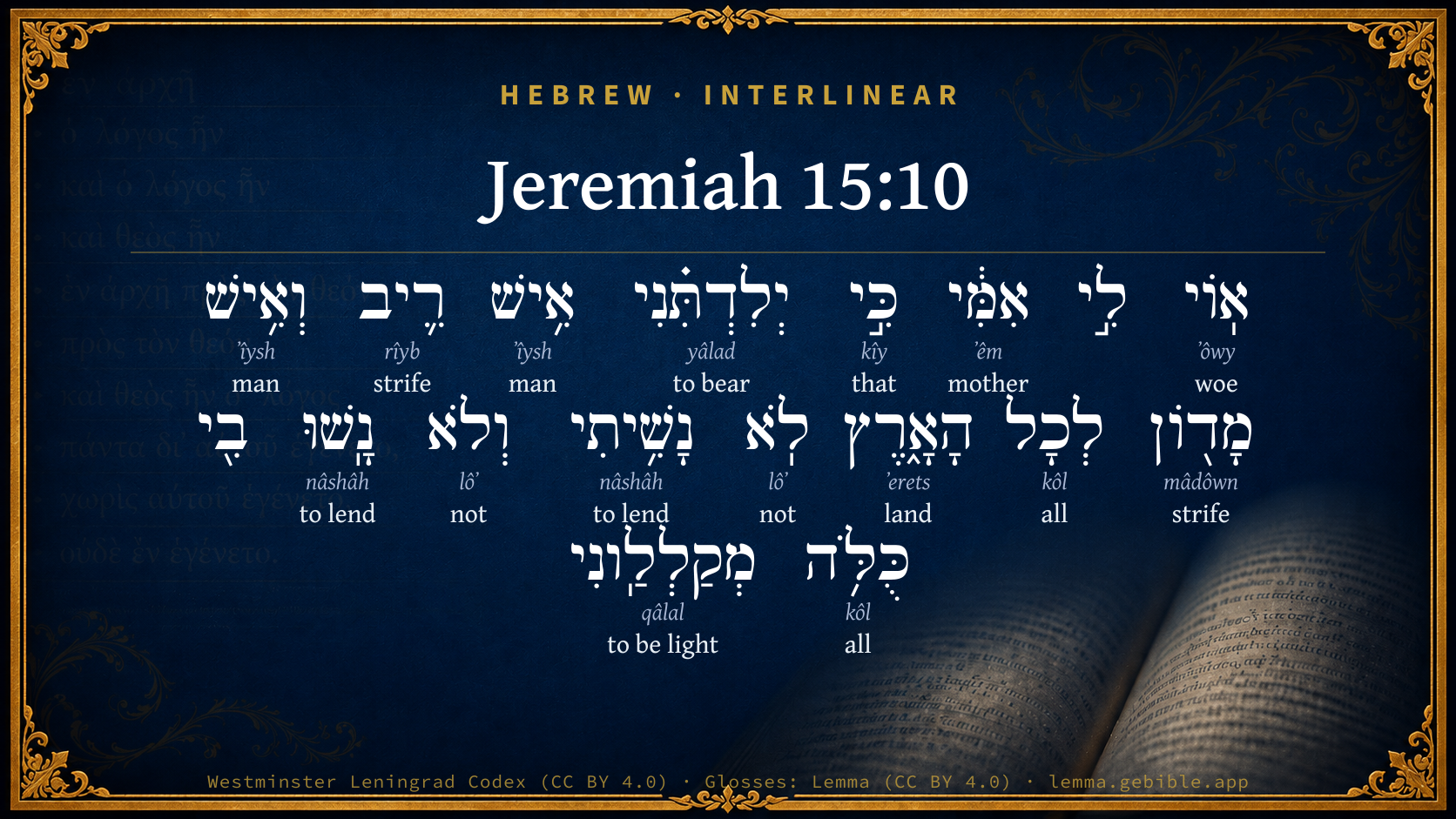
Jeremiah 15:10

Hebrew (Westminster Leningrad Codex) Jeremiah 15:10 appears in the Hebrew Old Testament. The text above is from the Westminster Leningrad Codex. Each word links to its Strong’s number, a concise gloss, and parsing drawn from the Open Scriptures Hebrew Bible morphology. Click any word for its full Brown-Driver-Briggs (BDB) entry.
Download image
Cite this verse

Jeremiah 15:10 (World English Bible). Public Domain. Lemma interlinear Bible study tool, https://lemma.gebible.app/v/jeremiah/15/10.

Show BibTeX & RIS
BibTeX
RIS
English Translation
Woe is me, my mother, that you have borne me a man of strife and a man of contention to the whole earth! I have not lent, neither have men lent to me; [yet] everyone of them does curse me.
World English Bible · Public Domain
Download a study sheet

One document with this verse’s original text, its word-by-word gloss line, the meaning frame, cross-references with their text, attributed commentary, and full source and license credits — printable, and it pastes into notes with its structure intact.

This verse Autodidact and up

Study sheet (.html) Plain text (.txt)

A passage Seminary Student

Up to 50 verses in one chapter. A passage sheet keeps up to 6 commentary sources and 12 cross-references per verse, in the order this page ranks them, and says so on the sheet whenever that leaves anything out. Ask for a single verse and you get the Autodidact verse sheet above.

Everything on this page stays free to read, with no account — the sheet is a download of what is already on screen, not access to it.

Want to remove ads? Support Godless Engineer
Compare translations 3

The same verse in 3 English versions, stacked beneath the original-language interlinear above. Click any original word for its lexicon entry.

Each is an independent rendering of the whole verse — the interlinear is not word-aligned to these translations.

Highlighted words mark where these versions differ — a whole-verse word diff, not a word-by-word alignment.

  • World English Bible Public Domain
    Woe is me, my mother, that you have borne me a man of strife and a man of contention to the whole earth! I have not lent, neither have men lent to me; [yet] everyone of them does curse me.
  • King James Version Public Domain
    Woe is me, my mother, that thou hast borne me a man of strife and a man of contention to the whole earth! I have neither lent on usury, nor men have lent to me on usury; yet every one of them doth curse me.
  • unfoldingWord Literal Text CC BY-SA 4.0
    Woe to me, my mother, that you bore me, a man of strife and a man of contention to all the land. I have not lent, nor have they lent to me, everyone of them is cursing me.

unfoldingWord Literal Text — © unfoldingWord, licensed CC BY-SA 4.0. Word-aligned USFM3 via Door43 (git.door43.org/unfoldingWord/en_ult).

Versions to compare (up to 4)

3 of 4 selected

Show all 18 translations

Every available English version of this verse, each an independent rendering of the whole verse.

  • World English Bible Public Domain
    Woe is me, my mother, that you have borne me a man of strife and a man of contention to the whole earth! I have not lent, neither have men lent to me; [yet] everyone of them does curse me.
  • Berean Standard Bible Public Domain
    Woe to me, my mother, that you have borne me, a man of strife and conflict in all the land. I have neither lent nor borrowed, yet everyone curses me.
  • Majority Standard Bible Public Domain
    Woe to me, my mother, that you have borne me, a man of strife and conflict in all the land. I have neither lent nor borrowed, yet everyone curses me.
  • King James Version Public Domain
    Woe is me, my mother, that thou hast borne me a man of strife and a man of contention to the whole earth! I have neither lent on usury, nor men have lent to me on usury; yet every one of them doth curse me.
  • American Standard Version (1901) Public Domain
    Woe is me, my mother, that thou hast borne me a man of strife and a man of contention to the whole earth! I have not lent, neither have men lent to me; `yet' every one of them doth curse me.
  • Revised Version (1885) Public Domain
    Woe is me, my mother, that thou hast borne me a man of strife and a man of contention to the whole earth! I have not lent on usury, neither have men lent to me on usury; yet every one of them doth curse me.
  • Geneva Bible (1599) Public Domain
    Wo is mee, my mother, that thou hast borne mee, a contentious man, and a man that striueth with the whole earth I haue neither lent on vsury, nor men haue lent vnto me on vsurie: yet euery one doeth curse me.
  • Douay-Rheims (1899) Public Domain
    Woe is me, my mother: why hast thou borne me a man of strife, a man of contention to all the earth? I have not lent on usury, neither hath any man lent to me on usury: yet all curse me.
  • Young's Literal Translation Public Domain
    Wo to me, my mother, For thou hast borne me a man of strife, And a man of contention to all the land, I have not lent on usury, Nor have they lent on usury to me -- All of them are reviling me.
  • Literal Standard Version CC BY-SA 4.0
    Woe to me, my mother, || For you have borne me, || A man of strife and a man of contention to all the land, || I have not lent on usury, || Nor have they lent on usury to me—All of them are reviling me.
  • Unlocked Literal Bible CC BY-SA 4.0
    Woe to me, my mother! For you have borne me, I who am a man of controversy and argument through all the land. I have not lent, nor has anyone lent to me, but they all curse me.
  • unfoldingWord Literal Text CC BY-SA 4.0
    Woe to me, my mother, that you bore me, a man of strife and a man of contention to all the land. I have not lent, nor have they lent to me, everyone of them is cursing me.
  • Darby Bible Public Domain
    Woe is me, my mother, that thou hast borne me a man of strife and a man of contention to the whole land! I have not lent on usury, nor have they lent to me on usury; [yet] every one of them doth curse me.
  • World Messianic Bible Public Domain
    Woe is me, my mother, that you have borne me, a man of strife, and a man of contention to the whole earth! I have not lent, neither have men lent to me; yet every one of them curses me.
  • Webster's Bible Public Domain
    Woe is me, my mother, that thou hast borne me a man of strife and a man of contention to the whole earth! I have neither lent on usury, nor have men lent to me on usury; yet every one of them doth curse me.
  • Free Bible Version CC BY-SA 4.0
    How sad I am, my mother, that you gave birth to me! I'm a victim of argument and conflict wherever I go in the country. I have never lent anyone anything, or borrowed anything, but still everyone curses me.
  • Bible in Basic English Public Domain
    Sorrow is mine, my mother, because you have given birth to me, a cause of fighting and argument in all the earth! I have not made men my creditors and I am not in debt to any, but every one of them is cursing me.
  • JPS Tanakh (1917) Public Domain
    Woe is me, my mother, that thou hast borne me a man of strife and a man of contention to the whole earth! I have not lent, neither have men lent to me; yet every one of them doth curse me.

Literal Standard Version (2020), Covenant Press — licensed CC BY-SA 4.0. Text via the HelloAO Bible API (eBible.org). Unlocked Literal Bible (unfoldingWord) — licensed CC BY-SA 4.0. Text via the HelloAO Bible API (eBible.org). unfoldingWord Literal Text — © unfoldingWord, licensed CC BY-SA 4.0. Word-aligned USFM3 via Door43 (git.door43.org/unfoldingWord/en_ult). Free Bible Version, Dr. Jonathan Gallagher — licensed CC BY-SA 4.0. Text via the HelloAO Bible API (eBible.org).

Word by word

More ways to search: Search by grammar → Find every occurrence → Compare this word →

Practice this passage: Drill this verse → Learn its vocabulary →

נָשִׁ֥יתִי
nâshâh
H5383
“to lend”
Verb, Qal, Perfect, 1st Person, Common, Singular
Part of Speech
Verb
Stem
Qal
Form
Perfect
Person
1st Person
Gender
Common
Number
Singular
Full BDB Definition

Origin: a primitive root [rather identical with H5382 , in the sense of H5378 ]

TWOT: 1427

to lend, be a creditor - (Qal) - to lend - creditor (participle) (substantive) - (Hiphil) to lend
  1. אֽוֹי ʼôwy H188 “woe” Particle, Interjection
  2. אִמִּ֔י ʼêm H517 “mother · my” Noun, Common, Feminine, Singular, Construct + Suffix, Personal, 1st Person, Common, Singular
  3. כִּ֣י kîy H3588 “that” Conjunction
  4. יְלִדְתִּ֗נִי yâlad H3205 “to bear · me” Verb, Qal, Perfect, 2nd Person, Feminine, Singular + Suffix, Personal, 1st Person, Common, Singular
  5. אִ֥ישׁ ʼîysh H376 “man of” Noun, Common, Masculine, Singular, Construct
  6. רִ֛יב rîyb H7379 “strife” Noun, Common, Both, Singular, Absolute
  7. וְאִ֥ישׁ ʼîysh H376 “and · man of” Conjunction + Noun, Common, Masculine, Singular, Construct
  8. מָד֖וֹן mâdôwn H4066 “strife” Noun, Common, Masculine, Singular, Absolute
  9. לְכָל kôl H3605 “to/for · all of” Preposition + Noun, Common, Masculine, Singular, Construct
  10. הָאָ֑רֶץ ʼerets H776 “the · land” Particle, Definite Article + Noun, Common, Both, Singular, Absolute
  11. לֹֽא lôʼ H3808 “not” Particle, Negative
  12. וְלֹא lôʼ H3808 “and · not” Conjunction + Particle, Negative
  13. נָֽשׁוּ nâshâh H5383 “to lend” Verb, Qal, Perfect, 3rd Person, Common, Plural
  14. כֻּלֹּ֥ה kôl H3605 “all · her” Noun, Common, Masculine, Singular, Construct + Suffix, Personal, 3rd Person, Feminine, Singular
  15. מְקַלְלַֽונִי qâlal H7043 “being light · me” Verb, Piel, Participle Active, Masculine, Plural, Construct + Suffix, Personal, 1st Person, Common, Singular

About this verse

These counts appear in no published source. They are computed here, from the morphology-tagged text and Lemma’s own curated glosses. What Lemma adds →

18
words
12
distinct lemmas
Prophets
section

Notable vocabulary

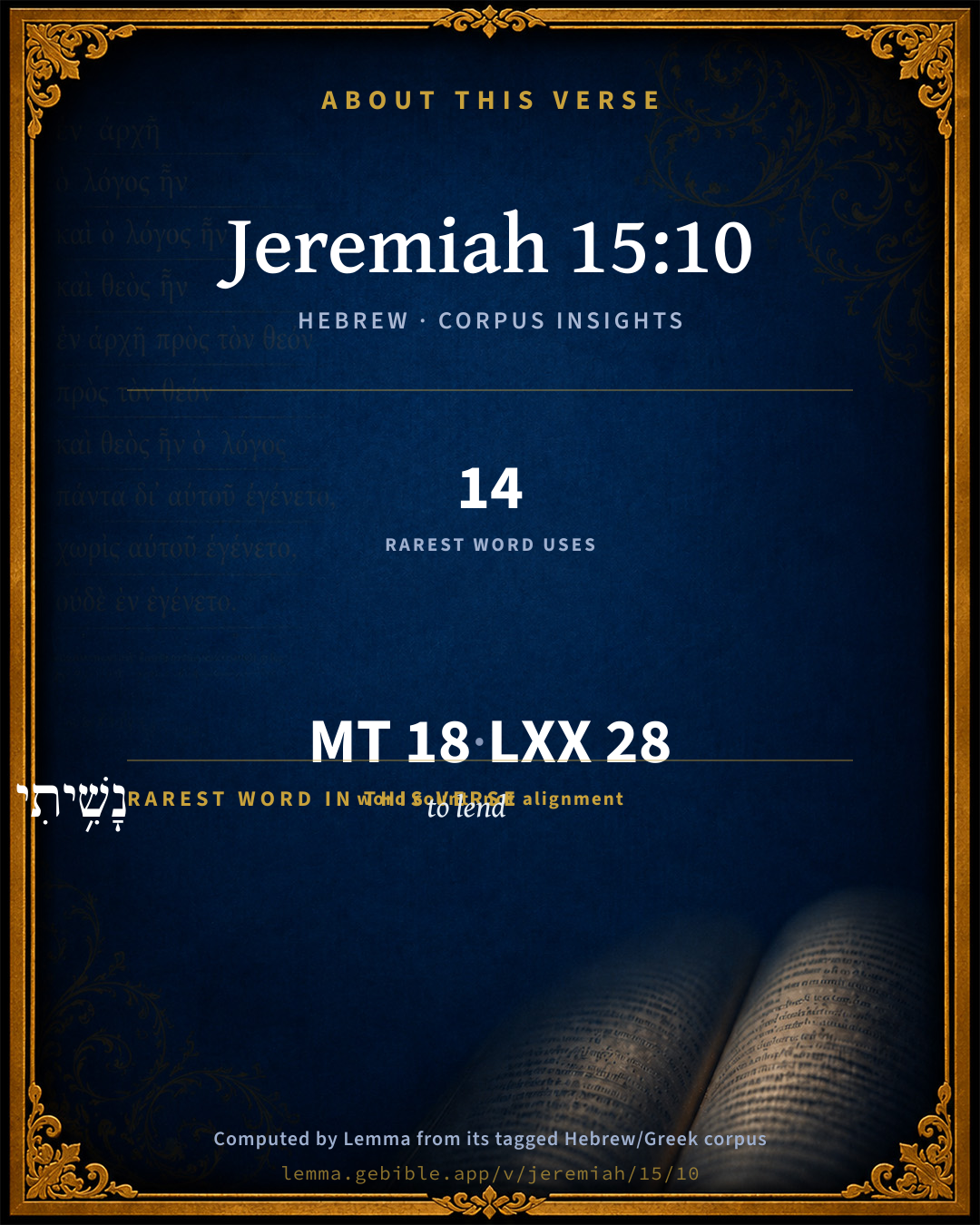
The rarest word here is נָשִׁ֥יתִי to lend H5383 — appearing just 14 times in the whole Hebrew Bible.

Shared distinctive vocabulary

נָשִׁ֥יתִי to lend H5383 occurs in 12 verses of the Hebrew Bible. Also found in:

Grammatical profile

  • 4 verbs
  • 8 nouns
  • 2 prepositions
  • 1 conjunction
  • 3 particles

Verb forms

  • יְלִדְתִּ֗נִי Qal · Perfect
  • נָשִׁ֥יתִי Qal · Perfect
  • נָֽשׁוּ Qal · Perfect
  • מְקַלְלַֽונִי Piel · Participle Active

Repetition

Words recur within this verse — often emphatic in Hebrew:

  • אִ֥ישׁ man H376 ×2
  • לְכָל all H3605 ×2
  • נָשִׁ֥יתִי to lend H5383 ×2
  • לֹֽא not H3808 ×2

Hebrew & Septuagint length

In the original languages it is 18 Hebrew tokens and 28 Greek tokens — but the two are counted differently (Hebrew bundles its prefixes and suffixes into one token; the Greek is in lemma form), so that isn’t a like-for-like length.

Cross-references

29

Topical passages linked to Jeremiah 15:10 in the Treasury of Scripture Knowledge — connected by theme and wording, ordered by reader-vote popularity; previews shown in the World English Bible.

  • Exodus 22:25 "If you lend money to any of my people with you who is poor, you shall not be to him as a creditor; neither shall you charge him interest.
  • Luke 6:22 Blessed are you when men shall hate you, and when they shall exclude and mock you, and throw out your name as evil, for the Son of Man's sake.
  • Leviticus 25:36 Take no interest from him or profit, but fear your God; that your brother may live among you.
  • Deuteronomy 23:19–20 You shall not lend on interest to your brother; interest of money, interest of food, interest of anything that is lent on interest:
  • 1 Kings 18:17–18 It happened, when Ahab saw Elijah, that Ahab said to him, Is it you, you troubler of Israel?
  • 1 Kings 21:20 Ahab said to Elijah, Have you found me, my enemy? He answered, I have found you, because you have sold yourself to do that which is evil in the sight of Yahweh.
  • 1 Kings 22:8 The king of Israel said to Jehoshaphat, there is yet one man by whom we may inquire of Yahweh, Micaiah the son of Imlah: but I hate him; for he does not prophesy good concerning me, but evil. Jehoshaphat said, "Don't let the king say so."
  • Nehemiah 5:1–6 Then there arose a great cry of the people and of their wives against their brothers the Jews.
  • Job 3:1–26 After this Job opened his mouth, and cursed the day of his birth.
  • Psalms 15:5 He who doesn't lend out his money for usury, Nor take a bribe against the innocent. He who does these things shall never be shaken.
  • Psalms 109:28 They may curse, but you bless. When they arise, they will be shamed, But your servant shall rejoice.
  • Psalms 120:5–6 Woe is me, that I live in Meshech, That I dwell among the tents of Kedar!
  • Proverbs 26:2 Like a fluttering sparrow, Like a darting swallow, So the undeserved curse doesn't come to rest.
  • Jeremiah 1:18–19 For, behold, I have made you this day a fortified city, and an iron pillar, and brazen walls, against the whole land, against the kings of Judah, against the princes of it, against the priests of it, and against the people of the land.
  • Jeremiah 15:20 I will make you to this people a fortified brazen wall; and they shall fight against you, but they shall not prevail against you; for I am with you to save you and to deliver you, says Yahweh.
  • Jeremiah 20:7–8 Yahweh, you have persuaded me, and I was persuaded; you are stronger than I, and have prevailed: I am become a laughing-stock all the day, every one mocks me.
  • Jeremiah 20:14–18 Cursed be the day in which I was born: don't let the day in which my mother bore me be blessed.
  • Ezekiel 3:7–9 But the house of Israel will not listen to you; for they will not listen to me: for all the house of Israel are of hard forehead and of a stiff heart.
  • Matthew 5:44 But I tell you, love your enemies, bless those who curse you, do good to those who hate you, and pray for those who mistreat you and persecute you,
  • Matthew 10:21–23 "Brother will deliver up brother to death, and the father his child. Children will rise up against parents, and cause them to be put to death.
  • Matthew 24:9 Then they will deliver you up to oppression, and will kill you. You will be hated by all of the nations for my name's sake.
  • Luke 2:34 and Simeon blessed them, and said to Mary, his mother, "Behold, this child is set for the falling and the rising of many in Israel, and for a sign which is spoken against.
  • Acts 16:20–22 When they had brought them to the magistrates, they said, "These men, being Jews, are agitating our city,
  • Acts 17:6–8 When they didn't find them, they dragged Jason and certain brothers before the rulers of the city, crying, "These who have turned the world upside down have come here also,
  • Ezekiel 2:6–7 You, son of man, don't be afraid of them, neither be afraid of their words, though briers and thorns are with you, and you do dwell among scorpions: don't be afraid of their words, nor be dismayed at their looks, though they are a rebellious house.
  • Acts 19:8–9 He entered into the synagogue, and spoke boldly for a period of three months, reasoning and persuading about the things concerning the Kingdom of God.
  • Acts 19:25–28 whom he gathered together, with the workmen of like occupation, and said, "Sirs, you know that by this business we have our wealth.
  • Acts 28:22 But we desire to hear from you what you think. For, as concerning this sect, it is known to us that everywhere it is spoken against."
  • 1 Corinthians 4:9–13 For, I think that God has displayed us, the apostles, last of all, like men sentenced to death. For we are made a spectacle to the world, both to angels and men.

Cross-references courtesy of OpenBible.info (CC BY 4.0).

Hebrew and Greek witnesses Masoretic Hebrew ↔ Greek Septuagint

The same verse in the two great witnesses to the Old Testament, shown verse-for-verse.

These are two independent witnesses, not word-aligned to each other, and the Septuagint is shown in lemma (dictionary) form.

Hebrew Jeremiah 15:10 Masoretic · Westminster Leningrad Codex

אֽוֹי לִ֣י אִמִּ֔י כִּ֣י יְלִדְתִּ֗נִי אִ֥ישׁ רִ֛יב וְאִ֥ישׁ מָד֖וֹן לְכָל הָאָ֑רֶץ לֹֽא נָשִׁ֥יתִי וְלֹא נָֽשׁוּ בִ֖י כֻּלֹּ֥ה מְקַלְלַֽונִי

Woe is me, my mother, that you have borne me a man of strife and a man of contention to the whole earth! I have not lent, neither have men lent to me; [yet] everyone of them does curse me.

World English Bible · Public Domain

Greek LXX Structure differs

In the Septuagint, Jeremiah is about an eighth shorter than the Hebrew and arranges its material differently — the Oracles Against the Nations (Hebrew chapters 46–51) appear in the middle of the Greek book, after 25:13. Because the chapter and verse boundaries do not line up, a verse-for-verse comparison with the Hebrew is not shown.

A verse-for-verse comparison isn’t shown here because the chapters and verses don’t line up. Switch to the LXX edition with the MT / LXX toggle above to read the Greek directly.

On this verse, Keil & Delitzsch discusses the Septuagint’s reading. Read the note in Commentary ↓

Hebrew: Westminster Leningrad Codex (CC BY 4.0). Greek: Septuagint (public domain); English from a public-domain English Septuagint. How the Septuagint differs from the Hebrew →

Targum (Aramaic paraphrase)

1

The Targum is the ancient Jewish Aramaic paraphrase of the Hebrew Scriptures — an interpretive translation, not the Hebrew text itself. Onkelos (literal) and Pseudo-Jonathan (expansive) render the Torah, and Jonathan the Prophets. Coverage is partial: where no permissively-licensed English translation exists for a verse, only the Aramaic is shown. This is verse-level text, not a word-by-word alignment to the Hebrew.

  1. Targum Jonathan Prophets (Joshua–Malachi)
    וַי לִי אִמִי אֲרֵי יְלִדְתִּינִי לְמֶהֱוֵי גְבַר דִין וֶאֱנַשׁ מָצוּ לְכָל יַתְבֵי אַרְעָא לָא רָשָׁן בִּי וּמָא דַאֲנָא דַשֵׁינָא לָא תָבַע מִנְהוֹן כּוּלְהוֹן מְלַטְטִין לִי:

    (no public-domain English translation for this verse)

    Targum Jonathan — Aramaic: “Mikraot Gedolot” (public domain). English: “Sefaria Community Translation” (CC0 1.0 (public-domain dedication)); “London "Chaldee Paraphrase," 1871” (public domain). Text via Sefaria.

Commentary

Notes on Jeremiah 15:10 from classic Christian and Jewish commentators (each source and its license shown beneath its notes). The classic Christian expositions comment on the surrounding passage and are grouped to its opening verse, so a note may address several verses; the Jewish commentaries on the Tanakh (Rashi and others) are per-verse, so they appear only where the commentator wrote on this verse.

Lemma curates 59 commentaries, every one of them public domain or Creative Commons licensed, each selected and text-cleaned for this edition rather than reprinted as found. About our sources →

Matthew Henry's Commentary

Jeremiah has now returned from his public work and retired into his closet; what passed between him and his God there we have an account of in these and the following verses, which he published afterwards, to affect the people with the weight and importance of his messages to them. Here is,

I. The complaint which the prophet makes to God of the many discouragements he met with in his work, Jer 15:10.

1. He met with a great deal of contradiction and opposition. He was a man of strife and contention to the whole land (so it might be read, rather than to the whole earth, for his business lay only in that land); both city and country quarrelled with him, and set themselves against him, and said and did all they could to thwart him. He was a peaceable man, gave no provocation to any, nor was apt to resent the provocations given him, and yet a man of strife, not a man striving, but a man striven with; he was for peace, but, when he spoke, they were for war. And, whatever they pretended, that which was the real cause of their quarrels with him was his faithfulness to God and to their souls. He showed them their sins that were working their ruin, and put them into a way to prevent that ruin, which was the greatest kindness he could do them; and yet this was it for which they were incensed against him and looked upon him as their enemy. Even the prince of peace himself was thus a man of strife, a sign spoken against, continually enduring the contradiction of sinners against himself. And the gospel of peace brings division, even to fire and sword, Mat 10:34, Mat 10:35; Luk 12:49, Luk 12:51. Now this made Jeremiah very uneasy, even to a degree of impatience. He cried out, Woe is me, my mother, that thou hast borne me, as if it were his mother's fault that she bore him, and he had better never have been born than be born to such an uncomfortable life; nay, he is angry that she had borne him a man of strife, as if he had been fatally determined to this by the stars that were in the ascendant at his birth. If he had any meaning of this kind, doubtless it was very much his infirmity; we rather hope it was intended for no more than a pathetic lamentation of his own case. Note, (1.) Even those who are most quiet and peaceable, if they serve God faithfully, are often made men of strife. We can but follow peace; we have the making only of one side of the bargain, and therefore can but, as much as in us lies, live peaceably. (2.) It is very uncomfortable to those who are of a peaceable disposition to live among those who are continually picking quarrels with them. (3.) Yet, if we cannot live so peaceably as we desire with our neighbours, we must not be so disturbed at it as thereby to lose the repose of our own minds and put ourselves upon the fret.

2. He met with a great deal of contempt, contumely, and reproach. They every one of them cursed him; they branded him as a turbulent factious man, as an incendiary and a sower of discord and sedition. They ought to have blessed him, and to have blessed God for him; but they had arrived at such a pitch of enmity against God and his word that for his sake they cursed his messenger, spoke ill of him, wished ill to him, did all they could to make him odious. They all did so; he had scarcely one friend in Judah or Jerusalem that would give him a good word. Note, It is often the lot of the best of men to have the worst of characters ascribed to them. So persecuted they the prophets. But one would be apt to suspect that surely Jeremiah had given them some provocation, else he could not have lost himself thus: no, not the least: I have neither lent money nor borrowed money, have been neither creditor nor debtor; for so general is the signification of the words here. (1.) It is implied here that those who deal much in the business of this world are often involved thereby in strife and contention; meum et tuum - mine and thine are the great make-bates; lenders and borrowers sue and are sued, and great dealers often get a great deal of ill-will. (2.) it was an instance of Jeremiah's great prudence, and it is written for our learning, that, being called to be a prophet, he entangled not himself in the affairs of this life, but kept clear from them, that he might apply the more closely to the business of his profession and might not give the least shadow of suspicion that he aimed at secular advantages in it nor any occasion to his neighbours to contend with him. He put out no money, for he was no usurer, nor indeed had he any money to lend: he took up no money, for he was no purchaser, no merchant, no spendthrift. He was perfectly dead to this world and the things of it: a very little served to keep him, and we find (Jer 16:2) that he had neither wife nor children to keep. And yet, (3.) Though he behaved thus discreetly, and so as one would think should have gained him universal esteem, yet he lay under a general odium, through the iniquity of the times. Blessed be God, bad as things are with us, they are not so bad but that there are those with whom virtue has its praise; yet let not those who behave most prudently think it strange if they have not the respect and esteem they deserve. Marvel not, my brethren, if the world hate you.

II. The answer which God gave to this complaint. Though there was in it a mixture of passion and infirmity, yet God graciously took cognizance of it, because it was for his sake that the prophet suffered reproach. In this answer, 1. God assures him that he should weather the storm and be made easy at last, Jer 15:11. Though his neighbours quarrelled with him for what he did in the discharge of his office, yet God accepted him and promised to stand by him. It is in the original expressed in the form of an oath: "If I take not care of thee, let me never be counted faithful; verily it shall go well with thy remnant, with the remainder of thy life" (for so the word signifies); "the residue of thy days shall be more comfortable to thee than those hitherto have been." Thy end shall be good; so the Chaldee reads it. Note, It is a great and sufficient support to the people of God that, how troublesome soever their way may be, it shall be well with them in their latter end, Psa 37:37. They have still a remnant, a residue, something behind and left in reserve, which will be sufficient to counterbalance all their grievances, and the hope of it may serve to make them easy. It should seem that Jeremiah, besides the vexation that his people gave him, was uneasy at the apprehension he had of sharing largely in the public judgments which he foresaw coming; and, though he mentioned not this, God replied to his thought of it, as to Moses, Exo 4:19. Jeremiah thought, "If my friends are thus abusive to me, what will my enemies be?" And God had thought fit to awaken in him an expectation of this kind, Jer 12:5. But here he quiets his mind with this promise: "Verily I will cause the enemy to entreat thee well in the time of evil, when all about thee shall be laid waste." Note, God has all men's hearts in his hand, and can turn those to favour his servants whom they were most afraid of. And the prophets of the Lord have often met with fairer and better treatment among open enemies than among those that call themselves his people. When we see trouble coming, and it looks very threatening, let us not despair, but hope in God, because it may prove better than we expect. This promise was accomplished when Nebuchadnezzar, having taken the city, charged the captain of the guard to be kind to Jeremiah, and let him have every thing he had a mind to, Jer 39:11, Jer 39:12. The following words, Shall iron break the northern iron, and the steel, or brass? (Jer 15:12), being compared with the promise of God made to Jeremiah (Jer 1:18), that he would make him an iron pillar and brazen walls, seem intended for his comfort. They were continually clashing with him, and were rough and hard as iron; but Jeremiah, being armed with power and courage from on high, is as northern iron, which is naturally stronger, and as steel, which is hardened by art; and therefore they shall not prevail against him; compare this with Eze 2:6; Eze 3:8, Eze 3:9. He might the better bear their quarrelling with him when he was sure of the victory. 2. God assures him that his enemies and persecutors should be lost in the storm, should be ruined at last, and that therein the word of God in his mouth should be accomplished and he proved a true prophet, Jer 15:13, Jer 15:14. God here turns his speech from the prophet to the people. To them also Jer 15:12 may be applied: Shall iron break the northern iron, and the steel? Shall their courage and strength, and the most hardly and vigorous of their efforts, be able to contest either with the counsel of God or with the army of the Chaldeans, which are as inflexible, as invincible, as the northern iron and steel. Let them therefore hear their doom: Thy substance and thy treasure will I give to the spoil, and that without price; the spoilers shall have it gratis; it shall be to them a cheap and easy prey. Observe, The prophet was poor; he neither lent nor borrowed; he had nothing to lose, neither substance. nor treasure, and therefore the enemy will treat him well, Cantabit vacuus coram latrone viator - The traveller that has no property about him will congratulate himself when accosted by a robber. But the people that had great estates in money and land would be slain for what they had, or the enemy, finding they had much, would use them hardly, to make them confess more. And it is their own iniquity that herein corrects them: It is for all thy sins, even in all thy borders. All parts of the country, even those which lay most remote, had contributed to the national guilt, and all shall now be brought to account. Let not one tribe lay the blame upon another, but each take shame to itself: It is for all thy sins in all thy borders. Thus shall they stay at home till they see their estates ruined, and then they shall be carried into captivity, to spend the sad remains of a miserable life in slavery: "I will make thee to pass with thy enemies, who shall lead thee in triumph into a land that thou knowest not, and therefore canst expect to find no comfort in it." All this is the fruit of God's wrath: "It is a fire kindled in my anger, which shall burn upon you, and, if not extinguished in time, will burn eternally."

Matthew Henry's Commentary on the Whole Bible (1708–1710) — public domain (CC PDM 1.0). Text via the HelloAO Bible API.

Ellicott's Commentary for English Readers

(10) Woe is me . . .—The abruptness of the transition suggests the thought that we have a distinct fragment which has been merged in the artificial continuity of the chapter. Possibly, as some have thought, Jer_15:10-11 have been misplaced in transcription, and should come after Jer_15:14, where they fit in admirably with the context. The sequence of thought may, however, be that the picture of the sorrowing mother in the previous verses suggests the reflection that there may be other causes for a mother’s sorrow than that of which he has spoken, and so he bursts out into the cry, “Woe is me, my mother!” The prophet feels more than ever the awfulness of his calling as a vessel of God’s truth. He, too, found that he had come “not to send peace on earth, but a sword” (Mat_10:34). His days were as full of strife as the life of the usurer, whose quarrels with his debtors had become the proverbial type of endless litigation. As examples of the working of the law of debt, see Exo_22:25; 2Ki_4:1; Pro_6:1-5; Isa_24:2; Psa_15:5; Psa_109:11.

We note, as characteristic of the pathetic tenderness of the prophet’s character, the address to his mother. We may think of her probably as still living, and the thought of her suffering embitters her son’s grief. The sword was piercing through her soul also (Luk_2:35). There, too, there was a Mater dolorosa.

A Bible Commentary for English Readers, edited by Charles John Ellicott (1878–1897) — public domain. Text from a community e-Sword module.

The Cambridge Bible for Schools and Colleges

gen. ed. J. J. S. Perowne

10. Woe is me, etc.] Cp. Job_3:1 ff., also Savonarola’s address to God in one of his sermons, “O Lord, whither hast thou led me? From my desire to save souls for Thee, I can no longer return to my rest. Why hast Thou made me ‘a man of strife, and a man of contention to the whole earth?’ ” W. R. Clark’s Savonarola, p. 230.

I have not lent …] Cp. Deu_23:20; Psa_15:5. Necessity being almost the sole motive for borrowing, the moneylender would naturally be held in extreme disfavour. So “Interest is money begotten of money; so that of the sources of gain this is the most unnatural” (Aristotle, Politics, Bk. I. ch. 3, end). “Sources of gain, which incur the hatred of mankind, as those of tax-gatherers, of usurers”. Cicero, de Officiis, Bk. I. § 150. Cp.

“When did friendship take

A breed for barren metal of his friend?”

Mer. of Venice, 1:3, v. 123.

Ch. Jer_15:10-21. The prophet bewails his lot. God’s reply

The passage as a whole is one of the most eloquent and pathetic in the Book. The date cannot be determined with confidence. The latter part of Jehoiakim’s reign is a fitting one to suggest. Jer_15:13-14 are almost certainly to be rejected, while 11 and 12 need either drastic emendation or omission. Gi. considers that 11–14 have been inserted here from another context. They are also unrhythmical. We may subdivide as follows.

(i) Jer_15:10-14. Alas, that I was ever born to be assailed by all men. I am subjected to revilings, as though I were a usurer or a defaulting debtor. Jehovah indeed promised me support in evil times, and that my foes should seek my aid when trouble came. Can what is strong as northern iron or bronze be broken? [Thy valued possessions throughout the land shall be plundered by thy foes because of thy misdeeds. They shall lead thee into captivity, by reason of thy sins.]

(ii) Jer_15:15-18. O Lord, Thou knowest that my sufferings are on Thy behalf. Spare Thou my foes no longer. Thy words have been my stay and sustenance, yea, my joy, in my loneliness. Thy wrath at the wickedness of the nation has been mine as well. Shall my pain be ever as now? Shall my trust in Thee be brought toconfusion?

(iii) Jer_15:19-21. The Lord’s reply. If thou wilt return wholeheartedly to My service, and reject from within thee every unworthy thought, I will accept thee again, and the people, unsolicited, shall seek My words at thy mouth. Through My support thou shalt be impregnable against all attacks of the strongest of thy enemies.

The Cambridge Bible for Schools and Colleges (gen. ed. J. J. S. Perowne; Cambridge University Press, 1878–1918) — public domain. Text from a community e-Sword module.

Trapp's Complete Commentary

John Trapp

Jer 15:10 Woe is me, my mother, that thou hast borne me a man of strife and a man of contention to the whole earth! I have neither lent on usury, nor men have lent to me on usury; [yet] every one of them doth curse me.

Ver. 10. Woe is me, my mother, that thou hast born me,] scil., In such an age wherein I may not pray for my people, nor can preach unto them to any good purpose. Buchanan bewailed it that he was born nec coelo, nec solo, nec coeculo erudite. {a} Jeremiah lamenteth here for a worse matter. Surely he might well say for his manifold sufferings:

“ Littora quot conchas, quot amaens rosaria flores,

Quotque soporiferum grana papaver habet;

premor salversis, ”& c.

- Ovid., Trist.

A man of strife and a man of contention.] {b} Generally opposed and quarrelled, for my free and faithful discharge of my duty. This is the world’s wages to godly ministers, whom they usually make their buttmark. But God be thanked, saith he with Jerome, quod dignus sim quem mundus oderit, that I am worthy whom the world should hate. Lutherus pascitur convitiis, saith he of himself, Luther is fed with reproaches.

I have neither lent on usury,] i.e., I have neither bought nor sold, as we say, meddled nor made with them. I have had as little to do with them any way as was possible. Usura praecipuum fomentum litium. Usuary particularily starts quarrels. I have kept myself close to my calling, and yet I cannot avoid their variance and virulencies. To preach is to derive upon a man’s self the hatred of the world, saith Luther.

{a} Camden’s Elisabeth.

{b} Virum arguentem. - Arab.

John Trapp, A Commentary or Exposition upon All the Books of the Old and New Testament (1647–1656) — public domain. Text from a community e-Sword module.

The Biblical Illustrator

Joseph S. Exell

Jer_15:10

A man of strife.

Men of progress, men of strife

I. Because of noncompliance with popular sins. Always some interested in doing wrong, and maintaining evil among the people. Those who will not conform, especially such as speak and labour against sin, are considered men of strife.

II. Because they are in advance of the age. They look at all matters from a more elevated standpoint, and seek to bring the people up to their level.

III. Because they are earnest and energetic. Some can be indifferent; true souls cannot be.

IV. Because all good work causes strife. Evil has to be conquered, the devil to be cast out. No curse will peaceably give place to a blessing.

V. Because the field of battle is the path of glory. Salvation is finally for him that endureth to the end. Fight the good fight of faith. (W. Whale.)

The Biblical Illustrator, edited by Joseph S. Exell (c. 1880s–1900s) — public domain. Text from a community e-Sword module.

Joseph Benson's Commentary

Jer 15:10-11. Wo is me, my mother — The prophet here complains of the opposition he met with from his countrymen for speaking unwelcome truths. Thou hast borne me a man of contention to the whole earth — Or, whole land, rather. I am the object of common hatred; every body takes occasion to quarrel with me, because I speak truths which they do not like to hear. I have neither lent upon usury, &c. — “The Jews were forbidden to take usury of their brethren, (Deu 23:19,) especially of the poor, (Exo 22:25,) which was thought so great an oppression that it made the man who was guilty of it hated and cursed by every one. The prophet says that he had never done this, and yet every body was his enemy, only for delivering those messages which he had received from God.” The Lord said, Verily it shall be well with thy remnant — The latter words of this verse expound the former: for by שׁרית, remnant, or residue, is meant the remnant of days that Jeremiah had to live. Verily, I will cause the enemy to entreat thee well — I will by my providence so order it that how cruelly and severely soever the enemy may deal with thy countrymen, yet they shall use thee kindly when they shall take the city. This was accordingly fulfilled: the Chaldeans, when they took Jerusalem, and carried the inhabitants of the land into captivity, treated Jeremiah with great kindness, giving him his choice to go where he pleased, and bestowing gifts upon him, as we read Jer 39:11; Jer 40:3-4.

Joseph Benson's Commentary on the Old and New Testaments (1811–1818) — public domain. Text from a community e-Sword module.

Whedon's Commentary on the Bible

Daniel D. Whedon

THE PROPHET IS CORRECTED AND COMFORTED, Jer_15:10-21.

10. Woe is me — Here begins the complaint of the prophet and the answer of Jehovah, in a conversation which constitutes the remainder of the chapter. “Woe is me,” my mother! The deep pathos of this language shows that it was no light burden of duty which Jeremiah was bearing. The language suggests that of Job, in which he cursed the day of his birth, (Job_3:3, etc.,) but is entirely different in spirit. What gives Jeremiah such depth of sorrow is, not only the fate of the commonwealth, but also his experience of personal loneliness, shut out as he was from the sympathy of his countrymen.

A man of strife — A prophet of evil omen. I have neither lent, etc. — So it seems that in ancient as well as modern times the relations of moneylender and borrower were fruitful of strife.

Daniel D. Whedon (gen. ed.), Commentary on the Old and New Testaments (1874–1909) — public domain. Text from a community e-Sword module.

Keil & Delitzsch

C. F. Keil & F. Delitzsch

Complaint of the Prophet, and Soothing Answer of the Lord. - His sorrow at the rejection by God of his petition so overcomes the prophet, that he gives utterance to the wish: he had rather not have been born than live on in the calling in which he must ever foretell misery and ruin to his people, thereby provoking hatred and attacks, while his heart is like to break for grief and fellow-feeling; whereupon the Lord reprovingly replies as in Jer 15:11-14.

Jer 15:10

"Woe is me, my mother, that thou hast born me, a man of strive and contention to all the earth! I have not lent out, nor have men lent to me; all curse me. Jer 15:11. Jahveh saith, Verily I strengthen thee to thy good; verily I cause the enemy to entreat thee in the time of evil and of trouble. Jer 15:12. Does iron break, iron from the north and brass? Jer 15:13. Thy substance and thy treasures give I for a prey without a price, and that for all thy sins, and in all thy borders, Jer 15:14. And cause thine enemies bring it into a land which thou knowest not; for fire burneth in mine anger, against you it is kindled."

Woe is me, exclaims Jeremiah in Jer 15:10, that my mother brought me forth! The apostrophe to his mother is significant of the depth of his sorrow, and is not to be understood as if he were casting any reproach on his mother; it is an appeal to his mother to share with him his sorrow at his lot. This lament is consequently very different from Job's cursing of the day of his birth, Job 3:1. The apposition to the suffix "me," the man of strife and contention, conveys the meaning of the lament in this wise: me, who must yet be a man, with whom the whole world strives and contends. Ew. wrongly render it: "to be a man of strife," etc.; for it was not his mother's fault that he became such an one. The second clause intimates that he has not provoked the strife and contention. נשׁה, lend, i.e., give on loan, and with בּ, to lend to a person, lend out; hence נשׁה, debtor, and נשׁה בו, creditor, Isa 24:2. These words are not an individualizing of the thought: all interchange of friendly services between me and human society is broken off (Hitz.). For intercourse with one's fellow-men does not chiefly, or in the foremost place, consist in lending and borrowing of gold and other articles. Borrowing and lending is rather the frequent occasion of strife and ill-will;

(Note: Calvin aptly remarks: Unde enim inter homines et lites et jurgia, nisi quia male inter ipsos convenit, dum ultro et citro negotiantur?)

and it is in this reference that it is here brought up. Jeremiah says he has neither as bad debtor or disobliging creditor given occasion to hatred and quarrelling, and yet all curse him. This is the meaning of the last words, in which the form מקללוני is hard to explain. The rabbinical attempts to clear it up by means of a commingling of the verbs קלל and קלה are now, and reasonably, given up. Ew. (Gram. 350, c) wants to make it מקללנני; but probably the form has arisen merely out of the wrong dividing of a word, and ought to be read כּלּהם קללוּני. So read most recent scholars, after the example of J. D. Mich.; cf. also Bttcher, Grammat. ii. S. 322, note. It is true that we nowhere else find כּלּהם; but we find an analogy in the archaic כּלּהם . In its favour we have, besides, the circumstance, that the heavy form הם is by preference appended to short words; see Bttcher, as above, S. 21.

Jer 15:11-14

To this complaint the Lord makes answer in Jer 15:11-14, first giving the prophet the prospect of complete vindication against those that oppose him (Jer 15:11), and then (Jer 15:12-14) pointing to the circumstances that shall compel the people to this result. The introduction of God's answer by אמר יהוה without כּה is found also in Jer 46:25, where Graf erroneously seeks to join the formula with what precedes. In the present 11th verse the want of the כּה is the less felt, since the word from the Lord that follows bears in the first place upon the prophet himself, and is not addressed to the people. אם לא is a particle of asseveration, introducing the answer which follows with a solemn assurance. The vowel-points of שׁרותך fo require שׁריתיך, 1 pers. perf., from שׁרה = the Aram. שׁרא, loose, solve (Dan 5:12): I loose (free) thee to thy good. The Chet. is variously read and rendered. By reason of the preceding אם, the view is improbable that we have here an infinitive; either שׁרותך, inf. Pi. of שׁרר in the sig. inflict suffering: "thy affliction becomes welfare" (Hitz.); or שׁרותך, inf. Kal of שׁרה, set free: thy release falls out to thy good (Ros., etc.). The context suggests the 1 pers. perf. of שׁרר, against which the defective written form is no argument, since this occurs frequently elsewhere, e.g., ענּתך, Nah 1:12. The question remains: whether we are to take שׁרר according to the Hebrew usage: I afflict thee to thy good, harass thee to thine advantage (Gesen. in the thes. p. 1482, and Ng.), or according to the Aramaic (_ra) in the sig. firmabo, stabiliam: I strengthen thee or support thee to thy good (Ew., Maur.). We prefer the latter rendering, because the saying: I afflict thee, is not true of God; since the prophet's troubles came not from God, nor is Jeremiah complaining of affliction at the hand of God, but only that he was treated as an enemy by all the world. לטוב, for good, as in Psa 119:122, so that it shall fall out well for thee, lead to a happy issue, for which we have elsewhere לטובה, Jer 14:11, Psa 86:17; Neh 5:19. - This happy issue is disclosed in the second clause: I bring it about that the enemy shall in time of trouble turn himself in supplication to thee, because he shall recognise in the prophet's prayers the only way of safety; cf. the fulfilment of this promise, Jer 21:1., Jer 37:3; Jer 38:14., Jer 42:2. הפנּיע, here causative, elsewhere only with the sig. of the Kal, e.g., Jer 36:25, Isa 53:12. "The enemy," in unlimited generality: each of thine adversaries.

Jer 15:12-14

That the case will turn out so is intimated by Jer 15:12-14, the exposition of which is, however, difficult and much debated. Jer 15:12 is rendered either: can iron (ordinary iron) break northern iron and brass (the first "iron" being taken as subject, the second as object)? or: can one break iron, (namely) iron of the north, and brass ("iron" being taken both times as object, and "break" having its subject indefinite)? or: can iron...break (ירוע intrans. as in Jer 11:16)? Of these three translations the first has little probability, inasmuch as the simile of one kind of iron breaking another is unnatural. But Hitz.'s view is wholly unnatural: that the first "iron" and "brass" are the object, and that "iron from the north" is subject, standing as it does between the two objects, as in Sol 5:6, where, however, the construction alleged is still very doubtful. Nor does the sense, which would in this way be expressed, go far to commend this rendering. By iron and brass we would then have to understand, according to Jer 6:28, the stiff-necked Jewish people; and by iron from the north, the calamity that was to come from the north. Thus the sense would be: will this calamity break the sullen obstinacy of the prophet's enemies? will it make them pliable? The verse would thus contain an objection on the part of the prophet against the concession vouchsafed by God in Jer 15:11. With this idea, however, Jer 15:11-14 are emphatically not in harmony. The other two translations take each a different view of the sense. The one party understand by iron and brass the prophet; the other, either the Jewish people or the northern might of the Chaldean empire. Holding that the prophet is so symbolized, L. de Dieu and Umbr. give the sense thus: "Let him but bethink him of his immoveable firmness against the onsets of the world; in spite of all, he is iron, northern iron and brass, that cannot be broken." Thus God would here be speaking to the prophet. Dahl., again, holds the verse to be spoken by the prophet, and gives the sense: Can I, a frail and feeble man, break the determination of a numerous and stiff-necked nation? Against the later view the objection already alleged against Hitz. is decisive, showing as it did that the verse cannot be the prophet's speech or complaint; against the former, the improbability that God would call the prophet iron, northern iron and brass, when the very complaint he has making showed how little of the firmness of iron he had about him. If by the northern iron we understand the Jewish people, then God would here say to the prophet, that he should always contend in vain against the stiff-neckedness of the people (Eichh.). This would have been but small comfort for him. But the appellation of northern iron does not at all fit the Jewish people. For the observation that the hardest iron, the steel made by the Chalybes in Pontus, was imported from the north, does not serve the turn; since a distinction between ordinary iron and very hard iron nowhere else appears in the Old Testament. The attribute "from the north" points manifestly to the iron sway of the Chaldean empire (Ros., Ew., Maur., and many others); and the meaning of the verse can only be this: As little as a man can break iron, will the Jewish people be able to break the hostile power of the north (Jer 13:20). Taken thus, the pictorial style of the verse contains a suggestion that the adversaries of the prophet will, by the crushing power of the Chaldeans, be reduced to the condition of turning themselves in supplication to the prophet.

Jer 15:13-14

With this Jer 15:13 and Jer 15:14 are thus connected: This time of evil and tribulation (Jer 15:10) will not last long. Their enemies will carry off the people's substance and treasures as their booty into a strange land. These verses are to be taken, with Umbr., as a declaration from the mouth of the Lord to His guilt-burdened people. This appears from the contents of the verses. The immediate transition from the address to the prophet to that to the people is to be explained by the fact, that both the prophet's complaint, Jer 15:10, and God's answer, Jer 15:11-13, have a full bearing on the people; the prophet's complaint at the attacks on the part of the people serving to force them to a sense of their obstinacy against the Lord, and God's answer to the complaint, that the prophet's announcement will come true, and that he will then be justified, serving to crush their sullen doggedness. The connection of thought in Jer 15:13 and Jer 15:14 is thus: The people that so assaults thee, by reason of thy threatening judgment, will not break the iron might of the Chaldeans, but will by them be overwhelmed. It will come about as thou hast declared to them in my name; their substance and their treasures will I give as booty to the Chaldeans. לא = בּלא מחיר, Isa 55:1, not for purchase-money, i.e., freely. As God sells His people for nought, i.e., gives them up to their enemies (cf. Isa 52:3; Psa 44:13), so here He threatens to deliver up their treasures to the enemy as a booty, and for nought. When Graf says that this last thought has no sufficient meaning, his reasons therefor do not appear. Nor is there anything "peculiar," or such as could throw suspicion on the passage, in the juxtaposition of the two qualifying phrases: and that for all thy sins, and in all thy borders. The latter phrase bears unmistakeably on the treasures, not on the sins. "Cause...to bring it," lit., I cause them (the treasures) to pass with thine enemies into a land which thou knowest not, i.e., I cause the enemies to bring them, etc. Hitz. and Graf erroneously: I carry thine enemies away into a land; which affords no suitable sense. The grounding clause: for hire, etc., is taken from Deu 32:22, to show that the threatening of judgment contained in Moses' song is about to come upon degenerate Judah. "Against you it is kindled" apply the words to Jeremiah's contemporaries.

(Note: Jer 15:11-14 are pronounced spurious by Hitz., Graf, and Ng., on the ground that Jer 15:13 and Jer 15:14 are a mere quotation, corrupted in the text, from Jer 17:3-4, and that all the three verses destroy the connection, containing an address to the people that does not at all fit into the context. But the interruption of the continuity could at most prove that the verses had got into a wrong place, as is supposed by Ew., who transposes them, and puts them next to Jer 15:9. But for this change in place there are no sufficient grounds, since, as our exposition of them shows, the verses in question can be very well understood in the place which they at present occupy. The other allegation, that Jer 15:13 and Jer 15:14 are a quotation, corrupted in text, from Jer 17:3-4, is totally without proof. In Jer 17:3-4 we have simply the central thoughts of the present passage repeated, but modified to suit their new context, after the manner characteristic of Jeremiah. The genuineness of the verses is supported by the testimony of the lxx, which has them here, while it omits them in Jer 17:3-4; and by the fact, that it is inconceivable they should have been interpolated as a gloss in a wholly unsuitable place. For those who impugn the genuineness have not even made the attempt to show the possibility or probability of such a gloss arising.)

Jer 15:15-16

Jeremiah continues his complaint. - Jer 15:15. "Thou knowest it, Jahveh; remember me, and visit me, and revenge me on my persecutors! Do not, in Thy long-suffering, take me away; know that for Thy sake I bear reproach. Jer 15:16. Thy words were found, and I did eat them; and Thy words were to me a delight and the joy of my heart: for Thy name was named upon me, Jahveh, God of hosts. Jer 15:17. I sat not in the assembly of the laughers, nor was merry; because of Thy hand I sat solitary; for with indignation Thou hast filled me. Jer 15:18. Why is my pain perpetual, and my wound malignant? will not heal. Wilt Thou really be to me as a deceiving brook, a water that doth not endure?"

The Lord's answer, Jer 15:11-14, has not yet restored tranquillity to the prophet's mind; since in it his vindication by means of the abasement of his adversaries had been kept at an indefinite distance. And so he now, Jer 15:15, prays the Lord to revenge him on his adversaries, and not to let him perish, since for His sake he bears reproach. The object to "Thou knowest, Lord," appears from the context - namely: "the attacks which I endure," or more generally: Thou knowest my case, my distress. At the same time he clearly means the harassment detailed in Jer 15:10, so that "Thou knowest" is, as to its sense, directly connected with Jer 15:10. But it by no means follows from this that Jer 15:11-14 are not original; only that Jeremiah did not feel his anxiety put at rest by the divine answer conveyed in these verses. In the climax: Remember me, visit me, i.e., turn Thy care on me, and revenge me, we have the utterance of the importunity of his prayer, and therein, too, the extremity of his distress. According to Thy long-suffering, i.e., the long-suffering Thou showest towards my persecutors, take me not away, i.e., do not deliver me up to final ruin. This prayer he supports by the reminder, that for the Lord's sake he bears reproach; cf. Psa 69:8. Further, the imperative: know, recognise, bethink thee of, is the utterance of urgent prayer. In Jer 15:16 he exhibits how he suffers for the Lord's sake. The words of the Lord which came to him he has received with eagerness, as it had been the choicest dainties. "Thy words were found" intimates that he had come into possession of them as something actual, without particularizing how they were revealed. With the figurative expression: I ate them, cf. the symbolical embodiment of the figure, Eze 2:9; Eze 3:3, Apoc. Jer 10:9. The Keri דּבריך is an uncalled for correction, suggested by the preceding יהי, and the Chet. is perfectly correct. Thy words turned out to me a joy and delight, because Thy name was named upon me, i.e., because Thou hast revealed Thyself to me, hast chosen me to be the proclaimer of Thy word.

Jer 15:17

To this calling he has devoted his whole life: has not sat in the assembly of the laughers, nor made merry with them; but sat alone, i.e., avoided all cheerful company. Because of Thy hand, i.e., because Thy hand had laid hold on me. The hand of Jahveh is the divine power which took possession of the prophets, transported their spirit to the ecstatic domain of inner vision, and impelled to prophesy; cf. Jer 20:7; Isa 8:11; Eze 1:3, etc. Alone I sat, because Thou hast filled me with indignation. זעם is the wrath of God against the moral corruptness and infatuation of Judah, with which the Spirit of God has filled Jeremiah in order that he may publish it abroad, cf. Jer 6:11. The sadness of what he had to publish filled his heart with the deepest grief, and constrained him to keep far from all cheery good fellowship.

Jer 15:18

Why is my pain become perpetual? "My pain" is the pain or grief he feels at the judgment he has to announce to the people; not his pain at the hostility he has on that account to endure. נצח adverbial = לנצח, as in Amo 1:11; Psa 13:2, etc. "My wound," the blow that has fallen on him. אנוּשׁה, malignant, is explained by "(that) will not heal," cf. Jer 30:12; Mic 1:9. The clause 'היו still depends on למּה, and the infin. gives emphasis: Wilt Thou really be? אכזב, lit., lying, deception, means here, and in Mic 1:16, a deceptive torrent that dries up in the season of drought, and so disappoints the hope of finding water, cf. Job 6:15. "A water," etc., is epexegesis: water that doth not endure. To this the Lord answers -

Jer 15:19-21

By reprimanding his impatience, and by again assuring him of His protection and of rescue from the power of his oppressors. - Jer 15:19. "Therefore thus saith Jahveh: If thou return, then will I bring thee again to serve me; and if thou separate the precious from the vile, thou shalt be as my mouth. They will return to thee, but thou shalt not return unto them. Jer 15:20. And I make thee unto this people a strong wall of brass, so that they fight against thee, but prevail not against thee; for I am with thee, to help thee and to save thee, saith Jahveh. Jer 15:21. And I save thee out of the hand of the wicked, and deliver thee out of the clutch of the violent."

In the words: if thou return, lies the reproach that in his complaint, in which his indignation had hurried him on to doubt God's faithfulness, Jeremiah had sinned and must repent. אשׁיבך is by many commentators taken adverbially and joined with the following words: then will I again cause thee to stand before me. But this adverbial use has been proved only for the Kal of שׁוּב, not for the Hiphil, which must here be taken by itself: then will I bring thee again, sc. into proper relations with me - namely, to stand before me, i.e., to be my servant. עמד , of the standing of the servant before his lord, to receive his commands, and so also of prophets, cf. Kg1 17:1; Kg1 18:15; Kg2 3:14, etc. In the words: if thou make to go forth, i.e., separate the precious from the vile, we have the figure of metal-refining, in course of which the pure metal is by fusion parted from the earthy and other ingredients mixed with it. The meaning of the figure is, however, variously understood. Some think here, unfittingly, of good and bad men; so Chald. and Rashi: if thou cause the good to come forth of the bad, turn the good into bad; or, if out of the evil mass thou cause to come forth at least a few as good, i.e., if thou convert them (Chr. B. Mich., Ros., etc.). For we cannot here have to do with the issue of his labours, as Graf well remarks, since this did not lie in his own power. Just as little is the case one of contrast between God's word and man's word, the view adopted by Ven., Eichh., Dahl., Hitz., Ew. The idea that Jeremiah presented man's word for God's word, or God's word mixed with spurious, human additions, is utterly foreign to the context; nay, rather it was just because he declared only what God imposed on him that he was so hard bested. Further, that idea is wholly inconsistent with the nature of true prophecy. Maurer has hit upon the truth: si quae pretiosa in te sunt, admixtis liberaveris sordibus, si virtutes quas habes maculis liberaveris impatientiae et iracundiae; with whom Graf agrees. כּפי (with the so-called כ verit.), as my mouth shalt thou be, i.e., as the instrument by which I speak, cf. Exo 4:16. Then shall his labours be crowned with success. They (the adversaries) will turn themselves to thee, in the manner shown in Jer 15:11, but thou shalt not turn thyself to them, i.e., not yield to their wishes or permit thyself to be moved by them from the right way. Jer 15:20. After this reprimand, the Lord renews to him the promise of His most active support, such as He had promised him at his call, Jer 1:18.; "to save thee" being amplified in Jer 15:21.

Keil & Delitzsch — Biblical Commentary on the Old Testament (1861–1891) — public domain (CC PDM 1.0). Text via the HelloAO Bible API. (Old Testament only.)

Tyndale Open Study Notes

Tyndale Open Resources

15:10-21 Jeremiah bared his heart to God over the unjust treatment he was receiving because he was delivering the Lord’s message. In response, the Lord promised to protect and care for his prophet.

15:10 Feelings of grief gripped Jeremiah when people hated and cursed him for no reason.

Tyndale Open Study Notes — © Tyndale Open Resources, licensed CC BY-SA 4.0. Text via the HelloAO Bible API.

Geneva Bible (1599)

Geneva Bible translators

Which is an occasion of contention and hatred.

By these are the Prophet’s words, complaining of the obstinacy of the people and that he was reserved to so wicked a time: wherein also he showeth what is the condition of God’s ministers, to wit, to have all the world against them, though they give none occasion.

Geneva Bible (1599) marginal notes — public domain. Text via Bolls.life.

Jamieson, Fausset & Brown

Robert Jamieson, A. R. Fausset & David Brown

(Jer 20:14; Job 3:1, &c.). Jeremiah seems to have been of a peculiarly sensitive temperament; yet the Holy Spirit enabled him to deliver his message at the certain cost of having his sensitiveness wounded by the enmities of those whom his words offended.

man of strife--exposed to strifes on the part of "the whole earth" (Psa 80:6).

I have neither lent, &c.--proverbial for, "I have given no cause for strife against me."

Jamieson, Fausset & Brown — Commentary Critical and Explanatory on the Whole Bible (1871) — public domain (CC PDM 1.0). Text via the HelloAO Bible API.

Adam Clarke's Commentary

Verse 10. A man of contention to the whole earth!] To the whole LAND, to all his countrymen; though he had done nothing to merit their displeasure.

Adam Clarke's Commentary on the Bible (1810–1826) — public domain. Text from a community e-Sword/MySword module.

John Calvin's Commentaries

The Prophet, when he saw that his labor availed nothing, or was not so fruitful as he wished, no doubt felt somewhat like a man, and shewed his own weakness. It must however be observed, that he was so restrained by the secret power of the Holy Spirit, that he did not break forth intemperately, as is the case with many; but, he kept the right end so in view, that his sorrows had ever a regard to his object, even to render his labor useful to the people. A clear example of which is seen in these words.

But he addresses his mother, as though he counted his own life a curse; what does this mean? “Why,” he says, “hast thou begotten me, my mother? Woe to me, that I have been born a man of strife and of contention!” We learn from these words, that the Prophet was not so composed and calm in his mind, but that he felt angry when he saw that he effected less than he wished; and yet it is evident from the context, that all this was expressed for the benefit of the public, even that the Jews might know, that their hardness of heart in despising God’s devoted servant, yea, in maliciously opposing him, would not turn out to their benefit. This is the purport of the whole.

He calls himself a man of strife, not only because he was constrained to contend with the people, for this he had in common with all prophets. God does not send them to flatter or to please the world; they must therefore contend with the world, for no one is brought to a right state, so as to undertake the yoke of God winingly and submissively, until he is proved guilty. Hence men will never obey God, they will never submit to his word, until they know that they are in a manner condemned; and for this reason have I said, that this evil is common to all prophets, — that they have to contend with the world. But Jeremiah calls himself a man of strife and contention, because he was slanderously spoken of throughout Judea, as one who through his moroseness drove the whole people to contentions and strifes. This then is to be referred to the false judgments formed by the people; for there was hardly any one who did not say that he was a turbulent man, and that if he was removed, there would have been tranquinity in the city and throughout the whole land. The same objection is at this day made by the enemies of the truth and godliness; they say, that we needlessly create disturbances, and that if we were quiet, there would be the most delightful peace throughout the whole world, and that dissensions and strifes arise only from us, that we are the fans by which the whole world is kindled into contentions. It was then for this reason that Jeremiah complained that he was born a man of strife and contention; not that he was contentious — not that that he gave any occasion to the people to speak so slanderously of him; for the subject here is not respecting the character of the Prophet, as he knew that his courage was approved by God; but as he saw that he was urged and charged with these false accusations, he calls himself a man of strife and a man of contention; the last word is from דן, den, which means to contend.

But as to the exclamation respecting his mother, I have already reminded you that it was an evidence of an intemperate feeling; for had he spoken in a composed state of mind, what had he to do with his mother, so as to make her an associate in the evil he complains of? He indeed seems to ascribe a part of the blame to his mother, because she had given him birth. Now this appears unreasonable. But it may at the same time be easily gathered, that the Prophet was not led away by so great a vehemence, except for the sake of promoting the public good, and that it was for this end that he uttered his complaint; for it was not his purpose to condemn his mother, though at the first view it appears so; but though she was innocent, he still shews that he was unjustly loaded with such calumnies, as that he was a man of strife and contention; as though he had said, “Enquire of my mother, who hath begotten me, whether I was contentious from the womb? has my mother been the cause why ye say that I am a turbulent man and the author of strifes? Doubtless nothing can be imputed to my mother; and I am as innocent as she is.” We now then see that the Prophet indirectly condemns the wickedness of the people, because they calumniated him, as though he moved tumults and strifes through the whole land; and this he more fully confirms by the words which follow: —

I have not given on usury, nor have they borrowed of me on usury; yet every one curses me He shews here that it was not for a private reason that he was hated by the whole people and loaded with calumnies: for whence come hatreds, and strifes, and complaints, and quarrels, and contentions among men, except through unfair dealing in their intercourse with one another? When, therefore, every one is bent on his own private advantage, he in bears anything to be taken from him. It is indeed a rare thing in the world, that they who carry on business with one another are really friends, and that they wholly approve of each other’s conduct; for, as I have already said, covetousness so prevails, that justice and equity disappear among most men. Hence the Prophet says, that he had not lent on usury Under one kind he includes all transactions of life, as though he had said, Je n’ay point traffique, I have had no contention about money affairs, for I have neither lent nor borrowed money, so that I have had no contention with the people on a private concern, nor have they quarrelled with me as though I had injured them or defrauded them, as though they had suffered any loss on my account: yet they all curse me.”

We see that the Prophet here testifies that he had not incurred the displeasure of the people through his own fault, or on account of any private concern, but because he had faithfully discharged his duty to God and to his ChurJeremiah He then brings against the people a most awful accusation, that they carried on war, not with a mortal man, but rather with God himself. We now understand what the Prophet had in view.

But all faithful teachers are here reminded, that if they perform their office strenuously and wisely, they will surely be loaded with many calumnies, and be called tumultuous, or morose, or disturbers of the peace. They ought then to be fortified against such stumbling — blocks, so that they may persevere in the course of their calling. They ought at the same time to take heed lest they create enemies through any private concerns. For when the pastors of the Church abstain from every public business, yet when they contend, as they ought with the world, all immediately cry out that they are contentious and turbulent; but if the other be added, if they quarrel with this or that man about worldly things, then it cannot be but that the word of God will be evil spoken of through their fault. Hence great care ought to be taken that those who sustain the office of public teaching should not engage in worldly business, and be thus exposed to the necessity of contending about worldly things: they have enough to do, and more than enough, in the warfare in which the Lord has engaged them.

Now when the Prophet says that they all cursed him, it was a sad instance of impiety; for he speaks not of heathens but of the seed of Abraham. There was no Church then in the world but at Jerusalem, and yet the Prophet was regarded there as contentious and a man of strife. It ought not then to appear strange to us, that not only professed enemies of Christ load us with reproaches, but that they also curse us who deem themselves to be members of the ChurJeremiah It now follows —

John Calvin's Commentaries (1540-1563) — public domain. Text from the Calvin Translation Society English edition (1840s-50s) via the Christian Classics Ethereal Library (ccel.org). Calvin's coverage is partial (roughly two-thirds of the Bible); uncommented books and verses are honest gaps, never fabricated. The 19th-century editor's footnotes and remarks are omitted so the notes are faithfully Calvin's own voice.

John Gill's Exposition

Woe is me, my mother, that thou hast born me a man of strife,.... Not that the prophet was a quarrelsome and contentious man, but others quarrelled and contended with him, and that for no other reason than for his faithful discharge of his office, under which he ought to have been easy; but being a man of like passions with others, wishes he had never been born, than to meet with so much trouble; and seems to blame his mother for bearing him; or however looked upon himself to be a miserable man through his birth, and that he was destined from thence to this sorrow:

and a man of contention to the whole earth; or "land"; the land of Judea, the inhabitants of it, as the Targum; for with no other had Jeremiah to do; and it were these only that contended with him, because he brought a disagreeable message to them, concerning their captivity:

I have neither lent on usury, nor men have lent to me on usury; which was not lawful with the Jews to do; and therefore such were cursed that did it: but this is not to be restrained to this particular branch of business, which was not usual; but has respect to all trade and commerce; and the meaning is, that the prophet did not concern himself with secular affairs, but attended to the duties of his office; he carried on no negotiations with men; he was neither a creditor nor a debtor; had nothing to do with pecuniary affairs; which often occasions strifes and contentions, quarrels and lawsuits; and yet, notwithstanding, could not be free from strife and debate:

yet everyone of them do curse me; that is, everyone of the inhabitants of the land of Judea, so much known were Jeremiah and his prophecies; these slighted and set light by both him and his predictions; and wished the vilest imprecations upon him for his messages to them. The word here used is compounded of two words, or derived from two roots, as Kimchi observes; the one signifies to make light or vilify, in opposition to honour and glory; and the other to curse, in opposition to blessing; and this is often the case of the ministers of the word, not only to be slighted and despised, but to be defamed and cursed; see Co1 4:12.

John Gill's Exposition of the Whole Bible (1746–1763) — public domain (CC PDM 1.0). Text via the HelloAO Bible API.

Albert Barnes' Notes on the Bible

Jeremiah vents his sorrow at the rejection of his prayer. In reading these and similar expostulations we feel that we have to do with a man who was the reluctant minister of a higher power, from where alone he drew strength to be content to do and suffer.

Strife - More exactly, “lawsuit;” the sense is, “I am as a man who has to enter into judgment with and reprove the whole earth.”

I have neither lent ... - i. e., I have no personal cause of quarrel with the people, that I should thus be perpetually at strife with them. The relations between the moneylender and the debtor were a fruitful source of lawsuits and quarrelling.

Albert Barnes' Notes on the Bible (1834–1885) — public domain. Text from a community e-Sword/MySword module.

Haydock's Catholic Bible Commentary

Strife. Jeremias was under continual persecution, (Menochius) yet ceased not to reprimand the wicked. (Haydock) --- Obsequium amicos, veritas odium parit. (Cicero) --- Usury. Such people are exposed to contention. (Menochius)

George Leo Haydock (1774–1849), Haydock's Catholic Family Bible and Commentary, 1859 edition — public domain. Excludes Psalms (Douay-Rheims chapter numbering differs from Protestant) and Deuterocanonical books (Catholic canon only).

Matthew Poole's English Annotations

The prophet in this verse cannot be excused from a great measure of passion and human infirmity; he almost curseth the day of his birth, denouncing himself a woeful, miserable man, to be born a man of strife and contention to the whole world, that is, those nations in it against which God sent him to denounce his judgments; which denunciations, how true soever, and the truth of which they afterward did effectually find, yet they were not able to bear, and therefore they strove with him, and contended against him; yet it was not for his sin.

Usury was forbidden the Jews, Deu 23:19, and so was the more odious; but saith the prophet, I have not followed that trade, I have neither lent nor borrowed upon usury; I have done them no wrong, or given them any occasion against me; yet they will not be reconciled to me, but speak of me all manner of evil. This was the lot of the old prophets, the lot of Samuel, of Christ, of his apostles, and of all the faithful ministers of the gospel ever since; let them carry themselves never so innocently and obligingly to people, yet if they will be faithful, and truly reveal unto people the mind and will of God, that is enough to anger a people whose wills are not subjugated to the will of God, and they will curse them.

Matthew Poole's English Annotations on the Holy Bible (1683–1685) — public domain. Text from a community e-Sword/MySword module.

The Pulpit Commentary

Vers. 10-21. These verses come in very unexpectedly, and are certainly not to be regarded as a continuation of the preceding discourse. They describe some deeply pathetic moment of the prophet"s inner life, and in all probability belong to a later period of the history of Judah. At any rate, the appreciation of the next chapter will be facilitated by reading it in close connection with Ver. 9 of the present chapter. But the section before us is too impressive to be east adrift without an attempt to find a place for it in the life of the prophet. The attempt has been made with some plausibility by a Jewish scholar, Dr. Gratz, who considers the background of these verses to be the sojourn of Jeremiah at Ramah, referred to in Jer_40:1, and groups them, therefore, with another prophecy, (Jer_31:15-17) in which Ramah is mentioned by name as the temporary abode of the Jewish captives. We are told in Jer_40:4, Jer_40:5, that Jeremiah had the choice given him of either going to Babylon with the exiles, or dwelling with the Jews who were allowed to remain under Gedaliah the governor. He chose, as the narrative in Jeremiah 40 tells us, to stay with Gedaliah; but the narrative could not, in accordance with the reserve which characterizes the inspired writers, reveal the state of mind in which this difficult choice was made. This omission is supplied in the paragraph before us. Jeremiah, with that lyric tendency peculiar to him among the prophets, gives a vent to his emotion in these impassioned verses. He tells his friends that the resolution to go to Gedaliah may cost him a severe struggle. He longs for rest, and in Babylon he would have more chance of a quiet life than among the turbulent Jews at home. But he has looked up to God for guidance, and, however painful to the flesh, God"s will must be obeyed. He gives us the substance of the revelation which he received. The Divine counselor points out that he has already interposed in the most striking manner for Jeremiah, and declares that if he will devote himself to the Jews under Gedaliah, a new and fruitful field will be open to him, in which, moreover, by Divine appointment, no harm can happen to him. Whether this is really the background of the paragraph must remain uncertain. In a case of this kind, we are obliged to call in the help of the imagination, if the words of the prophet are to be realized with any degree of vividness. There are some great difficulties in the text, and apparently one interpolation. (Vers. 13, 14 being in all probability an incorrect copy of Jer_17:3, Jer_17:4)

Woe is me, my mother! This is one of those passages (comp. Introduction) which illustrate the sensitive and shrinking character of our prophet. If his meek spirit erred, opprest That God denied repose, What sin is ours, to whom Heaven"s rest Is pledged to heal earth"s woes? (Cardinal Newman, in "Lyra Apostolica," 88.).

I have neither lent on usury, etc.; a speaking figure to men of the ancient world, to whom, as Dr. Payne Smith remarks, "the relations between the money-lender and the debtor were the most fruitful source of lawsuits and quarrellings.

The offense of faithful preaching.

That the preaching of the gospel should stir up the evil passions of men would at first appear strange. It is the declaration of good news to them that are perishing, and an effort to restore men to happiness and peace. But that it has been accompanied with such manifestations of ill will from the beginning is sufficiently well known. The preaching of the cross has in every age been resisted and resented by the world. It is "to the Jews a stumbling-block, and to the Greeks foolishness; but to them which are called, both Jews and Greeks, Christ the power of God, and the wisdom of. (1Co_1:23)

I WITH WHAT THE FAITHFUL PREACHER COMPARES HIMSELF. Jeremiah says that he might have been a brawler, a dishonest debtor, or a usurer to have stirred up the strife and hatred which he experienced. As has been said, lending and borrowing cause most lawsuits. have not lent nor borrowed." My dear Jeremiah! Thou mightest have done that; that is according to the custom of the country; there would be no such noise about that" (Zinzendorf). Elijah was reproached by Ahab, "Art thou he that troubleth Israel?". (1Ki_19:17) St. Paul was persecuted. Even Christ himself was accused of stirring up sedition, and the preaching of the Word has often been accompanied by demonstrations of violence.

II To WHAT THIS MAY BE ATTRIBUTED. It is due chiefly to the dislike of men to the truth itself, in whatever shape presented. The natural heart is enmity against God and his Word. Care must be taken to distinguish between accidental and essential provocations of this spirit. The manner of the preacher should never be such as of itself to dispose men unfavorably towards his message. The greatest care ought to be taken to conciliate and to win. But the original hatred of men to truth must not be ignored. It exists, and will have to be reckoned with in one form or another. One man will object to it in toto; another to the degree of obedience which it exacts. With some the idea will be pleasing but the practice irksome. If men hated Christ, we need not suppose that they will be more amiable towards us if we are faithful.

III CONSOLATIONS. These troubles need not afflict us if we remember, with respect to our hearers, that it is not theirs but them we desire. The worst enemies have been reconciled and the fiercest natures subdued by the power of the Word. It is well too in the midst of suffering to have the testimony of a good conscience. To him also who is faithful in the midst of opposition and hatred is that beatitude, Mat_5:11. But perhaps the strongest consolation of all is in the fellowship of him for whose sake the opposition is experienced. M.

The darkened home.

"She that hath borne... was yet day." Perhaps in all the range of human sorrows there is none greater than that which befalls a home when the dearly beloved mother of many children, yet needing sorely her care, is early cut off. Such a piteous case is described here. The prophet, bewailing the coming calamities of his country, adopts the heartbroken language of a husband bitterly mourning the death of his wife and the mother of his many children. He seems to think of her who is gone, and all her sweetness and grace and goodness rise up before him. He thinks of their children and how they will need their mother"s care, terribly need it, though never more can they have it, and his heart dies down within him. He thinks of himself and how utterly lonely his lot must be. At such times heart and mind almost give way, and faith and love Godward receive a blow beneath which they reel and sometimes never recover themselves, But this verse is as a holy angel of God, and enters that darkened home; and

I IT CALLS TO MEMORY WHAT THE LOST ONE WAS. Her life was as the shining of the sun bright, cheerful, generous, inspiriting, attracting, healthful, and joy-giving to all.

II IT DENIES NOT THE FACT WHICH IS so BITTERLY MOURNED. Her premature death, her sun went down, etc. Nothing can alter that fact. And perhaps, as the very words indicate, circumstances of peculiar sorrow may have surrounded her death. Like her told of in this verse, "she may have breathed out her life as if in labored sighs, expiring in heavy heart-breaths of grief." Not a calm, gradual, bright sunset, but the very reverse, the sun going down in dark clouds. The power to utter those blessed parting words of counsel and comfort taken from her, and in darkness and silence she had to wend her way to the unseen. But amid all this depth of gloom this verse

III SUGGESTS MOST BLESSED TRUTH. The sun of her life has not perished but shines elsewhere. We know that when the sun sinks below our horizon it has gone to gladden and bless other shores. And so with the life of the blessed dead. They all live unto God. All that in them which was so pure, so sweet, so full of the grace of God, has not perished; it is shining elsewhere, it has risen on another shore, flue eternal and the blessed. And on us it shall rise again, as the sunrise follows in due time the sunset. That life is not lost but is hidden with Christ in God, and so "when he who is our life shall appear" then shall that now hidden life "appear with him in glory, C.

The man who felt he had been born to strife and contention.

These words of the prophet are not, of course, to be taken too literally. They are the language of excited feeling and of poetry, and would not be permissible as a prosaic statement to which the man who makes it may be expected deliberately to adhere. The proper way of regarding the words is to take them as vividly indicating a position which no words could sufficiently describe. Jeremiah sometimes felt himself so hated and so isolated that there seemed but one way of accounting for his experience, and that was that he had been born to it. We know, indeed, that the truth was far otherwise. (see Jer_1:5) There we see how Jehovah himself reckoned Jeremiah to have come into this earthly existence, not for suffering, but for a career of noble and useful action, which, rightly considered, was a high privilege. But a man who is constantly suffering from the sin of his fellow-men in all its shapes and all its degrees, cannot be always looking at the bright side and speaking in harmony with such a view.

I A SERVANT OF GOD MAY HAVE TO LIVE A LIFE OF INCESSANT CONFLICT. Jeremiah"s case appears to have been an extreme one, and yet the history of the Church shows that a company by no means few might be reckoned as companions in his peculiar tribulation. It is not for us to say how far our lives shall be marked by external conflict. We must not seek conflict; but we must be ready for it if it comes. God gives to every one who is willing to be his servant a way in which to walk, a way which does not infringe on a single real right of a single human being. From beginning to end that way may be trodden, not only without injury to others, but with positive benefit to them. At the same time, nothing is more possible than that treading in such a way may expose him who strives to walk in it to all the various forms which, according to circumstances or opportunity, opposition may take. And therefore, when we are beginning to feel our way to the carrying out of God"s will, we must lay our account with opposition. How much of it may come, how far it may go, how long it may last, we cannot tell; and as we must not provoke it through mere exuberance of energy, so neither must we avoid it for the sake of a temporary peace which is really no peace. If opposition comes even intense opposition to the truth faithfully proclaimed, this only shows that the truth has proved itself an arrow, striking home and making its wound, whatever the ultimate consequence of that wound may be.

II THE MESSAGE OF GOD IS NOT THE ONLY CAUSE OF STRIFE AND CONTENTION. Jeremiah was reckoned as a troubler of Israel, and so in one sense he was; but Israel could only have been troubled by him because, first of all, it was in a condition which admitted of commotion. The wind troubles the waters and raises the waves into destructive fury; but this is just because they are in a condition easily acted on. The prophet, however, has another answer, an answer which served to show how much he marveled at the universality and intensity of the opposition with which he was met. He is far from being the only troubler of Israel. Suppose he becomes silent; strife and contention would not therefore cease. When he comes in with his reproofs, warnings, and threatenings, it is not upon a scene hitherto tranquil and harmonious that he enters. He finds abundance of quarrelling already, and one fertile source of the quarrelling lies in the relations between borrower and lender. They may cease their strife, and join their forces for a little while against the prophet who is their common enemy; but their mutual exasperation is not forgotten, their quarrel is by no means composed. They will return to it with as much bitterness as ever. The prophet, it will be noticed, speaks as if the hostility to him was a marvel. God has sent him to these men for their good; he has come to turn their steps from the way leading to destruction; and yet, because he tells them the truth, he has become their enemy. We see that his faith in human nature, as easily knowing its own best interests, is hard to shake. He does not at all wonder that the borrower should hate the rapacious lender and the lender hate the defaulting borrower; but there is a deep mystery when the man who comes to warn of danger is hated for his message, and hated all the more just as he becomes more earnest and persistent in the utterance of it.

III WE SEE THE PROPHET"S CONSCIOUSNESS OF THE PURITY OF HIS OWN MOTIVES. He is sure that in him there is no reason for hostility. He had defrauded none; he had oppressed none. With all his complainings here, it was well that he had no cause for self-reproach. Difficulties we must ever expect from that action of others which we cannot control; but let them not be increased needlessly by our own selfishness, obstinacy, and arrogance. Y.

The Pulpit Commentary (1880–1919), ed. H.D.M. Spence-Jones & Joseph S. Exell — public domain. Text from a community e-Sword module.

John Wesley's Explanatory Notes

I have not - I have done them no wrong, yet they speak of me all manner of evil.

John Wesley, Explanatory Notes Upon the Whole Bible (1754–1765) — public domain. Text via the GEBible commentary corpus.

Kretzmann's Popular Commentary

Paul E. Kretzmann

The Prophet’s Lamentation

v. 10. Woe is me, my mother, that thou hast borne me a man of strife and a man of contention to the whole earth! that is, one with whom the whole world, all men with whom he came into contact, were anxious to pick a quarrel. I have neither lent on usury, nor men have lent to me on usury, he had neither borrowed nor lent, either practice being a sure way of arousing enmity, yet every one of them doth curse me, all of them being his enemies without cause.

v. 11. The Lord said, Verily, it shall be well with thy remnant, literally, "I confirm thee for good," namely, that his tribulations would finally turn out to his benefit; verily, I will cause the enemy to entreat thee well in the time of evil and in the time of affliction, that is, the enemy would, when trouble came upon him, turn to the prophet with an imploring appeal, believing that the intercession of Jeremiah would have much weight in the eyes of Jehovah.

v. 12. Shall iron break the northern iron and the steel? literally, "Will then iron," that is, the ordinary iron used in Palestine, "break iron from the north and brass?" for the steel of Syria and of various parts of Asia Minor was noted for its excellence. The meaning evidently is that the people of Judah could not withstand the armies of the great northern empire which would soon be sent against them.

v. 13. Thy substance and thy treasures, all the wealth of Judah, will I give to the spoil without price, they will be theirs to take away for nothing, and that for all thy sins, even in all thy borders, the material wealth throughout the country would be taken away on account of the sins of the people.

v. 14. And I will make thee to pass with thine enemies into a land which thou knowest not, literally, "I let them," the treasures, "pass over into a land unknown to thee, as the booty of the enemy"; for a fire is kindled in Mine anger which shall burn upon you. Cf Deu 32:22.

v. 15. O Lord, Thou knowest, thus Jeremiah now presents his appeal to the Lord; remember me and visit me, in kindness and mercy, and revenge me of my persecutors, carrying out His revenge upon them; take me not away in Thy long-suffering, in a sudden calamity while over-patient toward the wicked. Know that for Thy sake I have suffered rebuke, the reproach of all the scoffers in Judah.

v. 16. Thy words were found, and I did eat them, the prophet eagerly laying hold of the words of Jehovah as they were offered; and Thy Word was unto me the joy and rejoicing of mine heart, for I am called by Thy name, O Lord God of hosts, it was revealed to Jeremiah, he was called as a minister of His Word. He had, therefore, devoted himself to this calling with all seriousness.

v. 17. I sat not in the assembly of the mockers nor rejoiced, he had not taken part in any frivolous gatherings; I sat alone because of Thy hand, being isolated on account of the fact that the power of the Lord had taken hold of him and urged him to do the work of a prophet; for Thou hast filled me with indignation, with a holy wrath over the corruption and obstinacy of Judah.

v. 18. Why is my pain perpetual, namely, the grief and sorrow which the prophet felt over the judgment of condemnation which he was obliged to proclaim to his people, and my wound incurable, which refuseth to be healed? Wilt Thou be altogether unto me as a liar, literally, "as a deceitful brook," whose dry bed disappointed the thirsty traveler, and as waters that fail? lacking the qualities of a perennial stream. To this reproachful exclamation the Lord answers.

v. 19. Therefore, thus saith the Lord, in a gentle reproof of His servant, If thou return, turning from his course of discontent with the ways of the Lord, which had almost brought him to the point of doubting the faithfulness of God, then will I bring thee again, and thou shall stand before Me, so that he would once more occupy the right relation to Jehovah and accept His commands at His mouth; and if thou take forth the precious from the vile, carefully separating them, as an assayer does, and retaining only that which is good, the reference being to the need of letting the virtues of patience and trust govern all his actions instead of impatience and hastiness, thou shalt be as My mouth, the instrument through which the Lord makes known His will to men. Let them return unto thee, in yielding to his entreaties and begging him to intercede for them, but return not thou unto them, following their profane ways and causing himself to be led astray by them.

v. 20. And I will make thee unto this people a fenced brazen wall, an impregnable wall against their attacks; and they shall fight against thee, but they shall not prevail against thee, not be able to overcome his firm resistance; for I am with thee to save thee and to deliver thee, saith the Lord.

v. 21. And I will deliver thee out of the hand of the wicked, and I will redeem thee out of the hand of the terrible, from the might of the violent, the enemies who would interfere with the message of Jehovah. In a similar way the assurance of the Lord sustains His servants, the true ministers of the Gospel, in our days also.

Paul E. Kretzmann, Popular Commentary of the Bible (1921–1924) — public domain. Text from a community e-Sword module.

unfoldingWord translationNotes

Door43 World Missions Community

General Information:

In these verse, Jeremiah speaks to Yahweh about his suffering, and Yahweh answers him.

Woe to me, my mother

Jeremiah pretends to speak to his mother as a way to emphasize how sad he is. (See: Apostrophe)

a man of controversy and argument

The words "controversy" and "argument" mean basically the same thing. Together they emphasize how much Jeremiah is arguing. AT: "a man with whom everyone argues all the time" (See: Doublet)

I have not lent, nor has anyone lent to me

This refers to lending money to people. Often lending money causes people to fight with one another. AT: "I have not lent money to anyone, nor has anyone lent money to me" or "I have not made anyone angry by lending or borrow money and then quarreling about it" (See: Assumed Knowledge and Implicit Information)

Will I not rescue you for good?

The implicit answer to this rhetorical question is "yes." This question can be written as a statement. AT: "I will certainly rescue you for good!" (See: Rhetorical Question)

your enemies

Those are the enemies of Jeremiah who disagreed with his prophecies.

in the time of calamity and distress

Here the words "calamity" and "distress" mean basically the same thing. They emphasize the amount or intensity of the calamity. AT: "in the time of great calamity" (See: Doublet)

Can one smash iron? Especially iron from the north that is mixed with bronze?

In these questions Yahweh speaks of the strength of Judah's enemies as if they were iron mixed with bronze. These rhetorical questions can be written as a statement. AT: "No one can smash iron, especially if it is as strong as the iron from the north that is mixed with bronze." or "But Judah's enemies, who are as strong as iron or bronze, will attack Judah from the north, no one will be able to stop them" (See: Rhetorical Question and Metaphor)

translationWords

woe

curse

Yahweh

good

adversary

beg

bronze

unfoldingWord translationNotes — © Distant Shores Media and the Door43 World Missions Community, licensed CC BY-SA 4.0. Source: git.door43.org/Door43/en_tn.

Rashi

Rabbi Shlomo Yitzchaki (Rashi)

Woe is to me, my mother Jeremiah was complaining about himself, that his townsmen hated him because of his castigations.

and a man of contention a man of quarrel, Cf. (Gen. 6:3) “Let My spirit not contend (יָדוֹן).”

I have not lent Cf. (Exodus 22:24) “You shall not be to him as a creditor (כְּנֹֹֹשֶה).”

they curse me I do not quarrel with them concerning matters of money that I claim from them, neither have they made any claim on me, yet all the people curse me.

Rashi on the Tanakh — English translations: “The Judaica Press complete Tanach with Rashi, translated by A. J. Rosenberg” (CC BY 4.0); “Pentateuch with Rashi's commentary by M. Rosenbaum and A.M. Silbermann, 1929-1934” (public domain); “The Metsudah Tanach series, Lakewood, N.J” (CC BY 4.0); and “The Book of Joshua, Metsudah Publications, 1997” (CC BY 4.0). Text via Sefaria.

Lesson kit

Teaching starters — assembled from the data on this page, not authored interpretation. Every prompt links to the verse data it draws on. Edit before teaching.

Jeremiah, in the Prophets, opens this verse with 18 words (12 distinct Hebrew lemmas). Its most distinctive word is nâshâh (“to lend”). A historical commentator’s framing appears above. Read the whole chapter for the surrounding context.

Discussion questions

  1. How does “to lend” (nâshâh) shape what this verse is saying?
  2. Exodus 22:25 shares the word «to lend» with this verse. How do the two illuminate each other?
  3. “man” occurs 2× in this one verse. What is the effect of the repetition?
  4. These translations render this verse differently; the difference is in the English rendering, not the original. What questions does that raise?
  5. The verb «יְלִדְתִּ֗נִי» is Qal Perfect. How does its form color the action?
  6. Reading how Matthew Henry's Commentary and Ellicott's Commentary for English Readers read this verse, where do the two commentators agree and where do they part?

Things to notice

Reading settings

Reading text

Shown beneath each verse's original-language words.

Old Testament
Old Testament edition

Read the OT as the Masoretic Hebrew (MT) or the Greek Septuagint (LXX).

English shown for the Greek Septuagint (in the Hebrew ↔ Greek comparison).

Comparing translations? Open the Compare panel on any verse page to stack up to four side by side.