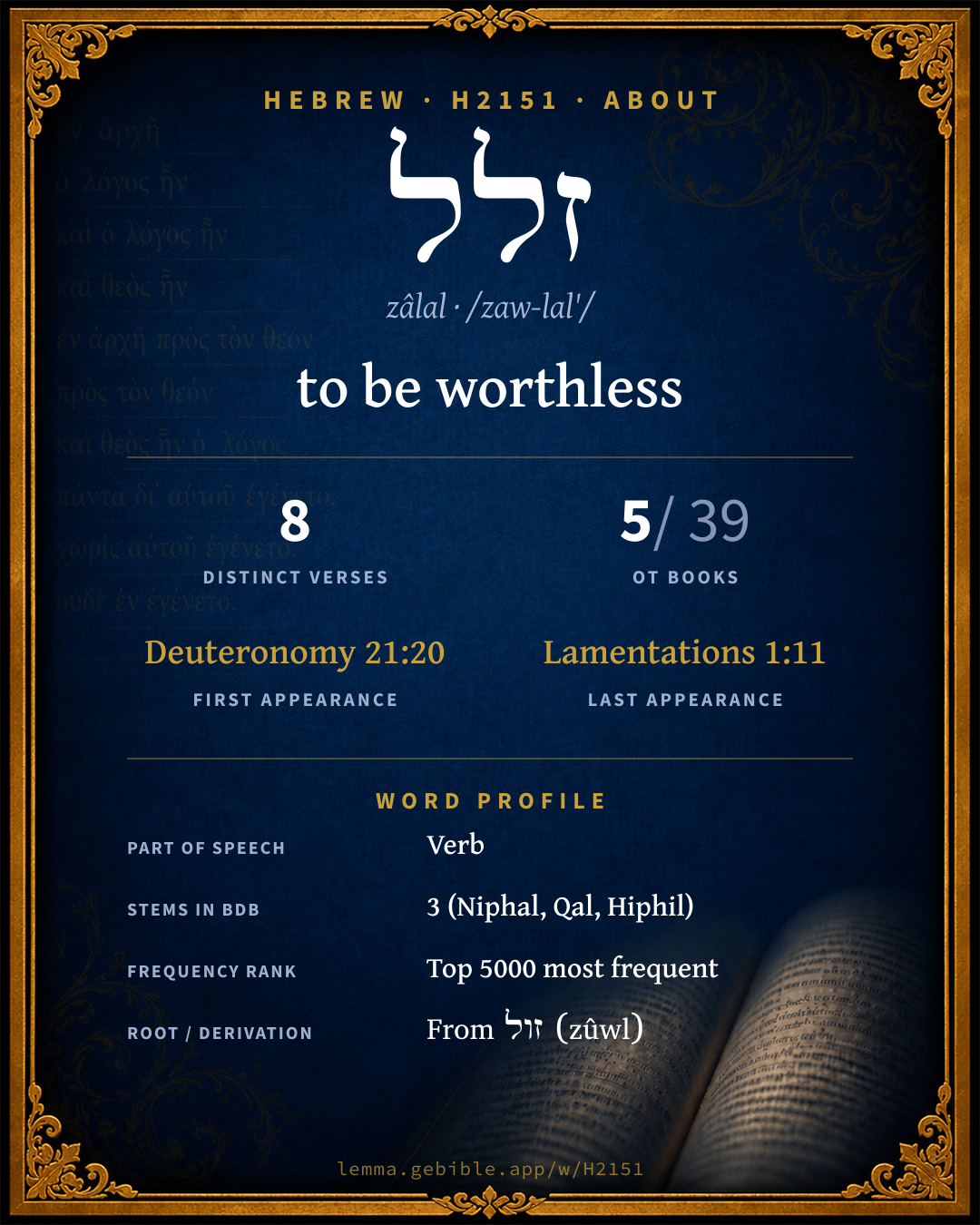
זָלַל
to be worthless
also: be vile, be insignificant, be light fuller range ↓
Full lexicon entry — Brown-Driver-Briggs (BDB)
From Brown-Driver-Briggs (BDB)
Where this word appears
See every Qal verb in the Hebrew Bible →
Grammar key — what these labels mean
Part of speech
- Verb
- An action or state-of-being word.
Stem
- Niphal
- Usually the simple passive or reflexive of the Qal (“he was written”).
- Qal
- The basic, simple active stem — the plain form of the verb (“he wrote”). Here: ‘be worthless’
Form
- Perfect
- A completed action or state — Hebrew marks aspect (completeness) more than strict tense (“he wrote”).
- Participle Active
- A verbal adjective expressing ongoing or characteristic action (“writing / one who writes”).
State
- Absolute
- The independent form of a noun, not bound to a following word.
- Construct
- A noun bound to a following noun in a possessive / “of” relationship (the construct chain).
Person
- 3rd Person
- The one spoken about (“he / she / it / they”).
Gender
- Common
- Either gender — not distinguished for this form.
- Masculine
- Grammatically masculine.
- Feminine
- Grammatically feminine.
Number
- Plural
- More than one (in Hebrew, generally three or more).
- Singular
- One.
Grammatical forms
- Verb, Qal, Participle Active, Masculine, Singular, Absolute 3 times (38%)
- Verb, Niphal, Perfect, 3rd Person, Common, Plural 2 times (25%)
- Verb, Qal, Participle Active, Masculine, Plural, Construct 1 time (13%)
- Verb, Qal, Participle Active, Feminine, Singular, Absolute 1 time (13%)
- Verb, Qal, Participle Active, Masculine, Plural, Absolute 1 time (13%)
Parsed forms decoded from the imported morphology (morphhb / Westminster Leningrad Codex — WLC text public domain, morphhb tagging CC BY 4.0), counted across 8 parsed occurrences — not distinct verses.
Every verse where H2151 appears — 8 distinct verses across 5 books. Click any verse to open its interlinear word-by-word view. Verse text shown in the World English Bible for context — . Each verse’s Hebrew form is shown with its reference; the English is not keyword-highlighted, since the data carries no word-level English alignment. Use “Compare translations” on any verse to read it across multiple English versions. This concordance covers the Hebrew Bible; Septuagint (Greek Old Testament) occurrences are not indexed here.
Deuteronomy 1 verse
Proverbs 3 verses
- Proverbs 23:20 בְּ/זֹלֲלֵ֖י prep + Qal ptcp.act mp cs Don't be among ones drinking too much wine, Or those who gorge themselves on meat:
- Proverbs 23:21 וְ֭/זוֹלֵל conj + Qal ptcp.act ms For the drunkard and the glutton shall become poor; And drowsiness clothes them in rags.
- Proverbs 28:7 זֽ֝וֹלְלִ֗ים Qal ptcp.act mp Whoever keeps the law is a wise son; But he who is a companion of gluttons shames his father.
Isaiah 2 verses
Jeremiah 1 verse
Lamentations 1 verse
About this entry
At a glance — auto-summarized from this page’s data, not written by a person. Every figure links to its source below. This summary describes the numbers; it doesn’t interpret them.
זלל (zâlal) is a Hebrew verb most often rendered “to be worthless.” Scripture first uses it in Deuteronomy 21:20. It turns up in 8 verses across 5 books, an uncommon footprint. It concentrates in Proverbs, which alone accounts for 38% of its uses. As a verb its force shifts by stem, across 3 stems (Niphal, Qal, and more). For the data behind this summary, explore the sense tree and the renderings breakdown below.
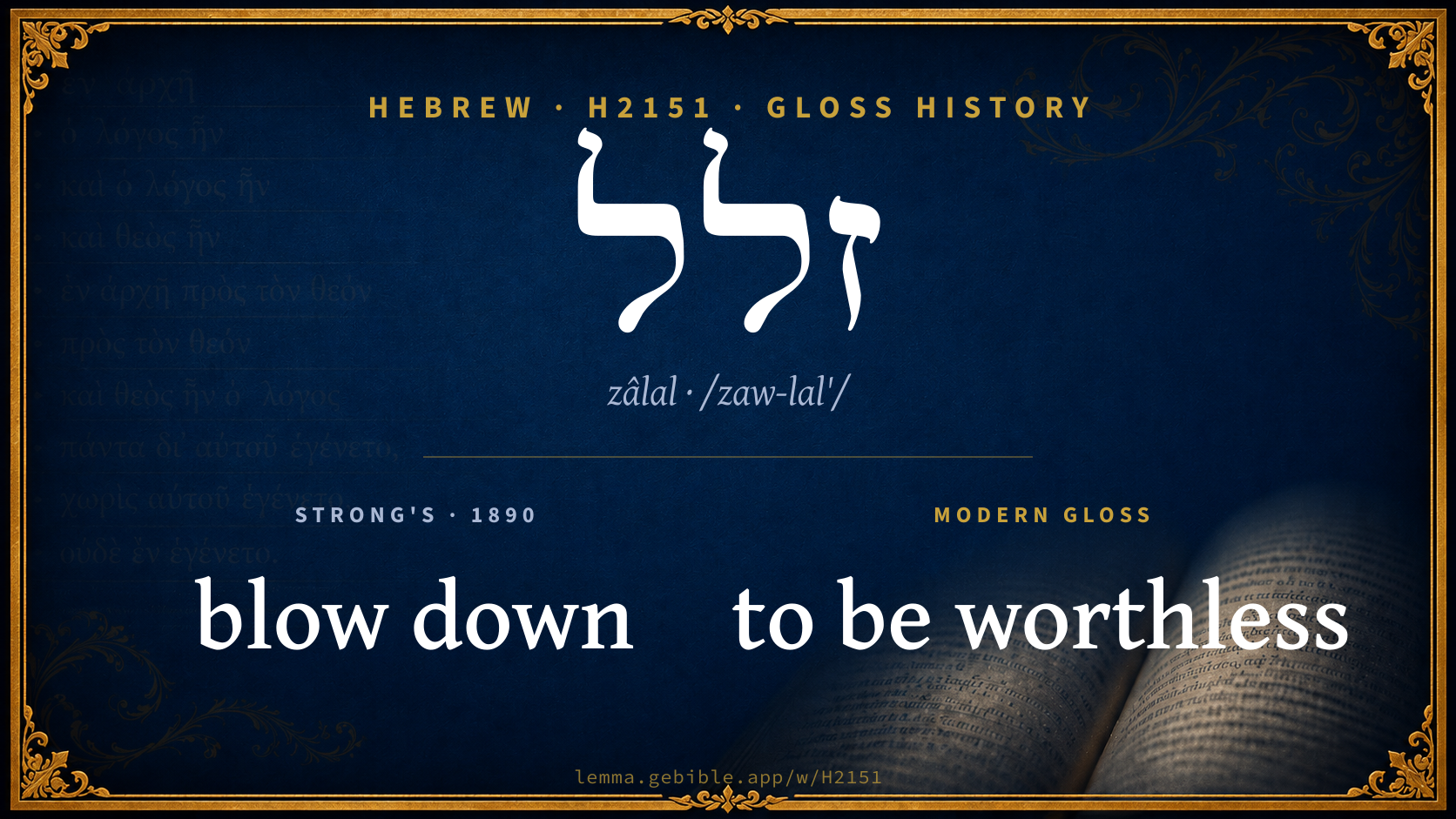
Gloss history
Strong's 1890 vs modern scholarship
About this word
Strong's H2151 catalogs a Hebrew word from the Hebrew Old Testament.
These counts are not copied from any lexicon or concordance. They are computed here, from the morphology-tagged Hebrew Old Testament. What Lemma adds →
- 8
- distinct verses
- The word appears in 8 distinct verses.
- 5 / 39
- OT books
- The word appears in 5 of 39 Old Testament books.
- #2,625
- by frequency
- Top 5000 most frequent Hebrew words (rank 2,625 of 8,640 Hebrew words by occurrence).
View all 8 occurrences in the concordance →
Most concentrated in
- Proverbs 3 verses 38%
- Isaiah 2 verses 25%
- Deuteronomy 1 verse 13%
By section of the Old Testament
By traditional corpus
Conventional, traditional groupings — biblical authorship is debated, so this is a traditional corpus grouping, not an authorship claim. Each share is this word’s portion of its verses in that division of the Hebrew canon. Each figure is a share of the word’s 8 distinct verses.
- Writings (Ketuvim) 4 verses · 50%
- Prophets (Nevi'im) 3 verses · 38%
- Torah (Pentateuch) 1 verse · 13%
How translations render this word
Counts come from each version’s own published word-to-Strong’s tagging or interlinear alignment — an approximate guide to how each version renders this word, not a word-level alignment the data otherwise carries. Because each total is that version’s own tagged count, the per-version totals vary from one another and need not match the appearance or distinct-verse counts above. These counts may also differ from a printed concordance because Lemma counts each distinctly tagged rendering and does not collapse phrase taggings into a single head-word total. This is a fixed set of word-tagged versions (KJV, ASV, BSB, ULT) and does not change with the reading translation you choose elsewhere. Each version’s license is shown beside its name below (and on Sources).
BDB lists this Strong’s number as 2 distinct words (homographs). Each count above pools all of them and is not split by sense — see the Senses section below. A low-frequency rendering may belong to a different one of those words, not the primary meaning.
- King James Version†: Among riotous eaters 1×, Flowed down 1×, Glutton 1×
- American Standard Version†: Among gluttonous eaters 1×, Glutton 1×, Gluttons 1×
- Berean Standard Bible†: Despised 1×, Glutton 1×, Gluttons 1×
- unfoldingWord Literal Text†: Among gluttonous eaters of 1×, Despised 1×, Gluttonous eaters 1×
King James Version Public Domain
Renders H2151 across 8† tagged occurrences — most commonly:
American Standard Version Public Domain
Renders H2151 across 8† tagged occurrences — most commonly:
Berean Standard Bible Public Domain
Renders H2151 across 9† tagged occurrences — most commonly:
unfoldingWord Literal Text CC BY-SA 4.0
Renders H2151 across 8† tagged occurrences — most commonly:
Senses in the full BDB
Hebrew verbs can shift meaning by stem (binyan): Qal is the basic action, Niphal is often passive or reflexive, Piel often intensifies or makes it factitive, and Hiphil is typically causative. The senses below are grouped under the stem BDB assigns to each.
What do BDB’s symbols mean?
BDB uses these scholarly abbreviations:
| Symbol | Meaning |
|---|---|
| 𝔊 | the Septuagint (the ancient Greek translation, LXX) |
| 𝔙 | the Vulgate (the Latin translation) |
| 𝔖 | the Syriac version (the Peshitta) |
| 𝔗 | the Targum (the Aramaic translation) |
| ψ | the Psalms |
| √ | root (the underlying root or stem) |
| ‖ | parallel passage (a synonymous or contrasted parallel) |
| † | the dagger: every passage where the word occurs is cited |
The 4 senses and sub-senses the full Brown-Driver-Briggs lexicon distinguishes for this word, in lexicon order (not ranked by frequency), with BDB’s own verbatim wording and sub-sense lettering. Shown in Hebrew script with BDB’s own scholarly abbreviations. The condensed entry is in the Lexicon Entry tab. See also the Forms in the corpus table below.
זלל I shake
Niphal
- . shake, quake
זלל II be light, worthless, make light of
Qal
- 1. be worthless, insignificant
- 2. trans. make light of = be lavish with, squander
Hiphil
- . make light of, despise
Senses from the full Brown-Driver-Briggs lexicon (Brown, Driver, Briggs; Oxford 1906 — public domain), digitized via Sefaria, supplemented by the OpenScriptures HebrewLexicon (CC BY 4.0). Full attribution on Sources.
Word origin
[ זָלַל ] vb. 1. be light, worthless, 2. make light of
— Brown-Driver-Briggs (Oxford 1906, public domain), digitized via Sefaria, supplemented by the OpenScriptures HebrewLexicon (CC BY 4.0). See Sources.
Derived from זול (zûwl) (H2107) — to lavish.
Jastrow Dictionary
A second Hebrew/Aramaic lexicon for comparison, covering Aramaic and post-biblical (Talmudic, Targumic, Midrashic) usage that the biblical-Hebrew BDB does not. Matched by lemma rather than by Strong’s number, so a lemma may carry more than one Jastrow headword (shown separately below), and the entries cover usage well beyond the Bible.
זָלַל
- (b. h; cmp. דלל) to be light, slender.—זוֹלֵל, v. זוּל.
- 1. to treat lightly, to despise, neglect (with ב). Ber. 6ᵇ (ref. to Ps. XII, 9) ובני אדם מְזַלְזְלִין בהן and which people treat slightly. Y. Peah I, 15ᵈ, sq. מז׳ בבני וכ׳ they despise the sons of the handmaids; Gen. R. s. 84. Sabb. 62ᵇ המְזַלְזֵל וכ׳ he who is neglectful in the observance &c. Ab. Zar. 36ᵃ לודאי מזלזלין הן Ms. M. (ed. דמזלזלו) the Lyddeans are neglectful of religious observances; a. e. e.g. Psalms 12:9
- 2. ז׳ מעות to disregard money-matters. Y. Snh. VIII, 26ᵇ top; ib. XI, beg. 30ᵃ (the rebellious son that took what belonged to his father) אינו חייב עד שיְזַלְזֵל מ׳ cannot be made responsible, unless he disregards money, expl. ib. ‘he takes an object and sells it for its exact cost price’ (thus proving both his rationality and his wastefulness).
זְלַל
- , to be of little value, disregarded. Targ. Prov. III, 21 לא נִזַל בעינך (h. text ילזו). Ib. IV, 21 לא נִיזְלָן בעיניך Var. ed. Lag. a. oth. ed. (ed. Lag. בעיניך, v. זְלֵי; h. text יליזו מ־).
- 1. to disregard, despise. Targ. Y. Deut. XXVII, 16. Targ. Y. Gen. XVI, 4 זלזלת (ed. pr. זַלְּלַת) she disregarded.—Ḥull. 133ᵃ זַלְזוּלֵי קא מְזַלְזֵל וכ׳ does he show that he treats religious observances with disrespect?, opp. חבב.—Ab. Zar. 35ᵃ ואתי לזַלְזוּלֵי בה Ms. M. (ed. לזִילְזוּלָא) and he may be induced to disregard it; a. e.
- 2. to count the lowest price. B. Mets. 52ᵇ מְזַלְזְלִינָן במעשר שני in redeeming second tithes we are permitted to count closely. Ib. תרי זילי לא מז׳ two lowerings of value must not be applied to it (to value closely and then to count a defective coin for full).
- ; contr. אִיזַּלְזֵל to be despised; to lower one’s self. Targ. Job XL, 4. Targ. Koh. IX, 16.—Targ. Y. Deut. XXVIII, 16.
A Dictionary of the Targumim, the Talmud Babli and Yerushalmi, and the Midrashic Literature (Marcus Jastrow; London, Luzac, 1903) — Public Domain. Digitized via Sefaria. Digitized via Sefaria. Full attribution on Sources.
Forms in the corpus
The 7 distinct written forms H2151 takes in the Hebrew Bible, most frequent first — each parse links to that stem’s occurrences in the concordance. Hebrew forms include their vowel points and cantillation, so a single lemma takes many written forms.
| Form | Parsing | Example | Uses |
|---|---|---|---|
| נָזֹֽלּוּ | Verb, Niphal, Perfect, 3rd Person, Common, Plural | Isaiah 64:1 | 2 |
| בְּ/זֹלֲלֵ֖י | Verb, Qal, Participle Active, Masculine, Plural, Construct | Proverbs 23:20 | 1 |
| וְ֭/זוֹלֵל | Verb, Qal, Participle Active, Masculine, Singular, Absolute | Proverbs 23:21 | 1 |
| זֽ֝וֹלְלִ֗ים | Verb, Qal, Participle Active, Masculine, Plural, Absolute | Proverbs 28:7 | 1 |
| זוֹלֵ֖ל | Verb, Qal, Participle Active, Masculine, Singular, Absolute | Deuteronomy 21:20 | 1 |
| זוֹלֵלָֽה | Verb, Qal, Participle Active, Feminine, Singular, Absolute | Lamentations 1:11 | 1 |
| מִ/זּוֹלֵ֖ל | Verb, Qal, Participle Active, Masculine, Singular, Absolute | Jeremiah 15:19 | 1 |
Same root — word family
Other BDB entries built from the same root as H2151, grouped by Strong’s listed origin. These share a root / origin per the lexicon — not necessarily a shared meaning. Each links to that word’s own entry.
Derives from
Shares the same root
Derived from this word
Compare all same-root words → Showing 4 of 5 — not the complete family. They share a root, not necessarily a meaning.
Septuagint verse parallels
This word appears in 8 verses that also exist in the Greek Old Testament (Septuagint), out of the 8 Hebrew verses it occurs in. You can read those verses in Greek by switching the Old Testament edition to the Septuagint.
Read these verses in the Septuagint
This is a verse-level parallel only — the same verses exist in both the Hebrew and Greek Old Testaments. No word-level Hebrew↔Greek correspondence is claimed: the data carries no such alignment, so no Greek word is shown as this Hebrew word’s translation. Coverage is not total — the Septuagint omits the deuterocanon and renumbers the Psalms, so some Hebrew verses have no direct Greek parallel.