
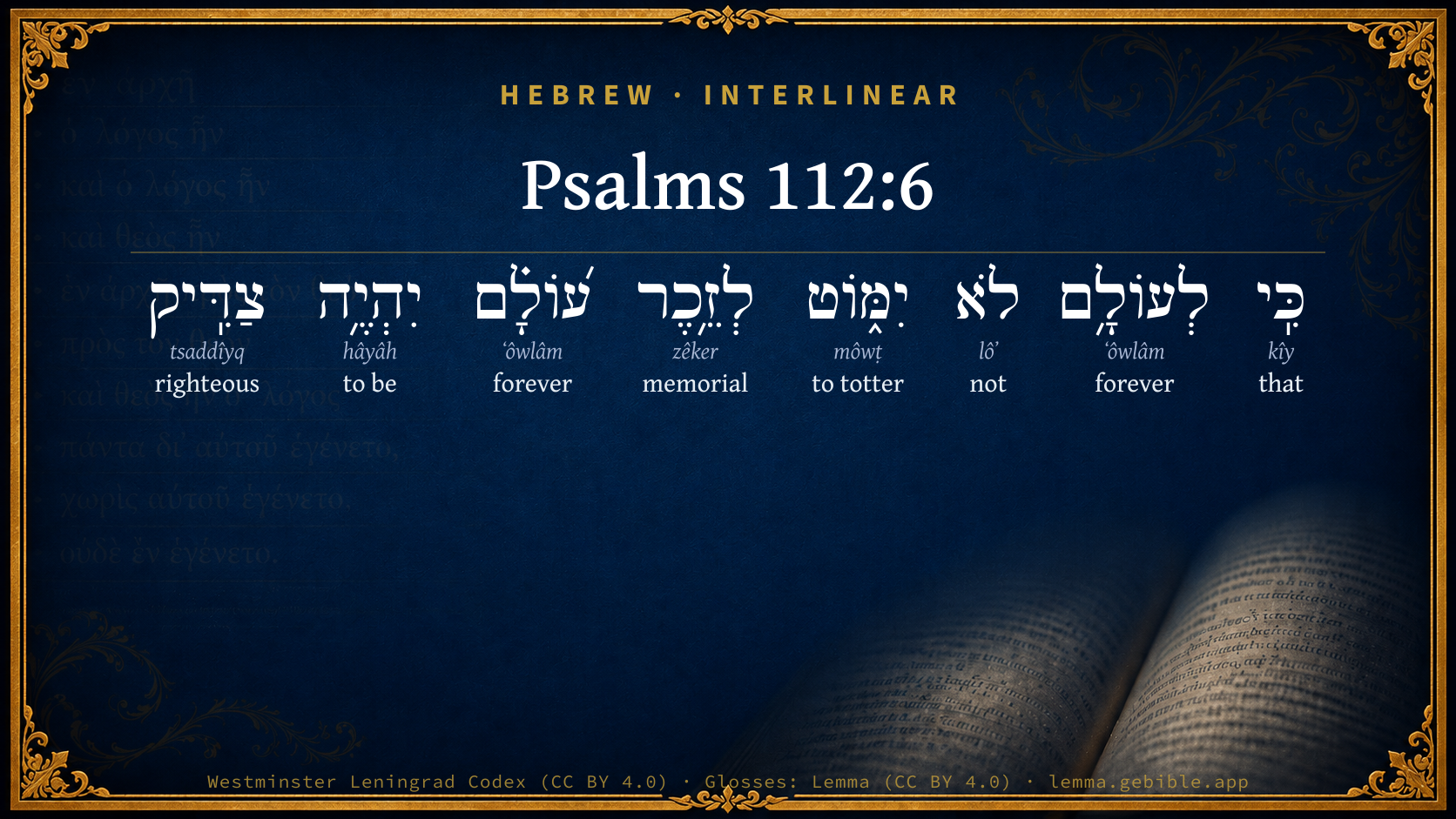
Psalms 112:6

Hebrew (Westminster Leningrad Codex) Psalms 112:6 appears in the Hebrew Old Testament. The text above is from the Westminster Leningrad Codex. Each word links to its Strong’s number, a concise gloss, and parsing drawn from the Open Scriptures Hebrew Bible morphology. Click any word for its full Brown-Driver-Briggs (BDB) entry.
Download image
Cite this verse

Psalms 112:6 (World English Bible). Public Domain. Lemma interlinear Bible study tool, https://lemma.gebible.app/v/psalms/112/6.

Show BibTeX & RIS
BibTeX
RIS
English Translation
For he will never be shaken. The righteous will be remembered forever.
World English Bible · Public Domain
Download a study sheet

One document with this verse’s original text, its word-by-word gloss line, the meaning frame, cross-references with their text, attributed commentary, and full source and license credits — printable, and it pastes into notes with its structure intact.

This verse Autodidact and up

Study sheet (.html) Plain text (.txt)

A passage Seminary Student

Up to 50 verses in one chapter. A passage sheet keeps up to 6 commentary sources and 12 cross-references per verse, in the order this page ranks them, and says so on the sheet whenever that leaves anything out. Ask for a single verse and you get the Autodidact verse sheet above.

Everything on this page stays free to read, with no account — the sheet is a download of what is already on screen, not access to it.

Want to remove ads? Support Godless Engineer
Compare translations 3

The same verse in 3 English versions, stacked beneath the original-language interlinear above. Click any original word for its lexicon entry.

Each is an independent rendering of the whole verse — the interlinear is not word-aligned to these translations.

Highlighted words mark where these versions differ — a whole-verse word diff, not a word-by-word alignment.

  • World English Bible Public Domain
    For he will never be shaken. The righteous will be remembered forever.
  • King James Version Public Domain
    Surely he shall not be moved for ever: the righteous shall be in everlasting remembrance.
  • unfoldingWord Literal Text CC BY-SA 4.0
    For he will not be moved for forever; the righteous will be for an eternal remembrance.

unfoldingWord Literal Text — © unfoldingWord, licensed CC BY-SA 4.0. Word-aligned USFM3 via Door43 (git.door43.org/unfoldingWord/en_ult).

Versions to compare (up to 4)

3 of 4 selected

Show all 18 translations

Every available English version of this verse, each an independent rendering of the whole verse.

  • World English Bible Public Domain
    For he will never be shaken. The righteous will be remembered forever.
  • Berean Standard Bible Public Domain
    Surely he will never be shaken; the righteous man will be remembered forever.
  • Majority Standard Bible Public Domain
    Surely he will never be shaken; the righteous man will be remembered forever.
  • King James Version Public Domain
    Surely he shall not be moved for ever: the righteous shall be in everlasting remembrance.
  • American Standard Version (1901) Public Domain
    For he shall never be moved; The righteous shall be had in everlasting remembrance.
  • Revised Version (1885) Public Domain
    For he shall never be moved; the righteous shall be had in everlasting remembrance.
  • Geneva Bible (1599) Public Domain
    Surely he shall neuer be moued: but the righteous shalbe had in euerlasting remembrance.
  • Douay-Rheims (1899) Public Domain
    because he shall not be moved for ever.
  • Young's Literal Translation Public Domain
    For -- to the age he is not moved; For a memorial age-during is the righteous.
  • Literal Standard Version CC BY-SA 4.0
    For he is not moved for all time; For the righteous is a continuous memorial.
  • Unlocked Literal Bible CC BY-SA 4.0
    For he will never be moved; the righteous person will be remembered forever.
  • unfoldingWord Literal Text CC BY-SA 4.0
    For he will not be moved for forever; the righteous will be for an eternal remembrance.
  • Darby Bible Public Domain
    For he shall not be moved for ever: the righteous shall be in everlasting remembrance.
  • World Messianic Bible Public Domain
    For he will never be shaken. The righteous will be remembered forever.
  • Webster's Bible Public Domain
    Surely he shall not be moved for ever: the righteous shall be in everlasting remembrance.
  • Free Bible Version CC BY-SA 4.0
    They will never fall. Those who live right won't be forgotten.
  • Bible in Basic English Public Domain
    He will not ever be moved; the memory of the upright will be living for ever.
  • JPS Tanakh (1917) Public Domain
    For he shall never be moved; the righteous shall be had in everlasting remembrance.

Literal Standard Version (2020), Covenant Press — licensed CC BY-SA 4.0. Text via the HelloAO Bible API (eBible.org). Unlocked Literal Bible (unfoldingWord) — licensed CC BY-SA 4.0. Text via the HelloAO Bible API (eBible.org). unfoldingWord Literal Text — © unfoldingWord, licensed CC BY-SA 4.0. Word-aligned USFM3 via Door43 (git.door43.org/unfoldingWord/en_ult). Free Bible Version, Dr. Jonathan Gallagher — licensed CC BY-SA 4.0. Text via the HelloAO Bible API (eBible.org).

Word by word

More ways to search: Search by grammar → Find every occurrence → Compare this word →

Practice this passage: Drill this verse → Learn its vocabulary →

About this verse

These counts appear in no published source. They are computed here, from the morphology-tagged text and Lemma’s own curated glosses. What Lemma adds →

8
words
7
distinct lemmas
Wisdom
section

Notable vocabulary

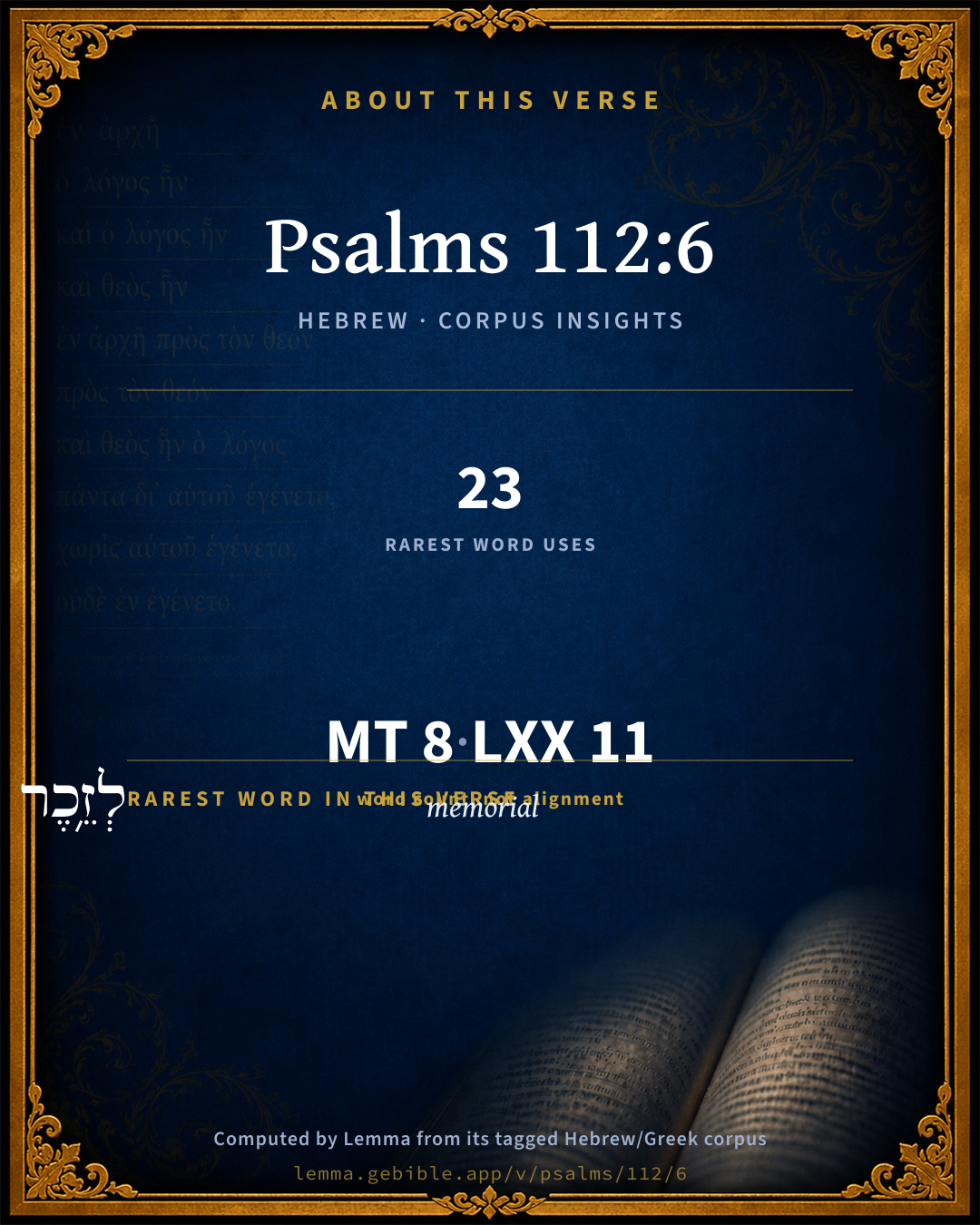
The rarest word here is לְזֵ֥כֶר memorial H2143 — appearing just 23 times in the whole Hebrew Bible.

Shared distinctive vocabulary

לְזֵ֥כֶר memorial H2143 occurs in 23 verses of the Hebrew Bible. Also found in:

Grammatical profile

  • 2 verbs
  • 3 nouns
  • 1 adjective
  • 1 conjunction
  • 1 particle

Verb forms

  • יִמּ֑וֹט Niphal · Imperfect
  • יִהְיֶ֥ה Qal · Imperfect

Repetition

A word recurs within this verse — often emphatic in Hebrew:

  • לְעוֹלָ֥ם forever H5769 ×2

Hebrew & Septuagint length

In English translation the verse runs 12 words from the Hebrew and 15 from the Septuagint (LXX English) — closely comparable.

A rough comparison of the two English renderings, which tokenize alike — not a word-level alignment.

Word counts can differ between the Hebrew and the Greek without any difference in meaning — e.g. the Hebrew direct-object marker אֵת has no separate Greek word, and Greek often adds the article ὁ.

In the original languages it is 8 Hebrew tokens and 11 Greek tokens — but the two are counted differently (Hebrew bundles its prefixes and suffixes into one token; the Greek is in lemma form), so that isn’t a like-for-like length.

Cross-references

11

Topical passages linked to Psalms 112:6 in the Treasury of Scripture Knowledge — connected by theme and wording, ordered by reader-vote popularity; previews shown in the World English Bible.

  • Proverbs 10:7 The memory of the righteous is blessed, But the name of the wicked will rot.
  • Psalms 62:2 He alone is my rock and my salvation, my fortress-- I will never be greatly shaken.
  • Psalms 125:1 Those who trust in Yahweh are as Mount Zion, Which can't be moved, but remains forever.
  • Hebrews 6:10 For God is not unrighteous, so as to forget your work and the labor of love which you showed toward his name, in that you served the saints, and still do serve them.
  • Psalms 15:5 He who doesn't lend out his money for usury, Nor take a bribe against the innocent. He who does these things shall never be shaken.
  • Psalms 55:22 Cast your burden on Yahweh, and he will sustain you. He will never allow the righteous to be moved.
  • Nehemiah 13:31 and for the wood-offering, at times appointed, and for the first fruits. Remember me, my God, for good.
  • Psalms 62:6 He alone is my rock and my salvation, my fortress. I will not be shaken.
  • Matthew 25:34–40 Then the King will tell those on his right hand, 'Come, blessed of my Father, inherit the Kingdom prepared for you from the foundation of the world;
  • 2 Peter 1:5–11 Yes, and for this very cause adding on your part all diligence, in your faith supply moral excellence; and in moral excellence, knowledge;
  • Nehemiah 13:22 I commanded the Levites that they should purify themselves, and that they should come and keep the gates, to sanctify the Sabbath day. Remember to me, my God, this also, and spare me according to the greatness of your loving kindness.

Cross-references courtesy of OpenBible.info (CC BY 4.0).

Hebrew and Greek witnesses Masoretic Hebrew ↔ Greek Septuagint

The same verse in the two great witnesses to the Old Testament, shown verse-for-verse.

You’re reading Greek Psalm 111 (Hebrew Psalm 112). The Septuagint counts the superscription, so verse numbers can differ from the Hebrew — chapter-level alignment, not verse-by-verse. Numbering follows Rahlfs.

These are two independent witnesses, not word-aligned to each other, and the Septuagint is shown in lemma (dictionary) form.

Hebrew Psalms 112:6 Masoretic · Westminster Leningrad Codex

כִּֽי לְעוֹלָ֥ם לֹא יִמּ֑וֹט לְזֵ֥כֶר ע֝וֹלָ֗ם יִהְיֶ֥ה צַדִּֽיק

For he will never be shaken. The righteous will be remembered forever.

World English Bible · Public Domain

Greek LXX Greek Psalm 111:6 Septuagint · lemma form

ὅτι εἰς ὁ αἰών οὐ σαλεύω εἰς μνημόσυνον αἰώνιος εἰμί δίκαιος

For he shall not be moved for ever; the righteous shall be in everlasting remembrance.

LXX2012 (modern English Septuagint) · Public Domain

Hebrew: Westminster Leningrad Codex (CC BY 4.0). Greek: Septuagint (public domain); English from LXX2012 (modern English Septuagint) (Public Domain). How the Septuagint differs from the Hebrew →

Commentary

Notes on Psalms 112:6 from classic Christian and Jewish commentators (each source and its license shown beneath its notes). The classic Christian expositions comment on the surrounding passage and are grouped to its opening verse, so a note may address several verses; the Jewish commentaries on the Tanakh (Rashi and others) are per-verse, so they appear only where the commentator wrote on this verse.

Lemma curates 59 commentaries, every one of them public domain or Creative Commons licensed, each selected and text-cleaned for this edition rather than reprinted as found. About our sources →

Matthew Henry's Commentary

In these verses we have,

I. The satisfaction of saints, and their stability. It is the happiness of a good man that he shall not be moved for ever, Psa 112:6. Satan and his instruments endeavour to move him, but his foundation is firm and he shall never be moved, at least not moved for ever; if he be shaken for a time, yet he settles again quickly.

1. A good man will have a settled reputation, and that is a great satisfaction. A good man shall have a good name, a name for good things, with God and good people: The righteous shall be in everlasting remembrance (Psa 112:6); in this sense his righteousness (the memorial of it) endures for ever, Psa 112:9. There are those that do all they can to sully his reputation and to load him with reproach; but his integrity shall be cleared up, and the honour of it shall survive him. Some that have been eminently righteous are had in a lasting remembrance on earth; wherever the scripture is read their good deeds are told for a memorial of them. And the memory of many a good man that is dead and gone is still blessed; but in heaven their remembrance shall be truly everlasting, and the honour of their righteousness shall there endure for ever, with the reward of it, in the crown of glory that fades not away. Those that are forgotten on earth, and despised, are remembered there, and honoured, and their righteousness found unto praise, and honour, and glory (Pe1 1:7); then, at furthest, shall the horn of a good man be exalted with honour, as that of the unicorn when he is a conqueror. Wicked men, now in their pride, lift up their horns on high, but they shall all be cut off, Psa 75:5, Psa 75:10. The godly, in their humility and humiliation, have defiled their horn in the dust (Job 16:15); but the day is coming when it shall be exalted with honour. That which shall especially turn to the honour of good men is their liberality and bounty to the poor: He has dispersed, he has given to the poor; he has not suffered his charity to run all in one channel, or directed it to some few objects that he had a particular kindness for, but he has dispersed it, given a portion to seven and also to eight, has sown beside all waters, and by thus scattering he has increased: and this is his righteousness, which endures for ever. Alms are called righteousness, not because they will justify us by making atonement for our evil deeds, but because they are good deeds, which we are bound to perform; so that if we are not charitable we are not just; we withhold good from those to whom it is due. The honour of this endures for ever, for it shall be taken notice of in the great day. I was hungry, and you gave me meat. This is quoted as an inducement and encouragement to charity, Co2 9:9.

2. A good man shall have a settled spirit, and that is a much greater satisfaction than the former; for so shall a man have rejoicing in himself alone, and not in another. Surely he shall not be moved, whatever happens, not moved either from his duty or from his comfort; for he shall not be afraid; his heart is established, Psa 112:7, Psa 112:8. This is a part both of the character and of the comfort of good people. It is their endeavour to keep their minds stayed upon God, and so to keep them calm, and easy, and undisturbed; and God has promised them both cause to do so and grace to do so. Observe, (1.) It is the duty and interest of the people of God not to be afraid of evil tidings, not to be afraid of hearing bad news; and, when they do, not to be put into confusion by it and into an amazing expectation of worse and worse, but whatever happens, whatever threatens, to be able to say, with blessed Paul, None of these things move me, neither will I fear, though the earth be removed, Psa 46:2. (2.) The fixedness of the heart is a sovereign remedy against the disquieting fear of evil tidings. If we keep our thoughts composed, and ourselves masters of them, our wills resigned to the holy will of God, our temper sedate, and our spirits even, under all the unevenness of Providence, we are well fortified against the agitations of the timorous. (3.) Trusting in the Lord is the best an surest way of fixing and establishing the heart. By faith we must cast anchor in the promise, in the word of God, and so return to him and repose in him as our rest. The heart of man cannot fix any where, to its satisfaction, but in the truth of God, and there it finds firm footing. (4.) Those whose hearts are established by faith will patiently wait till they have gained their point: He shall not be afraid, till he see his desire upon his enemies, that is, till he come to heaven, where he shall see Satan, and all his spiritual enemies, trodden under his feet, and, as Israel saw the Egyptians, dead on the sea-shore. Till he look upon his oppressors (so Dr. Hammond), till he behold them securely, and look boldly in their faces, as being now no longer under their power. It will complete the satisfaction of the saints, when they shall look back upon their troubles and pressures, and be able to say with St. Paul, when he had recounted the persecutions he endured (Ti2 3:11), But out of them all the Lord delivered me.

II. The vexation of sinners, Psa 112:10. Two things shall fret them: - 1. The felicity of the righteous: The wicked shall see the righteous in prosperity and honour and shall be grieved. It will vex them to see their innocency cleared and their low estate regarded, and those whom they hated and despised, and whose ruin they sought and hoped to see, the favourites of Heaven, and advanced to have dominion over them (Psa 49:14); this will make them gnash with their teeth and pine away. This is often fulfilled in this world. The happiness of the saints is the envy of the wicked, and that envy is the rottenness of their bones. But it will most fully be accomplished in the other world, when it shall make damned sinners gnash with their teeth, to see Abraham afar off, and Lazarus in him bosom, to see all the prophets in the kingdom of God and themselves thrust out. 2. Their own disappointment: The desire of the wicked shall perish. Their desire was wholly to the world and the flesh, and they ruled over them; and therefore, when these perish, their joy is gone, and their expectations from them are cut off, to their everlasting confusion; their hope is as a spider's web.

Matthew Henry's Commentary on the Whole Bible (1708–1710) — public domain (CC PDM 1.0). Text via the HelloAO Bible API.

Trapp's Complete Commentary

John Trapp

Psa 112:6 Surely he shall not be moved for ever: the righteous shall be in everlasting remembrance.

Ver. 6. Surely he shall not be moved for ever] Non mutabit. The world thinketh liberality to be the ready way to beggary; but it is otherwise; Isa 32:8, "The liberal man deviseth liberal things, and by liberal things he shall stand." Not getting, but giving, is the way to wealth.

The righteous shall be in everlasting remembrance] Namely, with the righteous. Demetrius hath good report of all good men, and of the truth itself, 3Jn 1:12. As for wicked men, Calumnias eorum nunquam effugit, there is no escaping their cavils and calumnies (Vatab.).

John Trapp, A Commentary or Exposition upon All the Books of the Old and New Testament (1647–1656) — public domain. Text from a community e-Sword module.

The Biblical Illustrator

Joseph S. Exell

Psa_112:6

The righteous shall be in everlasting remembrance.

The reputation of good men after death

I. Whence it comes to pass, that good men are very often defrauded of their just praise and reputation whilst they are alive.

1. From what cause it proceeds.

(1) Good men themselves are many times the cause of it. For the best men are imperfect; and present and visible imperfections do very much lessen and abate the reputation of a mans goodness.

(2) The principal cause is from others. From the hatred and opposition of bad men to holiness and virtue. From the envy of those who perhaps have some degree of goodness themselves.

(3) There is something in the very presence and nearness of goodness and virtue, which is apt to lessen it. Perhaps familiarity and conversation does insensibly beget something of contempt; but whatever the reason of it be, we find the thing most certainly true in experience.

2. For what reasons the providence of God permits it thus to be.

(1) To keep good men humble, and, as the expression is in Job, to hide pride from men.

(2) This life is not the proper season of reward, but of work and service.

II. What security good men have of a good name after death.

1. From the providence of God.

(1) In respect of the equity of it. God, who will not be behindhand with any man, concerns Himself to secure to good men the proper reward of their piety and virtue.

(2) In regard of the example of it. It is a great argument to virtue, and encouragement to men to act their part well, to see good men applauded, when they go off the stage.

2. The other part of the account of this truth is to be given from the nature of the thing: because death removes and takes away the chief obstacle of a good mans reputation. For then his defects are out of sight, and men are contented that his imperfections should be buried in his grave with him.

III. Inferences by way of application.

1. To vindicate the honour which the Christian Church hath for many ages done to the first teachers and martyrs of our religion; I mean more especially to the holy apostles of our Lord and Saviour; to whose honour the Christian Church hath thought fit to set apart solemn times, for the commemoration of their piety and suffering, and to stir up others to the imitation of them.

2. Let this consideration, that the righteous shall be in everlasting remembrance, be an encouragement to us to piety and goodness. This, to a generous nature, that is sensible of honour and reputation, is no small reward and encouragement.

3. Whenever we pretend to do honour to the memory of good men, let us charge ourselves with a strict imitation of their holiness and virtue. (J. Tillotson.)

Everlasting remembrance of the good

I. It is seen in the favours which Heaven confers upon remote posterity for their sake. God blesses childrens children, unborn generations, for the sake of a holy ancestor. David may be selected as an example of this (1Ki_11:11-13; 1Ki_15:4; 2Ki_8:19).

II. In the good which the Almighty accomplishes by their instrumentality through distant times.

1. By their biography.

2. By their literary productions.

III. In the connection of their labours with the indestructible consciousness of men. The saved and the lost will remember their counsel, their reproofs, their exhortations, their sermons, their prayers, for ever and ever.

IV. In the blessings which the almighty will impart to them through all eternity. The subject teaches--

(1) The immense value of a righteous man in society. His usefulness is as permanent as the stars.

(2) The best method of achieving lasting fame. Usefulness alone can give it. (Homilist.)

The religious aspect of history

It is now more than six hundred years ago since one of the earliest fathers of English history, an inmate of the venerable Abbey of St. Albans, which nurtured the first school of English historical learning, recounted, at the commencement of his work, how he was vexed by questions, some put by envious detractors, some arising from serious perplexity, whether the record of times that were dead and gone was worthy of the labour and study of Christian men. He replied, with a lofty consciousness of the greatness of his task, first by an appeal to the highest instincts of man, and then added, as a further and complete sanction of these instincts, the words of the psalmist, The just shall be had in everlasting remembrance. These are simple and familiar words; but the old chronicler of St. Albans was right in saying that they contain the principle which vindicates and sanctifies all historical research. If thou, he said to his readers, if thou forgettest and despisest the departed of past generations, who will remember thee? It was to keep alive, so he added, the memory of the good, and teach us to abhor the bad, that all the sacred historians have striven from Moses down to the deep-souled chroniclers of the years in which we ourselves are living.

1. Everlasting remembrance--eternal memory--a memorial that shall endure from generation to generation. This is what history aims to accomplish for the ages of the past. As we are reminded both by Scripture and by experience of the noble, the inextinguishable desire implanted within us to understand and to bring near to us the wonders of the firmament, so in like manner we may be assured that there lies deep in the human heart a desire not less noble, not less insatiable, to understand and to bring near to us the wonders of the ages that are dead and buried (Psa_77:5; Psa_77:10-11; Psa_78:2-4). As the celestial spheres are mapped out by the natural student to guide the mariner, and for times, and for seasons, and for days, and for years, so the spheres of earthly events are mapped out by the historical student, and the monuments of glory and the beacons of danger are set along the shores of the past, to direct us through the trackless ocean of the future. Happy, thrice happy he who has the ears to hear those voices of the dead which others cannot hear--who has the eyes to see those visions of the ancient times which to others are dim and dark. History may be fallible and uncertain, but it is our only guide to the great things that God has wrought for the race of man in former ages; it is the only means through which we can hear, and through which our fathers can declare to us the noble works which He has done in their days, and in the old time before them.

2. And not only the religion of the natural man, but the whole structure of the Bible is a testimony to the sacredness and the value of historical learning. Unlike all other sacred books, the sacred books both of the Old and New Testament are, at least half in each, not poetical, or dogmatical, but historical. Doctrine, precept, warning, exhortation, all are invested with double charms when clothed in the flesh and blood of historical facts. If there has been an everlasting remembrance of One supremely Just, in whom the Divine Mind was made known to man in a special and transcendent degree, it is because that Just One, the Holy and the True, became flesh and dwelt amongst us, and became (so let us speak with all reverence and all truth) the subject of historical description, of historical research, of historical analysis, of historical comparison. The sacred historians of the Jewish Commonwealth--still more the simple, homely, but profound historians of the New Testament whom we call the Evangelist,--are the most impressive of all preachers.

3. And this power is not confined to the history of the Jewish people, or of the Christian Church. It extends to the history of the nations--of the Gentiles, as they are called in the Bible. The just, without reserve, in whatever nation, and of whatever creed, is to be had in everlasting remembrance. Whatsoever things are true, etc., in whatsoever race, or under whatsoever form,--these things are the legitimate, the sacred, subjects which the Father of all good gifts has charged the historians of the world to read and to record wheresoever they can be discerned. (Dean Stanley.)

The reputation of the righteous

The desire of reputation is part of the social constitution which God has given us; and, when properly directed, has a powerful tendency to promote our moral perfection. But we desire not the esteem of our contemporaries alone. Extending our prospects through a wider sphere, we seek to be approved by the spirits of the just who adorned the ages that are past; and look forward, with fond expectation, to the reverence that awaits us, after this mortal frame shall have mouldered into dust. But though the desire of reputation be natural to man, and though it operates with peculiar force in the noblest minds; yet it is not to be followed as the guide of our conduct. It is valuable only when it acts in subordination to the principles of virtue, and gives additional force to their impression. Separated from these principles, it becomes a source of corruption and depravity. Instead of animating the soul to generous deeds, it descends to foster the swellings of vain glory, and to beget the meanness of ostentation, or the vileness of hypocrisy. When the love of praise is perverted to such unworthy purposes, it seldom accomplishes its end. For though the artifices of deceit may succeed for a while, and obtain for the undeserving a temporary applause, yet the constitution of things has placed an insuperable bar between the practice of iniquity and a durable reputation. To the virtuous alone belongs the reward of lasting glory; and the Almighty will not suffer a stranger to intermeddle with their joy. For them Providence has prepared the approbation of the age in which they live, and their memorial descends to warm the admiration of succeeding times. Light is sown for the upright; the memory of the just is blessed; and the righteous shall be in everlasting remembrance. Death removes the chief causes of uncharitable judgment, and enables us to estimate the value of departed worth, free from the influence of prejudice and passion. The little jealousies which darken the reputation of the living seldom pursue them beyond the limits of the grave. Envy ceases when their merit has ceased to be an obstacle to our ambition. Their imperfections are buried with their bodies in the tomb, and soon forgotten; while their better qualities, recalled often to our thoughts, and heightened by the inconveniences which their departure occasions, live in the remembrance of their neighbours, and receive the tribute of just approbation. We are even willing to repay them by an excess of praise for the injury we did them while alive. (J. Finlayson, D.D.)

The immortality of influence

We think that when a man dies he has done with the world, and that the world has done with him. That view, how, ever, needs revision. There is much about a man that cannot be put into a coffin. Keats left for his epitaph, Here lies one whose name was writ in water. The names of men are generally so writ, but the life and character are impressed on society deeply, indelibly. We cannot properly speak of the immortality of bad influence; yet that influence spreads and persists to a distressing extent. But we can speak confidently about the immortality of the influence of the good. Abel being dead yet speaketh; we are not told that Cain does. It is a reassuring thing to know that the good which men do is not buried with their bones. Not only do remarkable saints influence posterity beneficially; all saints do so, although it may be in a less degree. We find it easy to believe that the men influence posterity whose deeds are emblazoned in history, whose books are in the libraries, whoso monuments are in the minster, but we are slow to believe in the posthumous life of the obscure and unknown. Yet the immortality of influence is just as true in regard to the humble as to the illustrious. Nature perpetuates the memory of the frailest and most fugitive life, of the simplest and most insignificant action and event. The rolling pebble, the falling leaf, and the rippling water of millions of years ago left their sign in the rocks. The minute creatures of the primeval world built up the strata on which we live, and affecting traces of their being and action are palpable everywhere. All this is going on still; every flash of lightning is photographed, every whisper vibrates for ever, every movement in the physical world leaves an imperishable record. Let us not, then, be anxious lest we should be forgotten. A secret law renders the lowliest life immortal. This gives a new view of the duration of life. We plaintively speak of human life as a dream, a flower, a shade. But the doctrine of the immortality of influence puts the subject in another light. We gain a new view of the seriousness of life. Confined to threescore years life appears insignificant; yet in the light of immortality of influence it appears unspeakably solemn. There is no circle to our influence but the horizon; we are alive to the coming of the Son of Man. We must wait for the last day before we are finally judged. Why? Because men do not close their account with the world at their death; our influence reaches to the last day, and therefore only then can the full and final verdict be given. (W. L. Watkinson.)

The Biblical Illustrator, edited by Joseph S. Exell (c. 1880s–1900s) — public domain. Text from a community e-Sword module.

Joseph Benson's Commentary

Psa 112:6-8. He shall not be moved for ever — Though he may, for a season, be afflicted, yet he shall not be utterly and eternally destroyed, as wicked men shall be. The righteous — Hebrew, צדיק, the righteous man; shall be in everlasting remembrance — Though, while he lives, he may be exposed to the censures, slanders, and contradictions of sinners; yet, after his death, his memory shall be precious and honourable, both with God and men, his very enemies not excepted. He shall not be afraid of evil tidings — At the report of approaching calamities and the judgments of God, at which the wicked are so dismayed and affrighted. His heart is fixed, trusting in the Lord — Casting all his care upon God, and securely relying upon his providence and promise. His heart is established, &c. — This confidence is the prop and support of his soul; until he see his desire, &c. — Till he look upon his oppressors, as Dr. Hammond renders it: that is, till he see them all subdued, and made his footstool: till he come to heaven, where he shall see Satan and all his spiritual enemies put under his feet, as Israel saw the Egyptians dead on the sea-shore. It will complete the satisfaction and comfort of the saints, when they shall look back upon their conflicts, pressures, and troubles, and be able to say, with St. Paul, when he had recounted the persecutions he had endured, Out of them all the Lord hath delivered me.

Joseph Benson's Commentary on the Old and New Testaments (1811–1818) — public domain. Text from a community e-Sword module.

J. A. Alexander on Psalms

Joseph Addison Alexander

6. (Psa 112:6) For to eternity he shall not lie moved ; to the memory of eternity he shall be righteous. The for assigns the reason for his being pronounced happy. Moved, i. e. from his prosperous condition, or from his position as a righteous man. The construction of the last clause in the English versions (the righteous shall be in everlasting remembrance) is grammatical, and yields a good sense; but the latest interpreters prefer another, which makes to everlasting remembrance mean the same as to eternity. As long as he shall be remembered, he shall be remembered as a righteous man. This construction has the advantage of making the parallelism more exact.

Joseph Addison Alexander, The Psalms Translated and Explained (1850) — public domain. Text from a community e-Sword module.

Tyndale Open Study Notes

Tyndale Open Resources

112:6 The honesty and compassion of the wise keeps them from stumbling (15:5; 37:23-24), ensuring that they will be long remembered (Prov 10:7).

Tyndale Open Study Notes — © Tyndale Open Resources, licensed CC BY-SA 4.0. Text via the HelloAO Bible API.

John Calvin's Commentaries

6 Surely he shall not be moved. The Hebrew particle כי, ki, may here be taken in its natural or causal meaning, and thus be rendered for, especially if in the preceding verse we adopt the marginal reading, It shall be well with the man. For he refers in more explicit terms to that happiness of which he spake, that God sustains the compassionate and humane, so that amid all the vicissitudes of life they remain unmoved; that he makes their innocence appear, and protects them from unjust calumny. It is said they are never moved They are indeed liable to the incidents common to humanity, and even may often appear as if they were about to sink under the weight of their calamities; but their confidence remains unshaken, and by invincible patience they surmount all their adversities. With God as the defender of their righteousness, they yet do not escape from being assailed by the slanders of the ungodly, but it is enough for them that their name is blessed before God, the angels, and the whole assembly of the godly.

John Calvin's Commentaries (1540-1563) — public domain. Text from the Calvin Translation Society English edition (1840s-50s) via the Christian Classics Ethereal Library (ccel.org). Calvin's coverage is partial (roughly two-thirds of the Bible); uncommented books and verses are honest gaps, never fabricated. The 19th-century editor's footnotes and remarks are omitted so the notes are faithfully Calvin's own voice.

Ellicott's Commentary for English Readers

(6) See Psa_15:5; Pro_10:7.

A Bible Commentary for English Readers, edited by Charles John Ellicott (1878–1897) — public domain. Text from a community e-Sword module.

The Cambridge Bible for Schools and Colleges

gen. ed. J. J. S. Perowne

6. For (giving the reason for Well is it of Psa_112:5) he shall never be moved. He will enjoy firm and unshaken prosperity. Cp. Psa_15:5; Psa_55:22; Pro_10:30.

the righteous &c.] Cp. Pro_10:7; Sir_44:1-15. The line corresponds to Psa_111:4 a. As God has made Himself remembered by His marvellous works, so the godly man is held in remembrance for his acts of mercy.

The Cambridge Bible for Schools and Colleges (gen. ed. J. J. S. Perowne; Cambridge University Press, 1878–1918) — public domain. Text from a community e-Sword module.

John Gill's Exposition

Surely he shall not be moved for ever,.... Out of the heart of God, and from his love and affections; out of the covenant of grace, and from an interest in it; out of the hands of Christ, or off of him the foundation; out of the house and family of God; out of a state of grace and righteousness, into condemnation: and though he may be distressed by afflictions, yet not destroyed; and though he may be so shaken, as to fall from some degree of steadfastness in the faith, and into sin, yet not so as to perish everlastingly: the saint's perseverance is a sure and certain truth, and to be depended upon.

The righteous shall be in everlasting remembrance; with good men, and especially such whose names are recorded in Scripture: and even others are remembered after death; and for a long time after, their pious characters, sayings, actions, sufferings, works, and writings; and with God, who remembers his love to them, his covenant with them, his promises to them; has a book of remembrance for their thoughts, words, and actions; which will be remembered and spoken of at the last day, when forgotten by them; see Pro 10:9 &c.

John Gill's Exposition of the Whole Bible (1746–1763) — public domain (CC PDM 1.0). Text via the HelloAO Bible API.

Albert Barnes' Notes on the Bible

Surely he shall not be moved for ever - Luther, “For he shall remain always.” He shall be fixed, stable, firm, prosperous. He shall not be driven from place to place. He shall have a permanent home. He shall have a steady reputation. He shall have a constant influence. He shall be a firm, establislied, prosperous man. Of course this is to be taken in the general, and should not be pressed to mean that it will be, in the most literal sense, and always, true, for a good man “may” be “unfortunate in business,” and suffer with others; he may be sick; he may see reason to change his residence; he will certainly die. But still it is true that religion “tends” to produce this permanency, and that in this respect there is a marked difference between people who are truly pious, and those who are not.

The righteous shall be in everlasting remembrance - In Pro 10:7, it is said that “the name of the wicked shall rot;” and the meaning here is, that the way to secure a grateful remembrance among people after we are dead is to be righteous - to do something that shall deserve to be remembered. It cannot mean that a man who is righteous will “never” be forgotten, or that his name and deeds will never pass from the recollection of mankind - for that would not be true; but that people will delight to cherish the memory of the righteous; that they will be disposed to do justice to their character after they are dead; that the benevolent and the upright will be remembered when the names of the wicked shall be forgotten. The world has no interest in keeping up the memory of bad people, and as soon as it can be done hastens to forget them. Wicked people are remembered only when their deeds are enormous, and then their memory is cherished only to admonish and to warn. The world has no interest in keeping up the memory of Benedict Arnold, or Alexander VI, or Caesar Borgia except to warn future generations of the guilt and baseness of treason and profligacy; it “has” an interest in never suffering the names of Howard, of Wilberforce, of Henry Martyn, to die, for those names excite to noble feelings and to noble efforts wherever they are known. Such names are to be had “in everlasting remembrance.”

Albert Barnes' Notes on the Bible (1834–1885) — public domain. Text from a community e-Sword/MySword module.

Matthew Poole's English Annotations

Shall not be moved for ever; though he may for a season be afflicted, yet he shall not be utterly and eternally destroyed, as wicked men shall. Shall be in everlasting remembrance; though whilst he lives he may be exposed to the censures, and slanders, and contradictions of sinners, yet after death his memory will be precious and honourable, both with God and with all men, his very enemies not excepted.

Matthew Poole's English Annotations on the Holy Bible (1683–1685) — public domain. Text from a community e-Sword/MySword module.

The Treasury of David

Charles H. Spurgeon

Ver. 6. Surely he shall not be moved for ever. God has rooted and established him so that neither men nor devils shall sweep him from his place. His prosperity shall be permanent, and not like that of the gambler and the cheat, whose gains are evanescent: his reputation shall be bright and lustrous from year to year, for it is not a mere pretence; his home shall be permanent, and he shall not need to wander from place to place as a bird that wanders from her nest; and even his memory shall be abiding, for a good man is not soon forgotten, and

the righteous shall be in everlasting remembrance. They are of a most ancient family, and not mushrooms of an hour, and their grand old stock shall be found flourishing when all the proud houses of ungodly men shall have faded into nothing. The righteous are worth remembering, their actions are of the kind which record themselves, and God himself takes charge of their memorials. None of us likes the idea of being forgotten, and yet the only way to avoid it is to be righteous before God.

Ver. 6. What doth the text say?

The righteous (that is the bountiful) shall be in everlasting remembrance. God remembers our good deeds, when he rewards them (as he does our prayers, when he hears them). If to remember, then, be to reward, an everlasting reward is our everlasting remembrance... Now in those who are to be partakers of mercy, the divine wisdom requires this congruity, that they be such as have been ready to show mercy to others. Joseph Mede, 1586-1638.

Ver. 6. The righteous shall be in everlasting remembrance. The stately and durable pyramids of Egypt have not transmitted to posterity even the names of those buried in them. And what has even embalming done, but tossed them about, and exposed them to all the world as spectacles to the curious, of meanness, or horror? But the piety of Abraham, of Jacob, of David and Samuel, of Hezekiah, Josiah and others, is celebrated to this very day. So when pyramids shall sink, and seas cease to roll, when sun and moon and stars shall be no more, "the righteous shall be in everlasting remembrance." John Dun, 1790.

Ver. 6.

1. In this life the Christian is,

a. Steadfast;

b. Calm;

c. Unconquerable: and

2. When this life is over his memory is,

a. Beloved;

b. Influential;

c. Perpetual.

Ver. 6.

1. The character of the righteous is eternal: "surely, " etc.

2. His influence upon others is eternal: "shall be had, " etc. G.R.

Psalms 112:7*

Charles H. Spurgeon's The Treasury of David (1869–1885) — public domain. Psalms only. Text from a community e-Sword/MySword module.

Whedon's Commentary on the Bible

Daniel D. Whedon

6. He shall not be moved—His conduct being just and true, his works are wrought in God, and cannot be overthrown. Psa_90:17.

Everlasting remembrance—See Pro_10:7. עולם, (hholam,) “everlasting,” here and in the previous hemistich, must be taken in its sense of unlimited duration, the nature of the subject requiring it; while to “remembrance” must be attached the implied or adsignification of blessedness as the object or design, according to the idiomatic use of the word.

Daniel D. Whedon (gen. ed.), Commentary on the Old and New Testaments (1874–1909) — public domain. Text from a community e-Sword module.

The Pulpit Commentary

Surely he shall not be moved forever. God"s blessing shall abide with him, and make his happiness sure and stable. (On stability as a necessary element in happiness, see Aristotle, "Eth. Nic.," 1 10 8) The righteous shall be in everlasting remembrance; i.e. everlastingly remembered by God.

The Bible use of the word "everlasting.

This word is one which is used in common speech. Every one who speaks intensely is apt to speak extravagantly, and figures of speech are always capable of larger usage than the person who first employs them intended. Round the words eternal, for ever, and everlasting, Christian doctrines have gathered; the words have thus gained a precision of meaning; and it is difficult now to recover for them the simpler, colloquial meanings which belong to their common use in all languages. It is necessary to consider how we use the terms, if we would apprehend how the Bible-writers use them. We vow eternal friendship. We say we will never do things. But man has no right to use such terms, save as expressions of intense feeling.

I "EVERLASTING" IS A FIGURE FOR A PROLONGED PERIOD. "For eternal remembrance," i.e. for all future time, as long as man can remember anything, "the memory of the just is blessed; but the name of the wicked shall rot." When a thing goes on and on till we can no longer see it, and can think of no agency that can stop it, we call it "everlasting." An illustration may be taken from the familiar garden flower which we call "everlasting," because, in contrast with other flowers, it will last, in our vases, all the winter.

II "EVERLASTING" IS A FIGURE FOR THE DIVINE. It belongs to the thought of God, because we cannot conceive any causes which brought about his existence, or imagine any forces, or combination of forces, which can make his existence to cease. The word is applied by Moses to God, "The eternal God is thy Refuge, and underneath are the everlasting arms." Mere continuity cannot be the thought. That can only be the figure in the word. What must he be who was, and is, and is to come?

III "EVERLASTING" IS A FIGURE FOR THE SPIRITUAL. It is when it is applied to men and to men"s future. Everlasting life is spiritual life, of which one feature is continuity. Eternal death is spiritual death. And this is explained by the associations of the figure. One of our chiefest "notes of value" is the length of time that a thing will last. The gnat that is born and dies in an evening is esteemed of small value; the cedar tree, that outlasts the generations, is esteemed of great value. In order, then, to bring to us the sense of its supreme value, the spiritual life is spoken of as lasting forever. We raise the value of that which lasts for centuries; we reach the highest value in thinking of that which lasts forever. R.T.

The Pulpit Commentary (1880–1919), ed. H.D.M. Spence-Jones & Joseph S. Exell — public domain. Text from a community e-Sword module.

John Wesley's Explanatory Notes

Moved - Though he may for a season be afflicted, yet he shall not be eternally destroyed.

John Wesley, Explanatory Notes Upon the Whole Bible (1754–1765) — public domain. Text via the GEBible commentary corpus.

unfoldingWord translationNotes

Door43 World Missions Community

General Information:

The person who sings this song continues to describe a person who reveres Yahweh.

For he will never be moved

he will not be troubled or overwhelmed by circumstances for his trust is in Yahweh? This can be stated in active form. AT: "For nothing will ever move him" (See: Active or Passive)

the righteous person will be remembered forever

This can be stated in active form. AT: "people will remember the righteous person forever" (See: Active or Passive)

translationWords

righteous

eternity

fear

confidence

trust

Yahweh

unfoldingWord translationNotes — © Distant Shores Media and the Door43 World Missions Community, licensed CC BY-SA 4.0. Source: git.door43.org/Door43/en_tn.

Lesson kit

Teaching starters — assembled from the data on this page, not authored interpretation. Every prompt links to the verse data it draws on. Edit before teaching.

Psalms, in the Wisdom, opens this verse with 8 words (7 distinct Hebrew lemmas). Its most distinctive word is zêker (“memorial”). A historical commentator’s framing appears above. Read the whole chapter for the surrounding context.

Discussion questions

  1. How does “memorial” (zêker) shape what this verse is saying?
  2. Exodus 3:15 shares the word «memorial» with this verse. How do the two illuminate each other?
  3. “forever” occurs 2× in this one verse. What is the effect of the repetition?
  4. These translations render this verse differently. What is at stake in choosing one wording over another?
  5. The verb «יִמּ֑וֹט» is Niphal Imperfect. How does its form color the action?
  6. Reading how Matthew Henry's Commentary and Trapp's Complete Commentary read this verse, where do the two commentators agree and where do they part?

Things to notice

Reading settings

Reading text

Shown beneath each verse's original-language words.

Old Testament
Old Testament edition

Read the OT as the Masoretic Hebrew (MT) or the Greek Septuagint (LXX).

English shown for the Greek Septuagint (in the Hebrew ↔ Greek comparison).

Comparing translations? Open the Compare panel on any verse page to stack up to four side by side.