

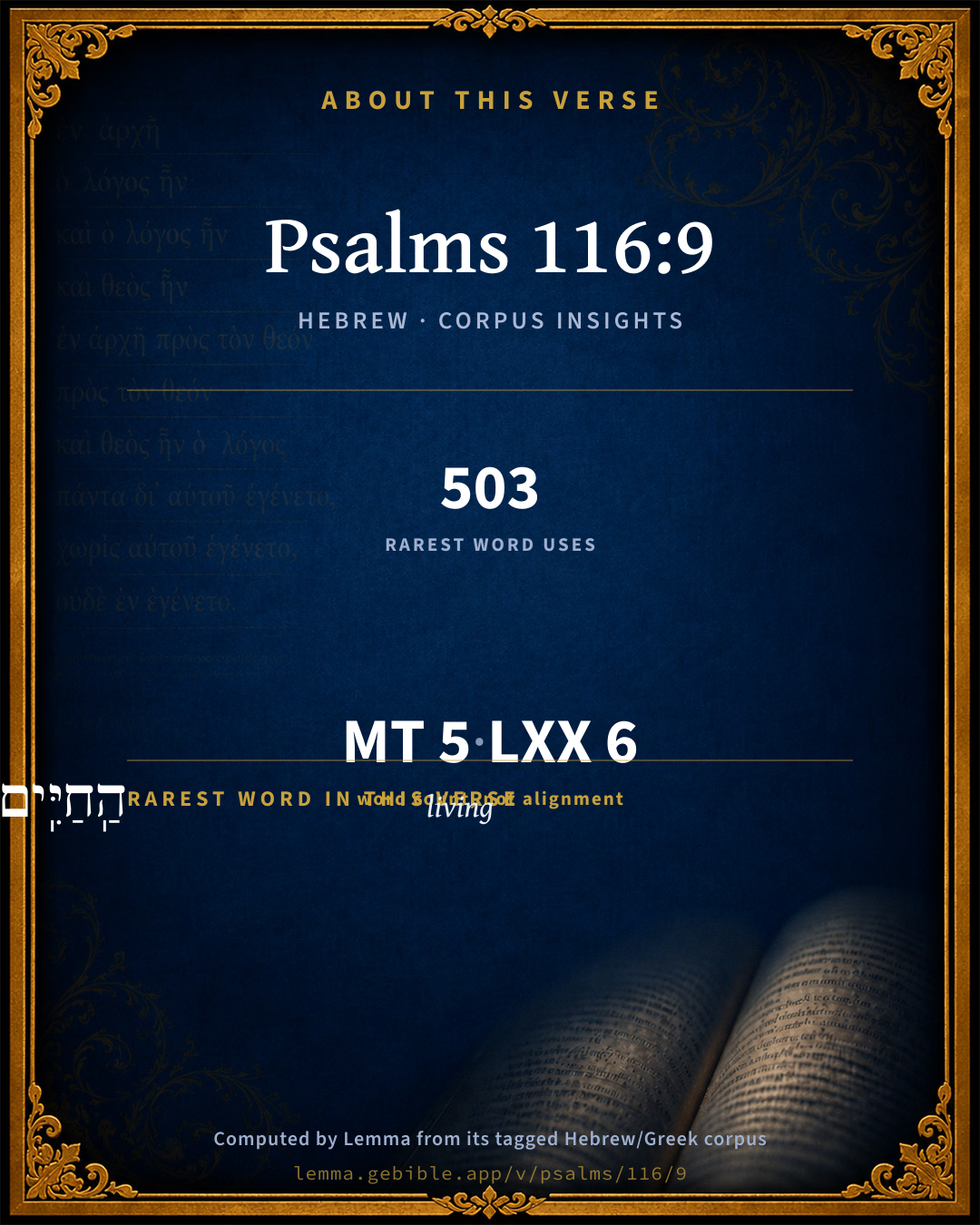
Psalms 116:9

Hebrew (Westminster Leningrad Codex) Psalms 116:9 appears in the Hebrew Old Testament. The text above is from the Westminster Leningrad Codex. Each word links to its Strong’s number, a concise gloss, and parsing drawn from the Open Scriptures Hebrew Bible morphology. Click any word for its full Brown-Driver-Briggs (BDB) entry.
Download image
Cite this verse

Psalms 116:9 (World English Bible). Public Domain. Lemma interlinear Bible study tool, https://lemma.gebible.app/v/psalms/116/9.

Show BibTeX & RIS
BibTeX
RIS
English Translation
I will walk before Yahweh in the land of the living.
World English Bible · Public Domain
Download a study sheet

One document with this verse’s original text, its word-by-word gloss line, the meaning frame, cross-references with their text, attributed commentary, and full source and license credits — printable, and it pastes into notes with its structure intact.

This verse Autodidact and up

Study sheet (.html) Plain text (.txt)

A passage Seminary Student

Up to 50 verses in one chapter. A passage sheet keeps up to 6 commentary sources and 12 cross-references per verse, in the order this page ranks them, and says so on the sheet whenever that leaves anything out. Ask for a single verse and you get the Autodidact verse sheet above.

Everything on this page stays free to read, with no account — the sheet is a download of what is already on screen, not access to it.

Want to remove ads? Support Godless Engineer
Compare translations 3

The same verse in 3 English versions, stacked beneath the original-language interlinear above. Click any original word for its lexicon entry.

Each is an independent rendering of the whole verse — the interlinear is not word-aligned to these translations.

Highlighted words mark where these versions differ — a whole-verse word diff, not a word-by-word alignment.

  • World English Bible Public Domain
    I will walk before Yahweh in the land of the living.
  • King James Version Public Domain
    I will walk before the LORD in the land of the living.
  • unfoldingWord Literal Text CC BY-SA 4.0
    I will walk to the face of Yahweh in the lands of the living.

unfoldingWord Literal Text — © unfoldingWord, licensed CC BY-SA 4.0. Word-aligned USFM3 via Door43 (git.door43.org/unfoldingWord/en_ult).

Versions to compare (up to 4)

3 of 4 selected

Show all 17 translations

Every available English version of this verse, each an independent rendering of the whole verse.

  • World English Bible Public Domain
    I will walk before Yahweh in the land of the living.
  • Berean Standard Bible Public Domain
    I will walk before the LORD in the land of the living.
  • Majority Standard Bible Public Domain
    I will walk before the LORD in the land of the living.
  • King James Version Public Domain
    I will walk before the LORD in the land of the living.
  • American Standard Version (1901) Public Domain
    I will walk before Jehovah In the land of the living.
  • Revised Version (1885) Public Domain
    I will walk before the LORD in the land of the living.
  • Geneva Bible (1599) Public Domain
    I shall walke before the Lord in the lande of the liuing.
  • Young's Literal Translation Public Domain
    I walk habitually before Jehovah In the lands of the living.
  • Literal Standard Version CC BY-SA 4.0
    I habitually walk before YHWH || In the lands of the living.
  • Unlocked Literal Bible CC BY-SA 4.0
    I will serve Yahweh in the land of the living.
  • unfoldingWord Literal Text CC BY-SA 4.0
    I will walk to the face of Yahweh in the lands of the living.
  • Darby Bible Public Domain
    I will walk before Jehovah in the land of the living.
  • World Messianic Bible Public Domain
    I will walk before the LORD in the land of the living.
  • Webster's Bible Public Domain
    I will walk before the LORD in the land of the living.
  • Free Bible Version CC BY-SA 4.0
    Now I can walk with the Lord in the land of the living.
  • Bible in Basic English Public Domain
    I will go before the Lord in the land of the living.
  • JPS Tanakh (1917) Public Domain
    I shall walk before the LORD in the lands of the living.

Literal Standard Version (2020), Covenant Press — licensed CC BY-SA 4.0. Text via the HelloAO Bible API (eBible.org). Unlocked Literal Bible (unfoldingWord) — licensed CC BY-SA 4.0. Text via the HelloAO Bible API (eBible.org). unfoldingWord Literal Text — © unfoldingWord, licensed CC BY-SA 4.0. Word-aligned USFM3 via Door43 (git.door43.org/unfoldingWord/en_ult). Free Bible Version, Dr. Jonathan Gallagher — licensed CC BY-SA 4.0. Text via the HelloAO Bible API (eBible.org).

Word by word

More ways to search: Search by grammar → Find every occurrence → Compare this word →

Practice this passage: Drill this verse → Learn its vocabulary →

הַֽחַיִּֽים
chay
H2416
“the · living”
Particle, Definite Article + Adjective, Adjective, Masculine, Plural, Absolute
Part of Speech
Particle + Adjective
Type
Adjective
Gender
Masculine
Number
Plural
State
Absolute
Full BDB Definition

Origin: from H2421

TWOT: 644a

living, alive (adjective) - green (of vegetation) - flowing, fresh (of water) - lively, active (of man) - reviving (of the springtime) - relatives (noun masculine) - life (abstract emphatic) (noun masculine) - life - sustenance, maintenance - living thing, animal (noun feminine) - animal - life - appetite - revival, renewal - community (noun feminine)
  1. אֶ֭תְהַלֵּךְ hâlak H1980 “to walk” Verb, Hithpael, Imperfect, 1st Person, Common, Singular
  2. לִפְנֵ֣י pânîym H6440 “to/for · face(s) of” Preposition + Noun, Common, Both, Plural, Construct
  3. יְהוָ֑ה Yᵉhôvâh H3068 “LORD” Noun, Proper
  4. בְּ֝אַרְצ֗וֹת ʼerets H776 “in/at · lands of” Preposition + Noun, Common, Both, Plural, Construct

About this verse

These counts appear in no published source. They are computed here, from the morphology-tagged text and Lemma’s own curated glosses. What Lemma adds →

5
words
5
distinct lemmas
Wisdom
section

Grammatical profile

  • 1 verb
  • 3 nouns
  • 1 adjective

Verb forms

  • אֶ֭תְהַלֵּךְ Hithpael · Imperfect

Hebrew & Septuagint length

In English translation the verse runs 11 words from the Hebrew and 14 from the Septuagint (LXX English) — closely comparable.

A rough comparison of the two English renderings, which tokenize alike — not a word-level alignment.

Word counts can differ between the Hebrew and the Greek without any difference in meaning — e.g. the Hebrew direct-object marker אֵת has no separate Greek word, and Greek often adds the article ὁ.

In the original languages it is 5 Hebrew tokens and 6 Greek tokens — but the two are counted differently (Hebrew bundles its prefixes and suffixes into one token; the Greek is in lemma form), so that isn’t a like-for-like length.

Cross-references

9

Topical passages linked to Psalms 116:9 in the Treasury of Scripture Knowledge — connected by theme and wording, ordered by reader-vote popularity; previews shown in the World English Bible.

  • Psalms 27:13 I am still confident of this: I will see the goodness of Yahweh in the land of the living.
  • Luke 1:75 In holiness and righteousness before him all the days of our life.
  • Genesis 17:1 When Abram was ninety-nine years old, Yahweh appeared to Abram, and said to him, "I am God Almighty. Walk before me, and be blameless.
  • 1 Kings 2:4 That Yahweh may establish his word which he spoke concerning me, saying, If your children take heed to their way, to walk before me in truth with all their heart and with all their soul, there shall not fail you (said he) a man on the throne of Israel.
  • 1 Kings 8:25 Now therefore, Yahweh, the God of Israel, keep with your servant David my father that which you have promised him, saying, There shall not fail you a man in my sight to sit on the throne of Israel, if only your children take heed to their way, to walk before me as you have walked before me.
  • 1 Kings 9:4 As for you, if you will walk before me, as David your father walked, in integrity of heart, and in uprightness, to do according to all that I have commanded you, and will keep my statutes and my ordinances;
  • Isaiah 53:8 By oppression and judgment he was taken away; and as for his generation, who [among them] considered that he was cut off out of the land of the living for the disobedience of my people to whom the stroke [was due]?
  • Psalms 61:7 He shall be enthroned in God's presence forever. Appoint your loving kindness and truth, that they may preserve him.
  • Luke 1:6 They were both righteous before God, walking blamelessly in all the commandments and ordinances of the Lord.

Cross-references courtesy of OpenBible.info (CC BY 4.0).

Hebrew and Greek witnesses Masoretic Hebrew ↔ Greek Septuagint

The same verse in the two great witnesses to the Old Testament, shown verse-for-verse.

You’re reading Greek Psalm 114 (Hebrew Psalm 116). The Septuagint counts the superscription, so verse numbers can differ from the Hebrew — chapter-level alignment, not verse-by-verse. Numbering follows Rahlfs.

These are two independent witnesses, not word-aligned to each other, and the Septuagint is shown in lemma (dictionary) form.

Hebrew Psalms 116:9 Masoretic · Westminster Leningrad Codex

אֶ֭תְהַלֵּךְ לִפְנֵ֣י יְהוָ֑ה בְּ֝אַרְצ֗וֹת הַֽחַיִּֽים

I will walk before Yahweh in the land of the living.

World English Bible · Public Domain

Greek LXX Greek Psalm 114:9 Septuagint · lemma form

εὐαρεστέω ἐναντίον κύριος ἐν χώρα ζάω

The house of Israel trusts in the Lord: he is their helper and defender.

LXX2012 (modern English Septuagint) · Public Domain

On this verse, Adam Clarke's Commentary discusses the Septuagint’s reading. Read the note in Commentary ↓

Hebrew: Westminster Leningrad Codex (CC BY 4.0). Greek: Septuagint (public domain); English from LXX2012 (modern English Septuagint) (Public Domain). How the Septuagint differs from the Hebrew →

Commentary

Notes on Psalms 116:9 from classic Christian and Jewish commentators (each source and its license shown beneath its notes). The classic Christian expositions comment on the surrounding passage and are grouped to its opening verse, so a note may address several verses; the Jewish commentaries on the Tanakh (Rashi and others) are per-verse, so they appear only where the commentator wrote on this verse.

Lemma curates 59 commentaries, every one of them public domain or Creative Commons licensed, each selected and text-cleaned for this edition rather than reprinted as found. About our sources →

Trapp's Complete Commentary

John Trapp

Psa 116:9 I will walk before the LORD in the land of the living.

Ver. 9. I will walk before the Lord] Indesinenter ambulabo. I will not only take a turn or two with God, go three or four steps with him, &c., but walk constantly and in all duties before him, with him, after him. Hypocrites do not walk with God, but halt with him, they follow him as a dog doth his master, till he comes by a carrion; they will launch no farther out into the main than they may be sure to return at pleasure safe again to the shore.

In the land] i.e. Here in this world, called also "the light of the living," Psa 56:13; Psa 52:5 Job 28:13.

John Trapp, A Commentary or Exposition upon All the Books of the Old and New Testament (1647–1656) — public domain. Text from a community e-Sword module.

The Biblical Illustrator

Joseph S. Exell

Psa_116:9

I will walk before the Lord in the land of the living.

The nature and necessity of good works

1. The matter of the duty in which the psalmist promiseth to engage--I will walk. It signifies the practice of what is good and lovely, as the words following intimate.

2. The manner in which he purposed to walk before the Lord, that is, in such a manner, that God, the searcher of hearts, would be pleased with it, and approve of it.

3. The place and time: while he continued on earth, and remained among the living.

I. Confirm the proposition, that inward affection to God must be declared by our outward conversation.

1. The one cannot be without the other.

2. This duty is frequently pressed in Scripture. Abraham; Noah; Zacharias; and Elizabeth.

3. Walking before the Lord has been abundantly rewarded. Enoch.

II. Show why our inward affection to God must be declared by our outward conversation.

1. In this way God is glorified.

2. Others are benefited.

3. Our own good is promoted. It is by a good conversation, that the security of our hearts, the integrity of our consciences, the soundness of our faith, and, in a word, the truth of all graces are clearly manifested, cherished, and increased.

III. Consider the necessity of good works.

1. They are commanded and expressly required by God Himself.

2. They are the way to the Kingdom of God.

3. They are an evidence or demonstration of our faith.

4. The not doing of them merits eternal death.

5. They are necessary as expressions of our gratitude.

IV. Conclusion.

1. This subject teacheth us that those who walk not in Gods ways cannot be esteemed His affectionate people.

2. The knowledge, affection and profession of persons who walk not before the Lord are all in vain.

3. Walking with God, in the external duties of religion, will best stop the mouths of the adversaries of the truth.

4. Those who walk not before the Lord in the land of the living are exposed to the most dreadful ruin. (G. Faitoute, M.A.)

The Christians walk before God

I. To walk before the Lord in the land of the living includes reconciliation with God as a pardoned sinner.

II. To walk before God in the land of the living requires a realizing sense of His presence and perfections.

III. To walk before God in the land of the living comprehends a supreme regard to the authority and the requirements of His Word.

IV. That we may walk before the Lord in the land of the living, we must have respect unto the recompense of reward. (J. Smyth, D.D.)

Walking before the Lord

I. To walk before the Lord is a style of speaking made use of to represent that manner of life peculiar to good men. It may be considered as including in it--

1. That men live under a lively impression of the presence of God.

2. The exercise of a sincere love to Him, and such friendly intercourse with Him as this imperfect state admits.

3. To live in dutiful and constant subjection to His will.

II. The excellence of such a course of life.

1. There is joy in it. If you are really desirous to know whether it be so, go and consult the words of Him who cannot lie. They say that gladness is sown for the upright in heart; that the voice of rejoicing is in the tabernacles of the righteous; that great peace have they who love Gods law; that everlasting joy shall be upon them. If you ask, again, how these things are so, they will reply, that the righteous rejoice before God; that their hearts rejoice in Him, because they have trusted in His holy name; that their rejoicing is this, the testimony of their conscience, that, in simplicity and godly sincerity, not in fleshly wisdom, but by the grace of God, they have their conversation in the world.

2. There is honour in it. There is a dignity connected with walking before the Lord superior to everything celebrated by that name among men. I will, says the Almighty, guide them with Mine eye. I will never leave them nor forsake them. I will be to them a God, and they shall be to Me a people.

3. There is a preparation for heaven in it. Every step they take in walking before the Lord in the land of the living is just so much progress in the path of life--every temptation overcome is a new advance to glory--every good disposition acquired will increase their happiness in the paradise of God. (W. F. Ireland, D.D.)

The Biblical Illustrator, edited by Joseph S. Exell (c. 1880s–1900s) — public domain. Text from a community e-Sword module.

Joseph Benson's Commentary

Psa 116:9. I will walk — Hebrew, אתהלךְ, ethhalleck, I will set myself to walk; before the Lord — I determine, in the strength of divine grace, to set him before me; to live as in his presence, and as under his eye; to speak and act in a manner becoming his presence, and the relation in which I stand to him as his servant and worshipper, his son and heir; to walk worthy of him unto all pleasing. It is the psalmist’s promise and resolution, in return for the blessings acknowledged in the preceding verse. In the land of the living — Among living men in this world. Observe, reader, the land of the living is a land of mercy, which we ought to be very thankful for; it is a land of opportunity, which we ought to improve; and the consideration that we are in this land should engage and quicken us to walk before God.

Joseph Benson's Commentary on the Old and New Testaments (1811–1818) — public domain. Text from a community e-Sword module.

J. A. Alexander on Psalms

Joseph Addison Alexander

9. (Psa 116:9) I will walk before Jehovah in the land of life (or of the living). This is also borrowed from Psa 56:13, with the substitution of land (literally lands) for light. Compare Psa 27:13. The hope here expressed is in contrast with Psa 115:17.

Joseph Addison Alexander, The Psalms Translated and Explained (1850) — public domain. Text from a community e-Sword module.

Tyndale Open Study Notes

Tyndale Open Resources

116:9 I walk in the Lord’s presence: The psalmist already lived with integrity, but since his experience of deep distress, he now enjoys open fellowship with the Lord (see 56:13; cp. Job 42:5).

Tyndale Open Study Notes — © Tyndale Open Resources, licensed CC BY-SA 4.0. Text via the HelloAO Bible API.

Geneva Bible (1599)

Geneva Bible translators

The Lord will preserve me, and save my life.

Geneva Bible (1599) marginal notes — public domain. Text via Bolls.life.

Adam Clarke's Commentary

Verse 9. I will walk before the Lord] אתהלך ethhallech, I will set myself to walk. I am determined to walk; my eyes are now brightened, so that I can see; my feet are strengthened, so that I can walk; and my soul is alive, so that I can walk with the living.

The Vulgate, the Septuagint, the AEthiopic, the Arabic, and the Anglo-Saxon end this Psalm here, which is numbered the cxivth; and begin with the tenth verse another Psalm, which they number cxvth; but this division is not acknowledged by the Hebrew, Chaldee, and Syriac.

Adam Clarke's Commentary on the Bible (1810–1826) — public domain. Text from a community e-Sword/MySword module.

John Calvin's Commentaries

9 I will walk in the presence of Jehovah. To walk in the presence of God is, in my opinion, equivalent to living under his charge. And thus David expects to enjoy his safety continually. For nothing is more desirable than that God should be upon the watch for us, that our life may be surrounded by his protecting care. The wicked, indeed, regard themselves as secure, the farther they are from God; but the godly consider themselves happy in this one thing, that he directs the whole tenor of their life. God adding, in the land of the living, he means to point out to us the course that we are expected to pursue; and that, almost every moment of time, fresh destructions press upon us, if he overlook us.

John Calvin's Commentaries (1540-1563) — public domain. Text from the Calvin Translation Society English edition (1840s-50s) via the Christian Classics Ethereal Library (ccel.org). Calvin's coverage is partial (roughly two-thirds of the Bible); uncommented books and verses are honest gaps, never fabricated. The 19th-century editor's footnotes and remarks are omitted so the notes are faithfully Calvin's own voice.

John Gill's Exposition

I will walk before the Lord in the land of the living. As in the sight of the omniscient God, according to his word and will, and in such manner as to please him. So Enoch's walking with God is by the apostle explained of pleasing him; compare Gen 5:22, and so the Septuagint, Vulgate Latin, and Arabic versions render it, "I will please the Lord"; or, as the Syriac and Ethiopic versions; "that I may please the Lord"; be grateful to him; or walk gratefully and acceptably before him, sensible of the obligations I am under to him: and this, in the strength of grace, he determined to do "in the land of the living"; in this world, where men live, and as long as he lived in it; or in the church of God, among the living in Jerusalem, with whom he resolved to walk in all the commandments and ordinances of the Lord. The land of Canaan is thought by Jarchi and Kimchi to be meant; and this being a type of heaven, the meaning may be, that he should walk and dwell where living and glorified saints are to all eternity; and so it is an expression of his faith of future glory and happiness, agreeably to what follows.

, and so the Septuagint, Vulgate Latin, and Arabic versions render it, "I will please the Lord"; or, as the Syriac and Ethiopic versions; "that I may please the Lord"; be grateful to him; or walk gratefully and acceptably before him, sensible of the obligations I am under to him: and this, in the strength of grace, he determined to do "in the land of the living"; in this world, where men live, and as long as he lived in it; or in the church of God, among the living in Jerusalem, with whom he resolved to walk in all the commandments and ordinances of the Lord. The land of Canaan is thought by Jarchi and Kimchi to be meant; and this being a type of heaven, the meaning may be, that he should walk and dwell where living and glorified saints are to all eternity; and so it is an expression of his faith of future glory and happiness, agreeably to what follows.

Psalms 116:10

psa 116:10

psa 116:10

psa 116:10I believed, therefore have I spoken,.... Here the Septuagint, Vulgate Latin, Arabic, and Ethiopic versions, begin a new psalm, but without any foundation in the original; nor is it countenanced by the Targum; and is manifestly against the connection with the preceding verses. David expresses his faith in relation to what goes before, though the particulars of it are not mentioned, but are left to be supplied from thence: he not only believed there was a God, but that this God was gracious and merciful, and that he was his God; who had made a covenant with him, ordered in all things, and sure: he believed the promises of it; and particularly the grand promise of it respecting Christ, and salvation by him: he believed the Lord would deliver him out of all his troubles; that he should walk before him, and see his goodness in the land of the living; he believed a future state of happiness he should hereafter enjoy. The Apostle Paul quotes this passage, and applies it to himself and other Gospel ministers; declaring their faith in the resurrection of the dead, and an eternal weight of glory they were looking for, Co2 4:13; and therefore spake so freely about these things. Faith gives boldness and freedom of speech to men; which believers use with God in prayer, in the believing views of him, as their God in Christ; and of Christ, his person, blood, righteousness, and sacrifice: it gives ministers boldness and freedom to speak out plainly, constantly, and boldly, the Gospel of Christ; it gives the same to private Christians, to speak freely one to another of their gracious experiences, and to declare publicly to the churches of Christ what God has done for their souls;

I was greatly afflicted; when he believed and spake, and yet nevertheless did; he might be afflicted, reproached, and persecuted for his faith, and his speaking of it; particularly as it respected his coming to the crown and kingdom of Israel. And it is no unusual thing for saints to be persecuted for their faith, and profession of it; and yet none of these things move them from it; their faith remains, and is much more precious than gold that perisheth; and they hold fast the profession of it. Many and great afflictions are the common lot of believers.

John Gill's Exposition of the Whole Bible (1746–1763) — public domain (CC PDM 1.0). Text via the HelloAO Bible API.

Albert Barnes' Notes on the Bible

I will walk before the Lord ... - Compare Psa 27:13, note; Isa 38:20, note. This expresses a full belief that he would live, and a purpose to live “before the Lord;” that is, as in his presence, in his service, and enjoying communion with him.

Albert Barnes' Notes on the Bible (1834–1885) — public domain. Text from a community e-Sword/MySword module.

Matthew Poole's English Annotations

I will walk before the Lord; or, I shall walk, &c. This is either,

1. The psalmist’s promise to God in requital of the favour last mentioned; I will therefore please God, as this phrase is used, Gen 5:24, compared with Heb 11:5; Gen 17:1. I will devote myself to the worship and service of God. Or,

2. His thankful acknowledgment of God’s further favour. Though I be now banished from the place of thy presence and worship, yet I assure myself that I shall be restored to it, and shall spend my days in thy house and service, which is the one thing that I desired above all other things, Psa 27:4.

In the land of the living; amongst living men of this world. See Poole "Psa 27:13".

Matthew Poole's English Annotations on the Holy Bible (1683–1685) — public domain. Text from a community e-Sword/MySword module.

The Treasury of David

Charles H. Spurgeon

Ver. 9. I will walk before the Lord in the land of the living. This is the Psalmist's second resolution, to live as in the sight of God in the midst of the sons of men. By a man's walk is understood his way of life: some men live only as in the sight of their fellow men, having regard to human judgment and opinion; but the truly gracious man considers the presence of God, and acts under the influence of his all observing eye. "Thou God seest me" is a far better influence than "My master sees me." The life of faith, hope, holy fear, and true holiness is produced by a sense of living and walking before the Lord, and he who has been favoured with divine deliverances in answer to prayer finds his own experience the best reason for a holy life, and the best assistance to his endeavours. We know that God in a special manner is nigh unto his people: what manner of persons ought we to be in all holy conversation and godliness?

Ver. 9. I will walk, etc. It is a holy resolution which this verse records. The previous verse had mentioned among the mercies vouchsafed, "Thou hast delivered my feet from falling"; and the first use of the restored limb is, I will walk before the LORD. It reminds me of the crippled beggar at the Beautiful Gate of the temple, to whom Peter had said, "In the name of Jesus Christ rise up and walk"; and "immediately his ankle bones received strength, and he leaping up stood and walked, and entered with them into the temple, walking, and leaping, and praising God." It is a very sure mark of a grateful heart to employ the gift to the praise of the giver, in such a manner as he would most wish it to be employed. Barton Bouchier.

Ver. 9. When you, my soul, return to this rest, thou shalt walk in order that thou mayest have some exercise in thy rest, that thy resting may not make thee restive. I will walk before the Lord in the land of the living. For now that my feet are delivered from falling, how can I better employ them than in walking? Were they delivered from falling that they should stand still and be idle? No, my soul, but to encourage me to walk: and where is so good walking as in the land of the living Alas! what walking is it in the winter, when all things are dead, when the very grass lies buried under ground, and scarce anything that has life in it is to be seen? But then is the pleasant walking, when nature spreads her green carpet to walk upon, and then it is the land of the living, when the trees shew they live, by bringing forth, if not fruits, at least leaves; when the valleys shew they live, by bringing forth sweet flowers to delight the smell, at least fresh grass to please the eyes. But is this the walking in the land of the living that David means? O my soul, to walk in the land of the living is to walk in the paths of righteousness: for there is no such death to the soul as sin, no such cause of tears to the eyes as guiltiness of conscience, no such falling of the feet as to fall from God: and therefore, to say the truth, the soul can never return to its rest if we walk not within in the paths of righteousness; and we cannot well say whether this rest be a cause of the walk, or the walking be a cause of the resting: but this we may say, they are certainly companions the one to the other, which is in effect but this that justification can never be without sanctification. Peace of conscience, and godliness of life, can never be one without the other. Or is it perhaps that David means that land of the living where Enoch and Elias are living, with the living God? But if he mean so, how can he speak so confidently, and say, "I will walk in the land of the living"? as though he could come to walk there by his own strength, or at his own pleasure? He therefore gives his reason: "I believed, and therefore I spake, "for the voice of faith is strong, and speaks with confidence; and because in faith he believes that he should come to walk in the land of the living, therefore with confidence lie speaks it, I will walk in the land of the living. Sir Richard Baker.

Ver. 9. I will walk before the LORD in the land of the living, i.e., I shall pass the whole of my life under his fatherly care and protection. The prophet has regard to the custom of men, and chiefly of parents: for those who ardently love their children have them always in their thoughts and carry them there, never ceasing from care and anxiety about them, but being always attentive to their safety. Omnis enim in natis chari stat cura parentis. Children are, therefore, said to walk before and in the sight of their parents, because they have them as constant guardians of their health and safety. Thus also the godly in this life walk before God, that is to say, are defended by his care and protection. Mollerus.

Ver. 9. I will walk before the LORD. According to a different reading of the first word, "I shall, "and, "I will, "the clause puts on several senses; if read "I shall walk, "they are words of confident expectation;if "I will, "they are words of obedient resolution. According to the former, the Psalmist promises somewhat to himself from God; according to the latter, he promises somewhat of himself to God. Both these constructions are probable and profitable. "Before God"; that is, in his service; or, "before God, "that is, under his care. Let us consider both senses.

1. I shall walk before the Lord in the land of the living; that is, by continuing in this world, I shall have opportunity of doing God service. It was not because those holy men had less assurance of God's love than we, but because they had greater affections to God's service than we, that this life was so amiable in their eyes. To this purpose the reasonings of David and Hezekiah concerning death and the grave are very observable. "Shall the dust praise thee? shall it declare thy truth"? so David, Ps 30:9. "The grave cannot praise thee, death cannot celebrate thee"; so Hezekiah, Isa 38:18. They saw death would render them useless for God's honour, and therefore they prayed for life.

It lets us see why a religious man may desire life, that he may walk before the LORD, and minister to him in the place wherein he hath set him. Indeed, that joy, hope, and desire of life which is founded upon this consideration is not only lawful, but commendable; and truly herein is a vast difference between the wicked and the godly. To walk in the land of the living is the wicked man's desire, yea, were it possible he would walk here for ever; but for what end? only to enjoy his lusts, have his fill of pleasure, and increase his wealth: whereas the godly man's aim in desiring to live is that he may "walk before God, "advance his glory, and perform his service. Upon this account it is that one hath fitly taken notice how David doth not say, I shall now satiate myself with delights in my royal city, but, I shall walk before the LORD in the land of the living.

2. And most suitably to this interpretation, this "before the LORD, "means under the Lord's careful eye. The words according to the Hebrew may be read, before the face of the LORD, by which is meant his presence, and that not general, before which all men walk, but special, before which only good men walk. Indeed, in this sense God's face is as much as his favour; and as to be cast out of his sight is to be under his anger, so to walk before his face is to be in favour with him: so that the meaning is, as the Psalmist had said, I shall live securely and safely in this world under the careful protection of the Almighty; and this is the confidence which he here seemeth to utter with so much joy, that God's gracious providence should watch over him the remainder of his days. Nathanael Hardy, in a Sermon entitled "Thankfulness in Grain, "1654.

Ver. 9. In the land of the living. These words admit of a threefold interpretation, being understood by some, especially for the land of Judea. By others, erroneously for the Jerusalem which is above. By the most, and most probably, for this habitable earth, the present world.

1. That exposition which Cajetan, Lorinus, with others, give of the words, would not be rejected, who conceive that by the land of the living David here meaneth Judea, in which, or rather over which being constituted king, he resolves to walk before God, and do him service. This is not improbably that "land of the living" in which the Psalmist when an exile "believed to see the goodness of the Lord"; this is certainly that "land of the living" wherein God promises to "set his glory"; nor was this title without just reason appropriated to that country. (1.) Partly, because it was a "land" which afforded the most plentiful supports and comforts of natural life, in regard of the wholesomeness of the climate, the goodness of the soil, the overflowing of milk and honey, with other conveniences both for food and delight. (2.) Chiefly, because it was the "land" in which the living God was worshipped, and where he vouchsafed to place his name; whereas the other parts of the world worshipped lifeless things, of which the Psalmist saith, "They have mouths, and speak not; eyes, and see not; ears, and hear not."

2. The land of the living is construed by the ancients to be that heavenly country, the place of the blessed. Indeed, this appellation does most fitly agree with heaven: this world is desertum mortuorum, a desert of dead, at least, dying men; that only is regio virorum, a region of living saints. "He who is our life" is in heaven, yea, "our life is hid with him in God, "and therefore we cannot be said to live till we come thither. In this sense no doubt that devout bishop and martyr, Babilas, used the words, who being condemned by Numerianus, the emperor, to an unjust death, a little before his execution repeated this and the two preceding verses, with a loud voice. Nor is it unfit for any dying saint to comfort himself with the like application of these words, and say in a confident hope of that blessed sight, I shall walk before the Lord in the land of the living.

3. But doubtless the literal and proper meaning of these words is of David's abode in the world;during which time, wheresoever he should be, he would "walk before God"; for that seems to be the emphasis of the plural number, lands, according to the original. The world consists of many countries, several lands, and it is possible for men either by force, or unwillingly, to remove from one country to another: but a good man when he changeth his country, yet altereth not his religion, yea, wherever he is he resolves to serve his God. Nathaniel Hardy.

Ver. 9. Land of the living. How unmeet, how shameful, how odious a thing is it that dead men should be here on the face of the earth, which is "the land of the living." That there are such is too true. "She that liveth in pleasure is dead while she liveth, "1Ti 5:6; Sardis had a name that she lived, but was dead, Re 3:1; "The dead bury their dead, "Mt 8:22; all natural men are "dead in sins, " Eph 2:1 2Co 5:14. William Gouge.

Ver. 9, 12, etc. The Hebrew word that is rendered walk, signifies a continued action, or the reiteration of an action. David resolves that he will not only take a turn or two with God, or walk a pretty way with God, as Orpah did with Ruth, and then take his leave of God, as Orpah did of her mother, Ru 1:10-15; but he resolves, whatever comes on it, that he will walk constantly, resolutely, and perpetually before God; or before the face of the Lord. Now, walking before the face of the Lord doth imply a very exact, circumspect, accurate, and precise walking before God; and indeed, no other walking is either suitable or pleasing to the eye of God. But is this all that he will do upon the receipt of such signal mercies? Oh no! for he resolves to take the cup of salvation, and to call upon the name of the Lord, and to offer the sacrifice of thanksgiving, Ps 116:13, 17. But is this all that he will do? Oh, no! for he resolves that he will presently pay his vows unto the Lord in the presence of all his people, Ps 116:14, 18. But is this all that he will do? Oh, no! for he resolves that he will love the Lord better than ever and more than ever, Ps 116:1-2. He loved God before with a real love, but having now received such rare mercies from God, he is resolved to love God with a more raised love, and with a more inflamed love, and with a more active and stirring love, and with a more growing and increasing love than ever. Thomas Brooks.

Ver. 9. The effect of deliverance upon ourselves: "I will walk, " etc.

1. Walk by faith in him.

2. Walk in love with him.

3. Walk by obedience to him. G. R.

Psalms 116:10*

Charles H. Spurgeon's The Treasury of David (1869–1885) — public domain. Psalms only. Text from a community e-Sword/MySword module.

The Pulpit Commentary

I will walk before the Lord in the land of the living; rather, lands of the living; i.e. my deliverance will enable me to walk at leisure, unhurried and free from care, in the broad regions of earth inhabited by the living.

The Pulpit Commentary (1880–1919), ed. H.D.M. Spence-Jones & Joseph S. Exell — public domain. Text from a community e-Sword module.

unfoldingWord translationNotes

Door43 World Missions Community

General Information:

The person who composed this psalm continues to speak.

in the land of the living

"in this world where people are alive." This is in contrast to the place of the dead.

I am greatly afflicted

This can be stated in active form. AT: "I suffer greatly" or "People afflict me very much" (See: Active or Passive)

In my confusion I said

"I said too quickly" or "I said without considering"

All men are liars

"Every person is a liar" or "All people are liars"

translationWords

servant

Yahweh

life

believe

afflicted

unfoldingWord translationNotes — © Distant Shores Media and the Door43 World Missions Community, licensed CC BY-SA 4.0. Source: git.door43.org/Door43/en_tn.

Rashi

Rabbi Shlomo Yitzchaki (Rashi)

in the lands of the living The land of Israel, for my enemies and my pursuers chased me out of it in the days of Saul, and against their will, I returned.

Rashi on the Tanakh — English translations: “The Judaica Press complete Tanach with Rashi, translated by A. J. Rosenberg” (CC BY 4.0); “Pentateuch with Rashi's commentary by M. Rosenbaum and A.M. Silbermann, 1929-1934” (public domain); “The Metsudah Tanach series, Lakewood, N.J” (CC BY 4.0); and “The Book of Joshua, Metsudah Publications, 1997” (CC BY 4.0). Text via Sefaria.

Lesson kit

Teaching starters — assembled from the data on this page, not authored interpretation. Every prompt links to the verse data it draws on. Edit before teaching.

Psalms, in the Wisdom, opens this verse with 5 words (5 distinct Hebrew lemmas). Its most distinctive word is chay (“living”). A historical commentator’s framing appears above. Read the whole chapter for the surrounding context.

Discussion questions

  1. The word chay carries the sense “living.” How does it shape the verse?
  2. How does Psalms 27:13, which shares this passage’s theme, read alongside this verse?
  3. The translations on this page render this verse differently — a whole-verse word diff, not a word-by-word alignment. What might account for the different wordings?
  4. «אֶ֭תְהַלֵּךְ» is a Hithpael Imperfect verb. How does that grammatical form shape the action described?
  5. Compare how Trapp's Complete Commentary and The Biblical Illustrator read this verse. Where do they agree or differ?

Things to notice

Reading settings

Reading text

Shown beneath each verse's original-language words.

Old Testament
Old Testament edition

Read the OT as the Masoretic Hebrew (MT) or the Greek Septuagint (LXX).

English shown for the Greek Septuagint (in the Hebrew ↔ Greek comparison).

Comparing translations? Open the Compare panel on any verse page to stack up to four side by side.