

Job 13:16

Hebrew (Westminster Leningrad Codex) Job 13:16 appears in the Hebrew Old Testament. The text above is from the Westminster Leningrad Codex. Each word links to its Strong’s number, a concise gloss, and parsing drawn from the Open Scriptures Hebrew Bible morphology. Click any word for its full Brown-Driver-Briggs (BDB) entry.
Download image
Cite this verse

Job 13:16 (World English Bible). Public Domain. Lemma interlinear Bible study tool, https://lemma.gebible.app/v/job/13/16.

Show BibTeX & RIS
BibTeX
RIS
English Translation
This also shall be my salvation, That a godless man shall not come before him.
World English Bible · Public Domain
Download a study sheet

One document with this verse’s original text, its word-by-word gloss line, the meaning frame, cross-references with their text, attributed commentary, and full source and license credits — printable, and it pastes into notes with its structure intact.

This verse Autodidact and up

Study sheet (.html) Plain text (.txt)

A passage Seminary Student

Up to 50 verses in one chapter. A passage sheet keeps up to 6 commentary sources and 12 cross-references per verse, in the order this page ranks them, and says so on the sheet whenever that leaves anything out. Ask for a single verse and you get the Autodidact verse sheet above.

Everything on this page stays free to read, with no account — the sheet is a download of what is already on screen, not access to it.

Want to remove ads? Support Godless Engineer
Compare translations 3

The same verse in 3 English versions, stacked beneath the original-language interlinear above. Click any original word for its lexicon entry.

Each is an independent rendering of the whole verse — the interlinear is not word-aligned to these translations.

Highlighted words mark where these versions differ — a whole-verse word diff, not a word-by-word alignment.

  • World English Bible Public Domain
    This also shall be my salvation, That a godless man shall not come before him.
  • King James Version Public Domain
    He also shall be my salvation: for an hypocrite shall not come before him.
  • unfoldingWord Literal Text CC BY-SA 4.0
    Even this for salvation to me: that the godless will not enter to his face.

unfoldingWord Literal Text — © unfoldingWord, licensed CC BY-SA 4.0. Word-aligned USFM3 via Door43 (git.door43.org/unfoldingWord/en_ult).

Versions to compare (up to 4)

3 of 4 selected

Show all 18 translations

Every available English version of this verse, each an independent rendering of the whole verse.

  • World English Bible Public Domain
    This also shall be my salvation, That a godless man shall not come before him.
  • Berean Standard Bible Public Domain
    Moreover, this will be my salvation, for no godless man can appear before Him.
  • Majority Standard Bible Public Domain
    Moreover, this will be my salvation, for no godless man can appear before Him.
  • King James Version Public Domain
    He also shall be my salvation: for an hypocrite shall not come before him.
  • American Standard Version (1901) Public Domain
    This also shall be my salvation, That a godless man shall not come before him.
  • Revised Version (1885) Public Domain
    This also shall be my salvation; for a godless man shall not come before him.
  • Geneva Bible (1599) Public Domain
    He shalbe my saluation also: for the hypocrite shall not come before him.
  • Douay-Rheims (1899) Public Domain
    And he shall be my saviour: for no hypocrite shall come before his presence.
  • Young's Literal Translation Public Domain
    Also -- He `is' to me for salvation, For the profane cometh not before Him.
  • Literal Standard Version CC BY-SA 4.0
    Also—He [is] to me for salvation, || For the profane do not come before Him.
  • Unlocked Literal Bible CC BY-SA 4.0
    This will be the reason for my deliverance, for no godless person would come before him.
  • unfoldingWord Literal Text CC BY-SA 4.0
    Even this for salvation to me: that the godless will not enter to his face.
  • Darby Bible Public Domain
    This also shall be my salvation, that a profane man shall not come before his face.
  • World Messianic Bible Public Domain
    This also will be my salvation, that a godless man will not come before him.
  • Webster's Bible Public Domain
    He also shall be my salvation: for a hypocrite shall not come before him.
  • Free Bible Version CC BY-SA 4.0
    By doing this I will be saved since no godless person could come before him.
  • Bible in Basic English Public Domain
    And that will be my salvation, for an evil-doer would not come before him,
  • JPS Tanakh (1917) Public Domain
    This also shall be my salvation, that a hypocrite cannot come before Him.

Literal Standard Version (2020), Covenant Press — licensed CC BY-SA 4.0. Text via the HelloAO Bible API (eBible.org). Unlocked Literal Bible (unfoldingWord) — licensed CC BY-SA 4.0. Text via the HelloAO Bible API (eBible.org). unfoldingWord Literal Text — © unfoldingWord, licensed CC BY-SA 4.0. Word-aligned USFM3 via Door43 (git.door43.org/unfoldingWord/en_ult). Free Bible Version, Dr. Jonathan Gallagher — licensed CC BY-SA 4.0. Text via the HelloAO Bible API (eBible.org).

Word by word

More ways to search: Search by grammar → Find every occurrence → Compare this word →

Practice this passage: Drill this verse → Learn its vocabulary →

About this verse

These counts appear in no published source. They are computed here, from the morphology-tagged text and Lemma’s own curated glosses. What Lemma adds →

9
words
8
distinct lemmas
Wisdom
section

Notable vocabulary

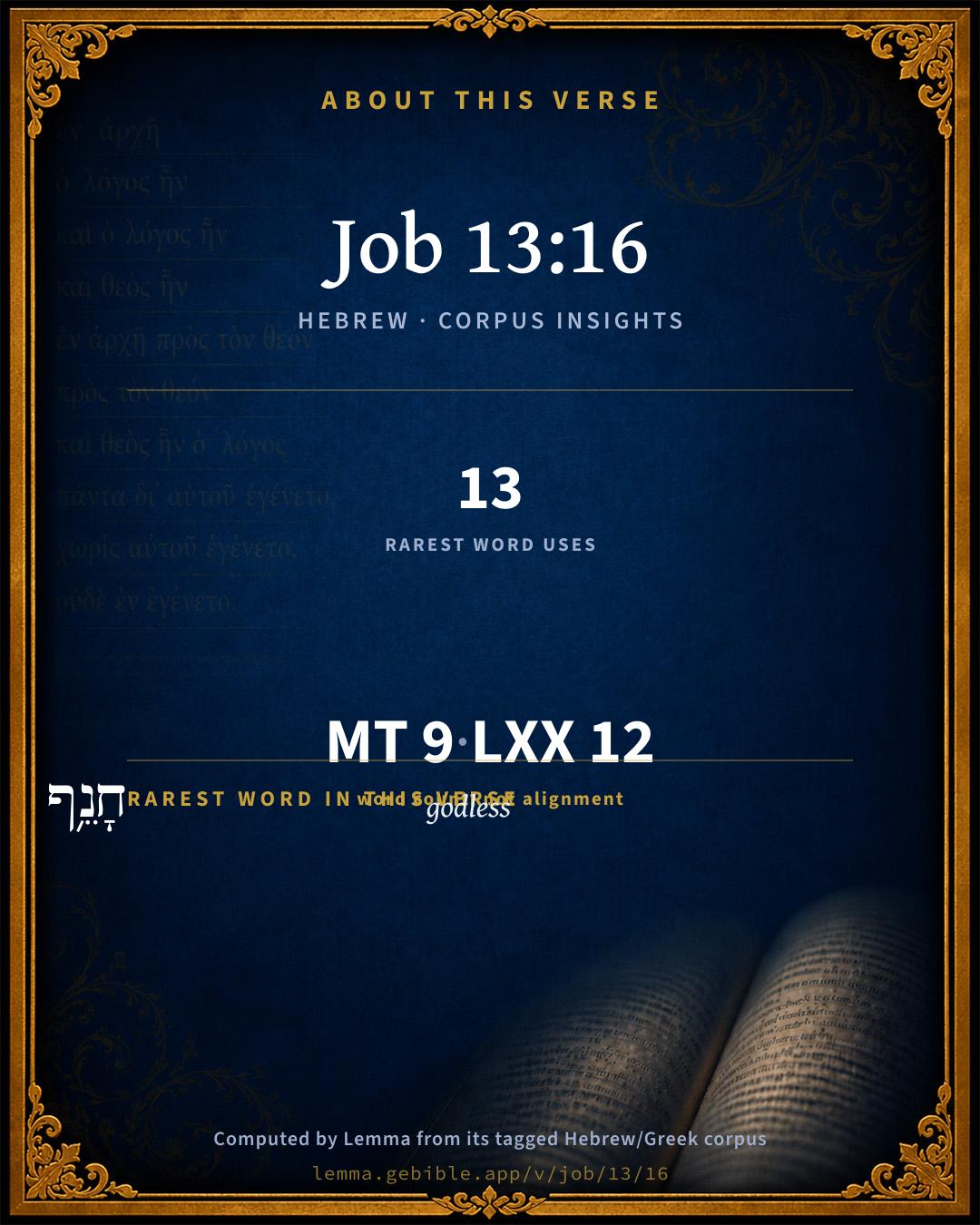
The rarest word here is חָנֵ֥ף godless H2611 — appearing just 13 times in the whole Hebrew Bible.

Shared distinctive vocabulary

חָנֵ֥ף godless H2611 occurs in 13 verses of the Hebrew Bible. Also found in:

Grammatical profile

  • 1 verb
  • 2 nouns
  • 1 adjective
  • 1 pronoun
  • 1 preposition
  • 1 conjunction
  • 2 particles

Verb forms

  • יָבֽוֹא Qal · Imperfect

Hebrew & Septuagint length

In English translation the verse runs 15 words from the Hebrew and 16 from the Septuagint (LXX English) — closely comparable.

A rough comparison of the two English renderings, which tokenize alike — not a word-level alignment.

Word counts can differ between the Hebrew and the Greek without any difference in meaning — e.g. the Hebrew direct-object marker אֵת has no separate Greek word, and Greek often adds the article ὁ.

In the original languages it is 9 Hebrew tokens and 12 Greek tokens — but the two are counted differently (Hebrew bundles its prefixes and suffixes into one token; the Greek is in lemma form), so that isn’t a like-for-like length.

Cross-references

12

Topical passages linked to Job 13:16 in the Treasury of Scripture Knowledge — connected by theme and wording, ordered by reader-vote popularity; previews shown in the World English Bible.

  • Isaiah 12:1–2 In that day you will say, "I will give thanks to you, Yahweh; for though you were angry with me, your anger has turned away and you comfort me.
  • Psalms 118:21 I will give thanks to you, for you have answered me, And have become my salvation.
  • Isaiah 33:14 The sinners in Zion are afraid; trembling has seized the godless ones: Who among us can dwell with the devouring fire? who among us can dwell with everlasting burning?
  • Exodus 15:2 Yah is my strength and song, He has become my salvation: This is my God, and I will praise him; My father's God, and I will exalt him.
  • Job 8:13 So are the paths of all who forget God. The hope of the godless man shall perish,
  • Job 27:8–10 For what is the hope of the godless, when he is cut off, When God takes away his life?
  • Job 36:13 "But those who are godless in heart lay up anger. They don't cry for help when he binds them.
  • Psalms 27:1 Yahweh is my light and my salvation. Whom shall I fear? Yahweh is the strength of my life. Of whom shall I be afraid?
  • Psalms 62:6–7 He alone is my rock and my salvation, my fortress. I will not be shaken.
  • Psalms 118:14 Yah is my strength and song. He has become my salvation.
  • Jeremiah 3:23 Truly in vain is [the help that is looked for] from the hills, the tumult on the mountains: truly in Yahweh our God is the salvation of Israel.
  • Acts 13:47 For so has the Lord commanded us, saying, 'I have set you as a light for the Gentiles, That you should bring salvation to the uttermost parts of the earth.'"

Cross-references courtesy of OpenBible.info (CC BY 4.0).

Hebrew and Greek witnesses Masoretic Hebrew ↔ Greek Septuagint

The same verse in the two great witnesses to the Old Testament, shown verse-for-verse.

These are two independent witnesses, not word-aligned to each other, and the Septuagint is shown in lemma (dictionary) form.

Hebrew Job 13:16 Masoretic · Westminster Leningrad Codex

גַּם הוּא לִ֥י לִֽישׁוּעָ֑ה כִּי לֹ֥א לְ֝פָנָ֗יו חָנֵ֥ף יָבֽוֹא

This also shall be my salvation, That a godless man shall not come before him.

World English Bible · Public Domain

Greek LXX Job 13:16 Septuagint · lemma form

καί οὗτος ἐγώ ἀποβαίνω εἰς σωτηρία οὐ γάρ ἐναντίον αὐτός δόλος εἰςἔρχομαι

And this shall turn to me for salvation; for fraud shall have no entrance before him.

LXX2012 (modern English Septuagint) · Public Domain

On this verse, Trapp's Complete Commentary discusses the Septuagint’s reading. Read the note in Commentary ↓

Hebrew: Westminster Leningrad Codex (CC BY 4.0). Greek: Septuagint (public domain); English from LXX2012 (modern English Septuagint) (Public Domain). How the Septuagint differs from the Hebrew →

Commentary

Notes on Job 13:16 from classic Christian and Jewish commentators (each source and its license shown beneath its notes). The classic Christian expositions comment on the surrounding passage and are grouped to its opening verse, so a note may address several verses; the Jewish commentaries on the Tanakh (Rashi and others) are per-verse, so they appear only where the commentator wrote on this verse.

Lemma curates 59 commentaries, every one of them public domain or Creative Commons licensed, each selected and text-cleaned for this edition rather than reprinted as found. About our sources →

Trapp's Complete Commentary

John Trapp

Job 13:16 He also [shall be] my salvation: for an hypocrite shall not come before him.

Ver. 16. He also shall be my salvation] So long as I judge myself God will not judge me, 1Co 11:32; nay, he will surely save me: for God will save the humble person, Job 22:29. What is humiliation but humility exercised? (Merlin in loc.) Non est igitur inanis electorum fides res evanida nec infirma, saith an interpreter here; Therefore the faith of God’s elect is no empty or vain thing, but a light shining from the Spirit of God, and such as overcometh the very darkness of death. It is a sure testimony of God’s good will toward us, and an infallible persuasion of our salvation, such as slighteth the world’s false censures, overcometh temptations of all sorts, laugheth at death, and through the thickest darkness of affliction beholdeth the pleased face of God in Christ, through whom we have boldness and access with confidence by the faith of him, Eph 2:12.

For an hypocrite shall not come before him] No, that is a privilege proper to the communion of saints; therefore I am no hypocrite, as you have charged me to be, Job 4:6; Job 8:13; for I dare both offer to maintain my ways before him to be upright for the main, and I doubt not but he will be my salvation, and that I shall appear before him in heaven: this no hypocrite shall ever do. Coram Deo dolus non ingreditur. How should he (say), when as he is an unclean wretch, as the Hebrew word signifieth; flagitious (so Vatablus rendereth it); a flagitious, impious person, a very fraud (so the Septuagint); a fair professor indeed, but a foul sinner, moiled all over, and even buried in a bog of wickedness. He is a wicked man in a godly man’s clothes, saith one. He doth but assume religion, saith another, as the devils do dead bodies without a soul to animate them. He is like the painted grapes that deceived the living birds; or the golden apples with this motto, No further than colours; touch them, and they vanish. He knows that he is naught, and that God knows it too; how then should he approach him, or appear before his throne? No, he dare not, for the very show of his face doth testify against him, as the prophet speaks in another case; or if he do, he shall not be able to subsist there, Psa 5:5; he shall not stand in judgment, Psa 1:5, but shall run away with these or the like words in his mouth, "Who among us shall dwell with the devouring fire? who among us shall dwell with everlasting burnings?" Isa 33:14. "Woe unto us! who shall deliver us out of the hands of this mighty God?" 1Sa 4:8. None, for he shall surely assign you a part with the devil and hypocrites, Mat 24:51; when as the righteous shall give thanks unto God’s name, and the upright only shall dwell in his presence, Psa 140:13.

John Trapp, A Commentary or Exposition upon All the Books of the Old and New Testament (1647–1656) — public domain. Text from a community e-Sword module.

The Biblical Illustrator

Joseph S. Exell

Job_13:16

For an hypocrite shall not come before Him.

The several sorts of hypocrisy

Jobs friends urged that because God had grievously afflicted him, he must needs have been a very wicked man. Job in reply maintains his innocency. He insists that God afflicts for other reasons, in His own good pleasure. He is sure that God cannot expect from him a false confession, or that his proceedings should be justified by any wrong supposition. God will, in the end, distinguish His faithful servant from the hypocrite. The word hypocrite is here used in opposition to such a sincere person as can maintain his own ways before God.

1. The greatest and highest degree of hypocrisy is when men, with a formed design and deliberate intention, endeavour under a pretence of religion and an appearance of serving God, to carry on worldly and corrupt ends. Such were the Scribes and Pharisees, whom our Saviour denounced. The apostles describe the same kind of hypocrisy in the characters of the worst men who were in following ages to arise in the Church (2Ti_3:2; Tit_1:16; 1Ti_4:2; Tit_1:11; Tit_3:10; 2Pe_2:1). This then is the highest degree of hypocrisy, and the word is now generally used in this worst sense.

2. There are those who do not absolutely mean to cast off all religion, nor dare in their own hearts totally to despise it; but yet willingly content themselves with the formal part of it, and by zealously observing certain outward rites and ceremonies, think to atone for great defects of sobriety, righteousness, and truth. Of the same species of hypocrisy are they guilty in all ages who make the advancement of religion and the increase of the kingdom of Christ to consist chiefly in the external, temporal, or worldly prosperity of those who are called by His name.

3. A lower degree of hypocrisy is the behaviour of those who have indeed right notions of religion, but content themselves with vain resolutions of future repentance, and for the present live securely in the practice of sin. Against this hypocrisy, this deceitfulness of sin, our Saviour warns us (Mat_24:42).

4. The lowest degree of hypocrisy is that of those who not only have right notions of religion and a due sense of the indispensable necessity of repentance and reformation hereafter, but even at present have some imperfect resolutions of immediate obedience, and even actual but yet ineffectual endeavours after it (Rom_7:19; comp. Mat_13:5; Mat_13:20). It is no better than a secret hypocrisy to account ourselves righteous for not being guilty of other faults, while the false heart indulges itself in any one known habitual sin, and speaks peace to itself by attending, only to one part of its own character. The use of what has been said is that from hence every man may learn not to judge his neighbour, who to his own master standeth or falleth, but to examine seriously the state of his own heart. Which, whosoever does, carefully and impartially, and with the true spirit of a Christian, will find little reason to be censorious upon others. (S. Clarke, D. D.)

The Biblical Illustrator, edited by Joseph S. Exell (c. 1880s–1900s) — public domain. Text from a community e-Sword module.

Joseph Benson's Commentary

Job 13:16. He also shall be my salvation — I rest assured that he will save me out of these miseries, sooner or later, one way or other, if not with a temporal, yet with an eternal salvation after death; of which he speaks Job 19:25. For a hypocrite — Or, rather, But a hypocrite shall not come before him — If I were a hypocrite, as you allege, I durst not present myself before him to plead my cause with him, as now I desire to do, nor could I hope for any salvation from or with him in heaven.

Joseph Benson's Commentary on the Old and New Testaments (1811–1818) — public domain. Text from a community e-Sword module.

Geneva Bible (1599)

Geneva Bible translators

Whereby he declareth that he is not an hypocrite as they charged him.

Geneva Bible (1599) marginal notes — public domain. Text via Bolls.life.

Jamieson, Fausset & Brown

Robert Jamieson, A. R. Fausset & David Brown

He--rather, "This also already speaks in my behalf (literally, 'for my saving acquittal') for an hypocrite would not wish to come before Him" (as I do) [UMBREIT]. (See last clause of Job 13:15).

Jamieson, Fausset & Brown — Commentary Critical and Explanatory on the Whole Bible (1871) — public domain (CC PDM 1.0). Text via the HelloAO Bible API.

Adam Clarke's Commentary

Verse 16. He also shall be my salvation] He will save me, because I trust in him.

A hypocrite] A wicked man shall never be able to stand before him. I am conscious of this, and were I, as you suppose, a secret sinner, I should not dare to make this appeal.

Adam Clarke's Commentary on the Bible (1810–1826) — public domain. Text from a community e-Sword/MySword module.

Ellicott's Commentary for English Readers

(16) He also shall be my salvation.—Comp. Psa_27:1, &c. It is characteristic of Job that, living, as he probably did, outside the pale of Israel, he nevertheless shared the faith and knowledge of God’s chosen people; and this cannot be said of any other nation, nor docs any literature give evidence of it. Indeed, it is this which most markedly distinguishes Job from his friends, in that he can and does trust God unreservedly, in spite of all adverse circumstances, overwhelming as they were; while his friends are ignorant of the great central fact that He is Himself the sinner’s hope, and are content to rest only upon vague and bald generalities. It is because, therefore, he has said, and can say, “He is and will be my salvation,” that he can also say, “I know that I shall be justified, that I am righteous, because I trust in Him” (Gen_15:6). We do not, in thus speaking, import the Gospel into Job, but exhibit that in Job which had already been manifest in Abraham, and probably recorded of him.

A Bible Commentary for English Readers, edited by Charles John Ellicott (1878–1897) — public domain. Text from a community e-Sword module.

The Cambridge Bible for Schools and Colleges

gen. ed. J. J. S. Perowne

16. He also shall be] Rather, this also.

for a hypocrite shall not] Rather, that a godless man will not; see on ch. Job_8:13. A godless man will not dare to go before God; but Job dares and desires; and this courage, sweet evidence to himself of his innocence, he says will be his salvation, that is, will secure him victory in his plea with God. He hardly distinguishes between his own consciousness of innocence and his innocence itself and the proof of it. He is so conscious of it that he is sure it will appear before God, cf. Job_13:18 and the passage ch. Job_27:8 foll.

The Cambridge Bible for Schools and Colleges (gen. ed. J. J. S. Perowne; Cambridge University Press, 1878–1918) — public domain. Text from a community e-Sword module.

John Gill's Exposition

He also shall be my salvation,.... Job, though he asserted the integrity of his heart and life, yet did not depend on his ways and works for salvation, but only on the Lord himself; this is to be understood not of temporal salvation, though God is the author of that, and it is only to be had of him, yet Job had no hope concerning that; but of spiritual and eternal salvation, which God the Father has contrived, determined, and resolved on, and sent his Son to effect; which Christ being sent is the author of by his obedience, sufferings, and death; and in him, and in his name alone, is salvation; and every soul, sensible of the insufficiency of himself and others to save him, will resolve, as Job here, that he, and he only, shall be his Saviour, who is an able, willing, and complete one; see Hos 14:3; and the words are expressive of faith of interest in him. Job knew him to be his Saviour, and living Redeemer, and would acknowledge no other; but claim his interest in him, now and hereafter, and which was his greatest support under all his troubles; see Job 19:26;

for an hypocrite shall not come before him; a hypocrite may come into the house of God, and worship him externally, and seem to be very devout and religious; and he shall come before the tribunal of God, and stand at his bar, to be tried and judged; but he shall not continue in the presence of God, nor enjoy his favour, or he shall not be able to make his cause good before him; and indeed he does not care to have himself examined by him, nor shall he be saved everlastingly, but undergo the most severe punishment, Mat 24:51. Job here either has respect to his friends, whom he censures as hypocrites, and retorts the charge upon they brought on him; or he has reference to that charge, and by this means clears himself of it, since there was nothing he was more desirous of than to refer his case to the decision of the omniscient God, and righteous Judge; which if he was an hypocrite he would never have done, since such can never stand so strict and severe an examination.

John Gill's Exposition of the Whole Bible (1746–1763) — public domain (CC PDM 1.0). Text via the HelloAO Bible API.

Albert Barnes' Notes on the Bible

He also shalt be my salvation - See the notes at Isa 12:2. Literally, “He is unto me for salvation,” that is, “I put my trust in him, and he will save me. The opportunity of appearing before God, and of maintaining my cause in his presence, will result in my deliverance from the charges which are alleged against me. I shall be able there to show that I am not a hypocrite, and God will become my defender.”

For an hypocrite shall not come before him - This seems to be a proverb, or a statement of a general and indisputable principle. Job admitted this to be true. Yet he expected to be able to vindicate himself before God, and this gould prove that he was not an hypocrite - on the general principle that a man who was permitted to stand before God and to obtain his favor, could not be an unrighteous man. To God he looked with confidence; and God, he had no doubt, would be his defender. This fact would prove that he could not be an hypocrite, as his friends maintained.

Albert Barnes' Notes on the Bible (1834–1885) — public domain. Text from a community e-Sword/MySword module.

Haydock's Catholic Bible Commentary

Hypocrite. If I were such, I should not dare to appeal so boldly to his tribunal. (Calmet)

George Leo Haydock (1774–1849), Haydock's Catholic Family Bible and Commentary, 1859 edition — public domain. Excludes Psalms (Douay-Rheims chapter numbering differs from Protestant) and Deuterocanonical books (Catholic canon only).

Matthew Poole's English Annotations

I rest assured that he will save me out of these miseries sooner or later, one way or other, if not with a temporal, yet with an eternal salvation after death; of which he speaks Job 19:25, &c.

For; or but, as this particle commonly signifies; for this clause is put by way of opposition to the former, and the sense is, But if I were a hypocrite, as you allege, I durst not present myself before him to plead my cause with him, as now I desire to do, nor could I hope for any salvation from or with him in heaven.

Matthew Poole's English Annotations on the Holy Bible (1683–1685) — public domain. Text from a community e-Sword/MySword module.

Whedon's Commentary on the Bible

Daniel D. Whedon

16. He… my salvation — He, God, not this, as some read. “Job reassures himself with the thought that God cannot reveal himself to the wicked.” — Renan. If then God accepts his challenge, it will be a virtual concession of his innocence.

Second strophe — Fixed in his determination to enter the lists with Deity, Job first pleads with God that he should forego the advantages omnipotence gives, so that his servant may have a fair and just trial, Job_13:17-22.

Daniel D. Whedon (gen. ed.), Commentary on the Old and New Testaments (1874–1909) — public domain. Text from a community e-Sword module.

The Pulpit Commentary

He also shall be my Salvation. Whatever God does to him (ver. 13), whatever burden he lays upon him, though he even "slay" him (ver. 15), yet Job is sure that ultimately, in one way or another, God will be his Salvation. It is this determined trustfulness which at once gives Job"s character its strength, and atones in a certain sense for his over-boldness in challenging God to a controversy. His heart is right with God. Though the secrets of the unseen world have been hidden from him, and the condition of man after death is a mystery on which he can only form vague conjectures, yet he is sure that in the end God will not fail him. For a hypocrite shall not come before him. If he were a hypocrite the case would be different; he would tremble before God, instead of feeling confident. But, knowing that he is honest and true, he is not afraid; he is bold to "come before him," and plead his cause before him.

The Pulpit Commentary (1880–1919), ed. H.D.M. Spence-Jones & Joseph S. Exell — public domain. Text from a community e-Sword module.

unfoldingWord translationNotes

Door43 World Missions Community

Connecting Statement:

Job finishes speaking to his friends and begins to address God directly.

This will be the reason for my deliverance

The abstract noun "deliverance" can be expressed with the verb "deliver." AT: "This is the reason that God will deliver me" or "This is why God will save me from my troubles" (See: Abstract Nouns)

God, listen carefully

Job begins directing his speech directly to God.

listen carefully to my speech; let my declaration come to your ears

These two lines mean basically the same thing and intensify Job's request for God to listen to him. (See: Parallelism)

let my declaration come to your ears

The abstract noun "declaration" can be expressed with the verb "declare." The ears represent listening. AT: "listen to my declaration" or "listen to what I declare" (See: Abstract Nouns and Metonymy)

translationWords

acquit

godly

God

unfoldingWord translationNotes — © Distant Shores Media and the Door43 World Missions Community, licensed CC BY-SA 4.0. Source: git.door43.org/Door43/en_tn.

Rashi

Rabbi Shlomo Yitzchaki (Rashi)

He is also Just as I am wholehearted with Him, so is He also my salvation, but you will not find favor in His eyes.

because a hypocrite cannot come before Him This is what was said to them (below 42:7): “because you did not speak to Me properly.”

Rashi on the Tanakh — English translations: “The Judaica Press complete Tanach with Rashi, translated by A. J. Rosenberg” (CC BY 4.0); “Pentateuch with Rashi's commentary by M. Rosenbaum and A.M. Silbermann, 1929-1934” (public domain); “The Metsudah Tanach series, Lakewood, N.J” (CC BY 4.0); and “The Book of Joshua, Metsudah Publications, 1997” (CC BY 4.0). Text via Sefaria.

Lesson kit

Teaching starters — assembled from the data on this page, not authored interpretation. Every prompt links to the verse data it draws on. Edit before teaching.

Job, in the Wisdom, opens this verse with 9 words (8 distinct Hebrew lemmas). Its most distinctive word is chânêph (“godless”). A historical commentator’s framing appears above. Read the whole chapter for the surrounding context.

Discussion questions

  1. What does “godless” (chânêph) contribute to the verse as a whole?
  2. Job 8:13 shares the word «godless» with this verse. How do the two illuminate each other?
  3. These translations render this verse differently. What is at stake in choosing one wording over another?
  4. The verb «יָבֽוֹא» is Qal Imperfect. How does its form color the action?
  5. Reading how Trapp's Complete Commentary and The Biblical Illustrator read this verse, where do the two commentators agree and where do they part?

Things to notice

Reading settings

Reading text

Shown beneath each verse's original-language words.

Old Testament
Old Testament edition

Read the OT as the Masoretic Hebrew (MT) or the Greek Septuagint (LXX).

English shown for the Greek Septuagint (in the Hebrew ↔ Greek comparison).

Comparing translations? Open the Compare panel on any verse page to stack up to four side by side.