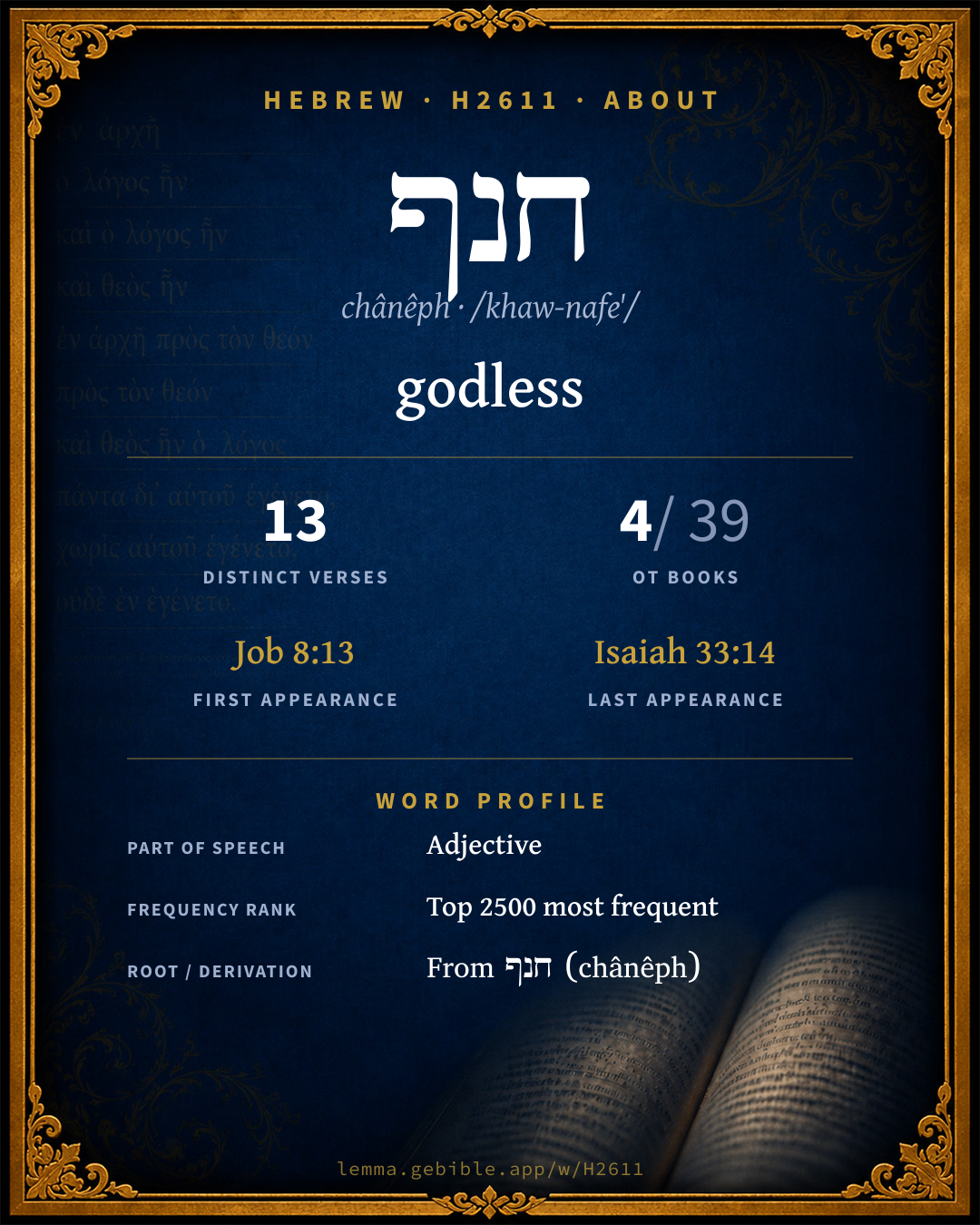
חָנֵף
godless
Full lexicon entry — Brown-Driver-Briggs (BDB)
From Brown-Driver-Briggs (BDB)
Where this word appears
See every Absolute-state word in the Hebrew Bible →
Grammar key — what these labels mean
Part of speech
- Adjective
- A word that describes or qualifies a noun.
State
- Absolute
- The independent form of a noun, not bound to a following word.
- Construct
- A noun bound to a following noun in a possessive / “of” relationship (the construct chain).
Gender
- Masculine
- Grammatically masculine.
Number
- Singular
- One.
- Plural
- More than one (in Hebrew, generally three or more).
Grammatical forms
- Adjective, Adjective, Masculine, Singular, Absolute 10 times (77%)
- Adjective, Adjective, Masculine, Plural, Construct 2 times (15%)
- Adjective, Adjective, Masculine, Plural, Absolute 1 time (8%)
Parsed forms decoded from the imported morphology (morphhb / Westminster Leningrad Codex — WLC text public domain, morphhb tagging CC BY 4.0), counted across 13 parsed occurrences — not distinct verses.
Every verse where H2611 appears — 13 distinct verses across 4 books. Click any verse to open its interlinear word-by-word view. Verse text shown in the World English Bible for context — . Each verse’s Hebrew form is shown with its reference; the English is not keyword-highlighted, since the data carries no word-level English alignment. Use “Compare translations” on any verse to read it across multiple English versions. This concordance covers the Hebrew Bible; Septuagint (Greek Old Testament) occurrences are not indexed here.
Job 8 verses
- Job 8:13 חָנֵ֣ף adj Adjective ms So are the paths of all who forget God. The hope of the godless man shall perish,
- Job 13:16 חָנֵ֥ף adj Adjective ms This also shall be my salvation, That a godless man shall not come before him.
- Job 15:34 חָנֵ֣ף adj Adjective ms For the company of the godless shall be barren, And fire shall consume the tents of bribery.
- Job 17:8 חָנֵ֥ף adj Adjective ms Upright men shall be astonished at this. The innocent shall stir up himself against the godless.
- Job 20:5 חָנֵ֣ף adj Adjective ms That the triumphing of the wicked is short, The joy of the godless but for a moment?
- Job 27:8 חָ֭נֵף adj Adjective ms For what is the hope of the godless, when he is cut off, When God takes away his life?
- Job 34:30 חָנֵ֗ף adj Adjective ms That the godless man may not reign, That there be no one to ensnare the people.
- Job 36:13 וְֽ/חַנְפֵי conj + Adjective Adjective mp cs "But those who are godless in heart lay up anger. They don't cry for help when he binds them.
Psalms 1 verse
Proverbs 1 verse
Isaiah 3 verses
- Isaiah 9:17 חָנֵ֣ף adj Adjective ms Therefore the Lord will not rejoice over their young men, neither will he have compassion on their fatherless and widows; for everyone is profane and an evil-doer, and every mouth speaks folly. For all this his anger is not turned away, but his hand is stretched out still.
- Isaiah 10:6 חָנֵף֙ adj Adjective ms I will send him against a profane nation, and against the people of my wrath will I give him a charge, to take the spoil, and to take the prey, and to tread them down like the mire of the streets.
- Isaiah 33:14 חֲנֵפִ֑ים adj Adjective mp The sinners in Zion are afraid; trembling has seized the godless ones: Who among us can dwell with the devouring fire? who among us can dwell with everlasting burning?
About this entry
At a glance — auto-summarized from this page’s data, not written by a person. Every figure links to its source below. This summary describes the numbers; it doesn’t interpret them.
חנף — transliterated chânêph — is a Hebrew adjective carrying the sense “godless.” More than half of its appearances fall in Job. It appears 13 verses across 4 books of the Hebrew Bible, among its uncommon vocabulary. Its earliest occurrence is Job 8:13. It shares a root with חנף, חנף and חנפה. Each statement above links to its evidence; the full detail follows below.
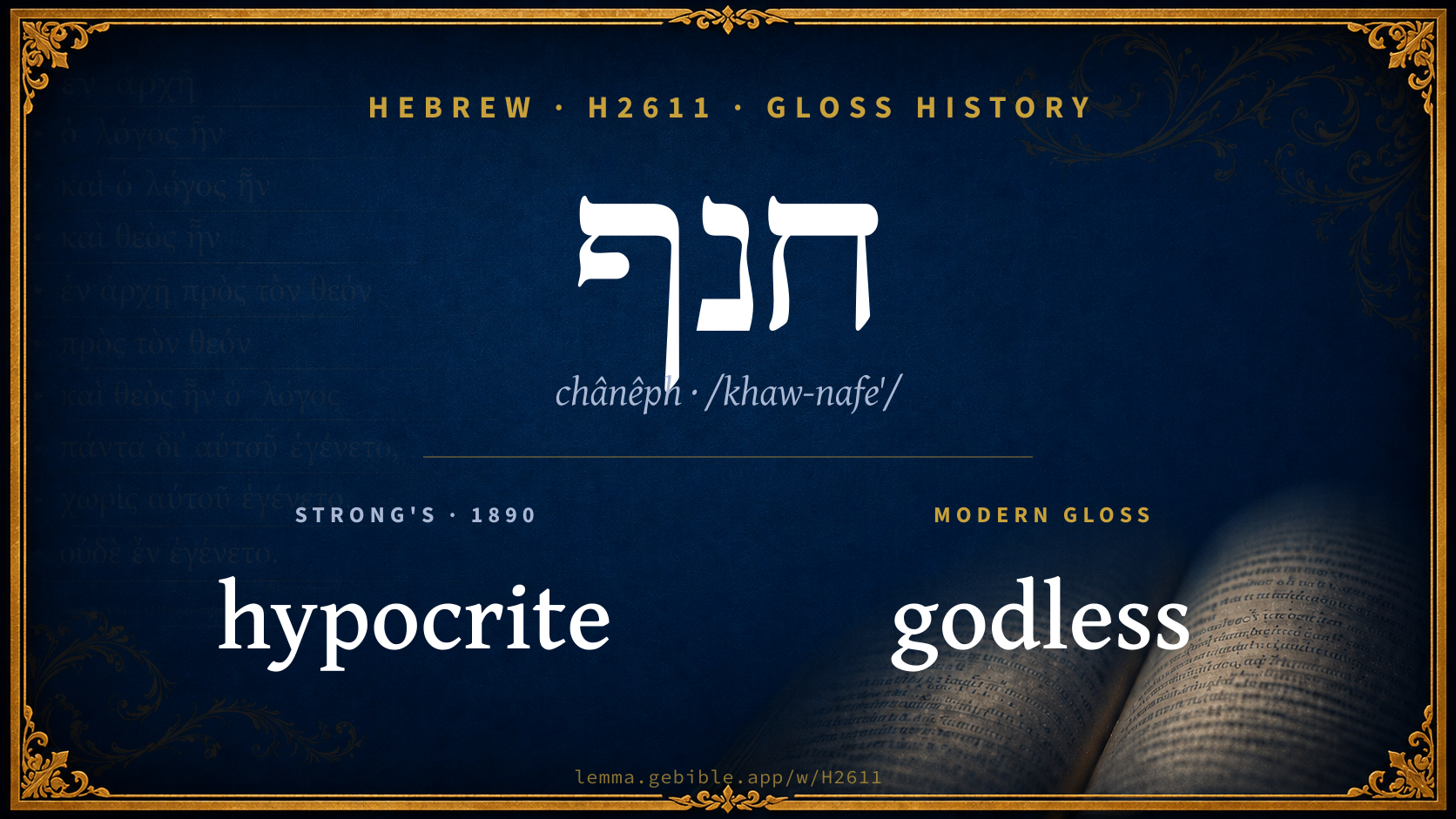
Gloss history
Strong's 1890 vs modern scholarship
About this word
Strong's H2611 catalogs a Hebrew word from the Hebrew Old Testament.
These counts are not copied from any lexicon or concordance. They are computed here, from the morphology-tagged Hebrew Old Testament. What Lemma adds →
- 13
- distinct verses
- The word appears in 13 distinct verses.
- 4 / 39
- OT books
- The word appears in 4 of 39 Old Testament books.
- #2,001
- by frequency
- Top 2500 most frequent Hebrew words (rank 2,001 of 8,640 Hebrew words by occurrence).
View all 13 occurrences in the concordance →
By section of the Old Testament
By traditional corpus
Conventional, traditional groupings — biblical authorship is debated, so this is a traditional corpus grouping, not an authorship claim. Each share is this word’s portion of its verses in that division of the Hebrew canon. Each figure is a share of the word’s 13 distinct verses.
- Writings (Ketuvim) 10 verses · 77%
- Prophets (Nevi'im) 3 verses · 23%
How translations render this word
Counts come from each version’s own published word-to-Strong’s tagging or interlinear alignment — an approximate guide to how each version renders this word, not a word-level alignment the data otherwise carries. Because each total is that version’s own tagged count, the per-version totals vary from one another and need not match the appearance or distinct-verse counts above. These counts may also differ from a printed concordance because Lemma counts each distinctly tagged rendering and does not collapse phrase taggings into a single head-word total. This is a fixed set of word-tagged versions (KJV, ASV, BSB, ULT) and does not change with the reading translation you choose elsewhere. Each version’s license is shown beside its name below (and on Sources).
BDB lists this Strong’s number as 2 distinct words (homographs). Each count above pools all of them and is not split by sense — see the Senses section below. A low-frequency rendering may belong to a different one of those words, not the primary meaning.
- King James Version†: Hypocrite 4×, Hypocrites 3×
- American Standard Version†: Godless 7×
- Berean Standard Bible†: Godless 7×
- unfoldingWord Literal Text†: Godless 10×
King James Version Public Domain
Renders H2611 across 12† tagged occurrences — most commonly:
Plus 5 renderings that appear only once — usually multi-word phrases or single function words the recovered tagging swept in, not distinct renderings. Not rendered by a distinct English word in 1 further occurrence.
American Standard Version Public Domain
Renders H2611 across 12† tagged occurrences — most commonly:
Plus 5 renderings that appear only once — usually multi-word phrases or single function words the recovered tagging swept in, not distinct renderings.
Berean Standard Bible Public Domain
Renders H2611 across 13† tagged occurrences — most commonly:
Plus 6 renderings that appear only once — usually multi-word phrases or single function words the recovered tagging swept in, not distinct renderings.
unfoldingWord Literal Text CC BY-SA 4.0
Renders H2611 across 14† tagged occurrences — most commonly:
Plus 4 renderings that appear only once — usually multi-word phrases or single function words the recovered tagging swept in, not distinct renderings.
Senses in the full BDB
Hebrew verbs can shift meaning by stem (binyan): Qal is the basic action, Niphal is often passive or reflexive, Piel often intensifies or makes it factitive, and Hiphil is typically causative. The senses below are grouped under the stem BDB assigns to each.
What do BDB’s symbols mean?
BDB uses these scholarly abbreviations:
| Symbol | Meaning |
|---|---|
| 𝔊 | the Septuagint (the ancient Greek translation, LXX) |
| 𝔙 | the Vulgate (the Latin translation) |
| 𝔖 | the Syriac version (the Peshitta) |
| 𝔗 | the Targum (the Aramaic translation) |
| ψ | the Psalms |
| √ | root (the underlying root or stem) |
| ‖ | parallel passage (a synonymous or contrasted parallel) |
| † | the dagger: every passage where the word occurs is cited |
The 6 senses and sub-senses the full Brown-Driver-Briggs lexicon distinguishes for this word, in lexicon order (not ranked by frequency), with BDB’s own verbatim wording and sub-sense lettering. Shown in Hebrew script with BDB’s own scholarly abbreviations. The condensed entry is in the Lexicon Entry tab. See also the Forms in the corpus table below.
חנף I
Qal
- Pf. 3 fs. חָֽנְפָה Is 24:5; 3 pl. חָנֵפ֑וּ Je 23:11; Impf. 3 fs. תֶּחֱנַף Je 3:1; תֶּחֱנָ֑ף Mi 4:11; וַתֶּחֱנַף Je 3:9 ψ 106:38; Inf. abs. חָנוֹף Je 3:1;— e.g. Isaiah 24:5
- 1. be polluted: of land Is 24:5; Je 3:1(×2) ψ 106:38; of Zion Mi 4:11. e.g. Isaiah 24:5
- 2. of prophet and priest = be חָנֵף (cf. infr.) i.e. profane, godless Je 23:11.—Je 3:9 appar. trans. וַתֶּחֱנַף את הארץ, Gf del. את, Gie cites Ges§ 121, 1, but read rather Hiph. וַתַּחֲנֵף with Codd. 𝔊 Ew al. (v. also Gf Gie). e.g. Jeremiah 23:11
Hiphil
- Impf. יַחֲנִיף Nu 35:33; Dn 11:32; 2 fs. וַתַּחֲנִ֫יפִי Je 3:2; 2 mpl. תַּחֲנִ֫יפוּ;— e.g. Numbers 35:33
- 1. pollute: the land Nu 35:33(×2) (by blood; P), Je 3:2 (by idolatry, etc.) + Je 3:9 (v. supr.) e.g. Numbers 35:33
- 2. make profane, godless Dn 11:32 c. acc. pers. e.g. Daniel 11:32
חנף II ofane, irreligious (Syriac ܚܰܢܦܳܐ profane, hence often heathen, apostate
Senses from the full Brown-Driver-Briggs lexicon (Brown, Driver, Briggs; Oxford 1906 — public domain), digitized via Sefaria, supplemented by the OpenScriptures HebrewLexicon (CC BY 4.0). Full attribution on Sources.
Word origin
I. vb. be polluted, profane (Arabic حَنَفَ incline, decline, hence حَنِيفٌ inclining to a right state, but in Heb. of inclining away from right, irreligion, profaneness, cf. حَنِفَ have a حَنَفٌ i.e. distortion of foot; Syriac in deriv. be profane, etc.; NH Hiph., Aramaic Aph. act falsely toward, flatter, חֲנוּכָּה hypocrisy; Assyrian ḫanpu, ruthlessness; ḫanâpu, exercise ruthlessness toward, Tel Amarna ZimZA vi. 1891, 256)—
II. adj. profane, irreligious (Syriac ܚܰܢܦܳܐ profane, hence often heathen, apostate; Arabic حَنِيفٌ inclining to a right state, especially the true religion, a Muslim)—abs. ח׳ Jb 8:13 + 10 times; pl. חֲנֵפִים Is 33:14; חַנְפֵי Jb 36:13 ψ 35:16;—profane, godless: of persons, אָדָם ח׳ Jb 34:30; גּוֹי ח׳ Is 10:6; as subst. godless man Is 9:16 (‖ מרע) Jb 8:13; 13:16; 17:8; 20:5; 27:8; Pr 11:9; coll. עֲדַת ח׳ Jb 15:34; pl. Is 33:14; חַנְפֵי־לֵב Jb 36:13; בְּחַנְפֵי לַעֲגֵי מָעוֹג ψ 35:16 as profane men, mockers for cake (i.e. table-jesters; on cstr. v. Ges§ 130, 5), but text dub. (v. Checrit. n. Bae).
— Brown-Driver-Briggs (Oxford 1906, public domain), digitized via Sefaria, supplemented by the OpenScriptures HebrewLexicon (CC BY 4.0). See Sources.
Derived from חנף (chânêph) (H2610) — to be profaned.
Jastrow Dictionary
A second Hebrew/Aramaic lexicon for comparison, covering Aramaic and post-biblical (Talmudic, Targumic, Midrashic) usage that the biblical-Hebrew BDB does not. Matched by lemma rather than by Strong’s number, so a lemma may carry more than one Jastrow headword (shown separately below), and the entries cover usage well beyond the Bible.
חָנַף
- (b. h.) [to bend, decline from the right path,] to be insincere, to flatter; to show favor in court; to deceive. Der. Er. Zuta ch. II אֶחְנוֹף לזה וכ׳ I will flatter (lower myself before) this one that he may give me to eat &c.
- same. Sot. 41ᵇ הִחְנִיפוּ לו וכ׳ thy flattered Agrippa (saying to him, ‘Thou art our brother’). Ib. מותר להַחְנִיף וכ׳ it is permissible to flatter (submit to the power of) the wicked &c. Y. Ber. VII, 11ᶜ. Pesik. R. s. 25 (ref. to Is. XXIV, 5) הבריות מַהֲנִיפִים זה לזה men deal insincerely with one another; והוא מַחֲנִיפוֹ וכ׳ and he puts him (the priest or Levite) off with deceptive intent, and says &c.; a. fr. e.g. Isaiah 24:5
חֲנֵף
- , Pa. חַנֵּיף ch. same. M. Kat. 17ᵃ דאפי׳ … לא חַנִּיפִי ליה not even a man like thee did I flatter. Shebu. 30ᵃ לחַנּוּפֵי ליה that I should favor him in court?—Keth. 84ᵇ מְחַנְּפִיתוּ להו would you favor them?; ib. 63ᵇ מַחְנִיפִיתוּ ליה (Af.) would you favor him?—Pesik. Asser, p. 98ᵃ (ref. to Is. XXIV, 5) את סבר מְחַנְּפָא לה והיא מְחַנְּפָה לך thou meanest to deceive it (the land by withholding the tithes, v. preced.), but it will disappoint thee; Tanḥ. R’eeh 14 את כבר מחנף וכ׳ (corr. acc.). e.g. Isaiah 24:5
- same, v. supra.
חָנֵף
- preced. wds.) hypocrite, flatterer; faithless, arbitrary, fickle. Esth. R. to I, 1 (ref. to Job XXXIV, 30) בשעה שהמלך ח׳ וכ׳ when a king is arbitrary and rules tyrannically &c. Ib. שהיה ח׳ וכ׳ for he (Ahasverus) was arbitrary, for he put to death &c.—Pl. חֲנֵפִים, חֲנֵפִין, חֲנֵי׳. Tosef. Yoma V (IV), 12; Yoma 86ᵇ מפרסמין את החנ׳ וכ׳ you may expose the hypocrites to prevent defamation of the divine Name. Koh. R. to IV, 1 חֲנֵיפֵי תורה pretenders of scholarship. Sot. 42ᵃ; Treat. Der. Er. ch. II. Ib. חֲנֵפוֹת (masc., v. מָסוֹר); a. e. e.g. Job 34:30
A Dictionary of the Targumim, the Talmud Babli and Yerushalmi, and the Midrashic Literature (Marcus Jastrow; London, Luzac, 1903) — Public Domain. Digitized via Sefaria. Digitized via Sefaria. Full attribution on Sources.
Forms in the corpus
The 8 distinct written forms H2611 takes in the Hebrew Bible, most frequent first — each parse links to that state’s occurrences in the concordance. Hebrew forms include their vowel points and cantillation, so a single lemma takes many written forms.
| Form | Parsing | Example | Uses |
|---|---|---|---|
| חָנֵ֣ף | Adjective, Adjective, Masculine, Singular, Absolute | Isaiah 9:17 | 4 |
| חָ֭נֵף | Adjective, Adjective, Masculine, Singular, Absolute | Job 27:8 | 2 |
| חָנֵ֥ף | Adjective, Adjective, Masculine, Singular, Absolute | Job 13:16 | 2 |
| בְּ֭/חַנְפֵי | Adjective, Adjective, Masculine, Plural, Construct | Psalms 35:16 | 1 |
| וְֽ/חַנְפֵי | Adjective, Adjective, Masculine, Plural, Construct | Job 36:13 | 1 |
| חֲנֵפִ֑ים | Adjective, Adjective, Masculine, Plural, Absolute | Isaiah 33:14 | 1 |
| חָנֵ֗ף | Adjective, Adjective, Masculine, Singular, Absolute | Job 34:30 | 1 |
| חָנֵף֙ | Adjective, Adjective, Masculine, Singular, Absolute | Isaiah 10:6 | 1 |
Same root — word family
Other BDB entries built from the same root as H2611, grouped by Strong’s listed origin. These share a root / origin per the lexicon — not necessarily a shared meaning. Each links to that word’s own entry.
Derives from
Shares the same root
Compare all same-root words → They share a root, not necessarily a meaning.
Septuagint verse parallels
This word appears in 12 verses that also exist in the Greek Old Testament (Septuagint), out of the 13 Hebrew verses it occurs in. You can read those verses in Greek by switching the Old Testament edition to the Septuagint.
Read these verses in the Septuagint
This is a verse-level parallel only — the same verses exist in both the Hebrew and Greek Old Testaments. No word-level Hebrew↔Greek correspondence is claimed: the data carries no such alignment, so no Greek word is shown as this Hebrew word’s translation. Coverage is not total — the Septuagint omits the deuterocanon and renumbers the Psalms, so some Hebrew verses have no direct Greek parallel.