
Psalms 35:16

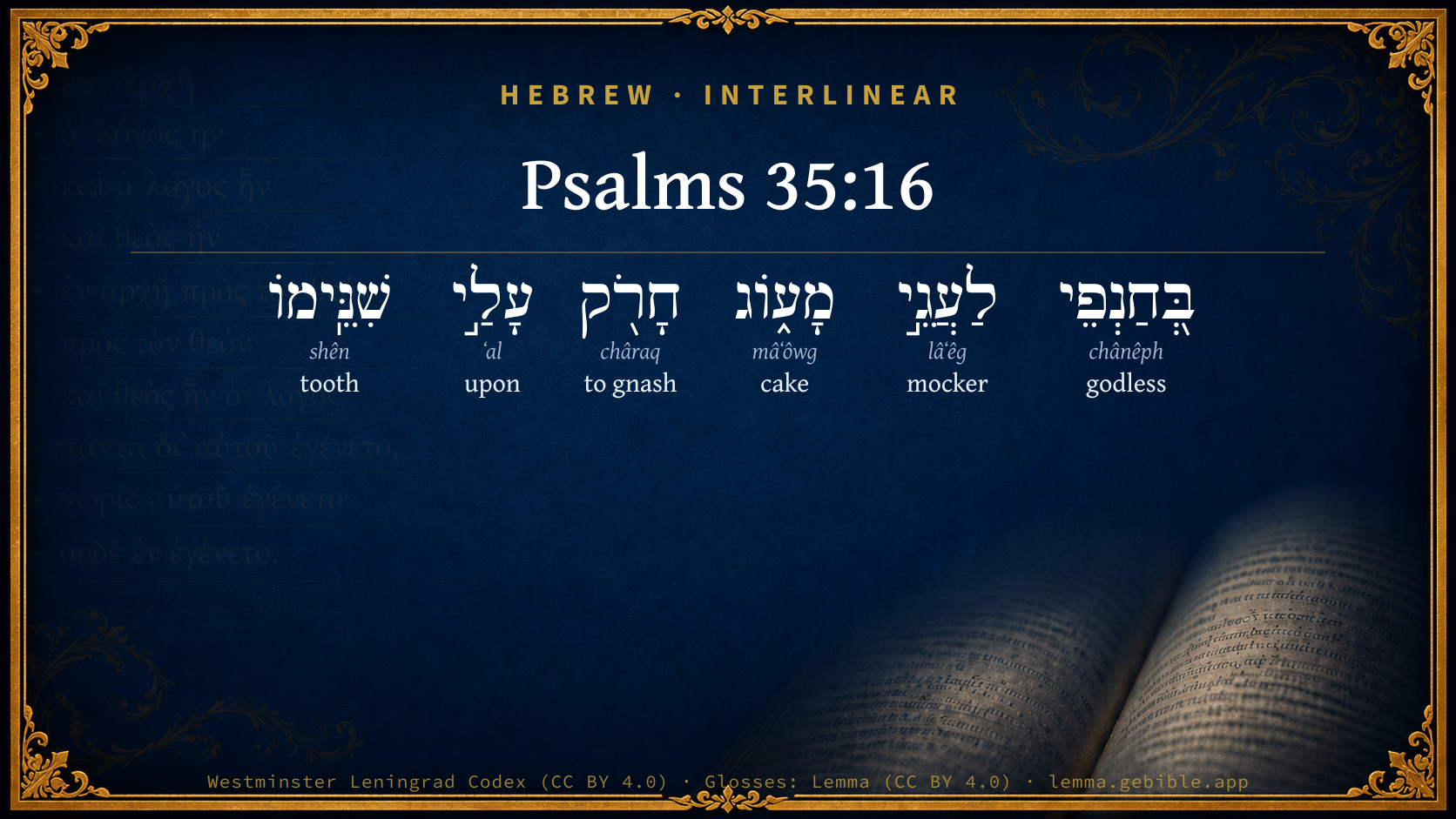
Hebrew (Westminster Leningrad Codex) Psalms 35:16 appears in the Hebrew Old Testament. The text above is from the Westminster Leningrad Codex. Each word links to its Strong’s number, a concise gloss, and parsing drawn from the Open Scriptures Hebrew Bible morphology. Click any word for its full Brown-Driver-Briggs (BDB) entry.
Download image
Cite this verse

Psalms 35:16 (World English Bible). Public Domain. Lemma interlinear Bible study tool, https://lemma.gebible.app/v/psalms/35/16.

Show BibTeX & RIS
BibTeX
RIS
English Translation
Like the profane mockers in feasts, They gnashed their teeth at me.
World English Bible · Public Domain
Highlights
  • 1 first appearance in the Hebrew Bible
Full analysis ↓
Download a study sheet

One document with this verse’s original text, its word-by-word gloss line, the meaning frame, cross-references with their text, attributed commentary, and full source and license credits — printable, and it pastes into notes with its structure intact.

This verse Autodidact and up

Study sheet (.html) Plain text (.txt)

A passage Seminary Student

Up to 50 verses in one chapter. A passage sheet keeps up to 6 commentary sources and 12 cross-references per verse, in the order this page ranks them, and says so on the sheet whenever that leaves anything out. Ask for a single verse and you get the Autodidact verse sheet above.

Everything on this page stays free to read, with no account — the sheet is a download of what is already on screen, not access to it.

Want to remove ads? Support Godless Engineer
Compare translations 3

The same verse in 3 English versions, stacked beneath the original-language interlinear above. Click any original word for its lexicon entry.

Each is an independent rendering of the whole verse — the interlinear is not word-aligned to these translations.

Highlighted words mark where these versions differ — a whole-verse word diff, not a word-by-word alignment.

  • World English Bible Public Domain
    Like the profane mockers in feasts, They gnashed their teeth at me.
  • King James Version Public Domain
    With hypocritical mockers in feasts, they gnashed upon me with their teeth.
  • unfoldingWord Literal Text CC BY-SA 4.0
    Among godless mockers of food, they gnashed their teeth at me.

unfoldingWord Literal Text — © unfoldingWord, licensed CC BY-SA 4.0. Word-aligned USFM3 via Door43 (git.door43.org/unfoldingWord/en_ult).

Versions to compare (up to 4)

3 of 4 selected

Show all 18 translations

Every available English version of this verse, each an independent rendering of the whole verse.

  • World English Bible Public Domain
    Like the profane mockers in feasts, They gnashed their teeth at me.
  • Berean Standard Bible Public Domain
    Like godless jesters at a feast, they gnashed their teeth at me.
  • Majority Standard Bible Public Domain
    Like godless jesters at a feast, they gnashed their teeth at me.
  • King James Version Public Domain
    With hypocritical mockers in feasts, they gnashed upon me with their teeth.
  • American Standard Version (1901) Public Domain
    Like the profane mockers in feasts, They gnashed upon me with their teeth.
  • Revised Version (1885) Public Domain
    Like the profane mockers in feasts, they gnashed upon me with their teeth.
  • Geneva Bible (1599) Public Domain
    With the false skoffers at bankets, gnashing their teeth against me.
  • Douay-Rheims (1899) Public Domain
    They were separated, and repented not: they tempted me, they scoffed at me with scorn: they gnashed upon me with their teeth.
  • Young's Literal Translation Public Domain
    With profane ones, mockers in feasts, Gnashing against me their teeth.
  • Literal Standard Version CC BY-SA 4.0
    With profane ones, mockers in feasts, || Gnashing their teeth against me.
  • Unlocked Literal Bible CC BY-SA 4.0
    With no respect at all they mocked me; they grind their teeth at me in rage.
  • unfoldingWord Literal Text CC BY-SA 4.0
    Among godless mockers of food, they gnashed their teeth at me.
  • Darby Bible Public Domain
    With profane jesters for bread, they have gnashed their teeth against me.
  • World Messianic Bible Public Domain
    Like the profane mockers in feasts, they gnashed their teeth at me.
  • Webster's Bible Public Domain
    With hypocritical mockers in feasts, they gnashed upon me with their teeth.
  • Free Bible Version CC BY-SA 4.0
    Like irreligious people mocking a cripple they mock me and call me names, gnashing their teeth at me.
  • Bible in Basic English Public Domain
    Like men of deceit they put me to shame; the voice of their wrath was loud against me.
  • JPS Tanakh (1917) Public Domain
    With the profanest mockeries of backbiting they gnash at me with their teeth.

Literal Standard Version (2020), Covenant Press — licensed CC BY-SA 4.0. Text via the HelloAO Bible API (eBible.org). Unlocked Literal Bible (unfoldingWord) — licensed CC BY-SA 4.0. Text via the HelloAO Bible API (eBible.org). unfoldingWord Literal Text — © unfoldingWord, licensed CC BY-SA 4.0. Word-aligned USFM3 via Door43 (git.door43.org/unfoldingWord/en_ult). Free Bible Version, Dr. Jonathan Gallagher — licensed CC BY-SA 4.0. Text via the HelloAO Bible API (eBible.org).

Word by word

More ways to search: Search by grammar → Find every occurrence → Compare this word →

Practice this passage: Drill this verse → Learn its vocabulary →

About this verse

These counts appear in no published source. They are computed here, from the morphology-tagged text and Lemma’s own curated glosses. What Lemma adds →

6
words
6
distinct lemmas
Wisdom
section

Notable vocabulary

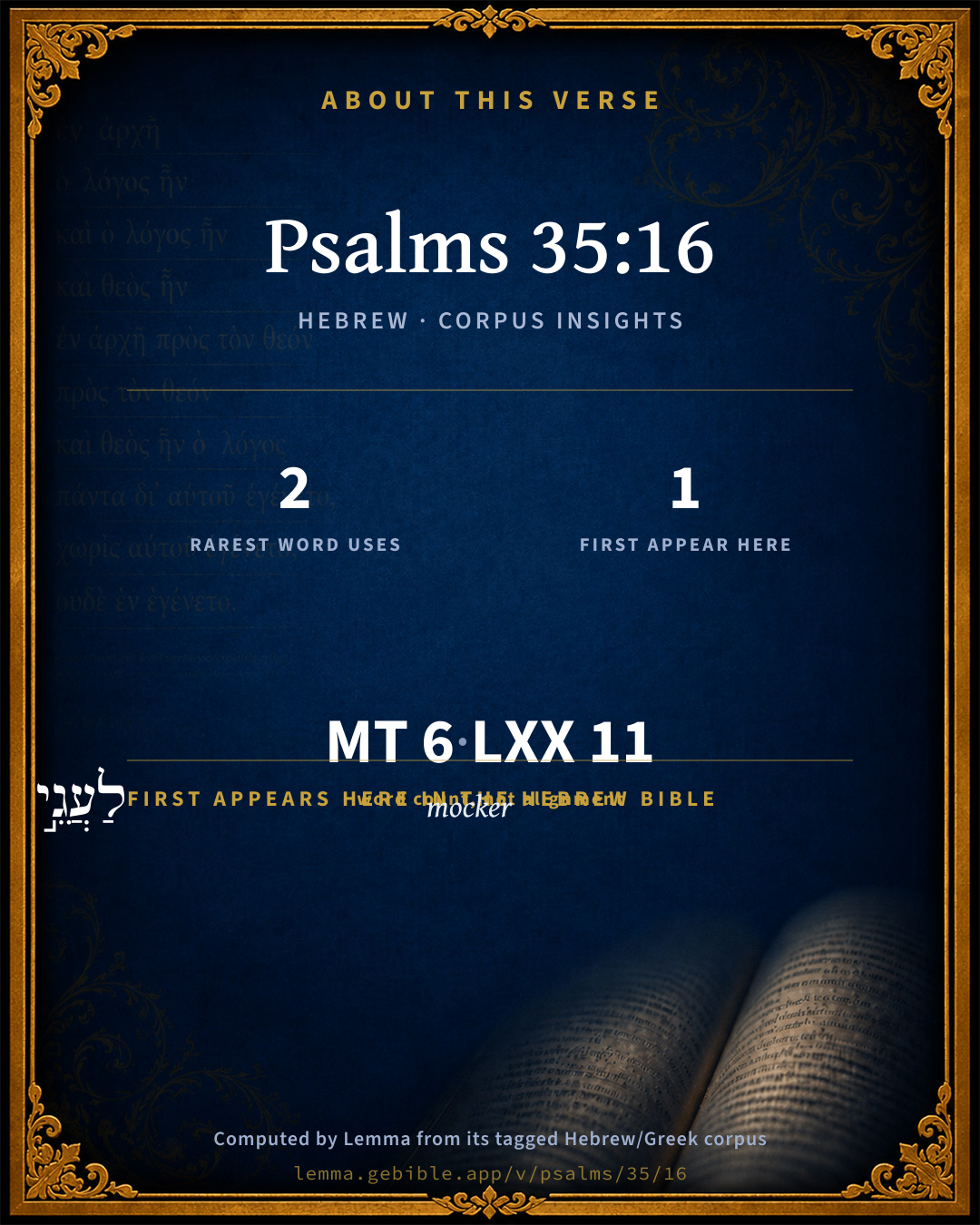
The rarest word here is לַעֲגֵ֣י mocker H3934 — appearing just 2 times in the whole Hebrew Bible.

First appearance in Scripture

This word makes its first canonical appearance in the Hebrew Bible here:

  • לַעֲגֵ֣י mocker H3934

Shared distinctive vocabulary

לַעֲגֵ֣י mocker H3934 occurs in 2 verses of the Hebrew Bible. Also found in:

Grammatical profile

  • 1 verb
  • 2 nouns
  • 2 adjectives
  • 1 preposition

Verb forms

  • חָרֹ֖ק Qal · Infinitive Absolute

Hebrew & Septuagint length

In English translation the verse runs 12 words from the Hebrew and 15 from the Septuagint (LXX English) — closely comparable.

A rough comparison of the two English renderings, which tokenize alike — not a word-level alignment.

Word counts can differ between the Hebrew and the Greek without any difference in meaning — e.g. the Hebrew direct-object marker אֵת has no separate Greek word, and Greek often adds the article ὁ.

In the original languages it is 6 Hebrew tokens and 11 Greek tokens — but the two are counted differently (Hebrew bundles its prefixes and suffixes into one token; the Greek is in lemma form), so that isn’t a like-for-like length.

Cross-references

8

Topical passages linked to Psalms 35:16 in the Treasury of Scripture Knowledge — connected by theme and wording, ordered by reader-vote popularity; previews shown in the World English Bible.

  • Lamentations 2:16 All your enemies have opened their mouth wide against you; They hiss and gnash the teeth; they say, We have swallowed her up; Certainly this is the day that we looked for; we have found, we have seen it.
  • Job 16:9 He has torn me in his wrath, and persecuted me; He has gnashed on me with his teeth: My adversary sharpens his eyes on me.
  • Psalms 37:12 The wicked plots against the just, And gnashes at him with his teeth.
  • John 18:28 They led Jesus therefore from Caiaphas into the Praetorium. It was early, and they themselves didn't enter into the Praetorium, that they might not be defiled, but might eat the Passover.
  • Acts 7:54 Now when they heard these things, they were cut to the heart, and they gnashed at him with their teeth.
  • 1 Samuel 20:24–42 So David hid himself in the field: and when the new moon was come, the king sat him down to eat food.
  • Isaiah 1:14–15 My soul hates your New Moons and your appointed feasts; They are a burden to me. I am weary of bearing them.
  • 1 Corinthians 5:8 Therefore let us keep the feast, not with old yeast, neither with the yeast of malice and wickedness, but with the unleavened bread of sincerity and truth.

Cross-references courtesy of OpenBible.info (CC BY 4.0).

Hebrew and Greek witnesses Masoretic Hebrew ↔ Greek Septuagint

The same verse in the two great witnesses to the Old Testament, shown verse-for-verse.

You’re reading Greek Psalm 34 (Hebrew Psalm 35). The Septuagint counts the superscription, so verse numbers can differ from the Hebrew — chapter-level alignment, not verse-by-verse. Numbering follows Rahlfs.

These are two independent witnesses, not word-aligned to each other, and the Septuagint is shown in lemma (dictionary) form.

Hebrew Psalms 35:16 Masoretic · Westminster Leningrad Codex

בְּ֭חַנְפֵי לַעֲגֵ֣י מָע֑וֹג חָרֹ֖ק עָלַ֣י שִׁנֵּֽימוֹ

Like the profane mockers in feasts, They gnashed their teeth at me.

World English Bible · Public Domain

Greek LXX Greek Psalm 34:16 Septuagint · lemma form

πειράζω ἐγώ ἐκμυκτηρίζω ἐγώ μυκτηρισμός βρύχω ἐπί ἐγώ ὁ ὀδούς αὐτός

They tempted me, they sneered at me most contemptuously, they gnashed their teeth upon me.

LXX2012 (modern English Septuagint) · Public Domain

On this verse, Ellicott's Commentary for English Readers discusses the Septuagint’s reading. Read the note in Commentary ↓

Hebrew: Westminster Leningrad Codex (CC BY 4.0). Greek: Septuagint (public domain); English from LXX2012 (modern English Septuagint) (Public Domain). How the Septuagint differs from the Hebrew →

Commentary

Notes on Psalms 35:16 from classic Christian and Jewish commentators (each source and its license shown beneath its notes). The classic Christian expositions comment on the surrounding passage and are grouped to its opening verse, so a note may address several verses; the Jewish commentaries on the Tanakh (Rashi and others) are per-verse, so they appear only where the commentator wrote on this verse.

Lemma curates 59 commentaries, every one of them public domain or Creative Commons licensed, each selected and text-cleaned for this edition rather than reprinted as found. About our sources →

Trapp's Complete Commentary

John Trapp

Psa 35:16 With hypocritical mockers in feasts, they gnashed upon me with their teeth.

Ver. 16. With hypocritical mockers in feasts] Cum sannionibus placentae vel cibi, with hypocritical mockers for a cake or dainties. There is an elegance in the original, which showeth it to be proverbial, and cannot be translated R. Solomon telleth us here, that they who delighted in flatteries gave their flatterers cakes baked with honey, to make them the more to flatter them. Solomon telleth of some that will transgress for a piece of bread, Pro 28:21. So those parasitic prophets, Eze 13:19. Or, I am made their table talk, as Hos 7:8, scornfully deriding me at their feasts and in their cups, Mensarii scurrae.

John Trapp, A Commentary or Exposition upon All the Books of the Old and New Testament (1647–1656) — public domain. Text from a community e-Sword module.

J. A. Alexander on Psalms

Joseph Addison Alexander

16. (Psa 35:16) With worthless mockers for bread—gnashing against me their teeth. This they did in the company of impious, reprobate, or worthless scoffers, who calumniate others for the sake of gaining favour with their wicked patrons. Hence they are called bread or cake scoffers, those who earn their food by spiteful mockery of others. The form of the whole verse is extremely idiomatic, and scarcely admits of an exact translation. The literal meaning of the first clause is with the worthless of mockers of bread, and in the second the verb gnash is an infinitive, which can only be rendered in intelligible English by a participle or a finite verb, they gnashed, or gnashing. This is always expressive of malignant rage, and shews that what is here described is not mere raillery but spiteful defamation.

Joseph Addison Alexander, The Psalms Translated and Explained (1850) — public domain. Text from a community e-Sword module.

Tyndale Open Study Notes

Tyndale Open Resources

35:16 The psalmist’s attackers snarl to express their bitter envy.

Tyndale Open Study Notes — © Tyndale Open Resources, licensed CC BY-SA 4.0. Text via the HelloAO Bible API.

Geneva Bible (1599)

Geneva Bible translators

The word signifieth cakes: meaning that the proud courtiers at their dainty feasts scoff, rail, and conspire his death.

Geneva Bible (1599) marginal notes — public domain. Text via Bolls.life.

Jamieson, Fausset & Brown

Robert Jamieson, A. R. Fausset & David Brown

mockers--who were hired to make sport at feasts (Pro 28:21).

Jamieson, Fausset & Brown — Commentary Critical and Explanatory on the Whole Bible (1871) — public domain (CC PDM 1.0). Text via the HelloAO Bible API.

Adam Clarke's Commentary

Verse 16. With hypocritical mockers in feasts] These verses seem to be prophetic of the treatment of Christ. They did tear me, and I knew it not. They blindfolded and buffeted him; they placed him in such circumstances as not to be able to discern who insulted him, except by a supernatural knowledge. With hypocritical mockers in feasts may also relate prophetically to our Lord's sufferings. Herod clothed him in a purple robe, put a reed in his hand for a sceptre, bowed the knee before him, and set him at naught. Here their hypocritical conduct (pretending one thing while they meant another) was manifest, and possibly; this occurred at one of Herod's feasts.

Adam Clarke's Commentary on the Bible (1810–1826) — public domain. Text from a community e-Sword/MySword module.

John Calvin's Commentaries

16. Among perfidious jesters. Others translate it, With hypocrites, but in my opinion David simply relates the combination of his enemies. And the meaning of the expression is to this effect, That among men of a crafty disposition, who had been addicted to deceit, and were consequently lost to all sense of shame, the only and the constant subject of their deliberations was, how they might destroy this afflicted man. David again reverts to the leaders of the people, and to those in power, as the source whence all the mischief took its rise; for this description could not apply to a great part of the common people, who acted rather by thoughtless impulse. He therefore speaks particularly of the rulers, and others of a similar character, and accuses them of cruelty, saying, that they gnash their teeth upon him like furious wild beasts. He first calls them perfidious or wicked, that he may the more easily obtain help and aid of God, as if calling upon him in the extremity of distress; and, secondly, he calls them jesters or mockers, by which he means that they have such effrontery, and are so far lost to all sense of shame, that there is nothing which they will not dare to do. As to the meaning of the word מעוג, maog, which follows, interpreters are not agreed. Properly, it signifies bread baked upon the hearth upon the embers. Some, however, because they could not elicit from it a meaning suitable to the passage, have thought that it should be taken for talkative jesting, or idle speech. Others, presuming to give a still wider range to their fancy, have supposed the meaning of the Psalmist to be, that the scoffing of such persons was as bread to them, because they take pleasure in scoffing and jesting. To me, it appears that we ought to retain the proper signification of the word, while, at the same time, it may be understood in a twofold sense. Some taking מעוג, maog, for a cake or tart, are of opinion that David here censures people of a delicate taste, who seek after fine and dainty fare, many of whom are always to be found in the courts of princes. Others rather suppose that he rebukes persons of a servile and sordid spirit, who, for the most trifling consideration, would employ their tongues in reviling others, just as in all ages there have been found men who, for a bit of bread, as we say, set their tongues to sale. When I carefully consider other passages in which David describes the nature and character of his enemies, I am disposed to think that those who indulged in jesting and scoffing at feasts, and who, in sitting over their cups, consulted about putting David to death, are here referred to. He therefore complains, that even in the midst of their feasting and banqueting, the ungodly, who had shaken off all shame, communed how they might take away his life.

John Calvin's Commentaries (1540-1563) — public domain. Text from the Calvin Translation Society English edition (1840s-50s) via the Christian Classics Ethereal Library (ccel.org). Calvin's coverage is partial (roughly two-thirds of the Bible); uncommented books and verses are honest gaps, never fabricated. The 19th-century editor's footnotes and remarks are omitted so the notes are faithfully Calvin's own voice.

Ellicott's Commentary for English Readers

(16) With hypocritical mockers in feasts.—This clause is full of difficulty. The LXX. and Vulg. have, “they tempted me, they mocked me with a mocking”; Symmachus, “in hypocrisy, with feigned words”; Chaldee, “with derisive words of flattery.” All these take the word rendered in the Authorised Version, “feasts,” as a cognate of a word in Isa_28:11, translated “stammering,” but which means rather, “barbarisms.” (Comp. Isa_33:19.) The word rendered “hypocritical” more properly means “profane” or “impious.” With these meanings we get a very good sense (with evident reference to the malicious attacks of foreigners, or of the anti-national party that affected foreign ways) in the manner of profane barbaric barbarisms, or with profanity and barbarism.

As to the rendering “feasts,” it comes from treating the word as the same used (1Ki_17:13) for a “cake.” “Cake-mockers” are explained to be parasites who hang about the tables of the rich, getting their dinner in return for their buffooneries. (Comp. the Greek ψωμοκόλακεις; Latin, bucellarii.)

A Bible Commentary for English Readers, edited by Charles John Ellicott (1878–1897) — public domain. Text from a community e-Sword module.

The Cambridge Bible for Schools and Colleges

gen. ed. J. J. S. Perowne

16. Like (less probably, among) the profanest of mocking parasites they gnash &c.; a gesture of rage, as though they would devour their victim (Psa_35:25). The obscure phrase in the first line is generally explained to mean mockers for a cake, buffoons who purchase entertainment for themselves by scurrilous jests (Gr. κνισσοκόλακες, ψωμοκόλακες, Lat. buccellarii). Another explanation is, like (or, among) the profanest of perverse mockers.

The Cambridge Bible for Schools and Colleges (gen. ed. J. J. S. Perowne; Cambridge University Press, 1878–1918) — public domain. Text from a community e-Sword module.

John Gill's Exposition

With hypocritical mockers in feasts,.... That is, the abjects gathered, themselves together with such; these may design Saul's courtiers, his parasites and flatterers, and who were hypocrites in religion also, and made it their business at Saul's table, and in their banquetings and revellings, to mock at David; and who were "hypocritical mockers of" or "for a piece of bread" (y), as it may be rendered; the same word is used for a pastry, or cake, and for flatterers; and they used at their feasts to throw a pastry baked with honey to parasites (z), for the word signifies a cake, or a piece of bread, Kg1 17:12; and the sense may be, that they mocked at David as wanting a piece of bread, and that he had brought himself to one; or else those, and they that gathered with them especially, mocked at David for the sake of a meal; or for a piece of bread; see Pro 28:27; and such sort of men were the enemies of Christ, the Scribes and Pharisees, hypocrites to God, flatterers of men, who loved feasts, and the uppermost places there, and whose god was their belly; and who were mockers of Christ, derided his doctrine, and scoffed at his person, especially when he hung upon the cross;

they gnashed upon me with their teeth; in indignation and contempt; as Stephen's enemies did on him, Act 7:54.

(y) "subsannatoribus subcineritii panis", Vatablus; "subsanmantes propter placentam", Piscator; "scoffers for a cake of bread", Ainsworth; hence a "parasite", a "table companion", or "trencher friend", is used for a "flatterer", vid. Suidam in voce (z) Weemse's Christ. Synag. l. 1. c. 6. s. 8. p. 209. of the Moral Law, l. 2. c. 9. p. 310.

John Gill's Exposition of the Whole Bible (1746–1763) — public domain (CC PDM 1.0). Text via the HelloAO Bible API.

Albert Barnes' Notes on the Bible

With hypocritical mockers in feasts - The word rendered hypocritical here - חנף chânêph - properly means people “profane, impious, abandoned.” It refers to such persons as are commonly found in scenes of revelry. The words rendered “mockers at feasts,” it is scarcely possible to render literally. The word translated, “mockers,” - לעג lâ‛êg - means properly one who stammers, or who speaks a foreign language; then, a jester, mocker, buffoon. The word rendered “feasts” - מעוג mâ‛ôg - means “a cake of bread;” and the whole phrase would denote “cake-jesters;” “table-buffoons” - those, perhaps, who act the part of jesters at the tables of the rich for the sake of good eating. “Gesenius.” - The meaning is, that he was exposed to the ribaldry or jesting of that low class of people; that those with whom he had formerly been on friendly terms, and whom he had admitted to his own table, and for whom he had wept in their troubles, now drew around themselves that low and common class of parasites and buffoons for the purpose of ridiculing or deriding him.

They gnashed upon me with their teeth - The act of gnashing with the teeth is expressive of anger or wrath. See the notes at Job 16:9; compare Mat 8:12; Mat 13:42, Mat 13:50; Mat 22:13; Mat 24:51; Mat 25:30; Luk 13:28. The meaning here is that they connected the expressions of auger or wrath with those of derision and scorn. The one is commonly not far from the other.

Albert Barnes' Notes on the Bible (1834–1885) — public domain. Text from a community e-Sword/MySword module.

Matthew Poole's English Annotations

Hypocritical, or profane, as this word signifies, Job 8:13; 13:16; 15:34; 17:8, and, as some add, in all other places.

Mockers; whose common practice it is to scoff at and deride others, and me in particular.

In feasts; or, of or for a cake; or, a morsel of bread, as this word signifies, 1Ki 17:12,13; 19:6; by which he further shows what vile and worthless persons these were, that would

transgress for a morsel of bread, as it is said, Pro 28:21. They made themselves buffoons and jesters, and accustomed themselves to mock and deride David, that thereby they might gain admittance to the acquaintance and tables of great men, where they might fill their bellies; which was all that they sought for, or got by it.

They gnashed upon me with their teeth; they used all expressions of rage and hatred against me, among which this was one, Job 16:9; Lam 2:16. This they did to curry favour with my great and potent adversaries.

Matthew Poole's English Annotations on the Holy Bible (1683–1685) — public domain. Text from a community e-Sword/MySword module.

The Treasury of David

Charles H. Spurgeon

Ver. 16. With hypocritical mockers in feasts, they gnashed upon me with their teeth. Like professional buffoons who grin around the banquet to make sport, so they made a business of jeering at the good man; not, however, out of mirth, but from violent, insatiable hatred. Like cake scoffers, or men who will jeer for a bit of bread, these hireling miscreants persecuted David in order to get a bellyful for themselves from Saul's table: having moreover an inward grudge against the son of Jesse because he was a better man than themselves. Very forcibly might our Lord have used the words of these verses! Let us not forget to see the Despised and Rejected of men here painted to the life. Calvary and the ribald crew around the cross seem brought before our eyes.

Ver. 16. With hypocritical mockers in feasts. Some cannot be merry, but it must be with Scripture; if they want a little diversion, the saints must be the subject of their discourse! they can vent their profane jests upon the word of God; this is their pastime over their cups upon the ale bench. How ready they are with their contumelious reflections; they have learnt their father's dialect, they are accusers of the brethren, their speech betrays them to be Hellians. You know that in ordinary, we can tell what countryman a person is by his speech, every country having almost a peculiar idiom; so it is here, these scoffers at religion by speaking the language of hell, let us understand whence they are. They have, it may be, a little wit, which they set off with a sort of an air in rhetorical raillery, and oh, how quick and sharp when they are upon this subject! These scoffing Ishmaelites are seated in the devil's chair, somewhat above their brethren in iniquity, as most deserving the place; and there is less ground to hope that such persons will be savingly wrought upon who arrive to such a height is sin as to make a mock of it, and to sport with holiness, than of others. Persons are got a great way towards hell when they mock at what is serious, and that with delight. This the Lord will visit for in his due time; for he knows who they are that so dishonour him by reproaching them that are his. Oliver Heywood.

Ver. 16. Hypocritical mockers in feasts. (gwam ygal ypnhb) Very difficult. The word (gwum), in 1Ki 17:12, the only other passage where it occurs, means "a cake." Hence (gwam ygal) is interpreted by Gesenius and others to mean, hangers on at the table of the rich (literally "cake mockers"), whose business it was, by witticisms and buffoonery to make entertainment for the guests, and who got their dinner in return, like the qwisokolakez, knisololakes, and the Medieval Lat. buccellarii. Then the words would mean, "Amongst the most profane." J. J. Stewart Perowne. (Would not our word loafers be somewhat analogous to these cake eaters of antiquity!) C. H. S.

Ver. 16. Hypocritical mockers. David aggravates the sin of those jeering companions who made him their table talk, and could not taste their cheer except seasoned with some salt jest quibbled out at him, with this, that they were hypocritical mockers; they did it slily, and wrapped up their scoffs, it is like in such language as might make some think, who did not well observe them, that they applauded him. There is a way of commending which some have learned to use when they mean to cast the greatest scorn upon those they hate bitterly, and these hypocritical mockers deserve the chair to be given them from all other scorners. William Gurnall.

Ver. 16. Mockers in feasts. If it were known at a feast that there was any one present or absent, whom the host disliked, it was customary for the guests to "make fun of them, "and use sarcastic language respecting them. These are the hypocritical mockers in feasts. John Gadsby.

None.

Psalms 35:17*

Charles H. Spurgeon's The Treasury of David (1869–1885) — public domain. Psalms only. Text from a community e-Sword/MySword module.

Whedon's Commentary on the Bible

Daniel D. Whedon

16. Hypocritical mockers in feasts—Impious table jesters: men whose occupation was to make merriment at feasts—buffoons.

They gnashed upon me—This was the fittest expression of their empty rage, to which they had been excited by the derision of these jesters.

Daniel D. Whedon (gen. ed.), Commentary on the Old and New Testaments (1874–1909) — public domain. Text from a community e-Sword module.

The Pulpit Commentary

With hypocritical mockers in feasts; literally, profane jesters of cakes; i.e. ribald parasites at a great man"s table, whose coarse buffoonery entitles them to a share of the dainties; they made me their butt, their jest, and their byword. (cf. Job_30:9) They gnashed upon me with their teeth; i.e. spoke fiercely and angrily against me, like dogs that snarl and show their teeth. (comp. Job_16:9 Psa_37:12)

The Pulpit Commentary (1880–1919), ed. H.D.M. Spence-Jones & Joseph S. Exell — public domain. Text from a community e-Sword module.

John Wesley's Explanatory Notes

Mockers - They made themselves buffoons and jesters, and accustomed themselves to mock and deride David, that thereby they might gain admittance to the tables of great men, which was all they sought for.

John Wesley, Explanatory Notes Upon the Whole Bible (1754–1765) — public domain. Text via the GEBible commentary corpus.

Rashi

Rabbi Shlomo Yitzchaki (Rashi)

Because of the flattery of scorn for food, they gnash, etc. Because of the flattery of scorn of eating and drinking, that they flatter Saul in order that he give them to eat and drink, they gnash their teeth against me.

food Heb. מעוג, an expression of eating, as (in I Kings 17:12): “if I have food (מעוג),” written regarding Elijah, but Menachem (p. 130) interpreted it as an expression of a loaf of bread, and so “if I have a cake (מעוג).”

Rashi on the Tanakh — English translations: “The Judaica Press complete Tanach with Rashi, translated by A. J. Rosenberg” (CC BY 4.0); “Pentateuch with Rashi's commentary by M. Rosenbaum and A.M. Silbermann, 1929-1934” (public domain); “The Metsudah Tanach series, Lakewood, N.J” (CC BY 4.0); and “The Book of Joshua, Metsudah Publications, 1997” (CC BY 4.0). Text via Sefaria.

Lesson kit

Teaching starters — assembled from the data on this page, not authored interpretation. Every prompt links to the verse data it draws on. Edit before teaching.

Psalms, in the Wisdom, opens this verse with 6 words (6 distinct Hebrew lemmas). Its most distinctive word is lâʻêg (“mocker”). A historical commentator’s framing appears above. Read the whole chapter for the surrounding context.

Discussion questions

  1. What does “mocker” (lâʻêg) contribute to the verse as a whole?
  2. This is the first place “mocker” appears in Scripture (first appears here). What does its debut here establish?
  3. How does Isaiah 28:11, which shares the word «mocker», read alongside this verse?
  4. The translations on this page render this verse differently — a whole-verse word diff, not a word-by-word alignment. What might account for the different wordings?
  5. «חָרֹ֖ק» is a Qal Infinitive Absolute verb. How does that grammatical form shape the action described?
  6. Compare how Trapp's Complete Commentary and J. A. Alexander on Psalms read this verse. Where do they agree or differ?

Things to notice

Reading settings

Reading text

Shown beneath each verse's original-language words.

Old Testament
Old Testament edition

Read the OT as the Masoretic Hebrew (MT) or the Greek Septuagint (LXX).

English shown for the Greek Septuagint (in the Hebrew ↔ Greek comparison).

Comparing translations? Open the Compare panel on any verse page to stack up to four side by side.