
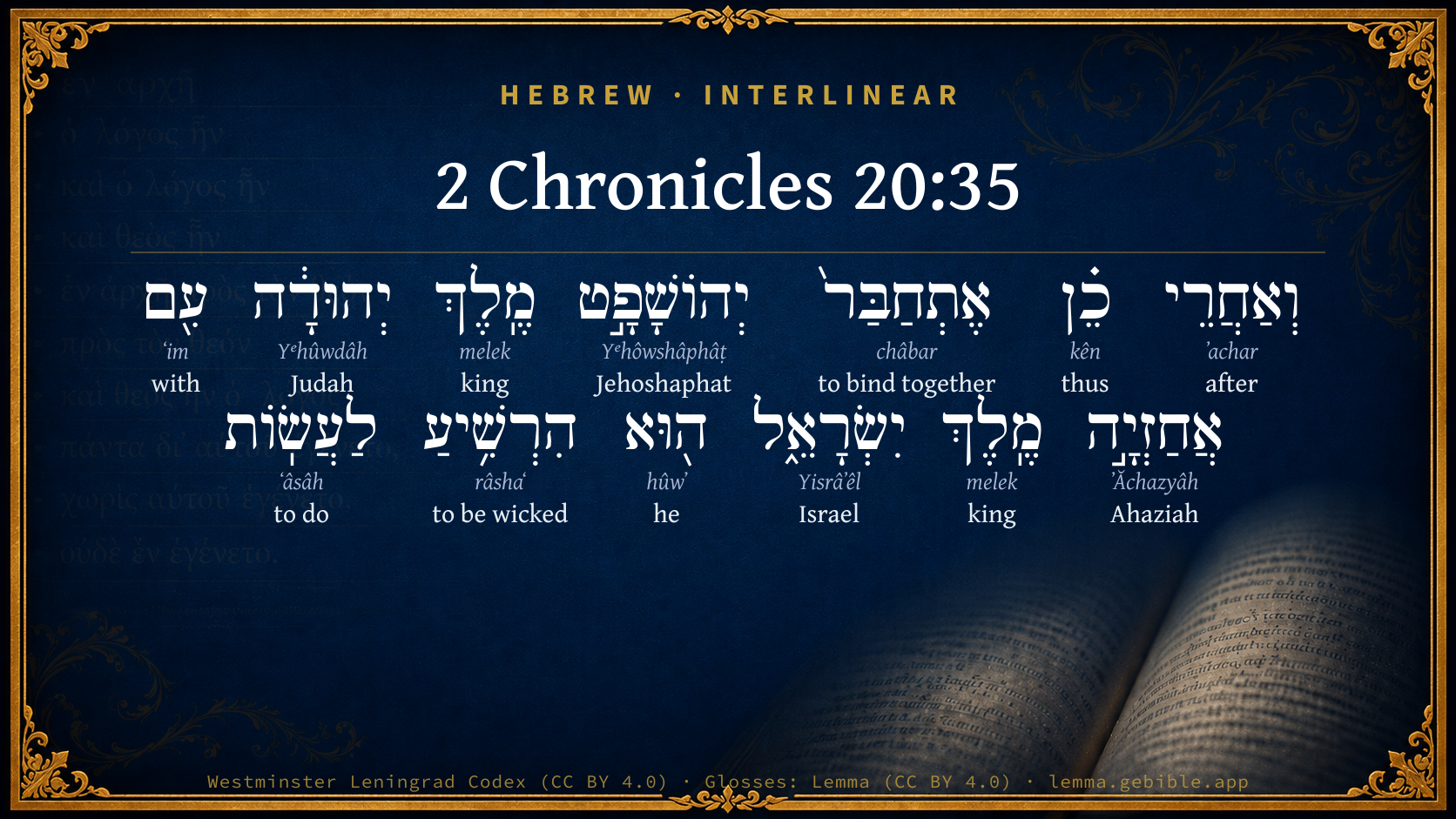
2 Chronicles 20:35

Hebrew (Westminster Leningrad Codex) 2 Chronicles 20:35 appears in the Hebrew Old Testament. The text above is from the Westminster Leningrad Codex. Each word links to its Strong’s number, a concise gloss, and parsing drawn from the Open Scriptures Hebrew Bible morphology. Click any word for its full Brown-Driver-Briggs (BDB) entry.
Download image
Cite this verse

2 Chronicles 20:35 (World English Bible). Public Domain. Lemma interlinear Bible study tool, https://lemma.gebible.app/v/2-chronicles/20/35.

Show BibTeX & RIS
BibTeX
RIS
English Translation
After this did Jehoshaphat king of Judah join himself with Ahaziah king of Israel; the same did very wickedly:
World English Bible · Public Domain
Download a study sheet

One document with this verse’s original text, its word-by-word gloss line, the meaning frame, cross-references with their text, attributed commentary, and full source and license credits — printable, and it pastes into notes with its structure intact.

This verse Autodidact and up

Study sheet (.html) Plain text (.txt)

A passage Seminary Student

Up to 50 verses in one chapter. A passage sheet keeps up to 6 commentary sources and 12 cross-references per verse, in the order this page ranks them, and says so on the sheet whenever that leaves anything out. Ask for a single verse and you get the Autodidact verse sheet above.

Everything on this page stays free to read, with no account — the sheet is a download of what is already on screen, not access to it.

Want to remove ads? Support Godless Engineer
Compare translations 3

The same verse in 3 English versions, stacked beneath the original-language interlinear above. Click any original word for its lexicon entry.

Each is an independent rendering of the whole verse — the interlinear is not word-aligned to these translations.

Highlighted words mark where these versions differ — a whole-verse word diff, not a word-by-word alignment.

  • World English Bible Public Domain
    After this did Jehoshaphat king of Judah join himself with Ahaziah king of Israel; the same did very wickedly:
  • King James Version Public Domain
    And after this did Jehoshaphat king of Judah join himself with Ahaziah king of Israel, who did very wickedly:
  • unfoldingWord Literal Text CC BY-SA 4.0
    And after this Jehoshaphat, the king of Judah, allied himself with Ahaziah, the king of Israel; he made himself guilty in so doing.

unfoldingWord Literal Text — © unfoldingWord, licensed CC BY-SA 4.0. Word-aligned USFM3 via Door43 (git.door43.org/unfoldingWord/en_ult).

Versions to compare (up to 4)

3 of 4 selected

Show all 18 translations

Every available English version of this verse, each an independent rendering of the whole verse.

  • World English Bible Public Domain
    After this did Jehoshaphat king of Judah join himself with Ahaziah king of Israel; the same did very wickedly:
  • Berean Standard Bible Public Domain
    Later, Jehoshaphat king of Judah made an alliance with Ahaziah king of Israel, who acted wickedly.
  • Majority Standard Bible Public Domain
    Later, Jehoshaphat king of Judah made an alliance with Ahaziah king of Israel, who acted wickedly.
  • King James Version Public Domain
    And after this did Jehoshaphat king of Judah join himself with Ahaziah king of Israel, who did very wickedly:
  • American Standard Version (1901) Public Domain
    And after this did Jehoshaphat king of Judah join himself with Ahaziah king of Israel; the same did very wickedly:
  • Revised Version (1885) Public Domain
    And after this did Jehoshaphat king of Judah join himself with Ahaziah king of Israel; the same did very wickedly:
  • Geneva Bible (1599) Public Domain
    Yet after this did Iehoshaphat King of Iudah ioyne himselfe with Ahaziah King of Israel, who was giuen to do euill.
  • Douay-Rheims (1899) Public Domain
    After these things Josaphat king of Juda made friendship with Ochozias king of Israel, whose works were very wicked.
  • Young's Literal Translation Public Domain
    And after this hath Jehoshaphat king of Judah joined himself with Ahaziah king of Israel, (he did wickedly in `so' doing),
  • Literal Standard Version CC BY-SA 4.0
    And after this Jehoshaphat king of Judah has joined himself with Ahaziah king of Israel (he did wickedly in doing [this]),
  • Unlocked Literal Bible CC BY-SA 4.0
    After this Jehoshaphat, king of Judah, allied himself with Ahaziah, king of Israel, who committed much wickedness.
  • unfoldingWord Literal Text CC BY-SA 4.0
    And after this Jehoshaphat, the king of Judah, allied himself with Ahaziah, the king of Israel; he made himself guilty in so doing.
  • Darby Bible Public Domain
    And after this Jehoshaphat king of Judah joined himself with Ahaziah king of Israel, who did very wickedly.
  • World Messianic Bible Public Domain
    After this, Jehoshaphat king of Judah joined himself with Ahaziah king of Israel. The same did very wickedly.
  • Webster's Bible Public Domain
    And after this Jehoshaphat king of Judah joined himself with Ahaziah king of Israel, who did very wickedly:
  • Free Bible Version CC BY-SA 4.0
    Later in his life, Jehoshaphat, king of Judah, allied himself with Ahaziah, king of Israel, who did wicked things.
  • Bible in Basic English Public Domain
    After this Jehoshaphat, king of Judah, became friends with Ahaziah, king of Israel, who did much evil:
  • JPS Tanakh (1917) Public Domain
    And after this did Jehoshaphat king of Judah join himself with Ahaziah king of Israel; the same did very wickedly;

Literal Standard Version (2020), Covenant Press — licensed CC BY-SA 4.0. Text via the HelloAO Bible API (eBible.org). Unlocked Literal Bible (unfoldingWord) — licensed CC BY-SA 4.0. Text via the HelloAO Bible API (eBible.org). unfoldingWord Literal Text — © unfoldingWord, licensed CC BY-SA 4.0. Word-aligned USFM3 via Door43 (git.door43.org/unfoldingWord/en_ult). Free Bible Version, Dr. Jonathan Gallagher — licensed CC BY-SA 4.0. Text via the HelloAO Bible API (eBible.org).

Word by word

More ways to search: Search by grammar → Find every occurrence → Compare this word →

Practice this passage: Drill this verse → Learn its vocabulary →

אֶתְחַבַּר֙
châbar
H2266
“to bind together”
Verb, Hithpael, Perfect, 3rd Person, Masculine, Singular
Part of Speech
Verb
Stem
Hithpael
Form
Perfect
Person
3rd Person
Gender
Masculine
Number
Singular
Full BDB Definition

Origin: a primitive root

TWOT: 598

to unite, join, bind together, be joined, be coupled, be in league, heap up, have fellowship with, be compact, be a charmer - (Qal) - to unite, be joined - to tie magic charms, charm - (Piel) - to unite with, make an ally of - to unite, join, ally - (Pual) - to be allied with, be united - to be joined together - (Hiphil) to join together, pile up (words) - (Hithpael) to join oneself to, make an alliance, league together
  1. וְאַחֲרֵי ʼachar H310 “and · after” Conjunction + Adverb
  2. כֵ֗ן kên H3651 “thus” Adverb
  3. יְהוֹשָׁפָ֣ט Yᵉhôwshâphâṭ H3092 “Jehoshaphat” Noun, Proper
  4. מֶֽלֶךְ melek H4428 “king of” Noun, Common, Masculine, Singular, Construct
  5. יְהוּדָ֔ה Yᵉhûwdâh H3063 “Judah” Noun, Proper
  6. עִ֖ם ʻim H5973 “with” Preposition
  7. אֲחַזְיָ֣ה ʼĂchazyâh H274 “Ahaziah” Noun, Proper
  8. מֶֽלֶךְ melek H4428 “king of” Noun, Common, Masculine, Singular, Construct
  9. יִשְׂרָאֵ֑ל Yisrâʼêl H3478 “Israel” Noun, Proper
  10. ה֖וּא hûwʼ H1931 “he” Pronoun, Personal, 3rd Person, Masculine, Singular
  11. הִרְשִׁ֥יעַ râshaʻ H7561 “to be wicked” Verb, Hiphil, Perfect, 3rd Person, Masculine, Singular
  12. לַעֲשֽׂוֹת ʻâsâh H6213 “to do” Preposition + Verb, Qal, Infinitive Construct

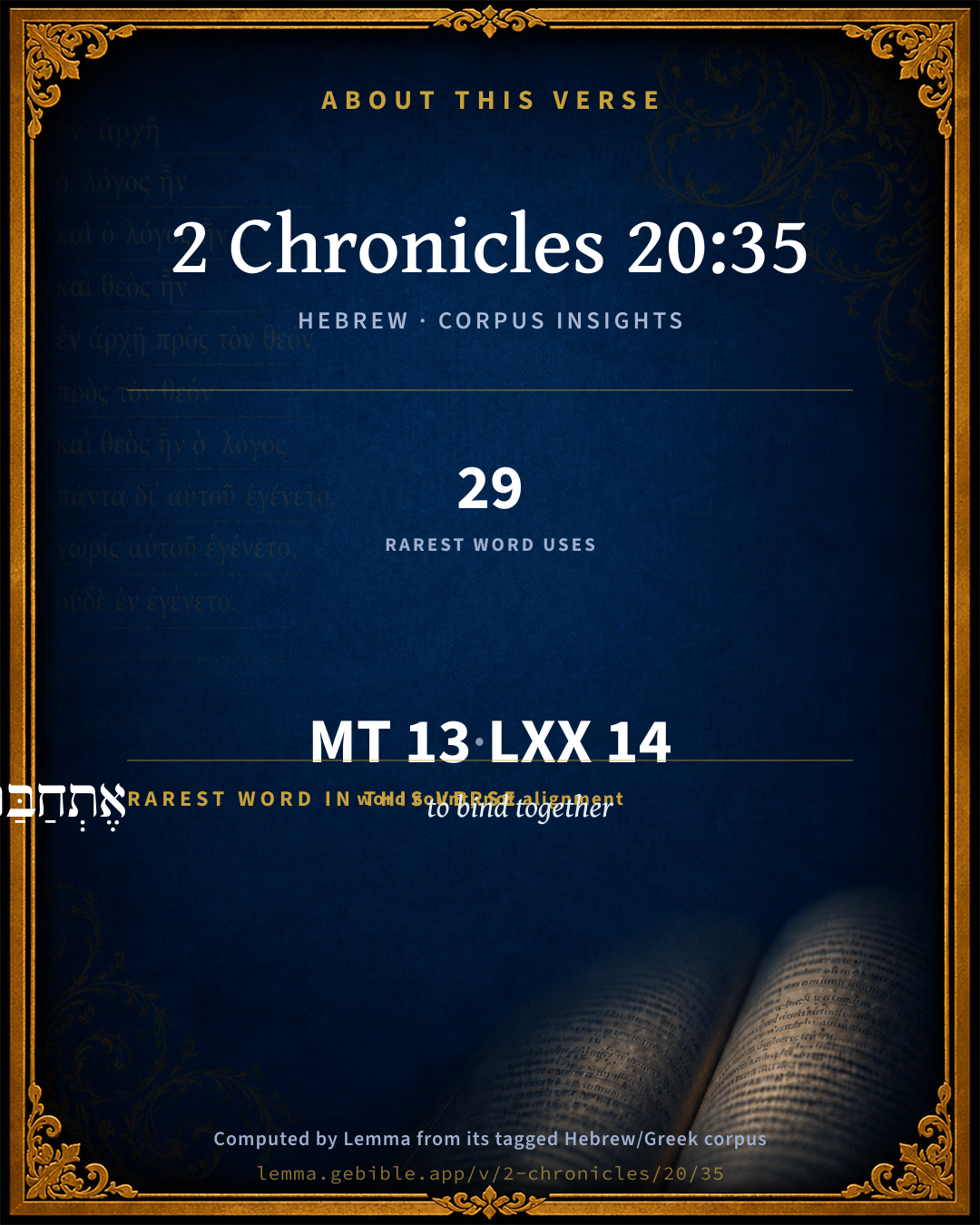
About this verse

These counts appear in no published source. They are computed here, from the morphology-tagged text and Lemma’s own curated glosses. What Lemma adds →

13
words
12
distinct lemmas
Historical
section

Shared distinctive vocabulary

אֶתְחַבַּר֙ to bind together H2266 occurs in 25 verses of the Hebrew Bible. Also found in:

Grammatical profile

  • 3 verbs
  • 6 nouns
  • 1 pronoun
  • 1 preposition
  • 2 adverbs

Verb forms

  • אֶתְחַבַּר֙ Hithpael · Perfect
  • הִרְשִׁ֥יעַ Hiphil · Perfect
  • לַעֲשֽׂוֹת Qal · Infinitive Construct

Repetition

A word recurs within this verse — often emphatic in Hebrew:

  • מֶֽלֶךְ king H4428 ×2

Hebrew & Septuagint length

In English translation the verse runs 19 words from the Hebrew and 21 from the Septuagint (LXX English) — closely comparable.

A rough comparison of the two English renderings, which tokenize alike — not a word-level alignment.

Word counts can differ between the Hebrew and the Greek without any difference in meaning — e.g. the Hebrew direct-object marker אֵת has no separate Greek word, and Greek often adds the article ὁ.

In the original languages it is 13 Hebrew tokens and 14 Greek tokens — but the two are counted differently (Hebrew bundles its prefixes and suffixes into one token; the Greek is in lemma form), so that isn’t a like-for-like length.

Cross-references

2

Topical passages linked to 2 Chronicles 20:35 in the Treasury of Scripture Knowledge — connected by theme and wording, ordered by reader-vote popularity; previews shown in the World English Bible.

  • 1 Kings 22:48–49 Jehoshaphat made ships of Tarshish to go to Ophir for gold: but they didn't go; for the ships were broken at Ezion Geber.
  • 2 Kings 1:2–16 Ahaziah fell down through the lattice in his upper chamber that was in Samaria, and was sick: and he sent messengers, and said to them, Go, inquire of Baal Zebub, the god of Ekron, whether I shall recover of this sickness.

Cross-references courtesy of OpenBible.info (CC BY 4.0).

Hebrew and Greek witnesses Masoretic Hebrew ↔ Greek Septuagint

The same verse in the two great witnesses to the Old Testament, shown verse-for-verse.

These are two independent witnesses, not word-aligned to each other, and the Septuagint is shown in lemma (dictionary) form.

Hebrew 2 Chronicles 20:35 Masoretic · Westminster Leningrad Codex

וְאַחֲרֵי כֵ֗ן אֶתְחַבַּר֙ יְהוֹשָׁפָ֣ט מֶֽלֶךְ יְהוּדָ֔ה עִ֖ם אֲחַזְיָ֣ה מֶֽלֶךְ יִשְׂרָאֵ֑ל ה֖וּא הִרְשִׁ֥יעַ לַעֲשֽׂוֹת

After this did Jehoshaphat king of Judah join himself with Ahaziah king of Israel; the same did very wickedly:

World English Bible · Public Domain

Greek LXX 2 Chronicles 20:35 Septuagint · lemma form

καί μετά οὗτος κοινωνέω ιωσαφατ βασιλεύς ἰουδά πρός οχοζιαν βασιλεύς ἰσραήλ καί οὗτος ἀνομέω

And afterwards Josaphat king of Juda entered into an alliance with Ochozias king of Israel, (now this was an unrighteous man,)

LXX2012 (modern English Septuagint) · Public Domain

Hebrew: Westminster Leningrad Codex (CC BY 4.0). Greek: Septuagint (public domain); English from LXX2012 (modern English Septuagint) (Public Domain). How the Septuagint differs from the Hebrew →

Commentary

Notes on 2 Chronicles 20:35 from classic Christian and Jewish commentators (each source and its license shown beneath its notes). The classic Christian expositions comment on the surrounding passage and are grouped to its opening verse, so a note may address several verses; the Jewish commentaries on the Tanakh (Rashi and others) are per-verse, so they appear only where the commentator wrote on this verse.

Lemma curates 59 commentaries, every one of them public domain or Creative Commons licensed, each selected and text-cleaned for this edition rather than reprinted as found. About our sources →

Trapp's Complete Commentary

John Trapp

2Ch 20:35 And after this did Jehoshaphat king of Judah join himself with Ahaziah king of Israel, who did very wickedly:

Ver. 35. Did Jehoshaphat king of Judah join himself.] So he fell once and again into the same sin. See 1Ki 22:44.

John Trapp, A Commentary or Exposition upon All the Books of the Old and New Testament (1647–1656) — public domain. Text from a community e-Sword module.

Albert Barnes' Notes on the Bible

After this - Jehoshaphat’s history had been formally completed 2Ch 20:34. Consequently we can lay no stress on the note of time contained in the words “after this,” which are detached from the context to which they originally referred. On the history 2Ch 20:35-37, see marginal references and notes.

Albert Barnes' Notes on the Bible (1834–1885) — public domain. Text from a community e-Sword/MySword module.

The Biblical Illustrator

Joseph S. Exell

2Ch_20:35-37

To make ships to go to Tarshish.

The wrecked fleet

I. The disaster to Jehoshaphats shipping.

II. The cause of this disaster. A judgment from Heaven. If Jehoshaphat had been a mere man of the world probably this disaster would not have occurred, but God would not allow one of His own servants to prosper in such an undertaking.

III. The lesson which the disaster teaches. Do not choose your associates amongst those who do not fear God. Always safest to keep under Christian influences. You will do well even to sacrifice a measure of financial interest and worldly prospect rather than be associated in business with a man who is out of all sympathy with you in religion. (J. Thain Davidson, D.D.)

The Biblical Illustrator, edited by Joseph S. Exell (c. 1880s–1900s) — public domain. Text from a community e-Sword module.

Joseph Benson's Commentary

2Ch 20:35. After this did Jehoshaphat join him with Ahaziah — This is mentioned as an aggravation of his sin, after so great an obligation laid upon him by God, and after he had been so sharply reproved by a prophet, yet he relapsed into the same sin; which proceeded partly from that near relation which was contracted between the two families, and partly from the easiness of Jehoshaphat’s temper, which could not resist the solicitations of others, in such things as might seem indifferent. For he did not join with him in war, as he did with Ahab, but in a peaceable way only, in a matter of trade and commerce. And yet God reproves and punishes him for it, (2Ch 20:37,) to show his great dislike of all familiar conversation of his servants and people with professed enemies of God and of religion, as Ahaziah was. Who did very wickedly — Or, who did industriously, and maliciously, and constantly, work wickedness, as the Hebrew phrase implies, giving himself up to idolatry, and all wickedness.

Joseph Benson's Commentary on the Old and New Testaments (1811–1818) — public domain. Text from a community e-Sword module.

Tyndale Open Study Notes

Tyndale Open Resources

20:35-37 The Lord destroyed the fleet to prevent Jehoshaphat’s alliance with King Ahaziah of Israel from prospering.

Tyndale Open Study Notes — © Tyndale Open Resources, licensed CC BY-SA 4.0. Text via the HelloAO Bible API.

Jamieson, Fausset & Brown

Robert Jamieson, A. R. Fausset & David Brown

after this did Jehoshaphat . . . join himself with Ahaziah . . . to make ships--A combined fleet was built at Ezion-geber, the destination of which was to voyage to Tartessus, but it was wrecked. Jehoshaphat's motive for entering into this partnership was to secure a free passage through Israel, for the vessels were to be conveyed across the Isthmus of Suez, and to sail to the west of Europe from one of the ports of Palestine on the Mediterranean. Eliezer, a prophet, denounced this unholy alliance, and foretold, as divine judgment, the total wreck of the whole fleet. The consequence was, that although Jehoshaphat broke off--in obedience to the divine will--his league with Ahaziah, he formed a new scheme of a merchant fleet, and Ahaziah wished to be admitted a partner [Kg1 22:48]. The proposal of the Israelitish king was respectfully declined [Kg1 22:49]. The destination of this new fleet was to Ophir, because the Israelitish seaports were not accessible to him for the Tartessus trade; but the ships, when just off the docks, were wrecked in the rocky creek of Ezion-geber.

Next: 2 Chronicles Chapter 21

Jamieson, Fausset & Brown — Commentary Critical and Explanatory on the Whole Bible (1871) — public domain (CC PDM 1.0). Text via the HelloAO Bible API.

Ellicott's Commentary for English Readers

(35) And after this.—The chronicler has omitted the notice that “Jehoshaphat made peace with the king of Israel” (1Ki_22:44), and now he omits two other short verses of the parallel account, viz., 1Ki_22:46-47 : “And the remnant of the sodomites, which had remained in the days of his father Asa, he consumed out of the land. There was then no king in Edom: a deputy was king.” The former omission is perfectly natural, as the Qĕdçshîm were not mentioned in Asa’s reign (comp. 1Ki_15:12); and the latter is probably due to the fact that it was the religious aspect, and not the political antecedents, of Jehoshaphat s conduct that most interested the chronicler. Hence also the didactic tone of the following verses as compared with 1Ki_22:48-49. The expression, “after this,” can only mean after the overthrow of the three nations (2Ch_20:1-30). As Ahaziah began to reign in the seventeenth year of Jehoshaphat, and reigned two years (1Ki_22:51), the league between them was formed in the seventeenth or eighteenth year of the king of Judah.

Join himself (‘ethchabbar).—An Aramaism (here only). This verse is peculiar to the chronicle.

Who did very wickedly.—He (viz., Ahaziah, the pronoun is emphatic) did very wickedly. The implied thought is: And, therefore, Jehoshaphat’s alliance was wrong. (Comp. 2Ch_19:2.)

A Bible Commentary for English Readers, edited by Charles John Ellicott (1878–1897) — public domain. Text from a community e-Sword module.

The Cambridge Bible for Schools and Colleges

gen. ed. J. J. S. Perowne

35. who did very wickedly] R.V. the same did very wickedly.

35–37 (cp. 1Ki_22:48-49). The Destruction of Jehoshaphat’s Fleet

The Chronicler gives an account of this incident quite different from that given in Kings. According to the latter it seems that Jehoshaphat’s fleet was wrecked through the inexperience of his mariners, and that he rejected the offer of the king of Israel to lend the services of more experienced seamen. In Chron. the loss of the ships is ascribed through the mouth of a prophet to Divine displeasure caused by Jehoshaphat’s association with Ahaziah. The accounts may be partly reconciled by the supposition that Jehoshaphat accepted the aid of the king of Israel in building but not in navigating the ships. The Chronicler here follows his habit of looking upon great public calamities as the direct punishment of particular sins.

The Cambridge Bible for Schools and Colleges (gen. ed. J. J. S. Perowne; Cambridge University Press, 1878–1918) — public domain. Text from a community e-Sword module.

John Gill's Exposition

And he joined himself with him to make ships to go to Tarshish,.... Of which; see Gill on Kg1 22:48, and though it is there said, Kg1 22:49, that Jehoshaphat refused letting the servants of Ahaziah go with his, that was after he had been reproved for joining with him, and after the ships were broken:

and they made the ships in Eziongeber; of which see Gill on Kg1 9:26.

John Gill's Exposition of the Whole Bible (1746–1763) — public domain (CC PDM 1.0). Text via the HelloAO Bible API.

Haydock's Catholic Bible Commentary

Things: the victory over Ammon, &c. H. --- Wicked. See C. xvi. 3.

George Leo Haydock (1774–1849), Haydock's Catholic Family Bible and Commentary, 1859 edition — public domain. Excludes Psalms (Douay-Rheims chapter numbering differs from Protestant) and Deuterocanonical books (Catholic canon only).

Matthew Poole's English Annotations

This is mentioned as an aggravation of his sin, after so great a favour and obligation laid upon him by God, and after he had been so sharply reproved and threatened by a prophet for the same thing, 2Ch 19:2; yet he relapsed into the same sin; which proceeded partly from that near relation which was contracted between the two families, and partly from the sweetness and easiness of Jehoshaphat’s temper, which could not resist the solicitations of others in such things as might seem indifferent. For he did not join with him in a war, as he did with Ahab, but in a peaceable way only, in a matter of trade and commerce. And yet God sharply reproves and punisheth him for it, 2Ch 20:37, to show his great dislike and detestation of all friendly and familiar conversation of his servants and people with idolaters and professed enemies of God and of religion, as Ahaziah was, who is therefore thus stigmatized in the next words,

who did very wickedly. Who did very wickedly, or, who did industriously, and maliciously, and constantly work wickedness, as the Hebrew phrase implies, giving himself up to idolatry and all wickedness.

Matthew Poole's English Annotations on the Holy Bible (1683–1685) — public domain. Text from a community e-Sword/MySword module.

The Pulpit Commentary

And after this. The historical episode of these three verses (35-37) is evidently misplaced. As Ahaziah succeeded his father Ahab in Jehoshaphat"s seventeenth year, we of course are at no loss to fix the time of Jehoshaphat"s "joining himself with Ahaziah." He had "joined himself" with Ahab, and had smarted for it, and yet "after" that, he "joined himself" with his son Ahaziah. We do not doubt that the "who" of this verse refers to Ahaziah, not, as some think, to Jehoshaphat.

The Pulpit Commentary (1880–1919), ed. H.D.M. Spence-Jones & Joseph S. Exell — public domain. Text from a community e-Sword module.

John Wesley's Explanatory Notes

After this - This is mentioned as an aggravation of his sin, after so great an obligation laid upon him by God; and after he had been so singularly reproved by a prophet yet he relapsed into the same sin which proceeded partly from that near relation which was contracted between the two families, and partly from the easiness of Jehoshaphat's temper, which could not resist the solicitations of others, in such things as might seem indifferent. For he did not join with him in war, as he did with Ahab, but in a peaceable way only, in a matter of trade and commerce. And yet God reproves and punisheth him for it, ver. 37, to shew his great dislike of all familiar conversation of his servants and people with professed enemies of God and of religion, as Ahaziah was. Very wickedly - Or who did industriously, and maliciously, and constantly work wickedness, as the Hebrew phrase implies, giving himself up to idolatry and all wickedness.

John Wesley, Explanatory Notes Upon the Whole Bible (1754–1765) — public domain. Text via the GEBible commentary corpus.

unfoldingWord translationNotes

Door43 World Missions Community

ships

These are ships capable of traveling on large bodies of water.

Tarshish

This is the name of a city. (See: How to Translate Names)

They built the ships

Jehoshaphat and Ahaziah did not build the ships, rather, their workers built them. AT: "Their workers built the ships" (See: Metonymy)

Ezion Geber

Translate the name of this place as you did in 2 Chronicles 8:17. (See: How to Translate Names)

Eliezer ... Dodavahu

These are names of men. (See: How to Translate Names)

Mareshah

Translate this man's name as you did in 2 Chronicles 11:08. (See: How to Translate Names)

The ships were wrecked so that

This can be stated in active form. AT: "The ships became ruined and" or "The ships wrecked so that" (See: Active or Passive)

they were not able to sail

"no one was able to sail them"

translationWords

Ahaziah

evil

prophet

unfoldingWord translationNotes — © Distant Shores Media and the Door43 World Missions Community, licensed CC BY-SA 4.0. Source: git.door43.org/Door43/en_tn.

Lesson kit

Teaching starters — assembled from the data on this page, not authored interpretation. Every prompt links to the verse data it draws on. Edit before teaching.

2 Chronicles, in the Historical, opens this verse with 13 words (12 distinct Hebrew lemmas). Its most distinctive word is châbar (“to bind together”). A historical commentator’s framing appears above. Read the whole chapter for the surrounding context.

Discussion questions

  1. What does “to bind together” (châbar) contribute to the verse as a whole?
  2. Genesis 14:3 shares the word «to bind together» with this verse. How do the two illuminate each other?
  3. “king” occurs 2× in this one verse. What is the effect of the repetition?
  4. The translations on this page render this verse differently — a whole-verse word diff, not a word-by-word alignment. What might account for the different wordings?
  5. The verb «אֶתְחַבַּר֙» is Hithpael Perfect. How does its form color the action?
  6. Reading how Trapp's Complete Commentary and Albert Barnes' Notes on the Bible read this verse, where do the two commentators agree and where do they part?

Things to notice

Reading settings

Reading text

Shown beneath each verse's original-language words.

Old Testament
Old Testament edition

Read the OT as the Masoretic Hebrew (MT) or the Greek Septuagint (LXX).

English shown for the Greek Septuagint (in the Hebrew ↔ Greek comparison).

Comparing translations? Open the Compare panel on any verse page to stack up to four side by side.