John 8:45

Greek (Tischendorf 8th ed.) John 8:45 appears in the Greek New Testament. The text above is from the Tischendorf 8th edition. Each word links to its Strong’s number and a concise gloss. Click any word for its full Thayer’s Greek Lexicon entry.
Download image
Cite this verse

John 8:45 (World English Bible). Public Domain. Lemma interlinear Bible study tool, https://lemma.gebible.app/v/john/8/45.

Show BibTeX & RIS
BibTeX
RIS
English Translation
But because I tell the truth, you don't believe me.
World English Bible · Public Domain
Download a study sheet

One document with this verse’s original text, its word-by-word gloss line, the meaning frame, cross-references with their text, attributed commentary, and full source and license credits — printable, and it pastes into notes with its structure intact.

This verse Autodidact and up

Study sheet (.html) Plain text (.txt)

A passage Seminary Student

Up to 50 verses in one chapter. A passage sheet keeps up to 6 commentary sources and 12 cross-references per verse, in the order this page ranks them, and says so on the sheet whenever that leaves anything out. Ask for a single verse and you get the Autodidact verse sheet above.

Everything on this page stays free to read, with no account — the sheet is a download of what is already on screen, not access to it.

Want to remove ads? Support Godless Engineer
Compare translations 3

The same verse in 3 English versions, stacked beneath the original-language interlinear above. Click any original word for its lexicon entry.

Each is an independent rendering of the whole verse — the interlinear is not word-aligned to these translations.

Highlighted words mark where these versions differ — a whole-verse word diff, not a word-by-word alignment.

  • World English Bible Public Domain
    But because I tell the truth, you don't believe me.
  • King James Version Public Domain
    And because I tell you the truth, ye believe me not.
  • unfoldingWord Literal Text CC BY-SA 4.0
    But because I speak the truth, you do not believe me.

unfoldingWord Literal Text — © unfoldingWord, licensed CC BY-SA 4.0. Word-aligned USFM3 via Door43 (git.door43.org/unfoldingWord/en_ult).

Versions to compare (up to 4)

3 of 4 selected

Show all 19 translations

Every available English version of this verse, each an independent rendering of the whole verse.

  • World English Bible Public Domain
    But because I tell the truth, you don't believe me.
  • Berean Standard Bible Public Domain
    But because I speak the truth, you do not believe Me!
  • Majority Standard Bible Public Domain
    But because I speak the truth, you do not believe Me!
  • King James Version Public Domain
    And because I tell you the truth, ye believe me not.
  • American Standard Version (1901) Public Domain
    But because I say the truth, ye believe me not.
  • Revised Version (1885) Public Domain
    But because I say the truth, ye believe me not.
  • Geneva Bible (1599) Public Domain
    And because I tell you the trueth, yee beleeue me not.
  • Douay-Rheims (1899) Public Domain
    But if I say the truth, you believe me not.
  • Young's Literal Translation Public Domain
    `And because I say the truth, ye do not believe me.
  • Literal Standard Version CC BY-SA 4.0
    And because I say the truth, you do not believe Me.
  • Unlocked Literal Bible CC BY-SA 4.0
    Yet, because I speak the truth, you do not believe me.
  • unfoldingWord Literal Text CC BY-SA 4.0
    But because I speak the truth, you do not believe me.
  • Darby Bible Public Domain
    and because I speak the truth, ye do not believe me.
  • World Messianic Bible Public Domain
    But because I tell the truth, you don’t believe me.
  • Webster's Bible Public Domain
    And because I tell you the truth, ye believe me not.
  • Free Bible Version CC BY-SA 4.0
    So because I tell you the truth, you don't believe me!
  • Bible in Basic English Public Domain
    But because I say what is true, you have no belief in me.
  • Text-Critical English NT CC BY 4.0
    But because I speak the truth, you do not believe me.
  • Tyndale New Testament (1534) Public Domain
    And because I tell you the trueth therfore ye beleve me not.

Literal Standard Version (2020), Covenant Press — licensed CC BY-SA 4.0. Text via the HelloAO Bible API (eBible.org). Unlocked Literal Bible (unfoldingWord) — licensed CC BY-SA 4.0. Text via the HelloAO Bible API (eBible.org). unfoldingWord Literal Text — © unfoldingWord, licensed CC BY-SA 4.0. Word-aligned USFM3 via Door43 (git.door43.org/unfoldingWord/en_ult). Free Bible Version, Dr. Jonathan Gallagher — licensed CC BY-SA 4.0. Text via the HelloAO Bible API (eBible.org).

Word by word

More ways to search: Search by grammar → Find every occurrence → Compare this word →

Practice this passage: Drill this verse → Learn its vocabulary →

ἀλήθειαν
alḗtheia
G225
“truth”
Noun, Accusative, Singular, Feminine
Part of Speech
Noun
Case
Accusative
Number
Singular
Gender
Feminine
Full Thayer's Definition

Origin: from G227

TDNT: 04:52,4

1. objectively a. what is true in any matter under consideration 1. truly, in truth, according to truth 2. of a truth, in reality, in fact, certainly b. what is true in things appertaining to God and the duties of man, moral and religious truth 1. in the greatest latitude 2. the true notions of God which are open to human reason without his supernatural intervention c. the truth as taught in the Christian religion, respecting God and the execution of his purposes through Christ, and respecting the duties of man, opposing alike to the superstitions of the Gentiles and the inventions of the Jews, and the corrupt opinions and precepts of false teachers even among Christians 2. subjectively a. truth as a personal excellence 1. that candour of mind which is free from affection, pretence, simulation, falsehood, deceit
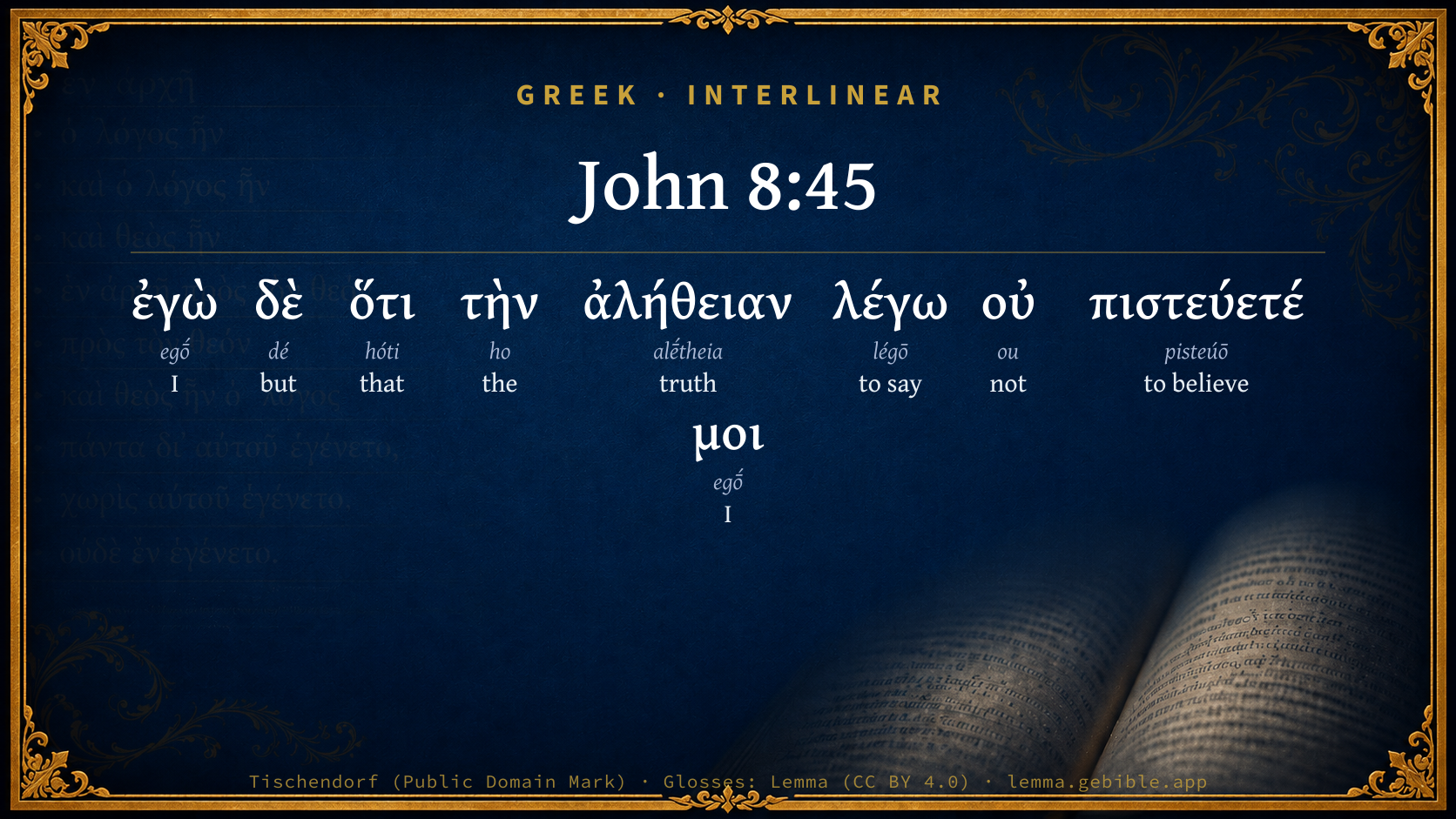
  1. ἐγὼ egṓ G1473 “I” Personal pronoun, 1st person, Nominative, Singular
  2. δὲ dé G1161 “but” Conjunction
  3. ὅτι hóti G3754 “that” Conjunction
  4. τὴν ho G3588 “the” Article, Accusative, Singular, Feminine
  5. λέγω légō G3004 “to say” Verb, Present, Active, Indicative, 1st person, Singular
  6. οὐ ou G3756 “not” Particle, Negative
  7. πιστεύετέ pisteúō G4100 “to believe” Verb, Present, Active, Indicative, 2nd person, Plural
  8. μοι egṓ G1473 “I” Personal pronoun, 1st person, Dative, Singular

About this verse

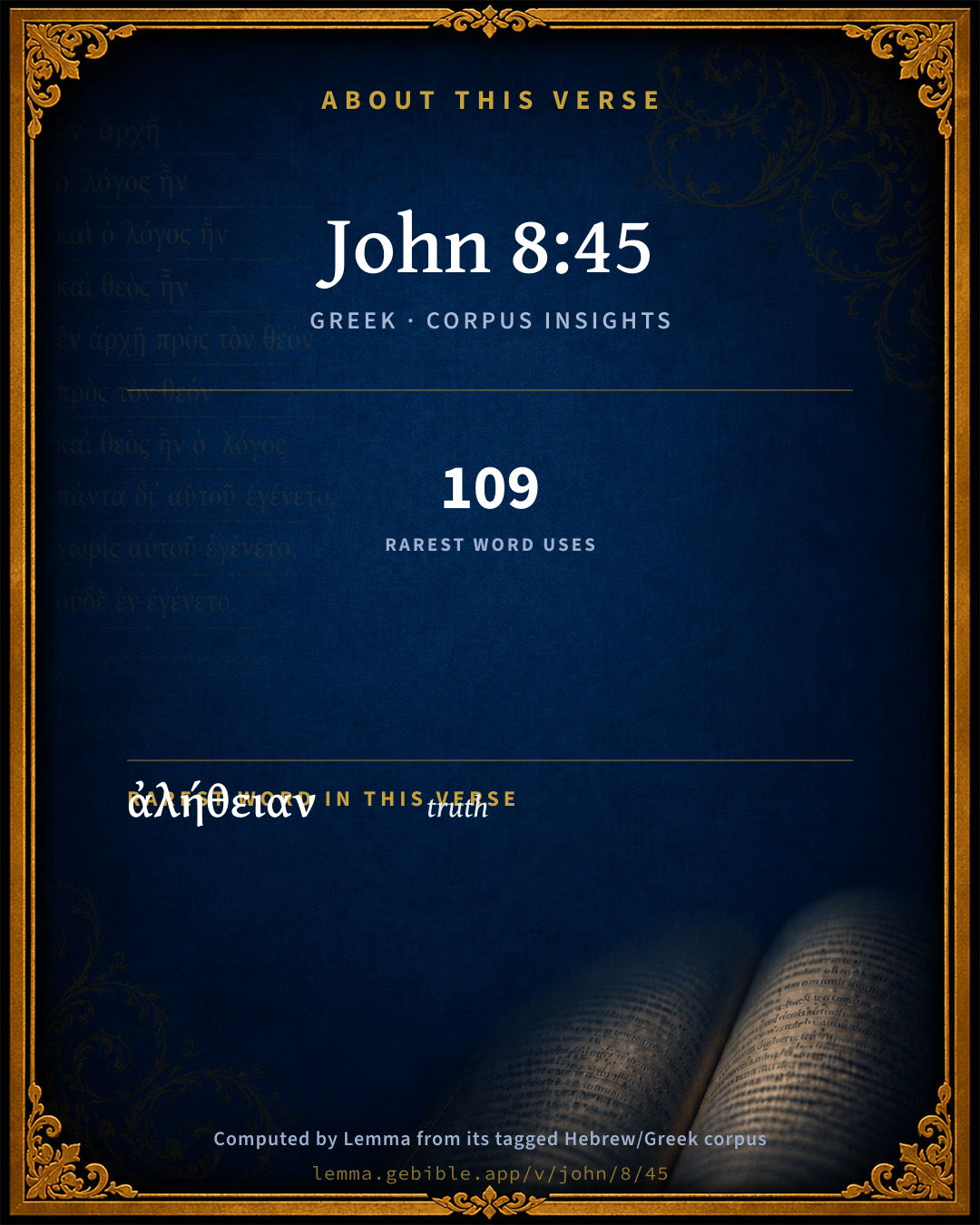
These counts appear in no published source. They are computed here, from the morphology-tagged text and Lemma’s own curated glosses. What Lemma adds →

9
words
8
distinct lemmas
Gospels
section

Repetition

A word recurs within this verse:

Cross-references

6

Topical passages linked to John 8:45 in the Treasury of Scripture Knowledge — connected by theme and wording, ordered by reader-vote popularity; previews shown in the World English Bible.

  • 2 Timothy 4:3–4 For the time will come when they will not listen to the sound doctrine, but, having itching ears, will heap up for themselves teachers after their own lusts;
  • John 3:19–20 This is the judgment, that the light has come into the world, and men loved the darkness rather than the light; for their works were evil.
  • John 7:7 The world can't hate you, but it hates me, because I testify about it, that its works are evil.
  • John 18:37 Pilate therefore said to him, "Are you a king then?" Jesus answered, "You say that I am a king. For this reason I have been born, and for this reason I have come into the world, that I should testify to the truth. Everyone who is of the truth listens to my voice."
  • Galatians 4:16 So then, have I become your enemy by telling you the truth?
  • 2 Thessalonians 2:10 and with all deception of wickedness for those who are being lost, because they didn't receive the love of the truth, that they might be saved.

Cross-references courtesy of OpenBible.info (CC BY 4.0).

Commentary

Notes on John 8:45 from classic Christian and Jewish commentators (each source and its license shown beneath its notes). The classic Christian expositions comment on the surrounding passage and are grouped to its opening verse, so a note may address several verses; the Jewish commentaries on the Tanakh (Rashi and others) are per-verse, so they appear only where the commentator wrote on this verse.

Lemma curates 59 commentaries, every one of them public domain or Creative Commons licensed, each selected and text-cleaned for this edition rather than reprinted as found. About our sources →

Bengel's Gnomon

Johann Albrecht Bengel

Joh 8:45. Ἐγώ, I) This pronoun is put with emphasis at the beginning of a sentence.—ὅτι, because) inasmuch as. It is a characteristic of truth, not to believed by the evil.—τὴν ἀληθείαν, the truth) to which the ψεῦδος, lie, is opposed.—λέγω, I tell) In antithesis to, he speaketh in the preceding verse.—οὐ, not) Ye give not ear to me: ye give ear to the devil.

Bengel's Gnomon of the New Testament — English translation (T&T Clark, Edinburgh, 1860) — public domain. Text from a community e-Sword module.

Meyer's Critical & Exegetical Commentary

Heinrich August Wilhelm Meyer

Joh_8:45. Because I, on the contrary, speak the truth, ye believe me not

ἐγὼ δέ] for the sake of strong emphasis, in opposition to the devil, placed at the beginning; and the causative ὅτι, a thoroughly tragical because, has its ground in the alien character of the relation between that which Jesus speaks and their devilish nature, to which latter a lie alone corresponds. Euth. Zigabenus aptly remarks: εἰ μὲν ἔλεγον ψεῦδος, ἐπιστεύσατέ μοι ἄν, ὡς τὸ ἴδιον τοῦ πατρὸς ὑμῶν λέγοντι. To take the sentence as a question (Ewald) would weaken its tragical force.

Meyer — Critical and Exegetical Commentary on the New Testament — English translation by Peter Christie, edited by Frederick Crombie (T&T Clark, 1880) — public domain. Text from a community e-Sword module.

Expositor's Greek Testament

ed. W. Robertson Nicoll

Joh 8:45 . ἐγὼ δὲ . “But I” in contrast to the devil “because I speak the truth you do not believe me.” Had I spoken falsehood you would have believed me, because it is your nature to live in what is false ( cf. Euthymius).

The Expositor's Greek Testament, edited by W. Robertson Nicoll (1897–1910) — public domain. Text from a community e-Sword module.

Jamieson, Fausset & Brown

Robert Jamieson, A. R. Fausset & David Brown

And because I tell you the truth, ye believe me not--not although, but just because He did so, for the reason given in the former verse. Had He been less true they would have hailed Him more readily.

Jamieson, Fausset & Brown — Commentary Critical and Explanatory on the Whole Bible (1871) — public domain (CC PDM 1.0). Text via the HelloAO Bible API.

John Calvin's Commentaries

45. But because I speak the truth. He confirms the preceding statement; for, since they have no other reason for opposing, but because truth is hateful and intolerable to them, they show plainly that they are the children of Satan.

John Calvin's Commentaries (1540-1563) — public domain. Text from the Calvin Translation Society English edition (1840s-50s) via the Christian Classics Ethereal Library (ccel.org). Calvin's coverage is partial (roughly two-thirds of the Bible); uncommented books and verses are honest gaps, never fabricated. The 19th-century editor's footnotes and remarks are omitted so the notes are faithfully Calvin's own voice.

Ellicott's Commentary for English Readers

(45) And because I tell you the truth.—The pronoun is full of emphatic meaning. And I, as contrary to him, because 1 tell you the truth, as contrary to the lie which is his characteristic.

Ye believe me not—i.e., ye believe not what I say. It does not mean, Ye believe not on Me, but Ye accept not the truth which I speak. There is something startling in this sharp opposition of truth and unbelief. To speak the truth is commonly to command belief. The mind of man is so constituted that truth is the first object of its search. Here was perfect truth presented to men, and they refused to accept it, because it was the truth, and they were themselves children of him who was a liar.

A Bible Commentary for English Readers, edited by Charles John Ellicott (1878–1897) — public domain. Text from a community e-Sword module.

The Cambridge Bible for Schools and Colleges

gen. ed. J. J. S. Perowne

45. And because I tell you, &c.] Better, But because I speak the truth, ye do not believe me. ‘Ye will listen to the devil (Joh_8:38); ye will believe a lie: but the Messiah speaking the truth ye will not believe.’ The tragic tone once more: comp. Joh_1:5; Joh_1:10-11, Joh_2:24, Joh_3:10; Joh_3:19, &c.

The Cambridge Bible for Schools and Colleges (gen. ed. J. J. S. Perowne; Cambridge University Press, 1878–1918) — public domain. Text from a community e-Sword module.

John Gill's Exposition

Then answered the Jews, and said unto him,.... Being incensed to the last degree, that he should say they were of their father the devil, and not of God; and that he spoke the truth, and no one could convince him of sin:

say we not well, that thou art a Samaritan? it seems they had said so before, though it is not recorded; and now they thought themselves justified in it, since he treated them, the true sons of Abraham, in such a manner; and the rather, since he had been lately among the Samaritans, and had in a parable spoken in favour of a Samaritan: they meant by this expression, that he was an irreligious man, and one that had no regard to the law of Moses; or at least played fast and loose with religion and the law, and was for any thing, as times served: the Jews had a very ill opinion of the Samaritans, on these accounts and to call a man a Samaritan, was all one as to call him an heretic, an idolater, or an excommunicated person; for such were the Samaritans with the Jews; they charged them with corrupting the Scriptures, and with worshipping idols, which were hid in Mount Gerizim; and they give us a dreadful account of their being anathematized by Ezra, Zorobabel, and Joshua; who, they say (r),

"gathered the whole congregation into the temple, and brought in three hundred priests, and three hundred children, and three hundred trumpets, and three hundred books of the law, in their hands; they blew the trumpets, and the Levites sung, and they anathematized the Samaritans, by the inexplicable name of God, and by the writing on tables, and with the anathema of the house of judgment, above and below; (saying,) let not any Israelite for ever eat of the fruit, or of the least morsel of a Samaritan; hence they say, whoso eateth the flesh of a Samaritan, it is all one as if he ate swine's flesh; also let not a Samaritan be made a proselyte, nor have a part in the resurrection of the dead; as it is said, "You have nothing to do with to build an house unto our God", Ezr 4:3, neither in this world, nor in the world to come: moreover, also let him have no part in Jerusalem; as it is said, "But you have no portion, nor, right, nor memorial in Jerusalem", Neh 2:20; and they sent this anathema to the Israelites that were in Babylon, and they added thereunto, curse upon curse moreover, king Cyrus added an everlasting anathema to it, as it is said, "And the God that hath caused his name to dwell there, destroy", &c. Ezr 6:12.''

And hence, because the Samaritans were had in such abhorrence by the Jews, they would not ask a blessing over food in company with them (s), nor say Amen after they had asked one (t); nor indeed, after the better sort of them had asked, unless the whole blessing was distinctly heard (u), that so they might be sure there was no heresy in it; by all which it appears, how opprobrious this name was, and what a sad character was fixed upon a man that bore it; see Gill on Joh 4:9; and as Christ was called by the Jews a Samaritan, they having no name more hateful and reproachful to call him by, so the Christians are still in their writings called Cuthites, or Samaritans; and it is indeed with them a general name for all Gentiles and idolaters, or whom they esteem such:

and hast a devil; familiarity and converse with one; by which means they imagined he knew their thoughts, and their actions, and by his assistance performed his miracles; or they took him for a lunatic, or a madman; whose lunacy and madness proceeded from the devil, with whom he was possessed: and this rather seems to be the sense, since in Joh 8:52 the Jews say they knew he had a devil, which they concluded from his saying, that such that observed his words, and kept them, should never die; which they considered as the words of a man out of his senses, seeing all men, even the best of men die, they not understanding his meaning; whereas they could not gather from hence, that he dealt with familiar spirits; and what still confirms this sense is, that these two are joined together in Joh 10:20, "he hath a devil, and is mad", and such as were demoniacs, men possessed with devils, were either mad, or lunatic, and melancholy; see Mat 8:28, compared with Mar 9:17. To which may be added, that it was a prevailing notion with the Jews, that madness and melancholy were owing to evil spirits, which had the predominancy over men: and seeing Christ was thought to be besides himself by his friends and relations, Mar 3:21, it need not be wondered at, that his enemies should fix such a character on him; nor was this an unusual one to be given to good men; the prophets and spiritual men of the Old Testament were accounted madmen, Kg2 9:11. And since our Lord was used in this abusive manner, it need not seem strange, that his followers should be treated in the same way; as the Apostle Paul and his companions in the ministry were, Act 26:24; see Joh 10:20.

(r) Pirke Eliezer, c. 38. (s) Bartenora in Misn. Beracot, c. 7. sect. 1. (t) Elias in Tishbi in voce (u) Misn. Beracot, c. 8. sect. 8. & Maimon. & Bartonera in ib.

John Gill's Exposition of the Whole Bible (1746–1763) — public domain (CC PDM 1.0). Text via the HelloAO Bible API.

Trapp's Complete Commentary

John Trapp

45 And because I tell you the truth, ye believe me not.

Ver. 45. And because I tell you the truth] {See Trapp on "Joh 8:40"}

John Trapp, A Commentary or Exposition upon All the Books of the Old and New Testament (1647–1656) — public domain. Text from a community e-Sword module.

Matthew Poole's English Annotations

Such is your hatred to the truth, that you hate me for no other reason but because I reveal my Father’s will (which is the truth) to you; than which nothing can evidence a greater hatred to truth, nor conformity and likeness to the devil. There cannot be a greater evidence of any one’s hatred of the truth, than the hatred of those who tell them the truth, and for this very reason, because they do so.

Matthew Poole's English Annotations on the Holy Bible (1683–1685) — public domain. Text from a community e-Sword/MySword module.

Whedon's Commentary on the Bible

Daniel D. Whedon

45. Ye believe me not—Jesus brings the principle home upon these Jews. Like their satanic father, they were normally so full of untruth that they disbelieved truth because it was truth. Right nature is exactly reversed. Falsehood is the thing to be believed. Such is man’s perversion by sin!

Daniel D. Whedon (gen. ed.), Commentary on the Old and New Testaments (1874–1909) — public domain. Text from a community e-Sword module.

The Pulpit Commentary

Then, turning to these children of the wicked one, Christ delivered a tremendous denunciation: But because I say the truth because I am the Organ, Utterance, and Incarnation of the truthye believe me not. If he spake lies to them, they would greedily receive them. The very cause of their lack of credence is the utterance of truth. The "I" is emphatic, and set over against the "you" of the second clause. There is a tragic force about this charge almost unparalleled, implying the most wilful estrangement from God, a rejection of known truth because it was truth, a love of darkness because it was darkness, a moral obtuseness which answers to the terrible language, "Lest they should see with their eyes," etc.

The Pulpit Commentary (1880–1919), ed. H.D.M. Spence-Jones & Joseph S. Exell — public domain. Text from a community e-Sword module.

John Wesley's Explanatory Notes

Because I speak the truth - Which liars hate.

John Wesley, Explanatory Notes Upon the Whole Bible (1754–1765) — public domain. Text via the GEBible commentary corpus.

Burkitt's Expository Notes on the New Testament

William Burkitt

Here observe, 1. The free reproof which Christ gave the Jews for their obstinate unbelief; because I tell you the truth, ye believe me not.

Observe, 2. The challenge which he gives the worst of his adversaries: Which of you convinceth me of sin? So perfectly pure, innocent, and spotless, was the doctrine and life of Christ, that although his enemies loaded him with slander and false accusation, yet none of them could justly convict of, much less condemn him for, the least known sin.

Observe, 3. The Jews being enraged at this free reproof, fell a railing at his person, charging him with being a Samaritan, possessed with an evil spirit. Our Saviour meekly replies, That he did not deal with the devil; but was honouring his Father in what he did, and said; and therefore his Father would take care of his honour, and judge between him and them.

Here note, That though Christ used some sharpness in reproving the Jews and representing them to themselves; yet he answers with wonderful mildness and meekness, when he discovers his resentments of his own reproaches: how cool was Christ in his own cause; but warm enough in God’s!

William Burkitt's Expository Notes on the New Testament (1700–1703) — public domain. Text from a community e-Sword module.

unfoldingWord translationNotes

Door43 World Missions Community

Connecting Statement:

Jesus continues speaking to the Jews.

because I speak the truth

"because I tell you true things about God"

Which one of you convicts me of sin?

Jesus uses this question to emphasize that he has never sinned. AT: "None of you can show that I have ever sinned!" (See: Rhetorical Question)

If I speak the truth

"If I say things that are true"

why do you not believe me?

Jesus uses this question to scold the Jewish leaders for their unbelief. AT: "you have no reason for not believing in me!" (See: Rhetorical Question)

the words of God

Here "words" is a metonym for the "message" of God. AT: "the message of God" or "the truth that comes from God" (See: Metonymy)

translationWords

true

believe

sin

word

God

unfoldingWord translationNotes — © Distant Shores Media and the Door43 World Missions Community, licensed CC BY-SA 4.0. Source: git.door43.org/Door43/en_tn.

Cambridge Greek Testament for Schools and Colleges

45. ἐγὼ δὲ ὅτι. But as for Me, because I say the truth, ye believe Me not: ἐγώ is in emphatic contrast to the ψεύστης. Just as the devil ‘stood not in the truth’ because of his natural alienation from it, so they do not accept the truth when Jesus offers it to them. They will listen to the devil (Joh 8:38); they will believe a lie: but the Messiah speaking the truth they will not believe. The tragic tone once more, but more definitely expressed: comp. Joh 1:5; Joh 1:10-11, Joh 2:24; Joh 3:10; Joh 3:19.

Cambridge Greek Testament for Schools and Colleges (Cambridge University Press, 1896; 21 vols, various authors incl. Carr, Maclear, Plummer, Farrar, Lumby, Moule, M. R. James, Simcox) — public domain. Text from a community e-Sword module.

Alford’s Greek Testament

Henry Alford

45.] ‘And the very reason why ye do not believe Me (as contrasted with him) is, because I speak the truth;—you not being of the truth, but of him who is falsehood itself.’ This implies a charge of wilful striving against known and recognized truth. Euthymius fills up the context—εἰ μὲν ἔλεγον ψεῦδος, ἐπιστεύσατέ μοι ἄν, ὡς τὸ ἴδιον τοῦ πατρὸς ὑμῶν λέγοντι: see ch. 5:43.

Henry Alford, The Greek Testament (1849–1861) — public domain. Text from a community e-Sword module.

International Critical Commentary

45. ἐγὼ δὲ ὅτι τὴν ἀλήθειαν λέγω, οὐ πιστεύετέ μοι, “But as for me (ἐγώ being placed first for emphasis), because I speak the truth, you do not believe me.” Truth is uncongenial to them. Cf. 3:19; and see on 16:7 for τὴν ἀλήθειαν λέγω.

πιστεύειν τα ι is not to be confused with that deeper faith which is expressed by πιστεύειν εἴς τινα (see on v. 31).

International Critical Commentary — older volumes (1896–1929), various authors — public domain. Text from a community e-Sword module.

Vincent's Word Studies in the New Testament

Marvin R. Vincent

And because I [εγω δε οτι] . Render but, instead of and. You would believe falsehood if I should speak it, but because I tell you the truth, you do not believe. The I is emphatic. I, because I tell you, etc.

Marvin R. Vincent, Word Studies in the New Testament (1887–1900) — public domain. Text from a community e-Sword/MySword module.

Godet's Commentaries

Frédéric Louis Godet

Vv. 45-47. “And because I say the truth to you, you believe me not. 46. Which of you can convict me of sin? And if I say the truth, why do you not believe me? 47. He that is of God hears the words of God; for this cause you hear them not, because you are not of God.”

What, ordinarily, causes a man to be believed is the fact that he speaks the truth. Jesus has with the Jews the opposite experience. They are so swayed by falsehood, by which their father has blinded their hearts, that precisely because he speaks the truth, he does not find credence with them. ᾿Εγώ, at the beginning: I, the organ of the truth, in opposition to Satan, the organ of falsehood.

Frédéric Louis Godet — Commentaries on Luke, John, Romans, and 1 Corinthians — English translation (T&T Clark, Edinburgh, 1870s–1890s) — public domain. Text from a community e-Sword module.

Lesson kit

Teaching starters — assembled from the data on this page, not authored interpretation. Every prompt links to the verse data it draws on. Edit before teaching.

John, in the Gospels, opens this verse with 9 words (8 distinct Greek lemmas). Its most distinctive word is alḗtheia (“truth”). A historical commentator’s framing appears above. Read the whole chapter for the surrounding context.

Discussion questions

  1. How does “truth” (alḗtheia) shape what this verse is saying?
  2. 2 Timothy 4:3–4 shares this passage’s theme. How do the two illuminate each other?
  3. “I” occurs 2× in this one verse. What is the effect of the repetition?
  4. These translations render this verse differently; the difference is in the English rendering, not the original. What questions does that raise?
  5. Reading how Bengel's Gnomon and Meyer's Critical & Exegetical Commentary read this verse, where do the two commentators agree and where do they part?

Things to notice

  • These translations choose different wording for 4 words in this verse.
  • “I” occurs 2× in this single verse.
  • 8 distinct Greek lemmas span 9 words in this verse.

Reading settings

Reading text

Shown beneath each verse's original-language words.

Old Testament
Old Testament edition

Read the OT as the Masoretic Hebrew (MT) or the Greek Septuagint (LXX).

English shown for the Greek Septuagint (in the Hebrew ↔ Greek comparison).

Comparing translations? Open the Compare panel on any verse page to stack up to four side by side.