Isaiah 3:7

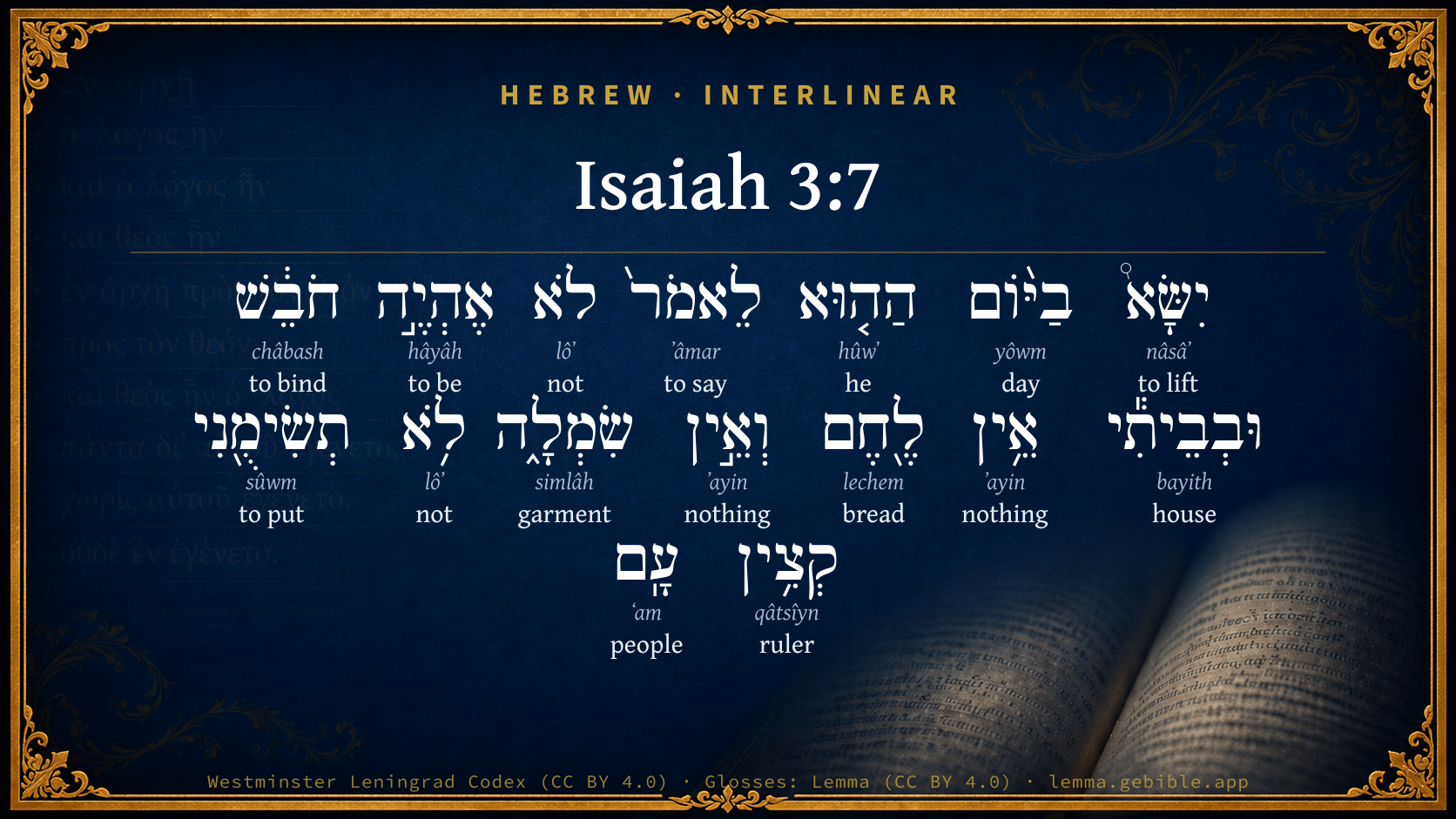
Hebrew (Westminster Leningrad Codex) Isaiah 3:7 appears in the Hebrew Old Testament. The text above is from the Westminster Leningrad Codex. Each word links to its Strong’s number, a concise gloss, and parsing drawn from the Open Scriptures Hebrew Bible morphology. Click any word for its full Brown-Driver-Briggs (BDB) entry.
Download image
Cite this verse

Isaiah 3:7 (World English Bible). Public Domain. Lemma interlinear Bible study tool, https://lemma.gebible.app/v/isaiah/3/7.

Show BibTeX & RIS
BibTeX
RIS
English Translation
In that day he will cry out, saying, I will not be a healer; For in my house is neither bread nor clothing. You shall not make me ruler of the people.
World English Bible · Public Domain
Download a study sheet

One document with this verse’s original text, its word-by-word gloss line, the meaning frame, cross-references with their text, attributed commentary, and full source and license credits — printable, and it pastes into notes with its structure intact.

This verse Autodidact and up

Study sheet (.html) Plain text (.txt)

A passage Seminary Student

Up to 50 verses in one chapter. A passage sheet keeps up to 6 commentary sources and 12 cross-references per verse, in the order this page ranks them, and says so on the sheet whenever that leaves anything out. Ask for a single verse and you get the Autodidact verse sheet above.

Everything on this page stays free to read, with no account — the sheet is a download of what is already on screen, not access to it.

Want to remove ads? Support Godless Engineer
Compare translations 3

The same verse in 3 English versions, stacked beneath the original-language interlinear above. Click any original word for its lexicon entry.

Each is an independent rendering of the whole verse — the interlinear is not word-aligned to these translations.

Highlighted words mark where these versions differ — a whole-verse word diff, not a word-by-word alignment.

  • World English Bible Public Domain
    In that day he will cry out, saying, I will not be a healer; For in my house is neither bread nor clothing. You shall not make me ruler of the people.
  • King James Version Public Domain
    In that day shall he swear, saying, I will not be an healer; for in my house is neither bread nor clothing: make me not a ruler of the people.
  • unfoldingWord Literal Text CC BY-SA 4.0
    On that day he will lift up, saying, “I will not be a healer, for in my house there is no bread and there is no cloak. Do not make me a ruler of the people.” q1

unfoldingWord Literal Text — © unfoldingWord, licensed CC BY-SA 4.0. Word-aligned USFM3 via Door43 (git.door43.org/unfoldingWord/en_ult).

Versions to compare (up to 4)

3 of 4 selected

Show all 18 translations

Every available English version of this verse, each an independent rendering of the whole verse.

  • World English Bible Public Domain
    In that day he will cry out, saying, I will not be a healer; For in my house is neither bread nor clothing. You shall not make me ruler of the people.
  • Berean Standard Bible Public Domain
    On that day he will cry aloud: “I am not a healer. I have no food or clothing in my house. Do not make me leader of the people!”
  • Majority Standard Bible Public Domain
    On that day he will cry aloud: “I am not a healer. I have no food or clothing in my house. Do not make me leader of the people!”
  • King James Version Public Domain
    In that day shall he swear, saying, I will not be an healer; for in my house is neither bread nor clothing: make me not a ruler of the people.
  • American Standard Version (1901) Public Domain
    in that day shall he lift up `his voice', saying, I will not be a healer; for in my house is neither bread nor clothing: ye shall not make me ruler of the people.
  • Revised Version (1885) Public Domain
    in that day shall he lift up his voice, saying, I will not be an healer; for in my house is neither bread nor clothing: ye shall not make me ruler of the people.
  • Geneva Bible (1599) Public Domain
    In that day hee shall sweare, saying, I cannot bee an helper: for there is no bread in mine house, nor clothing: therefore make me no prince of the people.
  • Douay-Rheims (1899) Public Domain
    In that day he shall answer, saying: I am no healer, and in my house there is no bread, nor clothing: make me not ruler of the people.
  • Young's Literal Translation Public Domain
    He lifteth up, in that day, saying: `I am not a binder up, And in my house is neither bread nor garment, Ye do not make me a ruler of the people.'
  • Literal Standard Version CC BY-SA 4.0
    He lifts up, in that day, saying, “I am not a binder up, || And in my house is neither bread nor garment, || You do not make me a ruler of the people.”
  • Unlocked Literal Bible CC BY-SA 4.0
    On that day he will shout and say, 'I will not be a healer; I have no bread or clothing. You will not make me ruler of the people.'”
  • unfoldingWord Literal Text CC BY-SA 4.0
    On that day he will lift up, saying, “I will not be a healer, for in my house there is no bread and there is no cloak. Do not make me a ruler of the people.” q1
  • Darby Bible Public Domain
    he will lift up [his hand] in that day, saying, I cannot be a healer, and in my house there is neither bread nor clothing; ye shall not make me a chief of the people.
  • World Messianic Bible Public Domain
    In that day he will cry out, saying, “I will not be a healer; for in my house is neither bread nor clothing. You shall not make me ruler of the people.”
  • Webster's Bible Public Domain
    In that day shall he swear, saying, I will not be a healer; for in my house is neither bread nor clothing: make me not a ruler of the people.
  • Free Bible Version CC BY-SA 4.0
    But immediately his brother will shout back, “No, not me! I can't take care of this family's problems. In my house I don't have food or clothes. Don't put me in charge as your leader!”
  • Bible in Basic English Public Domain
    Then he will say with an oath, I will not be a helper, for in my house there is no bread or clothing: I will not let you make me a ruler of the people.
  • JPS Tanakh (1917) Public Domain
    In that day shall he swear, saying: 'I will not be a healer; for in my house is neither bread nor a mantle; ye shall not make me ruler of a people.'

Literal Standard Version (2020), Covenant Press — licensed CC BY-SA 4.0. Text via the HelloAO Bible API (eBible.org). Unlocked Literal Bible (unfoldingWord) — licensed CC BY-SA 4.0. Text via the HelloAO Bible API (eBible.org). unfoldingWord Literal Text — © unfoldingWord, licensed CC BY-SA 4.0. Word-aligned USFM3 via Door43 (git.door43.org/unfoldingWord/en_ult). Free Bible Version, Dr. Jonathan Gallagher — licensed CC BY-SA 4.0. Text via the HelloAO Bible API (eBible.org).

Word by word

More ways to search: Search by grammar → Find every occurrence → Compare this word →

Practice this passage: Drill this verse → Learn its vocabulary →

קְצִ֥ין
qâtsîyn
H7101
“ruler of”
Noun, Common, Masculine, Singular, Construct
Part of Speech
Noun
Type
Common
Gender
Masculine
Number
Singular
State
Construct
Full BDB Definition

Origin: from H7096 in the sense of determining

TWOT: 2054a

chief, ruler, commander - chief, commander (in war) - dictator - ruler (of one in authority)
  1. יִשָּׂא֩ nâsâʼ H5375 “to lift” Verb, Qal, Imperfect, 3rd Person, Masculine, Singular
  2. בַיּ֨וֹם yôwm H3117 “in/at the · day” Preposition, Determined + Noun, Common, Masculine, Singular, Absolute
  3. הַה֤וּא hûwʼ H1931 “the · he” Particle, Definite Article + Pronoun, Personal, 3rd Person, Masculine, Singular
  4. לֵאמֹר֙ ʼâmar H559 “to say” Preposition + Verb, Qal, Infinitive Construct
  5. לֹא lôʼ H3808 “not” Particle, Negative
  6. אֶהְיֶ֣ה hâyâh H1961 “to be” Verb, Qal, Imperfect, 1st Person, Common, Singular
  7. חֹבֵ֔שׁ châbash H2280 “binding” Verb, Qal, Participle Active, Masculine, Singular, Absolute
  8. וּבְבֵיתִ֕י bayith H1004 “and · in/at · house · my” Conjunction + Preposition + Noun, Common, Masculine, Singular, Construct + Suffix, Personal, 1st Person, Common, Singular
  9. אֵ֥ין ʼayin H369 “nothing” Particle, Negative
  10. לֶ֖חֶם lechem H3899 “bread” Noun, Common, Both, Singular, Absolute
  11. וְאֵ֣ין ʼayin H369 “and · nothing” Conjunction + Particle, Negative
  12. שִׂמְלָ֑ה simlâh H8071 “garment” Noun, Common, Feminine, Singular, Absolute
  13. לֹ֥א lôʼ H3808 “not” Particle, Negative
  14. תְשִׂימֻ֖נִי sûwm H7760 “to put · me” Verb, Qal, Imperfect, 2nd Person, Masculine, Plural + Suffix, Personal, 1st Person, Common, Singular
  15. עָֽם ʻam H5971 “people” Noun, Common, Masculine, Singular, Absolute

About this verse

These counts appear in no published source. They are computed here, from the morphology-tagged text and Lemma’s own curated glosses. What Lemma adds →

16
words
14
distinct lemmas
Prophets
section

Notable vocabulary

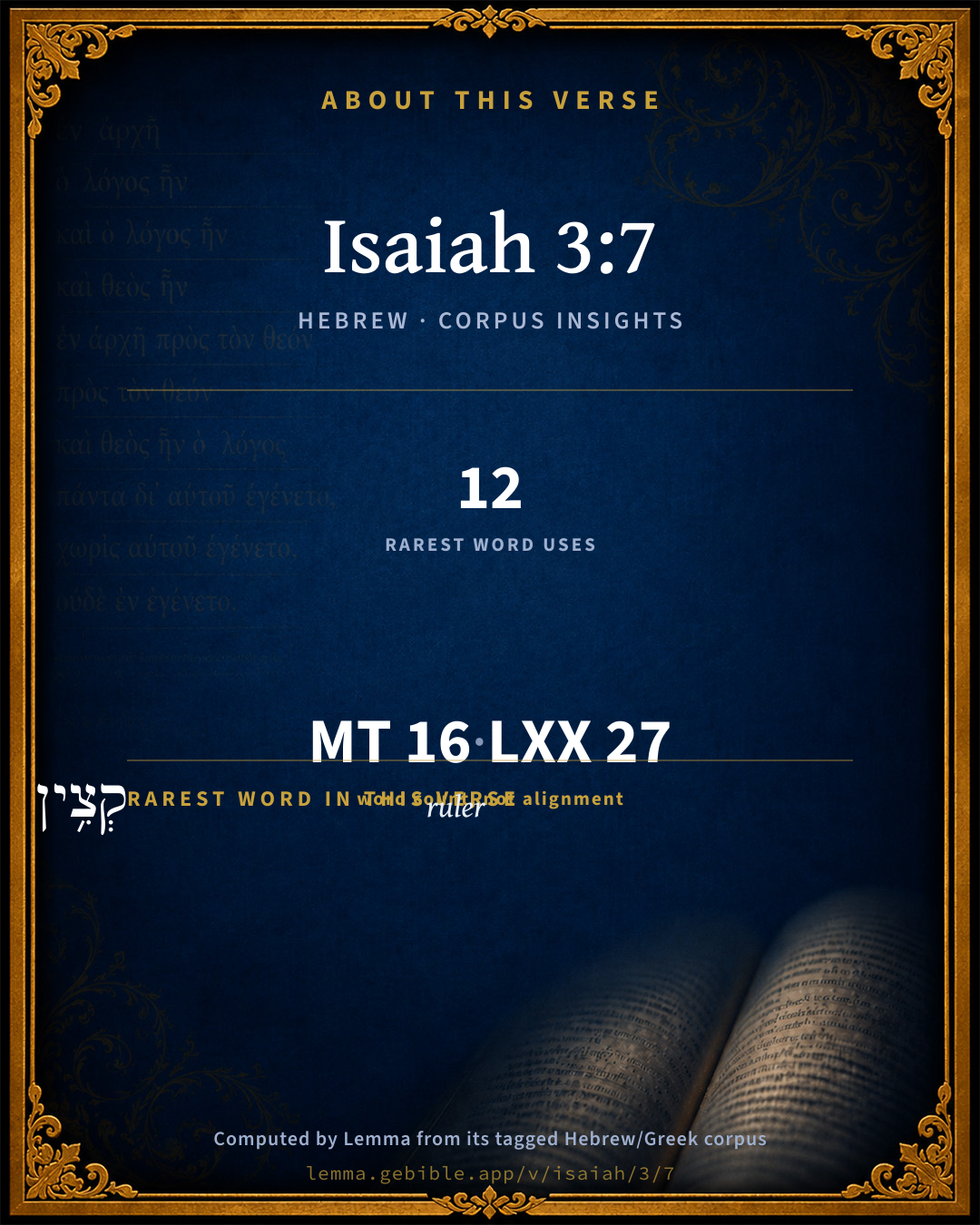
The rarest word here is קְצִ֥ין ruler H7101 — appearing just 12 times in the whole Hebrew Bible.

Shared distinctive vocabulary

קְצִ֥ין ruler H7101 occurs in 12 verses of the Hebrew Bible. Also found in:

Grammatical profile

  • 5 verbs
  • 6 nouns
  • 1 pronoun
  • 4 particles

Verb forms

  • יִשָּׂא֩ Qal · Imperfect
  • לֵאמֹר֙ Qal · Infinitive Construct
  • אֶהְיֶ֣ה Qal · Imperfect
  • חֹבֵ֔שׁ Qal · Participle Active
  • תְשִׂימֻ֖נִי Qal · Imperfect

Repetition

Words recur within this verse — often emphatic in Hebrew:

  • אֵ֥ין nothing H369 ×2
  • לֹא not H3808 ×2

Hebrew & Septuagint length

In English translation the verse runs 32 words from the Hebrew and 34 from the Septuagint (LXX English) — closely comparable.

A rough comparison of the two English renderings, which tokenize alike — not a word-level alignment.

Word counts can differ between the Hebrew and the Greek without any difference in meaning — e.g. the Hebrew direct-object marker אֵת has no separate Greek word, and Greek often adds the article ὁ.

In the original languages it is 16 Hebrew tokens and 27 Greek tokens — but the two are counted differently (Hebrew bundles its prefixes and suffixes into one token; the Greek is in lemma form), so that isn’t a like-for-like length.

Cross-references

9

Topical passages linked to Isaiah 3:7 in the Treasury of Scripture Knowledge — connected by theme and wording, ordered by reader-vote popularity; previews shown in the World English Bible.

  • Hosea 5:13 When Ephraim saw his sickness, And Judah his wound, Then Ephraim went to Assyria, And sent to king Jareb: But he is not able to heal you, Neither will he cure you of your wound.
  • Genesis 14:22 Abram said to the king of Sodom, "I have lifted up my hand to Yahweh, God Most High, possessor of heaven and earth,
  • Deuteronomy 32:40 For I lift up my hand to heaven, And say, As I live forever,
  • Isaiah 58:12 Those who shall be of you shall build the old waste places; you shall raise up the foundations of many generations; and you shall be called The repairer of the breach, The restorer of paths to dwell in.
  • Jeremiah 14:19 Have you utterly rejected Judah? has your soul loathed Zion? why have you struck us, and there is no healing for us? We looked for peace, but no good came; and for a time of healing, and, behold, dismay!
  • Lamentations 2:13 What shall I testify to you? what shall I liken to you, daughter of Jerusalem? What shall I compare to you, that I may comfort you, virgin daughter of Zion? For your breach is great like the sea: who can heal you?
  • Ezekiel 34:4 You haven't strengthened the diseased, neither have you healed that which was sick, neither have you bound up that which was broken, neither have you brought back that which was driven away, neither have you sought that which was lost; but with force and with rigor have you ruled over them.
  • Hosea 6:1 "Come, and let us return to Yahweh; For he has torn us to pieces, And he will heal us; He has injured us, And he will bind up our wounds.
  • Revelation 10:5–6 The angel who I saw standing on the sea and on the land lifted up his right hand to the sky,

Cross-references courtesy of OpenBible.info (CC BY 4.0).

Hebrew and Greek witnesses Masoretic Hebrew ↔ Greek Septuagint

The same verse in the two great witnesses to the Old Testament, shown verse-for-verse.

These are two independent witnesses, not word-aligned to each other, and the Septuagint is shown in lemma (dictionary) form.

Hebrew Isaiah 3:7 Masoretic · Westminster Leningrad Codex

יִשָּׂא֩ בַיּ֨וֹם הַה֤וּא לֵאמֹר֙ לֹא אֶהְיֶ֣ה חֹבֵ֔שׁ וּבְבֵיתִ֕י אֵ֥ין לֶ֖חֶם וְאֵ֣ין שִׂמְלָ֑ה לֹ֥א תְשִׂימֻ֖נִי קְצִ֥ין עָֽם

In that day he will cry out, saying, I will not be a healer; For in my house is neither bread nor clothing. You shall not make me ruler of the people.

World English Bible · Public Domain

Greek LXX Isaiah 3:7 Septuagint · lemma form

καί ἀποκρίνω εἶπον ἐν ὁ ἡμέρα ἐκεῖνος οὐ εἰμί σύ ἀρχηγός οὐ γάρ εἰμί ἐν ὁ οἶκος ἐγώ ἄρτος οὐδέ ἱμάτιον οὐ εἰμί ἀρχηγός ὁ λαός οὗτος

And he shall answer in that day, and say, I will not be your ruler; for I have no bread in my house, nor raiment: I will not be the ruler of this people.

LXX2012 (modern English Septuagint) · Public Domain

On this verse, Trapp's Complete Commentary discusses the Septuagint’s reading. Read the note in Commentary ↓

Hebrew: Westminster Leningrad Codex (CC BY 4.0). Greek: Septuagint (public domain); English from LXX2012 (modern English Septuagint) (Public Domain). How the Septuagint differs from the Hebrew →

Targum (Aramaic paraphrase)

1

The Targum is the ancient Jewish Aramaic paraphrase of the Hebrew Scriptures — an interpretive translation, not the Hebrew text itself. Onkelos (literal) and Pseudo-Jonathan (expansive) render the Torah, and Jonathan the Prophets. Coverage is partial: where no permissively-licensed English translation exists for a verse, only the Aramaic is shown. This is verse-level text, not a word-by-word alignment to the Hebrew.

  1. Targum Jonathan Prophets (Joshua–Malachi)
    יְתִיב בְּעִדָנָא הַהִיא לְמֵימָר לֵית אֲנָא כָשַׁר לְמֶהֱוֶי רֵישׁ וּבְבֵיתִי לֵית מָה דְאֵיכוּל וְלֵית מָה דְאִתְכַּסֵי לָא תְמַנוּנִי רַב בְּרֵישׁ כָּל עַמָא:

    He shall answer in that time, saying, I am not a proper person to become a chief, and in my house I have nothing that I could eat, and nothing wherewith I could clothe myself; appoint me not a chief over all this people.

    Targum Jonathan — Aramaic: “Mikraot Gedolot” (public domain). English: “Sefaria Community Translation” (CC0 1.0 (public-domain dedication)); “London "Chaldee Paraphrase," 1871” (public domain). Text via Sefaria.

Commentary

Notes on Isaiah 3:7 from classic Christian and Jewish commentators (each source and its license shown beneath its notes). The classic Christian expositions comment on the surrounding passage and are grouped to its opening verse, so a note may address several verses; the Jewish commentaries on the Tanakh (Rashi and others) are per-verse, so they appear only where the commentator wrote on this verse.

Lemma curates 59 commentaries, every one of them public domain or Creative Commons licensed, each selected and text-cleaned for this edition rather than reprinted as found. About our sources →

Trapp's Complete Commentary

John Trapp

Isa 3:7 In that day shall he swear, saying, I will not be an healer; for in my house [is] neither bread nor clothing: make me not a ruler of the people.

Ver. 7. In that day shall he swear, saying.] It is come to pass in some places at this day, Ut ambigant prudentiores, otium, an officium aliquod Reip. sint persecuturi, that wise men doubt whether they had best bear office or not; but true goodness is public spirited, though to private disadvantage.

I will not be an healer,] i.e., A ruler. I will not be a binder up, {a} or a surgeon, for this State is no better than a great spittle; the whole head is sick and the whole heart heavy, &c. I dare not therefore meddle with it, since it is incurable, incorrigible. The Septuagint render it, I will not be thy prince. A king hath his name in Greek from healing, {b} as Plutarch observeth, because he is to be the physician or surgeon of the commonwealth.

In mine house is neither bread nor clothing.] I have not for mine own, much less for you. A prince had need to be well underlaid, that he may not need to pill and poll his subjects, or in judging to gape after gain.

{a} In caducum parietem non inclinabo.

{b} ‘Aναξ from ακος medela cure.

John Trapp, A Commentary or Exposition upon All the Books of the Old and New Testament (1647–1656) — public domain. Text from a community e-Sword module.

Geneva Bible (1599)

Geneva Bible translators

Fear shall rather cause him to forswear himself, than to take such a dangerous charge upon him.

Geneva Bible (1599) marginal notes — public domain. Text via Bolls.life.

Jamieson, Fausset & Brown

Robert Jamieson, A. R. Fausset & David Brown

swear--literally, "lift up," namely, his hand; the gesture used in solemn attestation. Or, his voice, that is, answer; so Vulgate.

healer--of the body politic, incurably diseased (Isa 1:6).

neither . . . clothing--so as to relieve the people and maintain a ruler's dignity. A nation's state must be bad indeed, when none among men, naturally ambitious, is willing to accept office.

Jamieson, Fausset & Brown — Commentary Critical and Explanatory on the Whole Bible (1871) — public domain (CC PDM 1.0). Text via the HelloAO Bible API.

Adam Clarke's Commentary

Verse 7. In that day shall he swear - "Then shall he openly declare"] The Septuagint, Syriac, and Jerome, read וישא veyissa, adding the conjunction, which seems necessary in this place.

I will not be a healer] I am not a leche. - Old MS. Bible. Leech was the ancient English word for a physician.

For in my house is neither bread nor clothing - "For in my house is neither bread nor raiment"] "It is customary through all the East," says Sir J. Chardin, "to gather together an immense quantity of furniture and clothes; for their fashions never alter." Princes and great men are obliged to have a great stock of such things in readiness for presents upon all occasions. "The kings of Persia," says the same author, "have great wardrobes, where there are always many hundreds of habits ready, designed for presents, and sorted," Harmer, Observ., II. 11 and 88. A great quantity of provision for the table was equally necessary. The daily provision for Solomon's household, whose attendants were exceedingly numerous, was proportionately great, 1Kg 4:22-23. Even Nehemiah, in his strait circumstances, had a large supply daily for his table; at which he received a hundred and fifty of the Jews and rulers, besides those that came from among the neighbouring heathen, Neh 5:17-18.

This explains the meaning of the excuse made by him that is desired to undertake the government. He alleges that he has not wherewithal to support the dignity of the station, by such acts of liberality and hospitality as the law of custom required of persons of superior rank. See Harmer's Observations, I. 340, II. 88.

Adam Clarke's Commentary on the Bible (1810–1826) — public domain. Text from a community e-Sword/MySword module.

The Cambridge Bible for Schools and Colleges

gen. ed. J. J. S. Perowne

7. swear] better, protest, lit. “lift up (sc. his voice).”

healer] lit. “binder-up” (of the wounds of the state), see Isa_1:6

in my house … clothing] “I am as poor as any of you.”

The Cambridge Bible for Schools and Colleges (gen. ed. J. J. S. Perowne; Cambridge University Press, 1878–1918) — public domain. Text from a community e-Sword module.

John Gill's Exposition

In that day shall he swear,.... Or "lift up", that is, his hand (e), which was a gesture used in swearing, and therefore is so rendered; the meaning is, that he shall at once immediately give an answer, and for the solemn confirmation of it shall say an oath with it, saying,

I will not be a healer, or "a binder"; that is, of wounds, of political wounds, made in the nation, and which were incurable. See Isa 1:6 for the meaning is, that he neither was fit to be, nor could he be, a healer of the distempered state of the nation, it was so desperately bad. The Targum is,

"I am not fit to be a head or governor;''

and so Kimchi explains it of a governor, who, he says, is so called, because he binds and imprisons those that transgress his commands; and to this sense Jarchi and Abarbinel:

for in my house is neither bread nor clothing; not a sufficiency of either to support such grandeur and dignity; not enough to keep a proper table, and a suitable equipage:

make me not a ruler of the people; this shows that the state of the nation must be very bad indeed, that men, who are naturally ambitious of power and honour, should refuse government when offered to them.

(e) "attollet manum", Piscator.

John Gill's Exposition of the Whole Bible (1746–1763) — public domain (CC PDM 1.0). Text via the HelloAO Bible API.

Albert Barnes' Notes on the Bible

In that day shall he swear - Hebrew, ישׁא yı̂shā' ‘Shall he lift up’ - that is, the voice, or the hand. To lift up the hand was one of the modes of taking an oath. Perhaps it means only that he should lift up “the voice” - that is, “should answer;” compare Num 14:1. The Vulgate, the Septuagint, and the Chaldee, read it simply ‘he shall answer.’

I will not be an healer - Hebrew, ‘a binder up,’ Isa 1:6. The Vulgate renders it, ‘I am not a physician.’ The Septuagint and the Chaldee, ‘I am not sufficient to be a leader.’ The meaning is, that the state of affairs was so ruinous and calamitous that he would not attempt to restore them; as if, in the body, disease should have so far progressed that he would not undertake to restore the person, and have him “die” under his hands, so as to expose himself to the reproach of being an unsuccessfill and unskillful physician.

Is neither bread nor clothing - I am not rich. I have not the means of providing for the needs of the people, or to maintain the rank of a ruler. ‘It is customary,’ says Sir John Chardin, ‘to gather together an immense quantity of clothes, for their fashions never alter.’ ‘The kings of Persia have great wardrobes, where they have always many hundreds of habits ready, designed for presents, and sorted.’ - “Lowth.” The description here is one of very great calamity and anarchy. So great would be the ruin and danger, that men would be unwilling to be chosen to the office of princes and rulers, and none could be found who would desire to possess the highest honors of the nation. Generally men “aspire” to office; here they were unwilling, on account of the disordered and ruined state of affairs, even to accept of it.

Albert Barnes' Notes on the Bible (1834–1885) — public domain. Text from a community e-Sword/MySword module.

Haydock's Catholic Bible Commentary

Clothing. The indigent were excluded from dignities, for fear lest they should seek to enrich themselves by unjustifiable means, Exodus xviii. 22. (Plut.[Plutarch?] in Sol.) (Pliny, [Natural History?] xvi. 19.) (Calmet)

George Leo Haydock (1774–1849), Haydock's Catholic Family Bible and Commentary, 1859 edition — public domain. Excludes Psalms (Douay-Rheims chapter numbering differs from Protestant) and Deuterocanonical books (Catholic canon only).

Matthew Poole's English Annotations

He shall swear, Heb. he shall lift up; understand either,

1. His voice; he shall cry aloud, to show his earnestness in refusing the offer; or,

2. His hand, which was the usual gesture in swearing, Gen 14:22; Deu 32:40, &c., to show his resolvedness.

An healer; a repairer of the ruins of the state.

In my house is neither bread nor clothing; I have not sufficient provisions, either of food or raiment, for my own family; much less, as you falsely suppose, for the discharge of so high a trust.

Matthew Poole's English Annotations on the Holy Bible (1683–1685) — public domain. Text from a community e-Sword/MySword module.

The Pulpit Commentary

In that day shall he swear; or, lift up his voice speaking with emotion (Kay). I will not be a healer; literally, a binder-up; (comp. Isa_1:6) "I will not undertake to heal the calamities of the state." In my house is neither bread nor clothing; i.e. "I am not a wealthy man; I have no stores laid up; I am quite unfit to be the people"s ruler." Make me not; or, ye shall not make me. The decently clad man entirely declines to be advanced to the helm of the state.

The Pulpit Commentary (1880–1919), ed. H.D.M. Spence-Jones & Joseph S. Exell — public domain. Text from a community e-Sword module.

John Wesley's Explanatory Notes

An healer - A repairer of the ruins of the state.

John Wesley, Explanatory Notes Upon the Whole Bible (1754–1765) — public domain. Text via the GEBible commentary corpus.

J. A. Alexander on Isaiah

Joseph Addison Alexander

This verse contains the refusal of the invitation given in the one preceding. “In that day he shall lift up (his voice in reply) saying I will not be a healer, and in my house there is no bread, and there is no clothing; ye shall not make me a ruler of people.” In that day may either mean at once, without deliberation, or continue the narrative without special emphasis. Some supply hand after lift up, as a gesture of swearing, or the name of God as in the third commandment, and understand the phrase to mean that he shall swear. But the great majority of writers supply voice, some in the specific sense of answering, or in the simple sense of uttering, but others with more probability in that of speaking with a loud voice, or distinctly and with emphasis, he shall protest, or openly declare. The whole connection seems to show that this is a profession of great poverty, which, if true, shows more clearly the condition of the people, and if false, the general aversion to office. The last clause does not simply mean do not make me, but you must not, or you shall not make me a ruler.

Joseph Addison Alexander, The Prophecies of Isaiah (1846–1847; New York: Scribner, 1870–1878) — public domain. Text from a community e-Sword module.

Rashi

Rabbi Shlomo Yitzchaki (Rashi)

He shall swear on that day [lit. he will raise. The word יִשָּׂא] is only an expression of swearing; he will swear to them, I will not be a ‘Chovesh.’ I will not be one of those confined to the study hall, since, in my house there is neither bread nor clothing; I have understanding neither of the Mishnah nor of the Aggadah. Another explanation according to the simple meaning is: I will not be a confiner; I will not be a judge, who confines the convicts to prison.

Rashi on the Tanakh — English translations: “The Judaica Press complete Tanach with Rashi, translated by A. J. Rosenberg” (CC BY 4.0); “Pentateuch with Rashi's commentary by M. Rosenbaum and A.M. Silbermann, 1929-1934” (public domain); “The Metsudah Tanach series, Lakewood, N.J” (CC BY 4.0); and “The Book of Joshua, Metsudah Publications, 1997” (CC BY 4.0). Text via Sefaria.

Ibn Ezra

Rabbi Abraham ibn Ezra

יִשא He will swear (comp. לא תשא את שם יי thou shalt not swear by the name of the Lord, Exod. 20:7).

חובש Ruler. It is the same verb as in הובש מכה ‘ dressing a wound;’ comp. עֶצֶר power (Judg. 18:7).

There is no clothing. Even for myself.

Ibn Ezra on the Tanakh — English translations: “Sefaria Community Translation” (CC0 1.0 (public-domain dedication)); “Yalkut, Sifsei Chachomim Chumash, Metsudah Publications, 2009” (CC BY 4.0); and “Commentary of Ibn Ezra on Isaiah - trans. by M. Friedlander, 1873” (public domain). Text via Sefaria.

Lesson kit

Teaching starters — assembled from the data on this page, not authored interpretation. Every prompt links to the verse data it draws on. Edit before teaching.

Isaiah, in the Prophets, opens this verse with 16 words (14 distinct Hebrew lemmas). Its most distinctive word is qâtsîyn (“ruler”). A historical commentator’s framing appears above. Read the whole chapter for the surrounding context.

Discussion questions

  1. The word qâtsîyn carries the sense “ruler.” How does it shape the verse?
  2. How does Joshua 10:24, which shares the word «ruler», read alongside this verse?
  3. What does the repetition of “nothing” (2× in this one verse) do in this verse?
  4. These translations render this verse differently; the difference is in the English rendering, not the original. What questions does that raise?
  5. «יִשָּׂא֩» is a Qal Imperfect verb. How does that grammatical form shape the action described?
  6. Compare how Trapp's Complete Commentary and Geneva Bible (1599) read this verse. Where do they agree or differ?

Things to notice

Reading settings

Reading text

Shown beneath each verse's original-language words.

Old Testament
Old Testament edition

Read the OT as the Masoretic Hebrew (MT) or the Greek Septuagint (LXX).

English shown for the Greek Septuagint (in the Hebrew ↔ Greek comparison).

Comparing translations? Open the Compare panel on any verse page to stack up to four side by side.