
Habakkuk 2:14

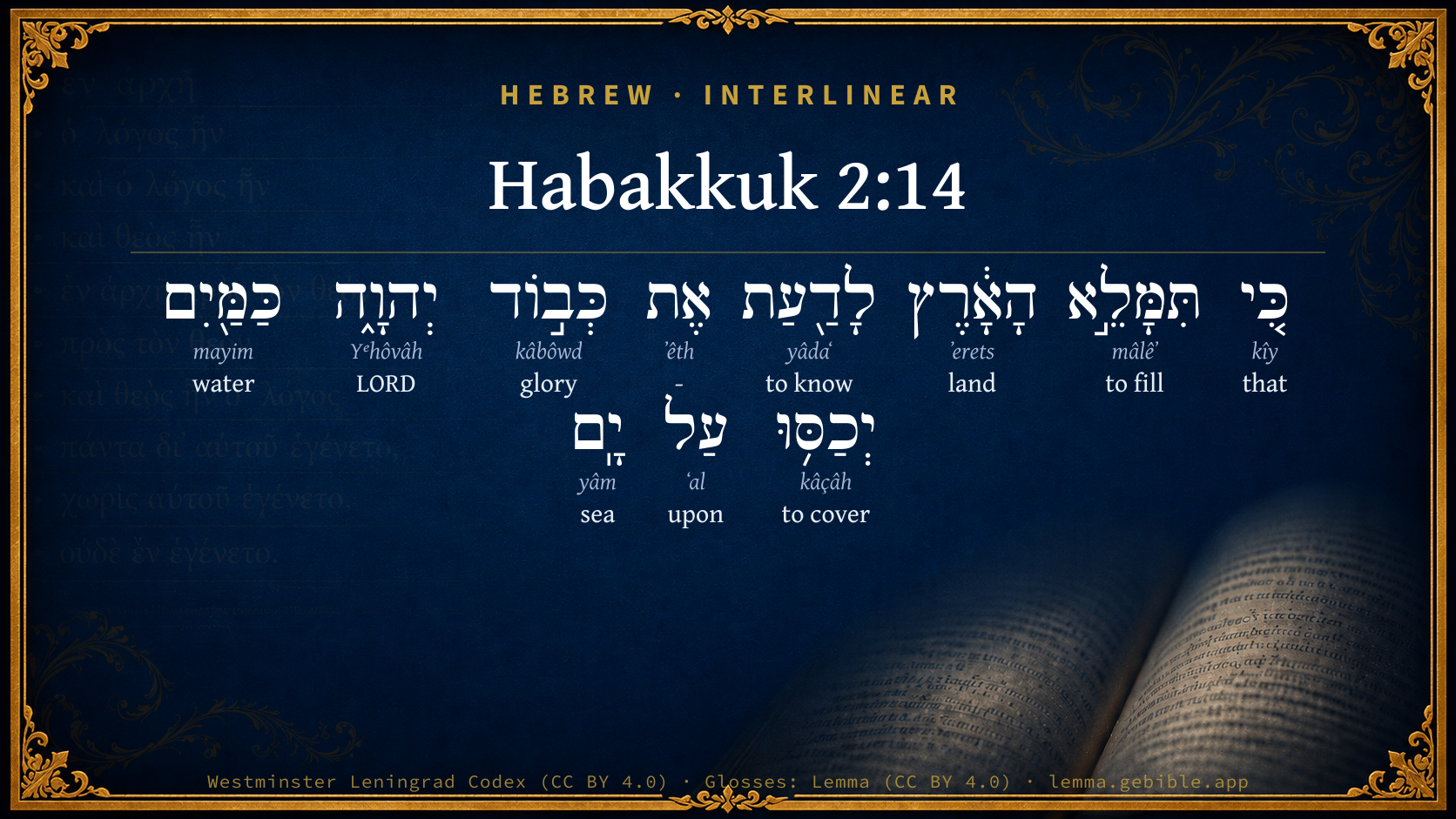
Hebrew (Westminster Leningrad Codex) Habakkuk 2:14 appears in the Hebrew Old Testament. The text above is from the Westminster Leningrad Codex. Each word links to its Strong’s number, a concise gloss, and parsing drawn from the Open Scriptures Hebrew Bible morphology. Click any word for its full Brown-Driver-Briggs (BDB) entry.
Download image
Cite this verse

Habakkuk 2:14 (World English Bible). Public Domain. Lemma interlinear Bible study tool, https://lemma.gebible.app/v/habakkuk/2/14.

Show BibTeX & RIS
BibTeX
RIS
English Translation
For the earth will be filled with the knowledge of the glory of Yahweh, as the waters cover the sea.
World English Bible · Public Domain
Download a study sheet

One document with this verse’s original text, its word-by-word gloss line, the meaning frame, cross-references with their text, attributed commentary, and full source and license credits — printable, and it pastes into notes with its structure intact.

This verse Autodidact and up

Study sheet (.html) Plain text (.txt)

A passage Seminary Student

Up to 50 verses in one chapter. A passage sheet keeps up to 6 commentary sources and 12 cross-references per verse, in the order this page ranks them, and says so on the sheet whenever that leaves anything out. Ask for a single verse and you get the Autodidact verse sheet above.

Everything on this page stays free to read, with no account — the sheet is a download of what is already on screen, not access to it.

Want to remove ads? Support Godless Engineer
Compare translations 3

The same verse in 3 English versions, stacked beneath the original-language interlinear above. Click any original word for its lexicon entry.

Each is an independent rendering of the whole verse — the interlinear is not word-aligned to these translations.

Highlighted words mark where these versions differ — a whole-verse word diff, not a word-by-word alignment.

  • World English Bible Public Domain
    For the earth will be filled with the knowledge of the glory of Yahweh, as the waters cover the sea.
  • King James Version Public Domain
    For the earth shall be filled with the knowledge of the glory of the LORD, as the waters cover the sea.
  • unfoldingWord Literal Text CC BY-SA 4.0
    For the earth will be filled with knowing the glory of Yahweh, as the waters cover over the sea.

unfoldingWord Literal Text — © unfoldingWord, licensed CC BY-SA 4.0. Word-aligned USFM3 via Door43 (git.door43.org/unfoldingWord/en_ult).

Versions to compare (up to 4)

3 of 4 selected

Show all 18 translations

Every available English version of this verse, each an independent rendering of the whole verse.

  • World English Bible Public Domain
    For the earth will be filled with the knowledge of the glory of Yahweh, as the waters cover the sea.
  • Berean Standard Bible Public Domain
    For the earth will be filled with the knowledge of the glory of the LORD as the waters cover the sea.
  • Majority Standard Bible Public Domain
    For the earth will be filled with the knowledge of the glory of the LORD as the waters cover the sea.
  • King James Version Public Domain
    For the earth shall be filled with the knowledge of the glory of the LORD, as the waters cover the sea.
  • American Standard Version (1901) Public Domain
    For the earth shall be filled with the knowledge of the glory of Jehovah, as the waters cover the sea.
  • Revised Version (1885) Public Domain
    For the earth shall be filled with the knowledge of the glory of the LORD, as the waters cover the sea.
  • Geneva Bible (1599) Public Domain
    For the earth shall be filled with the knowledge of the glory of the Lord, as the waters couer the sea.
  • Douay-Rheims (1899) Public Domain
    For the earth shall be filled, that men may know the glory of the Lord, as waters covering the sea.
  • Young's Literal Translation Public Domain
    For full is the earth of the knowledge of the honour of Jehovah, As waters cover `the bottom of' a sea.
  • Literal Standard Version CC BY-SA 4.0
    For the earth is full of the knowledge of the glory of YHWH, || As the waters cover over a sea.
  • Unlocked Literal Bible CC BY-SA 4.0
    Yet the land will be filled with the knowledge of the glory of Yahweh as the waters cover the sea.
  • unfoldingWord Literal Text CC BY-SA 4.0
    For the earth will be filled with knowing the glory of Yahweh, as the waters cover over the sea.
  • Darby Bible Public Domain
    For the earth shall be filled with the knowledge of the glory of Jehovah as the waters cover the sea.
  • World Messianic Bible Public Domain
    For the earth will be filled with the knowledge of the LORD’s glory, as the waters cover the sea.
  • Webster's Bible Public Domain
    For the earth shall be filled with the knowledge of the glory of the LORD, as the waters cover the sea.
  • Free Bible Version CC BY-SA 4.0
    For the earth will be filled with the knowledge of the Lord's glory as the waters fill the sea.
  • Bible in Basic English Public Domain
    For the earth will be full of the knowledge of the glory of the Lord as the sea is covered by the waters.
  • JPS Tanakh (1917) Public Domain
    For the earth shall be filled with the knowledge of the glory of the LORD, as the waters cover the sea.

Literal Standard Version (2020), Covenant Press — licensed CC BY-SA 4.0. Text via the HelloAO Bible API (eBible.org). Unlocked Literal Bible (unfoldingWord) — licensed CC BY-SA 4.0. Text via the HelloAO Bible API (eBible.org). unfoldingWord Literal Text — © unfoldingWord, licensed CC BY-SA 4.0. Word-aligned USFM3 via Door43 (git.door43.org/unfoldingWord/en_ult). Free Bible Version, Dr. Jonathan Gallagher — licensed CC BY-SA 4.0. Text via the HelloAO Bible API (eBible.org).

Word by word

More ways to search: Search by grammar → Find every occurrence → Compare this word →

Practice this passage: Drill this verse → Learn its vocabulary →

יְכַסּ֥וּ
kâçâh
H3680
“to cover”
Verb, Piel, Imperfect, 3rd Person, Masculine, Plural
Part of Speech
Verb
Stem
Piel
Form
Imperfect
Person
3rd Person
Gender
Masculine
Number
Plural
Full BDB Definition

Origin: a primitive root

TWOT: 1008

to cover, conceal, hide - (Qal) conceal, covered (participle) - (Niphal) to be covered - (Piel) - to cover, clothe - to cover, conceal - to cover (for protection) - to cover over, spread over - to cover, overwhelm - (Pual) - to be covered - to be clothed - (Hithpael) to cover oneself, clothe oneself
  1. כִּ֚י kîy H3588 “that” Conjunction
  2. תִּמָּלֵ֣א mâlêʼ H4390 “to fill” Verb, Niphal, Imperfect, 3rd Person, Feminine, Singular
  3. הָאָ֔רֶץ ʼerets H776 “the · land” Particle, Definite Article + Noun, Common, Both, Singular, Absolute
  4. לָדַ֖עַת yâdaʻ H3045 “to know” Preposition + Verb, Qal, Infinitive Construct
  5. אֶת ʼêth H853 “-” Particle, Direct Object
  6. כְּב֣וֹד kâbôwd H3519 “glory of” Noun, Common, Both, Singular, Construct
  7. יְהוָ֑ה Yᵉhôvâh H3068 “LORD” Noun, Proper
  8. כַּמַּ֖יִם mayim H4325 “like/as the · water(s)” Preposition, Determined + Noun, Common, Masculine, Plural, Absolute
  9. עַל ʻal H5921 “upon” Preposition
  10. יָֽם yâm H3220 “sea” Noun, Common, Masculine, Singular, Absolute

About this verse

These counts appear in no published source. They are computed here, from the morphology-tagged text and Lemma’s own curated glosses. What Lemma adds →

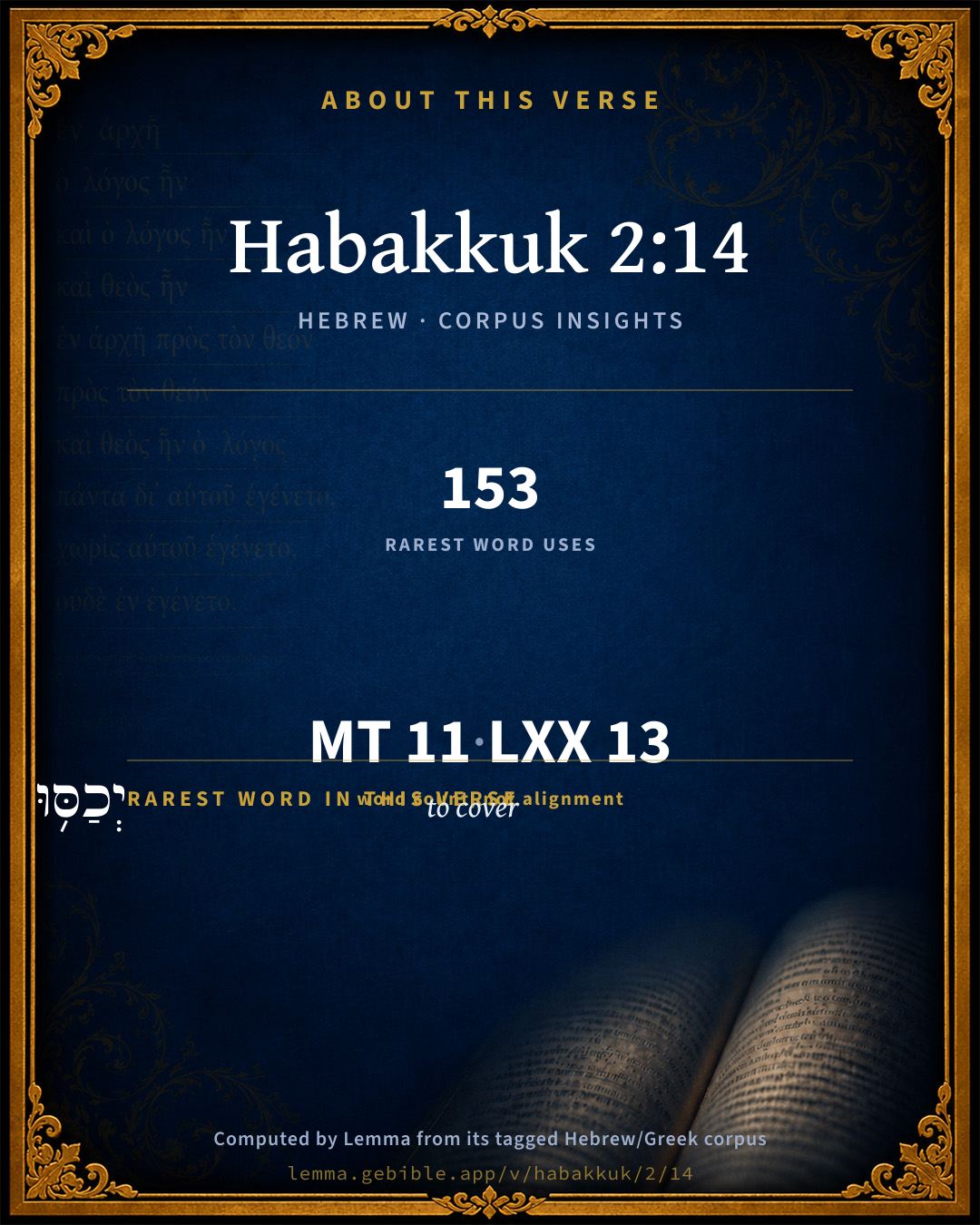
11
words
11
distinct lemmas
Prophets
section

Grammatical profile

  • 3 verbs
  • 5 nouns
  • 1 preposition
  • 1 conjunction
  • 1 particle

Verb forms

  • תִּמָּלֵ֣א Niphal · Imperfect
  • לָדַ֖עַת Qal · Infinitive Construct
  • יְכַסּ֥וּ Piel · Imperfect

Hebrew & Septuagint length

In English translation the verse runs 20 words from the Hebrew and 21 from the Septuagint (LXX English) — closely comparable.

A rough comparison of the two English renderings, which tokenize alike — not a word-level alignment.

Word counts can differ between the Hebrew and the Greek without any difference in meaning — e.g. the Hebrew direct-object marker אֵת has no separate Greek word, and Greek often adds the article ὁ.

In the original languages it is 11 Hebrew tokens and 13 Greek tokens — but the two are counted differently (Hebrew bundles its prefixes and suffixes into one token; the Greek is in lemma form), so that isn’t a like-for-like length.

Cross-references

10

Topical passages linked to Habakkuk 2:14 in the Treasury of Scripture Knowledge — connected by theme and wording, ordered by reader-vote popularity; previews shown in the World English Bible.

  • Isaiah 11:9 They shall not hurt nor destroy in all my holy mountain; for the earth shall be full of the knowledge of Yahweh, as the waters cover the sea.
  • Psalms 22:27 All the ends of the earth shall remember and turn to Yahweh. All the relatives of the nations shall worship before you.
  • Psalms 72:19 Blessed be his glorious name forever! Let the whole earth be filled with his glory! Amen and amen.
  • Isaiah 6:3 One called to another, and said, "Holy, holy, holy, is Yahweh of Hosts! The whole earth is full of his glory!"
  • Psalms 86:9 All nations you have made will come and worship before you, Lord. They shall glorify your name.
  • Zechariah 14:8–9 It will happen in that day, that living waters will go out from Jerusalem; half of them toward the eastern sea, and half of them toward the western sea; in summer and in winter will it be.
  • Revelation 11:15 The seventh angel sounded, and great voices in heaven followed, saying, "The kingdom of the world has become the Kingdom of our Lord, and of his Christ. He will reign forever and ever!"
  • Psalms 67:1–2 May God be merciful to us, bless us, And cause his face to shine on us. Selah.
  • Revelation 15:4 Who wouldn't fear you, Lord, And glorify your name? For you only are holy. For all the nations will come and worship before you. For your righteous acts have been revealed."
  • Psalms 98:1–3 Sing to Yahweh a new song, For he has done marvelous things! His right hand, and his holy arm, have worked salvation for him.

Cross-references courtesy of OpenBible.info (CC BY 4.0).

Hebrew and Greek witnesses Masoretic Hebrew ↔ Greek Septuagint

The same verse in the two great witnesses to the Old Testament, shown verse-for-verse.

These are two independent witnesses, not word-aligned to each other, and the Septuagint is shown in lemma (dictionary) form.

Hebrew Habakkuk 2:14 Masoretic · Westminster Leningrad Codex

כִּ֚י תִּמָּלֵ֣א הָאָ֔רֶץ לָדַ֖עַת אֶת כְּב֣וֹד יְהוָ֑ה כַּמַּ֖יִם יְכַסּ֥וּ עַל יָֽם

For the earth will be filled with the knowledge of the glory of Yahweh, as the waters cover the sea.

World English Bible · Public Domain

Greek LXX Habakkuk 2:14 Septuagint · lemma form

ὅτι πίμπλημι ὁ γῆ ὁ γιγνώσκω ὁ δόξα κύριος ὡς ὕδωρ κατακαλύπτω αὐτός

For the earth shall be filled with the knowledge of the glory of the Lord; it shall cover them as water.

LXX2012 (modern English Septuagint) · Public Domain

Hebrew: Westminster Leningrad Codex (CC BY 4.0). Greek: Septuagint (public domain); English from LXX2012 (modern English Septuagint) (Public Domain). How the Septuagint differs from the Hebrew →

Targum (Aramaic paraphrase)

1

The Targum is the ancient Jewish Aramaic paraphrase of the Hebrew Scriptures — an interpretive translation, not the Hebrew text itself. Onkelos (literal) and Pseudo-Jonathan (expansive) render the Torah, and Jonathan the Prophets. Coverage is partial: where no permissively-licensed English translation exists for a verse, only the Aramaic is shown. This is verse-level text, not a word-by-word alignment to the Hebrew.

  1. Targum Jonathan Prophets (Joshua–Malachi)
    אֲרֵי תִּתְמְלֵי אַרְעָא לְמֵידַע יַת דְחַלְתָּא דַייָ כְּמַיָא דִי לְיַמָא חָפָן:

    (no public-domain English translation for this verse)

    Targum Jonathan — Aramaic: “Mikraot Gedolot” (public domain). English: “Sefaria Community Translation” (CC0 1.0 (public-domain dedication)); “London "Chaldee Paraphrase," 1871” (public domain). Text via Sefaria.

Commentary

Notes on Habakkuk 2:14 from classic Christian and Jewish commentators (each source and its license shown beneath its notes). The classic Christian expositions comment on the surrounding passage and are grouped to its opening verse, so a note may address several verses; the Jewish commentaries on the Tanakh (Rashi and others) are per-verse, so they appear only where the commentator wrote on this verse.

Lemma curates 59 commentaries, every one of them public domain or Creative Commons licensed, each selected and text-cleaned for this edition rather than reprinted as found. About our sources →

Trapp's Complete Commentary

John Trapp

Hab 2:14 For the earth shall be filled with the knowledge of the glory of the LORD, as the waters cover the sea.

Ver. 14. For the earth shall be filled with the knowledge of the glory of the Lord, &c.] He shall make himself a glorious name among the nations of the earth, by executing vengeance upon Babylon, and so pleading the cause of his oppressed people (whom he seemed, during their captivity there, to neglect), that men shall have cause to say, "Verily there is a reward for the righteous: verily there is a God that judgeth in the earth," Psa 58:11.

As the waters cover the sea] The channel of the sea; that is, plentifully and abundantly; see a like promise Isa 11:9, but to another purpose. That is a famous promise of the coming and kingdom of Christ; and so some interpreters apply this. Wherein though they seem to be mistaken, considering the context; yet the ancients rightly here hence argued, that Christ would certainly come again to judgment, because many wicked men escape in this world without condign punishment, which then they shall be sure of, 2Th 1:6; 2Th 1:9. Then all shall be set to rights, though now they may seem less equally carried; and the reason of God’s proceedings with men shall be cleared up, which now also we are bound to believe (sometimes secret, but) ever just. At the day of judgment we shall see an excellent harmony in this discord of things; and all obscure passages shall be made as plain to us as if they were written with the most glittering sunbeam upon a wall of crystal. Then shall this sweet promise have its full accomplishment: "The earth shall be filled with the knowledge of the glory of the Lord, as the waters cover the sea," in greatest abundance, and redundancy.

John Trapp, A Commentary or Exposition upon All the Books of the Old and New Testament (1647–1656) — public domain. Text from a community e-Sword module.

The Biblical Illustrator

Joseph S. Exell

Hab_2:14

For the earth shall be filled with the knowledge of the glory of the Lord, as the waters cover the sea.

The knowledge of God

There shall be such a revelation of Gods character and attributes as shall win the faith and love and adoration of the human family. Now, where is that revelation made? In nature you get only glimpses of God; it tells us something of His wisdom and His power, but it tells us nothing about His mercy and His forgiving love. Every word that nature utters to a sinner is a word of terror. God has so loved us that He has sent His only-begotten Son, through whom we may learn to know the Father. This knowledge of God in Christ meets every want. It is of this knowledge the text speaks--an experimental knowledge of Christ which brings us to God, and fits us for heaven. This knowledge gives us lie. It has a quickening power. The man that knows and receives Christ lives--lives a spiritual life that shall last for ever. This knowledge also produces love. And it produces holiness in the heart and life. It prepares us for heaven, which is the home of love. This knowledge is to be universal! Reason teaches us to expect it.

2. The Bible proclaims it.

3. There are signs of the near approach of this glorious day. The first sign is the decay of idolatry; the second is the decline of popery. A third is the increase of knowledge. A fourth is the uprising of humanity. A fifth is the condition of Christianity. (Charles Garrett.)

Gods glory universally known

The prophet teaches here, that so remarkable would be Gods judgment on the Babylonians that His name would thereby be celebrated through the whole world. There is in the verse an implied contrast; for God appeared not in His own glory when the Jews were led away into exile; the temple being demolished and the whole city destroyed; and also when the whole eastern region was exposed to rapine and plunder. When, therefore, the Babylonians were, after the Assyrians, swallowing up all their neighbours, the glory of God did not then shine, nor was it conspicuous in the world. The Jews themselves had become mute; for their miseries had, as it were, stupefied them; their mouths were at least closed, so that they could not from the heart bless God, while He was so severely afflicting them. And then, in that manifold confusion of all things the profane thought that all things here take place fortuitously, and that there is no Divine providence. God, then, was at that time hid; hence the prophet says, Filled shall be the earth with the knowledge of God.; that is, God will again become known when, by stretching forth His hand, He will execute vengeance on the Babylonians; then will the Jews, as well other nations, acknowledge that the world is governed by Gods providence, as it had been once created by Him. We now understand his meaning, and why he says that the earth would be filled with the knowledge of Gods glory; for the glory of God previously disappeared from the world, with regard to the perceptions of men; but it shone forth again when God Himself had erected His tribunal by overthrowing Babylon, and thereby proved that there is no power among men which He cannot control. We have the same sentence in Isa_11:9. The prophet then speaks, indeed, of the Kingdom of Christ; for when Christ was openly made known to the world, the knowledge of Gods glory at the same time filled the earth; for God then appeared in His own living image. But yet our prophet uses a proper language when he says that the earth shall then be filled with the knowledge of Gods glory, when He should execute vengeance on the Babylonians. Hence incorrectly have some applied this to the preaching of the Gospel, as though Habakkuk made a transition from the ruin of Babylon to the general judgment. This is (surely) a strained exposition. It is, indeed, a well known mode of speaking, and often occurs in the Psalms, that the power, grace, and truth of God are made known through the world, when He delivers His people and restrains the ungodly. The same mode the prophet now adopts; and he compares his fulness of knowledge to the waters of the sea, because the sea is so deep that there is no measuring of the waters. So Habakkuk intimates that the glory of God would be so much known that it would not only fill the world, but in a manner overflow it; as the waters of the sea by their vast quantity cover the deep, so the glory of God would fill heaven and earth, so as to have no limits. If, at the same time, there be a wish to extend this sentence to the coming of Christ, I do not object; for we know that the grace of redemption flowed in a perpetual stream until Christ appeared in the world. But the prophet, I have no doubt, sets forth here the greatness of Gods power in the destruction of Babylon. (John Calvin.)

The triumph of the Gospel

If we seek at all times to trace the providences of God we shall often find that He makes His throne darkness to us; and from the thick darkness we hear a voice saying, What I do, thou knowest not now; but thou shalt know hereafter. But in tracing the operations of the word of His grace, and the state of His Church, we find this clearly made known. The eternal fiat has gone forth, The earth shall be filled with the knowledge of the glory of the Lord, as the waters cover the sea.

I. The subject-matter of this prophecy. The glory of the Lord has various meanings. A grand display of it was made when Moses and Aaron and the seventy elders were called up into the mount. Any particular visible display of Gods presence was His glory. But the term has also reference to the Gospel. There was a glory attending the law, but this was much more glorious. It is more glorious than the law in its Author, His Person, and His work. The Gospel is peculiarly glorious above the law--

1. In its extent. If we look at former times we might perhaps think that God had selected a few--one family--as His peculiar treasure; but now we find this was only that the coming of the Messiah might be more clearly marked.

2. It re presents the Divine attributes more gloriously than the law. Majesty, justice, hatred of sin were shown. Here is the richest display both of grace and justice. Here Gods glory is concentrated as in a focus.

3. It is more glorious as life and immortality are more clearly revealed The knowledge, etc; This word has also various meanings. Sometimes it means discrimination; at others, publication; and when applied by a believer, it is full assurance. The knowledge in the text implies--

(1) Clearness;

(2) impression.

All the theoretical displays of the Gospel are of no avail without the impression of its truth. The design of the Gospel is to change him who heartily believes it into its own nature. It is the glory of God, and it changes the soul from glory to glory, and makes it partaker of the Divine nature.

3. Performance. Believe and obey the Gospel. The sinner believes; the believer works.

4. This leads us to the universal tendency of this knowledge. Like leaven, it will work its way.

II. What is said concerning this glory. The margin of some Bibles reads, the channels of the sea.

1. Clearness. These channels are very deep; so is Divine science--not superficial.

2. Experience. The waters do touch every surface of land; they wash every shore. The glory of God shall be felt by every people.

3. Universal. The channels are effectually covered; so shall the world be filled.

III. Remarks in support of the prophets declaration.

1. Gods covenant with Abraham. All the families of the earth were to be blessed in him.

2. It was renewed to Isaac, Jacob, etc.; but especially to Jesus Christ.

3. It was the burden of all the prophecies.

4. See the commission of the apostles.

5. We may refer the accomplishment of this to the promised agency of the Holy Ghost.

6. We argue it from the effects which have been produced. Application--

(1) You are interested in this individually.

(2) See what God expects from us. (J. Summerfield, A. M.)

The Biblical Illustrator, edited by Joseph S. Exell (c. 1880s–1900s) — public domain. Text from a community e-Sword module.

Whedon's Commentary on the Bible

Daniel D. Whedon

Hab_2:14 gives an additional reason for the overthrow of the Chaldeans. Jehovah has purposed to establish his universal kingdom upon earth; to make room for this kingdom of peace and righteousness the cruel and warlike Chaldean must be retired from the scene of action.

The knowledge of the glory of Jehovah — The glory of Jehovah is the divine manifestation in nature, in history, in revelation; here in the events connected with the overthrow of the Chaldeans. These are intended to give the whole world a more adequate idea of the nature and character of Jehovah.

As the waters cover the sea — A picture of overflowing abundance (compare Isa_11:9). The overthrow of the mighty world conqueror will be so remarkable that the news of it will spread far and wide (compare Psa_126:2).

Daniel D. Whedon (gen. ed.), Commentary on the Old and New Testaments (1874–1909) — public domain. Text from a community e-Sword module.

Geneva Bible (1599)

Geneva Bible translators

In the destruction of the Babylonians his glory shall appear through all the world.

Geneva Bible (1599) marginal notes — public domain. Text via Bolls.life.

Jamieson, Fausset & Brown

Robert Jamieson, A. R. Fausset & David Brown

Adapted from Isa 11:9. Here the sense is, "The Jews shall be restored and the temple rebuilt, so that God's glory in saving His people, and punishing their Chaldean foe, shall be manifested throughout the world," of which the Babylonian empire formed the greatest part; a type of the ultimate full manifestation of His glory in the final salvation of Israel and His Church, and the destruction of all their foes.

waters cover the sea--namely, the bottom of the sea; the sea-bed.

Jamieson, Fausset & Brown — Commentary Critical and Explanatory on the Whole Bible (1871) — public domain (CC PDM 1.0). Text via the HelloAO Bible API.

Adam Clarke's Commentary

Verse 14. For the earth shall be filled] This is a singular and important verse. It may be first applied to Babylon. God's power and providence shall be widely displayed in the destruction of this city and empire, in the humiliation of Nebuchadnezzar, Da 4:37, and in the captivity and restoration of his people. See Newcome, and see Isa 11:9.

Secondly. It may be applied to the glorious days of the Messiah. The land of Judea should by his preaching, and that of his disciples, be filled with the knowledge of God. God's great design fully discovered, and the scheme of salvation amply explained.

Thirdly. It may be applied to the universal spread of the Gospel over the habitable globe; when the fulness of the Gentiles should be brought in, and the Jews gathered in with that fulness. The earth cannot perish till every continent, island, and inhabitant, is illuminated with the light of the Gospel.

Adam Clarke's Commentary on the Bible (1810–1826) — public domain. Text from a community e-Sword/MySword module.

John Calvin's Commentaries

The Prophet briefly teaches us here, that so remarkable would be God’s judgement on the Babylonians that his name would thereby be celebrated through the whole world. But there is in this verse an implied contrast; for God appeared not in his own glory when the Jews were led away into exile; the temple being demolished and the whole city destroyed; and also when the whole easterly region was exposed to rapine and plunder. When therefore the Babylonians were, after the Assyrians, swallowing up all their neighbors, the glory of God did not then shine, nor was it conspicuous in the world. The Jews themselves had become mute; for their miseries had, as it were, stupefied them; their mouths were at least closed, so that they could not from the heart bless God, while he was so severely afflicting them. And then, in that manifold confusion of all things, the profane thought that all things here take place fortuitously, and that there is no divine providence. God then was at that time hid: hence the Prophet says, Filled shall be the earth with the knowledge of God; that is, God will again become known, when by stretching forth his hand he will execute vengeance on the Babylonians; then will the Jews, as well as other nations, acknowledge that the world is governed by God’s providence, as it had been once created by him.

We now understand the Prophet’s meaning, and why he says, that the earth would be filled with the knowledge of God’s glory; for the glory of God previously disappeared from the world, with regard to the perceptions of men; but it shone forth again, when God himself had erected his tribunal by overthrowing Babylon, and thereby proved that there is no power among men which he cannot control. We have the same sentence in Isaiah 11:9. The Prophet there speaks indeed of the kingdom of Christ; for when Christ was openly made known to the world, the knowledge of God’s glory at the same time filled the earth; for God then appeared in his own living image. But yet our Prophet uses a proper language, when he says that the earth shall then be filled with the knowledge of God’s glory, when he should execute vengeance on the Babylonians. Hence incorrectly have some applied this to the preaching of the gospel, as though Habakkuk made a transition from the ruin of Babylon to the general judgement: this is a strained exposition. It is indeed a well-known mode of speaking, and often occurs in the Psalms, that the power, grace, and truth of God are made known through the world, when he delivers his people and restrains the ungodly. The same mode the Prophet now adopts; and he compares this fullness of knowledge to the waters of the sea, because the sea, as we know, is so deep, that there is no measuring of its waters. So Habakkuk intimates, that the glory of God would be so much known that it would not only fill the world, but in a manner overflow it: as the waters of the sea by their vast quantity cover the deep, so the glory of God would fill heaven and earth, so as to have no limits. If, at the same time, there be a wish to extend this sentence to the coming of Christ, I do not object: for we know that the grace of redemption flowed in a perpetual stream until Christ appeared in the world. But the Prophet, I have no doubt, sets forth here the greatness of God’s power in the destruction of Babylon.

John Calvin's Commentaries (1540-1563) — public domain. Text from the Calvin Translation Society English edition (1840s-50s) via the Christian Classics Ethereal Library (ccel.org). Calvin's coverage is partial (roughly two-thirds of the Bible); uncommented books and verses are honest gaps, never fabricated. The 19th-century editor's footnotes and remarks are omitted so the notes are faithfully Calvin's own voice.

Ellicott's Commentary for English Readers

(14) With the knowledge.—Better, as concerns the knowledge. See the same promise in Isa_11:9. It is here introduced in contrast to the short-lived glory of Babylon. The enslaved nations raised the Babylonian palaces only for the fire to destroy them. But Jehovah’s glory shall be made known all the world over, and shall not be effaced.

A Bible Commentary for English Readers, edited by Charles John Ellicott (1878–1897) — public domain. Text from a community e-Sword module.

The Cambridge Bible for Schools and Colleges

gen. ed. J. J. S. Perowne

14. As the waters cover] Or, like the waters which cover the (bed of the) sea. The knowledge shall be not only universal but deep. Isa_11:9. The verse explains the preceding. The Lord of Hosts, God Omnipotent, whose purposes overrule all, shall bring in His kingdom, and in the judgments that precede its coming the great fabrics reared by heathenism for its idolatries and its oppressions shall become fuel for the fire (Isa_9:5). This is the line of thought most natural. Another might be that when the reign of peace in Jehovah’s kingdom shall come in men themselves shall burn to the ground their strongholds of war and their edifices of pride, just as they shall beat their swords to ploughshares (Isa_2:4).

The Cambridge Bible for Schools and Colleges (gen. ed. J. J. S. Perowne; Cambridge University Press, 1878–1918) — public domain. Text from a community e-Sword module.

John Gill's Exposition

Woe unto him that giveth his neighbour drink,.... Before the full accomplishment of the above prophecy concerning the abundance of the knowledge of the Lord in the earth, and before the utter destruction of antichrist; between that and the Reformation, when it had its fulfilment in part; the following practices inveighed against would be used, as we find they are, and for which the man of sin and his followers will be punished: one of which is expressed by a man's "giving his neighbour drink"; which is a commendable action, when drink is given to a person in want to quench his thirst, or in sorrowful and distressed circumstances to refresh and cheer him; but when this is done to intoxicate him, and draw him into uncleanness, it is an evil one; and which is the sense of the phrase here, as appears by the "woe" denounced, and by what follows; and is to be understood, not in a literal sense, but in a figurative one; and is expressive of the various artful methods and alluring ways used by the Papists, especially the Jesuits, after the Reformation, with the Protestants, to forsake their religion, and to draw them into the superstition and idolatry of the church of Rome; and which are in the New Testament signified by "the wine of her fornication", with which the kings, nations, and inhabitants of the earth, are made drunk, Rev 17:2 crying up the devotion and religion of their church, its antiquity, purity, holiness, and unity; pretending great love to the souls of men, that they seek nothing but their spiritual good; promising them great advantages, temporal and spiritual, worldly riches and honour, and sure and certain salvation within the pale of their church, without which they say there is none; and by such means they have intoxicated many princes, kingdoms, and multitudes of people, since the Reformation; and have drawn them off from the profession of the Protestant religion, and brought them back to Popery again, as in Poland, Bohemia, Hungary, Germany, France, and other places; and these methods they are now taking in all Protestant countries, and in ours, and that with great success, as is notorious, and time will more abundantly show; but there is a "woe" lies against them for it:

that puttest thy bottle to him; giving him not only a glass or cup at a time, but a whole bottle to drink off at once, in order to inebriate him. The word is by some translated "thy gall", or "thy poison" (k); which fitly enough expresses the poisonous doctrines of the church of Rome, which men insensibly imbibe, infused in her wine of fornication, or drink in through the alluring and ensnaring methods taken. It properly signifies "heat" or "wrath". The Targum is,

"that pours it with heat, that he may drink, and be inebriated.''

The Syriac version is,

"woe to him that gives his neighbour to drink the dregs of fury.''

The words may be truly rendered, "adding thy wrath" (l); that is, to the alluring and enticing methods before mentioned, adding menaces, wrathful words, and furious persecutions: and this the Papists do where they can; when good words and fair speeches will not prevail, and they can not gain over proselytes with flattery, deceit, and lying, they threaten them with racks and tortures, with prisons and galleys, and death itself in various shapes, to force men into their communion; and which they have put in execution in many places, in Bohemia, Hungary, and in France even to this day; and this is what in the New Testament is called "the wine of the wrath of her fornication", Rev 14:8,

and makest him drunken also, that thou mayest look on their nakedness! as Ham did on his father's nakedness when in such circumstances: all the above methods are taken in order to intoxicate them, deprive them of the use of their reason, as is the case of a drunken man; and so bring them to believe, with an implicit faith, as the church believes; to believe things contrary to reason; to give into the spiritual whoredom and idolatry of that church, as men when drunk are easily drawn into uncleanness; to cast off their profession of the true religion, as a garment is cast off, as men when drunk are apt to do; and particularly to reject the doctrine of justification by the righteousness of Christ, which is the only robe to cover the nakedness of men, and receive the doctrine of merit and justification by works; in short, to apostatize wholly from the religion they have professed, and join in communion with the whore of Rome, that so they may look upon their apostasy, which is their nakedness, with the utmost pleasure and delight.

(k) "venenum tuum", Montanus; so some in Drusius, and R. Jonah in Ben Melech. (l) "adjugenti, sive adhibenti furorem tuum", Tigurine version.

John Gill's Exposition of the Whole Bible (1746–1763) — public domain (CC PDM 1.0). Text via the HelloAO Bible API.

Albert Barnes' Notes on the Bible

For the earth shall be filled with the knowledge of the glory of the Lord - Habakkuk modifies in a degree the words of Isaiah which he embodies, marking that the destruction of Babylon was a stage only toward the coming of those good things which God taught His people to long for, not their very coming. All the world should be then full of the knowledge of the glory of the Lord, not, as yet, wholly of Himself Jerome: “When Babylon shall be overthrown, then shall the power of the might of the Lord be known unto all. So shall the whole earth be filled with the glory of the Lord, as the waters cover the bottom of the sea. This as to the letter. But it is plain, that the Devil also and antichrist, and the perverse teaching of heretics, built a city in blood; i. e, their own Church, with the destruction of those whom they deceive ... But when they fail in the fire (either this fire which is felt, or consumed in the fire of the devil their prince, or burned up with the fire whereof the Lord says, ‘I came to send a fire upon the earth,’ and so brought back from their former course, and doing penitence), the whole earth shall be filled with the glory of the Lord, when, at the preaching of the apostles, their ‘sound shall go out into all the world,’ as waters covering the sea, i. e., all the saltness and bitterness of the world which Satan had rained down and the earth had drunk, the waters of the Lord shall cover, and cause the place of their ancient bitterness not to appear.”

Rup.: “‘For the Spirit of the Lord filled the earth,’ and when He filled it, ‘the earth was filled with the knowledge of the glory of the Lord,’ so that unlearned and ignorant men became wise and eloquent, and earthly became heavenly, yea, they who were earth became heaven, knowing the glory of the Lord, declaring the glory of God, not any how, but as waters cover the sea. Great as must be waters, which would cover the sea, or compared to which the sea were nothing, far greater is the miracle, when the abundance of heavenly wisdom, given to the simple, surpassed the sea, i. e., the wisdom of all mankind.” This verse being already a received image of the spread of the gospel Isa 11:9, it would of itself be understood to include this also; but more generally, it declares how upon all the judgments of God, a larger knowledge of Him would follow Cyril: “All things are full of Christ, who is the Glory of the Father; wherefore also He said Joh 17:4, I have glorified Thee on earth, I have finished the work which Thou gavest me to do.”

Albert Barnes' Notes on the Bible (1834–1885) — public domain. Text from a community e-Sword/MySword module.

Haydock's Catholic Bible Commentary

Sea. The land and naval forces attacked Tyre. (Calmet) --- Vast multitudes came against Babylon. (Menochius) --- The punishment of the wicked will cause many to adore and to fear the Lord. (Haydock)

George Leo Haydock (1774–1849), Haydock's Catholic Family Bible and Commentary, 1859 edition — public domain. Excludes Psalms (Douay-Rheims chapter numbering differs from Protestant) and Deuterocanonical books (Catholic canon only).

Matthew Poole's English Annotations

The earth; the land of Chaldea, of the Medes and Persians, and their confederates, the lands oppressed by the Chaldeans, but Judea more particularly.

Shall be filled; every eye shall see, or ear hear, or tongue speak what they know.

With the knowledge, sight and sense,

of the glory, just and glorious proceedings of God against Babylon; for when God shall appear to execute his just judgments upon his own and his church’s enemies, he will appear glorious indeed.

The Lord; the God of Israel, their Holy One, as Hab 1:12.

As the waters cover the sea: it is a proverbial speech, expressing the general notice and deep sense all should have of God’s justice, truth, power, and zeal against mighty oppressors, such as Babylon was full of.

Matthew Poole's English Annotations on the Holy Bible (1683–1685) — public domain. Text from a community e-Sword/MySword module.

The Pulpit Commentary

The prophet now gives the reason of the vanity of these human undertakings. For the earth shall be filled, etc. The words are from Isa_11:9, with some little alterations. (comp. Num_14:21) This is cue of the passages which attests "the community of testimony," as it is called, among the prophets. To take a few out of many cases that Isa_2:2-4 compared with Mic_4:1-4; Isa_13:19-22 Jer_1:3-9, etc.; Isa_52:7 with Nah_1:15; Jer_49:7-22 with Oba_1:1-4; Amo_9:13 with Joe_3:18 (Lodd, "Doctrine of Scripture," 1:145). All the earth is to be filled with, and to recognize, the glory of God as manifested in the overthrow of ungodliness; and therefore Babylon, and the world power of which she is a type, must be subdued and perish. This announcement looks forward to the establishment of Messiah"s kingdom, which "shall break in pieces and consume all these kingdoms, and shall stand forever". (Dan_2:44) We must remember how intimately in the minds of Eastern heathens the prosperity of a nation was connected with its local deities. Nothing in their eyes could show more perfectly the impotence of a god than his failing to protect his worshippers from destruction. (comp. 2Ki_18:33, etc.) The glory of Jehovah and his sovereignty over the earth would be seen and acknowledged in the overthrow of Babylon, the powerful, victorious nation. As the waters cover the sea. As the waters fill the basin of the sea (Gen_1:22; 1Ki_7:23, where the great vessel of ablution is called "the sea

The Pulpit Commentary (1880–1919), ed. H.D.M. Spence-Jones & Joseph S. Exell — public domain. Text from a community e-Sword module.

Scofield Reference Notes

C. I. Scofield

For the earth shall be filled

Cf. Isa 11:9 which fixes the time when "the earth," etc. It is when David’s righteous Branch has set up the kingdom. (See "Kingdom (O.T.),"; 2Sa 7:9; Zec 12:8 also, "Kingdom (N.T.),"; Luk 1:31-33; 1Co 15:28. Habakkuk’s phrase marks an advance on that of Isaiah. In the latter it is "the knowledge of the Lord." That, in a certain sense, is being diffused now; but in Habakkuk it is "the knowledge of the glory of the Lord," and that cannot be till He is manifested in glory; Mat 24:30; Mat 25:31; Luk 9:26; 2Th 1:7; 2Th 2:8; Jud 1:14. The transfiguration was a foreview of this. Luk 9:26-29.

The Scofield Reference Bible (1917 edition), notes by C. I. Scofield — public domain. Text from a community e-Sword module.

Lesson kit

Teaching starters — assembled from the data on this page, not authored interpretation. Every prompt links to the verse data it draws on. Edit before teaching.

Habakkuk, in the Prophets, opens this verse with 11 words (11 distinct Hebrew lemmas). Its most distinctive word is kâçâh (“to cover”). A historical commentator’s framing appears above. Read the whole chapter for the surrounding context.

Discussion questions

  1. How does “to cover” (kâçâh) shape what this verse is saying?
  2. How does Isaiah 11:9, which shares this passage’s theme, read alongside this verse?
  3. These translations render this verse differently; the difference is in the English rendering, not the original. What questions does that raise?
  4. «תִּמָּלֵ֣א» is a Niphal Imperfect verb. How does that grammatical form shape the action described?
  5. Compare how Trapp's Complete Commentary and The Biblical Illustrator read this verse. Where do they agree or differ?

Things to notice

Reading settings

Reading text

Shown beneath each verse's original-language words.

Old Testament
Old Testament edition

Read the OT as the Masoretic Hebrew (MT) or the Greek Septuagint (LXX).

English shown for the Greek Septuagint (in the Hebrew ↔ Greek comparison).

Comparing translations? Open the Compare panel on any verse page to stack up to four side by side.