
Jeremiah 23:16

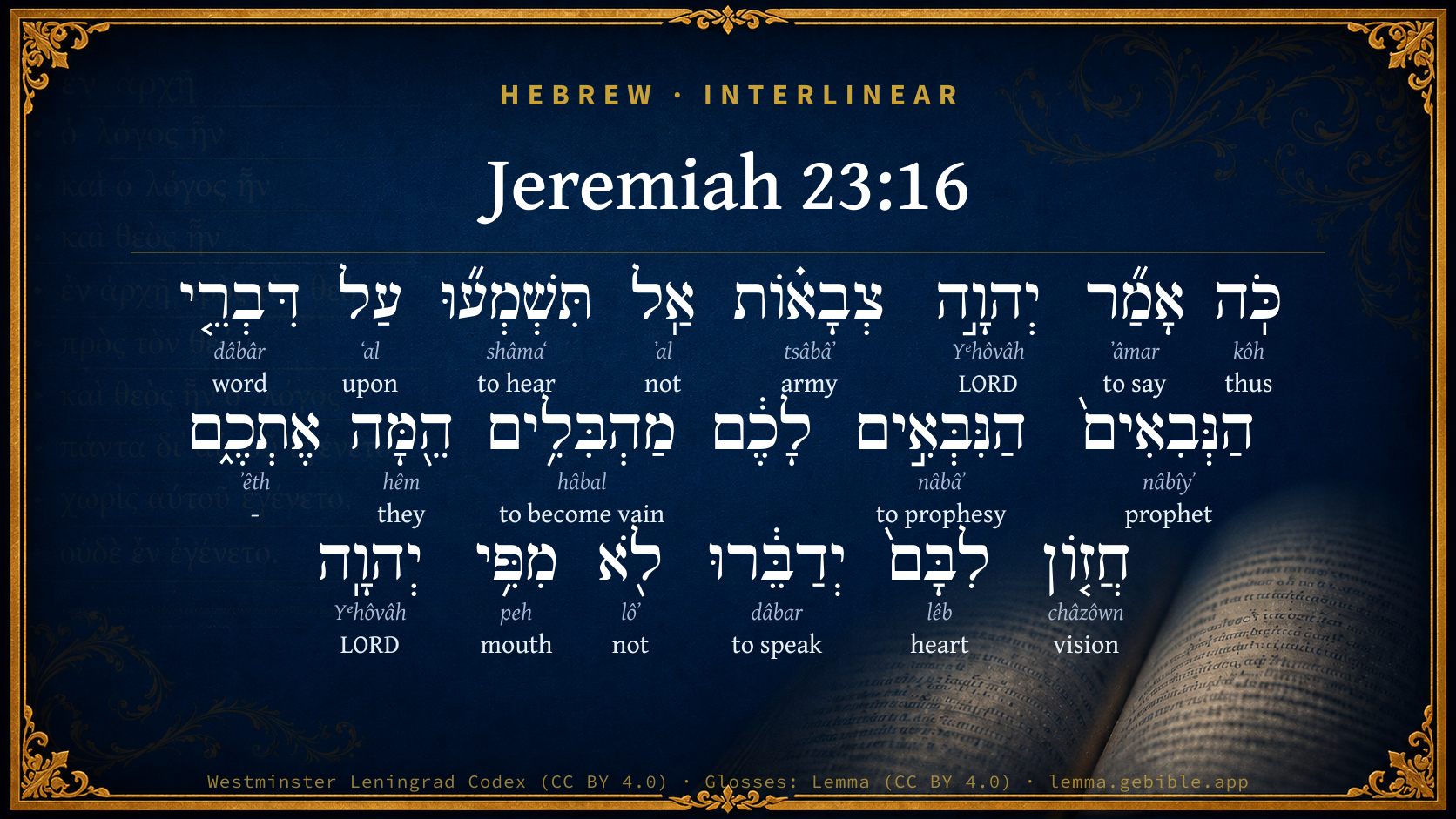
Hebrew (Westminster Leningrad Codex) Jeremiah 23:16 appears in the Hebrew Old Testament. The text above is from the Westminster Leningrad Codex. Each word links to its Strong’s number, a concise gloss, and parsing drawn from the Open Scriptures Hebrew Bible morphology. Click any word for its full Brown-Driver-Briggs (BDB) entry.
Download image
Cite this verse

Jeremiah 23:16 (World English Bible). Public Domain. Lemma interlinear Bible study tool, https://lemma.gebible.app/v/jeremiah/23/16.

Show BibTeX & RIS
BibTeX
RIS
English Translation
Thus says Yahweh of Hosts, Don't listen to the words of the prophets who prophesy to you: they teach you vanity; they speak a vision of their own heart, and not out of the mouth of Yahweh.
World English Bible · Public Domain
Download a study sheet

One document with this verse’s original text, its word-by-word gloss line, the meaning frame, cross-references with their text, attributed commentary, and full source and license credits — printable, and it pastes into notes with its structure intact.

This verse Autodidact and up

Study sheet (.html) Plain text (.txt)

A passage Seminary Student

Up to 50 verses in one chapter. A passage sheet keeps up to 6 commentary sources and 12 cross-references per verse, in the order this page ranks them, and says so on the sheet whenever that leaves anything out. Ask for a single verse and you get the Autodidact verse sheet above.

Everything on this page stays free to read, with no account — the sheet is a download of what is already on screen, not access to it.

Want to remove ads? Support Godless Engineer
Compare translations 3

The same verse in 3 English versions, stacked beneath the original-language interlinear above. Click any original word for its lexicon entry.

Each is an independent rendering of the whole verse — the interlinear is not word-aligned to these translations.

Highlighted words mark where these versions differ — a whole-verse word diff, not a word-by-word alignment.

  • World English Bible Public Domain
    Thus says Yahweh of Hosts, Don't listen to the words of the prophets who prophesy to you: they teach you vanity; they speak a vision of their own heart, and not out of the mouth of Yahweh.
  • King James Version Public Domain
    Thus saith the LORD of hosts, Hearken not unto the words of the prophets that prophesy unto you: they make you vain: they speak a vision of their own heart, and not out of the mouth of the LORD.
  • unfoldingWord Literal Text CC BY-SA 4.0
    Thus says Yahweh of Armies: “Do not listen to the words of the prophets who are prophesying to you. They are deluding you; they are speaking a vision of their heart, not from the mouth of Yahweh.

unfoldingWord Literal Text — © unfoldingWord, licensed CC BY-SA 4.0. Word-aligned USFM3 via Door43 (git.door43.org/unfoldingWord/en_ult).

Versions to compare (up to 4)

3 of 4 selected

Show all 18 translations

Every available English version of this verse, each an independent rendering of the whole verse.

  • World English Bible Public Domain
    Thus says Yahweh of Hosts, Don't listen to the words of the prophets who prophesy to you: they teach you vanity; they speak a vision of their own heart, and not out of the mouth of Yahweh.
  • Berean Standard Bible Public Domain
    This is what the LORD of Hosts says: “Do not listen to the words of the prophets who prophesy to you. They are filling you with false hopes. They speak visions from their own minds, not from the mouth of the LORD.
  • Majority Standard Bible Public Domain
    This is what the LORD of Hosts says: “Do not listen to the words of the prophets who prophesy to you. They are filling you with false hopes. They speak visions from their own minds, not from the mouth of the LORD.
  • King James Version Public Domain
    Thus saith the LORD of hosts, Hearken not unto the words of the prophets that prophesy unto you: they make you vain: they speak a vision of their own heart, and not out of the mouth of the LORD.
  • American Standard Version (1901) Public Domain
    Thus saith Jehovah of hosts, Hearken not unto the words of the prophets that prophesy unto you: they teach you vanity; they speak a vision of their own heart, and not out of the mouth of Jehovah.
  • Revised Version (1885) Public Domain
    Thus saith the LORD of hosts, Hearken not unto the words of the prophets that prophesy unto you; they teach you vanity: they speak a vision of their own heart, and not out of the mouth of the LORD.
  • Geneva Bible (1599) Public Domain
    Thus sayth ye Lord of hosts, Heare not the wordes of the prophets that prophecie vnto you, and teach you vanitie: they speake the vision of their owne heart, and not out of the mouth of the Lord.
  • Douay-Rheims (1899) Public Domain
    Thus saith the Lord of hosts: Hearken not to the words of the prophets that prophesy to you, and deceive you: they speak a vision of their own heart, and not out of the mouth of the Lord.
  • Young's Literal Translation Public Domain
    Thus said Jehovah of Hosts: Ye do not hearken unto the words Of the prophets who are prophesying to you, They are making you vain things, A vision of their own heart they speak, Not from the mouth of Jehovah.
  • Literal Standard Version CC BY-SA 4.0
    Thus said YHWH of Hosts: “You do not listen to the words || Of the prophets who are prophesying to you, || They are making you vain things, || They speak a vision of their own heart, || Not from the mouth of YHWH.
  • Unlocked Literal Bible CC BY-SA 4.0
    Yahweh of hosts says this, “Do not listen to the words of the prophets who prophesy to you. They have deluded you! They are announcing visions from their own minds, not from Yahweh's mouth.
  • unfoldingWord Literal Text CC BY-SA 4.0
    Thus says Yahweh of Armies: “Do not listen to the words of the prophets who are prophesying to you. They are deluding you; they are speaking a vision of their heart, not from the mouth of Yahweh.
  • Darby Bible Public Domain
    Thus saith Jehovah of hosts: Hearken not unto the words of the prophets that prophesy unto you: they lead you to vanity; they speak a vision of their own heart, not out of the mouth of Jehovah.
  • World Messianic Bible Public Domain
    The LORD of Hosts says, “Don’t listen to the words of the prophets who prophesy to you. They teach you vanity. They speak a vision of their own heart, and not out of the mouth of the LORD.
  • Webster's Bible Public Domain
    Thus saith the LORD of hosts, Hearken not to the words of the prophets that prophesy to you: they make you vain: they speak a vision of their own heart, and not from the mouth of the LORD.
  • Free Bible Version CC BY-SA 4.0
    This is what the Lord Almighty says: Don't pay attention to what these prophets say when they prophesy to you. They're fooling you with visions they make up in their own minds. They're not from me.
  • Bible in Basic English Public Domain
    This is what the Lord of armies has said: Do not give ear to the words which the prophets say to you: they give you teaching of no value: it is from themselves that their vision comes, and not out of the mouth of the Lord.
  • JPS Tanakh (1917) Public Domain
    Thus saith the LORD of hosts: Hearken not unto the words of the prophets that prophesy unto you, they lead you unto vanity; they speak a vision of their own heart, and not out of the mouth of the LORD.

Literal Standard Version (2020), Covenant Press — licensed CC BY-SA 4.0. Text via the HelloAO Bible API (eBible.org). Unlocked Literal Bible (unfoldingWord) — licensed CC BY-SA 4.0. Text via the HelloAO Bible API (eBible.org). unfoldingWord Literal Text — © unfoldingWord, licensed CC BY-SA 4.0. Word-aligned USFM3 via Door43 (git.door43.org/unfoldingWord/en_ult). Free Bible Version, Dr. Jonathan Gallagher — licensed CC BY-SA 4.0. Text via the HelloAO Bible API (eBible.org).

Word by word

More ways to search: Search by grammar → Find every occurrence → Compare this word →

Practice this passage: Drill this verse → Learn its vocabulary →

מַהְבִּלִ֥ים
hâbal
H1891
“becoming vain”
Verb, Hiphil, Participle Active, Masculine, Plural, Absolute
Part of Speech
Verb
Stem
Hiphil
Form
Participle Active
Gender
Masculine
Number
Plural
State
Absolute
Full BDB Definition

Origin: a primitive root

TWOT: 463

to act emptily, become vain, be vain - (Qal) - to become vain - to be utterly vain (with cognate acc) - (Hiphil) - to cause to become vain - to fill with vain hopes
  1. כֹּֽה kôh H3541 “thus” Adverb
  2. אָמַ֞ר ʼâmar H559 “to say” Verb, Qal, Perfect, 3rd Person, Masculine, Singular
  3. יְהוָ֣ה Yᵉhôvâh H3068 “LORD” Noun, Proper
  4. צְבָא֗וֹת tsâbâʼ H6635 “armies” Noun, Common, Both, Plural, Absolute
  5. אַֽל ʼal H408 “not” Particle, Negative
  6. תִּשְׁמְע֞וּ shâmaʻ H8085 “to hear” Verb, Qal, Jussive, 2nd Person, Masculine, Plural
  7. עַל ʻal H5921 “upon” Preposition
  8. דִּבְרֵ֤י dâbâr H1697 “words of” Noun, Common, Masculine, Plural, Construct
  9. הַנְּבִאִים֙ nâbîyʼ H5030 “the · prophets” Particle, Definite Article + Noun, Common, Masculine, Plural, Absolute
  10. הַנִּבְּאִ֣ים nâbâʼ H5012 “the · prophesying” Particle, Definite Article + Verb, Niphal, Participle Active, Masculine, Plural, Absolute
  11. הֵ֖מָּה hêm H1992 “they” Pronoun, Personal, 3rd Person, Masculine, Plural
  12. אֶתְכֶ֑ם ʼêth H853 “- · you” Particle, Direct Object + Suffix, Personal, 2nd Person, Masculine, Plural
  13. חֲז֤וֹן châzôwn H2377 “vision of” Noun, Common, Masculine, Singular, Construct
  14. לִבָּם֙ lêb H3820 “heart · their” Noun, Common, Masculine, Singular, Construct + Suffix, Personal, 3rd Person, Masculine, Plural
  15. יְדַבֵּ֔רוּ dâbar H1696 “to speak” Verb, Piel, Imperfect, 3rd Person, Masculine, Plural
  16. לֹ֖א lôʼ H3808 “not” Particle, Negative
  17. מִפִּ֥י peh H6310 “from · mouth of” Preposition + Noun, Common, Masculine, Singular, Construct
  18. יְהוָֽה Yᵉhôvâh H3068 “LORD” Noun, Proper

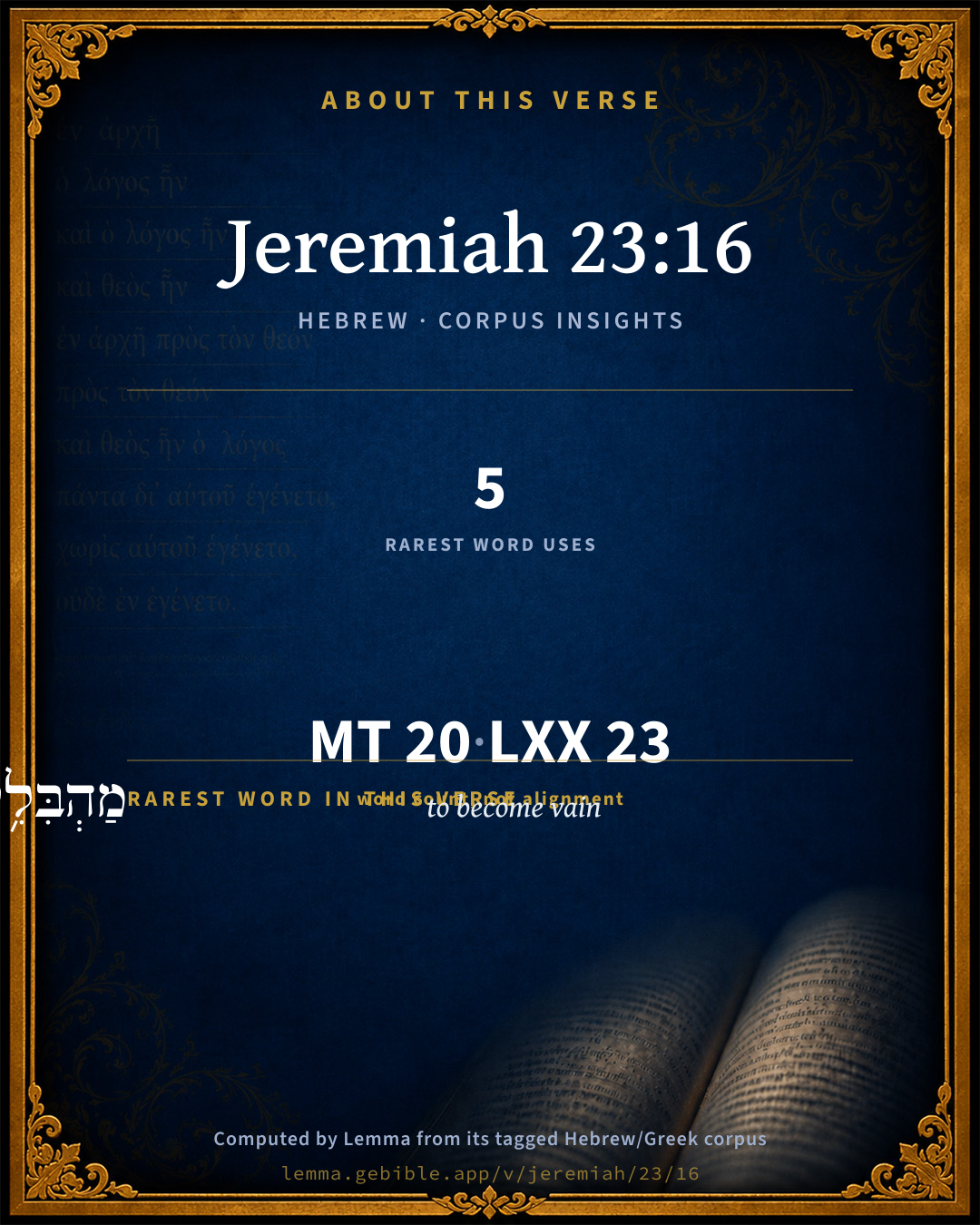
About this verse

These counts appear in no published source. They are computed here, from the morphology-tagged text and Lemma’s own curated glosses. What Lemma adds →

20
words
18
distinct lemmas
Prophets
section

Notable vocabulary

The rarest word here is מַהְבִּלִ֥ים to become vain H1891 — appearing just 5 times in the whole Hebrew Bible.

Shared distinctive vocabulary

מַהְבִּלִ֥ים to become vain H1891 occurs in 5 verses of the Hebrew Bible. Also found in:

Grammatical profile

  • 5 verbs
  • 8 nouns
  • 1 pronoun
  • 2 prepositions
  • 1 adverb
  • 3 particles

Verb forms

  • אָמַ֞ר Qal · Perfect
  • תִּשְׁמְע֞וּ Qal · Jussive
  • הַנִּבְּאִ֣ים Niphal · Participle Active
  • מַהְבִּלִ֥ים Hiphil · Participle Active
  • יְדַבֵּ֔רוּ Piel · Imperfect

Repetition

A word recurs within this verse — often emphatic in Hebrew:

  • יְהוָ֣ה LORD H3068 ×2

Hebrew & Septuagint length

In the original languages it is 20 Hebrew tokens and 23 Greek tokens — but the two are counted differently (Hebrew bundles its prefixes and suffixes into one token; the Greek is in lemma form), so that isn’t a like-for-like length.

Cross-references

21

Topical passages linked to Jeremiah 23:16 in the Treasury of Scripture Knowledge — connected by theme and wording, ordered by reader-vote popularity; previews shown in the World English Bible.

  • Jeremiah 14:14 Then Yahweh said to me, The prophets prophesy lies in my name; I didn't send them, neither have I commanded them, neither spoke I to them: they prophesy to you a lying vision, and divination, and a thing of nothing, and the deceit of their own heart.
  • Ezekiel 13:6 They have seen falsehood and lying divination, who say, Yahweh says; but Yahweh has not sent them: and they have made men to hope that the word would be confirmed.
  • Jeremiah 27:9–10 But as for you, don't you listen to your prophets, nor to your diviners, nor to your dreams, nor to your soothsayers, nor to your sorcerers, who speak to you, saying, You shall not serve the king of Babylon:
  • Ezekiel 13:3 Thus says the Lord Yahweh, Woe to the foolish prophets, who follow their own spirit, and have seen nothing!
  • Matthew 7:15 "Beware of false prophets, who come to you in sheep's clothing, but inwardly are ravening wolves.
  • 2 Corinthians 11:13–15 For such men are false apostles, deceitful workers, masquerading as Christ's apostles.
  • Galatians 1:8–9 But even though we, or an angel from heaven, should preach to you any gospel other than that which we preached to you, let him be cursed.
  • 2 Kings 17:15 They rejected his statutes, and his covenant that he made with their fathers, and his testimonies which he testified to them; and they followed vanity, and became vain, and [went] after the nations that were round about them, concerning whom Yahweh had charged those who they should not do like them.
  • Jeremiah 23:21 I sent not these prophets, yet they ran: I didn't speak to them, yet they prophesied.
  • Jeremiah 27:14–17 Don't listen to the words of the prophets who speak to you, saying, You shall not serve the king of Babylon; for they prophesy a lie to you.
  • 1 John 4:1 Beloved, don't believe every spirit, but test the spirits, whether they are of God, because many false prophets have gone out into the world.
  • Jeremiah 23:26 How long shall this be in the heart of the prophets who prophesy lies, even the prophets of the deceit of their own heart?
  • Micah 2:11 If a man walking in a spirit of falsehood lies: 'I will prophesy to you of wine and of strong drink;' He would be the prophet of this people.
  • Proverbs 19:27 If you stop listening to instruction, my son, You will stray from the words of knowledge.
  • Jeremiah 2:5 thus says Yahweh, What unrighteousness have your fathers found in me, that they have gone far from me, and have walked after vanity, and are become vain?
  • Jeremiah 9:20 Yet hear the word of Yahweh, you women, and let your ear receive the word of his mouth; and teach your daughters wailing, and everyone her neighbor lamentation.
  • Jeremiah 29:8 For thus says Yahweh of hosts, the God of Israel: Don't let your prophets who are in the midst of you, and your diviners, deceive you; neither listen you to your dreams which you cause to be dreamed.
  • Ezekiel 13:16 [to wit], the prophets of Israel who prophesy concerning Jerusalem, and who see visions of peace for her, and there is no peace, says the Lord Yahweh.
  • Ezekiel 13:23 Therefore you shall no more see false visions, nor practice divination. I will deliver my people out of your hand; and you shall know that I am Yahweh.
  • Ezekiel 22:28 Her prophets have daubed for them with whitewash, seeing false visions, and divining lies to them, saying, Thus says the Lord Yahweh, when Yahweh has not spoken.
  • Romans 1:21 Because, knowing God, they didn't glorify him as God, neither gave thanks, but became vain in their reasoning, and their senseless heart was darkened.

Cross-references courtesy of OpenBible.info (CC BY 4.0).

Hebrew and Greek witnesses Masoretic Hebrew ↔ Greek Septuagint

The same verse in the two great witnesses to the Old Testament, shown verse-for-verse.

These are two independent witnesses, not word-aligned to each other, and the Septuagint is shown in lemma (dictionary) form.

Hebrew Jeremiah 23:16 Masoretic · Westminster Leningrad Codex

כֹּֽה אָמַ֞ר יְהוָ֣ה צְבָא֗וֹת אַֽל תִּשְׁמְע֞וּ עַל דִּבְרֵ֤י הַנְּבִאִים֙ הַנִּבְּאִ֣ים לָכֶ֔ם מַהְבִּלִ֥ים הֵ֖מָּה אֶתְכֶ֑ם חֲז֤וֹן לִבָּם֙ יְדַבֵּ֔רוּ לֹ֖א מִפִּ֥י יְהוָֽה

Thus says Yahweh of Hosts, Don't listen to the words of the prophets who prophesy to you: they teach you vanity; they speak a vision of their own heart, and not out of the mouth of Yahweh.

World English Bible · Public Domain

Greek LXX Structure differs

In the Septuagint, Jeremiah is about an eighth shorter than the Hebrew and arranges its material differently — the Oracles Against the Nations (Hebrew chapters 46–51) appear in the middle of the Greek book, after 25:13. Because the chapter and verse boundaries do not line up, a verse-for-verse comparison with the Hebrew is not shown.

A verse-for-verse comparison isn’t shown here because the chapters and verses don’t line up. Switch to the LXX edition with the MT / LXX toggle above to read the Greek directly.

On this verse, Lange's Commentary on the Holy Scriptures discusses the Septuagint’s reading. Read the note in Commentary ↓

Hebrew: Westminster Leningrad Codex (CC BY 4.0). Greek: Septuagint (public domain); English from a public-domain English Septuagint. How the Septuagint differs from the Hebrew →

Targum (Aramaic paraphrase)

1

The Targum is the ancient Jewish Aramaic paraphrase of the Hebrew Scriptures — an interpretive translation, not the Hebrew text itself. Onkelos (literal) and Pseudo-Jonathan (expansive) render the Torah, and Jonathan the Prophets. Coverage is partial: where no permissively-licensed English translation exists for a verse, only the Aramaic is shown. This is verse-level text, not a word-by-word alignment to the Hebrew.

  1. Targum Jonathan Prophets (Joshua–Malachi)
    כִּדְנַן אֲמַר יְיָ צְבָאוֹת לָא תְקַבְּלוּן לְפִתְגָמֵי נְבִיֵי שִׁקְרָא דְמִתְנַבָּן לְכוֹן מַטְעָן אִינוּן לְכוֹן רְשַׁע לִבְּהוֹן מְמַלְלִין לָא בְּמֵימְרָא דַיָי:

    (no public-domain English translation for this verse)

    Targum Jonathan — Aramaic: “Mikraot Gedolot” (public domain). English: “Sefaria Community Translation” (CC0 1.0 (public-domain dedication)); “London "Chaldee Paraphrase," 1871” (public domain). Text via Sefaria.

Commentary

Notes on Jeremiah 23:16 from classic Christian and Jewish commentators (each source and its license shown beneath its notes). The classic Christian expositions comment on the surrounding passage and are grouped to its opening verse, so a note may address several verses; the Jewish commentaries on the Tanakh (Rashi and others) are per-verse, so they appear only where the commentator wrote on this verse.

Lemma curates 59 commentaries, every one of them public domain or Creative Commons licensed, each selected and text-cleaned for this edition rather than reprinted as found. About our sources →

Trapp's Complete Commentary

John Trapp

Jer 23:16 Thus saith the LORD of hosts, Hearken not unto the words of the prophets that prophesy unto you: they make you vain: they speak a vision of their own heart, [and] not out of the mouth of the LORD.

Ver. 16. Hearken not unto the words of the prophets.] Stop your ears to their enchantments, and seriously decline them, as ye would do a serpent in your way, or poison in your meats.

They make you vain.] Or, Beguile you. Fair words make fools fain. See Rom 16:18.

John Trapp, A Commentary or Exposition upon All the Books of the Old and New Testament (1647–1656) — public domain. Text from a community e-Sword module.

Joseph Benson's Commentary

Jer 23:16-17. Thus saith the Lord, Hearken not unto the words of the prophets — People are under no religious obligation to hear what is contrary to the revealed will of God, or to obey those who enjoin things which that does not require. They make you vain — Or rather, they deceive you, as the words may be properly rendered: or they make you trust to and undertake vain things. The inhabitants of Jerusalem were fed by these false prophets with the vain hopes of being able to drive the Babylonians from their walls, and raise the siege of the city; yea, and of shaking off the yoke of Nebuchadnezzar entirely, and being quite free for the future. They speak a vision of their own heart — A pretended vision which they have framed themselves. They say still — That is, they persist to say; unto them that despise me — That are destitute even of my fear, and therefore slight my authority, and violate my commands; The Lord hath said, Ye shall have peace — Whereas, in truth, I have said the contrary, and have assured them, There is no peace to the wicked — Thus they both make me to patronise sin, and to contradict myself.

Joseph Benson's Commentary on the Old and New Testaments (1811–1818) — public domain. Text from a community e-Sword module.

Lange's Commentary on the Holy Scriptures

B. WARNING AGAINST DECEPTION BY THE PROPHETS

Jer_23:16-22

16          Thus saith Jehovah Zebaoth,

Listen not to the words of the prophets who prophesy to you;

They deceive you.16

They speak their own heart’s vision, not from the mouth of Jehovah.

17     They say continually to my despisers:

Jehovah hath spoken,17“There shall be peace to you;”

And wherever one walketh18 in the hardness of his heart,

There they say: no evil shall come upon you.

18     For he who hath stood in the counsel of Jehovah,

Let him perceive19 and hear his word,

Let him who hath marked my word20 proclaim it.21

19     Behold, a storm-wind of Jehovah!

Fury is gone forth22and whirling storm—

Upon the head of the ungodly it will be rolled.

20     The anger of Jehovah will not turn back,

Till he execute and carry out the plans of his heart.

At the end of days ye will become aware of this.

21     I sent not the prophets, yet they ran,

I spake not to them, yet they prophesied.

22     But had they stood in my counsel,

Then they would have proclaimed my words to my people,

And have brought them back from their wicked way,

And from the wickedness of their deeds.

EXEGETICAL AND CRITICAL

The main thought is: warning against false prophets who deceive the people and proclaim what comes not from the mouth of the Lord but from their own heart (Jer_23:16). Thus they proclaim peace to the despisers of the Lord, and impunity to those who go about in the hardness of their heart (Jer_23:17). Thus too they betray themselves. For he to whom is granted the honor of receiving information concerning the counsel of the Lord, cannot do otherwise than proclaim the Lord’s word as he received it (Jer_23:18). But the word of the Lord never proclaims impunity to the despisers. Rather concerning these is to be expected a tempest of anger from the Lord, who will not rest till He has carried out all His plans. In the end of days this will indeed be marked (Jer_23:19-20). Thus they are not sent or commissioned by the Lord (Jer_23:21). But even had they, without receiving any express commission, only assisted as witnesses to the counsel of the Lord they would have proclaimed the word of the Lord to the people, and have turned them from their wicked way (Jer_23:22). The warning against the false prophets is thus occasioned by the admission of the double fact, that the Lord has not sent them, and that they have not been present at the counsel of the Lord or received information thereof. That the Lord has not sent them will be proved by His doing just the contrary of what they predicted. But that they have not at all entered into the counsel of the Lord is seen from this, that what they proclaimed to the people does not agree with the genuine word of the Lord, and that they have not labored to turn the people from their wicked way.

Jer_23:18. For he who hath stood … proclaim it. There are two modes of explanation: 1. He who has stood in the counsel of God, he sees and hears my word, he who has marked my word let him proclaim it (Graf). 2. For who has stood in the counsel of the Lord? etc. The latter explanation would however either have the meaning, that no one had stood in the counsel of the Lord, which a prophet could not say, or we must take עמד בסוד in the sense of privately, without calling, assisting in the counsel of the Lord—which would be arbitrary and require before Jer_23:18 the supplementation of the double thought: “such things have I not said to them, and they cannot have heard them in my counsel (quasi me invito).” Hence מִי can be taken in the sense of quisquis only according to the first mode of interpretation. (Comp. Naegelsb. Gr., § 79, 6). The connection is then as follows: Listen not to the prophets, they deceive you, for they proclaim their own thoughts, not my commissions, promising impunity to my despisers. For he who has stood in the counsel of the Lord, must proclaim the Lord’s word, which cannot possibly be favorable to His despisers. The point of the thought is therefore contained in Jer_23:17 : The despisers of the service of Jehovah were well-known people. If prophets, who pretended to speak in the name of Jehovah, promised such impunity, they thus proved themselves indisputably to be deceivers.—To stand in the counsel is not to sit in the counsel (Psa_1:1). The latter designates assistance with an advisory voice.—Such an one is called אִישׁ עֵצָהIsa_40:13. Comp. Rom_11:34. Standing in the counsel of the Lord, i. e. as hearers, is declared in the proper sense of prophets: Isa_6:1-8; 1Ki_22:19-23.—Yet we shall not err, if we assume that Jeremiah wishes the expression here to be taken in a wider sense, in which sense Amo_3:7גָּלָה סוֹדוֹ is used. Comp. Psa_25:14. For we cannot suppose that all the prophets received all their revelations in the form in which, according to the passages cited, Micah and Isaiah received those mentioned.—Let him perceive [see]. How can the word of the Lord be seen? A reference to Jer_2:31; Ecc_1:16 does not seem to me satisfactory. Certainly the divine revelation might partly be seen in vision (comp. הֲזוֹן לִבָּם Jer_23:16; Jer_1:11; Jer_1:13; Jer_24:1), partly heard (1Sa_3:9-10); it could be received by the organ of the eye or the ear.—The effect of the seeing and hearing is indicated by “mark:” he who gives heed to my word, hears it not only with the outer but the inner ear, he may, etc.

Jer_23:19-20. Behold. a storm-wind … aware of this. In antithesis to Jer_23:17 it is here set forth, what the true intention of Jehovah is with respect to the people. Both verses are repeated Jer_30:23-24.—A storm-wind of Jehovah, not physical but spiritual; an outburst of divine wrath is proclaimed by the prophet.—Upon the head. Comp. 2Sa_3:29.—Will not turn back. The storm will produce not merely a slight passing effect but a thoroughly destructive one. It will not cease till the will of the holy and just God is completely accomplished. Comp. Isa_45:23; Psa_132:11.—At the end of days, etc. Comp. Gen_49:1; Num_24:14; Deu_4:30; Deu_31:29; Isa_2:2; Jer_48:47; Jer_49:39. A contrast to the present is here involved: you do not now regard it as possible; at the end of days, however, i. e. at the conclusion of this section of history in which we live, you will indeed perceive it, viz., that it can and must be thus. End of days, therefore, expresses a relative idea. Comp. Jer_23:12.

Jer_23:21-22. I sent not … their deeds. A new and perfectly clear reason for the desolation in Jer_23:16. How could those be true prophets whom the Lord sent not, to whom He spoke not? If, however, they should allege, that if not rite officially and de jure yet actually they had received information of the divine counsel, they must at least proclaim the word of Jehovah in its severity as hostile to the wicked and urging them to repentance. But since this is not the case they are irrefutably demonstrated to be false prophets and deceivers.

DOCTRINAL AND ETHICAL

1. On Jer_21:2. “King Zedekiah sends word to Jeremiah, that the Lord is to do according to all His miracles, that Nebuchadnezzar may withdraw. A demand rather cavalierly made in such evil circumstances. But the noble are so unfortunate! It is indeed as though it only depended on them to arrange matters with God; as if He were only waiting for them, as if it were a point of honor not to be over-hasty, but first to await a little extremity …. It is a very necessary observance for a servant of the Lord, that he try his superiors, whether there is any trace remaining in them of having been once baptized, well brought up and instructed in the fear of the Lord. If he observe anything of this kind, he must insist upon it and especially not allow them to deal too familiarly with the Judge of all the earth, but plainly demonstrate to them their insufficiency and nothingness, if they measure themselves by Him. Though Zedekiah had spoken so superficially, Jeremiah answered him without hesitation, definitely and positively, and accustomed him to a different manner of dealing with the Lord.” Zinzendorf. “When the ungodly desire God’s help, they commonly appeal not to His saving power to heal them, but to His miraculous power to save them, while they persist in their impenitence.” Starke.

2. On Jer_21:8. “It is pure grace on the part of God, when He leaves to man the choice between the good and the evil; not that it is permitted him to choose the evil, but that he may choose freely the good, which he is under obligation to do, Deu_30:19.” Starke. “God lays before us the way of life and the way of death. The way of life is however always contrary to human reason, and that on which it sees merely death and shame. … If thou wilt save thyself thou must leave the false Jerusalem, fallen under the judgment, and seek thy life where there seems to be only death. He who would save his life must lose it, and he who devotes it for the sake of the truth will save it.” Diedrich.

3. On Jer_21:11-14. “To be such a king is to be an abomination to the Lord, and severe judgment will follow. God appoints magistrates for His service and for the use of men; he who only seeks his own enjoyment in office, is lost. Jerusalem, situated on rocks in the midst of a plain, looks secure; but against God neither rocks avail nor aught else. The fire will break out even in them, and consume all around, together with the forest of cedar-houses in the city. The corruption is seated within, and therefore proceeds from within outwards, so that nothing of the former stock can remain. What shall a government do which no longer bears the sword of justice? What shall a church do which is no longer founded on God’s truth as its only power?” Diedrich. Comp. moreover on the whole of Jeremiah 24. the extended moral reflections of Cyrillus Alex. περὶ τῆς ἐν πνεύματι καὶ ἀληθ. προσκυνήσεως. Lib. I.

4. On Jer_22:1. “Jeremiah is to deliver a sermon at court, in which he reminds the king of his office of magistrate, in which he is to administer justice to every man.” Cramer.

It was no easy task for Jeremiah to go into the lions’ den and deliver such an uncourtly message to him. We are reminded of the prophet Jonah. But Jeremiah did not flee as he did.

5. On Jer_22:1-3. [“But we ought the more carefully to notice this passage, that we may learn to strengthen ourselves against bad examples, lest the impiety of men should overturn our faith; when we see in God’s church things in such disorder, that those who glory in the name of God are become like robbers, we must beware lest we become on this account alienated from true religion. We must, indeed, desert such monsters, but we must take care lest God’s word, through men’s wickedness, should lose its value in our esteem. We ought then to remember the admonition of Christ, to hear the Scribes and Pharisees who sat in Moses’ seat (Mat_23:2).” Calvin.—S. R. A.]

6. On Jer_22:10. [“Dying saints may be justly envied, while living sinners are justly pitied. And so dismal perhaps the prospect of the times may be, that tears even for a Josiah, even for a Jesus, must be restrained, that they may be reserved for ourselves and our children (Luk_23:28).” Henry.—S. R. A.]

“Nequaquam gentilis plangendus est atque Judæus, qui in ecclesia non fuerunt et simul mortui sunt, de quibus Salvator dicit: dimitte mortuos sepelire mortuos suos (Mat_8:22). Sed eos plange, qui per scelera atque peccata egrediuntur de ecclesia et nolunt ultra reverti ad earn damnatione vitiorum.” Hieron. Epist. 46 ad Rusticam. “Nolite flere mortuum, sed plorate raptorem avarum, pecuniæ sitientem et inexplebilem auri cupidinem. Cur mortuos inutiliter ploramus? Eos ploremus, qui in melius mutari possunt.” Basilius Seleucensis. Comp. Basil, Magn. Homil. 4 de Gratiarum actione post dimid.—Ghislerus.

7. On Jer_22:6-9. “God does not spare even the authorities. For though He has said that they are gods, when they do not rightly administer their office they must die like men (Psa_82:6) … No cedars are too high for God, no splendor too mighty; He can destroy all at once, and overturn, and overturn, and overturn. Eze_21:27,” Cramer.

Another passage from which it is seen how perverse and unjustifiable is the illusion that God’s election is a surety against His anger, and a permit to any wilfulness. The individual representatives of the objects of divine election should never forget that God can march over their carcases, and the ruins of their glory, to the fulfilment of His promise, and that He can rebuild on a higher stage, what He has destroyed on a lower. Comp. remarks on Jer_22:24.

8. On Jer_22:13-19. It is blasphemy to imagine that God will be frère et compagnon to all princes as such, and that He has a predilection for them as of His own kind. Does He not say to his majesty the king of Judah, with whom, in respect of the eminence of his dynasty and throne no other prince of earth could compare, that he should be buried like an ass, dragged and cast out before the gates of Jerusalem? This Jehoiakim was however an aristocrat, a heartless, selfish tyrant, who for his own pleasure trampled divine and human rights under foot. If such things were done in the green tree, what shall be done in the dry?

“He who builds his house with other people’s property, collects stones for his grave.” Cramer.

9. On Jer_22:14. [“It was a proof of luxury when men began to indulge in superfluities. In old times the windows were small; for use only was regarded by frugal men; but afterwards a sort of madness possessed the minds of many, so that they sought to be suspended as it were in the air. And hence they began to have wider windows. The thing in itself, as I have said, is not what God condemns; but we must ever remember, that men never go to excesses in external things, except when their hearts are infected with pride, so that they do not regard what is useful, what is becoming, but are carried away by fondness for excess.” Calvin.—S. R. A.]

10. On Jer_22:15. “God may grant the great lords a preference in eating and drinking and the splendor of royal courts, but it is not His will that these be regarded as the main things, but that true religion, right and justice must have the precedence;—this is the Lord’s work. But cursed is he who does the Lord’s work remissly. Jer_48:10.” Cramer.

11. On Jer_22:17. “Description of haughty, proud, magnificent, merciless and tyrannical lords and rulers, who are accomplices of thieves.” Cramer.

12. On Jer_22:19. [“God would have burial a proof to distinguish us from brute animals even after death, as we in life excel them, and as our condition is much nobler than that of the brute creation. Burial is also a pledge as it were of immortality; for when man’s body is laid hid in the earth, it is as it were a mirror of a future life. Since then burial is an evidence of God’s grace and favor towards mankind, it is on the other hand a sign of a curse, when burial is denied.” Calvin.—S. R. A.]

13. On Jer_22:24. “Great lords often imagine that they not only sit in the bosom of God, but that they are a pearl in His crown; or as the prophet says here, God’s signet-ring. Therefore, it is impossible that they should not succeed in their designs. But God looks not on the person of the princes, and knows the magnificent no more than the poor. Job_34:19.” Cramer.

14. On Jer_22:28. [“What is idolized will, first or last, be despised and broken, what is unjustly honored will be justly contemned, and rivals with God will be the scorn of man. Whatever we idolize we shall be disappointed in, and then shall despise.” Henry.—S. R. A.]

“The compliment is a very poor one for a king, who thinks somewhat of himself, and to whom it in a certain measure pertains that he be honored….But here it is the word of the Lord, and in consideration of these words it is declared in 2Ch_36:12, to be evil on the part of Zedekiah, that he did not humble himself before Jeremiah. Teachers must be much on their guard against assuming such purely prophetic, that is, extraordinary acts. It cost the servants of the Lord many a death, who were obliged thus to employ themselves, and when it is easy for one to ape it without a divine calling he thus betrays his frivolity and incompetence, if not his pride and delusion.” Zinzendorf.

15. On Jer_22:28-30. Irenæus (Adv. Hær. 3:30) uses this passage to prove that the Lord could not have been Joseph’s natural son, for otherwise he would have fallen under the curse of this passage, and appear as one not entitled to dominion (“qui eum dicunt ex Joseph generatum et in eo habere spem, abdicatos se faciunt a regno, sub maledictione et increpatione decidentes, quæ erga Jechoniam et in semen ejus est”). Basil the Great (Epist. ad Amphilochium) endeavors to show that this passage, with its declaration that none of Jeconiah’s descendants should sit on David’s throne, is not in contradiction to the prophecy of Jacob (Gen_49:10), that a ruler should not be lacking from Judah, till He came for whom the nations were hoping. Basil distinguishes in this relation between dominion and royal dignity.—The former continued, the latter ceased, and this period of, so to speak, latent royalty, was the bridge to the present, in which Christ rules in an invisible manner, but yet in real power and glory as royal priest, and at the same time represents Himself as the fulfilment of the hope of the nations. In like manner John of Damascus concludes that according to this passage there could be no prospect of the fulfilment of the promise in Gen_49:10, if Mary had not virgineo modo borne the scion of David, who however was not to occupy the visible throne of David. (Orat. II. in Nativ. B. Mariæ p. med.)—Ambrose finally (Comment. in Ev. Luc. L. III. cap. ult.) raises the question how Jeremiah could say, that ex semine Jechoniæ neminem regnaturum esse, since Christ was of the seed of Jeconiah and reigned? He answers: “Illic (Jer_22:30) futuros ex semine Jechoniæ posteros non negatur et ideo de semine ejus est Christus (comp. Mat_1:11), et quod regnavit Christus, non contra prophetiam est, non enim seculari honore regnavit, nee in Jechoniæ sedibus sedit, sed regnavit in sede David.” Ghislerus.

16. On Jer_23:2. “Nonnulli præsmles gregis quosdam pro peccato a communione ceiciunt, ut pæniteant, sed quali sorte vivere debeant ad melius exhortando non visitant. Quibus congrue increpans sermo divinus comminatur: pastores, qui pascunt populum meum, vos dispersistis gregem meum, ejecistis et non visitastis eum.” Isidor. Hisp. de summo bono she LL. sentt. Cap. 46. Ghislerus.

17. On Jer_23:5-6. Eusebius (Dem. Ev. VII. 9) remarks that Christ among all the descendants of David is the only one, who rules over the whole earth, and everywhere not only preaches justice and righteousness by His doctrine but is Himself also the author of the rising [of the Sun] of righteousness for all, according to Psa_72:7 : ἀνατελεῖ ἐν ταῖς ἡμέραις αὐτοῦ δικαιοσύνη, καὶ πλῆθος εἰρήνης ἕως οὗ ἀνταναιρεθῇ ἡ σελήνη (LXX.) Cyril of Alex. (Glaphyr. in Gen. I. p. 133) explains Ἰωσεδέκ as justitia Dei, in so far as we are made righteous in Him, not for the sake of the works of righteousness that we have done, but according to His great mercy. Rom_3:24; Tit_3:5.

18. On Jer_23:6. [“If we regard God in Himself, He is indeed righteous, but not our righteousness. If we desire to have God as our righteousness, we must seek Christ; for this cannot be found except in Him. … Paul says that He has been given or made to us righteousness,—for what end? that we might be made the righteousness of God in Him. (1Co_1:30). Since, then, Christ is made our righteousness, and we are counted the righteousness of God in Him, we hence learn how properly and fitly it has been said that He would be Jehovah, not only that the power of His divinity might defend us, but also that we might become righteous in Him, for He is not only righteous for Himself, but He is our righteousness.” Calvin. See also a long note in Wordsworth, to show that Jehovah our Righteousness refers to Christ;—S. R. A.]

“The character of a true church is when the Lytrum, the ransom-money of Jesus Christ, is known and valued by all, and when they have written this secret, foolish and absolutely inscrutable to reason, in the heart with the finger of the living God: that Jesus by His blood has taken away the sins of the world. ‘O let it ne’er escape my thought, at what a price my soul was bought.’ This is the evening and morning prayer of every church, which is a true sister from above.” Zinzendorf.

19. On Jer_23:5-8. “The return under Ezra was also a fulfilment of this promise, but inferior and preliminary: not all came, and those who did come brought their sins back with them. They were still under the Law and had to wait for Righteousness; still in their return they had a pledge that the Messiah was yet to come and prepare the true city of peace. Now, however, all has been long fulfilled and we can enjoy it perfectly, if we have the mind for it. We have now a country of which no tyrant can rob us; our walk and citizenship is in heaven. We have been delivered from all our suffering, when we sit down at the feet of Jesus to hear His word. Then there is a power of resurrection within us, So that we can fly with our souls beyond the world and laugh at all our foes. For Christ has made us righteous by His daily forgiveness, so that we may also bring ourselves daily into heaven. Yea verily, the kingdom of heaven is come very nigh unto us! Jeremiah then longed to see and hear this more nearly, and now we can have it.” Diedrich.

20. On Jer_23:9. “Great love renders God’s servant so ardent, that he deals powerful blows on the seducers. He does not think that he has struck a wasp’s nest and embittered his life here forever, for he has a higher life and gives the lower one willingly for love. Yet all the world will hold him for an incorrigible and mad enthusiast, who spares no one. He says himself that he is as it were drunk with God and His word, when he on the other hand contemplates the country.” Diedrich.

21. On Jer_23:11. “They are rogues. They know how to find subterfuges, and I would like to see him who accuses a false and unfaithful teacher, and manages his own case so that he does not himself come into the dilemma.” Zinzendorf.

22. On Jer_23:13-14. “In the prophets of Samaria I see folly. This is the character which the Lord gives to error, false religion, heterodoxy. But in the prophets of Jerusalem I find abomination. This is the description of the or thodox, when they apply their doctrine, so that either the wicked are strengthened or no one is converted.” Zinzendorf.

23. On Jer_23:15. “From the prophets of Jerusalem hypocrisy goes forth into all the land. This is the natural consequence of the superiority, which the consistories, academies, ministers, etc., have and in due measure ought to have, that when they become corrupt they communicate their corruption to the whole region, and it is apparent in the whole land what sort of theologians sit at the helm.” Zinzendorf.

24. On Jer_23:16. Listen not to the words of the prophets, they deceive you. Luther says (Altenb. Tom. II. p. 330): “But a Christian has so much power that he may and ought to come forward even among Christians and teach, where he sees that the teacher himself is wanting,” etc.; and “The hearers altogether have the right to judge and decide concerning all doctrine. Therefore the priests and liveried Christians have snatched this office to themselves; because, if this office remained in the church, the aforesaid could retain nothing for their own.” (Altenb. Tom. II. p. 508).—The exercise of this right on the part of members of the church has its difficulties. May not misunderstanding, ignorance, even wickedness cause this to be a heavy and unjust pressure on the ministers of the word, and thus mediately tend to the injury of the church? Certainly. Still it is better for the church to exercise this right than not to do so. The former is a sign of spiritual life, the latter of spiritual death. It will be easier to find a corrective for some extravagances than to save a church become religiously indifferent from the fate of Laodicea (Rev_3:16).

25. On Jer_23:16. [“But here a question may be raised, How can the common people understand that some speak from God’s mouth, and that others propound their own glosses? I answer, That the doctrine of the Law was then sufficient to guide the minds of the people, provided they closed not their eyes; and if the Law was sufficient at that time, God does now most surely give us a clearer light by His prophets, and especially by His Gospel.” Calvin—S. R. A.]

26. On Jer_23:17. “The pastors, who are welcome and gladly seen at a rich man’s table, wish him in fact long life, good health, and all prosperity. What they wish they prophesy. This is not unnatural; but he who is softened by it is ill-advised.” Zinzendorf.

27. On Jer_23:21. [“There is a twofold call; one is internal, the other belongs to order, and may therefore be called external or ecclesiastical. But the external call is never legitimate, except it be preceded by the internal; for it does not belong to us to create prophets, or apostles, or pastors, as this is the special work of the Holy Spirit. … But it often happens that the call of God is sufficient, especially for a time. For when there is no church, there is no remedy for the evil, except God raise up extraordinary teachers.” Calvin.—S. R. A.]

28. On Jer_23:22. “If I knew that my teacher was a most abominable miscreant, personally, and in heart the worst enemy of God in his parish; so long as, for any reason, he preaches, expounds, develops, inculcates the word of God; even though he should betray here and there in his expressions, that this word was not dwelling in him; if only he does not ex professo at one time throw down what at another time he teaches of good and true quasi aliud agendo: I assure you before the Lord that I should fear to censure his preaching.” Zinzendorf.

29. On Jer_23:23. “ God’s essential attribute is Omnipresence. For He is higher than heaven, what canst thou do? deeper than hell, what canst thou know? Longer than the earth and broader than the sea (Job_4:8). And He is not far from every one of us (Act_17:27).” Cramer.—“We often think God is quite far from us, when He is yet near to us, has us in His arms, presses us to His heart and kisses us.” Luther.—“ When we think the Sun of righteousness, Jesus, is not risen, and is still behind the mountain, and will not come to us, He is yet nearest to us. The Lord is nigh unto them that are of a broken heart. (Psa_34:19) ”—“Deus et omni et nullo loco “—” Cuncta Deus replens molem se fundit in omnem.” MS. notes to my copy of Cramer’s Bibel.—“ Si vis peccare, O homo, quære tibi locum, ubi Deus non videat.” Augustine.

30. On Jer_23:28. [“When any one rejects the wheat because it is covered with chaff, and who will pity him who says that he has indeed wheat on his floor, but that it is mixed with chaff, and therefore not fit for food? … If we be negligent, and think that it is a sufficient excuse for despising the Word of God, because Satan brings in his fallacies, we shall perish in our sloth like him who neglects to cleanse his wheat that he might turn it to bread.” Calvin.—S. R. A.]

He who cannot restrain his mouth or his ink let him expectorate. But let him say openly and honestly that they are his own dreams, which he preaches. The false prophets certainly know that mere falsehood is empty straw. They therefore always mingle some of the genuine word of God amongst it. An unavailing mixture! It is in this mingling that Satan’s highest art is displayed, so that he at the same time furthers his own work and testifies against himself. Comp. Genesis 3

31. On Jer_23:29. God’s word is the highest reality, life and power, while the dreams of the false prophets are pretence, death and weakness. God’s word is therefore compared to a fire which burns, warms, and enlightens, so that it burns up the hardest flint, melts the thickest ice, illuminates the deepest obscurities. It is compared further to a hammer which crushes the hardest rocks into sand.—He who mingles God’s wheat among his straw, will find that the wheat will become fire and burn up the straw (1Co_3:12-15). He Who handles the word of the Lord purely, let him not despair if he sees before him hearts of adamant (Zec_7:12). He who seeks peace is not ashamed to bow beneath the hammer of the word. For the destructive power of the word applies to that in us which is opposed to God, while the God-related elements are loosed and set free by those very crushing blows.—He, however, to whom the peace of God is an object of derision, may feed on the straw of this world. But how will it be when finally the day comes that God will come upon him with fire and hammer? What then remains to him as the result of his straw-diet, which is in a condition to withstand the blows of the hammer and the fire?

Help, Lord, against Thy scornful foes,

Who seek our souls to lead astray;

Whose mockeries at mortal woes

Will end in terrible dismay!

Grant that Thy holy word may root

Deep in our hearts, and richer fruit

May ever bear to endless day.

“God’s word converts, all other doctrine befools.” Luther.

32. On Jer_23:29. “God’s word in general is like a fire: the more it is urged the more widely and brightly it extends. God has caused His word to be proclaimed to the world as a matter, which they can dispense with as little as fire. Fire often smoulders long in secret before it breaks out, thus the power of the divine word operates in its time. God’s word can make people as warm as if glowing coals lay upon them; it shines as brightly upon them, as if a lamp were held under their eyes; it tells every one the truth and purifies from all vices. He who deals evilly with God’s word burns himself by it, he who opposes it is consumed by it. But the word of God is as little to blame as a lamp or a fire when an unskilful person is burned by it. Yet it happens that often it will not be suffered in the world, then there is fire in all the streets. That is the unhappy fire of persecution, which is kindled incidentally in the world by the preaching of the Gospel.” Jos. Conr. Schaller, Pastor at Cautendorf, Sermons on the Gospels, 1742.

33. On Jer_23:30. “Teachers and preachers are not to steal their sermons from other books, but take them from the Bible, and testify that which they speak from their inward experience (Joh_3:11). False teachers steal God’s word, inventing a foreign meaning for it, and using this for the palliation of their errors.” Starke—“Hinc illi ζῆλοι at auctions, who can obtain this or that good book, this or that manuscript? Here they are thus declared to be plagiarios; and they are necessarily so because they are not taught of God. But I would rather they would steal from true men of God than from each other.”—Zinzendorf.

34. On Jer_23:33-40. “ When the word of God becomes intolerable to men, then men in their turn become intolerable to our Lord God; yea, they are no more than inutile pondus terræ, which the land can no more bear, therefore they must be winnowed out, Jer_15:17.” Cramer.

35. On Jer_24:5-7. “ He who willingly and readily resigns himself to the will of God even to the cross, may escape misfortune. But he who opposes himself to the hand of God cannot escape.” Cramer.—“The captives are dearest to God. By the first greater affliction He prepares their souls for repentance and radical conversion, so that He has in them again His people and inheritance. O the gracious God, that He allows even those who on account of sin must be so deeply degraded and rendered slaves, even in such humiliation to be His people! The captives are forgiven their opposition to God; they are separated from the number of nations existing in the world, politically they are dead and banished to the interior. Now, God will show them what His love can do; they shall return, and in true nearness to God be His true Israel.” Diedrich.

36. On Jer_24:7. [“Since He affirms that He would give them a heart to understand, we hence learn that men are by nature blind, and also that when they are blinded by the devil they cannot return to the right way, and that they cannot be otherwise capable of light than by having God to illuminate them by His Spirit. … This passage also shows, that we cannot really turn to God until we acknowledge Him to be the Judge; for until the sinner sets himself before God’s tribunal he will never be touched with the feeling of true repentance. … Though God rules the whole world. He yet declares that He is the God of the Church; and the faithful whom He has adopted He favors with this high distinction, that they are His people; and He does this that they may be persuaded that there is safety in Him, according to what is said by Habakkuk, ‘Thou art our God, we shall not die’ (Hab_1:12). And of this sentence Christ Himself is the best interpreter, when He says, that He is not the God of the dead, but of the living (Luk_20:38).” Calvin.—S. R. A.]

HOMILETICAL AND PRACTICAL

1. On Jer_21:8. This text may be used on all occasions when an important decision is to be made or on the entrance on a new section of life, as, e. g., at synods, diets, New Years, beginning of the church-year, at confirmations, weddings, installations, etc. What the present day demands and promises: I. It demands from us an important choice. II. It promises us, according as we choose, life or death.

2. On Jer_22:2-9. In how far the divine election is conditional and unconditional. I. It is conditional with respect to individual elected men, places, things. For 1, these become partakers of the salvation promised by the election only by behaviour well-pleasing to God; 2, if they behave in a manner displeasing to God, the election does not protect them from destruction. II. The election is unconditional with respect to the eternal ideas lying at the foundation of the single appearances, and their absolute realizations.

3. On Jer_22:24. [Payson:—“The punishment of the impenitent inevitable and justifiable. I. To mention some awful instances in which God has verified this declaration: (a), the apostate angels; (b) our first parents; (c) destruction of mankind by the flood; (d) the children of Israel; (e) Moses, David, the disobedient prophet, Christ. II. Some of the reasons for such a declaration. Not a disposition to give pain or desire for revenge. It is the nature and tendency of sin to produce misery.”—S. R. A.]

4. On Jer_23:5-6. The Son of David. What the prophet declares of Him is fourfold: 1. He will Himself be righteous; 2. He will rule well as king and execute judgment and righteousness; 3. He will be our righteousness; 4. Under Him shall Judah be helped and Israel dwell safely.

5. On Jer_23:14. [Lathrop: “The horrible guilt of those who strengthen the hands of the wicked. 1. All sin is horrible in its nature. 2. This is to oppose the government of the Almighty. 3. It directly tends to the misery of mankind. 4. It supports the cause of the Evil Spirit. 5. It is to become partakers of their sins. 6. It is horrible as directly contrary to the command of God, and marked with His peculiar abhorrence.”—S. R. A.]

6. On Jer_23:23-24. The Omnipresence of God. 1. What it means. God is everywhere present, (a). He fills heaven and earth; (b) there is no removal from Him in space; (c) nothing is hidden from Him. 2. There is in this for us (a) a glorious consolation, (b) an earnest admonition. [Charnock, Jortin, and Wesley have sermons on this text, all of very similar outline. The following are Jortin’s practical conclusions; “ This doctrine 1. Should lead us to seek to resemble God’s perfections 2. Should deter us from sin. 3. Should teach us humility. 4. Should encourage us to reliance and contentment, to faith and hope.”—S. R. A.]

7. On Jer_23:29-30. God’s Word and man’s word. 1. The former is life and power (wheat, fire, hammer). The latter pretence and weakness (dream, straw). 2. The two are not to be mixed with each other. [Cecil: This shows 1. The vanity of all human imaginations in religion, (a). What do they afford to man? (b). How much do they hinder? 2. The energy of spiritual truth. Let us entreat God that our estimate may be practical.—S. R. A.]

8. On Jer_24:1-10. The good and bad figs an emblem of humanity well-pleasing and displeasing to God. 1. The prisoners and broken-hearted are, like the good figs, well-pleasing to God. For (a) they know the Lord and turn to Him; (b) He is their God and they are His people. 2. Those who dwell proudly and securely are displeasing to God, like the bad figs. For (a) they live on in foolish blindness; (b) they challenge the judgment of God.

Footnotes:

[16]Jer_23:16.—מהבליםמ, Hiph. here only. The Kal in Jer_2:5; 2Ki_17:15; Psa_62:11; Job_27:12. He who renders another frivolous, so that his mind is directed to what is frivolous, has led him astray, deceived him. Comp. Jer_14:14; Eze_13:2-3.

[17]Jer_23:17.—אמרים אמור ונו. On the construction comp. Naegelsb. Gr., § 97, 1, a, Anm.—Instead of דִּבֶּר the LXX. and Syriac, according to the view of some, read דִּבַר. But they might have taken דִּבֵּר itself as a subst.=דָּבָר, as in Hos_1:2; Jer_5:13. The LXX. also connect the word with the preceding: τοῖς ἀπωθουμένοις λόγον κυρίου, while the Syriac translates: dicunt iis, qui me exasperant; ex oraculo Domini pax erit vobis. דִּבֶּר יי׳ certainly never stands as an introductory formula (=כִּה אָמַ ר): it most prevalently stands after אשׁר or באשׁר. But as Jeremiah was quoting the words of the Pseudo-prophets he may have purposely avoided the current formula of the true prophets. As the more difficult reading then דִּבֶּךּ deserves the preference.

[18]Jer_23:17.—וכל הלך. The construction is not to be explained by the effect of the לְ before סנאצי, but the participle is used absolutely as it is frequently, especially after כֹל. Comp. Naegelsb. Gr., § 97, 2 b.

[19]Jer_23:18.—וירא. Jussive apodosis. On the Vau comp. Naegelsb. Gr., § 111, 1 b.

[20]Jer_23:18.—דברי. The Masoretes unnecessarily alter into דברו. הקשׁיב with the accus. in Job_13:6; Psa_17:1; Psa_61:2.>

[21]Jer_23:18.—If we take מִי, as we have done, as a relative pronoun, and read וַיִשְׁמָ‍ֽע, the apodosis is wanting to the second clause. From this reading it appears that the Masoretes took מִי for an interrogative. By comparison with Jer_9:11, and with Jer_23:22 below, it is thus seen that we are to punctuate וִיִשְמָ‍ֽע (comp. Jdg_18:25), he may cause to hear, may proclaim.

[22]Jer_23:19.—הֵמָה is in explicative apposition. יָצ‍ֽאָה to be taken as a perfect: the hurricane has already burst forth.

Lange's Commentary on the Holy Scriptures (Critical, Doctrinal, and Homiletical), ed. John Peter Lange, English translation edited by Philip Schaff (1864–1880) — public domain. Text from a community e-Sword module.

Tyndale Open Study Notes

Tyndale Open Resources

23:16-32 The Lord appealed to the people to reject these prophets and listen instead to his word.

23:16 The false prophets gave the people futile hopes; they had not been commissioned to speak for the Lord, and their ideas came from their own imaginations.

Tyndale Open Study Notes — © Tyndale Open Resources, licensed CC BY-SA 4.0. Text via the HelloAO Bible API.

Geneva Bible (1599)

Geneva Bible translators

Which they have invented of their own brain.

Geneva Bible (1599) marginal notes — public domain. Text via Bolls.life.

Jamieson, Fausset & Brown

Robert Jamieson, A. R. Fausset & David Brown

make you vain--They seduce you to vanity, that is, idolatry, which will prove a vain trust to you (Jer 2:5; Kg2 17:15; Jon 2:8), [GESENIUS]. Rather, "they delude you with vain promises of security" (Jer 23:17; compare Psa 62:10) [MAURER].

of their own heart--of their own invention (Jer 23:21; Jer 14:14).

Jamieson, Fausset & Brown — Commentary Critical and Explanatory on the Whole Bible (1871) — public domain (CC PDM 1.0). Text via the HelloAO Bible API.

Adam Clarke's Commentary

Verse 16. Hearken not unto the words of the prophets] That is, of those who promise you safety, without requiring you to forsake your sins and turn unto the Lord; see Jer 23:17.

Adam Clarke's Commentary on the Bible (1810–1826) — public domain. Text from a community e-Sword/MySword module.

John Calvin's Commentaries

What is here said must have appeared very severe, and must have grievously offended the people; for Jeremiah forbade them to hear the teaching of the prophets. He indeed concedes to them the name of prophets, which was a sacred name; but yet he discredits them, and deprives them of all dignity. he speaks not of magicians or impostors, who were aliens to God’s people; he speaks not of Egyptians, or Chaldeans, or any like them, nor does he speak of the prophets of Samaria, but of those who daily appeared in the Temple and boasted that they were divinely chosen, endued with the spirit of revelation, and that they brought nothing but what God had committed to them. As then Jeremiah forbade them to hear these, some great perplexity must have necessarily seized the minds of all, especially of the simple, — “What does this mean? why does God suffer these unprincipled men to occupy a place in the Temple, and to exercise there the prophetic office, while at the same time they are cheats, perjurers, and impostors?”

In the same manner we see that many at this day are perplexed on account of the discords by which the Church is harassed, and as it were torn to pieces. We are constrained to contend with those who arrogate to themselves the name of the Catholic Church, who boast that they are bishops, vicars of Christ, successors of the Apostles. When therefore the ignorant see such hostile conflicts in the very bosom of the Church, they must necessarily be terrified, and such stumbling-block shakes dreadfully their faith. Hence this passage ought to be especially noticed; for though at first ignorant people may be disturbed by such a prohibition as this, yet every one who really fears God will exercise his mind, so that he may distinguish between false and true prophets; and God will never leave his chosen people destitute of the spirit of judgment and discernment, when teachers contend on both sides, and tumults nearly overthrow the Church; even then, as I have said, God will preserve his own elect, provided we piously and humbly strive to submit to his word; he will also guide us by his hand, so that we may not be deceived. Since then God had commanded Jeremiah to forbid the people to hear the false prophets, let us not at this day wonder, that faithful teachers who desire to maintain true doctrine and genuine piety, feel themselves constrained to oppose these men of titles who shelter themselves under the masked names of pastors, and prelates, and bishops, that they may delude the unwary and the ignorant; Hear not, he says, the words of the prophets who prophesy to you

He adds, They make you to be vain; that is, they infatuate you. But this would not have been sufficient, had he not added what more fully confirmed it. Hence Jeremiah says, that they brought forward the vision of their own hearts, and did not speak what came from God’s mouth. This is a mark which can never deceive us, except we willingly throw ourselves into the snares and intrigues of Satan, as many do who wilfully seek to be deceived, and even hunt for falsehoods; but whosoever applies his mind to the study of truth, can never be deceived, if by this mark, which is set before us, he distinguishes between prophets and prophets; for every one who speaks according to the mere suggestions of his own mind must be an impostor. No one then ought to be deemed a sound teacher, but he who speaks from God’s mouth.

But here a question may be raised, How can the common people understand that some speak from God’s mouth, and that others propound their own glosses? I answer, That the doctrine of the Law was then sufficient to guide the minds of the people, provided they closed not their eyes; and if the Law was sufficient at that time, God does now most surely give us a clearer light by his prophets, and especially by his Gospel. Since then God has once given us his testimony, every one ought to obey him as soon as he knows what is right, what he ought to follow, and what he ought to shun.

We now then see how useful this passage is; for there is nothing more miserable than for men to be tossed here and there, and to be led astray from the way of salvation. There is therefore nothing more desirable than to know this way with certainty, Now, God shews us the way here as by the finger; for he says that those who speak from his mouth can be heard with safety; but that others are to be rejected, how much soever they may boast of being prophets, and thus seek under the guise of authority to subject men’s minds captive to themselves. And this ought to suffice at this day to put an end to all controversies; for on this no doubt depends almost every question that is now agitated in the world. The Papists will have their own devices to be taken as oracles, and claim to be the Church; but we, on the other hand, say that perfect wisdom is alone to be found in the Law, in the Prophets, and in the Gospel. Were we then to attend to the mouth of God, it would be easy to settle all the disputes between us. It hence also follows, that the Papists are deceived because they deign not to ask at God’s mouth, but choose to become slaves to men and to their own falsehoods, rather than to inquire what pleases God; for he himself has spoken, and has not spoken hiddenly, neither doubtfully nor obscurely; for there is nothing more clear than his teaching, provided men do not become wilfully blind. He then adds, —

John Calvin's Commentaries (1540-1563) — public domain. Text from the Calvin Translation Society English edition (1840s-50s) via the Christian Classics Ethereal Library (ccel.org). Calvin's coverage is partial (roughly two-thirds of the Bible); uncommented books and verses are honest gaps, never fabricated. The 19th-century editor's footnotes and remarks are omitted so the notes are faithfully Calvin's own voice.

Ellicott's Commentary for English Readers

(16) They make you vain.—i.e., they befool, deceive you. As the next verse shows, they filled the people with vain hopes of peace. This was then, as always, the crucial test between the true prophet and the false. The one roused the conscience, caused pain and anger by his reproofs; the other soothed and quieted men with a false assurance (Jer_6:14; Jer_14:13). They invented a vision which did not come to them from the mouth of Jehovah. (Comp. Deu_13:1-5.)

A Bible Commentary for English Readers, edited by Charles John Ellicott (1878–1897) — public domain. Text from a community e-Sword module.

The Cambridge Bible for Schools and Colleges

gen. ed. J. J. S. Perowne

16. teach you vanity] deceive you with vain hopes, speak peace to those who are going on still in wicked courses. Cp. next v. This is a test whereby the false may be distinguished from the true prophet.

of their own heart] imagined by themselves.

16–18. See introd. summary to section.

The Cambridge Bible for Schools and Colleges (gen. ed. J. J. S. Perowne; Cambridge University Press, 1878–1918) — public domain. Text from a community e-Sword module.

John Gill's Exposition

Thus saith the Lord of hosts, hearken not unto the words of the prophets that prophesy unto you,.... Do not hear them; stop your ears at what they say; give no credit to them. The Targum is,

"do not receive the words of the false prophets that prophesy unto you:''

they make you vain; they filled their heads with vain and empty things, and their hearts with vain hopes, which deceived them; so the Targum,

"they deceive you;''

they taught them vain things, and made them vain and sinful in their lives and conversations; and therefore were not to be hearkened to:

they speak a vision of their own heart, and not out of the mouth of the Lord; what they imagined they saw was a device of their own hearts, and what was agreeable to them, which must be bad enough; a produce of their own brains; an invention of their own; mere doctrines of men, and not such as come from the mouth of God, are his revealed will, and according to his word; and therefore not to be hearkened to; for nothing is to be heard and received, in matters of religion, but what is according to the revelation of God's will in his word; see Isa 8:20. The Targum is,

"they speak to you the wickedness of their hearts, and not by the word of the Lord.''

John Gill's Exposition of the Whole Bible (1746–1763) — public domain (CC PDM 1.0). Text via the HelloAO Bible API.

Albert Barnes' Notes on the Bible

How were the people to know the false prophets from the true? The former bring a message that fills with vain hopes, or “speak a vision” out of their own invention.

Albert Barnes' Notes on the Bible (1834–1885) — public domain. Text from a community e-Sword/MySword module.

Haydock's Catholic Bible Commentary

Own. To rely on private judgment, and not on the Church, is a mark of falsehood. (Worthington)

George Leo Haydock (1774–1849), Haydock's Catholic Family Bible and Commentary, 1859 edition — public domain. Excludes Psalms (Douay-Rheims chapter numbering differs from Protestant) and Deuterocanonical books (Catholic canon only).

Matthew Poole's English Annotations

People are under no religious obligation to hear any thing but the revealed will of God, and are not to obey those that call to them for what that doth not call to them; nor to listen to them, the scope of whose teaching is but to make them vain, sinfully vain, or to deceive their souls; no man is under an obligation to deceive himself. They pretend to visions, that God hath revealed his mind to them in the same way as he useth to reveal himself to true prophets; but there is no such thing, it is but a fiction of their own. Our Lord, Mat 7:15, gives us the same way to know false prophets: Jer 23:20, By their fruits you shall know them. Let their external mission be what and which way it will, if what they teach agree not with the revealed will of God, they are false prophets. Many of these priests were regularly enough descended, and the prophets regularly enough educated and constituted, yet by this showed themselves false prophets, that what they published was not from God, nor agreed with his revealed will; therefore the people were under no religious obligation to hearken to them.

Matthew Poole's English Annotations on the Holy Bible (1683–1685) — public domain. Text from a community e-Sword/MySword module.

Whedon's Commentary on the Bible

Daniel D. Whedon

16, 17. Thus saith the Lord — Having denounced punishment against the false prophets, Jeremiah now warns the people against them. His charges against them are summed up in two: 1) They speak a vision of their own heart; 2) They say… Ye shall have peace.

Daniel D. Whedon (gen. ed.), Commentary on the Old and New Testaments (1874–1909) — public domain. Text from a community e-Sword module.

The Pulpit Commentary

Vers. 16-22. A warning addressed to the people against the false prophecies (comp. Ezekiel 13).

They make you vain; i.e. fill you with vain imaginations. A similar phrase occurs in Jer_2:5, on which see note. A vision of their own heart; the heart being the center of the intellectual as well as of the moral life, according to the Hebrew conception.

Uninspired prophecy.

The Jews were warned not to listen to the prophets, because they were not inspired by God. This fact was considered to be a sufficient proof of their inefficiency, and necessarily so, since the prophets professed to be acting as the oracles of God, and not merely indulging in their own speculations and conjectures. Herein lay the danger of their position. They held official rank as religious teachers, their claims were backed by venerated tradition, they boldly professed to speak with Divine authority; yet they were not sent by God. The same danger accompanies the pretensions of men in our own day, who claim a right to be heard without question by reason of their high office in the Church, and yet have no Divine commission. The appearance of this uninspired prophecy in Jeremiah"s age may, therefore, be a warning to modern times.

I THE ORIGIN OF THIS PROPHECY WAS PRIVATE SPECULATION. The prophets spoke "a vision of their own heart." Such a vision could only be a revelation of themselves. This is what uninspired religious speculation amounts to. It is a revelation of man, not a revelation of God. Attempts are made to arrive at truth in three ways.

1. By observation. But observation cannot reveal

a. the future,

b. the Divine.

2. By reasoning. This must be based on experience, and can bear no more strain than its basis. It is not found that we have sufficient data in normal experience to warrant important predictions of history and conclusions on vexed theological questions.

3. By intuition. Intuition does reveal truth, but only the truth of our own nature. We have no reason for supposing that this is always a counterpart to the facts of the larger world.

II PRIVATE SPECULATION WAS ESPECIALLY LIKELY TO IMPORT ERROR INTO THIS PROPHECY. It was always fallible, but in the present instance it was peculiarly likely to err.

1. It was attempting too great a task. The prophets were venturing to predict the future of their nation under the most difficult circumstances.

2. It was biased by prejudice, passion, and interest. The prophets were swayed by their own inclination. In religious questions personal considerations blind men to pure truth.

III NEVERTHELESS THIS PROPHECY WAS VERY POPULAR.

1. It was recommended by the official teachers.

2. It was recommended by the majority of the prophets. Jeremiah stood almost alone; his opponents were numerous.

3. It was flattering to the people; it represented them as less guilty, as deserving less punishment than was threatened by Jeremiah.

4. It was pleasant. The prophets spoke smooth words and promised comfortable things. Such teaching is only too popular.

IV NO PROPHECY IS RELIABLE WHICH IS NOT INSPIRED BY GOD. The prophecy is condemned simply for want of this one fundamental condition. The history of religions speculation proves the helplessness of all attempts to solve the great problems of the future and of the spiritual by bare human intelligence. If, therefore, we believe that the Bible is inspired, weight should be given to its teaching as to an authority. In our own thought, and our meditation on the Scriptures, we need those lesser degrees of inspiration by which all Christians may be led into truth. (Joh_16:13)

Vers. 16-18, 22. "Trying the spirits.

In ver. 18 read, "For who hath stood in the counsel of Jehovah? Let him see and hear his word: who hath marked his word? Let him proclaim it.

I HEARERS ARE TO DISCRIMINATE BETWEEN FALSE PROPHETS AND TRUE. A very serious permission. But not for an occasion only: to be exercised whenever the witnesses conflict. The essential principle of Protestantism. The prophet is one who speaks in God"s Name and reveals his will. The question, therefore, is of interest for all time; is exceedingly important, but not morally difficult.

1. The effect of false prophecy is disastrous.

2. Earnest and prayerful discrimination is the best safeguard against religious indifference.

II A DISTINGUISHING TEST IS FURNISHED. It is a moral one. By their relation to the Law of Moses were the different prophets to be judged of.

1. The marks of the false prophet. His influence is an unrighteous one. He encourages evildoers, either by directly unrighteous teaching or through the indirect influence which he exercises.

2. The marks of the true prophet. He is as unmistakably in favor of morality and religion. He is distinguished:

(1) By his reverence. "He who hath stood in the counsel of Jehovah." To sit in that counsel would be to pretend to be equal and advise; but the true prophet has no word from himself. His messages proceed from God, and in his Name he speaks. In every age the messenger of God is one who has communion with him, is conscious of a living Presence and a revealing Spirit. "That which I received of the Lord, delivered I unto you:" not "I think; I am of opinion" etc. No pretence of infallibility.

(2) By diligent and devout attention to God"s revelations. In the first place the written Word, and in the next the spoken. Of the latter, only the prayerful and studious soul can be the vehicle. We have to be silent that God may speak. The Word of God already revealed will be respectfully and faithfully observed. Consecration and quietness are marks of waiting upon God. And the message delivered will be faithful to the original that was seen or heard, and agreeable to what is already known of the will of God. The careless arrogance of the false prophet is soon corrected by what God has already revealed of himself. It is the devout hearer" who alone has right to speak in God"s Name, and his testimony will be approved by the spiritual sense of believers and "signs following." The spiritual character of the messenger of God how much of his message does it represent? M.

Speaking the vision of one"s own heart.

Observe

I THERE IS THE PUTTING OF ONE"S OWN IMAGINATION IN THE PLACE OF GOD"S TRUTH. A prophet, divinely sent, expresses the words which God has put into his mouth, or reports the vision which God has made to rise before him. If, then, it was true that these prophets, as prophets, were speaking only the vision of their own hear% it was quite enough to condemn them. It is very possible that they had" brought themselves to believe that they were speaking the truth. In the days when prophetic vision was vouchsafed to man nothing was easier than for a heated imagination to see whatever it wanted to see; and then the subject of this vision would persuade himself that the vision was of God. How, then, was a prophet to know that what he had seen was truly of God? The answer is very largely to be found in considering the sense of burden and responsibility which evidently rested on true prophets. About a true prophet there was nothing egotistic, conceited, or impetuous. Generally, too, he had to say things which were painful for a sensitive man to speak, and humiliating for self willed people to hear; whereas these prophets against whom Jeremiah warns the people managed to say things very agreeable. We read that they proclaimed peace and prosperity to the evildoer. Now, whatever peculiarity there was in the visions given to the prophets, it is plain that there could be nothing contradictory to God"s holiness and his laws, so clearly expressed, for human life. When prophets came with visions contradicting human self-will and human expectations, there was in this a presumption that they were sent of God. David desired to build a house for God in place of the old tabernacle, and doubtless the desire seemed to be one to which there could be no possible objection. Nathan, however, bad a vision by which David was forbidden to build. It would have been pleasanter to go to the king with a message more accordant to his wishes, but he could only speak what God had shown him a word requiring submission of the human will to a higher and a wiser one. So, turning to the New Testament, we find Ananias at Damascus and Peter at Joppa receiving visions which seemed to them full of incredibility, going right in the face of all their previous experiences and convictions. Furthermore, it must not be forgotten that some, at least, of these lying prophecies were purchased with money. People paid the diviners to hear pleasant things, and pleasant things must be told them even if they were false.

II THERE WERE EFFECTIVE TESTS FOR THESE VAIN IMAGINATIONS FOR ANY WHO CARED TO EMPLOY THEM. Honest minds know how to receive a true prophet. There is a subtle sympathy between speakers of the right sort and hearers of the right sort. God, who sent so many prophets to Israel, was not likely to leave Israel without a sure way of testing them. So if the prophet or dreamer of dreams gave the people a sign or wonder, and then told them to go after other gods, they might thereby know that he was a deceiver. No sign, however specious and wonderful it be, can make that a truth today which yesterday was a lie. Every fresh prophet must be in harmony with the tried and approved prophets who have gone before him, There is, indeed, no greater peril than to turn away from any true messenger of God; and happily there is no need to do so, through uncertainty as to his credentials, Any one who points out a present wrong in our lives that needs to be put right immediately, is to that extent a prophet of God; and if, in addition, he ventures on certain predictions, then all we can do is to wait. Gamaliel"s shrewd advice cannot be too constantly kept in mind. What we cannot be certain about while a thing is in the seed will be made clear when it comes to the fruit. The most important matters are ever those on which we have to decide at once; and God never fails to send forth his light and truth so as to make the decision right. Y.

The Pulpit Commentary (1880–1919), ed. H.D.M. Spence-Jones & Joseph S. Exell — public domain. Text from a community e-Sword module.

John Wesley's Explanatory Notes

Hearken not - People are under no religious obligation to hear any thing but the revealed will of God, and are not to obey those that call to them for what that doth not call to them.

John Wesley, Explanatory Notes Upon the Whole Bible (1754–1765) — public domain. Text via the GEBible commentary corpus.

unfoldingWord translationNotes

Door43 World Missions Community

Connecting Statement:

Jeremiah continues to deliver Yahweh's message about the false prophets and priests that he began in Jeremiah 23:9.

Yahweh of hosts says this

Jeremiah often uses these words to introduce an important message from Yahweh. See how you translated this in Jeremiah 6:6.

They have deluded you!

"The prophets have caused you to believe something that is not true!"

visions from their own minds

Here "minds" refers to the thoughts of the false prophets. AT: "visions that they imagined" (See: Metonymy)

not from Yahweh's mouth

Here "mouth" refers to what Yahweh said. AT: "not what Yahweh said" (See: Metonymy)

They are constantly saying

The word "constantly" is an exaggeration to emphasize that this is what they normally say. (See: Hyperbole and Generalization)

everyone walking in the stubbornness of his own heart says

Here "heart" refers to their desires. To follow those desires is spoken of as walking in them. AT: "everyone stubbornly does whatever they desire to do" (See: Metaphor and Metonymy)

Disaster will not come upon you

"Nothing bad will happen to you"

Yet who has stood in Yahweh's council meeting? Who sees and hears his word? Who pays attention to his word and listens?

These questions are used to rebuke the priests and false prophets for not obeying Yahweh. AT: "No one advises Yahweh. No one understands what Yahweh says. No one obeys Yahweh's commands." (See: Rhetorical Question)

pays attention to his word and listens

These two phrases mean the same thing. They can be combined in one phrase. AT: "obeys his word at all"

translationWords

word

prophet

vision

mind

declare

peace

walk

stiff-necked

heart

council

unfoldingWord translationNotes — © Distant Shores Media and the Door43 World Missions Community, licensed CC BY-SA 4.0. Source: git.door43.org/Door43/en_tn.

Lesson kit

Teaching starters — assembled from the data on this page, not authored interpretation. Every prompt links to the verse data it draws on. Edit before teaching.

Jeremiah, in the Prophets, opens this verse with 20 words (18 distinct Hebrew lemmas). Its most distinctive word is hâbal (“to become vain”). A historical commentator’s framing appears above. Read the whole chapter for the surrounding context.

Discussion questions

  1. How does “to become vain” (hâbal) shape what this verse is saying?
  2. How does 2 Kings 17:15, which shares the word «to become vain», read alongside this verse?
  3. What does the repetition of “LORD” (2× in this one verse) do in this verse?
  4. These translations render this verse differently. What is at stake in choosing one wording over another?
  5. «אָמַ֞ר» is a Qal Perfect verb. How does that grammatical form shape the action described?
  6. Compare how Trapp's Complete Commentary and Joseph Benson's Commentary read this verse. Where do they agree or differ?

Things to notice

Reading settings

Reading text

Shown beneath each verse's original-language words.

Old Testament
Old Testament edition

Read the OT as the Masoretic Hebrew (MT) or the Greek Septuagint (LXX).

English shown for the Greek Septuagint (in the Hebrew ↔ Greek comparison).

Comparing translations? Open the Compare panel on any verse page to stack up to four side by side.