
2 Samuel 23:6

Hebrew (Westminster Leningrad Codex) 2 Samuel 23:6 appears in the Hebrew Old Testament. The text above is from the Westminster Leningrad Codex. Each word links to its Strong’s number, a concise gloss, and parsing drawn from the Open Scriptures Hebrew Bible morphology. Click any word for its full Brown-Driver-Briggs (BDB) entry.
Download image
Cite this verse

2 Samuel 23:6 (World English Bible). Public Domain. Lemma interlinear Bible study tool, https://lemma.gebible.app/v/2-samuel/23/6.

Show BibTeX & RIS
BibTeX
RIS
English Translation
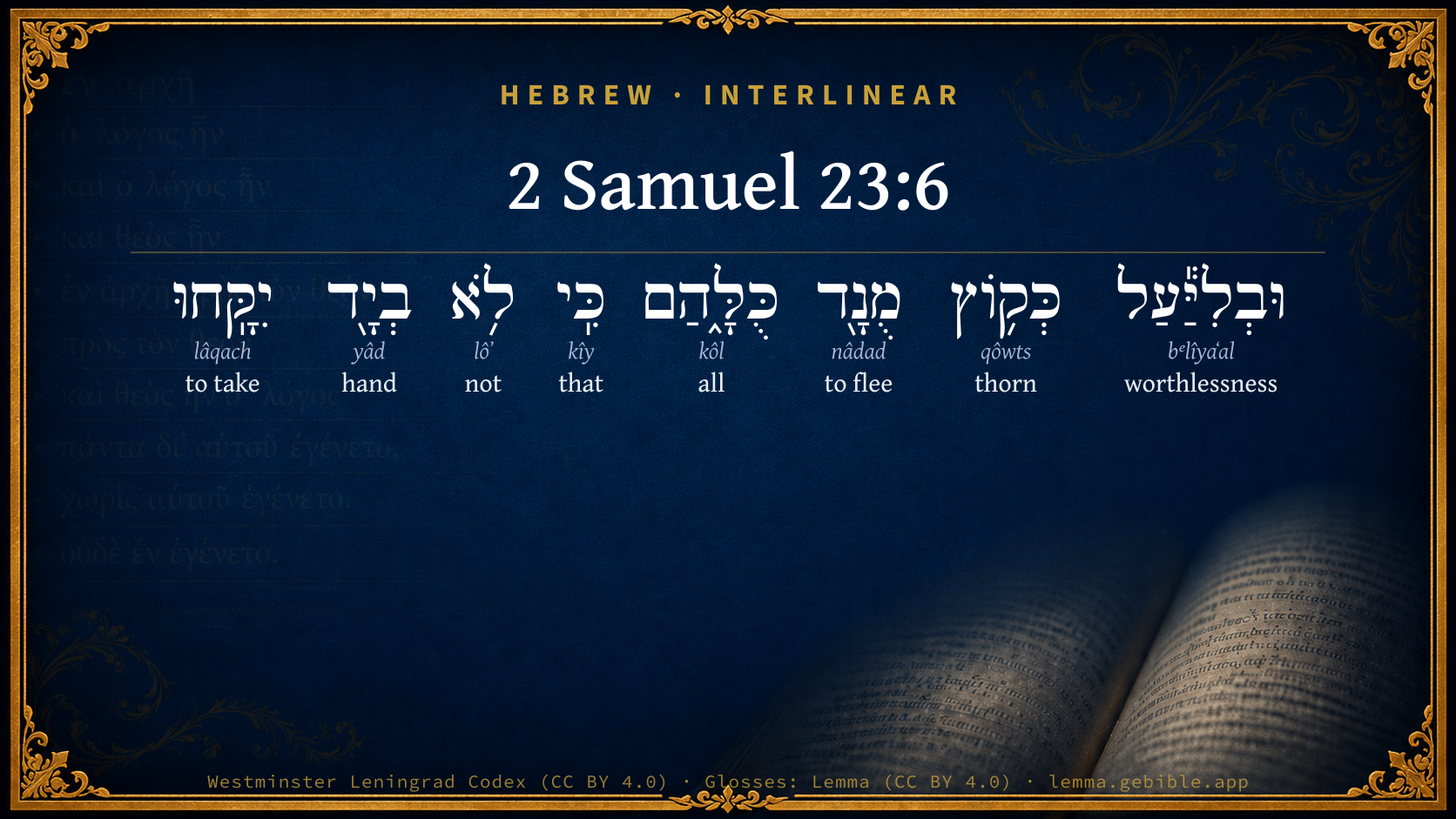
But the ungodly shall be all of them as thorns to be thrust away, Because they can't be taken with the hand
World English Bible · Public Domain
Download a study sheet

One document with this verse’s original text, its word-by-word gloss line, the meaning frame, cross-references with their text, attributed commentary, and full source and license credits — printable, and it pastes into notes with its structure intact.

This verse Autodidact and up

Study sheet (.html) Plain text (.txt)

A passage Seminary Student

Up to 50 verses in one chapter. A passage sheet keeps up to 6 commentary sources and 12 cross-references per verse, in the order this page ranks them, and says so on the sheet whenever that leaves anything out. Ask for a single verse and you get the Autodidact verse sheet above.

Everything on this page stays free to read, with no account — the sheet is a download of what is already on screen, not access to it.

Want to remove ads? Support Godless Engineer
Compare translations 3

The same verse in 3 English versions, stacked beneath the original-language interlinear above. Click any original word for its lexicon entry.

Each is an independent rendering of the whole verse — the interlinear is not word-aligned to these translations.

Highlighted words mark where these versions differ — a whole-verse word diff, not a word-by-word alignment.

  • World English Bible Public Domain
    But the ungodly shall be all of them as thorns to be thrust away, Because they can't be taken with the hand
  • King James Version Public Domain
    But the sons of Belial shall be all of them as thorns thrust away, because they cannot be taken with hands:
  • unfoldingWord Literal Text CC BY-SA 4.0
    But the wicked, all of them, like a thorn thrown away because they do not take in the hand.

unfoldingWord Literal Text — © unfoldingWord, licensed CC BY-SA 4.0. Word-aligned USFM3 via Door43 (git.door43.org/unfoldingWord/en_ult).

Versions to compare (up to 4)

3 of 4 selected

Show all 18 translations

Every available English version of this verse, each an independent rendering of the whole verse.

  • World English Bible Public Domain
    But the ungodly shall be all of them as thorns to be thrust away, Because they can't be taken with the hand
  • Berean Standard Bible Public Domain
    But the worthless are all like thorns raked aside, for they can never be gathered by hand.
  • Majority Standard Bible Public Domain
    But the worthless are all like thorns raked aside, for they can never be gathered by hand.
  • King James Version Public Domain
    But the sons of Belial shall be all of them as thorns thrust away, because they cannot be taken with hands:
  • American Standard Version (1901) Public Domain
    But the ungodly shall be all of them as thorns to be thrust away, Because they cannot be taken with the hand;
  • Revised Version (1885) Public Domain
    But the ungodly shall be all of them as thorns to be thrust away, for they cannot be taken with the hand:
  • Geneva Bible (1599) Public Domain
    But the wicked shalbe euery one as thornes thrust away, because they can not be taken with handes.
  • Douay-Rheims (1899) Public Domain
    But transgressors shall all of them be plucked up as thorns: which are not taken away with hands.
  • Young's Literal Translation Public Domain
    As to the worthless -- As a thorn driven away `are' all of them, For -- not by hand are they taken;
  • Literal Standard Version CC BY-SA 4.0
    As for the worthless—All of them [are] driven away as a thorn, || For they are not taken away by hand;
  • Unlocked Literal Bible CC BY-SA 4.0
    But the worthless will all be like thorns to be thrown away, because they cannot be gathered by one's hands.
  • unfoldingWord Literal Text CC BY-SA 4.0
    But the wicked, all of them, like a thorn thrown away because they do not take in the hand.
  • Darby Bible Public Domain
    But [the sons] of Belial [are] all of them as thorns thrust away, Because they cannot be taken with hands;
  • World Messianic Bible Public Domain
    But all the ungodly will be as thorns to be thrust away, because they can’t be taken with the hand.
  • Webster's Bible Public Domain
    But the sons of Belial shall be all of them as thorns thrust away, because they cannot be taken with hands:
  • Free Bible Version CC BY-SA 4.0
    But evil people are like thorns to be thrown aside; they can't be held in the hand.
  • Bible in Basic English Public Domain
    But the evil-doers, all of them, will be like thorns to be pushed away, because they may not be gripped in the hand:
  • JPS Tanakh (1917) Public Domain
    But the ungodly, they are as thorns thrust away, all of them, for they cannot be taken with the hand;

Literal Standard Version (2020), Covenant Press — licensed CC BY-SA 4.0. Text via the HelloAO Bible API (eBible.org). Unlocked Literal Bible (unfoldingWord) — licensed CC BY-SA 4.0. Text via the HelloAO Bible API (eBible.org). unfoldingWord Literal Text — © unfoldingWord, licensed CC BY-SA 4.0. Word-aligned USFM3 via Door43 (git.door43.org/unfoldingWord/en_ult). Free Bible Version, Dr. Jonathan Gallagher — licensed CC BY-SA 4.0. Text via the HelloAO Bible API (eBible.org).

Word by word

More ways to search: Search by grammar → Find every occurrence → Compare this word →

Practice this passage: Drill this verse → Learn its vocabulary →

About this verse

These counts appear in no published source. They are computed here, from the morphology-tagged text and Lemma’s own curated glosses. What Lemma adds →

8
words
8
distinct lemmas
Historical
section

Notable vocabulary

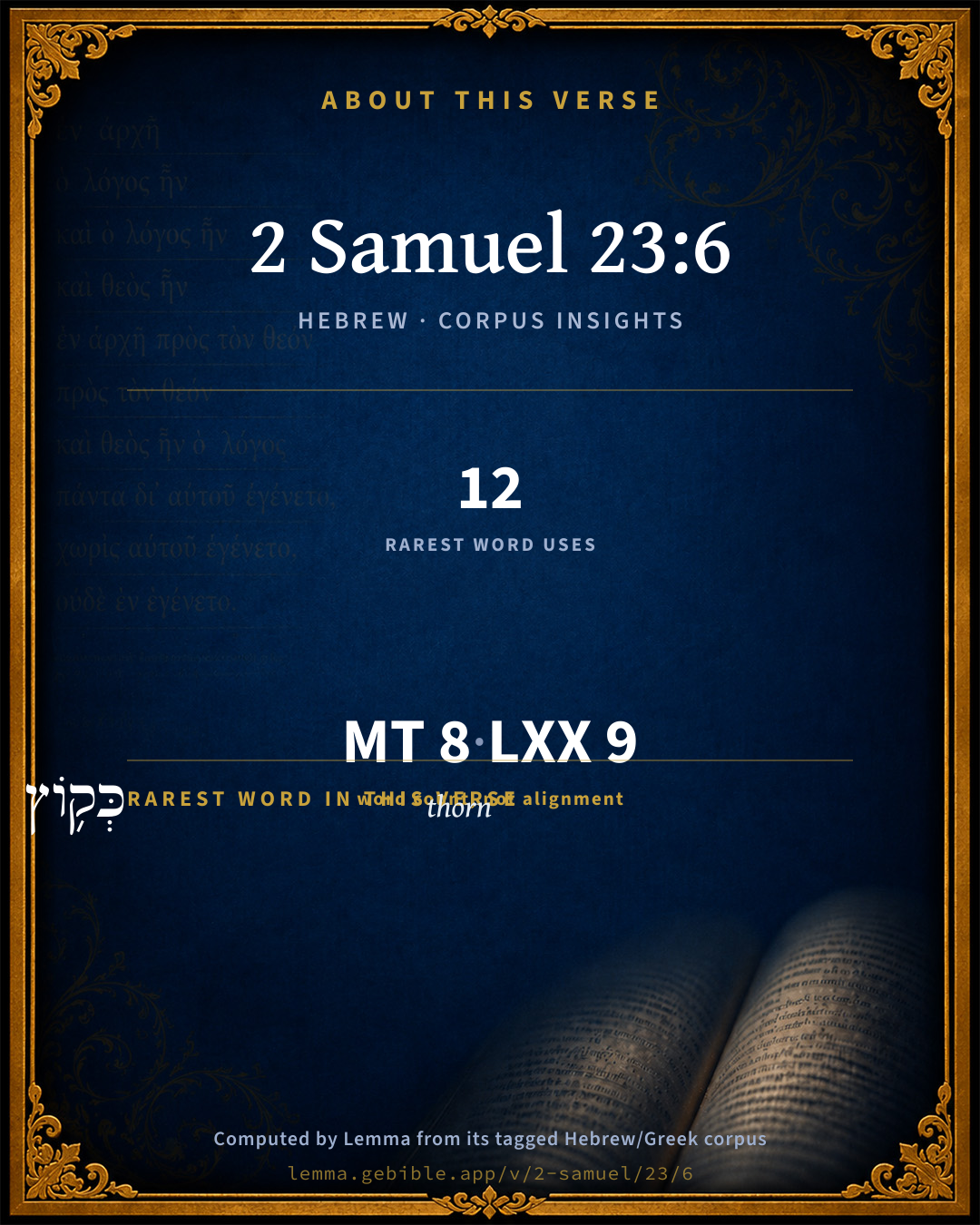
The rarest word here is כְּק֥וֹץ thorn H6975 — appearing just 12 times in the whole Hebrew Bible.

Shared distinctive vocabulary

כְּק֥וֹץ thorn H6975 occurs in 12 verses of the Hebrew Bible. Also found in:

Grammatical profile

  • 2 verbs
  • 4 nouns
  • 1 conjunction
  • 1 particle

Verb forms

  • מֻנָ֖ד Hophal · Participle Passive
  • יִקָּֽחוּ Niphal · Imperfect

Hebrew & Septuagint length

In English translation the verse runs 22 words from the Hebrew and 17 from the Septuagint (LXX English) — closely comparable.

A rough comparison of the two English renderings, which tokenize alike — not a word-level alignment.

Word counts can differ between the Hebrew and the Greek without any difference in meaning — e.g. the Hebrew direct-object marker אֵת has no separate Greek word, and Greek often adds the article ὁ.

In the original languages it is 8 Hebrew tokens and 9 Greek tokens — but the two are counted differently (Hebrew bundles its prefixes and suffixes into one token; the Greek is in lemma form), so that isn’t a like-for-like length.

Cross-references

8

Topical passages linked to 2 Samuel 23:6 in the Treasury of Scripture Knowledge — connected by theme and wording, ordered by reader-vote popularity; previews shown in the World English Bible.

  • Ezekiel 2:6 You, son of man, don't be afraid of them, neither be afraid of their words, though briers and thorns are with you, and you do dwell among scorpions: don't be afraid of their words, nor be dismayed at their looks, though they are a rebellious house.
  • Deuteronomy 13:13 Certain base fellows are gone out from the midst of you, and have drawn away the inhabitants of their city, saying, Let us go and serve other gods, which you have not known;
  • Isaiah 33:12 The peoples shall be as the burning of lime, as thorns cut down, that are burned in the fire.
  • Genesis 3:18 Thorns also and thistles will it bring forth to you; and you will eat the herb of the field.
  • 1 Samuel 2:12 Now the sons of Eli were base men; they didn't know Yahweh.
  • 2 Samuel 20:1 There happened to be there a base fellow, whose name was Sheba, the son of Bichri, a Benjamite: and he blew the trumpet, and said, We have no portion in David, neither have we inheritance in the son of Jesse: every man to his tents, Israel.
  • Song of Solomon 2:2 As a lily among thorns, So is my love among the daughters. Beloved
  • Matthew 13:41 The Son of Man will send out his angels, and they will gather out of his Kingdom all things that cause stumbling, and those who do iniquity,

Cross-references courtesy of OpenBible.info (CC BY 4.0).

Hebrew and Greek witnesses Masoretic Hebrew ↔ Greek Septuagint

The same verse in the two great witnesses to the Old Testament, shown verse-for-verse.

These are two independent witnesses, not word-aligned to each other, and the Septuagint is shown in lemma (dictionary) form.

Hebrew 2 Samuel 23:6 Masoretic · Westminster Leningrad Codex

וּבְלִיַּ֕עַל כְּק֥וֹץ מֻנָ֖ד כֻּלָּ֑הַם כִּֽי לֹ֥א בְיָ֖ד יִקָּֽחוּ

But the ungodly shall be all of them as thorns to be thrust away, Because they can't be taken with the hand

World English Bible · Public Domain

Greek LXX 2 Samuel 23:6 Septuagint · lemma form

ὥσπερ ἄκανθα ἐκὠθέω πᾶς αὐτός ὅτι οὐ χείρ λαμβάνω

All these are as a thorn thrust forth, for they shall not be taken with the hand,

LXX2012 (modern English Septuagint) · Public Domain

On this verse, Haydock's Catholic Bible Commentary discusses the Septuagint’s reading. Read the note in Commentary ↓

Hebrew: Westminster Leningrad Codex (CC BY 4.0). Greek: Septuagint (public domain); English from LXX2012 (modern English Septuagint) (Public Domain). How the Septuagint differs from the Hebrew →

Targum (Aramaic paraphrase)

1

The Targum is the ancient Jewish Aramaic paraphrase of the Hebrew Scriptures — an interpretive translation, not the Hebrew text itself. Onkelos (literal) and Pseudo-Jonathan (expansive) render the Torah, and Jonathan the Prophets. Coverage is partial: where no permissively-licensed English translation exists for a verse, only the Aramaic is shown. This is verse-level text, not a word-by-word alignment to the Hebrew.

  1. Targum Jonathan Prophets (Joshua–Malachi)
    וְרַשִׁיעַיָא עָבְדֵי חֶטְאָה דָמָן לְכֻבִּין דִבְמִפַּקְהוֹן רַכִּיכִין לְמִקְטַף וְכַד אֱנַשׁ חַיֵס עֲלֵיהוֹן וְשָׁבֵיק לְהוֹן אָזְלִין וְתַקְפִין עַד דְלֵית אֶפְשַׁר לְמִקְרָב לְהוֹן בְּיָד:

    (no public-domain English translation for this verse)

    Targum Jonathan — Aramaic: “Mikraot Gedolot” (public domain). English: “Sefaria Community Translation” (CC0 1.0 (public-domain dedication)); “London "Chaldee Paraphrase," 1871” (public domain). Text via Sefaria.

Commentary

Notes on 2 Samuel 23:6 from classic Christian and Jewish commentators (each source and its license shown beneath its notes). The classic Christian expositions comment on the surrounding passage and are grouped to its opening verse, so a note may address several verses; the Jewish commentaries on the Tanakh (Rashi and others) are per-verse, so they appear only where the commentator wrote on this verse.

Lemma curates 59 commentaries, every one of them public domain or Creative Commons licensed, each selected and text-cleaned for this edition rather than reprinted as found. About our sources →

Trapp's Complete Commentary

John Trapp

2Sa 23:6 But [the sons] of Belial [shall be] all of them as thorns thrust away, because they cannot be taken with hands:

Ver. 6. But the sons of Belial.] Lawless, aweless, yokeless, masterless men, or monsters rather, such as contemn the word, and refuse to be reformed; untractable, incorrigible, such as were the Jews in Christ’s time, and so continue to be.

Shall be all of them as thorns.] That bear no good fruit, but only pricks, to hurt those that meddle with them. These shall be thrust away, that is, powerfully proceeded against; they shall be stubbed up by the roots, and burnt, viz., in hell fire. Those refractory Jews, for instance, on whom wrath came to the utmost, because "they pleased not God, but were contrary to all men," {1Th 2:15-16} and the same is and shall be seen in Antichrist and his adherents, cast alive into the lake of fire. {Rev 19:20}

John Trapp, A Commentary or Exposition upon All the Books of the Old and New Testament (1647–1656) — public domain. Text from a community e-Sword module.

Joseph Benson's Commentary

2Sa 23:6-7. But the sons of Belial — Having in the foregoing verses described the nature and stability of that kingdom which God had, by a sure covenant, settled upon him and his seed; and especially upon the Messiah, who was to be one of his posterity; he now describes the nature and miserable condition of all the enemies of this holy and blessed kingdom. Shall be all as thorns — Which men do not use to handle, but thrust them away. And so will God thrust away from himself, and from his people and kingdom, all those who shall either secretly or openly set themselves against it. That shall touch them must be fenced — He must arm himself with some iron weapon, whereby he may cut them down; or, with the staff of a spear, or some such thing, whereby he may thrust them away from himself, that they do him no hurt. They shall be utterly burned — Or, if men do not cut them down or thrust them away, they will burn and consume them. The place — Or, in their place, where they grow or stand.

Joseph Benson's Commentary on the Old and New Testaments (1811–1818) — public domain. Text from a community e-Sword module.

Tyndale Open Study Notes

Tyndale Open Resources

23:6 Cp. Ps 1:4-5.

Tyndale Open Study Notes — © Tyndale Open Resources, licensed CC BY-SA 4.0. Text via the HelloAO Bible API.

Adam Clarke's Commentary

Verse 6. But the sons of Belial shall be all of them as thorns] There is no word in the text for sons; it is simply Belial, the good-for-nothing man, and may here refer - first to Saul, and secondly to the enemies of our Lord.

As thorns thrust away] A metaphor taken from hedging; the workman thrusts the thorns aside either with his bill or hand, protected by his impenetrable mitten or glove, till, getting a fair blow at the roots, he cuts them all down. The man is fenced with iron, and the handle of his bill is like the staff of a spear. This is a good representation of the dubbing-bill, with which they slash the thorn hedge on each side before they level the tops by the pruning-shears. The handle is five or six feet long. This is a perfectly natural and intelligible image.

Adam Clarke's Commentary on the Bible (1810–1826) — public domain. Text from a community e-Sword/MySword module.

Ellicott's Commentary for English Readers

(6) The sons of Belial.—According to the Masoretic punctuation, Belial is not here in the common form, but in the stronger abstract form=worthlessness. The coming in of Divine righteousness leads not only to the assimilation of that which is holy, but also to the rejection of that which is evil, by a law as necessary and immutable as that of action and reaction in the material world. The figures used are to show that, although the wicked injure whatever touches them, means will yet be found by which they may safely be put out of the way.

A Bible Commentary for English Readers, edited by Charles John Ellicott (1878–1897) — public domain. Text from a community e-Sword module.

The Cambridge Bible for Schools and Colleges

gen. ed. J. J. S. Perowne

6. But the sons of Belial] But the wicked, &c. All ungodly men and evil things are described as worthlessness or wickedness. Their judgment and destruction is the necessary consequence of the perfect rule of the righteous king. Cp. Mat_13:41.

The Cambridge Bible for Schools and Colleges (gen. ed. J. J. S. Perowne; Cambridge University Press, 1878–1918) — public domain. Text from a community e-Sword module.

John Gill's Exposition

But the sons of Belial shall be all of them as thorns thrust away,.... Not like the tender grass that springs up, and flourishes after rain, and the sunshine upon that; but like thorns, useless, hurtful, and pernicious, and fit only for burning: this is true of wicked men in general, that cast off the yoke of the Lord, and become unprofitable, as Belial signifies; and of wicked governors in particular, who, instead of being helpful, are harmful to a commonwealth; and instead of being the joy and comfort of their subjects, and of giving pleasure to them, and making them cheerful and prosperous, give pain and trouble, and cause grief and sorrow; and are, if possible, to be thrust away, and deposed from government:

because they cannot be taken with hands; thorns cannot be handled and gently dealt with, but some instrument must be used to put them away with force; so wicked men, and especially wicked rulers, are untractable, and not to be managed in a gentle way, and therefore violent ones must be taken.

John Gill's Exposition of the Whole Bible (1746–1763) — public domain (CC PDM 1.0). Text via the HelloAO Bible API.

Haydock's Catholic Bible Commentary

But. This word is neglected by the Septuagint, who enjoin this to the preceding verse. "Because the lawless man shall not flourish. They are all like thorns thrust out, for they shall not be handled," lest they prick. (Haydock)

George Leo Haydock (1774–1849), Haydock's Catholic Family Bible and Commentary, 1859 edition — public domain. Excludes Psalms (Douay-Rheims chapter numbering differs from Protestant) and Deuterocanonical books (Catholic canon only).

Matthew Poole's English Annotations

The sons of Belial, or, the men of Belial, as it is expressed 2Sa 16:7, and elsewhere. Having in the foregoing verses described the nature, and felicity, and stability of that kingdom which God himself had by a sure and everlasting covenant settled upon him and his seed; and especially, upon the Messiah, who was to be one of his posterity; he now describes the quality, the mischievous nature, the hazardous and miserable condition, of all the enemies of this holy and blessed kingdom, whom he justly calleth sons of Belial, because they rebelled against God’s appointment, and against that king whom God had set over them; for which reason others are so called, 1Sa 10:27; 2Ch 13:7.

As thorns thrust away which men do not use to handle, as they do other trees, but thrust them away from themselves, by some instrument chosen for that purpose. And so will God remove or thrust away from himself, and from his people and kingdom, all those who shall either secretly or openly set themselves against it. And this may be here added, either,

1. By way of prescription to rulers, whom, as before he admonished to be just and kind to their people, 2Sa 23:3,4; so here he requires them to be severe in punishing and purging away wicked and incorrigible men from about his throne, and from among his people; the encouraging of the good, and the punishing of the bad, being the two chief works of every good magistrate, and the two pillars of all government. Or,

2. By way of caution; to show, that notwithstanding the holiness, and happiness, and sureness of this kingdom, yet there would be sons of Belial in it, who would endeavour to disturb and overthrow it, but to no purpose; for all their projects against it should be vain, and fall upon their own heads.

Matthew Poole's English Annotations on the Holy Bible (1683–1685) — public domain. Text from a community e-Sword/MySword module.

Whedon's Commentary on the Bible

Daniel D. Whedon

6. The worthless — Literally, worthlessness, an elliptical expression for worthless or wicked men, depicting the godless as personified worthlessness. He doubtless had in mind the profane and godless enemies who had been to him, all through his own reign, a source of vexation and anxiety, including also such as Saul and his partisans, Shimei and his sympathizers, traitors among his own familiar friends, like Ahithophel, and even the sons of Zeruiah.

As thorns thrust aside — As the prickly shrubs which are hated and destroyed by husbandmen; apt illustration of the wicked.

Not in the hand may they be taken — As all who have tried it know. So, too, he who carelessly, or without properly guarding himself, meddles with the godless, must suffer injury. David found Joab as a prickly thorn when he injudiciously attempted to transfer his office to Amasa.

Filled with iron — That is, defended with some sort of iron armour to protect his flesh against the thorns. The expression is elliptical, and comes from filling one’s hand with any thing; that is, taking in hand, or providing one’s self with, means of defence. So the righteous ruler must be armed with all needful authority and power to make himself a terror to evil doers, and show that he beareth not the sword in vain. See Rom_13:1-6.

Shaft of a spear — The long wooden handle or staff by which the husbandman may lop the bush, and cut its roots without being hurt. Thorns thus cut were used for burning lime. Isa_33:12. Dr. Thomson saw people in the north of Palestine cutting up thorns with their mattocks and pruning hooks, and gathering them into bundles for the lime-kiln.

Burned in their place — That is, the place where they grew. The same observant traveller just referred to says: “It is a curious fidelity to real life that, when the thorns are merely to be destroyed, they are never cut up, but set on fire where they grow.”

Daniel D. Whedon (gen. ed.), Commentary on the Old and New Testaments (1874–1909) — public domain. Text from a community e-Sword module.

The Pulpit Commentary

Vers. 6, 7. The sons of Belial; Hebrew, belial; not a proper name, but a word signifying "worthlessness," and especially vicious worthlessness. (see note on 1Sa_1:16) It is from this worthlessness that opposition arises to the just king, and he recognizes it as that which thwarts his efforts. The words may be rendered

But the ungodly are as thorns, to be all of them thrust away; For they may not be taken hold of with the hand. And the man that would touch them Must arm himself with iron and the staff of a spear; And they shall be utterly burned with fire unto nothingness.

The vicious worthlessness which opposes righteous government must be treated like thorns, too prickly and sharp pointed for gentle dealing. They must be torn up by an iron hook fixed to the end of a spear-handle, and then burnt. The word translated in the same place in the Authorized Version is rendered by Jerome "even to nothing;" and it is just the sort of phrase for which his authority is greatest; for he went to Palestine, and remained there several years, to study the language under Hebrew teachers on the spot. The Septuagint must have had a different reading, as it translates "their shame."

The Pulpit Commentary (1880–1919), ed. H.D.M. Spence-Jones & Joseph S. Exell — public domain. Text from a community e-Sword module.

John Wesley's Explanatory Notes

But - Having in the foregoing verses described the nature, and stability of that kingdom which God had by a sure covenant settled upon him and his seed; and especially, upon the Messiah, who was to be one of his posterity; he now describes the nature and miserable condition, of all the enemies of this holy and blessed kingdom. As thorns - Which men do not use to handle, but thrust them away. And so will God thrust away from himself, and from his people, and kingdom, all those who shall either secretly or openly set themselves against it.

John Wesley, Explanatory Notes Upon the Whole Bible (1754–1765) — public domain. Text via the GEBible commentary corpus.

unfoldingWord translationNotes

Door43 World Missions Community

General Information:

This concludes David's last words.

But the worthless will all be like thorns to be thrown away

Here the wicked person is compared to useless thorns. This can be stated in active form. AT: "But the wicked person is worthless and dangerous like thorns we throw away" (See: Simile and Active or Passive)

because they cannot be gathered by one's hands

"because no one can pick them up with his hands without the thorns hurting him"

They must be burned up where they lie

"Where thorns are found, that is where they must be burned." This means God will destroy wicked people.

translationWords

worthy

thorn

spear

unfoldingWord translationNotes — © Distant Shores Media and the Door43 World Missions Community, licensed CC BY-SA 4.0. Source: git.door43.org/Door43/en_tn.

Rashi

Rabbi Shlomo Yitzchaki (Rashi)

Like an itinerant thorn. Cordon in O.F. When [this thorn is] young it is soft. It then travels to and fro and eventually hardens until it is [so sharp that it is] unable to be held in one's hand.

Rashi on the Tanakh — English translations: “The Judaica Press complete Tanach with Rashi, translated by A. J. Rosenberg” (CC BY 4.0); “Pentateuch with Rashi's commentary by M. Rosenbaum and A.M. Silbermann, 1929-1934” (public domain); “The Metsudah Tanach series, Lakewood, N.J” (CC BY 4.0); and “The Book of Joshua, Metsudah Publications, 1997” (CC BY 4.0). Text via Sefaria.

Lesson kit

Teaching starters — assembled from the data on this page, not authored interpretation. Every prompt links to the verse data it draws on. Edit before teaching.

2 Samuel, in the Historical, opens this verse with 8 words (8 distinct Hebrew lemmas). Its most distinctive word is qôwts (“thorn”). A historical commentator’s framing appears above. Read the whole chapter for the surrounding context.

Discussion questions

  1. The word qôwts carries the sense “thorn.” How does it shape the verse?
  2. Genesis 3:18 shares the word «thorn» with this verse. How do the two illuminate each other?
  3. These translations render this verse differently; the difference is in the English rendering, not the original. What questions does that raise?
  4. The verb «מֻנָ֖ד» is Hophal Participle Passive. How does its form color the action?
  5. Reading how Trapp's Complete Commentary and Joseph Benson's Commentary read this verse, where do the two commentators agree and where do they part?

Things to notice

Reading settings

Reading text

Shown beneath each verse's original-language words.

Old Testament
Old Testament edition

Read the OT as the Masoretic Hebrew (MT) or the Greek Septuagint (LXX).

English shown for the Greek Septuagint (in the Hebrew ↔ Greek comparison).

Comparing translations? Open the Compare panel on any verse page to stack up to four side by side.