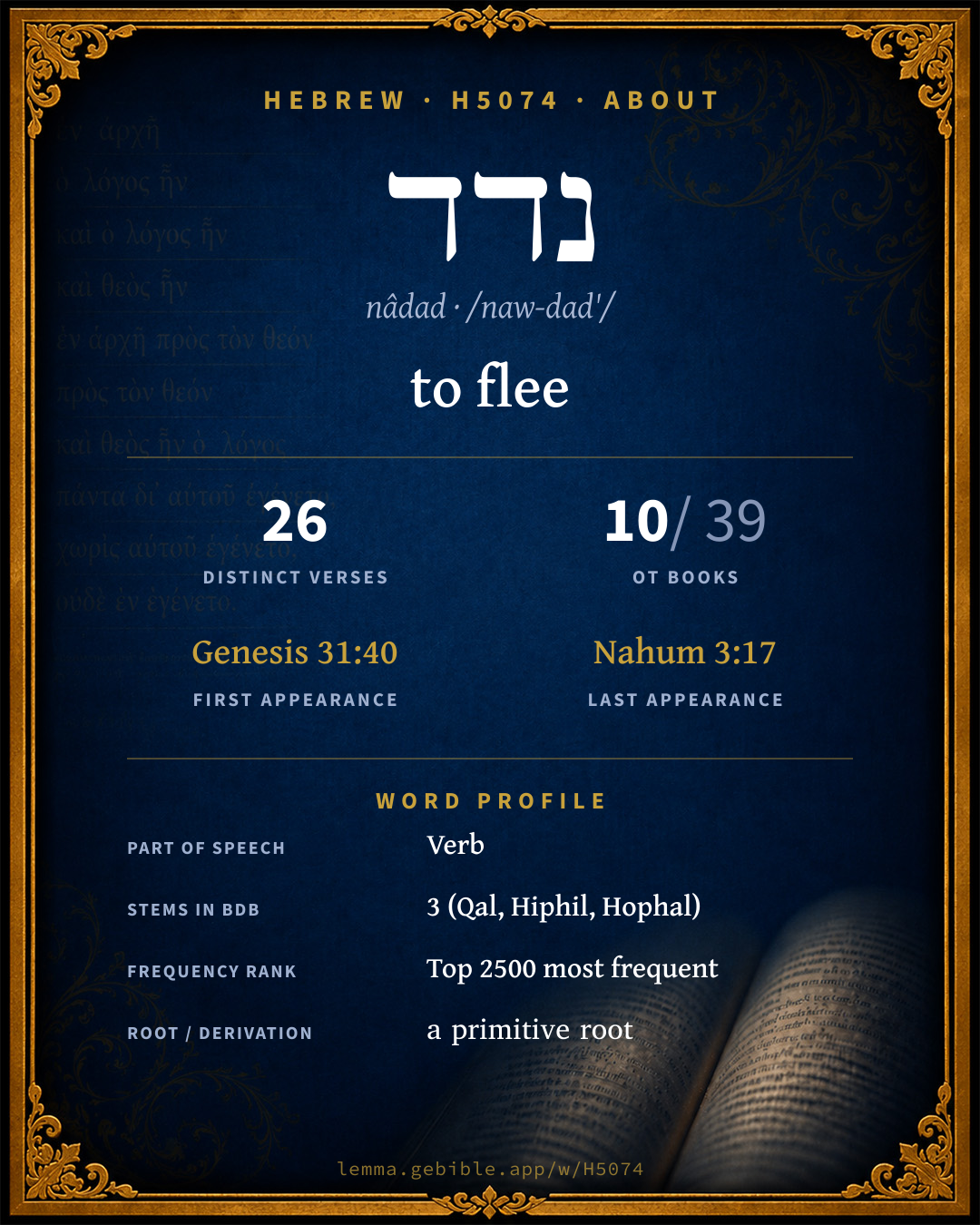
נָדַד
to flee
‘to flee’ is one of 5 main senses fuller range ↓
Full lexicon entry — Brown-Driver-Briggs (BDB)
From Brown-Driver-Briggs (BDB)
Where this word appears
See every Qal verb in the Hebrew Bible →
Grammar key — what these labels mean
Part of speech
- Verb
- An action or state-of-being word.
Stem
- Qal
- The basic, simple active stem — the plain form of the verb (“he wrote”). Here: ‘retreat’
- Hophal
- The passive counterpart of the Hiphil (“he was caused to…”). Here: ‘be chased away’
- Hiphil
- The causative active stem (“he caused / brought about”). Here: ‘chase away’
- Hithpolel
- The reflexive counterpart of the Polel.
Form
- Perfect
- A completed action or state — Hebrew marks aspect (completeness) more than strict tense (“he wrote”).
- Participle Active
- A verbal adjective expressing ongoing or characteristic action (“writing / one who writes”).
- Imperfect
- An incomplete, ongoing, or future action (“he will / would write”).
- Sequential Imperfect
- An imperfect with prefixed waw — the standard past-narrative form (waw-consecutive imperfect).
- Participle Passive
- A verbal adjective expressing action received (“written”).
- Infinitive Construct
- A bound verbal noun, frequently with prepositions (“to write / in writing”).
State
- Absolute
- The independent form of a noun, not bound to a following word.
Person
- 3rd Person
- The one spoken about (“he / she / it / they”).
Gender
- Common
- Either gender — not distinguished for this form.
- Masculine
- Grammatically masculine.
- Feminine
- Grammatically feminine.
Number
- Plural
- More than one (in Hebrew, generally three or more).
- Singular
- One.
Grammatical forms 14 distinct
- Verb, Qal, Perfect, 3rd Person, Common, Plural 7 times (25%)
- Verb, Qal, Participle Active, Masculine, Singular, Absolute 7 times (25%)
- Verb, Qal, Imperfect, 3rd Person, Masculine, Plural 2 times (7%)
- Verb, Qal, Perfect, 3rd Person, Feminine, Singular 2 times (7%)
- Verb, Hophal, Imperfect, 3rd Person, Masculine, Singular 1 time (4%)
- Verb, Poal, Perfect, 3rd Person, Masculine, Singular 1 time (4%)
- Verb, Qal, Sequential Imperfect, 3rd Person, Feminine, Singular 1 time (4%)
- Verb, Hophal, Participle Passive, Masculine, Singular, Absolute 1 time (4%)
+6 more forms (6 occurrences)
Parsed forms decoded from the imported morphology (morphhb / Westminster Leningrad Codex — WLC text public domain, morphhb tagging CC BY 4.0), counted across 28 parsed occurrences — not distinct verses.
Every verse where H5074 appears — 26 distinct verses across 10 books. Click any verse to open its interlinear word-by-word view. Verse text shown in the World English Bible for context — . Each verse’s Hebrew form is shown with its reference; the English is not keyword-highlighted, since the data carries no word-level English alignment. Use “Compare translations” on any verse to read it across multiple English versions. This concordance covers the Hebrew Bible; Septuagint (Greek Old Testament) occurrences are not indexed here.
Genesis 1 verse
2 Samuel 1 verse
Esther 1 verse
Job 3 verses
- Job 15:23 נֹ֘דֵ֤ד Qal ptcp.act ms He wanders abroad for bread, saying, 'Where is it?' He knows that the day of darkness is ready at his hand.
- Job 18:18 יְנִדֻּֽ/הוּ Hiphil impf 3mp + sfx pers 3ms He shall be driven from light into darkness, And chased out of the world.
- Job 20:8 וְ֝/יֻדַּ֗ד conj + Hophal impf 3ms He shall fly away as a dream, and shall not be found: Yes, he shall be chased away like a vision of the night.
Psalms 4 verses
- Psalms 31:11 נָדְד֥וּ Qal pf 3cp Because of all my adversaries I have become utterly contemptible to my neighbors, A fear to my acquaintances. Those who saw me on the street fled from me.
- Psalms 55:7 נְדֹ֑ד Qal inf.cs Behold, then I would wander far off. I would lodge in the wilderness." Selah.
- Psalms 64:8 יִ֝תְנֹדֲד֗וּ Hithpolel impf 3mp Their own tongues shall ruin them. All who see them will shake their heads.
- Psalms 68:12 יִדֹּד֣וּ/ן יִדֹּד֑וּ/ן Qal impf 3mp + sfx n Qal impf 3mp + sfx n "Kings of armies flee! They flee!" She who waits at home divides the spoil,
Proverbs 1 verse
Isaiah 8 verses
- Isaiah 10:14 נֹדֵ֣ד Qal ptcp.act ms and my hand has found as a nest the riches of the peoples; and as one gathers eggs that are forsaken, have I gathered all the earth: and there was none that moved the wing, or that opened the mouth, or chirped.
- Isaiah 10:31 נָדְדָ֖ה Qal pf 3fs Madmenah is a fugitive; the inhabitants of Gebim flee for safety.
- Isaiah 16:2 נוֹדֵ֖ד Qal ptcp.act ms For it shall be that, as wandering birds, as a scattered nest, so shall the daughters of Moab be at the fords of the Arnon.
- Isaiah 16:3 נֹדֵ֖ד Qal ptcp.act ms Give counsel, execute justice; make your shade as the night in the midst of the noonday; hide the outcasts; don't betray the fugitive.
- Isaiah 21:14 נֹדֵֽד Qal ptcp.act ms To him who was thirsty they brought water; the inhabitants of the land of Tema did meet the fugitives with their bread.
- Isaiah 21:15 נָדָ֑דוּ Qal pf 3cp For they fled away from the swords, from the drawn sword, and from the bent bow, and from the heat of battle.
- Isaiah 22:3 נָֽדְדוּ Qal pf 3cp All your rulers fled away together, they were bound by the archers; all who were found of you were bound together; they fled afar off.
- Isaiah 33:3 נָדְד֖וּ Qal pf 3cp At the noise of the thunder the peoples are fled; at the lifting up of yourself the nations are scattered.
Jeremiah 3 verses
- Jeremiah 4:25 נָדָֽדוּ Qal pf 3cp I saw, and, behold, there was no man, and all the birds of the sky were fled.
- Jeremiah 9:10 נָדְד֖וּ Qal pf 3cp For the mountains will I take up a weeping and wailing, and for the pastures of the wilderness a lamentation, because they are burned up, so that none passes through; neither can men hear the voice of the cattle; both the birds of the sky and the animals are fled, they are gone.
- Jeremiah 49:5 לַ/נֹּדֵֽד prep det + Qal ptcp.act ms Behold, I will bring a fear on you, says the Lord, Yahweh of Hosts, from all who are round about you; and you shall be driven out every man right forth, and there shall be none to gather together the fugitives.
Hosea 2 verses
- Hosea 7:13 נָדְד֣וּ Qal pf 3cp Woe to them! For they have wandered from me. Destruction to them! For they have trespassed against me. Though I would redeem them, Yet they have spoken lies against me.
- Hosea 9:17 נֹדְדִ֖ים Qal ptcp.act mp My God will cast them away, because they did not listen to him; And they will be wanderers among the nations.
Nahum 2 verses
- Nahum 3:7 יִדּ֣וֹד Qal impf 3ms It will happen that all those who look at you will flee from you, and say, 'Nineveh is laid waste Who will mourn for her?' Where will I seek comforters for you?"
- Nahum 3:17 וְ/נוֹדַ֔ד conj + Poal pf 3ms Your guards are like the locusts, and your officials like the swarms of locusts, which settle on the walls on a cold day, but when the sun appears, they flee away, and their place is not known where they are.
About this entry
At a glance — auto-summarized from this page’s data, not written by a person. Every figure links to its source below. This summary describes the numbers; it doesn’t interpret them.
At its core, נדד (nâdad) means “to flee.” Scripture first uses it in Genesis 31:40. Spanning 26 verses in 10 books, it ranks among the moderately common words of the Hebrew Bible. Its uses concentrate in Isaiah (31% of all occurrences). The verb spans 3 stems, from Qal to Hiphil. Dig into 26-verse concordance and the renderings breakdown below.
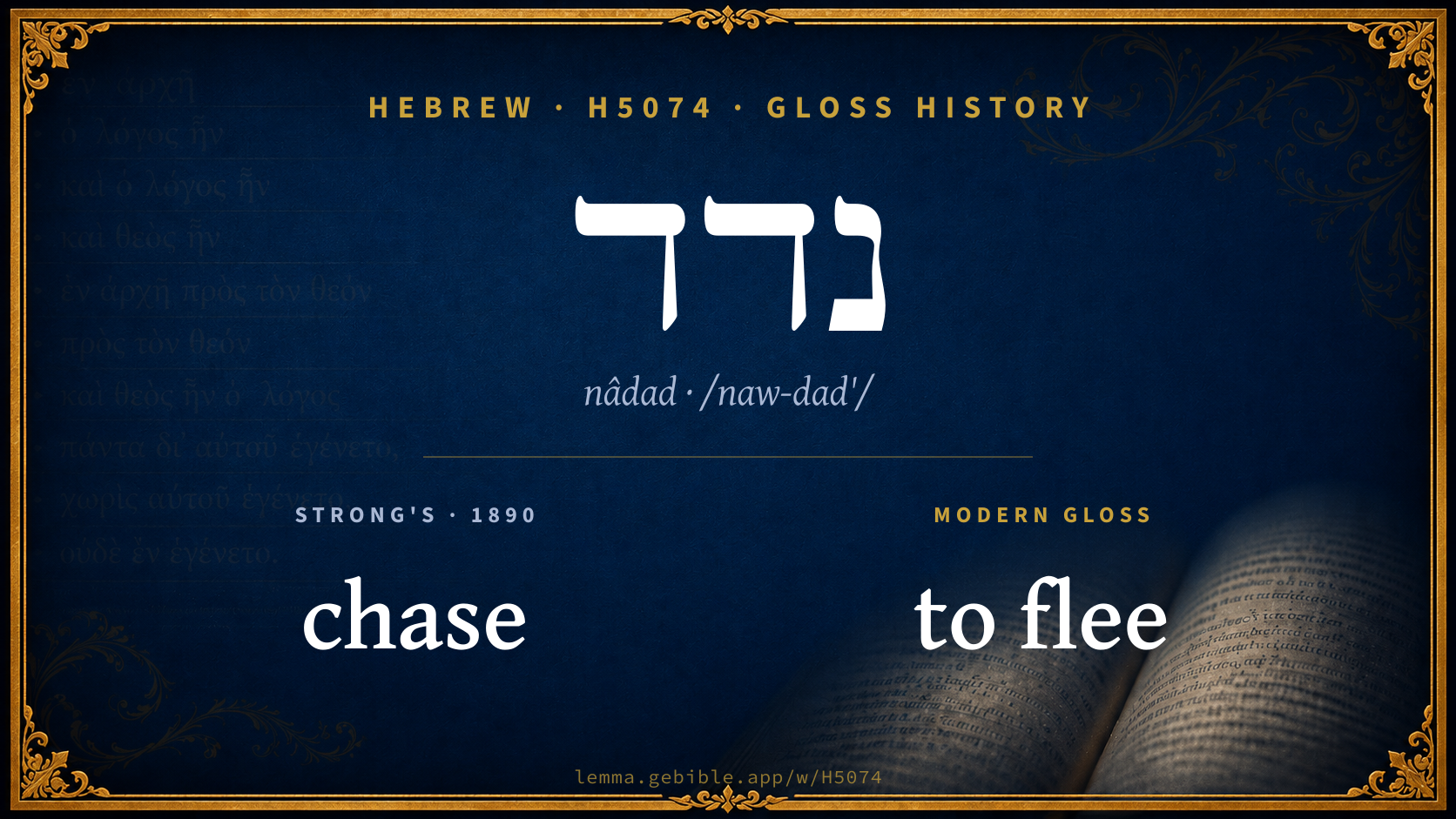
Gloss history
Strong's 1890 vs modern scholarship
About this word
Strong's H5074 catalogs a Hebrew word from the Hebrew Old Testament.
These counts are not copied from any lexicon or concordance. They are computed here, from the morphology-tagged Hebrew Old Testament. What Lemma adds →
- 26
- distinct verses
- The word appears in 26 distinct verses.
- 10 / 39
- OT books
- The word appears in 10 of 39 Old Testament books.
- #1,190
- by frequency
- Top 2500 most frequent Hebrew words (rank 1,190 of 8,640 Hebrew words by occurrence).
View all 26 occurrences in the concordance →
By section of the Old Testament
By traditional corpus
Conventional, traditional groupings — biblical authorship is debated, so this is a traditional corpus grouping, not an authorship claim. Each share is this word’s portion of its verses in that division of the Hebrew canon. Each figure is a share of the word’s 26 distinct verses.
- Prophets (Nevi'im) 16 verses · 62%
- Writings (Ketuvim) 9 verses · 35%
- Torah (Pentateuch) 1 verse · 4%
How translations render this word
Counts come from each version’s own published word-to-Strong’s tagging or interlinear alignment — an approximate guide to how each version renders this word, not a word-level alignment the data otherwise carries. Because each total is that version’s own tagged count, the per-version totals vary from one another and need not match the appearance or distinct-verse counts above. These counts may also differ from a printed concordance because Lemma counts each distinctly tagged rendering and does not collapse phrase taggings into a single head-word total. This is a fixed set of word-tagged versions (KJV, ASV, BSB, ULT) and does not change with the reading translation you choose elsewhere. Each version’s license is shown beside its name below (and on Sources).
- King James Version: Wandereth 4×, Fled 3×, Are fled 2×
- American Standard Version: Are fled 2×, Fled 2×, Fugitives 2×
- Berean Standard Bible: Have fled 2×, They flee 2×
- unfoldingWord Literal Text: Flee 3×, Wandering 3×, They have fled 2×
King James Version Public Domain
Renders H5074 across 28 tagged occurrences — most commonly:
Plus 19 renderings that appear only once — usually multi-word phrases or single function words the recovered tagging swept in, not distinct renderings.
American Standard Version Public Domain
Renders H5074 across 28 tagged occurrences — most commonly:
Plus 20 renderings that appear only once — usually multi-word phrases or single function words the recovered tagging swept in, not distinct renderings.
Berean Standard Bible Public Domain
Renders H5074 across 26 tagged occurrences — most commonly:
Plus 22 renderings that appear only once — usually multi-word phrases or single function words the recovered tagging swept in, not distinct renderings. Not rendered by a distinct English word in 2 further occurrences.
unfoldingWord Literal Text CC BY-SA 4.0
Renders H5074 across 28 tagged occurrences — most commonly:
Plus 18 renderings that appear only once — usually multi-word phrases or single function words the recovered tagging swept in, not distinct renderings.
7 senses and sub-senses in the full BDB
Hebrew verbs can shift meaning by stem (binyan): Qal is the basic action, Niphal is often passive or reflexive, Piel often intensifies or makes it factitive, and Hiphil is typically causative. The senses below are grouped under the stem BDB assigns to each. This entry also uses Hophal (the passive of Hiphil).
What do BDB’s symbols mean?
BDB uses these scholarly abbreviations:
| Symbol | Meaning |
|---|---|
| 𝔊 | the Septuagint (the ancient Greek translation, LXX) |
| 𝔙 | the Vulgate (the Latin translation) |
| 𝔖 | the Syriac version (the Peshitta) |
| 𝔗 | the Targum (the Aramaic translation) |
| ψ | the Psalms |
| √ | root (the underlying root or stem) |
| ‖ | parallel passage (a synonymous or contrasted parallel) |
| † | the dagger: every passage where the word occurs is cited |
The 7 senses and sub-senses the full Brown-Driver-Briggs lexicon distinguishes for this word, in lexicon order (not ranked by frequency), with BDB’s own verbatim wording and sub-sense lettering. Shown in Hebrew script with BDB’s own scholarly abbreviations. The condensed entry is in the Lexicon Entry tab. See also the Forms in the corpus table below.
Qal
- Pf. 3 fs. נָֽדְדָה Is 10:31 Est 6:1; 3 pl. נָֽדְדוּ Ho 7:13 + 4 times, נָדָ֑דוּ Is 21:15 Je 4:25; Impf. יִדּוֹד Na 3:7; 3 fs. וַתִּדַּד Gn 31:40; 3 mpl. יִדֹּדוּן ψ 68:13(×2); Inf. cstr. נְדֹד ψ 55:8; Pt. נֹדֵד Je 49:5 +; f. נוֹדֶ֫דֶת Pr 27:8; pl. נֹדְדִים Ho 9:17;— e.g. Isaiah 10:31
- 1. retreat, flee Is 21:15 from before (מִפְּנֵי) swords; 33:3 at the sound (מִקּוֹל) of tumult; abs. 10:31; 22:3 ψ 68:13(×2), of birds and beasts Je 4:25; 9:9 (+ הָלָ֑כוּ); pt. = fugitive Is 16:3; 21:14; of fleeing in horror, disgust, c. מִן pers. Na 3:7 ψ 31:12. e.g. Isaiah 21:15
- 2. flee, depart, Isr. from (מִן) י׳ Ho 7:13; of sleep (מֵעֵינַי) Gn 31:40 (E), abs. Est 6:1. e.g. Hosea 7:13
- 3. wander, stray (homeless, cf. נוד), עוֹף נוֹדֵד Is 16:2 (in sim.), so Pr 27:8 (מִן loc., in sim.), cf. v 8 (מִן loc.); of scattered Isr. Ho 9:17 Je 49:5; (searching) for food Jb 15:23 (wicked man); אַרְחִיק נְדֹד ψ 55:8 I will wander afar. e.g. Isaiah 16:2
- 4. trans. flutter wings (of bird, in fig.) Is 10:14. Poʿal Pf. consec. שֶׁמֶשׁ זָֽרְחָה וְנֹדַד Na 3:17 the sun hath arisen and it (the locust swarm) is chased away. e.g. Isaiah 10:14
Hiphil
- chase away, Impf. 3 mpl. sf. וּמִתֵּבֵל יְנִדֻּ֑הוּ Jb 18:18 (of wicked, ‖ יֶהְדְּפֻהוּ מֵאוֹר). e.g. Job 18:18
Hophal
- be chased away, Impf. 3 ms. וְיֻדַּד כְּחֶזְיוֹן Jb 20:8 (of wicked); קוֹץ מֻנָֿד 2 S 23:6 thorns thrust away (si vera l., cf. Dr.; Klo Bu HPS ק׳ מִדְבָּר). Hithpoʿl Impf. יִתְנוֹדְדוּ ψ 64:9 flee away (in horror, disgust, cf. Qal Na 3:7 ψ 31:12). e.g. Job 20:8
Senses from the full Brown-Driver-Briggs lexicon (Brown, Driver, Briggs; Oxford 1906 — public domain), digitized via Sefaria, supplemented by the OpenScriptures HebrewLexicon (CC BY 4.0). Full attribution on Sources.
Word origin
vb. retreat, flee, depart, stray, wander, flutter (NH id.; Arabic نَدَّ flee, run away; Aramaic ܢܰܕ hate, abominate, shrink from, Aph. put to flight, etc.; נְדַד flee);—
— Brown-Driver-Briggs (Oxford 1906, public domain), digitized via Sefaria, supplemented by the OpenScriptures HebrewLexicon (CC BY 4.0). See Sources.
Origin: a primitive root
Jastrow Dictionary
A second Hebrew/Aramaic lexicon for comparison, covering Aramaic and post-biblical (Talmudic, Targumic, Midrashic) usage that the biblical-Hebrew BDB does not. Matched by lemma rather than by Strong’s number, so a lemma may carry more than one Jastrow headword (shown separately below), and the entries cover usage well beyond the Bible.
נָדַד
- (b. h.)
- 1. to move, shake, chase. Snh. 107ᵃ (ref. to Ps. XI, 1) שלא יאמרו … צפור נְדַדְתּוֹ lest they say, that mountain among you (David)—a bird has shaken it. Esth. R. to VI, 1 נָדְדוּ שמים כסאו וכ׳ the heavens shook the throne of &c. Sifré Deut. 38 ונוֹדֵד שנת וכ׳ and chases away the sleep of his eyes (watches constantly) over it; a. e. e.g. Psalms 11:1
- 2. to be restless, flee. Meg. 15ᵇ (ref. to Esth. VI, 1) נָדְדָה שנת מלכו וכ׳ the sleep of the King of the world fled; ib. נדדו עליונים וכ׳ those on high were agitated; Pirké d’R. El. ch. L; a. e.—Tosef. B. Kam. IX, 27 ונדדה and the tooth was loosened.—Part. pass. נָדוּד; f. נְדוּדָה. Ib. היתה … שינו נ׳ וכ׳ (not נדדה) if his tooth had been loose, and he (the master) caused it to fall out; Kidd. 24ᵇ; a. e. e.g. Esther 6:1
- to make unsteady, chase. B. Bath. 10ᵃ שמְנַדְּדִין שינה מעיניהם who chase the sleep from their eyes (study by night). Keth. 62ᵃ שמְנַדְּדוֹת וכ׳ who keep themselves awake (while their husbands are studying); a. e.—Lev. R. s. 18, v. נִדְנֵד.
- to be shaken. Yalk. Lev. 571 ובלבד שלא תהא מִתְנַדֶּדֶת provided it (the bench) be not shaken (when they sit on it).
נְדַד
- , to be restless, flee. Targ. Job VII, 4. Targ. Ps. LV, 8. Targ. Esth. VI, 1 נָדַת; a. fr.
- 1. same.Targ. Job XV, 23 (some ed. מַנְדַּד part. pass. Af. driven about).
- 2. to make (sleep) flee, to keep awake. Targ. Esth. l. c. נַדֵּיד ed. Lag. (ed. Amst. נְדַד; oth. ed. נַדֵּי; corr. acc.).
- 3. to cause to be sleepless. Targ. II Esth. l. c.
- to be restless, agitated. Ib.
A Dictionary of the Targumim, the Talmud Babli and Yerushalmi, and the Midrashic Literature (Marcus Jastrow; London, Luzac, 1903) — Public Domain. Digitized via Sefaria. Digitized via Sefaria. Full attribution on Sources.
Forms in the corpus
The 26 distinct written forms H5074 takes in the Hebrew Bible, most frequent first — each parse links to that stem’s occurrences in the concordance. Hebrew forms include their vowel points and cantillation, so a single lemma takes many written forms.
Same root — word family
Other BDB entries built from the same root as H5074, grouped by Strong’s listed origin. These share a root / origin per the lexicon — not necessarily a shared meaning. Each links to that word’s own entry.
Derived from this word
- מדד middad H4059 to extend
- נדד nᵉdad H5075 to flee
- נדד nâdud H5076 tossing
- נדה niddâh H5079 impurity
Compare all same-root words → Showing 4 of 5 — not the complete family. They share a root, not necessarily a meaning.
Septuagint verse parallels
This word appears in 26 verses that also exist in the Greek Old Testament (Septuagint), out of the 26 Hebrew verses it occurs in. You can read those verses in Greek by switching the Old Testament edition to the Septuagint.
Read these verses in the Septuagint
- Genesis 31:40
- 2 Samuel 23:6
- Esther 6:1
- Job 15:23
- Psalms 31:11
- Proverbs 27:8
- Isaiah 10:14
- Jeremiah 4:25
- Hosea 7:13
- Nahum 3:7
This is a verse-level parallel only — the same verses exist in both the Hebrew and Greek Old Testaments. No word-level Hebrew↔Greek correspondence is claimed: the data carries no such alignment, so no Greek word is shown as this Hebrew word’s translation. Coverage is not total — the Septuagint omits the deuterocanon and renumbers the Psalms, so some Hebrew verses have no direct Greek parallel.