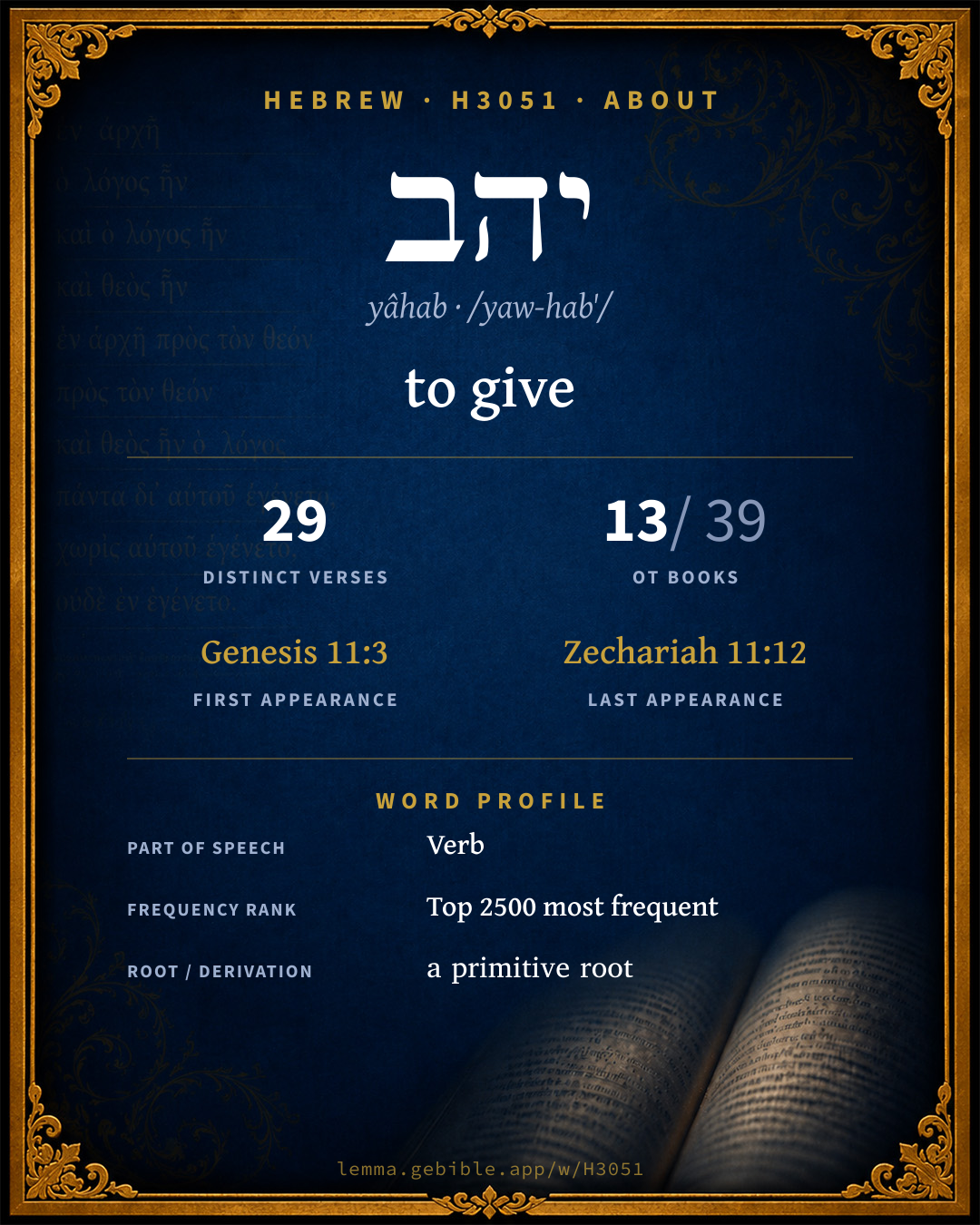
יָהַב
to give
also: provide, ascribe, come fuller range ↓
Full lexicon entry — Brown-Driver-Briggs (BDB)
From Brown-Driver-Briggs (BDB)
Where this word appears
Grammar key — what these labels mean
Part of speech
- Verb
- An action or state-of-being word.
Stem
- Qal
- The basic, simple active stem — the plain form of the verb (“he wrote”).
Form
- Imperative
- A direct command (“write!”).
Person
- 2nd Person
- The one addressed (“you”).
Gender
- Masculine
- Grammatically masculine.
- Feminine
- Grammatically feminine.
Number
- Plural
- More than one (in Hebrew, generally three or more).
- Singular
- One.
Grammatical forms
- Verb, Qal, Imperative, 2nd Person, Masculine, Plural 18 times (55%)
- Verb, Qal, Imperative, 2nd Person, Masculine, Singular 14 times (42%)
- Verb, Qal, Imperative, 2nd Person, Feminine, Singular 1 time (3%)
Parsed forms decoded from the imported morphology (morphhb / Westminster Leningrad Codex — WLC text public domain, morphhb tagging CC BY 4.0), counted across 33 parsed occurrences — not distinct verses.
Every verse where H3051 appears — 29 distinct verses across 13 books. Click any verse to open its interlinear word-by-word view. Verse text shown in the World English Bible for context — . Each verse’s Hebrew form is shown with its reference; the English is not keyword-highlighted, since the data carries no word-level English alignment. Use “Compare translations” on any verse to read it across multiple English versions. This concordance covers the Hebrew Bible; Septuagint (Greek Old Testament) occurrences are not indexed here.
Genesis 8 verses
- Genesis 11:3 הָ֚בָ/ה Qal impv 2ms + sfx h They said one to another, "Come, let's make brick, and burn them thoroughly." They had brick for stone, and they used tar for mortar.
- Genesis 11:4 הָ֣בָ/ה Qal impv 2ms + sfx h They said, "Come, let's build us a city, and a tower, whose top reaches to the sky, and let's make us a name; lest we be scattered abroad on the surface of the whole earth."
- Genesis 11:7 הָ֚בָ/ה Qal impv 2ms + sfx h Come, let's go down, and there confuse their language, that they may not understand one another's speech."
- Genesis 29:21 הָבָ֣/ה Qal impv 2ms + sfx h Jacob said to Laban, "Give me my wife, for my days are fulfilled, that I may go in to her."
- Genesis 30:1 הָֽבָ/ה Qal impv 2ms + sfx h When Rachel saw that she bore Jacob no children, Rachel envied her sister. She said to Jacob, "Give me children, or else I will die."
- Genesis 38:16 הָֽבָ/ה Qal impv 2ms + sfx h He turned to her by the way, and said, "Please come, let me come in to you:" for he didn't know that she was his daughter-in-law. She said, "What will you give me, that you may come in to me?"
- Genesis 47:15 הָֽבָ/ה Qal impv 2ms + sfx h When the money was all spent in the land of Egypt, and in the land of Canaan, all the Egyptians came to Joseph, and said, "Give us bread, for why should we die in your presence? For our money fails."
- Genesis 47:16 הָב֣וּ Qal impv 2mp Joseph said, "Give your cattle; and I will give you food for your cattle, if money fails."
Exodus 1 verse
Deuteronomy 2 verses
Joshua 1 verse
Judges 2 verses
- Judges 1:15 הָֽבָ/ה Qal impv 2ms + sfx h She said to him, Give me a blessing; for that you have set me in the land of the South, give me also springs of water. Caleb gave her the upper springs and the lower springs.
- Judges 20:7 הָב֥וּ Qal impv 2mp Behold, you children of Israel, all of you, give here your advice and counsel.
Ruth 1 verse
1 Samuel 1 verse
2 Samuel 2 verses
1 Chronicles 2 verses
Job 1 verse
Psalms 6 verses
- Psalms 29:1 הָב֣וּ הָב֥וּ Qal impv 2mp Qal impv 2mp Ascribe to Yahweh, you sons of the mighty, Ascribe to Yahweh glory and strength.
- Psalms 29:2 הָב֣וּ Qal impv 2mp Ascribe to Yahweh the glory due to his name. Worship Yahweh in holy array.
- Psalms 60:11 הָֽבָ/ה Qal impv 2ms + sfx h Give us help against the adversary, For the help of man is vain.
- Psalms 96:7 הָב֣וּ הָב֥וּ Qal impv 2mp Qal impv 2mp Ascribe to Yahweh, you families of nations, Ascribe to Yahweh glory and strength.
- Psalms 96:8 הָב֣וּ Qal impv 2mp Ascribe to Yahweh the glory due to his name. Bring an offering, and come into his courts.
- Psalms 108:12 הָֽבָ/ה Qal impv 2ms + sfx h Give us help against the enemy, For the help of man is vain.
Proverbs 1 verse
Zechariah 1 verse
About this entry
At a glance — auto-summarized from this page’s data, not written by a person. Every figure links to its source below. This summary describes the numbers; it doesn’t interpret them.
יהב — transliterated yâhab — is a Hebrew verb carrying the sense “to give.” Where the King James Version says “give,” newer translations reach for “ascribe” (Berean Standard Bible); the renderings breakdown has the detail. The Hebrew Bible uses it across 29 verses — moderately common. More than a quarter of its appearances fall in Genesis. BDB distinguishes 6 senses; alongside “to give” it spans “provide”, “ascribe”, and “come”. Each statement above links to its evidence; the full detail follows below.
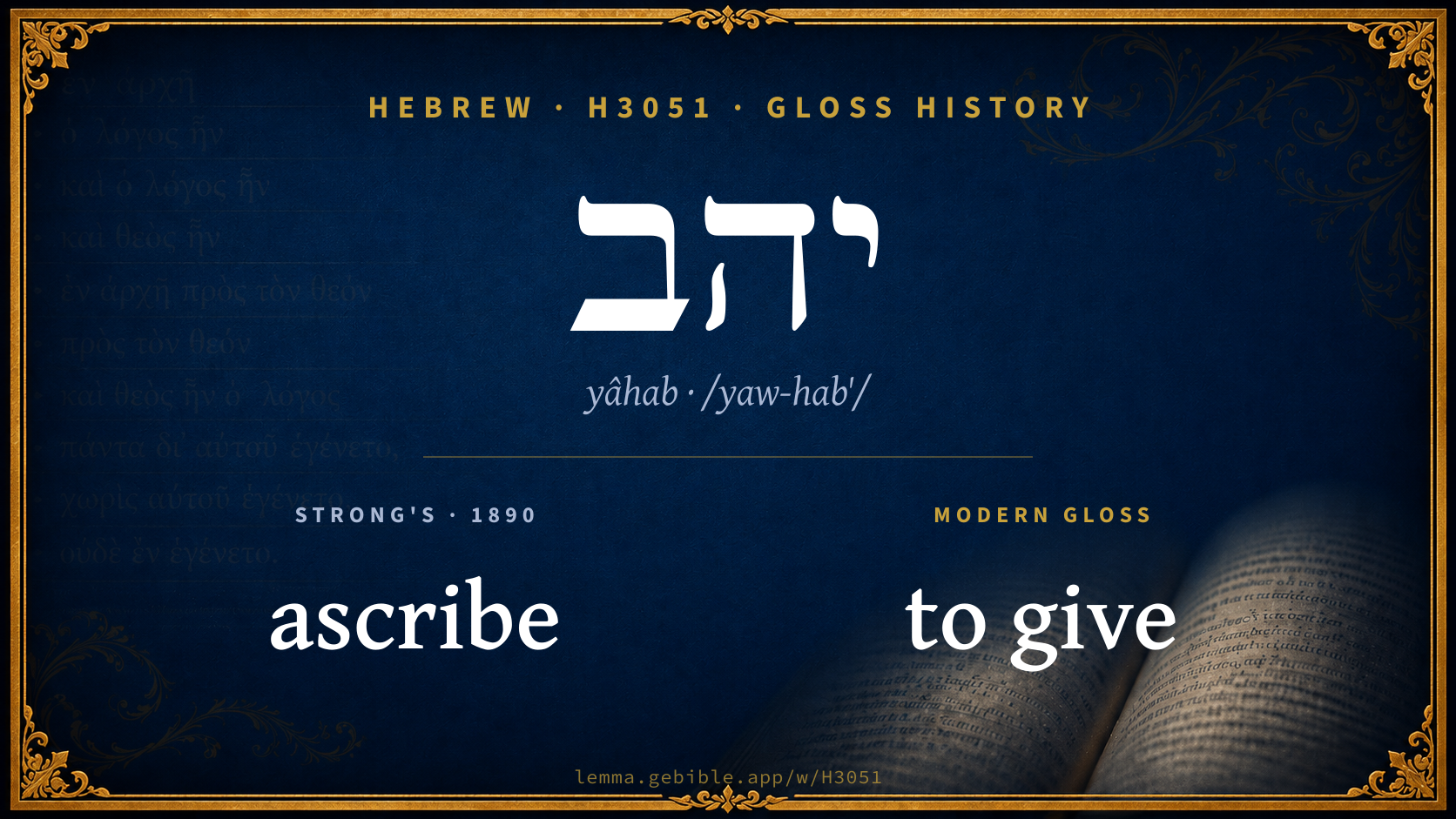
Gloss history
Strong's 1890 vs modern scholarship
About this word
Strong's H3051 catalogs a Hebrew word from the Hebrew Old Testament.
These counts are not copied from any lexicon or concordance. They are computed here, from the morphology-tagged Hebrew Old Testament. What Lemma adds →
- 29
- distinct verses
- The word appears in 29 distinct verses.
- 13 / 39
- OT books
- The word appears in 13 of 39 Old Testament books.
- #1,064
- by frequency
- Top 2500 most frequent Hebrew words (rank 1,064 of 8,640 Hebrew words by occurrence).
View all 29 occurrences in the concordance →
Most concentrated in
- Genesis 8 verses 28%
- Psalms 6 verses 21%
- Deuteronomy 2 verses 7%
By section of the Old Testament
By traditional corpus
Conventional, traditional groupings — biblical authorship is debated, so this is a traditional corpus grouping, not an authorship claim. Each share is this word’s portion of its verses in that division of the Hebrew canon. Each figure is a share of the word’s 29 distinct verses.
- Torah (Pentateuch) 11 verses · 38%
- Writings (Ketuvim) 11 verses · 38%
- Prophets (Nevi'im) 7 verses · 24%
How translations render this word
Counts come from each version’s own published word-to-Strong’s tagging or interlinear alignment — an approximate guide to how each version renders this word, not a word-level alignment the data otherwise carries. Because each total is that version’s own tagged count, the per-version totals vary from one another and need not match the appearance or distinct-verse counts above. These counts may also differ from a printed concordance because Lemma counts each distinctly tagged rendering and does not collapse phrase taggings into a single head-word total. This is a fixed set of word-tagged versions (KJV, ASV, BSB, ULT) and does not change with the reading translation you choose elsewhere. Each version’s license is shown beside its name below (and on Sources).
- King James Version: Give 22×, Go to 4×, Bring 2×
- American Standard Version: Ascribe 10×, Give 9×, Come 5×
- Berean Standard Bible: Ascribe 10×, Give 8×, Come 5×
- unfoldingWord Literal Text: Give 12×, Ascribe 7×, Come 5×
King James Version Public Domain
Renders H3051 across 34 tagged occurrences — most commonly:
Plus 6 renderings that appear only once — usually multi-word phrases or single function words the recovered tagging swept in, not distinct renderings.
American Standard Version Public Domain
Renders H3051 across 36 tagged occurrences — most commonly:
Plus 12 renderings that appear only once — usually multi-word phrases or single function words the recovered tagging swept in, not distinct renderings.
Berean Standard Bible Public Domain
Renders H3051 across 33 tagged occurrences — most commonly:
Plus 8 renderings that appear only once — usually multi-word phrases or single function words the recovered tagging swept in, not distinct renderings.
unfoldingWord Literal Text CC BY-SA 4.0
Renders H3051 across 34 tagged occurrences — most commonly:
Plus 6 renderings that appear only once — usually multi-word phrases or single function words the recovered tagging swept in, not distinct renderings.
Senses in BDB
The 6 senses BDB distinguishes for this word, in lexicon order (not ranked by frequency or importance). The full entry — with sub-senses — is in the Lexicon Entry tab.
- to give, provide, ascribe, come
(Qal)
- to give
- to set, place
- to provide (with reflexive)
- to ascribe (glory)
- to grant, permit, come now
Word origin
Origin: a primitive root
Jastrow Dictionary
A second Hebrew/Aramaic lexicon for comparison, covering Aramaic and post-biblical (Talmudic, Targumic, Midrashic) usage that the biblical-Hebrew BDB does not. Matched by lemma rather than by Strong’s number, so a lemma may carry more than one Jastrow headword (shown separately below), and the entries cover usage well beyond the Bible.
יְהַב
- to give. Targ. Gen. III, 12. Targ. Job III, 19 יֵיהַב Ms. (ed. יָהִיב, ed. Wil. יְהִיב); a. fr.—Part. pass. יְהִיב. Targ. Num. III, 9; a. fr.—Imperative הַב. Targ. Gen. XXX, 26; a. fr.—Y. Ber. VIII, 11ᵇ bot., a. fr. י׳ ליה מילא gave him assurance of safety. Ib. יהב את פלגא (read as:) Y. Naz. V, end, 54ᵇ הב וכ׳ give thou half of it. Ib. [read:] אמר דיֵיבִין ליה יַהֲבוּ ליה ואכל he ordered that they give him (to eat); they gave him, and he ate. Kidd. 9ᵃ אי יהבינא לך וכ׳ (read: יַהֲבִינָהּ) if I give it to thee, wilt thou be betrothed unto me? Said she הָבָהּ מֵיהֲבָהּ give it; כל הבה מיהבה וכ׳ all such phrases as ‘give it’, mean nothing (do not mean assent to the proposal); a. v. fr.—נסב וי׳ (h. = נשא ונתן) to deal. Cant. R. to III, 6. Y. Shebi. VII, 37ᶜ top; a. e.—Lev. R. s. 19, v. infra.—2) to put, place. Targ. Ex. XVI, 33; a. fr.—Y. Keth. XII, 35ᵃ bot. אין אנן יַהֲבִין ליה נֵיהֲבֵיה וכ׳ if we put him (his coffin) anywhere, we must put him with R. &c.; a. fr.
- to be given. Targ. Is. IX, 5. Targ. Ex. V, 16; a. fr.—Kidd. 7ᵃ משום דא׳ למחילה because it (money or money’s worth) may be given away without consideration; v. נָתַן.—[Lev. R. s. 19 … תתיהב דיהבת וכ׳, read: תִּתְיַתַּב … דיַתְּבַת, v. יְתֵב I.]
A Dictionary of the Targumim, the Talmud Babli and Yerushalmi, and the Midrashic Literature (Marcus Jastrow; London, Luzac, 1903) — Public Domain. Digitized via Sefaria. Digitized via Sefaria. Full attribution on Sources.
Forms in the corpus
The 12 distinct written forms H3051 takes in the Hebrew Bible, most frequent first — each parse links to that stem’s occurrences in the concordance. Hebrew forms include their vowel points and cantillation, so a single lemma takes many written forms.
| Form | Parsing | Example | Uses |
|---|---|---|---|
| הָב֥וּ | Verb, Qal, Imperative, 2nd Person, Masculine, Plural | Deuteronomy 32:3 | 9 |
| הָב֣וּ | Verb, Qal, Imperative, 2nd Person, Masculine, Plural | Deuteronomy 1:13 | 7 |
| הָֽבָ/ה | Verb, Qal, Imperative, 2nd Person, Masculine, Singular | Genesis 30:1 | 6 |
| הָ֚בָ/ה | Verb, Qal, Imperative, 2nd Person, Masculine, Singular | Genesis 11:3 | 2 |
| הָ֣בָ/ה | Verb, Qal, Imperative, 2nd Person, Masculine, Singular | Genesis 11:4 | 2 |
| הַ֤ב | Verb, Qal, Imperative, 2nd Person, Masculine, Singular | Proverbs 30:15 | 1 |
| הַ֥ב | Verb, Qal, Imperative, 2nd Person, Masculine, Singular | Proverbs 30:15 | 1 |
| הָ֠בִי | Verb, Qal, Imperative, 2nd Person, Feminine, Singular | Ruth 3:15 | 1 |
| הָ֣בוּ | Verb, Qal, Imperative, 2nd Person, Masculine, Plural | Job 6:22 | 1 |
| הָ֥בָ/ה | Verb, Qal, Imperative, 2nd Person, Masculine, Singular | Exodus 1:10 | 1 |
| הָב֤וּ | Verb, Qal, Imperative, 2nd Person, Masculine, Plural | 1 Chronicles 16:28 | 1 |
| הָבָ֣/ה | Verb, Qal, Imperative, 2nd Person, Masculine, Singular | Genesis 29:21 | 1 |
Same root — word family
Other BDB entries built from the same root as H3051, grouped by Strong’s listed origin. These share a root / origin per the lexicon — not necessarily a shared meaning. Each links to that word’s own entry.
Derived from this word
Compare all same-root words → They share a root, not necessarily a meaning.
Septuagint verse parallels
This word appears in 28 verses that also exist in the Greek Old Testament (Septuagint), out of the 29 Hebrew verses it occurs in. You can read those verses in Greek by switching the Old Testament edition to the Septuagint.
Read these verses in the Septuagint
- Genesis 11:3
- Exodus 1:10
- Deuteronomy 1:13
- Joshua 18:4
- Judges 1:15
- Ruth 3:15
- 1 Samuel 14:41
- 2 Samuel 11:15
- 1 Chronicles 16:28
- Job 6:22
- Psalms 29:1
- Proverbs 30:15
This is a verse-level parallel only — the same verses exist in both the Hebrew and Greek Old Testaments. No word-level Hebrew↔Greek correspondence is claimed: the data carries no such alignment, so no Greek word is shown as this Hebrew word’s translation. Coverage is not total — the Septuagint omits the deuterocanon and renumbers the Psalms, so some Hebrew verses have no direct Greek parallel.