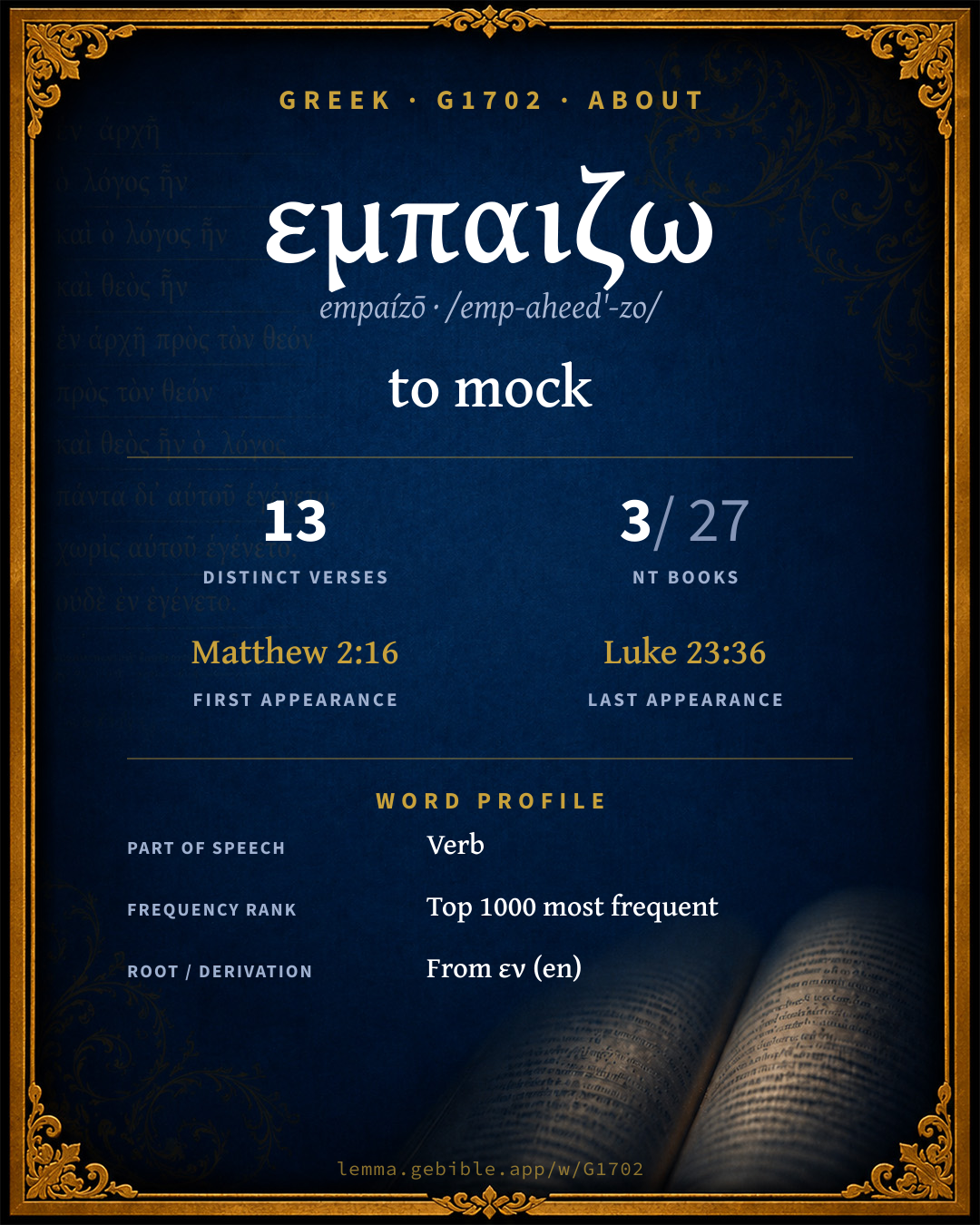
ἐμπαίζω
to mock
Full lexicon entry — Thayer's Greek Lexicon
From Thayer's Greek Lexicon
Where this word appears
See every Aorist-tense verb in the Greek New Testament →
Grammar key — what these labels mean
Part of speech
- Verb
- An action or state-of-being word.
Tense
- Aorist
- Action viewed as a simple whole, without regard to duration — often past (perfective aspect).
- Present
- Ongoing or general action in present time (imperfective aspect).
- Future
- Action expected in future time.
- Imperfect
- Continuous or repeated action in past time (“was writing”).
Voice
- Active
- The subject performs the action.
- Passive
- The subject receives the action.
Mood
- Indicative
- States a fact or asks a factual question (the mood of reality).
- Participle
- A verbal adjective (“writing,” “having written”).
- Infinitive
- A verbal noun (“to write”), unmarked for person or number.
Case
- Nominative
- The case of the subject (and the predicate nominative).
Person
- 3rd person
- The one spoken about (“he / she / it / they”).
Gender
- Masculine
- Grammatically masculine.
Number
- Plural
- More than one.
- Singular
- One.
Grammatical forms 9 distinct
- Verb, Aorist, Active, Indicative, 3rd person, Plural 4 times (31%)
- Verb, Present, Active, Participle, Nominative, Plural, Masculine 2 times (15%)
- Verb, Aorist, Active, Infinitive 1 time (8%)
- Verb, Aorist, Active, Participle, Nominative, Singular, Masculine 1 time (8%)
- Verb, Aorist, Passive, Indicative, 3rd person, Singular 1 time (8%)
- Verb, Future, Active, Indicative, 3rd person, Plural 1 time (8%)
- Verb, Future, Passive, Indicative, 3rd person, Singular 1 time (8%)
- Verb, Imperfect, Active, Indicative, 3rd person, Plural 1 time (8%)
+1 more form (1 occurrence)
Parsed forms decoded from the imported morphology (Robinson–Tischendorf, public domain), counted across 13 parsed occurrences — not distinct verses.
Every verse where G1702 appears — 13 distinct verses across 3 books. Click any verse to open its interlinear word-by-word view. Verse text shown in the World English Bible for context — . Each verse’s Greek form is shown with its reference; the English is not keyword-highlighted, since the data carries no word-level English alignment. Use “Compare translations” on any verse to read it across multiple English versions. This concordance covers the Greek New Testament; Septuagint (Greek Old Testament) occurrences of this word are not indexed here.
Matthew 5 verses
- Matthew 2:16 ἐνεπαίχθη aor pass ind 3sg Then Herod, when he saw that he was mocked by the wise men, was exceedingly angry, and sent out, and killed all the male children who were in Bethlehem and in all the surrounding countryside, from two years old and under, according to the exact time which he had learned from the wise men.
- Matthew 20:19 ἐμπαῖξαι aor act inf and will hand him over to the Gentiles to mock, to scourge, and to crucify; and the third day he will be raised up."
- Matthew 27:29 ἐνέπαιξαν aor act ind 3pl They braided a crown of thorns and put it on his head, and a reed in his right hand; and they kneeled down before him, and mocked him, saying, "Hail, King of the Jews!"
- Matthew 27:31 ἐνέπαιξαν aor act ind 3pl When they had mocked him, they took the robe off of him, and put his clothes on him, and led him away to crucify him.
- Matthew 27:41 ἐμπαίζοντες pres act ptcp nom pl masc Likewise the chief priests also mocking, with the scribes, the Pharisees, and the elders, said,
Mark 3 verses
- Mark 10:34 ἐμπαίξουσιν fut act ind 3pl They will mock him, spit on him, scourge him, and kill him. On the third day he will rise again."
- Mark 15:20 ἐνέπαιξαν aor act ind 3pl When they had mocked him, they took the purple off of him, and put his own garments on him. They led him out to crucify him.
- Mark 15:31 ἐμπαίζοντες pres act ptcp nom pl masc Likewise, also the chief priests mocking among themselves with the scribes said, "He saved others. He can't save himself.
Luke 5 verses
- Luke 14:29 ἐμπαίζειν pres act inf Or perhaps, when he has laid a foundation, and is not able to finish, everyone who sees begins to mock him,
- Luke 18:32 ἐμπαιχθήσεται fut pass ind 3sg For he will be delivered up to the Gentiles, will be mocked, treated shamefully, and spit on.
- Luke 22:63 ἐνέπαιζον impf act ind 3pl The men who held Jesus mocked him and beat him.
- Luke 23:11 ἐμπαίξας aor act ptcp nom sg masc Herod with his soldiers humiliated him and mocked him. Dressing him in luxurious clothing, they sent him back to Pilate.
- Luke 23:36 ἐνέπαιξαν aor act ind 3pl The soldiers also mocked him, coming to him and offering him vinegar,
About this entry
At a glance — auto-summarized from this page’s data, not written by a person. Every figure links to its source below. This summary describes the numbers; it doesn’t interpret them.
At its core, εμπαιζω (empaízō) means “to mock.” Scripture first uses it in Matthew 2:16. It appears 13 verses across 3 books of the Greek New Testament, among its uncommon vocabulary. The word gravitates to Matthew (38%), then Luke and Mark. It clusters with εν, εγγραφω and εγγυος under a shared root. Each statement above links to its evidence; the full detail follows below.
Gloss history
Strong's 1890 vs modern scholarship
About this word
Strong's G1702 catalogs a Greek word from the Greek New Testament.
These counts are not copied from any lexicon or concordance. They are computed here, from the morphology-tagged Greek New Testament. What Lemma adds →
- 13
- distinct verses
- The word appears in 13 distinct verses.
- 3 / 27
- NT books
- The word appears in 3 of 27 New Testament books.
- #863
- by frequency
- Top 1000 most frequent Greek words (rank 863 of 5,347 Greek words by occurrence).
View all 13 occurrences in the concordance →
By section of the New Testament
By traditional corpus
Conventional, traditional groupings — biblical authorship is debated, so this is a traditional corpus grouping, not an authorship claim. Some books belong to more than one corpus (Luke is in both the Gospels and the Lukan corpus, and so on), so these shares overlap and need not total 100%. Each figure is a share of the word’s 13 distinct verses.
- Gospels 13 verses · 100%
- Lukan (Luke–Acts) 5 verses · 38%
How translations render this word
Counts come from each version’s own published word-to-Strong’s tagging or interlinear alignment — an approximate guide to how each version renders this word, not a word-level alignment the data otherwise carries. Because each total is that version’s own tagged count, the per-version totals vary from one another and need not match the appearance or distinct-verse counts above. These counts may also differ from a printed concordance because Lemma counts each distinctly tagged rendering and does not collapse phrase taggings into a single head-word total. This is a fixed set of word-tagged versions (KJV, ASV, BSB, ULT) and does not change with the reading translation you choose elsewhere. Each version’s license is shown beside its name below (and on Sources).
- King James Version: Mocked 4×, Mock 2×, Mocking 2×
- American Standard Version: Mocked 5×, Mock 2×, Mocking 2×
- Berean Standard Bible: Mocked 4×, They had mocked 2×
- unfoldingWord Literal Text: Him 3×, Mock 2×, Mocked 2×
King James Version Public Domain
Renders G1702 across 13 tagged occurrences — most commonly:
Plus 3 renderings that appear only once — usually multi-word phrases or single function words the recovered tagging swept in, not distinct renderings.
American Standard Version Public Domain
Renders G1702 across 13 tagged occurrences — most commonly:
Plus 2 renderings that appear only once — usually multi-word phrases or single function words the recovered tagging swept in, not distinct renderings.
Berean Standard Bible Public Domain
Renders G1702 across 13 tagged occurrences — most commonly:
Plus 7 renderings that appear only once — usually multi-word phrases or single function words the recovered tagging swept in, not distinct renderings.
unfoldingWord Literal Text CC BY-SA 4.0
Renders G1702 across 16 tagged occurrences — most commonly:
Plus 5 renderings that appear only once — usually multi-word phrases or single function words the recovered tagging swept in, not distinct renderings.
Senses in Thayer's
The 1 sense Thayer's distinguishes for this word, in lexicon order (not ranked by frequency or importance). The full entry — with sub-senses — is in the Lexicon Entry tab.
- to play with, trifle with
Word origin
Derived from εν (en) (G1722).
Forms in the corpus
The 9 distinct written forms G1702 takes in the Greek New Testament, most frequent first — each parse links to that tense’s occurrences in the concordance.
| Form | Parsing | Example | Uses |
|---|---|---|---|
| ἐνέπαιξαν enépaixan | Verb, Aorist, Active, Indicative, 3rd person, Plural | Matthew 27:29 | 4 |
| ἐμπαίζοντες empaízontes | Verb, Present, Active, Participle, Nominative, Plural, Masculine | Matthew 27:41 | 2 |
| ἐμπαίζειν empaízein | Verb, Present, Active, Infinitive | Luke 14:29 | 1 |
| ἐμπαίξας empaíxas | Verb, Aorist, Active, Participle, Nominative, Singular, Masculine | Luke 23:11 | 1 |
| ἐμπαίξουσιν empaíxousin | Verb, Future, Active, Indicative, 3rd person, Plural | Mark 10:34 | 1 |
| ἐμπαιχθήσεται empaichthḗsetai | Verb, Future, Passive, Indicative, 3rd person, Singular | Luke 18:32 | 1 |
| ἐμπαῖξαι empaîxai | Verb, Aorist, Active, Infinitive | Matthew 20:19 | 1 |
| ἐνέπαιζον enépaizon | Verb, Imperfect, Active, Indicative, 3rd person, Plural | Luke 22:63 | 1 |
| ἐνεπαίχθη enepaíchthē | Verb, Aorist, Passive, Indicative, 3rd person, Singular | Matthew 2:16 | 1 |
Same root — word family
Other Thayer's entries built from the same root as G1702, grouped by Strong’s listed origin. These share a root / origin per the lexicon — not necessarily a shared meaning. Each links to that word’s own entry.
Derives from
Shares the same root
- εγγραφω engráphō G1449 to inscribe
- εγγυος éngyos G1450 surety
- εγκαθετος enkáthetos G1455 to spy
- εγκαινια enkaínia G1456 dedication
- εγκαλεω enkaléō G1458 to accuse
- εγκαταλειπω enkataleípō G1459 to abandon
- εγκατοικεω enkatoikéō G1460 to dwell
- εγκεντριζω enkentrízō G1461 to graft
- εγκομβοομαι enkombóomai G1463 band
- εγκοπτω enkóptō G1465 to hinder
- εγκρατης enkratḗs G1468 strong
- εγκρινω enkrínō G1469 to judge worthy
- εγκρυπτω enkrýptō G1470 to conceal
- εγκυος énkyos G1471 pregnant
- εγχριω enchríō G1472 to anoint
- ελλογεω ellogéō G1677 impute
- εμβαινω embaínō G1684 to enter
- εμβαλλω embállō G1685 to cast in
- εμβαπτω embáptō G1686 to dip in
- εμβατευω embateúō G1687 to enter
- εμβιβαζω embibázō G1688 to lead in
- εμβλεπω emblépō G1689 to look at
- εμβριμαομαι embrimáomai G1690 to warn sternly
- εμμαινομαι emmaínomai G1693 to rage against
+58 more words share this root (not shown).
Derived from this word
Compare all same-root words → Showing 4 of 86 — not the complete family. They share a root, not necessarily a meaning.
Septuagint usage
The same Greek word εμπαιζω appears 19 times in the Greek Old Testament (Septuagint), across 18 verses in 15 books.
- 19
- LXX occurrences
- Tagged occurrences of this Greek word in the Septuagint.
- 18
- verses
- Distinct Septuagint verses containing this word.
- 15 / 39
- OT books
- The word appears in 15 of the 39 Old Testament books.
Sample Septuagint occurrences
- Genesis 39:14 ἐνπαίζω
- Exodus 10:2 ἐνπαίζω
- Numbers 22:29 ἐνπαίζω
- Judges 19:25 ἐνπαίζω
- 1 Samuel 6:6 ἐνπαίζω
- 1 Chronicles 10:4 ἐνπαίζω
- 2 Chronicles 36:16 ἐνπαίζω
- Psalms 103:26 ἐνπαίζω
- Proverbs 23:35 ἐνπαίζω
- Isaiah 33:4 ἐνπαίζω
- Jeremiah 10:15 ἐνπαίζω
- Ezekiel 22:5 ἐνπαίζω
Septuagint occurrences (same lexeme)
Every verse where the same Strong’s number (G1702) appears in the Greek Septuagint. Verse text shown in the World English Bible for context; the Greek form is the matched word — the English is not keyword-highlighted.
- Genesis 39:14 ἐνπαίζω that she called to the men of her house, and spoke to them, saying, "Behold, he has brought in a Hebrew to us to mock us. He came in to me to lie with me, and I cried with a loud voice.
- Genesis 39:17 ἐνπαίζω She spoke to him according to these words, saying, "The Hebrew servant, whom you have brought to us, came in to me to mock me,
- Exodus 10:2 ἐνπαίζω and that you may tell in the hearing of your son, and of your son's son, what things I have done to Egypt, and my signs which I have done among them; that you may know that I am Yahweh."
- Numbers 22:29 ἐνπαίζω Balaam said to the donkey, Because you have mocked me, I would there were a sword in my hand, for now I had killed you.
- Judges 19:25 ἐνπαίζω But the men wouldn't listen to him: so the man laid hold on his concubine, and brought her forth to them; and they knew her, and abused her all the night until the morning: and when the day began to spring, they let her go.
- 1 Samuel 6:6 ἐνπαίζω Why then do you harden your hearts, as the Egyptians and Pharaoh hardened their hearts? When he had worked wonderfully among them, didn't they let the people go, and they departed?
- 1 Samuel 31:4 ἐνπαίζω Then said Saul to his armor bearer, Draw your sword, and thrust me through therewith, lest these uncircumcised come and thrust me through, and abuse me. But his armor bearer would not; for he was sore afraid. Therefore Saul took his sword, and fell on it.
- 1 Chronicles 10:4 ἐνπαίζω Then said Saul to his armor-bearer, Draw your sword, and thrust me through therewith, lest these uncircumcised come and abuse me. But his armor-bearer would not; for he was sore afraid. Therefore Saul took his sword, and fell on it.
- 2 Chronicles 36:16 ἐνπαίζω but they mocked the messengers of God, and despised his words, and scoffed at his prophets, until the wrath of Yahweh arose against his people, until there was no remedy.
- Psalms 103:26 ἐνπαίζω
- Proverbs 23:35 ἐνπαίζω "They hit me, and I was not hurt; They beat me, and I don't feel it! When will I wake up? I can do it again. I can find another."
- Proverbs 27:7 ἐνπαίζω A full soul loathes a honeycomb; But to a hungry soul, every bitter thing is sweet.
- Isaiah 33:4 ἐνπαίζω Your spoil shall be gathered as the caterpillar gathers: as locusts leap shall men leap on it.
- Jeremiah 10:15 ἐνπαίζω They are vanity, a work of delusion: in the time of their visitation they shall perish.
- Ezekiel 22:5 ἐνπαίζω Those who are near, and those who are far from you, shall mock you, you infamous one [and] full of tumult.
- Nahum 2:4 ἐνπαίζω The chariots rage in the streets. They rush back and forth in the broad ways. Their appearance is like torches. They run like the lightnings.
- Habakkuk 1:10 ἐνπαίζω Yes, he scoffs at kings, and princes are a derision to him. He laughs at every stronghold, for he builds up an earthen ramp, and takes it.
- Zechariah 12:3 ἐνπαίζω It will happen in that day, that I will make Jerusalem a burdensome stone for all the peoples. All who burden themselves with it will be severely wounded, and all the nations of the earth will be gathered together against it.
These are occurrences of the same Greek lexeme (G1702) in the Septuagint — not a translation of any one Hebrew word. The store carries no word-level Hebrew↔Greek alignment, so no Hebrew original is asserted here. Counts come from the recovered LXX Strong's tagging — high-frequency vocabulary is well covered, while rare or late forms may be untagged — so they reflect tagged occurrences and may slightly undercount.