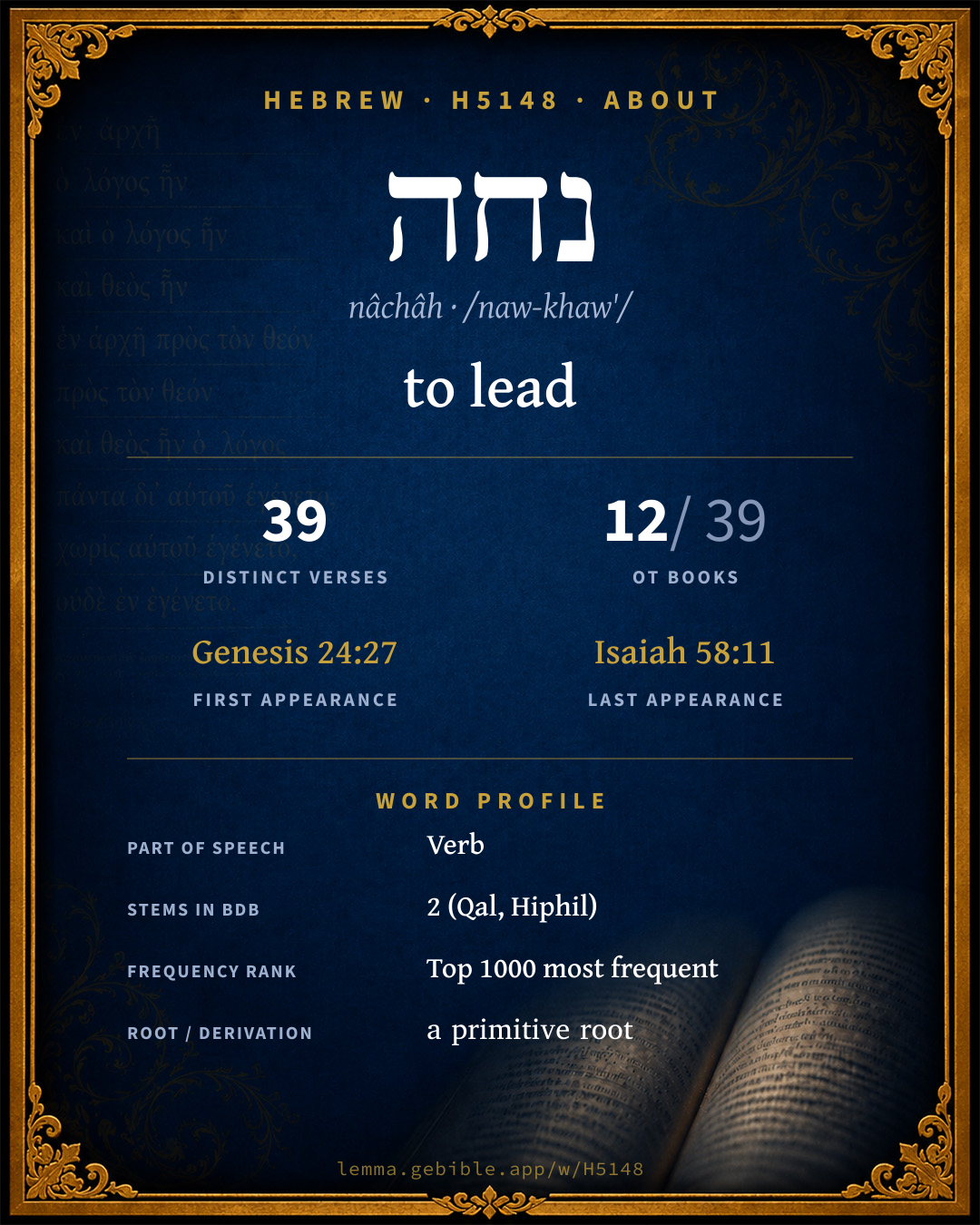
נָחָה
to lead
‘to lead’ is one of 3 main senses fuller range ↓
Full lexicon entry — Brown-Driver-Briggs (BDB)
From Brown-Driver-Briggs (BDB)
Where this word appears
See every Hiphil verb in the Hebrew Bible →
Grammar key — what these labels mean
Part of speech
- Verb
- An action or state-of-being word.
Stem
- Hiphil
- The causative active stem (“he caused / brought about”).
- Qal
- The basic, simple active stem — the plain form of the verb (“he wrote”).
Form
- Sequential Imperfect
- An imperfect with prefixed waw — the standard past-narrative form (waw-consecutive imperfect).
- Imperfect
- An incomplete, ongoing, or future action (“he will / would write”).
- Perfect
- A completed action or state — Hebrew marks aspect (completeness) more than strict tense (“he wrote”).
- Imperative
- A direct command (“write!”).
- Infinitive Construct
- A bound verbal noun, frequently with prepositions (“to write / in writing”).
- Sequential Perfect
- A perfect with prefixed waw continuing a preceding imperfect or command (waw-consecutive perfect).
Person
- 3rd Person
- The one spoken about (“he / she / it / they”).
- 2nd Person
- The one addressed (“you”).
- 1st Person
- The speaker (“I / we”).
Gender
- Masculine
- Grammatically masculine.
- Common
- Either gender — not distinguished for this form.
- Feminine
- Grammatically feminine.
Number
- Singular
- One.
- Plural
- More than one (in Hebrew, generally three or more).
Grammatical forms 13 distinct
- Verb, Hiphil, Sequential Imperfect, 3rd Person, Masculine, Singular 7 times (18%)
- Verb, Hiphil, Imperfect, 2nd Person, Masculine, Singular 6 times (15%)
- Verb, Hiphil, Imperfect, 3rd Person, Masculine, Singular 5 times (13%)
- Verb, Qal, Perfect, 3rd Person, Masculine, Singular 4 times (10%)
- Verb, Qal, Imperative, 2nd Person, Masculine, Singular 4 times (10%)
- Verb, Hiphil, Imperfect, 3rd Person, Feminine, Singular 3 times (8%)
- Verb, Hiphil, Infinitive Construct 2 times (5%)
- Verb, Qal, Perfect, 2nd Person, Masculine, Singular 2 times (5%)
+5 more forms (6 occurrences)
Parsed forms decoded from the imported morphology (morphhb / Westminster Leningrad Codex — WLC text public domain, morphhb tagging CC BY 4.0), counted across 39 parsed occurrences — not distinct verses.
Every verse where H5148 appears — 39 distinct verses across 12 books. Click any verse to open its interlinear word-by-word view. Verse text shown in the World English Bible for context — . Each verse’s Hebrew form is shown with its reference; the English is not keyword-highlighted, since the data carries no word-level English alignment. Use “Compare translations” on any verse to read it across multiple English versions. This concordance covers the Hebrew Bible; Septuagint (Greek Old Testament) occurrences are not indexed here.
Genesis 2 verses
- Genesis 24:27 נָחַ֣/נִי Qal pf 3ms + sfx pers 1cs He said, "Blessed be Yahweh, the God of my master Abraham, who has not forsaken his loving kindness and his truth toward my master. As for me, Yahweh has led me in the way to the house of my master's relatives."
- Genesis 24:48 הִנְחַ֨/נִי֙ Hiphil pf 3ms + sfx pers 1cs I bowed my head, and worshiped Yahweh, and blessed Yahweh, the God of my master Abraham, who had led me in the right way to take my master's brother's daughter for his son.
Exodus 4 verses
- Exodus 13:17 נָחָ֣/ם Qal pf 3ms + sfx pers 3mp It happened, when Pharaoh had let the people go, that God didn't lead them by the way of the land of the Philistines, although that was near; for God said, "Lest perhaps the people change their minds when they see war, and they return to Egypt;"
- Exodus 13:21 לַ/נְחֹתָ֣/ם prep + Hiphil inf.cs + sfx pers 3mp Yahweh went before them by day in a pillar of cloud, to lead them on their way, and by night in a pillar of fire, to give them light, that they might go by day and by night:
- Exodus 15:13 נָחִ֥יתָ Qal pf 2ms "You, in your loving kindness, have led the people that you have redeemed. You have guided them in your strength to your holy habitation.
- Exodus 32:34 נְחֵ֣ה Qal impv 2ms Now go, lead the people to the place of which I have spoken to you. Behold, my angel shall go before you. Nevertheless in the day when I punish, I will punish them for their sin."
Numbers 1 verse
Deuteronomy 1 verse
1 Samuel 1 verse
1 Kings 1 verse
2 Kings 1 verse
Nehemiah 2 verses
- Nehemiah 9:12 הִנְחִיתָ֖/ם Hiphil pf 2ms + sfx pers 3mp Moreover in a pillar of cloud you led them by day; and in a pillar of fire by night, to give them light in the way in which they should go.
- Nehemiah 9:19 לְ/הַנְחֹתָ֣/ם prep + Hiphil inf.cs + sfx pers 3mp yet you in your manifold mercies didn't forsake them in the wilderness: the pillar of cloud didn't depart from over them by day, to lead them in the way; neither the pillar of fire by night, to show them light, and the way in which they should go.
Job 3 verses
- Job 12:23 וַ/יַּנְחֵֽ/ם conj + Hiphil wimpf 3ms + sfx pers 3mp He increases the nations, and he destroys them. He enlarges the nations, and he leads them captive.
- Job 31:18 אַנְחֶֽ/נָּה Hiphil impf 1cs + sfx pers 3fs (No, from my youth he grew up with me as with a father, Her have I guided from my mother's womb);
- Job 38:32 תַנְחֵֽ/ם Hiphil impf 2ms + sfx pers 3mp Can you lead forth the constellations in their season? Or can you guide the Bear with her cubs?
Psalms 18 verses
- Psalms 5:8 נְחֵ֬/נִי Qal impv 2ms + sfx pers 1cs Lead me, Yahweh, in your righteousness because of my enemies. Make your way straight before my face.
- Psalms 23:3 יַֽנְחֵ֥/נִי Hiphil impf 3ms + sfx pers 1cs He restores my soul. He guides me in the paths of righteousness for his name's sake.
- Psalms 27:11 וּ֭/נְחֵ/נִי conj + Qal impv 2ms + sfx pers 1cs Teach me your way, Yahweh. Lead me in a straight path, because of my enemies.
- Psalms 31:3 תַּֽנְחֵ֥/נִי Hiphil impf 2ms + sfx pers 1cs For you are my rock and my fortress, Therefore for your name's sake lead me and guide me.
- Psalms 43:3 יַנְח֑וּ/נִי Hiphil impf 3mp + sfx pers 1cs Oh, send out your light and your truth. Let them lead me. Let them bring me to your holy hill, To your tents.
- Psalms 60:9 נָחַ֣/נִי Qal pf 3ms + sfx pers 1cs Who will bring me into the strong city? Who has led me to Edom?
- Psalms 61:2 תַנְחֵֽ/נִי Hiphil impf 2ms + sfx pers 1cs From the end of the earth, I will call to you, when my heart is overwhelmed. Lead me to the rock that is higher than I.
- Psalms 67:4 תַּנְחֵ֣/ם Hiphil impf 2ms + sfx pers 3mp Oh let the nations be glad and sing for joy, For you will judge the peoples with equity, And govern the nations on earth. Selah.
- Psalms 73:24 תַנְחֵ֑/נִי Hiphil impf 2ms + sfx pers 1cs You will guide me with your counsel, And afterward receive me to glory.
- Psalms 77:20 נָחִ֣יתָ Qal pf 2ms You led your people like a flock, By the hand of Moses and Aaron.
- Psalms 78:14 וַ/יַּנְחֵ֣/ם conj + Hiphil wimpf 3ms + sfx pers 3mp In the daytime he also led them with a cloud, And all night with a light of fire.
- Psalms 78:53 וַ/יַּנְחֵ֣/ם conj + Hiphil wimpf 3ms + sfx pers 3mp He led them safely, so that they weren't afraid, But the sea overwhelmed their enemies.
- Psalms 78:72 יַנְחֵֽ/ם Hiphil impf 3ms + sfx pers 3mp So he was their shepherd according to the integrity of his heart, And guided them by the skillfulness of his hands.
- Psalms 107:30 וַ֝/יַּנְחֵ֗/ם conj + Hiphil wimpf 3ms + sfx pers 3mp Then they are glad because it is calm, So he brings them to their desired haven.
- Psalms 108:10 נָחַ֣/נִי Qal pf 3ms + sfx pers 1cs Who will bring me into the fortified city? Who has led me to Edom?
- Psalms 139:10 תַנְחֵ֑/נִי Hiphil impf 3fs + sfx pers 1cs Even there your hand will lead me, And your right hand will hold me.
- Psalms 139:24 וּ֝/נְחֵ֗/נִי conj + Qal impv 2ms + sfx pers 1cs See if there is any wicked way in me, And lead me in the everlasting way.
- Psalms 143:10 תַּ֝נְחֵ֗/נִי Hiphil impf 2ms + sfx pers 1cs Teach me to do your will, For you are my God. Your Spirit is good. Lead me in the land of uprightness.
Proverbs 3 verses
- Proverbs 6:22 תַּנְחֶ֬ה Hiphil impf 3fs When you walk, it will lead you. When you sleep, it will watch over you. When you awake, it will talk with you.
- Proverbs 11:3 תַּנְחֵ֑/ם Hiphil impf 3fs + sfx pers 3mp The integrity of the upright shall guide them, But the perverseness of the treacherous shall destroy them.
- Proverbs 18:16 יַנְחֶֽ/נּוּ Hiphil impf 3ms + sfx pers 3ms A man's gift makes room for him, And brings him before great men.
Isaiah 2 verses
- Isaiah 57:18 וְ/אַנְחֵ֕/הוּ conj + Hiphil impf 1cs + sfx pers 3ms I have seen his ways, and will heal him: I will lead him also, and restore comforts to him and to his mourners.
- Isaiah 58:11 וְ/נָחֲ/ךָ֣ conj + Qal wpf 3ms + sfx pers 2ms and Yahweh will guide you continually, and satisfy your soul in dry places, and make strong your bones; and you shall be like a watered garden, and like a spring of water, whose waters don't fail.
About this entry
At a glance — auto-summarized from this page’s data, not written by a person. Every figure links to its source below. This summary describes the numbers; it doesn’t interpret them.
At its core, נחה (nâchâh) means “to lead.” The King James Version usually renders it “lead,” while modern versions prefer “lead me” (Berean Standard Bible) — see the renderings breakdown. Spanning 39 verses in 12 books, it ranks among the moderately common words of the Hebrew Bible. Its uses concentrate in Psalms (46% of all occurrences). The verb spans 2 stems, from Qal to Hiphil. Dig into 39-verse concordance and the renderings breakdown below.
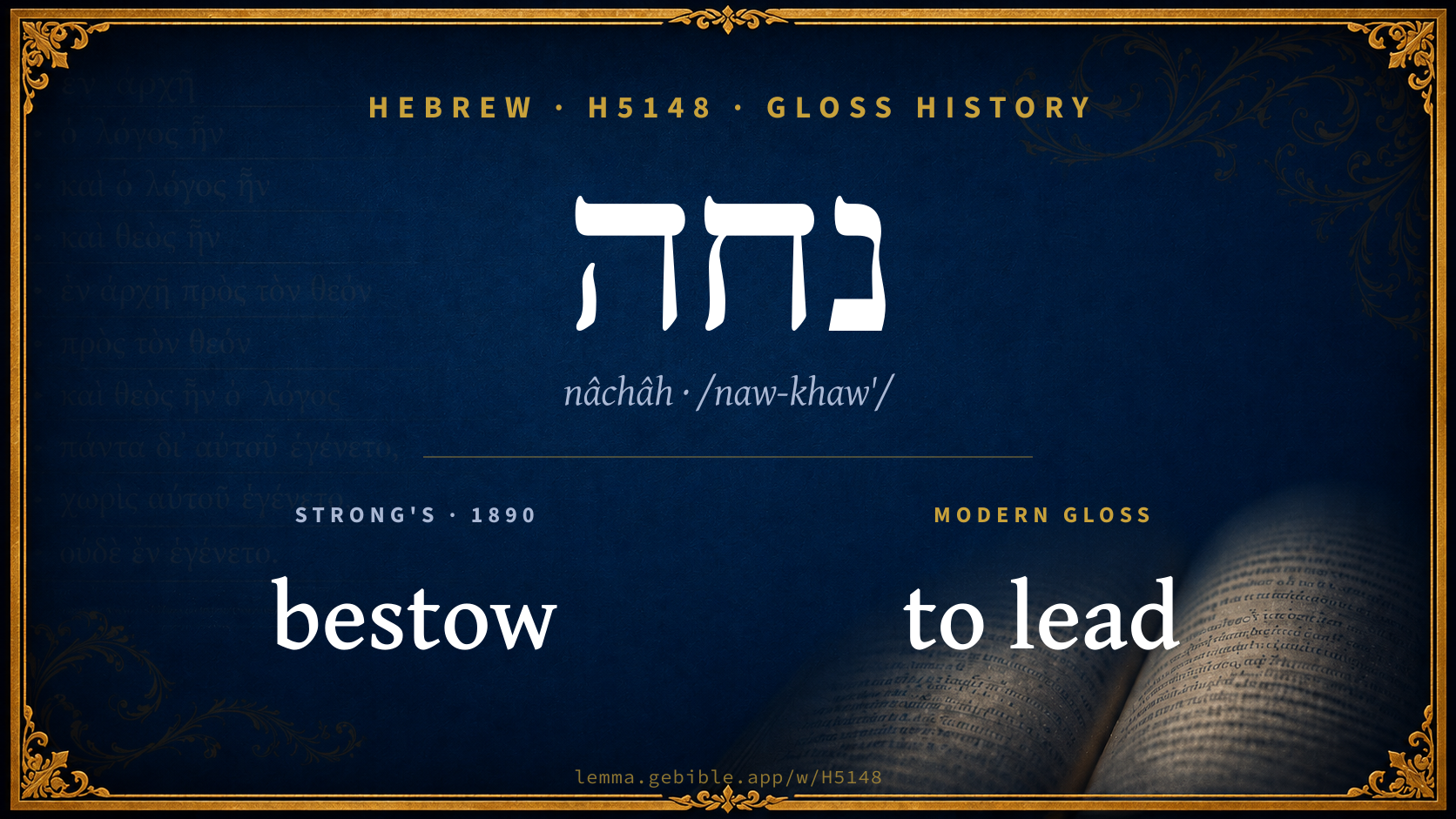
Gloss history
Strong's 1890 vs modern scholarship
About this word
Strong's H5148 catalogs a Hebrew word from the Hebrew Old Testament.
These counts are not copied from any lexicon or concordance. They are computed here, from the morphology-tagged Hebrew Old Testament. What Lemma adds →
- 39
- distinct verses
- The word appears in 39 distinct verses.
- 12 / 39
- OT books
- The word appears in 12 of 39 Old Testament books.
- #922
- by frequency
- Top 1000 most frequent Hebrew words (rank 922 of 8,640 Hebrew words by occurrence).
View all 39 occurrences in the concordance →
By section of the Old Testament
By traditional corpus
Conventional, traditional groupings — biblical authorship is debated, so this is a traditional corpus grouping, not an authorship claim. Each share is this word’s portion of its verses in that division of the Hebrew canon. Each figure is a share of the word’s 39 distinct verses.
- Writings (Ketuvim) 26 verses · 67%
- Torah (Pentateuch) 8 verses · 21%
- Prophets (Nevi'im) 5 verses · 13%
How translations render this word
Counts come from each version’s own published word-to-Strong’s tagging or interlinear alignment — an approximate guide to how each version renders this word, not a word-level alignment the data otherwise carries. Because each total is that version’s own tagged count, the per-version totals vary from one another and need not match the appearance or distinct-verse counts above. These counts may also differ from a printed concordance because Lemma counts each distinctly tagged rendering and does not collapse phrase taggings into a single head-word total. This is a fixed set of word-tagged versions (KJV, ASV, BSB, ULT) and does not change with the reading translation you choose elsewhere. Each version’s license is shown beside its name below (and on Sources).
- King James Version: Lead 9×, He led 2×, Shall guide 2×
- American Standard Version: Lead 8×, Hath led 2×, He led 2×
- Berean Standard Bible: Lead me 7×, He led them 2×, Lead 2×
- unfoldingWord Literal Text: He led them 3×, Lead me 3×, Lead them 3×
King James Version Public Domain
Renders H5148 across 39 tagged occurrences — most commonly:
Plus 24 renderings that appear only once — usually multi-word phrases or single function words the recovered tagging swept in, not distinct renderings.
American Standard Version Public Domain
Renders H5148 across 39 tagged occurrences — most commonly:
Plus 23 renderings that appear only once — usually multi-word phrases or single function words the recovered tagging swept in, not distinct renderings.
Berean Standard Bible Public Domain
Renders H5148 across 39 tagged occurrences — most commonly:
Plus 26 renderings that appear only once — usually multi-word phrases or single function words the recovered tagging swept in, not distinct renderings.
unfoldingWord Literal Text CC BY-SA 4.0
Renders H5148 across 45 tagged occurrences — most commonly:
Plus 25 renderings that appear only once — usually multi-word phrases or single function words the recovered tagging swept in, not distinct renderings.
Senses in the full BDB
Hebrew verbs can shift meaning by stem (binyan): Qal is the basic action, Niphal is often passive or reflexive, Piel often intensifies or makes it factitive, and Hiphil is typically causative. The senses below are grouped under the stem BDB assigns to each.
What do BDB’s symbols mean?
BDB uses these scholarly abbreviations:
| Symbol | Meaning |
|---|---|
| 𝔊 | the Septuagint (the ancient Greek translation, LXX) |
| 𝔙 | the Vulgate (the Latin translation) |
| 𝔖 | the Syriac version (the Peshitta) |
| 𝔗 | the Targum (the Aramaic translation) |
| ψ | the Psalms |
| √ | root (the underlying root or stem) |
| ‖ | parallel passage (a synonymous or contrasted parallel) |
| † | the dagger: every passage where the word occurs is cited |
The 2 senses and sub-senses the full Brown-Driver-Briggs lexicon distinguishes for this word, in lexicon order (not ranked by frequency), with BDB’s own verbatim wording and sub-sense lettering. Shown in Hebrew script with BDB’s own scholarly abbreviations. The condensed entry is in the Lexicon Entry tab. See also the Forms in the corpus table below.
Qal
- Pf. sf. נָחַ֫נִי Gn 24:27 + 2 times; וְנָֽחֲךָ Is 58:11; נָחָם Ex 13:17; 2 ms. נָחִ֫יתָ Ex 15:13 ψ 77:21; Imv. נְחֵה Ex 32:34; sf. נְחֵנִי ψ 5:9 + 2 times;—lead, bring, sq. acc. pers., subj. man Ex 32:34 (sq. אֶל־), cf. ψ 60:11; 108:11 (both sq. עַד־; ‖ הוביל); usually subj. י׳ Gn 24:27 (J; also sq. בַּדֶּרֶךְ + acc. loc.), Ex 13:17 (E; sq. דֶּרֶךְ), 15:13 (song; ‖ נהל), ψ 77:21; fig. of guidance in prosperity and righteousness ψ 5:9 (‖ הושׁר דרך), 27:11 (sq. בְּאֹרַח; ‖ הורה דרך), 139:24 (sq. בדרך עולם); cf. Is 58:11. e.g. Genesis 24:27
Hiphil
- Pf. sf. הִנְחַ֫נִי Gn 24:48; 2 ms. sf. הִנְחִתָם Ne 9:12; Impf. sf. יַנְחֵ֫נִי Nu 23:7 ψ 23:3; יַנְחֶ֫נּוּ Dt 32:12 Pr 18:16; 3 fs. תַּנְחֶה Pr 6:22, etc.; Inf. cstr. sf. לְהַנְחֹתָם Ne 9:19; לַנְחֹתָם Ex 13:21;—lead, guide (= Qal) sq. acc. pers. Nu 23:7 (JE; + מִן).—1 S 22:4 (+ אֶת־פְּנֵי), 1 K 10:26 2 K 18:11 v. sub נוח Hiph. B.—; of guiding = treating kindly (the helpless) Jb 31:18, of guiding constellations 38:32 (‖ הוציא); usually subj. י׳ Gn 24:48 (J; sq. בַּדֶּרֶךְ) Dt 32:12 ψ 78:14, 53, 72 (Isr. as flock; ‖ רעה); Is 57:18 ψ 107:30 (sq. אֶל־); cf. of pillar of cloud Ex 13:21 (J), Ne 9:12, 19; also Jb 12:23, read prob. וַיַּנִּחֵם and leaves them (Je 14:9). ψ 67:5; especially in path of blessing ψ 23:3; 31:4 (‖ נהל), 61:3 (sq. בְּ), 73:24; cf. 43:3; 139:10 (‖ אחז), 143:10 (sq. בְּ); also of instruction, etc., Pr 6:22; 11:3; 18:16 (sq. לִפְנֵי). e.g. Genesis 24:48
Senses from the full Brown-Driver-Briggs lexicon (Brown, Driver, Briggs; Oxford 1906 — public domain), digitized via Sefaria, supplemented by the OpenScriptures HebrewLexicon (CC BY 4.0). Full attribution on Sources.
Word origin
vb. lead, guide (Arabic نَحَا go in direction of, turn (eyes) toward);—
— Brown-Driver-Briggs (Oxford 1906, public domain), digitized via Sefaria, supplemented by the OpenScriptures HebrewLexicon (CC BY 4.0). See Sources.
Origin: a primitive root
Jastrow Dictionary
A second Hebrew/Aramaic lexicon for comparison, covering Aramaic and post-biblical (Talmudic, Targumic, Midrashic) usage that the biblical-Hebrew BDB does not. Matched by lemma rather than by Strong’s number, so a lemma may carry more than one Jastrow headword (shown separately below), and the entries cover usage well beyond the Bible.
נָחָה I
- , v. נחי
*נָחָה II
- (נוּחַ) = הֲנָחָה, rest, relief. Gen. R. s. 10, end כיון שנחו … ניתן להם נ׳ when the hands of their Maker left off from (extending) them, they were given rest (permanency); Yalk. ib. 16 חנייה.
נחי
- to bring to rest, to lead. Ex. R. s. 20 (ref. to Ex. XIII, 17) לא נָחָם ממצרים וכ׳ he did not lead them from Egypt to Palestine by the route of eleven journeys; Tanḥ. B’shall. 1 נחם נהגם naḥam means, he led them; v. נִיחוּם. e.g. Exodus 13:17
A Dictionary of the Targumim, the Talmud Babli and Yerushalmi, and the Midrashic Literature (Marcus Jastrow; London, Luzac, 1903) — Public Domain. Digitized via Sefaria. Digitized via Sefaria. Full attribution on Sources.
Forms in the corpus
The 35 distinct written forms H5148 takes in the Hebrew Bible, most frequent first — each parse links to that stem’s occurrences in the concordance. Hebrew forms include their vowel points and cantillation, so a single lemma takes many written forms.
Septuagint verse parallels
This word appears in 30 verses that also exist in the Greek Old Testament (Septuagint), out of the 39 Hebrew verses it occurs in. You can read those verses in Greek by switching the Old Testament edition to the Septuagint.
Read these verses in the Septuagint
- Genesis 24:27
- Exodus 13:17
- Numbers 23:7
- Deuteronomy 32:12
- 1 Samuel 22:4
- 1 Kings 10:26
- 2 Kings 18:11
- Job 12:23
- Psalms 5:8
- Proverbs 6:22
- Isaiah 57:18
This is a verse-level parallel only — the same verses exist in both the Hebrew and Greek Old Testaments. No word-level Hebrew↔Greek correspondence is claimed: the data carries no such alignment, so no Greek word is shown as this Hebrew word’s translation. Coverage is not total — the Septuagint omits the deuterocanon and renumbers the Psalms, so some Hebrew verses have no direct Greek parallel.