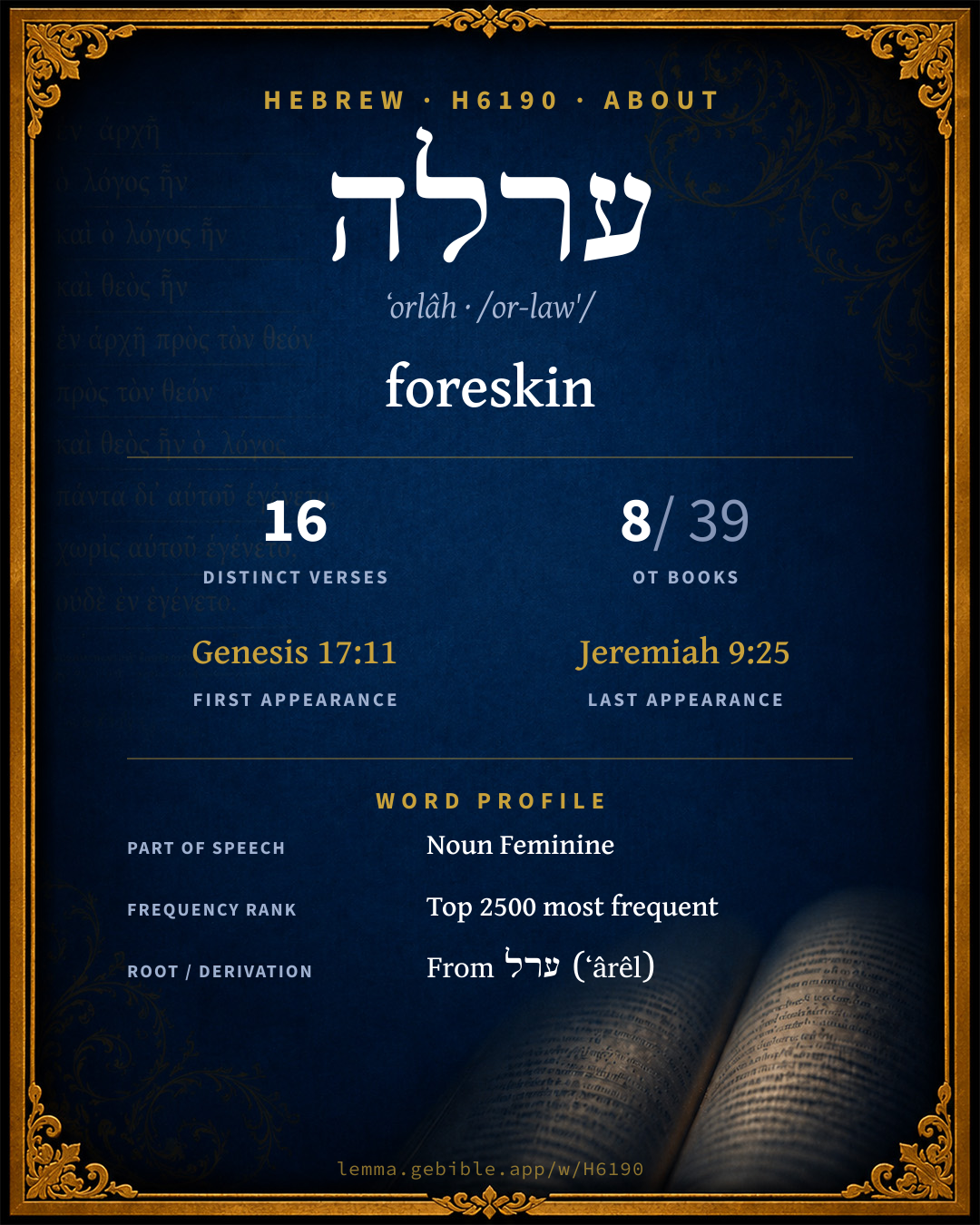
עׇרְלָה
foreskin
Full lexicon entry — Brown-Driver-Briggs (BDB)
From Brown-Driver-Briggs (BDB)
Where this word appears
See every Construct-state word in the Hebrew Bible →
Grammar key — what these labels mean
Part of speech
- Noun
- A naming word — a person, place, thing, or idea.
Noun type
- Common
- A common noun — a general class of person, place, or thing (“king,” “city,” “water”), not a specific name.
State
- Construct
- A noun bound to a following noun in a possessive / “of” relationship (the construct chain).
- Absolute
- The independent form of a noun, not bound to a following word.
Gender
- Feminine
- Grammatically feminine.
Number
- Singular
- One.
- Plural
- More than one (in Hebrew, generally three or more).
Grammatical forms
- Noun, Common, Feminine, Singular, Construct 9 times (56%)
- Noun, Common, Feminine, Plural, Construct 4 times (25%)
- Noun, Common, Feminine, Singular, Absolute 2 times (13%)
- Noun, Common, Feminine, Plural, Absolute 1 time (6%)
Parsed forms decoded from the imported morphology (morphhb / Westminster Leningrad Codex — WLC text public domain, morphhb tagging CC BY 4.0), counted across 16 parsed occurrences — not distinct verses.
Every verse where H6190 appears — 16 distinct verses across 8 books. Click any verse to open its interlinear word-by-word view. Verse text shown in the World English Bible for context — . Each verse’s Hebrew form is shown with its reference; the English is not keyword-highlighted, since the data carries no word-level English alignment. Use “Compare translations” on any verse to read it across multiple English versions. This concordance covers the Hebrew Bible; Septuagint (Greek Old Testament) occurrences are not indexed here.
Genesis 6 verses
- Genesis 17:11 עָרְלַתְ/כֶ֑ם n c fs cs + sfx pers 2mp You shall be circumcised in the flesh of your foreskin. It will be a token of a covenant between me and you.
- Genesis 17:14 עָרְלָת֔/וֹ n c fs cs + sfx pers 3ms The uncircumcised male who is not circumcised in the flesh of his foreskin, that soul shall be cut off from his people. He has broken my covenant."
- Genesis 17:23 עָרְלָתָ֗/ם n c fs cs + sfx pers 3mp Abraham took Ishmael his son, all who were born in his house, and all who were bought with his money; every male among the men of Abraham's house, and circumcised the flesh of their foreskin in the same day, as God had said to him.
- Genesis 17:24 עָרְלָתֽ/וֹ n c fs cs + sfx pers 3ms Abraham was ninety-nine years old, when he was circumcised in the flesh of his foreskin.
- Genesis 17:25 עָרְלָתֽ/וֹ n c fs cs + sfx pers 3ms Ishmael, his son, was thirteen years old when he was circumcised in the flesh of his foreskin.
- Genesis 34:14 עָרְלָ֑ה n c fs and said to them, "We can't do this thing, to give our sister to one who is uncircumcised; for that is a reproach to us.
Exodus 1 verse
Leviticus 2 verses
- Leviticus 12:3 עָרְלָתֽ/וֹ n c fs cs + sfx pers 3ms In the eighth day the flesh of his foreskin shall be circumcised.
- Leviticus 19:23 עָרְלָת֖/וֹ n c fs cs + sfx pers 3ms "'When you come into the land, and have planted all kinds of trees for food, then you shall count their fruit as forbidden. Three years shall they be forbidden to you. It shall not be eaten.
Deuteronomy 1 verse
Joshua 1 verse
1 Samuel 2 verses
- 1 Samuel 18:25 עָרְל֣וֹת n c fp cs Saul said, Thus shall you tell David, The king desires no dowry except one hundred foreskins of the Philistines, to be avenged of the king's enemies. Now Saul thought to make David fall by the hand of the Philistines.
- 1 Samuel 18:27 עָרְלֹ֣תֵי/הֶ֔ם n c fp cs + sfx pers 3mp and David arose and went, he and his men, and killed of the Philistines two hundred men; and David brought their foreskins, and they gave them in full number to the king, that he might be the king's son-in-law. Saul gave him Michal his daughter as wife.
2 Samuel 1 verse
Jeremiah 2 verses
- Jeremiah 4:4 עָרְל֣וֹת n c fp cs Circumcise yourselves to Yahweh, and take away the foreskins of your heart, you men of Judah and inhabitants of Jerusalem; lest my wrath go forth like fire, and burn so that none can quench it, because of the evil of your doings.
- Jeremiah 9:25 בְּ/עָרְלָֽה prep + n c fs Behold, the days come, says Yahweh, that I will punish all those who are circumcised in [their] uncircumcision:
About this entry
At a glance — auto-summarized from this page’s data, not written by a person. Every figure links to its source below. This summary describes the numbers; it doesn’t interpret them.
“foreskin” is the headline sense of the Hebrew noun ערלה (ʻorlâh). Scripture first uses it in Genesis 17:11. It appears 16 verses across 8 books of the Hebrew Bible, among its uncommon vocabulary. More than a third of its appearances fall in Genesis. See the sense tree, 16-verse concordance, and the renderings breakdown below.
Gloss history
Strong's 1890 vs modern scholarship
About this word
Strong's H6190 catalogs a Hebrew word from the Hebrew Old Testament.
These counts are not copied from any lexicon or concordance. They are computed here, from the morphology-tagged Hebrew Old Testament. What Lemma adds →
- 16
- distinct verses
- The word appears in 16 distinct verses.
- 8 / 39
- OT books
- The word appears in 8 of 39 Old Testament books.
- #1,752
- by frequency
- Top 2500 most frequent Hebrew words (rank 1,752 of 8,640 Hebrew words by occurrence).
View all 16 occurrences in the concordance →
By section of the Old Testament
By traditional corpus
Conventional, traditional groupings — biblical authorship is debated, so this is a traditional corpus grouping, not an authorship claim. Each share is this word’s portion of its verses in that division of the Hebrew canon. Each figure is a share of the word’s 16 distinct verses.
- Torah (Pentateuch) 10 verses · 63%
- Prophets (Nevi'im) 6 verses · 38%
How translations render this word
Counts come from each version’s own published word-to-Strong’s tagging or interlinear alignment — an approximate guide to how each version renders this word, not a word-level alignment the data otherwise carries. Because each total is that version’s own tagged count, the per-version totals vary from one another and need not match the appearance or distinct-verse counts above. These counts may also differ from a printed concordance because Lemma counts each distinctly tagged rendering and does not collapse phrase taggings into a single head-word total. This is a fixed set of word-tagged versions (KJV, ASV, BSB, ULT) and does not change with the reading translation you choose elsewhere. Each version’s license is shown beside its name below (and on Sources).
- King James Version: Foreskin 7×, Foreskins 5×
- American Standard Version: Foreskin 7×, Foreskins 5×
- Berean Standard Bible: Foreskins 4×, Foreskin 3×
- unfoldingWord Literal Text: Foreskin 6×, Foreskins 3×, Foreskins of 3×
King James Version Public Domain
Renders H6190 across 15 tagged occurrences — most commonly:
Plus 3 renderings that appear only once — usually multi-word phrases or single function words the recovered tagging swept in, not distinct renderings. Not rendered by a distinct English word in 1 further occurrence.
American Standard Version Public Domain
Renders H6190 across 15 tagged occurrences — most commonly:
Plus 3 renderings that appear only once — usually multi-word phrases or single function words the recovered tagging swept in, not distinct renderings.
Berean Standard Bible Public Domain
Renders H6190 across 10 tagged occurrences — most commonly:
Plus 3 renderings that appear only once — usually multi-word phrases or single function words the recovered tagging swept in, not distinct renderings. Not rendered by a distinct English word in 5 further occurrences.
unfoldingWord Literal Text CC BY-SA 4.0
Renders H6190 across 16 tagged occurrences — most commonly:
Plus 2 renderings that appear only once — usually multi-word phrases or single function words the recovered tagging swept in, not distinct renderings.
Senses in BDB
The 1 sense BDB distinguishes for this word, in lexicon order (not ranked by frequency or importance). The full entry — with sub-senses — is in the Lexicon Entry tab.
- foreskin, uncircumcised
Word origin
n.f. foreskin;—ע׳ Gn 34:14; Je 9:24; cstr. עָרְלַת Ex 4:25; Dt 10:16, etc.; pl. הָעֲרָלוֹת (not עֳ׳) Jos 5:3 (Köii. 1, 158); cstr. עָרְלוֹת Je 4:4 + 2 times; עָרְלֹתֵיהֶם 1 S 18:27;—foreskin 1 S 18:25, 27; 2 S 3:14, cf. גִּבְעַת הָעֲרָלוֹת Jos 5:3 hill of the foreskins, near Gilgal; of circumcision, כרת ע׳ Ex 4:25 (J), בְּשַׂר ע׳ Gn 17:11 + 5 times P (v. II. מוּל), אִישׁ אֲשֶׁר לוֹ ע׳ Gn 34:14 (P), i.e. one uncircumcised; cf. Je 9:24; fig. of fruit trees, עָרְלָתוֹ Lv 19:23 (P; v. [עָרַל]); fig. of heart, ע׳ לבב Dt 10:16; Je 4:4.
— Brown-Driver-Briggs (Oxford 1906, public domain), digitized via Sefaria, supplemented by the OpenScriptures HebrewLexicon (CC BY 4.0). See Sources.
Derived from ערל (ʻârêl) (H6189) — uncircumcised.
Jastrow Dictionary
A second Hebrew/Aramaic lexicon for comparison, covering Aramaic and post-biblical (Talmudic, Targumic, Midrashic) usage that the biblical-Hebrew BDB does not. Matched by lemma rather than by Strong’s number, so a lemma may carry more than one Jastrow headword (shown separately below), and the entries cover usage well beyond the Bible.
עָרְלָה
- ערל to hang over, v. Ges. Thes. s. v. ערל) [sheath,] prepuce; the uncircumcised membrum. Gen. R. s. 46 עָרְלַת הגוף the foreskin of the membrum. Sabb. 134ᵇ, sq. עָרְלתוֹ ודאי דוחה את השבת the cutting of his prepuce, where there is no doubt (about the condition of the infant), supersedes the Sabbath. Ib. ע׳ כבושה, v. כָּבַשׁ. Pes. 92ᵃ הפורש מן הע׳ וכ׳ he who separates himself from the prepuce (a gentile converted and circumcised) is like one that separates himself from a grave (has to undergo the lustrations of one that has been in contact with a corpse). Ned. III, 11 שאין הע׳ קרויה אלא לשמם for ʿorlah (the word ʿărelim) is used only as a general name for gentiles, v. עָרֵל. Ib. מאוסה (היא ה)ע׳ שנתגנו וכ׳ uncircumcision is detestable, for it is applied to the wicked as a reproach (with ref. to Jer. IX, 25); a. fr.—Pl. עֲרָלוֹת, constr. עָרְלוֹת. Yeb. 72ᵃ; Sabb. 135ᵇ מי שיש לו שתי ע׳ if one has two prepuces; (oth. opin. two membra to be circumcised). Gen. G. s. 46, a. e. ארבע ע׳ הן וכ׳ the term ʿorlah (uncircumcision) is applied in four ways; a. fr.—Trnsf. (v. Lev. XIX, 23) [that which is to be rejected,] the fruit of trees of the first three years. Orl. I, 2 חייב בע׳ is subject to the law of ʿorlah. Ib. 6 נטיעה של ע׳ a young tree subject to the law of ʿorlah. Ib. 7 שרף הע׳ resin of a young tree; a. fr.—Tosef. Ter. V, 9, a. fr. עוֹרְלָה.—ʿOrlah, name of a treatise of Mishnah, Tosefta and Talmud Y’rushalmi, of the Order of Z’raʿim. e.g. Jeremiah 9:25
A Dictionary of the Targumim, the Talmud Babli and Yerushalmi, and the Midrashic Literature (Marcus Jastrow; London, Luzac, 1903) — Public Domain. Digitized via Sefaria. Digitized via Sefaria. Full attribution on Sources.
Forms in the corpus
The 12 distinct written forms H6190 takes in the Hebrew Bible, most frequent first — each parse links to that state’s occurrences in the concordance. Hebrew forms include their vowel points and cantillation, so a single lemma takes many written forms.
| Form | Parsing | Example | Uses |
|---|---|---|---|
| עָרְלָתֽ/וֹ | Noun, Common, Feminine, Singular, Construct | Genesis 17:24 | 3 |
| עָרְל֣וֹת | Noun, Common, Feminine, Plural, Construct | 1 Samuel 18:25 | 2 |
| עָרְלַ֣ת | Noun, Common, Feminine, Singular, Construct | Deuteronomy 10:16 | 2 |
| בְּ/עָרְלָֽה | Noun, Common, Feminine, Singular, Absolute | Jeremiah 9:25 | 1 |
| הָ/עֲרָלֽוֹת | Noun, Common, Feminine, Plural, Absolute | Joshua 5:3 | 1 |
| עָרְל֥וֹת | Noun, Common, Feminine, Plural, Construct | 2 Samuel 3:14 | 1 |
| עָרְלַתְ/כֶ֑ם | Noun, Common, Feminine, Singular, Construct | Genesis 17:11 | 1 |
| עָרְלָ֑ה | Noun, Common, Feminine, Singular, Absolute | Genesis 34:14 | 1 |
| עָרְלָת֔/וֹ | Noun, Common, Feminine, Singular, Construct | Genesis 17:14 | 1 |
| עָרְלָת֖/וֹ | Noun, Common, Feminine, Singular, Construct | Leviticus 19:23 | 1 |
| עָרְלָתָ֗/ם | Noun, Common, Feminine, Singular, Construct | Genesis 17:23 | 1 |
| עָרְלֹ֣תֵי/הֶ֔ם | Noun, Common, Feminine, Plural, Construct | 1 Samuel 18:27 | 1 |
Septuagint verse parallels
This word appears in 14 verses that also exist in the Greek Old Testament (Septuagint), out of the 16 Hebrew verses it occurs in. You can read those verses in Greek by switching the Old Testament edition to the Septuagint.
Read these verses in the Septuagint
This is a verse-level parallel only — the same verses exist in both the Hebrew and Greek Old Testaments. No word-level Hebrew↔Greek correspondence is claimed: the data carries no such alignment, so no Greek word is shown as this Hebrew word’s translation. Coverage is not total — the Septuagint omits the deuterocanon and renumbers the Psalms, so some Hebrew verses have no direct Greek parallel.