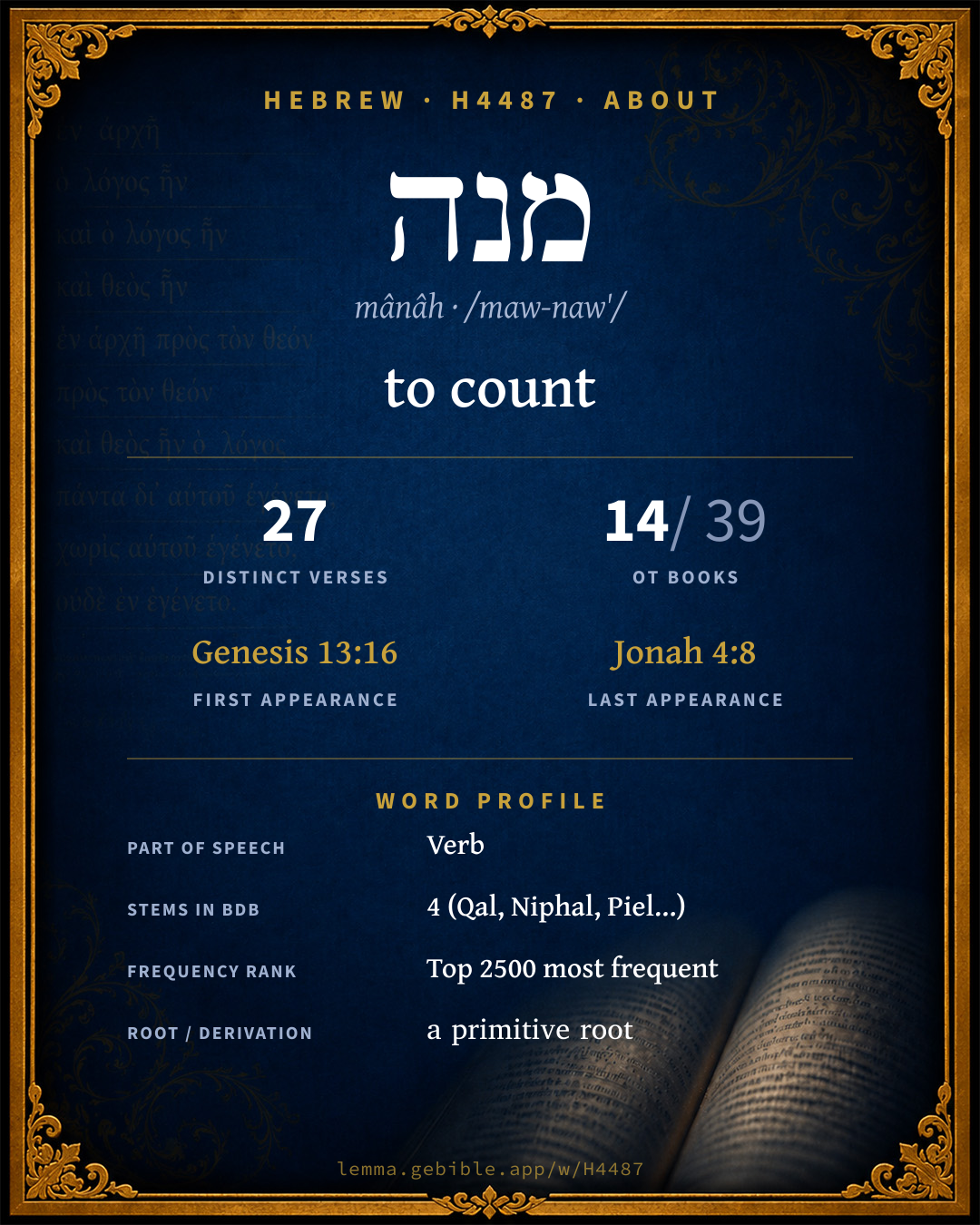
מָנָה
to count
also: reckon, number, assign, tell fuller range ↓
Full lexicon entry — Brown-Driver-Briggs (BDB)
From Brown-Driver-Briggs (BDB)
Where this word appears
See every Qal verb in the Hebrew Bible →
Grammar key — what these labels mean
Part of speech
- Verb
- An action or state-of-being word.
Stem
- Piel
- An intensive or resultative active stem.
- Qal
- The basic, simple active stem — the plain form of the verb (“he wrote”). Here: ‘count’
- Niphal
- Usually the simple passive or reflexive of the Qal (“he was written”). Here: ‘be counted’
- Pual
- The passive counterpart of the Piel. Here: ‘pl.’
Form
- Sequential Imperfect
- An imperfect with prefixed waw — the standard past-narrative form (waw-consecutive imperfect).
- Infinitive Construct
- A bound verbal noun, frequently with prepositions (“to write / in writing”).
- Imperfect
- An incomplete, ongoing, or future action (“he will / would write”).
- Perfect
- A completed action or state — Hebrew marks aspect (completeness) more than strict tense (“he wrote”).
- Participle Active
- A verbal adjective expressing ongoing or characteristic action (“writing / one who writes”).
- Participle Passive
- A verbal adjective expressing action received (“written”).
- Imperative
- A direct command (“write!”).
State
- Absolute
- The independent form of a noun, not bound to a following word.
Person
- 3rd Person
- The one spoken about (“he / she / it / they”).
- 1st Person
- The speaker (“I / we”).
- 2nd Person
- The one addressed (“you”).
Gender
- Masculine
- Grammatically masculine.
- Common
- Either gender — not distinguished for this form.
Number
- Singular
- One.
- Plural
- More than one (in Hebrew, generally three or more).
Grammatical forms 16 distinct
- Verb, Piel, Sequential Imperfect, 3rd Person, Masculine, Singular 5 times (18%)
- Verb, Qal, Infinitive Construct 5 times (18%)
- Verb, Niphal, Imperfect, 3rd Person, Masculine, Plural 2 times (7%)
- Verb, Niphal, Imperfect, 3rd Person, Masculine, Singular 2 times (7%)
- Verb, Piel, Perfect, 3rd Person, Masculine, Singular 2 times (7%)
- Verb, Qal, Participle Active, Masculine, Singular, Absolute 2 times (7%)
- Verb, Qal, Perfect, 1st Person, Common, Singular 1 time (4%)
- Verb, Qal, Sequential Imperfect, 3rd Person, Masculine, Plural 1 time (4%)
+8 more forms (8 occurrences)
Parsed forms decoded from the imported morphology (morphhb / Westminster Leningrad Codex — WLC text public domain, morphhb tagging CC BY 4.0), counted across 28 parsed occurrences — not distinct verses.
Every verse where H4487 appears — 27 distinct verses across 14 books. Click any verse to open its interlinear word-by-word view. Verse text shown in the World English Bible for context — . Each verse’s Hebrew form is shown with its reference; the English is not keyword-highlighted, since the data carries no word-level English alignment. Use “Compare translations” on any verse to read it across multiple English versions. This concordance covers the Hebrew Bible; Septuagint (Greek Old Testament) occurrences are not indexed here.
Genesis 1 verse
Numbers 1 verse
2 Samuel 1 verse
1 Kings 3 verses
- 1 Kings 3:8 יִמָּנֶ֛ה Niphal impf 3ms Your servant is in the midst of your people which you have chosen, a great people, that can't be numbered nor counted for multitude.
- 1 Kings 8:5 יִמָּנ֖וּ Niphal impf 3mp King Solomon and all the congregation of Israel, who were assembled to him, were with him before the ark, sacrificing sheep and oxen, that could not be counted nor numbered for multitude.
- 1 Kings 20:25 תִֽמְנֶה Qal impf 2ms and number you an army, like the army that you have lost, horse for horse, and chariot for chariot; and we will fight against them in the plain, and surely we shall be stronger than they. He listened to their voice, and did so.
2 Kings 1 verse
1 Chronicles 4 verses
- 1 Chronicles 9:29 מְמֻנִּים֙ Pual ptcp.pass mp Some of them also were appointed over the furniture, and over all the vessels of the sanctuary, and over the fine flour, and the wine, and the oil, and the frankincense, and the spices.
- 1 Chronicles 21:1 לִ/מְנ֖וֹת prep + Qal inf.cs Satan stood up against Israel, and moved David to number Israel.
- 1 Chronicles 21:17 לִ/מְנ֣וֹת prep + Qal inf.cs David said to God, Isn't it I who commanded the people to be numbered? It is even I who have sinned and done very wickedly; but these sheep, what have they done? Please let your hand, O Yahweh my God, be against me, and against my father's house; but not against your people, that they should be plagued.
- 1 Chronicles 27:24 לִ/מְנוֹת֙ prep + Qal inf.cs Joab the son of Zeruiah began to number, but didn't finish; and there came wrath for this on Israel; neither was the number put into the account in the chronicles of king David.
2 Chronicles 1 verse
Job 1 verse
Psalms 3 verses
- Psalms 61:7 מַ֣ן Piel impv 2ms He shall be enthroned in God's presence forever. Appoint your loving kindness and truth, that they may preserve him.
- Psalms 90:12 לִ/מְנ֣וֹת prep + Qal inf.cs So teach us to number our days, That we may gain a heart of wisdom.
- Psalms 147:4 מוֹנֶ֣ה Qal ptcp.act ms He counts the number of the stars. He calls them all by their names.
Ecclesiastes 1 verse
Isaiah 2 verses
- Isaiah 53:12 נִמְנָ֑ה Niphal pf 3ms Therefore will I divide him a portion with the great, and he shall divide the spoil with the strong; because he poured out his soul to death, and was numbered with the transgressors: yet he bore the sin of many, and made intercession for the transgressors.
- Isaiah 65:12 וּ/מָנִ֨יתִי conj + Qal pf 1cs I will destine you to the sword, and you shall all bow down to the slaughter; because when I called, you did not answer; when I spoke, you did not hear; but you did that which was evil in my eyes, and chose that in which I didn't delight.
Jeremiah 1 verse
Daniel 3 verses
- Daniel 1:5 וַ/יְמַן֩ conj + Piel wimpf 3ms The king appointed for them a daily portion of the king's dainties, and of the wine which he drank, and that they should be nourished three years; that at the end of it they should stand before the king.
- Daniel 1:10 מִנָּ֔ה Piel pf 3ms The prince of the eunuchs said to Daniel, I fear my lord the king, who has appointed your food and your drink: for why should he see your faces worse looking than the youths who are of your own age? so would you endanger my head with the king.
- Daniel 1:11 מִנָּה֙ Piel pf 3ms Then said Daniel to the steward whom the prince of the eunuchs had appointed over Daniel, Hananiah, Mishael, and Azariah:
Jonah 4 verses
- Jonah 1:17 וַ/יְמַ֤ן conj + Piel wimpf 3ms Yahweh prepared a great fish to swallow up Jonah, and Jonah was in the belly of the fish three days and three nights.
- Jonah 4:6 וַ/יְמַ֣ן conj + Piel wimpf 3ms Yahweh God prepared a vine, and made it to come up over Jonah, that it might be a shade over his head, to deliver him from his discomfort. So Jonah was exceedingly glad because of the vine.
- Jonah 4:7 וַ/יְמַ֤ן conj + Piel wimpf 3ms But God prepared a worm at dawn the next day, and it chewed on the vine, so that it withered.
- Jonah 4:8 וַ/יְמַ֨ן conj + Piel wimpf 3ms It happened, when the sun arose, that God prepared a sultry east wind; and the sun beat on Jonah's head, so that he fainted, and requested for himself that he might die, and said, "It is better for me to die than to live."
About this entry
At a glance — auto-summarized from this page’s data, not written by a person. Every figure links to its source below. This summary describes the numbers; it doesn’t interpret them.
מנה (mânâh) is a Hebrew verb most often rendered “to count.” Its English rendering has broadened — “number” classically, “count” (Berean Standard Bible) in modern versions; see the renderings breakdown. Spanning 27 verses in 14 books, it ranks among the moderately common words of the Hebrew Bible. It first appears in Genesis 13:16. Different stems carry different senses — BDB groups them under 4 stems, among them Qal and Niphal. For the data behind this summary, explore the sense tree and the renderings breakdown below.
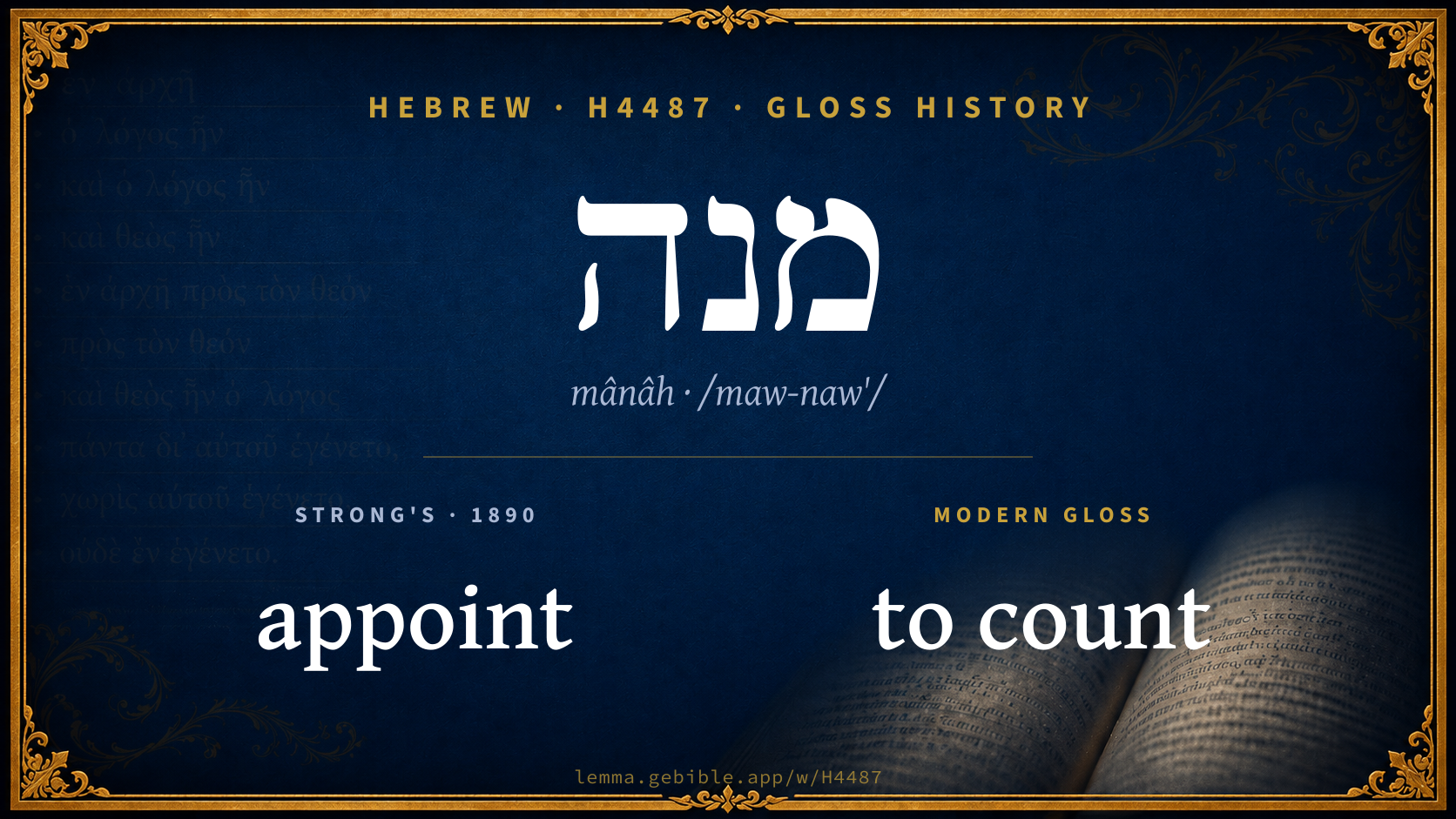
Gloss history
Strong's 1890 vs modern scholarship
About this word
Strong's H4487 catalogs a Hebrew word from the Hebrew Old Testament.
These counts are not copied from any lexicon or concordance. They are computed here, from the morphology-tagged Hebrew Old Testament. What Lemma adds →
- 27
- distinct verses
- The word appears in 27 distinct verses.
- 14 / 39
- OT books
- The word appears in 14 of 39 Old Testament books.
- #1,190
- by frequency
- Top 2500 most frequent Hebrew words (rank 1,190 of 8,640 Hebrew words by occurrence).
View all 27 occurrences in the concordance →
Most concentrated in
- 1 Chronicles 4 verses 15%
- Jonah 4 verses 15%
- 1 Kings 3 verses 11%
By section of the Old Testament
By traditional corpus
Conventional, traditional groupings — biblical authorship is debated, so this is a traditional corpus grouping, not an authorship claim. Each share is this word’s portion of its verses in that division of the Hebrew canon. Each figure is a share of the word’s 27 distinct verses.
- Writings (Ketuvim) 13 verses · 48%
- Prophets (Nevi'im) 12 verses · 44%
- Torah (Pentateuch) 2 verses · 7%
How translations render this word
Counts come from each version’s own published word-to-Strong’s tagging or interlinear alignment — an approximate guide to how each version renders this word, not a word-level alignment the data otherwise carries. Because each total is that version’s own tagged count, the per-version totals vary from one another and need not match the appearance or distinct-verse counts above. These counts may also differ from a printed concordance because Lemma counts each distinctly tagged rendering and does not collapse phrase taggings into a single head-word total. This is a fixed set of word-tagged versions (KJV, ASV, BSB, ULT) and does not change with the reading translation you choose elsewhere. Each version’s license is shown beside its name below (and on Sources).
BDB lists this Strong’s number as 2 distinct words (homographs). Each count above pools all of them and is not split by sense — see the Senses section below. A low-frequency rendering may belong to a different one of those words, not the primary meaning.
- King James Version†: Number 6×, Be numbered 3×, Prepared 3×
- American Standard Version†: Number 6×, Prepared 4×, Be numbered 3×
- Berean Standard Bible†: Count 5×, Appointed 3×, Had appointed 2×
- unfoldingWord Literal Text†: Appointed 4×, Count 4×, Then 3×
King James Version Public Domain
Renders H4487 across 28† tagged occurrences — most commonly:
Plus 14 renderings that appear only once — usually multi-word phrases or single function words the recovered tagging swept in, not distinct renderings.
American Standard Version Public Domain
Renders H4487 across 28† tagged occurrences — most commonly:
Plus 13 renderings that appear only once — usually multi-word phrases or single function words the recovered tagging swept in, not distinct renderings.
Berean Standard Bible Public Domain
Renders H4487 across 28† tagged occurrences — most commonly:
Plus 14 renderings that appear only once — usually multi-word phrases or single function words the recovered tagging swept in, not distinct renderings.
unfoldingWord Literal Text CC BY-SA 4.0
Renders H4487 across 35† tagged occurrences — most commonly:
Plus 20 renderings that appear only once — usually multi-word phrases or single function words the recovered tagging swept in, not distinct renderings.
8 senses and sub-senses in the full BDB
Hebrew verbs can shift meaning by stem (binyan): Qal is the basic action, Niphal is often passive or reflexive, Piel often intensifies or makes it factitive, and Hiphil is typically causative. The senses below are grouped under the stem BDB assigns to each. This entry also uses Pual (the passive of Piel).
What do BDB’s symbols mean?
BDB uses these scholarly abbreviations:
| Symbol | Meaning |
|---|---|
| 𝔊 | the Septuagint (the ancient Greek translation, LXX) |
| 𝔙 | the Vulgate (the Latin translation) |
| 𝔖 | the Syriac version (the Peshitta) |
| 𝔗 | the Targum (the Aramaic translation) |
| ψ | the Psalms |
| √ | root (the underlying root or stem) |
| ‖ | parallel passage (a synonymous or contrasted parallel) |
| † | the dagger: every passage where the word occurs is cited |
The 8 senses and sub-senses the full Brown-Driver-Briggs lexicon distinguishes for this word, in lexicon order (not ranked by frequency), with BDB’s own verbatim wording and sub-sense lettering. Shown in Hebrew script with BDB’s own scholarly abbreviations. The condensed entry is in the Lexicon Entry tab. See also the Forms in the corpus table below.
מנה I count, number, reckon, assign (NH id.
Qal
- Pf. מָנָה Nu 23:10; וּמָנִ֫יתִי Is 65:12; Impf. 2 ms. תִּמְנֶה־ 1 K 20:25; וַיִּמְנוּ 2 K 12:11; Imv. מְנֵה 2 S 24:1; Inf. cstr. לִמְנוֹת Gn 13:16 + 4 times; Pt. מוֹנֶה Je 33:13 ψ 147:4;— e.g. Numbers 23:10
- 1. count, number (cf. סָפַר) dust (grains) Gn 13:16 (J), cf. עֲפַר יַעֲקֹב Nu 23:10 (JE); money 2 K 12:11; stars (מ׳ מִסְפָּר לַכּוֹכָבִים) ψ 147:4; flock Je 33:13 (symb. of peace); days ψ 90:12; people, army 2 S 24:1 1 Ch 21:1, 17, cf. 27:24 (object om.); 1 K 20:25. e.g. Genesis 13:16
- 2. reckon, assign, appoint לַחֶרֶב Is 65:12 (with play on מְנִי v 11). e.g. Isaiah 65:12
Niphal
- Pf. נִמְנָה Is 53:12; Impf. יִמָּנֶה Gn 13:16 1 K 3:8; יִמָּנוּ 1 K 8:5=2 Ch 5:6; Inf. cstr. הִמָּנוֹת Ec 1:15;— e.g. Isaiah 53:12
- 1. be counted, numbered, of descendants Gn 13:16 (J), of people 1 K 3:8 (‖ נִסְפַּר); of sacrificial animals 1 K 8:5=2 Ch 5:6 (both ‖ id.); indef. Ec 1:15. e.g. Genesis 13:16
- 2. be reckoned, assigned (a place), of servant of י׳ Is 53:12 (c. אֶת פֹּשְׁעִים). e.g. Isaiah 53:12
Piel
- (late and poet.) (Biblical Aramaic and 𝔗 מַנִּי);—Pf. מִנָּה Dn 1:10, 11; מִנּוּ Jb 7:3; Impf. וַיְמַן Jon 2:1 + 4 times; Imv. מַן ψ 61:8; appoint, ordain, food Dn 1:10, v 5 (sq. לְ), officer v 11 (sq. על); nights of weariness (לֵילוֹת עָמָל) Jb 7:3 (subj. indef.; sq. לְ); in story of Jonah, obj. fish Jon 2:1, ricinus 4:6, worm v 7, wind v 8 (all subj. י׳); obj. חֶסֶד וֶאֱמֶת ψ 61:8 (subj. י׳). e.g. Daniel 1:10
Pual
- Pt. pl. מְמֻנִּים 1 Ch 9:29 appointed, of porters (sq. עַל). e.g. 1 Chronicles 9:29
מנה II part, portion
Senses from the full Brown-Driver-Briggs lexicon (Brown, Driver, Briggs; Oxford 1906 — public domain), digitized via Sefaria, supplemented by the OpenScriptures HebrewLexicon (CC BY 4.0). Full attribution on Sources.
Word origin
I. vb. count, number, reckon, assign (NH id.; Assyrian manû DlHWB 416; Arabic مَنَى assign, apportion; Aramaic ܡܢܳܐ, מְנָא);—
II. n.f. part, portion;—מ׳ Ex 29:26 + 4 times; (on מְנָֽת־ Je 13:25, cf. ψ 16:5, v. מְנָת); pl. מָנוֹת 1 S 1:4 + 5 times; sf. מָֽנוֹתָ֫יהָ Est 2:9;—part, portion, especially choice portion, Ex 29:26 Lv 7:33; 8:29 (all of sacrificial animal; all P); cf. 2 Ch 31:19; also 1 S 1:4, 5; 9:23; of distrib. of choice bits Ne 8:10, 12 Est 9:19, 22; cf. also Est 2:9 (v. Dn 1:5, 10).
— Brown-Driver-Briggs (Oxford 1906, public domain), digitized via Sefaria, supplemented by the OpenScriptures HebrewLexicon (CC BY 4.0). See Sources.
Origin: a primitive root
Jastrow Dictionary
A second Hebrew/Aramaic lexicon for comparison, covering Aramaic and post-biblical (Talmudic, Targumic, Midrashic) usage that the biblical-Hebrew BDB does not. Matched by lemma rather than by Strong’s number, so a lemma may carry more than one Jastrow headword (shown separately below), and the entries cover usage well beyond the Bible.
מָנֶה
- from which μνᾶ, [one hundred,] Maneh, a weight in gold or silver, equal to one hundred common or fifty sacred shekels (v. Zuckerm. Talm. Münz. p. 7, sq.). Bekh. 5ᵃ מ׳ של קודש כפול היה the sacred Maneh was double the weight of the common. Ib. VIII, 7 במ׳ צורי taking the Tyrian M. as a standard. Ib. 49ᵇ מ׳ צורי … מ׳ של צורי ‘the Tyrian M.’ … means the standard of the Tyrian system (one Sela = 4 Zuz, Rashi). Keth. I, 2 בתולה … מאתים ואלמנה מ׳ the widowhood of a maiden is two hundred (Zuz), and that of a widow (remarried) is one hundred (Zuz, a common Shekel). B. Kam. 90ᵇ מ׳ צורי תנן או מ׳ מדינה תנן does the Mishnah (Snh. VIII, 6) mean a Tyrian or a country Maneh (twelve and a half Zuz)? Shebu. VI, 1 מ׳ לי בידך thou owest me one hundred denars. Snh. VIII, 2 מ׳ בשר meat of the weight of a Maneh. Shebi. I, 2 ששים מ׳ באיטלקי the weight of sixty M. in the Italian system. Ker. 6ᵃ; a. fr.—Erub. 85ᵃ bot. פנו מקום לבן מאה מ׳ make room for one worth one hundred M. (in gold).—Trnsf. מ׳ בן פרס a Maneh son of a P’ras (half a Maneh), i.e. a distinguished son of a less distinguished father. Taan. 21ᵇ.—Pl. מָנִים, מָנִין. Y. Shek. VI, 49ᶜ bot. אלף … מ׳ the weight of fifteen hundred M. Ker. l. c.; a. e.—Chald. form: מָנֵי. Targ. Ez. XLV, 12 (Kimḥi מָנָא).—Pl. מָנִין, מָנַיָּא, מָנָן, מָנָאֵי, מָנוֹי. Ib. Targ. Is. VII, 23. Targ. I Kings X, 17; a. e.—Esth. R. to VI, 10; Lev. R. s. 28.—Sabb. 133ᵇ שב מ׳ תרבא (not מינאי, v. Rabb. D. S. a. l. note 90) fat weighing seven M. (Rashi: seven portions of fat). Y. B. Kam. IX, 6ᵈ bot. [read as Tosaf. to Bab. B. Kam. 100ᵇ:) חמש מנוי עמר וח׳ מ׳ סממנין וכ׳ wool worth five M., dyeing material worth five, and ten M. wages. Y. Meg. IV, 74ᵈ bot. מניי (corr. acc.); a. e.
מָנָה I
- preced.) share, portion. Bekh. V, 1 שוקלין מ׳ כנגד מ׳ you must weigh one piece (of the meat of the first-born) against another piece (of secular meat of ascertained weight). Gitt. 59ᵇ, a. e. ליטול מ׳ מ׳ יפה ראשון that he (the priest) have the privilege of first choice (when a division is made). Sifré Deut. 53; Yalk. ib. 875 מ׳ יפה the best portion (at the meal). Yalk. Num. 765, end מלך שבירר לעצמו מ׳ וכ׳ a king who selected a portion for himself, and another came and spoke disparagingly of it; a. fr.—Pl. מָנוֹת. Sabb. 149ᵃ; Tosef. ib. XVII (XVIII), 5. Ib. 4 מפיסין על מָנוֹתֵיהֶן cast lots for their portions (at the table); a. e.—V. מְנָת.
מָנָה II
- to count, v. מני.
מני
- (b. h.) to divide, distribute; to count. Bekh. IX, 7 ומוֹנֶה בשבט אחד וכ׳ (Bab. ed. 58ᵇ ומונין א׳) and he counts with the rod, one, two &c. Ib. מְנָאָם רביצין if he counted them while they were crouching. Shebu. 34ᵃ bot. מָנֶה מָנִיתִי לך וכ׳ (not מְנִיתִיךָ, v. Rabb. D. S. a. l. note) I counted (delivered) to thee a Maneh (as a loan) in the presence &c.; ib.ᵇ R. Hash. 12ᵃ חכמי ישראל מוֹנִין למבול וכ׳ the Jewish scholars count the dates of the flood in accordance with R. El. (beginning the year with Tishri), and the astronomical calendar in accordance with R. J. (beginning with Nisan), Pesik. R. s. 15, beg. אין מונין ללבנה וכ׳ we count by the moon (fix the date of the new month) only when seen after sunset. Succ. 29ᵃ, a. fr. מונין ללבנה regulate the seasons by the moon (have a lunar year). Men. 65ᵇ, a. e. מְנֵה ימים וכ׳ count the required number of days and proclaim (one day as) the New Moon Day. Yoma V, 3; a. fr.—Part. pass. מָנוּי; f. מְנוּיָה; pl. מְנוּיִים, מְנוּיִין, מְנוּיִן; מְנוּיוֹת a) counted. Taan. 8ᵇ דבר המ׳ that which has been counted (is known by number). Bekh. IX, 7 אחד מן המ׳ one of the sheep already counted.—b) classified; (pl.) class. Ḥag. 17ᵇ מה חדש למְנוּיָיו אף עצרת למְנוּיָיו (עצרת = שבוע של ע׳) as the New Moon festival belongs to its class (of days), so does the Pentecost (which is determined by counting weeks) belong to its class (of weeks), i.e. the pilgrim’s sacrifice (חגיגה) may be offered during the entire eighth week from Passover; R. Hash. 5ᵃ למְנוּיָו.—c) (v. Nif.) entered for a share in the sacrifice. Zeb. V, 8 אינו נאכל אלא למנויו can be partaken of only by those registered for it. Pes. V, 3 (61ᵃ) שחטו שלא לאוכליו ושלא למנוייו (Bab. ed. למנויו) if while slaughtering he had in mind such as were unable to partake of it (sick persons &c.) or such as had not been registered for it. Ib. 61ᵃ bot. איתקש אוכלין למנויין (Ms. M. אוכליו למנוייו) the partakers (to be held in mind) are analogous to the registered. Ib. 70ᵃ אינה … למְנוּיֶהָ Ms. M. (ed. incorr. למנוייו, למנויו) it (the pilgrim’s sacrifice) can only be partaken of by those registered for it; a. fr.
- 1. to be counted. Num. R. s. 1 אינן נִמְנִים ולא נמדדין are neither numbered nor measured. Bets. 3ᵇ, a. e. את שדרכו לִימָּנוֹת, v. אֵת. Gitt. V, 6 נִמְנוּ (usu. נמנו וגמרו) they (their votes) were counted, they resolved, v. גָּמַר II; a. fr.
- 2. to be counted on for a share in the Passover lamb, to be registered (Ex. XII, 4). Pes. VIII, 3 לעולם נִימְנִין עליו וכ׳ persons may continually be entered for a share in it, as long as there remains for each &c. Ib. נימנין ומושכין וכ׳ they may be entered and withdraw again. Ib. 89ᵃ אבל לִימָּנוֹת but as for registering (additional names). Tosef. ib. VII, 7 רצו להמשך ולהִמָּנוֹת וכ׳ (ed. Zuck. incorr.) if some of them wish to withdraw and have others entered on their share &c.; a. fr. e.g. Exodus 12:4
- 3. to be specified. Y. Taan. IV, 68ᵇ (ref. to Mish. ib. IV, 5) מה ראה … להִימָּנוֹת what reason was there for that specification of the time when each family of priests and the people had to offer wood?; Y. Shek. IV, beg. 47ᵈ; Y. Meg. I, 70ᶜ top.
- to cause to be entered; to add to the number of sharers; to transmit one’s share to another person. Y. Pes. VIII, 36ᵃ top הי׳ אותו על חנם he gave him a share gratuitously. Tosef. ib. l. c. בני חבורה שרצו להַמְנוֹת וכ׳ (ed. Zuck. לַמְנוֹת) members of a party who desire to give others a share in their own portion. Ib. המַמְנֶה אחרים על חלקו (ed. Zuck. פסחו) he who assigns to others a share in his portion; a. fr.
- to be added to the number; to be entered as a member of a group or of a family. Tosef. ib. VIII, 3 ה׳ על אחד מהם if he (the orphan) has been entered as his guest by one of the guardians. Ib. 6 בני חבורה שהוּמְנוּ וכ׳ ed. Zuck. (oth. ed. שנמנו) members of a group who have been entered (in a body) in addition to the original participants; a. e.
- to appoint, elect. Gitt. V, 4 שמי׳ להן אביהן וכ׳ for whom their father had appointed an executor. Ib. שמִינָּהוּ אבי וכ׳ whom the father … has appointed. Taan. 10ᵇ כל שראוי למַנּוֹתוֹ וכ׳ who is worthy to be elected manager &c.; a. fr.—Part. pass. מְמוּנֶּה; pl. מְמוּנִּים. Sot. 42ᵃ למה סגן ממ׳ for what purpose is a deputy high priest appointed?; Yoma 39ᵃ מימינו ed. (corr. acc.; v. Rabb. D. S. a. l. note); a. fr.—Hor. 13ᵇ שאביהם ממונים פרנס וכ׳ Ms. M. (ed. שממ׳ אביהם, = מן הממונים) whose father is of those worthy to be elected manager (v. Taan. l. c.).—V. מְמוּנֶּה.—Esp. to ordain as teacher and judge. Y. Snh. I, 19ᵃ bot. ב"ד שמי׳ שלא וכ׳ a court that ordained without the consent of the Nasi. Ib. היה כל אחד מְמַנֶּה וכ׳ each teacher used to ordain his own pupils; a. fr.
- 1. to be appointed, designated as deputy, to be ordained. Sifra Aḥăré Par. 5, ch. VIII לרבות כהן אחר המִתְמַנֶּה to imply the other priest that is designated as a deputy. Y. Bicc. III, 65ᵈ top חכם שנ׳ וכ׳ when a scholar is ordained, his sins are forgiven. Ib. זה שהוא מתמ׳ בכסף וכ׳ (not מתמני) before him who has been ordained for money, we must not stand up, nor do we call him rabbi, and the cloak upon him is like the cover of ass. Yoma 22ᵇ. Y. Shek. V, 48ᵈ bot. מאי אם זה שנ׳ על … אתם שאתם מִתְמַנִּין וכ׳ if this one appointed superintendent of wicks, was privileged to be counted among the great of the generation, how much more you who are to be appointed over the preservation of lives (as directors of charities). R. Hash. II, 9 (25ᵃ) שנִתְמַנּוּ ב"ד על וכ׳ Ms. O. (ed. שעמדו, v. Rabb. D. S. a. l. note 90) who have been ordained as a court for all Israel; a. fr.
- 2. (of things) to be assigned. Tosef. Sot. VII, 20 נִתְמַנָּה לאדם פרנסה וכ׳ if a livelihood has been assigned to a man (by Providence, i.e. if he has succeeded in establishing a livelihood), he must buy a house; חזר נ׳ לו יקח וכ׳ (v. ed. Zuckerm. note) if more has been provided for him, he must buy a field … and then marry a wife.
A Dictionary of the Targumim, the Talmud Babli and Yerushalmi, and the Midrashic Literature (Marcus Jastrow; London, Luzac, 1903) — Public Domain. Digitized via Sefaria. Digitized via Sefaria. Full attribution on Sources.
Forms in the corpus
The 24 distinct written forms H4487 takes in the Hebrew Bible, most frequent first — each parse links to that stem’s occurrences in the concordance. Hebrew forms include their vowel points and cantillation, so a single lemma takes many written forms.
Same root — word family
Other BDB entries built from the same root as H4487, grouped by Strong’s listed origin. These share a root / origin per the lexicon — not necessarily a shared meaning. Each links to that word’s own entry.
Derived from this word
- מנא mᵉnâʼ H4483 to number
- מנה mâneh H4488 mina
- מנה môneh H4489 number
- מנה mânâh H4490 portion
- מנת mᵉnâth H4521 portion
Proper names from this root
People and places named from this root — a name, not an additional meaning of the word.
Compare all same-root words → Showing 4 of 8 — not the complete family. 2 of the same-root words are proper names (people or places). They share a root, not necessarily a meaning.
Septuagint verse parallels
This word appears in 26 verses that also exist in the Greek Old Testament (Septuagint), out of the 27 Hebrew verses it occurs in. You can read those verses in Greek by switching the Old Testament edition to the Septuagint.
Read these verses in the Septuagint
- Genesis 13:16
- Numbers 23:10
- 2 Samuel 24:1
- 1 Kings 3:8
- 2 Kings 12:10
- 1 Chronicles 9:29
- 2 Chronicles 5:6
- Job 7:3
- Psalms 61:7
- Ecclesiastes 1:15
- Isaiah 53:12
- Jeremiah 33:13
This is a verse-level parallel only — the same verses exist in both the Hebrew and Greek Old Testaments. No word-level Hebrew↔Greek correspondence is claimed: the data carries no such alignment, so no Greek word is shown as this Hebrew word’s translation. Coverage is not total — the Septuagint omits the deuterocanon and renumbers the Psalms, so some Hebrew verses have no direct Greek parallel.