
Ezekiel 7:10

Hebrew (Westminster Leningrad Codex) Ezekiel 7:10 appears in the Hebrew Old Testament. The text above is from the Westminster Leningrad Codex. Each word links to its Strong’s number, a concise gloss, and parsing drawn from the Open Scriptures Hebrew Bible morphology. Click any word for its full Brown-Driver-Briggs (BDB) entry.
Download image
Cite this verse

Ezekiel 7:10 (World English Bible). Public Domain. Lemma interlinear Bible study tool, https://lemma.gebible.app/v/ezekiel/7/10.

Show BibTeX & RIS
BibTeX
RIS
English Translation
Behold, the day, behold, it comes: your doom is gone forth; the rod has blossomed, pride has budded.
World English Bible · Public Domain
Download a study sheet

One document with this verse’s original text, its word-by-word gloss line, the meaning frame, cross-references with their text, attributed commentary, and full source and license credits — printable, and it pastes into notes with its structure intact.

This verse Autodidact and up

Study sheet (.html) Plain text (.txt)

A passage Seminary Student

Up to 50 verses in one chapter. A passage sheet keeps up to 6 commentary sources and 12 cross-references per verse, in the order this page ranks them, and says so on the sheet whenever that leaves anything out. Ask for a single verse and you get the Autodidact verse sheet above.

Everything on this page stays free to read, with no account — the sheet is a download of what is already on screen, not access to it.

Want to remove ads? Support Godless Engineer
Compare translations 3

The same verse in 3 English versions, stacked beneath the original-language interlinear above. Click any original word for its lexicon entry.

Each is an independent rendering of the whole verse — the interlinear is not word-aligned to these translations.

Highlighted words mark where these versions differ — a whole-verse word diff, not a word-by-word alignment.

  • World English Bible Public Domain
    Behold, the day, behold, it comes: your doom is gone forth; the rod has blossomed, pride has budded.
  • King James Version Public Domain
    Behold the day, behold, it is come: the morning is gone forth; the rod hath blossomed, pride hath budded.
  • unfoldingWord Literal Text CC BY-SA 4.0
    Behold, the day! Behold, it is coming! Doom has gone out! The rod has blossomed, arrogance has budded!

unfoldingWord Literal Text — © unfoldingWord, licensed CC BY-SA 4.0. Word-aligned USFM3 via Door43 (git.door43.org/unfoldingWord/en_ult).

Versions to compare (up to 4)

3 of 4 selected

Show all 18 translations

Every available English version of this verse, each an independent rendering of the whole verse.

  • World English Bible Public Domain
    Behold, the day, behold, it comes: your doom is gone forth; the rod has blossomed, pride has budded.
  • Berean Standard Bible Public Domain
    Behold, the day is here! It has come! Doom has gone out, the rod has budded, arrogance has bloomed.
  • Majority Standard Bible Public Domain
    Behold, the day is here! It has come! Doom has gone out, the rod has budded, arrogance has bloomed.
  • King James Version Public Domain
    Behold the day, behold, it is come: the morning is gone forth; the rod hath blossomed, pride hath budded.
  • American Standard Version (1901) Public Domain
    Behold, the day, behold, it cometh: thy doom is gone forth; the rod hath blossomed, pride hath budded.
  • Revised Version (1885) Public Domain
    Behold, the day, behold, it cometh: thy doom is gone forth; the rod hath blossomed, pride hath budded.
  • Geneva Bible (1599) Public Domain
    Beholde, the day, beholde, it is come: the morning is gone forth, the rod florisheth: pride hath budded.
  • Douay-Rheims (1899) Public Domain
    Behold the day, behold it is come: destruction is gone forth, the rod hath blossomed, pride hath budded.
  • Young's Literal Translation Public Domain
    Lo, the day, lo, it hath come, Gone forth hath the morning, Blossomed hath the rod, flourished the pride.
  • Literal Standard Version CC BY-SA 4.0
    Behold, the day, behold, it has come, || The circlet has gone forth, || The rod has blossomed, the pride has flourished.
  • Unlocked Literal Bible CC BY-SA 4.0
    Behold, the day! Behold, it is coming! Doom has gone out! The rod has blossomed, arrogance has budded!
  • unfoldingWord Literal Text CC BY-SA 4.0
    Behold, the day! Behold, it is coming! Doom has gone out! The rod has blossomed, arrogance has budded!
  • Darby Bible Public Domain
    Behold the day, behold, it is come: the doom is gone forth; the rod hath blossomed, pride is full blown.
  • World Messianic Bible Public Domain
    “‘Behold, the day! Behold, it comes! Your doom has gone out. The rod has blossomed. Pride has budded.
  • Webster's Bible Public Domain
    Behold the day, behold, it is come; the morning is gone forth; the rod hath blossomed, pride hath budded.
  • Free Bible Version CC BY-SA 4.0
    Can't you see? The day is here! It has arrived! The consequences of your actions have come full circle—the walking stick has blossomed, pride has come into full bloom.
  • Bible in Basic English Public Domain
    See, the day; see, it is coming: the crowning time has gone out; the twisted way is flowering, pride has put out buds.
  • JPS Tanakh (1917) Public Domain
    Behold the day; behold, it cometh; the turn is come forth; the rod hath blossomed, arrogancy hath budded.

Literal Standard Version (2020), Covenant Press — licensed CC BY-SA 4.0. Text via the HelloAO Bible API (eBible.org). Unlocked Literal Bible (unfoldingWord) — licensed CC BY-SA 4.0. Text via the HelloAO Bible API (eBible.org). unfoldingWord Literal Text — © unfoldingWord, licensed CC BY-SA 4.0. Word-aligned USFM3 via Door43 (git.door43.org/unfoldingWord/en_ult). Free Bible Version, Dr. Jonathan Gallagher — licensed CC BY-SA 4.0. Text via the HelloAO Bible API (eBible.org).

Word by word

More ways to search: Search by grammar → Find every occurrence → Compare this word →

Practice this passage: Drill this verse → Learn its vocabulary →

הַצְּפִרָ֔ה
tsᵉphîyrâh
H6843
“the · crown”
Particle, Definite Article + Noun, Common, Feminine, Singular, Absolute
Part of Speech
Particle + Noun
Type
Common
Gender
Feminine
Number
Singular
State
Absolute
Full BDB Definition

Origin: formed like H6842

TWOT: 1960a

plait, chaplet, wreath, crown - plait, coronet, diadem
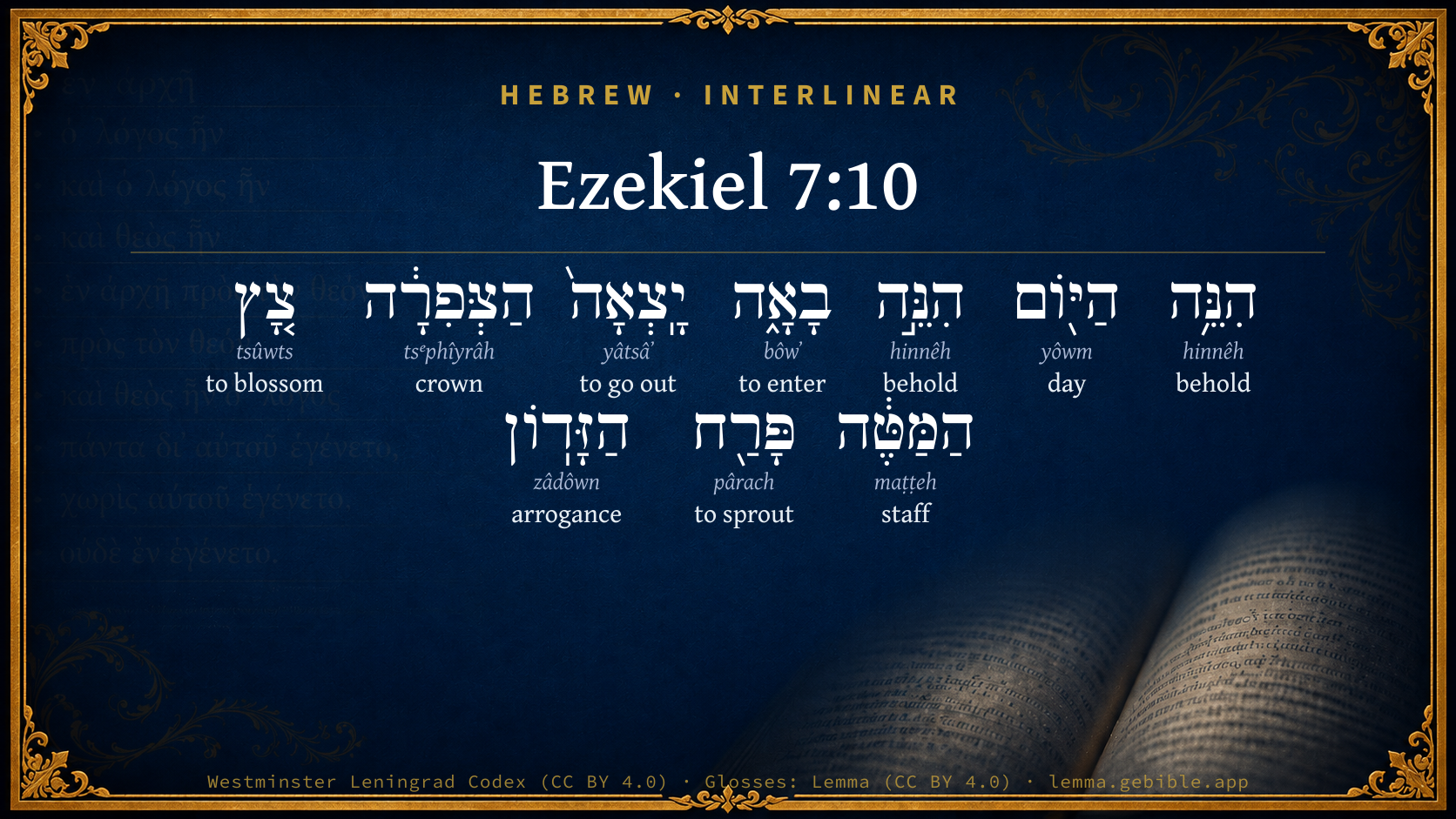
  1. הִנֵּ֥ה hinnêh H2009 “behold” Particle, Demonstrative
  2. הַיּ֖וֹם yôwm H3117 “the · day” Particle, Definite Article + Noun, Common, Masculine, Singular, Absolute
  3. הִנֵּ֣ה hinnêh H2009 “behold” Particle, Demonstrative
  4. בָאָ֑ה bôwʼ H935 “entering” Verb, Qal, Participle Active, Feminine, Singular, Absolute
  5. יָֽצְאָה֙ yâtsâʼ H3318 “to go out” Verb, Qal, Perfect, 3rd Person, Feminine, Singular
  6. צָ֚ץ tsûwts H6692 “to blossom” Verb, Qal, Perfect, 3rd Person, Masculine, Singular
  7. הַמַּטֶּ֔ה maṭṭeh H4294 “the · staff” Particle, Definite Article + Noun, Common, Masculine, Singular, Absolute
  8. פָּרַ֖ח pârach H6524 “to sprout” Verb, Qal, Perfect, 3rd Person, Masculine, Singular
  9. הַזָּדֽוֹן zâdôwn H2087 “the · arrogance” Particle, Definite Article + Noun, Common, Masculine, Singular, Absolute

About this verse

These counts appear in no published source. They are computed here, from the morphology-tagged text and Lemma’s own curated glosses. What Lemma adds →

10
words
9
distinct lemmas
Prophets
section

Notable vocabulary

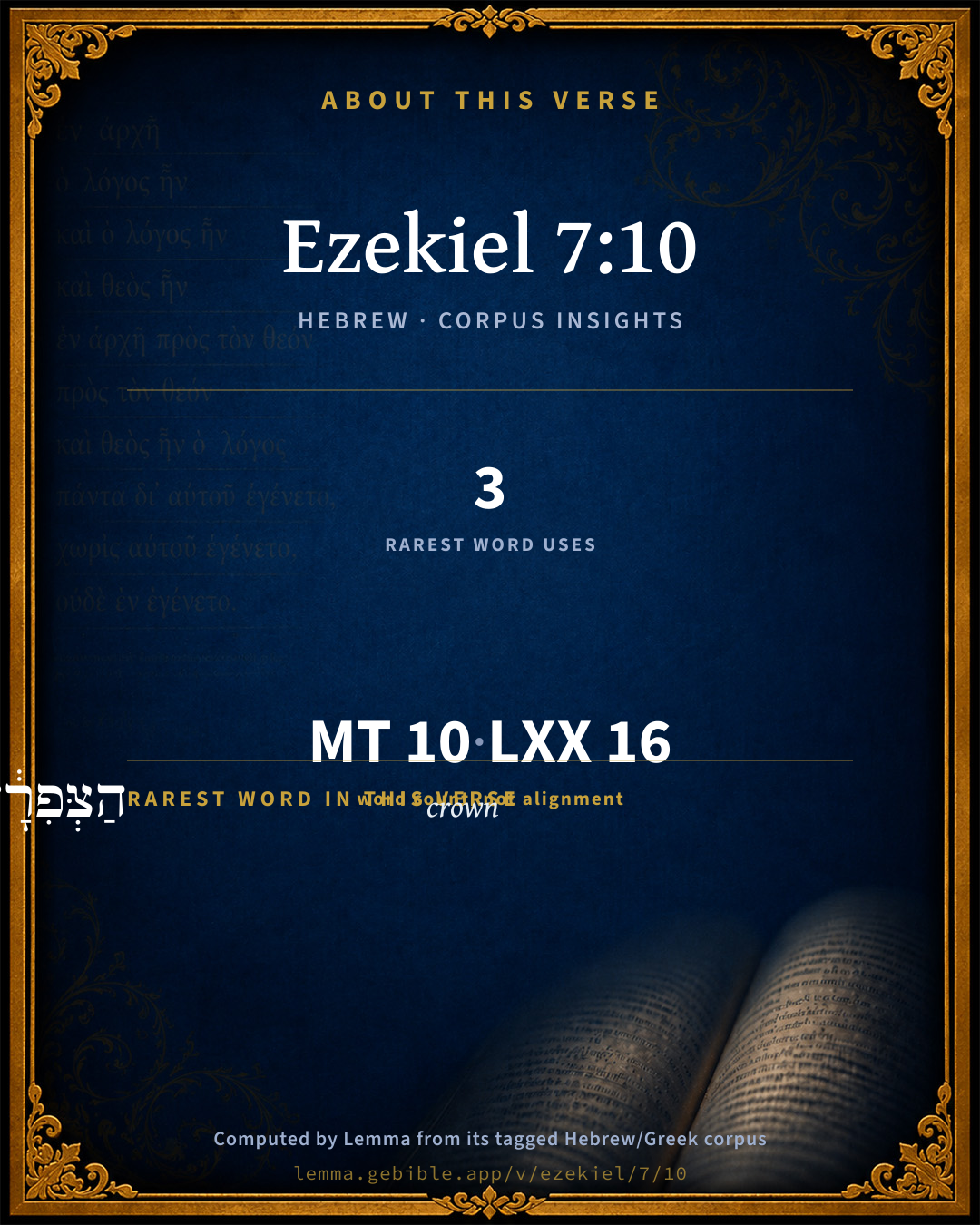
The rarest word here is הַצְּפִרָ֔ה crown H6843 — appearing just 3 times in the whole Hebrew Bible.

Shared distinctive vocabulary

הַצְּפִרָ֔ה crown H6843 occurs in 3 verses of the Hebrew Bible. Also found in:

Grammatical profile

  • 4 verbs
  • 4 nouns
  • 2 particles

Verb forms

  • בָאָ֑ה Qal · Participle Active
  • יָֽצְאָה֙ Qal · Perfect
  • צָ֚ץ Qal · Perfect
  • פָּרַ֖ח Qal · Perfect

Repetition

A word recurs within this verse — often emphatic in Hebrew:

  • הִנֵּ֥ה behold H2009 ×2

Hebrew & Septuagint length

In English translation the verse runs 18 words from the Hebrew and 11 from the Septuagint (LXX English) — the Septuagint runs noticeably shorter here. See the side-by-side →

A rough comparison of the two English renderings, which tokenize alike — not a word-level alignment.

Word counts can differ between the Hebrew and the Greek without any difference in meaning — e.g. the Hebrew direct-object marker אֵת has no separate Greek word, and Greek often adds the article ὁ.

In the original languages it is 10 Hebrew tokens and 16 Greek tokens — but the two are counted differently (Hebrew bundles its prefixes and suffixes into one token; the Greek is in lemma form), so that isn’t a like-for-like length.

Cross-references

13

Topical passages linked to Ezekiel 7:10 in the Treasury of Scripture Knowledge — connected by theme and wording, ordered by reader-vote popularity; previews shown in the World English Bible.

  • Isaiah 10:5 Ho Assyrian, the rod of my anger, the staff in whose hand is my indignation!
  • 1 Thessalonians 5:3 For when they are saying, "Peace and safety," then sudden destruction will come on them, like birth pains on a pregnant woman; and they will in no way escape.
  • James 4:6 But he gives more grace. Therefore it says, "God resists the proud, but gives grace to the humble."
  • Proverbs 16:18 Pride goes before destruction, And a haughty spirit before a fall.
  • Numbers 17:8 It happened on the next day, that Moses went into the tent of the testimony; and, behold, the rod of Aaron for the house of Levi was budded, and put forth buds, and produced blossoms, and bore ripe almonds.
  • Psalms 89:32 Then I will punish their sin with the rod, And their iniquity with stripes.
  • Proverbs 14:3 The fool's talk brings a rod to his back, But the lips of the wise protect them.
  • Isaiah 28:1 Woe to the crown of pride of the drunkards of Ephraim, and to the fading flower of his glorious beauty, which is on the head of the fat valley of those who are overcome with wine!
  • Ezekiel 7:6 An end is come, the end is come; it awakes against you; behold, it comes.
  • Ezekiel 19:14 Fire is gone out of the rods of its branches, it has devoured its fruit, so that there is in it no strong rod to be a scepter to rule. This is a lamentation, and shall be for a lamentation.
  • Ezekiel 21:10 it is sharpened that it may make a slaughter; it is furbished that it may be as lightning: shall we then make mirth? the rod of my son, it condemns every tree.
  • Ezekiel 21:13 For there is a trial; and what if even the rod that condemns shall be no more? says the Lord Yahweh.
  • Daniel 4:37 Now I, Nebuchadnezzar, praise and extol and honor the King of heaven; for all his works are truth, and his ways justice; and those who walk in pride he is able to abase.

Cross-references courtesy of OpenBible.info (CC BY 4.0).

Hebrew and Greek witnesses Masoretic Hebrew ↔ Greek Septuagint

The same verse in the two great witnesses to the Old Testament, shown verse-for-verse.

Here the Septuagint runs noticeably shorter than the Hebrew — LXX2012 (modern English Septuagint) 11 words vs World English Bible 18. A rough length comparison of the two English translations, not a word-level alignment — read both below.

These are two independent witnesses, not word-aligned to each other, and the Septuagint is shown in lemma (dictionary) form.

Hebrew Ezekiel 7:10 Masoretic · Westminster Leningrad Codex

הִנֵּ֥ה הַיּ֖וֹם הִנֵּ֣ה בָאָ֑ה יָֽצְאָה֙ הַצְּפִרָ֔ה צָ֚ץ הַמַּטֶּ֔ה פָּרַ֖ח הַזָּדֽוֹן

Behold, the day, behold, it comes: your doom is gone forth; the rod has blossomed, pride has budded.

World English Bible · Public Domain

Greek LXX Ezekiel 7:10 Septuagint · lemma form

ἰδού ὁ πέρας ἥκω ἰδού ἡμέρα κύριος εἰ καί ὁ ῥάβδος ἀνθέω ὁ ὕβρις ἐκ ἀναἵστημι

Behold, the day of the Lord! although the rod has blossomed,

LXX2012 (modern English Septuagint) · Public Domain

On this verse, Haydock's Catholic Bible Commentary discusses the Septuagint’s reading. Read the note in Commentary ↓

Hebrew: Westminster Leningrad Codex (CC BY 4.0). Greek: Septuagint (public domain); English from LXX2012 (modern English Septuagint) (Public Domain). How the Septuagint differs from the Hebrew →

Targum (Aramaic paraphrase)

1

The Targum is the ancient Jewish Aramaic paraphrase of the Hebrew Scriptures — an interpretive translation, not the Hebrew text itself. Onkelos (literal) and Pseudo-Jonathan (expansive) render the Torah, and Jonathan the Prophets. Coverage is partial: where no permissively-licensed English translation exists for a verse, only the Aramaic is shown. This is verse-level text, not a word-by-word alignment to the Hebrew.

  1. Targum Jonathan Prophets (Joshua–Malachi)
    הָא יוֹם פּוּרְעֲנוּתָא מְטָא הָא אַתְיָא אִתְגְלִיאַת מַלְכוּתָא צְמַח שׁוּלְטָנָא הוֹפַע רַשִׁיעָא:

    (no public-domain English translation for this verse)

    Targum Jonathan — Aramaic: “Mikraot Gedolot” (public domain). English: “Sefaria Community Translation” (CC0 1.0 (public-domain dedication)); “London "Chaldee Paraphrase," 1871” (public domain). Text via Sefaria.

Commentary

Notes on Ezekiel 7:10 from classic Christian and Jewish commentators (each source and its license shown beneath its notes). The classic Christian expositions comment on the surrounding passage and are grouped to its opening verse, so a note may address several verses; the Jewish commentaries on the Tanakh (Rashi and others) are per-verse, so they appear only where the commentator wrote on this verse.

Lemma curates 59 commentaries, every one of them public domain or Creative Commons licensed, each selected and text-cleaned for this edition rather than reprinted as found. About our sources →

Trapp's Complete Commentary

John Trapp

Eze 7:10 Behold the day, behold, it is come: the morning is gone forth; the rod hath blossomed, pride hath budded.

Ver. 10. The morning is gone forth.] Matutina sententia, The decree bringeth forth, {as Zep 2:2} {See Trapp on "Zep 2:2"}

The rod hath blossomed.] You have had your floralia, good times and shall shortly have your funeralia, funeral. Nebuchadnezzar (that rod of my wrath) is at hand.

Pride hath budded.] And will shortly bring forth, viz., the bitter fruit of your bold rebellion. Not much unlike to this was the almond rod seen by Jeremiah. {Eze 1:11}

John Trapp, A Commentary or Exposition upon All the Books of the Old and New Testament (1647–1656) — public domain. Text from a community e-Sword module.

The Biblical Illustrator

Joseph S. Exell

Eze_7:10

The rod hath blossomed, pride hath budded.

Sin in blossom

I. Beauty may be associated with evil. Well would it be for men to remember they may be thus connected in fact as well as figure. For there may be beauty of countenance and form that covers and quickens the corrupt, for in all Israel there were none to be so much praised as Absalom for beauty. And is not the genius of poetry often the brilliance of the fires of passion: and eloquence the engine of error, and art the bribe of superstition? Do not magnificent mansions and picturesque acres often stand chiefly as the symbols of the careful selfishness, the cold self-containedness of their owners? Yes, other evils than pride seem to have the blossoms that make the world exclaim beautiful, splendid, great! Such is the love of display, that there is many a man who for the spangles wears the funeral pall.

II. Success is no test of moral right or wrong. Pride blossoms, so does envy, so does selfishness, so sometimes does every bough on the upas tree of sin. Lowliness often seems sterile, so does love, so does prayer, so, indeed, often in the winter of our soul seems every branch on the tree of life. The Babylonians besieged Jerusalem, and had success. Judas betrayed Jesus, and had success. What then? We dare not test our life work and the work of others by the standard of success or failure.

III. The forces of retribution are ever at work. Just as the circulation of the sap through all the vessels of the tree, the influences of sunlight and air, and all the forces working out the mystery of growth are gradually and silently (though probably not silently, if our ears were keener) preparing for the hour of bud and blossom, all actions are ever setting at work retributive results. These results gradually, and sometimes silently, but ever surely, are tending to the crises that are days of judgment, and to the great crisis that is the day of judgment. (U. R. Thomas.)

The Biblical Illustrator, edited by Joseph S. Exell (c. 1880s–1900s) — public domain. Text from a community e-Sword module.

Joseph Benson's Commentary

Eze 7:10-11. Behold the day — Which has lingered so long! it is come at last. The morning is gone forth — The day of destruction is already begun. The rod hath blossomed — As the same word which signifies a tribe, signifies also a rod, the meaning of this sentence may be, the tribe of Judah hath flourished, or hath been prosperous. The consequence is mentioned in the following words: Pride hath budded — Her prosperity first filled her with pride, and that begat violence and all kinds of wickedness. Or the sense may be, Nebuchadnezzar, the rod of God’s anger, the rod of correction ordained for Judah, is grown in power and pride, in violence and cruelty, and is thus prepared to punish the Jews, whose pride and luxury, injustice and idolatry, have exposed them to this instrument of the divine vengeance. Violence is risen up into a rod of wickedness — Some render this, Violence is risen up against the rod of wickedness, and understand it of the violent, impetuous Chaldean army rising up against the tribe of Judah, here called the rod of wickedness, to cut it down. None of them shall remain — The Hebrew only expresses none of them, the words shall remain being supplied by our translators. Some versions read, None of them shall be free from evil. Neither shall there be wailing for them — The calamity shall be so general, families will be cut off so entirely, and they will be so stunned, as it were, with the greatness of their affliction, and so taken up in providing for their own safety, that there will be no particular lamentation or wailing made for those who fall.

Joseph Benson's Commentary on the Old and New Testaments (1811–1818) — public domain. Text from a community e-Sword module.

Keil & Delitzsch

C. F. Keil & F. Delitzsch

Second Strophe

Eze 7:10. Behold the day, behold, it cometh; the fate springeth up; the rod sprouteth; the pride blossometh. Eze 7:11. The violence riseth up as the rod of evil: nothing of them, nothing of their multitude, nothing of their crowd, and nothing glorious upon them. Eze 7:12. The time cometh, the day approacheth: let not the buyer rejoice, and let not the seller trouble himself; for wrath cometh upon the whole multitude thereof. Eze 7:13. For the seller will not return to that which was sold, even though his life were still among the living: for the prophecy against its whole multitude will not turn back; and no one will strengthen himself as to his life through his iniquity. Eze 7:14. They blow the trumpet and make everything ready; but no one goeth into the battle: for my wrath cometh upon all their multitude. - The rod is already prepared; nothing will be left of the ungodly. This is the leading thought of the strophe. The three clauses of Eze 7:10 are synonymous; but there is a gradation in the thought. The approaching fate springs up out of the earth (יצא, applied to the springing up of plants, as in Kg1 5:13; Isa 11:1, etc.); it sprouts as a rod, and flowers as pride. Matteh, the rod as an instrument of chastisement (Isa 10:5). This rod is then called za=dho4n, pride, inasmuch as God makes use of a proud and violent people, namely the Chaldeans (Hab 1:6.; Jer 50:31 seq.), to inflict the punishment. Sprouting and blossoming, which are generally used as figurative representations of fresh and joyous prosperity, denote here the vigorous growth of that power which is destined to inflict the punishment. Both châmâs (violence) and zâdhōn (pride) refer to the enemy who is to chastise Israel. The violence which he employs rises up into the chastening rod of "evil," i.e., of ungodly Israel. In Eze 7:11 the effect of the blow is described in short, broken sentences. The emotion apparent in the frequent repetition of לא is intensified by the omission of the verb, which gives to the several clauses the character of exclamations. So far as the meaning is concerned, we have to insert יהיה in thought, and to take מן ekat o in a partitive sense: there will not be anything of them, i.e., nothing will be left of them (the Israelites, or the inhabitants of the land). מהם (of them) is explained by the nouns which follow. המון and the ἁπ. λεγ. לחולםÅ¡, plural of הם or המה, both derivatives of המה, are so combined that המון signifies the tumultuous multitude of people, המה the multitude of possessions (like המון, Isa 60:2; Psa 37:16, etc.). The meaning which Hvernick assigns to hâmeh, viz., anxiety or trouble, is unsupported and inappropriate. The ἁπ λεγ. נהּ is not to be derived from נהה, to lament, as the Rabbins affirm; or interpreted, as Kimchi - who adopts this derivation - maintains, on the ground of Jer 16:4., as signifying that, on account of the multitude of the dying, there will be no more lamentation for the dead. This leaves the Mappik in ה unexplained. נהּ is a derivative of a root נוהּ; in Arabic, na=ha, elata fuit res, eminuit, magnificus fuit; hence ,נהּres magnifica. When everything disappears in such a way as this, the joy occasioned by the acquisition of property, and the sorrow caused by its loss, will also pass away (Eze 7:12). The buyer will not rejoice in the property he has bought, for he will not be able to enjoy it; and the seller will not mourn that he has been obliged to part with his possession, for he would have lost it in any case.

(Note: "It is a natural thing to rejoice in the purchase of property, and to mourn over its sale. But when slavery and captivity stare you in the face, rejoicing and mourning are equally absurd." - Jerome.)

The wrath of God is kindled against their whole multitude; that is to say, the judgment falls equally upon them all. The suffix in המונהּ refers, as Jerome has correctly shown, to the "land of Israel" (admath, Yisrâeel) in Eze 7:2, i.e., to the inhabitants of the land. The words, "the seller will not return to what he has sold," are to be explained from the legal regulations concerning the year of Jubilee in Lev 25, according to which all landed property that had been sold was to revert to its original owner (or his heir), without compensation, in the year of jubilee; so that he would then return to his mimkâr (Lev 25:14, Lev 25:27-28). Henceforth, however, this will take place no more, even if היּתם, their (the sellers') life, should be still alive (sc., at the time when the return to his property would take place, according to the regulations of the year of jubilee), because Israel will be banished from the land. The clause 'ועוד בּחיּים ה is a conditional circumstantial clause. The seller will not return (לא ישׁוּב) to his possession, because the prophecy concerning the whole multitude of the people will not return (לא), i.e., will not turn back (for this meaning of שׁוּב, compare Isa 45:23; Isa 55:11). As לא ישׁוּב corresponds to the previous לא ישׁוּב, so does חזון את־כּל המונהּ to חרון אל־כּל־המונהּ in Eze 7:12. In the last clause of Eze 7:13, חיּתו is not to be taken with בּעונו in the sense of "in the iniquity of his life," which makes the suffix in בּעונו superfluous, but with יתחזּקוּ, the Hithpael being construed with the accusative, "strengthen himself in his life." Whether these words also refer to the year of jubilee, as Hvernick supposes, inasmuch as the regulation that every one was to recover his property was founded upon the idea of the restitution and re-creation of the theocracy, we may leave undecided; since the thought is evidently simply this: ungodly Israel shall be deprived of its possession, because the wicked shall not obtain the strengthening of his life through his sin. This thought leads on to Eze 7:14, in which we have a description of the utter inability to offer any successful resistance to the enemy employed in executing the judgment. There is some difficulty connected with the word בּתּקוע, since the infin. absolute, which the form תּקוע seems to indicate, cannot be construed with either a preposition or the article. Even if the expression ּבתּקוע תּקעוּ in Jer 6:1 was floating before the mind of Ezekiel, and led to his employing the bold phrase ּבתּקוע, this would not justify the use of the infinitive absolute with a preposition and the article. תּקוע must be a substantive form, and denote not clangour, but the instrument used to sound an alarm, viz., the shōphâr (Eze 33:3). הכין, an unusual form of the inf. abs. (see Jos 7:7), used in the place of the finite tense, and signifying to equip for war, as in Nah 2:4. הכּל, everything requisite for waging war. And no one goes into the battle, because the wrath of God turns against them (Lev 26:17), and smites them with despair (Deu 32:30).

Keil & Delitzsch — Biblical Commentary on the Old Testament (1861–1891) — public domain (CC PDM 1.0). Text via the HelloAO Bible API. (Old Testament only.)

Tyndale Open Study Notes

Tyndale Open Resources

7:10 blossomed to full flower: In their wickedness and pride, the people of Israel were ripe to be plucked (cp. Amos 8:1-2).

Tyndale Open Study Notes — © Tyndale Open Resources, licensed CC BY-SA 4.0. Text via the HelloAO Bible API.

Geneva Bible (1599)

Geneva Bible translators

The scourge is in a readiness.

That is, the proud tyrant Nebuchadnezzar, hath gathered his force and is ready.

Geneva Bible (1599) marginal notes — public domain. Text via Bolls.life.

Jamieson, Fausset & Brown

Robert Jamieson, A. R. Fausset & David Brown

rod . . . blossomed, pride . . . budded--The "rod" is the Chaldean Nebuchadnezzar, the instrument of God's vengeance (Isa 10:5; Jer 51:20). The rod sprouting (as the word ought to be translated), &c., implies that God does not move precipitately, but in successive steps. He as it were has planted the ministers of His vengeance, and leaves them to grow till all is ripe for executing His purpose. "Pride" refers to the insolence of the Babylonian conqueror (Jer 50:31-32). The parallelism ("pride" answering to "rod") opposes JEROME'S view, that "pride" refers to the Jews who despised God's threats; (also CALVIN'S, "though the rod grew in Chaldea, the root was with the Jews"). The "rod" cannot refer, as GROTIUS thought, to the tribe of Judah, for it evidently refers to the "smiteth" (Eze 7:9) as the instrument of smiting.

Jamieson, Fausset & Brown — Commentary Critical and Explanatory on the Whole Bible (1871) — public domain (CC PDM 1.0). Text via the HelloAO Bible API.

Adam Clarke's Commentary

Verse 10. Behold the day] The same words are repeated, sometimes varied, and pressed on the attention with new figures and new circumstances, in order to alarm this infatuated people. Look at the day! It is come!

The morning is gone forth] It will wait no longer. The rod that is to chastise you hath blossomed; it is quite ready.

Pride hath budded.] Your insolence, obstinacy, and daring opposition to God have brought forth their proper fruits.

Adam Clarke's Commentary on the Bible (1810–1826) — public domain. Text from a community e-Sword/MySword module.

John Calvin's Commentaries

Now Ezekiel uses another figure, but to the same purpose. He repeats what he had said before: the day is come, and he adds another part, that the morning had advanced But we said that the impious, when God connives at their sins, exult as it were in darkness without shame or fear. Since therefore they were as wanton as if they had obtained the license of night, the Prophet denounces that morning is at hand, because God would suddenly bring to light what they thought would be always hidden. Since therefore, when God retired, they supposed themselves in complete darkness, the Prophet recalls them to the consideration of the daily order of things: for light emerges immediately from the dawn. Thus he laughs at their folly, because they thought that God had his eyes shut, when for the time he dissembles. This therefore is the reason, as was fully explained yesterday, why the Prophet calls the sudden change morning Therefore the morning has arisen, afterwards, the rod has blossomed, pride has flourished It is not doubtful that he means Nebuchadnezzar by the rod, but interpreters vary on the context; for many refer the following verse to the king of Babylon: but others, in my judgment rightly, take it of the Israelites themselves. As to his saying the rod has blossomed, it refers to God’s forbearance. For when the Israelites had sinned a long while with impunity, they thought, as I said yesterday, that their peace with God would be perpetual. But here Ezekiel pronounces in opposition to this, that God had as it were a hidden root; as he who plants a tree waits for the time, till it rises to a just magnitude. Hence he compares Nebuchadnezzar to a rod which was growing. God could indeed without man’s assistance destroy the Israelites, and could also compel others to obey him: for all creatures are at hand to fulfill his commands; but here Ezekiel commends God’s forbearance, though he had planted the tree, from which the rod was to spring up with which he would smite the Israelites. So he reproves their sloth, because they did not reflect upon the time of their visitation, which God had determined in his secret counsel.

On the whole, in saying the rod has flourished, he refers to those steps which God takes in executing his judgments. For he does not act hastily after the manner of men, but just as a husbandman in sowing and planting. Hence God provides for his own use ministers of vengeance, and permits them to increase and to arrive at maturity. If therefore God does not hasten as we wish, we may know that he still has rods prepared, and if they are not yet grown to maturity, it is because the time which the Almighty has previously fixed is not yet arrived. Now it follows, that pride has budded I have just said that some referred this to the Babylonians, but I rather understand it of the Israelites. Hence God shows how the staff grew in Chaldea by which the Israelites were to be struck, and yet the root was among themselves. For here the noun “pride” is to be taken as usual in a bad sense: it does not denote simply haughtiness or arrogance, but that licentiousness which springs from a contempt of God. But this does not suit the Babylonians as far as God governed them with his hand, when he wished to take vengeance on the Israelites. But in this sense there is nothing forced, that the staff with which the Israelites were to be struck had increased, and yet it had no other origin than their sins, and hence that no other root need be sought for than this. Hence it flourished, but whence did it spring? from pride The seed therefore of this staff was the pride of the Israelites. But this pride is akin to impiety, and we know that they were blinded by their confidence when they despised God, and treated all his threats as vain. Hence the Prophet points out pride as the fountain of all evils. A clearer explanation follows —

John Calvin's Commentaries (1540-1563) — public domain. Text from the Calvin Translation Society English edition (1840s-50s) via the Christian Classics Ethereal Library (ccel.org). Calvin's coverage is partial (roughly two-thirds of the Bible); uncommented books and verses are honest gaps, never fabricated. The 19th-century editor's footnotes and remarks are omitted so the notes are faithfully Calvin's own voice.

Ellicott's Commentary for English Readers

(10) The morning is gone forth.—The same word as in Eze_7:7, and in the same sense—the circle is complete, the end is reached, sin hath brought forth death. “The rod” is commonly understood of the Chaldæan conqueror; but as the word is the same for rod and for tribe, and is very often used in the latter sense, it will be more in accordance with the connection to understand here a play upon the word. There will be then an allusion to the rods of the tribes in Num_17:8. There the rod of Aaron was made to bud and blossom by Divine power in evidence of his having been chosen of God; here the rod representing the tribe at Jerusalem in its self-will and pride has budded and blossomed to its destruction. So the description continues in the next verse, “Violence is risen up into a rod of wickedness.” Not a rod for the punishment of wickedness; but into a wicked people.

A Bible Commentary for English Readers, edited by Charles John Ellicott (1878–1897) — public domain. Text from a community e-Sword module.

The Cambridge Bible for Schools and Colleges

gen. ed. J. J. S. Perowne

10–13. The ruin is universal, overtaking all classes

10. morning is gone forth] Rather: is come forth,—the figure of a plant springing up; Job_14:2, “man cometh forth like a flower.” On “morning” see Eze_7:7; R.V. doom as there.

rod hath blossomed] i.e. sprouted and grown so as to become a rod. The general scope of the passage seems to imply that the “rod” here is that by which Israel shall be chastised. In Jer_50:31 Babylon is named “pride” (R.V. marg.), and the words “pride has budded” may serve to explain “the rod has blossomed.” If the pride were that which the rod was to humble the words would better be attached to the next verse.

The Cambridge Bible for Schools and Colleges (gen. ed. J. J. S. Perowne; Cambridge University Press, 1878–1918) — public domain. Text from a community e-Sword module.

John Gill's Exposition

Violence is risen up into a rod of wickedness,.... Some understand this of the Chaldeans, who came with great violence against the Jews, and were a rod in the hand of the Lord, to scourge them for their wickedness; and this seems to be the sense of the Targum,

"spoilers are risen up to visit the wicked;''

but rather the violence, oppression, and rapine of the Jews are meant, and mentioned as the cause of their punishment; for this their oppression of the poor and needy, the widow and the fatherless, among them, God suffered the king of Babylon, a wicked prince, to come and chastise them:

none of them shall remain, nor of their multitude, nor of any of theirs; meaning not the Chaldean army, as if they came not of themselves, but of God, and much less were cut off, for they returned to their own land again; but the Jews, who either should die in the siege with the famine and pestilence, or be put to death by the sword, or be carried into captivity:

neither shall there be wailing for them; the destruction should be so general, that there would be but few left to mourn; and those that were left would be struck with such a stupor and amazement at the calamity, that they would not be capable of mourning; or with such a dread of the enemy, that there would be no place for lamentation over their dead friends and relations.

John Gill's Exposition of the Whole Bible (1746–1763) — public domain (CC PDM 1.0). Text via the HelloAO Bible API.

Haydock's Catholic Bible Commentary

Budded; figurative expressions, denoting a speedy vengeance. (Calmet) --- Chaldean, "the reign is open, the ruler has flourished, the wicked hath appeared." In this reign of Nabuchodonosor ye shall be chastised. (Haydock) --- Septuagint or rather Theodotion, from whom many things have bee supplied according to St. Jerome, (Calmet) have, "The deceit (or thick foliage; Greek: ploke) has gone forth, the rod," &c. (Haydock)

George Leo Haydock (1774–1849), Haydock's Catholic Family Bible and Commentary, 1859 edition — public domain. Excludes Psalms (Douay-Rheims chapter numbering differs from Protestant) and Deuterocanonical books (Catholic canon only).

Matthew Poole's English Annotations

If you will open your eyes, you may see the lowering day of vengeance: see Eze 7:7.

The rod hath blossomed: this and what follows may refer either,

1. To Nebuchadnezzar and his Chaldeans, the rod of God’s anger; they flourish, are strong and heavy, like to last too long in their strength to break Israel. Pride hath budded; as they flourish in strength, they exceed in pride and arrogance, which buddeth forth in the haughty designs they lay of raising themselves on the ruins of all countries.

Matthew Poole's English Annotations on the Holy Bible (1683–1685) — public domain. Text from a community e-Sword/MySword module.

Whedon's Commentary on the Bible

Daniel D. Whedon

10. Gone forth — Rather, sprung up. (Compare Job_14:12.) On the meaning of the expression see Eze_7:6.

The rod hath blossomed — The trees of their own planting have grown and borne fruit, and from these trees of abomination and pride (compare Eze_7:4) shall now be cut the rod of punishment.

Daniel D. Whedon (gen. ed.), Commentary on the Old and New Testaments (1874–1909) — public domain. Text from a community e-Sword module.

The Pulpit Commentary

It is come. Read, as before, it cometh; and for morning, doom (see note on ver. 7). The rod hath blossomed, etc. The three verbs imply a climax. The "doom" springs out of the earth; the rod of vengeance blossoms (the word is the same as that which describes the blooming of Aaron"s rod, (Num_17:8) and the phrase was probably suggested by the history); pride (either that of the Chaldean ministers of vengeance, or of Israel as working out its own punishment; I incline to the latter) buds and bears fruit. in Isa_27:6 the word follows on "blossom," andtherefore seems applicable to the formation of the fruit rather than the flower. (For the image of the rod, comp. Psa_110:2; Isa_10:26; Mic_6:9)

The day is come.

This chapter opened with a prophecy of "an end." It now proceeds to the annunciation of a new beginning. No end is absolutely final. In the night which sees the death of one day a new day is born.

I THE FUTURE BECOMES PRESENT. The much anticipated day at length arrives. We are thus forever overtaking the future. However far the future event may be, it will surely be reached, if time is the only impediment to be got over. The day of death may be far ahead, but most assuredly it will come. The dreaded day will come only too swiftly. The hoped for day will also dawn, though we become weary in waiting for it. God"s great day of doom will arrive, though the sinner mock at its tarrying. Christ"s glorious day of triumph will also appear, though the Church grow faint and wonders at its slow approach.

II THE NEW DAY WILL BE REVEALED BY ITS OWN ADVENT. No prediction can exactly describe the coming day, for no words can paint the thing that has not been. We vainly try to anticipate the future, and we blunder into the greatest mistakes. We cannot know what sorrow is till the day of sorrow breaks, nor can we understand the joy of the Lord till a glad day of heavenly love smiles upon us. We shall not know death till we are in the day of death. When the new day of the life beyond dawns we shall know its meaning as we can never guess now.

III THE COMING DAY WILL HAVE A NEW CHARACTER. No two days are exactly alike. Ezekiel was announcing a day of doom. The awful thunders of that day are to roll over the heads of guilty and impenitent men with a surprise and a horror never anticipated in easier times. Thus it was in the doom of Israel under the Babylonian invasion. But there are brighter days to anticipate. There is the day of light after the night of doubt; the day of joy"s sunshine succeeding the night of sorrow"s weeping; the day of penitent new beginnings after the night of sin; the day of busy service after the night of rest and waiting. Carlyle writes

Lo! here hath been dawning Another blue day: Think, wilt thou let it Slip useless away?

Out of eternity This new day is born; Into eternity At night will return.

Behold it aforetime No eye ever did; So soon it forever From all eyes is hid.

IV THE CHARACTER OF THE NEW DAY IS DETERMINED BY OUR CONDUCT IN THE OLD DAYS. The day of doom is not the day of fate. It is a day of judgment, i.e. of examination, discrimination, and consequent decision. Therefore it is determined by the character of the old days it judges. The new day may come to us as a surprise, but it will not fall out by chance as one of storm or one of sunshine. When it arrives we shall see that, in its deepest character, it bears the record of our own past.

The Pulpit Commentary (1880–1919), ed. H.D.M. Spence-Jones & Joseph S. Exell — public domain. Text from a community e-Sword module.

John Wesley's Explanatory Notes

Is come - Of your wickedness; pride and violence in particular.

John Wesley, Explanatory Notes Upon the Whole Bible (1754–1765) — public domain. Text via the GEBible commentary corpus.

Kretzmann's Popular Commentary

Paul E. Kretzmann

The Ruin Accomplished

v. 10. Behold the day, that of the final reckoning, behold, it is come; the morning is gone forth, the destined calamity has arisen; the rod hath blossomed, pride hath budded, the powers of vengeance maturing for the purpose of performing the Lord’s punishment upon the covenant people.

v. 11. Violence, namely, that of the conquering Chaldeans, is risen up into a rod of wickedness, namely, to carry out the punishment upon the wicked; none of them shall remain, the inhabitants being either slaughtered or carried into captivity, nor of their multitude, noisy and boisterous though they formerly were, nor of any of theirs, of their riches or possessions; neither shall there be wailing for them, literally, "neither is there anything glorious among them," anything of which they might feel justly proud.

v. 12. The time is come, the day draweth near. Let not the buyer rejoice, on account of a bargain which he made, nor the seller mourn, over the loss of property which he would gladly have retained; for wrath is upon all the multitude thereof, the Lord’s judgment striking them all in the same manner.

v. 13. For the seller shall not return to that which is sold, since all laws regarding the return of property would be annulled by Israel’s removal from the land, although they were yet alive, literally, "even were their life still among the living," at the time when, according to ancient regulations, the seller might regain possession of his property; for the vision is touching the whole multitude thereof, which shall not return, that is, the vision vouchsafed by the Lord to his prophet is against the entire mass of the people and will not be changed, neither shall any strengthen himself in the iniquity of his life, that is, possession should be withdrawn from the whole nation, because no evil person should, by committing wickedness, be strengthened in his life and thus he enabled to withstand the enemy.

v. 14. They, the Jews, the people of the covenant nation, have blown the trumpet, as though preparing for battle, even to make all ready; but none goeth to the battle, their courage having been taken from them by the Lord’s judgment; for My wrath is upon all the multitude thereof, and their timidity is the consequence of His anger.

v. 15. The sword is without, in the persons of the invaders, and the pestilence and the famine within, so that the attack of the Lord comes from both sides; he that is in the field, out in the line of battle, shall die with the sword, and he that is in the city, famine and pestilence shall devour him, so that no one may escape the punishment of the Lord.

v. 16. But they that escape of them shall escape and shall be on the mountains like doves of the valleys, driven from their natural habitat, far removed from their nests, all of them mourning, making known their sorrow, their feeling of pain and grief, every one for his iniquity. The mournful cry of the dove is a fitting comparison at this point, the mixing of figure and reality tending to increase the emphasis.

v. 17. All hands shall be feeble, on account of the weakness brought about by terror and the feeling of disgrace, and all knees shall be weak as water, their strength being taken from them, so that they refuse to stand up and remain firm.

v. 18. They shall also gird themselves with sackcloth, as a sign of deep mourning, and horror shall cover them, surrounding them like a garment; and shame shall be upon all faces, as a result of their finally realizing their iniquity, and baldness upon all their heads, as they pluck out their hair in the depth of their mourning.

v. 19. They shall cast their silver in the streets, and their gold shall be removed, they themselves discarding the precious metals which they possessed as having now lost all their value, as being loathsome, in fact, in view of the abuses to which they had been put; their silver and their gold shall not be able to deliver them in the day of the wrath of the Lord; Cf 1Pe 1:18. They shall not satisfy their souls, so that their lives would be spared, neither fill their bowels, in providing the necessaries of life, their money being unable to procure for them either deliverance from the sword or deliverance from a death by hunger, because it, their wealth, is the stumbling-block of their iniquity, the cause of many of their transgressions.

v. 20. As for the beauty of his ornament, the riches with which Israel was endowed, with which he might adorn himself, he set it in majesty, he turned it to the service of pride; but they made the images of their abominations and of their detestable things therein, that is, out of the gold and silver given them by God the children of Israel made idols, loathsome things in the sight of Jehovah; therefore have I set it far from them, He had removed their wealth, their gold and silver, and also their Temple, from them, so that they could no longer defile it with their abominations.

v. 21. And I will give it into the hands of the strangers for a prey, to the invaders, to use as they saw fit, and to the wicked of the earth for a spoil, the Babylonians, of course, taking advantage of their victory to the full, and they shall pollute it, both the Temple and all the wealth captured by them.

v. 22. My face will I turn also from them, from the inhabitants of Jerusalem, and they, the invaders, shall pollute My secret place, namely, the treasury of the Sanctuary, which was profaned by the Chaldeans as they took it to Babylon; for the robbers shall enter into it and defile it.

v. 23. Make a chain, forging fetters for the inhabitants of the land; for the land is full of bloody crimes, of blood-guiltiness, and the city, namely, Jerusalem, is full of violence.

v. 24. Wherefore I will bring the worst of the heathen, those who excelled in transgressions as they invaded the land of Israel, and they shall possess their houses, occupying them for themselves; I will also make the pomp of the strong, the might of Israel wherein they trusted, to cease, and their holy places, which the Lord will no longer accept as consecrated to Him, shall be defiled.

v. 25. Destruction cometh, literally, "contraction," to emphasize the force of the blow to be delivered; and they shall seek peace, making every attempt to find deliverance from the impending calamities, and there shall be none.

v. 26. Mischief shall come upon mischief, and rumor shall be upon rumor, one blow following the other; Cf Mat 24:6. Then, when it is really too late, shall they seek a vision of the prophet; but the Law shall perish from the priest and counsel from the ancients, that is, they would seek advice in vain, their very leaders having their understanding dulled.

v. 27. The king shall mourn, as the ruler of the nation, and the prince, the heads of the smaller divisions in the nation, shall be clothed with desolation, and the hands of the people of the land, that is, of the nation as such, shall be troubled, trembling with terror. I will do unto them after their way, according to their behavior, and according to their deserts will I judge them, as they deserved by their misdeeds; and they shall know that I am the Lord, this fact being impressed upon them with special force by the Lord’s punishment upon the whole nation. If people will not heed the Lord’s Word and will with ready obedience, His punishment will call their attention to the fact of His sovereignty.

Paul E. Kretzmann, Popular Commentary of the Bible (1921–1924) — public domain. Text from a community e-Sword module.

unfoldingWord translationNotes

Door43 World Missions Community

General Information:

These are Yahweh's words about Israel.

Behold, the day! Behold, it is coming!

"Behold! The day is coming!" You may need to make explicit which day is coming. AT: "Behold! The day when I will punish you is coming!" (See: Assumed Knowledge and Implicit Information)

Behold

"Look" or "Listen" or "Pay attention to what I am about to tell you"

Doom has gone out

"Disaster has begun to come to Israel" or "Terrible things have begun to happen"

The rod has blossomed, arrogance has budded

Possible meanings are 1) "The people of Israel have grown very proud" or "The people of Israel have become very violent and very proud." (See: Metaphor)

Violence has grown up into a rod of wickedness

"The people's violence has led them to do more wicked things"

translationWords

proud

evil

unfoldingWord translationNotes — © Distant Shores Media and the Door43 World Missions Community, licensed CC BY-SA 4.0. Source: git.door43.org/Door43/en_tn.

Rashi

Rabbi Shlomo Yitzchaki (Rashi)

Behold the day Behold the day has come.

behold it is coming The evil.

the dawn has gone forth The dawn of the day of the evil.

the staff has budded to strike you.

the willful wickedness has blossomed The wicked Nebuchadnezzar has revealed himself.

Rashi on the Tanakh — English translations: “The Judaica Press complete Tanach with Rashi, translated by A. J. Rosenberg” (CC BY 4.0); “Pentateuch with Rashi's commentary by M. Rosenbaum and A.M. Silbermann, 1929-1934” (public domain); “The Metsudah Tanach series, Lakewood, N.J” (CC BY 4.0); and “The Book of Joshua, Metsudah Publications, 1997” (CC BY 4.0). Text via Sefaria.

Lesson kit

Teaching starters — assembled from the data on this page, not authored interpretation. Every prompt links to the verse data it draws on. Edit before teaching.

Ezekiel, in the Prophets, opens this verse with 10 words (9 distinct Hebrew lemmas). Its most distinctive word is tsᵉphîyrâh (“crown”). The Greek Septuagint runs shorter here. A historical commentator’s framing appears above. Read the whole chapter for the surrounding context.

Discussion questions

  1. How does “crown” (tsᵉphîyrâh) shape what this verse is saying?
  2. How does Isaiah 28:5, which shares the word «crown», read alongside this verse?
  3. What does the repetition of “behold” (2× in this one verse) do in this verse?
  4. The Septuagint runs shorter here than the Hebrew. What might account for the difference?
  5. These translations render this verse differently; the difference is in the English rendering, not the original. What questions does that raise?
  6. «בָאָ֑ה» is a Qal Participle Active verb. How does that grammatical form shape the action described?
  7. Compare how Trapp's Complete Commentary and The Biblical Illustrator read this verse. Where do they agree or differ?

Things to notice

Reading settings

Reading text

Shown beneath each verse's original-language words.

Old Testament
Old Testament edition

Read the OT as the Masoretic Hebrew (MT) or the Greek Septuagint (LXX).

English shown for the Greek Septuagint (in the Hebrew ↔ Greek comparison).

Comparing translations? Open the Compare panel on any verse page to stack up to four side by side.