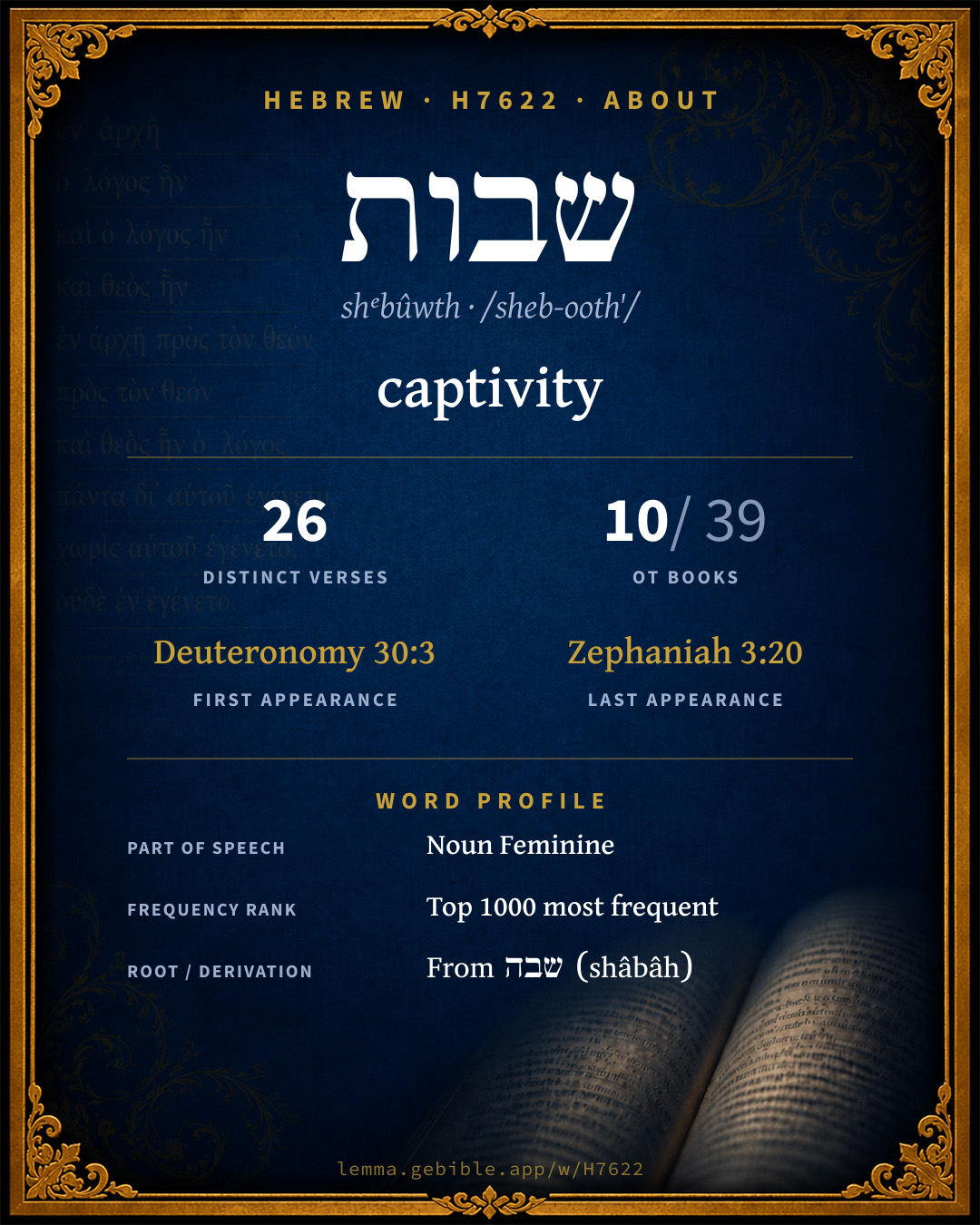
שְׁבִית
captivity
Full lexicon entry — Brown-Driver-Briggs (BDB)
From Brown-Driver-Briggs (BDB)
Where this word appears
Grammar key — what these labels mean
Part of speech
- Noun
- A naming word — a person, place, thing, or idea.
Noun type
- Common
- A common noun — a general class of person, place, or thing (“king,” “city,” “water”), not a specific name.
State
- Construct
- A noun bound to a following noun in a possessive / “of” relationship (the construct chain).
Gender
- Feminine
- Grammatically feminine.
Number
- Singular
- One.
- Plural
- More than one (in Hebrew, generally three or more).
Grammatical forms
- Noun, Common, Feminine, Singular, Construct 40 times (98%)
- Noun, Common, Feminine, Plural, Construct 1 time (2%)
Parsed forms decoded from the imported morphology (morphhb / Westminster Leningrad Codex — WLC text public domain, morphhb tagging CC BY 4.0), counted across 41 parsed occurrences — not distinct verses.
Every verse where H7622 appears — 26 distinct verses across 10 books. Click any verse to open its interlinear word-by-word view. Verse text shown in the World English Bible for context — . Each verse’s Hebrew form is shown with its reference; the English is not keyword-highlighted, since the data carries no word-level English alignment. Use “Compare translations” on any verse to read it across multiple English versions. This concordance covers the Hebrew Bible; Septuagint (Greek Old Testament) occurrences are not indexed here.
Deuteronomy 1 verse
Job 1 verse
Psalms 4 verses
- Psalms 14:7 שְׁב֣וּת n c fs cs Oh that the salvation of Israel would come out of Zion! When Yahweh restores the fortunes of his people, Then Jacob shall rejoice, and Israel shall be glad.
- Psalms 53:6 שְׁב֣וּת n c fs cs Oh that the salvation of Israel would come out of Zion! When God brings back the captivity of his people, Then Jacob shall rejoice. Israel shall be glad.
- Psalms 85:1 שבות שְׁבִ֣ית n c fs cs n c fs cs Yahweh, you have been favorable to your land. You have restored the fortunes of Jacob.
- Psalms 126:4 שבות/נו שְׁבִיתֵ֑/נוּ n c fs cs + sfx pers 1cp n c fs cs + sfx pers 1cp Restore our fortunes again, Yahweh, Like the streams in the Negev.
Jeremiah 11 verses
- Jeremiah 29:14 שבית/כם שְׁבוּתְ/כֶ֗ם n c fs cs + sfx pers 2mp n c fs cs + sfx pers 2mp I will be found by you, says Yahweh, and I will turn again your captivity, and I will gather you from all the nations, and from all the places where I have driven you, says Yahweh; and I will bring you again to the place from where I caused you to be carried away captive.
- Jeremiah 30:3 שְׁב֨וּת n c fs cs For, behold, the days come, says Yahweh, that I will turn again the captivity of my people Israel and Judah, says Yahweh; and I will cause them to return to the land that I gave to their fathers, and they shall possess it.
- Jeremiah 30:18 שְׁבוּת֙ n c fs cs Thus says Yahweh: Behold, I will turn again the captivity of Jacob's tents, and have compassion on his dwelling-places; and the city shall be built on its own hill, and the palace shall be inhabited after its own manner.
- Jeremiah 31:23 שְׁבוּתָ֑/ם n c fs cs + sfx pers 3mp Thus says Yahweh of Hosts, the God of Israel, Yet again shall they use this speech in the land of Judah and in the cities of it, when I shall bring again their captivity: Yahweh bless you, habitation of righteousness, mountain of holiness.
- Jeremiah 32:44 שְׁבוּתָ֖/ם n c fs cs + sfx pers 3mp Men shall buy fields for money, and subscribe the deeds, and seal them, and call witnesses, in the land of Benjamin, and in the places about Jerusalem, and in the cities of Judah, and in the cities of the hill-country, and in the cities of the lowland, and in the cities of the South: for I will cause their captivity to return, says Yahweh.
- Jeremiah 33:7 שְׁב֣וּת שְׁב֣וּת n c fs cs n c fs cs I will cause the captivity of Judah and the captivity of Israel to return, and will build them, as at the first.
- Jeremiah 33:11 שְׁבוּת n c fs cs the voice of joy and the voice of gladness, the voice of the bridegroom and the voice of the bride, the voice of those who say, Give thanks to Yahweh of Hosts, for Yahweh is good, for his loving kindness endures forever; [and of them] who bring [sacrifices of] thanksgiving into the house of Yahweh. For I will cause the captivity of the land to return as at the first, says Yahweh.
- Jeremiah 33:26 שְׁבוּתָ֖/ם n c fs cs + sfx pers 3mp then will I also cast away the seed of Jacob, and of David my servant, so that I will not take of his seed to be rulers over the seed of Abraham, Isaac, and Jacob: for I will cause their captivity to return, and will have mercy on them.
- Jeremiah 48:47 שְׁבוּת n c fs cs Yet will I bring back the captivity of Moab in the latter days, says Yahweh. Thus far is the judgment of Moab.
- Jeremiah 49:6 שְׁב֥וּת n c fs cs But afterward I will bring back the captivity of the children of Ammon, says Yahweh.
- Jeremiah 49:39 שבית שְׁב֥וּת n c fs cs n c fs cs But it shall happen in the latter days, that I will bring back the captivity of Elam, says Yahweh.
Lamentations 1 verse
Ezekiel 3 verses
- Ezekiel 16:53 שְׁבִ֣יתְ/הֶ֔ן שבית שְׁב֤וּת שבית שְׁב֥וּת ו/שבית וּ/שְׁב֥וּת n c fs cs + sfx pers 3fp n c fs cs n c fs cs n c fs cs n c fs cs conj + n c fs cs conj + n c fs cs I will turn again their captivity, the captivity of Sodom and her daughters, and the captivity of Samaria and her daughters, and the captivity of your captives in the midst of them;
- Ezekiel 29:14 שְׁב֣וּת n c fs cs and I will bring back the captivity of Egypt, and will cause them to return into the land of Pathros, into the land of their birth; and they shall be there a base kingdom.
- Ezekiel 39:25 שבית שְׁב֣וּת n c fs cs n c fs cs Therefore thus says the Lord Yahweh: Now will I bring back the captivity of Jacob, and have mercy on the whole house of Israel; and I will be jealous for my holy name.
Hosea 1 verse
Joel 1 verse
Amos 1 verse
Zephaniah 2 verses
- Zephaniah 2:7 שבות/ם שְׁבִיתָֽ/ם n c fs cs + sfx pers 3mp n c fs cs + sfx pers 3mp The coast will be for the remnant of the house of Judah. They will find pasture. In the houses of Ashkelon, they will lie down in the evening, for Yahweh, their God, will visit them, and restore them.
- Zephaniah 3:20 שְׁבוּתֵי/כֶ֛ם n c fp cs + sfx pers 2mp At that time will I bring you in, and at that time will I gather you; for I will give you honor and praise among all the peoples of the earth, when I bring back your captivity before your eyes, says Yahweh.
About this entry
At a glance — auto-summarized from this page’s data, not written by a person. Every figure links to its source below. This summary describes the numbers; it doesn’t interpret them.
The Hebrew noun שבות centers on the idea of “captivity.” Older and newer Bibles part ways — “captivity” in the King James Version, “fortunes” (unfoldingWord Literal Text) in modern versions. See the renderings breakdown. It appears 26 verses across 10 books of the Hebrew Bible, among its moderately common vocabulary. The word gravitates to Jeremiah (42%), then Psalms and Ezekiel. Its earliest occurrence is Deuteronomy 30:3. For the data behind this summary, explore the sense tree and the renderings breakdown below.
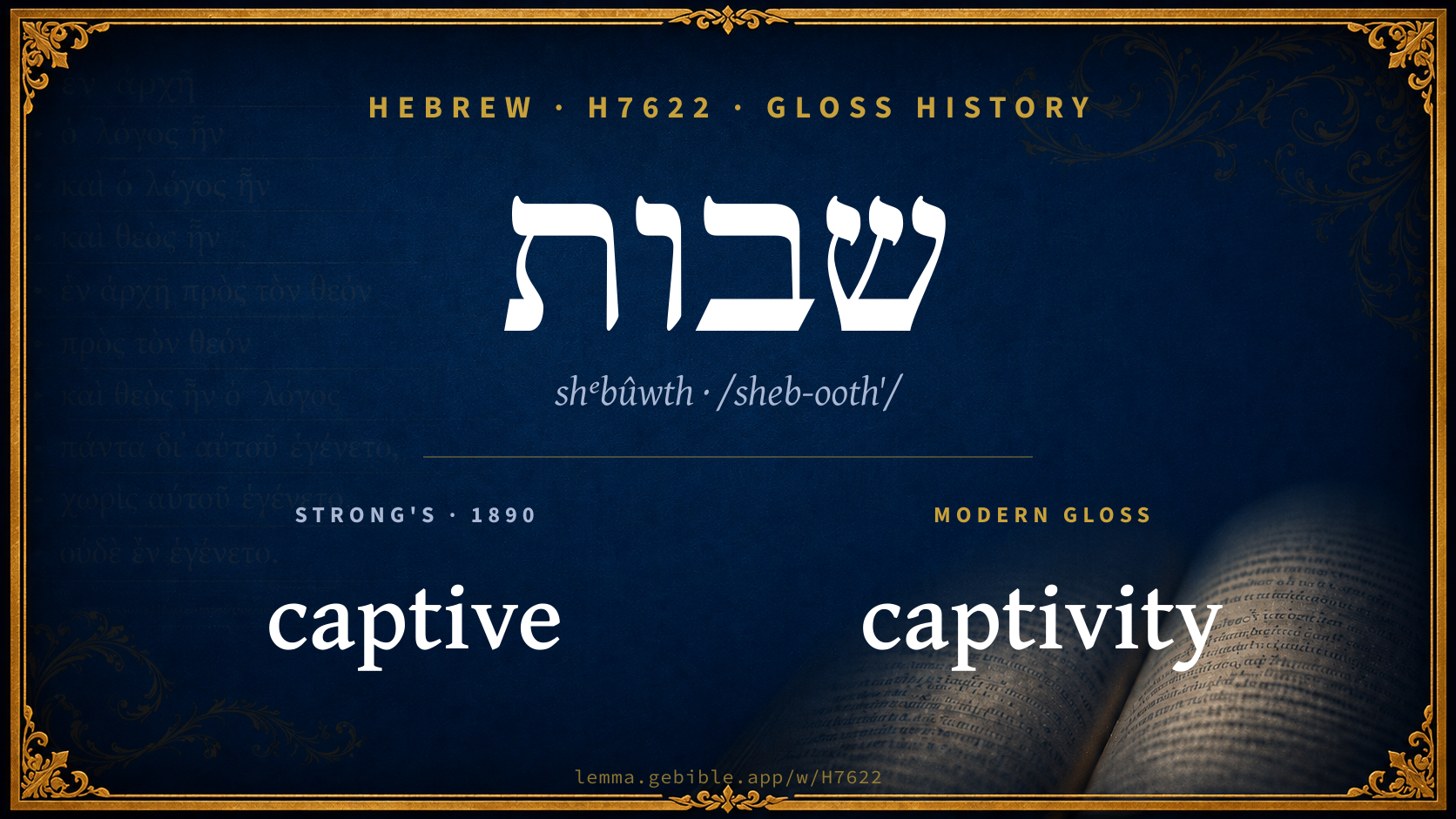
Gloss history
Strong's 1890 vs modern scholarship
About this word
Strong's H7622 catalogs a Hebrew word from the Hebrew Old Testament.
These counts are not copied from any lexicon or concordance. They are computed here, from the morphology-tagged Hebrew Old Testament. What Lemma adds →
- 26
- distinct verses
- The word appears in 26 distinct verses.
- 10 / 39
- OT books
- The word appears in 10 of 39 Old Testament books.
- #891
- by frequency
- Top 1000 most frequent Hebrew words (rank 891 of 8,640 Hebrew words by occurrence).
View all 26 occurrences in the concordance →
By section of the Old Testament
By traditional corpus
Conventional, traditional groupings — biblical authorship is debated, so this is a traditional corpus grouping, not an authorship claim. Each share is this word’s portion of its verses in that division of the Hebrew canon. Each figure is a share of the word’s 26 distinct verses.
- Prophets (Nevi'im) 19 verses · 73%
- Writings (Ketuvim) 6 verses · 23%
- Torah (Pentateuch) 1 verse · 4%
How translations render this word
Counts come from each version’s own published word-to-Strong’s tagging or interlinear alignment — an approximate guide to how each version renders this word, not a word-level alignment the data otherwise carries. Because each total is that version’s own tagged count, the per-version totals vary from one another and need not match the appearance or distinct-verse counts above. These counts may also differ from a printed concordance because Lemma counts each distinctly tagged rendering and does not collapse phrase taggings into a single head-word total. This is a fixed set of word-tagged versions (KJV, ASV, BSB, ULT) and does not change with the reading translation you choose elsewhere. Each version’s license is shown beside its name below (and on Sources).
- King James Version: Captivity 27×, I will cause their captivity 2×
- American Standard Version: Captivity 23×, I will cause the captivity 2×, I will cause their captivity 2×
- Berean Standard Bible: Captivity 19×, Captives 3×, Captive 2×
- unfoldingWord Literal Text: Fortunes 7×, Captivity 3×, Captivity of 3×
King James Version Public Domain
Renders H7622 across 32 tagged occurrences — most commonly:
Plus 3 renderings that appear only once — usually multi-word phrases or single function words the recovered tagging swept in, not distinct renderings. Not rendered by a distinct English word in 12 further occurrences.
American Standard Version Public Domain
Renders H7622 across 32 tagged occurrences — most commonly:
Plus 5 renderings that appear only once — usually multi-word phrases or single function words the recovered tagging swept in, not distinct renderings.
Berean Standard Bible Public Domain
Renders H7622 across 30 tagged occurrences — most commonly:
Plus 6 renderings that appear only once — usually multi-word phrases or single function words the recovered tagging swept in, not distinct renderings. Not rendered by a distinct English word in 2 further occurrences.
unfoldingWord Literal Text CC BY-SA 4.0
Renders H7622 across 19 tagged occurrences — most commonly:
Plus 4 renderings that appear only once — usually multi-word phrases or single function words the recovered tagging swept in, not distinct renderings.
Senses in the full BDB
What do BDB’s symbols mean?
BDB uses these scholarly abbreviations:
| Symbol | Meaning |
|---|---|
| 𝔊 | the Septuagint (the ancient Greek translation, LXX) |
| 𝔙 | the Vulgate (the Latin translation) |
| 𝔖 | the Syriac version (the Peshitta) |
| 𝔗 | the Targum (the Aramaic translation) |
| ψ | the Psalms |
| √ | root (the underlying root or stem) |
| ‖ | parallel passage (a synonymous or contrasted parallel) |
| † | the dagger: every passage where the word occurs is cited |
The 6 senses and sub-senses the full Brown-Driver-Briggs lexicon distinguishes for this word, in lexicon order (not ranked by frequency), with BDB’s own verbatim wording and sub-sense lettering. Shown in Hebrew script with BDB’s own scholarly abbreviations. The condensed entry is in the Lexicon Entry tab. See also the Forms in the corpus table below.
- 1. in cl. נָתַן בַּשִּׁבִית Nu 21:29 (JE) give his daughters into captivity (or as captives, ‖ פְּלֵיטִם of sons, cf. Je 48:46); cf. (perhaps) La 1:7 (v. [מִשְׁבָּת] sub שׁבת). e.g. Numbers 21:29
- 2. in phr. restore the captivity of, acc. after שׁוּב, הֵשִׁיב, י׳ subj. [vb. Qal Dt 30:3 + 15 times, + Ez 16:53d ψ 126:1 (v. supr.); Hiph. Je 32:44 + 5 times, + Qal Kt, Hiph. Qr, Je 33:26 + 2 times]: e.g. Deuteronomy 30:3
- a. of Isr. (or Judah) Ho 6:11 (𝔊 joins to 7:1, so as gloss, We Now), Zp 2:7; 3:20; Dt 30:3; Je 29:14; 30:3, 18 (שׁ׳ אָהֳלֵי יַעֲקֹב), 31:23; 32:44; 33:7(×2), 11 (שׁ׳ הָאָרֶץ), v 26 La 2:14 (subj. proph.), Ez 16:53 a, c, d (on text v. supr.), 39:25 Am 9:14; Jo 4:1 ψ 14:7 = 53:7, 85:2; 126:1 (v. supr.), v 4. e.g. Hosea 6:11
- b. of other nations Je 48:47 (cf. v 46), 49:6, 39; Ez 29:14 (cf. v 13). e.g. Jeremiah 48:47
- c. appar. in more gen. sense, restore fortunes of Sodom Ez 16:53 b (Krae, cf. foll.). e.g. Ezekiel 16:53
- d. restore fortunes of individuals, Jb 42:10. e.g. Job 42:10
Senses from the full Brown-Driver-Briggs lexicon (Brown, Driver, Briggs; Oxford 1906 — public domain), digitized via Sefaria, supplemented by the OpenScriptures HebrewLexicon (CC BY 4.0). Full attribution on Sources.
Word origin
n.f. id. (√ שׁבה 𝔊 Thes SS PreusschenZAW xv (1895), 1 ff. Krae Ez 16:53; > √ שׁוב EwJBW v (1852–3), 216 f.; § 165 b Ol§ 412, 417 Bö§ 464 Kue TTijdschr. vii. 519 ff. OortIb. xiv. 157 SchwallyZAW viii (1888), 200 al.; Köii. 1, 166 f., 474; ii. 2. § 329 i thinks deriv. of שׁבה and שׁוב are confused, cf. Ew§ 166 b);—abs. שְׁבִית Nu 21:29; cstr. שְׁבוּת Ho 6:11 +, sf. שְׁבוּתְךָ Dt 30:3, שְׁבִיתְהֶן Ez 16:53a (v. infr.), שְׁבוּתֵיכֶם Zp 3:20 (read -תְכֶם Now GASm), etc. [MT has שְׁבוּת, etc. 16 times, + Kt (שְׁבִית Qr) Zp 2:7 ψ 85:2; 126:4 + Ez 16:53a (Gi, but Baer שְׁבִיתְהֶן Kt et Qr, v. his note), + Qr (Kt שׁבית) Je 29:14; 49:39; Ez 16:53 b, c + v d (but וְשַׁבְתִּ֫י for וּשְׁב֯יו Vrss Comm.), La 2:14; Jb 42:10; שְׁבִית Kt et Qr Nu 21:29, שְׁבִיתַיִךְ Ez 16:53 (but Co Krae שְׁבוּתֵךְ); שְׁבִית prob. earlier Ew§; 186 b al. ψ 126:1 read prob. שְׁבִית for שִׁיבַת];—
— Brown-Driver-Briggs (Oxford 1906, public domain), digitized via Sefaria, supplemented by the OpenScriptures HebrewLexicon (CC BY 4.0). See Sources.
Derived from שבה (shâbâh) (H7617) — to capture.
Jastrow Dictionary
A second Hebrew/Aramaic lexicon for comparison, covering Aramaic and post-biblical (Talmudic, Targumic, Midrashic) usage that the biblical-Hebrew BDB does not. Matched by lemma rather than by Strong’s number, so a lemma may carry more than one Jastrow headword (shown separately below), and the entries cover usage well beyond the Bible.
שְׁבוּת
- (שָׁבַת) rest, abstention from secular occupation. Sabb. 89ᵃ כלום … שאתם צריכים ש׳ do you (angels) work, that you needed rest? [Sifra Emor ch. XIII, Par. 11, a. e. ש׳ (אלא) שבתון, read: שְׁבוֹת, v. שָׁבַת.]—Esp. sh’buth, an occupation, on the Sabbath and Festivals, forbidden by the Rabbis as being out of harmony with the celebration of the day. Bets. V, 2 כל שחייבין עלין משום ש׳ וכ׳ all occupations which are forbidden as sh’buth … on the Sabbath, are also forbidden on the Holy Days; ואלו הן משום ש׳ וכ׳ and these are forbidden as sh’buth: you must not climb up a tree &c. Ib. 37ᵃ ש׳ גרידתא a plain act forbidden as sh’buth; ש׳ דרשות an act of exercise of authority; ש׳ דמצוה an act of a religious nature. Pes. 65ᵃ אין ש׳ במקדש the prohibition of acts as sh’buth does not apply to Temple functions; a. v. fr.
A Dictionary of the Targumim, the Talmud Babli and Yerushalmi, and the Midrashic Literature (Marcus Jastrow; London, Luzac, 1903) — Public Domain. Digitized via Sefaria. Digitized via Sefaria. Full attribution on Sources.
Forms in the corpus
The 24 distinct written forms H7622 takes in the Hebrew Bible, most frequent first — each parse links to that state’s occurrences in the concordance. Hebrew forms include their vowel points and cantillation, so a single lemma takes many written forms.
| Form | Parsing | Example | Uses |
|---|---|---|---|
| שְׁב֣וּת | Noun, Common, Feminine, Singular, Construct | Amos 9:14 | 8 |
| שְׁב֥וּת | Noun, Common, Feminine, Singular, Construct | Ezekiel 16:53 | 5 |
| שבית | Noun, Common, Feminine, Singular, Construct | Ezekiel 16:53 | 5 |
| שְׁבוּת | Noun, Common, Feminine, Singular, Construct | Jeremiah 33:11 | 2 |
| שְׁבוּתָ֖/ם | Noun, Common, Feminine, Singular, Construct | Jeremiah 32:44 | 2 |
| ו/שבית | Noun, Common, Feminine, Singular, Construct | Ezekiel 16:53 | 1 |
| וּ/שְׁב֥וּת | Noun, Common, Feminine, Singular, Construct | Ezekiel 16:53 | 1 |
| שְׁב֤וּת | Noun, Common, Feminine, Singular, Construct | Ezekiel 16:53 | 1 |
| שְׁב֨וּת | Noun, Common, Feminine, Singular, Construct | Jeremiah 30:3 | 1 |
| שְׁבִ֣ית | Noun, Common, Feminine, Singular, Construct | Psalms 85:1 | 1 |
| שְׁבִ֣יתְ/הֶ֔ן | Noun, Common, Feminine, Singular, Construct | Ezekiel 16:53 | 1 |
| שְׁבִיתֵ֑/נוּ | Noun, Common, Feminine, Singular, Construct | Psalms 126:4 | 1 |
| שְׁבִיתָֽ/ם | Noun, Common, Feminine, Singular, Construct | Zephaniah 2:7 | 1 |
| שְׁבוּת֙ | Noun, Common, Feminine, Singular, Construct | Jeremiah 30:18 | 1 |
| שְׁבוּתְ/ךָ֖ | Noun, Common, Feminine, Singular, Construct | Deuteronomy 30:3 | 1 |
| שְׁבוּתְ/כֶ֗ם | Noun, Common, Feminine, Singular, Construct | Jeremiah 29:14 | 1 |
| שְׁבוּתֵ֑/ךְ | Noun, Common, Feminine, Singular, Construct | Lamentations 2:14 | 1 |
| שְׁבוּתֵי/כֶ֛ם | Noun, Common, Feminine, Plural, Construct | Zephaniah 3:20 | 1 |
| שְׁבוּתָ֑/ם | Noun, Common, Feminine, Singular, Construct | Jeremiah 31:23 | 1 |
| שבות | Noun, Common, Feminine, Singular, Construct | Psalms 85:1 | 1 |
| שבות/ם | Noun, Common, Feminine, Singular, Construct | Zephaniah 2:7 | 1 |
| שבות/נו | Noun, Common, Feminine, Singular, Construct | Psalms 126:4 | 1 |
| שבית/ך | Noun, Common, Feminine, Singular, Construct | Lamentations 2:14 | 1 |
| שבית/כם | Noun, Common, Feminine, Singular, Construct | Jeremiah 29:14 | 1 |
Same root — word family
Other BDB entries built from the same root as H7622, grouped by Strong’s listed origin. These share a root / origin per the lexicon — not necessarily a shared meaning. Each links to that word’s own entry.
Derives from
Shares the same root
Proper names from this root
People and places named from this root — a name, not an additional meaning of the word.
Compare all same-root words → Showing 4 of 5 — not the complete family. 2 of the same-root words are proper names (people or places). They share a root, not necessarily a meaning.
Septuagint verse parallels
This word appears in 20 verses that also exist in the Greek Old Testament (Septuagint), out of the 26 Hebrew verses it occurs in. You can read those verses in Greek by switching the Old Testament edition to the Septuagint.
Read these verses in the Septuagint
- Deuteronomy 30:3
- Job 42:10
- Psalms 53:6
- Jeremiah 30:3
- Lamentations 2:14
- Ezekiel 16:53
- Hosea 6:11
- Joel 3:1
- Amos 9:14
- Zephaniah 2:7
This is a verse-level parallel only — the same verses exist in both the Hebrew and Greek Old Testaments. No word-level Hebrew↔Greek correspondence is claimed: the data carries no such alignment, so no Greek word is shown as this Hebrew word’s translation. Coverage is not total — the Septuagint omits the deuterocanon and renumbers the Psalms, so some Hebrew verses have no direct Greek parallel.