

Job 17:11

Hebrew (Westminster Leningrad Codex) Job 17:11 appears in the Hebrew Old Testament. The text above is from the Westminster Leningrad Codex. Each word links to its Strong’s number, a concise gloss, and parsing drawn from the Open Scriptures Hebrew Bible morphology. Click any word for its full Brown-Driver-Briggs (BDB) entry.
Download image
Cite this verse

Job 17:11 (World English Bible). Public Domain. Lemma interlinear Bible study tool, https://lemma.gebible.app/v/job/17/11.

Show BibTeX & RIS
BibTeX
RIS
English Translation
My days are past, my plans are broken off, As are the thoughts of my heart.
World English Bible · Public Domain
Highlights Full analysis ↓
Download a study sheet

One document with this verse’s original text, its word-by-word gloss line, the meaning frame, cross-references with their text, attributed commentary, and full source and license credits — printable, and it pastes into notes with its structure intact.

This verse Autodidact and up

Study sheet (.html) Plain text (.txt)

A passage Seminary Student

Up to 50 verses in one chapter. A passage sheet keeps up to 6 commentary sources and 12 cross-references per verse, in the order this page ranks them, and says so on the sheet whenever that leaves anything out. Ask for a single verse and you get the Autodidact verse sheet above.

Everything on this page stays free to read, with no account — the sheet is a download of what is already on screen, not access to it.

Want to remove ads? Support Godless Engineer
Compare translations 3

The same verse in 3 English versions, stacked beneath the original-language interlinear above. Click any original word for its lexicon entry.

Each is an independent rendering of the whole verse — the interlinear is not word-aligned to these translations.

Highlighted words mark where these versions differ — a whole-verse word diff, not a word-by-word alignment.

  • World English Bible Public Domain
    My days are past, my plans are broken off, As are the thoughts of my heart.
  • King James Version Public Domain
    My days are past, my purposes are broken off, even the thoughts of my heart.
  • unfoldingWord Literal Text CC BY-SA 4.0
    My days have passed, my plans are broken, the desires of my heart.

unfoldingWord Literal Text — © unfoldingWord, licensed CC BY-SA 4.0. Word-aligned USFM3 via Door43 (git.door43.org/unfoldingWord/en_ult).

Versions to compare (up to 4)

3 of 4 selected

Show all 18 translations

Every available English version of this verse, each an independent rendering of the whole verse.

  • World English Bible Public Domain
    My days are past, my plans are broken off, As are the thoughts of my heart.
  • Berean Standard Bible Public Domain
    My days have passed; my plans are broken off—even the desires of my heart.
  • Majority Standard Bible Public Domain
    My days have passed; my plans are broken off—even the desires of my heart.
  • King James Version Public Domain
    My days are past, my purposes are broken off, even the thoughts of my heart.
  • American Standard Version (1901) Public Domain
    My days are past, my purposes are broken off, Even the thoughts of my heart.
  • Revised Version (1885) Public Domain
    My days are past, my purposes are broken off, even the droughts of my heart.
  • Geneva Bible (1599) Public Domain
    My dayes are past, mine enterprises are broken, and the thoughts of mine heart
  • Douay-Rheims (1899) Public Domain
    My days have passed away, my thoughts are dissipated, tormenting my heart.
  • Young's Literal Translation Public Domain
    My days have passed by, My devices have been broken off, The possessions of my heart!
  • Literal Standard Version CC BY-SA 4.0
    My days have passed by, || My plans have been broken off, || The possessions of my heart!
  • Unlocked Literal Bible CC BY-SA 4.0
    My days are past; my plans are shattered, and so are the desires of my heart.
  • unfoldingWord Literal Text CC BY-SA 4.0
    My days have passed, my plans are broken, the desires of my heart.
  • Darby Bible Public Domain
    My days are past, my purposes are broken off, the cherished thoughts of my heart.
  • World Messianic Bible Public Domain
    My days are past. My plans are broken off, as are the thoughts of my heart.
  • Webster's Bible Public Domain
    My days are past, my purposes are broken off, even the thoughts of my heart.
  • Free Bible Version CC BY-SA 4.0
    My life is over. My plans are gone. My heart is broken.
  • Bible in Basic English Public Domain
    My days are past, my purposes are broken off, even the desires of my heart.
  • JPS Tanakh (1917) Public Domain
    My days are past, my purposes are broken off, even the thoughts of my heart.

Literal Standard Version (2020), Covenant Press — licensed CC BY-SA 4.0. Text via the HelloAO Bible API (eBible.org). Unlocked Literal Bible (unfoldingWord) — licensed CC BY-SA 4.0. Text via the HelloAO Bible API (eBible.org). unfoldingWord Literal Text — © unfoldingWord, licensed CC BY-SA 4.0. Word-aligned USFM3 via Door43 (git.door43.org/unfoldingWord/en_ult). Free Bible Version, Dr. Jonathan Gallagher — licensed CC BY-SA 4.0. Text via the HelloAO Bible API (eBible.org).

Word by word

More ways to search: Search by grammar → Find every occurrence → Compare this word →

Practice this passage: Drill this verse → Learn its vocabulary →

About this verse

These counts appear in no published source. They are computed here, from the morphology-tagged text and Lemma’s own curated glosses. What Lemma adds →

6
words
6
distinct lemmas
Wisdom
section

Notable vocabulary

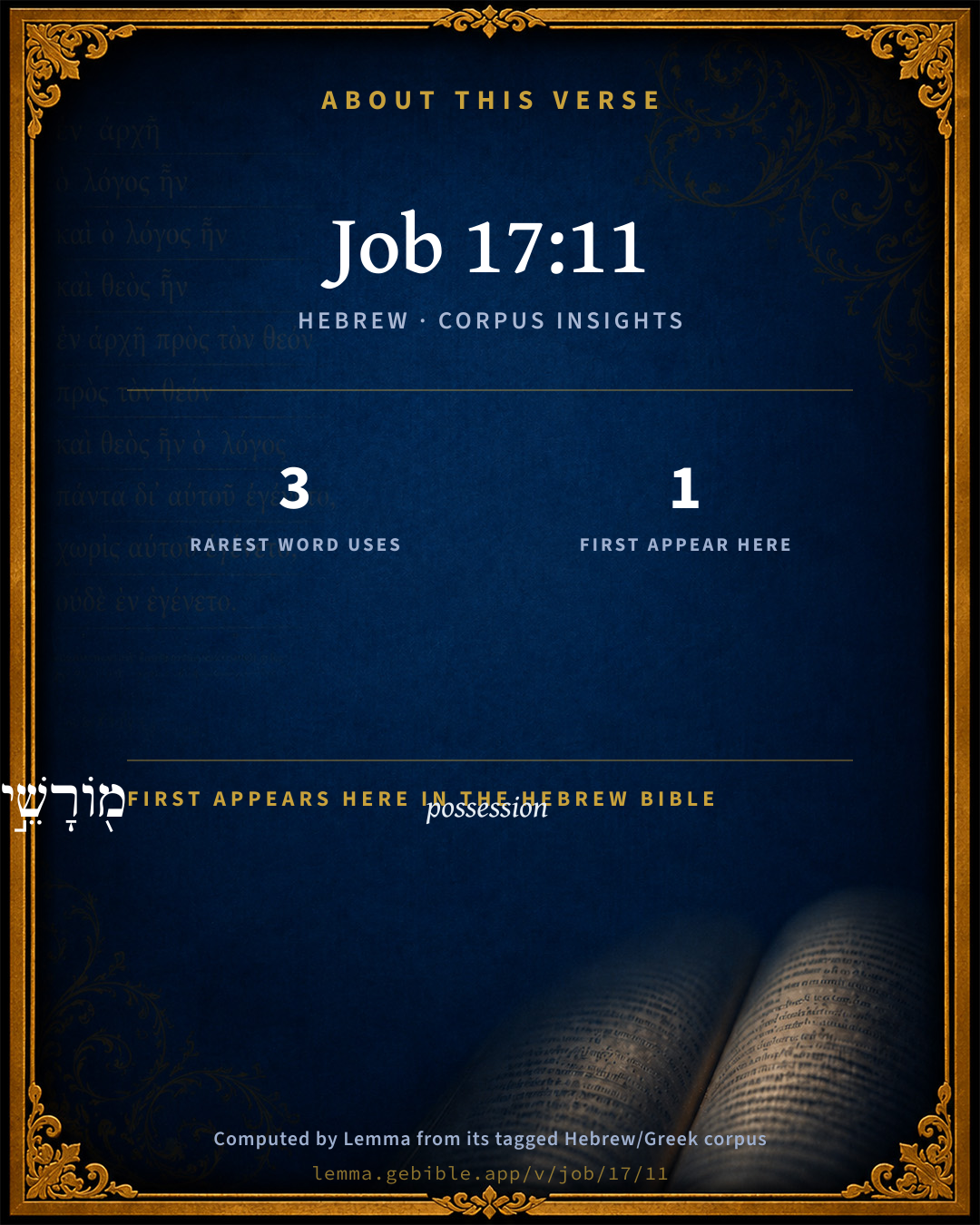
The rarest word here is מ֖וֹרָשֵׁ֣י possession H4180 — appearing just 3 times in the whole Hebrew Bible.

First appearance in Scripture

This word makes its first canonical appearance in the Hebrew Bible here:

  • מ֖וֹרָשֵׁ֣י possession H4180

Shared distinctive vocabulary

מ֖וֹרָשֵׁ֣י possession H4180 occurs in 3 verses of the Hebrew Bible. Also found in:

Grammatical profile

  • 2 verbs
  • 4 nouns

Verb forms

  • עָ֭בְרוּ Qal · Perfect
  • נִתְּק֑וּ Niphal · Perfect

Hebrew & Septuagint length

In English translation the verse runs 16 words from the Hebrew and 11 from the Septuagint (LXX English) — the Septuagint runs noticeably shorter here. See the side-by-side →

A rough comparison of the two English renderings, which tokenize alike — not a word-level alignment.

Word counts can differ between the Hebrew and the Greek without any difference in meaning — e.g. the Hebrew direct-object marker אֵת has no separate Greek word, and Greek often adds the article ὁ.

Cross-references

11

Topical passages linked to Job 17:11 in the Treasury of Scripture Knowledge — connected by theme and wording, ordered by reader-vote popularity; previews shown in the World English Bible.

  • Job 7:6 My days are swifter than a weaver's shuttle, And are spent without hope.
  • Isaiah 38:10 I said, In the noontide of my days I shall go into the gates of Sheol: I am deprived of the residue of my years.
  • Proverbs 16:9 A man's heart plans his course, But Yahweh directs his steps.
  • Isaiah 8:10 Take counsel together, and it shall be brought to nothing; speak the word, and it shall not stand: for God is with us.
  • Lamentations 3:37 Who is he who says, and it comes to pass, when the Lord doesn't command it?
  • 2 Corinthians 1:15–17 In this confidence, I was determined to come first to you, that you might have a second benefit;
  • James 4:13–15 Come now, you who say, "Today or tomorrow let's go into this city, and spend a year there, trade, and make a profit."
  • Job 9:25–26 "Now my days are swifter than a runner. They flee away, they see no good,
  • Proverbs 19:21 There are many plans in a man's heart, But Yahweh's counsel will prevail.
  • Ecclesiastes 9:10 Whatever your hand finds to do, do it with your might; for there is no work, nor device, nor knowledge, nor wisdom, in Sheol, where you are going.
  • Romans 1:13 Now I don't desire to have you unaware, brothers, that I often planned to come to you, and was hindered so far, that I might have some fruit among you also, even as among the rest of the Gentiles.

Cross-references courtesy of OpenBible.info (CC BY 4.0).

Hebrew and Greek witnesses Masoretic Hebrew ↔ Greek Septuagint

The same verse in the two great witnesses to the Old Testament, shown verse-for-verse.

Here the Septuagint runs noticeably shorter than the Hebrew — LXX2012 (modern English Septuagint) 11 words vs World English Bible 16. A rough length comparison of the two English translations, not a word-level alignment — read both below.

These are two independent witnesses, not word-aligned to each other, and the Septuagint is shown in lemma (dictionary) form.

Hebrew Job 17:11 Masoretic · Westminster Leningrad Codex

יָמַ֣י עָ֭בְרוּ זִמֹּתַ֣י נִתְּק֑וּ מ֖וֹרָשֵׁ֣י לְבָבִֽי

My days are past, my plans are broken off, As are the thoughts of my heart.

World English Bible · Public Domain

Greek LXX Job 17:11 Septuagint · lemma form

ὁ ἡμέρα ἐγώ παραἔρχομαι ἐν βρόμος ῥήγνυμι δέ ὁ ἄρθρον ὁ καρδία ἐγώ

My days have passed in groaning, and my heart-strings are broken.

LXX2012 (modern English Septuagint) · Public Domain

On this verse, Albert Barnes' Notes on the Bible discusses the Septuagint’s reading. Read the note in Commentary ↓

Hebrew: Westminster Leningrad Codex (CC BY 4.0). Greek: Septuagint (public domain); English from LXX2012 (modern English Septuagint) (Public Domain). How the Septuagint differs from the Hebrew →

Commentary

Notes on Job 17:11 from classic Christian and Jewish commentators (each source and its license shown beneath its notes). The classic Christian expositions comment on the surrounding passage and are grouped to its opening verse, so a note may address several verses; the Jewish commentaries on the Tanakh (Rashi and others) are per-verse, so they appear only where the commentator wrote on this verse.

Lemma curates 59 commentaries, every one of them public domain or Creative Commons licensed, each selected and text-cleaned for this edition rather than reprinted as found. About our sources →

Trapp's Complete Commentary

John Trapp

Job 17:11 My days are past, my purposes are broken off, [even] the thoughts of my heart.

Ver. 11. My days are past] q.d. It is past time of day for me to hope for a return of a prosperous condition, since I am irrecoverably diseased, and cannot be long of life.

My purposes are broken off] Or, My thoughts are plucked up by the roots, even the possessions of mine heart, that is, those thoughts that should wholly possess me, and take me up entirely, seizing upon my spirit; q.d. I am not now in case to think settledly and seriously of any good, my sorrows are so many, and my sores so grievous. The Chaldee hath it, The tables of my heart are broken. How foolish then are they who put off their repentance till they are cast upon their sick beds, when they may soon find enough to do to attend the pain and infirmity of their bodies! To suffer and be sick (saith one) is work enough for any man at one time; he had not need to have his greatest work to do when he hath such work to do.

John Trapp, A Commentary or Exposition upon All the Books of the Old and New Testament (1647–1656) — public domain. Text from a community e-Sword module.

The Biblical Illustrator

Joseph S. Exell

Job_17:11

My purposes are broken off.

Broken purposes

What mental anguish is concentrated in these few words! They raise the sufferings of Job from one of mere physical pain to one of mental despair: Let us glance, first, at some objects of human ambition--their wreck, their loss, and their gain.

I. The cherished purposes of life. The generality of persons live without forming any purposes at all. They drift along the current, and laying aside the strength and glory of manhood are nothing but logs. The true purposes of life are not mere languid dreams, or objectless hopes, or anticipations of pleasure, and we must not confound these with the ambition alluded to by Job. But they are the thought out plans and aspirations of a vigorous mind in true earnest.

1. Sometimes these purposes are selfish.

2. Sometimes these ambitions are philanthropic.

3. Sometimes these purposes are religious.

There is the longing to lead a notably pious life, to be a pattern for others to copy, to bring up a godly family, to convert sinners, and to be worthy soldiers of the cross.

II. The broken purposes of life. How often are ambitions formed; how seldom are they realised! Our purposes are always being broken. We have had a cherished plant, and longed to see it flower. But the frost has nipped the bud, and it has withered and drooped. We have had a loved child for whom we cherished a hope of carrying forward the work of our lives. But the loved one had been taken from us altogether or has turned out a sorrow instead of a joy. We have intended to go hither or thither, but the storm has intervened and we have been left behind.

III. The hand of God in the purposes of life. Job did not realise that his purposes had been cut off by God, and that there was an object underlying the sorrow which filled his heart. Neither do men understand that there may be a reason that they cannot fathom which has hindered the success of their cherished hopes. Eternity will show that mans purposes are broken--

1. Because if successful they would have been injurious to ourselves. Many souls have been saved by being kept from riches or power. Many have been kept from ruin by having their cherished idol taken away.

2. Because they might work some evil for others. We often see instances of misdirected philanthropy. But how seldom we can see behind the scenes, and how little do we know what will really benefit our fellow creatures!

3. Because God sees that we are not fitted for the work,

4. Because He has higher and better purposes for us.

5. Because He desires to bring us to a state of perfect trust in Himself. He crushes our plans to show us how weak, how foolish we are, and to lay us low in humility. How much wiser are His arrangements! (J. J. S. Bird.)

Broken purposes

I. Men form purposes. Mind is active and made to think. Men speculate and resolve. Pleasure and wealth, honour and worldly position eagerly sought.

II. These purposes not always fulfilled. Broken off as threads of the web cut off from the loom (Isa_32:1-20). Impossible to realise. Providence intervenes; man proposeth, God disposeth. Greeks represented the fates as spinning the threads of human life. Procrastination prevents performance. Satan hinders (1Th_2:18).

III. This is a sad fact in experience. My purposes. Good resolutions formed and never carried out; plans adopted and forsaken; principles never come to maturity, and life wasted in attempting, and nothing done! (The Study.)

Broken purposes

The world is full of broken columns. Every heart carries its own crowded cemetery. The cemeteries in which you lay dead flesh and bones are not the true cemeteries. The graveyards are in the heart. My purposes are broken off; this is the cry of a disappointed man; the muffled moan of a baffled hope. It is not the peculiar cry of a Jew, or of a Gentile, of an Orientalist, or an Occidentalist, it is simply the voice of universal man. God has graciously enriched the world with example men; men who have been made to show in their melancholy experience how vain is ambition, how uncertain is expectation, how unstable is strength. Job is such man.

I. As revealing the speculative side of human life. All men have purposes. Man cannot live by history alone; he must strengthen himself by hope. Man puts out his hand and plucks of the tree of tomorrow. Every man speculates concerning the future, and feels himself inspired as he dwells on the charms of the coming time. Mans power of speculation always exceeds mans power of realisation. The poetic fancy is in advance of the toiling hand. The wanderers mind is at the destination long before the wanderers foot has taken the first step of the journey! The power of speculation and the power of realisation are not coordinate. We paint many a fire which we never can enkindle. We plant olive yards which bear no fruit, and dig wells which hold no water. Yet we would not give up this power of projecting ourselves into the future! We would not like to be barred in the small prison called today. Not a man but is pleasing himself with some dream of fancy. Each is saying, The times will change for the better; the cold winds will die out; the sky will be a cloudless arch; I shall walk on a carpet of violets through palaces of perfume.

II. As disclosing the real side of human experience. Purposes!--that is poetry; Broken! - that is history! This is a sad combination of words! Life is full of half-built towers. Men had begun to build, but were not able to finish. Life is a pile of fragments. Nowhere is there aught complete. Life is all beginnings; there is no finished pinnacle!

III. As suggesting mans true course as a speculatist and as a worker. Go to now, ye that say today or tomorrow, etc. There is a tonight between today and tomorrow. Learn--

1. All purposes against God must be broken off.

2. Form the loftiest purposes for God, and they will be fulfilled.

3. Remember the moral import of uncertainty. (Anon.)

The Biblical Illustrator, edited by Joseph S. Exell (c. 1880s–1900s) — public domain. Text from a community e-Sword module.

Joseph Benson's Commentary

Job 17:11. My days are past — The days of my life. I am a dying man, and therefore the hopes you give me of the bettering of my condition are vain. My purposes are broken off — Or the designs and expectations which I had in my prosperous days concerning myself and children, and the continuance of my happiness. Even the thoughts of my heart — Hebrew, מורשׁי, morashei; the possessions of my heart; that is, those counsels and intentions which in a great measure possessed my heart, and were natural and familiar to me. All these are disappointed and come to nothing.

Joseph Benson's Commentary on the Old and New Testaments (1811–1818) — public domain. Text from a community e-Sword module.

Jamieson, Fausset & Brown

Robert Jamieson, A. R. Fausset & David Brown

Only do not vainly speak of the restoration of health to me; for "my days are past."

broken off--as the threads of the web cut off from the loom (Isa 38:12).

thoughts--literally, "possessions," that is, all the feelings and fair hopes which my heart once nourished. These belong to the heart, as "purposes" to the understanding; the two together here describe the entire inner man.

Jamieson, Fausset & Brown — Commentary Critical and Explanatory on the Whole Bible (1871) — public domain (CC PDM 1.0). Text via the HelloAO Bible API.

Adam Clarke's Commentary

Verse 11. My days are past] Job seems to relapse here into his former state of gloom. These transitions are very frequent in this poem; and they strongly mark the struggle of piety and resignation with continued affliction, violent temptation, and gloomy providences.

The thoughts of my heart.] All my purposes are interrupted; and all my schemes and plans, in relation to myself and family, are torn asunder, destroyed, and dissipated.

Adam Clarke's Commentary on the Bible (1810–1826) — public domain. Text from a community e-Sword/MySword module.

The Cambridge Bible for Schools and Colleges

gen. ed. J. J. S. Perowne

11. Very different from their delusive anticipations was the truth in regard to Job’s condition. His days were past, and his life with all its cherished purposes cut off. The thoughts of his heart is lit. as margin, the possessions, i. e. the enterprises and purposes which he cherished and clung to as that dearest to him.

The Cambridge Bible for Schools and Colleges (gen. ed. J. J. S. Perowne; Cambridge University Press, 1878–1918) — public domain. Text from a community e-Sword module.

John Gill's Exposition

My days are past,.... Or "passed away", or "passed over" (w); not that they passed over the time fixed and appointed by God, for there is no passing the bound settled by him, Job 14:5; but either the common term of man's life was passed with Job, or he speaks of things in his own apprehension; he imagined his death was so near, that he had not a day longer to live; his days, as he before says, were extinct, were at an end, he should never enjoy another day; and therefore it was folly to flatter him with a promise of long life, or encourage him to expect it; which he may mention as a proof of there being not a wise man among them, since they all suggested this in case of repentance; or his meaning is, that his good days, or days of goodness, as Jarchi interprets it, were past; his days of prosperity were at an end, and evil days were come upon him, in which he had no pleasure; nor had he any reason to believe it would be otherwise with him:

my purposes are broken off; Job doubtless had formed in his mind great designs of good things, natural, civil; and religious, concerning the enlargement of his temporal estate, the settlement of his children in the world, making provision for the poor, supporting and enlarging the interest of true religion, the reformation of his Heathenish neighbours, and the spread of divine truths among them; but now they were all frustrated, he was not in a capacity of carrying them into execution, and was obliged to drop them, and think no more of them, nor was there with him any prospect of ever renewing them; they were "rooted up" (x), or plucked up, as some render the word, so that there was no likelihood of their ever rising up again, and coming to any effect:

even the thoughts of my heart; or "the possessions" (y) of it, as the thoughts are; they are the things of a man, which especially belong to him; they are the inheritance of his mind, what none have a right unto, and a claim upon, but himself, nor can any know but himself, and to whom he discovers them: now the thread of these is broken off at death, they then cease; not that the mind or soul of man ceases to be, or ceases to be a thinking being, it still thinks; but only its thoughts are not employed about the same things in a future state, or in the state after death, as in this, see Psa 146:4.

(w) "transierunt", Pagninus, Montanus, &c. (x) "evulsae sunt", Pagninus, Montanus, Piscator; "radicitus evulsae sunt", Michaelis. (y) "possessiones", Montanus, Vatablus, Piscator, Cocceius, Schmidt; "haereditariae possessiones", Schultens; so Drusius & Michaelis.

John Gill's Exposition of the Whole Bible (1746–1763) — public domain (CC PDM 1.0). Text via the HelloAO Bible API.

Albert Barnes' Notes on the Bible

My days are past - “I am about to die.” Job relapses again into sadness - as he often does. A sense of his miserable condition comes over him like a cloud, and he feels that he must die.

My purposes are broken off - All my plans fail, and my schemes of life come to an end. No matter what they could say now, it was all over with him, and he must die; compare Isa 38:12 :

“My habitation is taken away, and is removed from me

Like a shepherd’s tent;

My life is cut off as by a weaver

Who severeth the web from the loom;

Between the morning and the night thou wilt make an end of me.”

Even the thoughts of my heart - Margin, possessions. Noyes, “treasures.” Dr. Good, “resolves.” Dr. Stock, “the tenants of my heart.” Vulgate, “torquen’es cor meum.” Septuagint, τὰ ἄρθρα τῆς καρδίας μου ta arthra tēs kardias mou - the strings of my heart. The Hebrew word (מורשׁ môrâsh) means properly possession (from ירשׁ yârash, to inherit); and the word here means the dear possessions of his heart; his cherished plans and schemes; the delights of his soul - the purposes which he had hoped to accomplish. All these were now to be broken on by death. This is to man one of the most trying things in death. All his plans must be arrested. His projects of ambition and gain, of pleasure and of fame, of professional eminence and of learning, all are arrested midway. The farmer is compelled to leave his plow in the furrow; the mechanic, his work unfinished; the lawyer, his brief half prepared; the student, his books lying open; the man who is building a palace, leaves it incomplete; and he who is seeking a crown, is taken away when it seemed just within his grasp. How many unfinished plans are caused by death every day! How many unfinished books, sermons, houses, does it make! How many schemes of wickedness and of benevolence, of fraud and of kindness, of gain and of mercy, are daily broken in upon by death! Soon, reader, all your plans and mine will be ended - mine, perhaps, before these lines meet your eye; yours soon afterward. God grant that our purposes of life may be such that we shall be willing to have them broken in upon - all so subordinate to the GREAT PLAN of being prepared for heaven, that we may cheerfully surrender them at any moment, at the call of the Master summoning us into his awful presence!

Albert Barnes' Notes on the Bible (1834–1885) — public domain. Text from a community e-Sword/MySword module.

Haydock's Catholic Bible Commentary

Thoughts, or fine projects of living happy a long time. (Calmet)

George Leo Haydock (1774–1849), Haydock's Catholic Family Bible and Commentary, 1859 edition — public domain. Excludes Psalms (Douay-Rheims chapter numbering differs from Protestant) and Deuterocanonical books (Catholic canon only).

Matthew Poole's English Annotations

My days; the days of my life. I am a lost and dying man, and therefore the hopes you give me of the bettering of my condition are vain and groundless.

My purposes; or, my designs, or

thoughts, to wit, which I had in my prosperous days, concerning myself and children, and the continuance of my happiness.

The thoughts of my heart, Heb. the possessions of my heart, i.e. those thoughts which in a great measure possessed my heart, which were most natural, and familiar, and delightful to me. All my thoughts, and designs, and hopes are disappointed, and come to nothing.

Matthew Poole's English Annotations on the Holy Bible (1683–1685) — public domain. Text from a community e-Sword/MySword module.

Whedon's Commentary on the Bible

Daniel D. Whedon

11. My days are past — The want of wisdom Job has just spoken of, the friends have shown in their glowing promises of future worldly bliss provided he will repent; that, too, while he has both feet in the grave. The thought serves as a transition to the elegy renewed in this verse.

Thoughts — מורשׁי, possessions, or treasures. Zockler calls them the wards, or nurslings, of the heart. The term comprehends thought, hope, purpose, affection — all the furniture of the soul.

Daniel D. Whedon (gen. ed.), Commentary on the Old and New Testaments (1874–1909) — public domain. Text from a community e-Sword module.

The Pulpit Commentary

My days are past. My days are slipping away from me. Life is well-nigh over. What, then, does it matter what you say? My purposes are broken off, even the thoughts of my heart; literally, the possessions of my heart "all the store that it has accumulated my desires, purposes, wishes. I no longer care to vindicate my innocence in the sight of men, or to clear my character from aspersions.

The premature arrest of the purposes of life.

Job looks out from the sadness of his present condition, and turns in thought to his past days, to the purposes of those days the hopes he had cherished, the plans he had laid, even the thoughts of his heart. Alas l they are dashed broken off. His purposes not accomplished, his plans useless, his hopes frustrated, his thoughts disappointed, his very days are past! How sad! how painful! We may reflect

I ON THE LIABILITY, TO WHICH EVERY ONE IS SUBJECT, OF HAVING THE PURPOSES OF HIS LIFE BROKEN OFF. No one can certainly calculate on the prolongation of his life. The plans wisely laid even for good and holy purposes may be frustrated. The thoughtfully devised scheme for usefulness, even for the highest service to men, as well as the prudent endeavour to promote the felicity of home, or to advance personal culture, may all be torn asunder or broken, snapped off without coming to maturity. None can calculate on the future.

II ON THE WISDOM OF SO FRAMING OUR ESTIMATE OF LIFE THAT WE ALWAYS TAKE INTO ACCOUNT THE UNCERTAINTY OF ITS TENURE. No man has a just view of his life who does not consider how soon life"s plans may be overset, torn to shreds. Life is not assured to us. We have no pledge that we shall have time to finish the work we have begun. Hence it is wise to frame our estimate of life in view of the possibility that all our hopes may be disappointed, our purposes broken off, and the thoughts of our hearts never fulfilled.

III THE POSSIBLE ARREST OF LIFE"S PURPOSES PREMATURELY MAKES IT NEEDFUL THAT EVERY ONE SHOULD SEEK DILIGENTLY TO DO HIS WORK WHILE OPPORTUNITY IS AFFORDED. Some work is given to every man to do, and time is given in which to do it. For no man is expected to do that for which he has not time. But no time may be wasted. The great lesson is again and again read in our hearing, "Work while it is called to-day, for the night cometh when no man can work." The uncertainty of our life"s duration makes diligence imperative; it checks too confident an assurance of the future, and it makes it all-important that the life be grasped whose duration is assured. Happy he who can form good purposes and find time to fulfil them! R.G.

Broken purposes.

Job seems to be sinking back into despair after the hopeful and confident utterance of ver. 9. Perhaps the explanation of the situation lies in the difficulty the patriarch experiences in squaring the convictions of his rising faith with the actual condition in which he now lies. He wonders how his innocence can be vindicated, how he can bold on and increase in strength, although he is now persuaded that God will help him ultimately to do so. Meanwhile all his purposes are broken. Let us notice three kinds of broken purposes

I BAD PURPOSES. Surely these should be broken. It is absurd to suppose that because an evil design has been conceived in the dark recesses of the imagination it must be effected. Bad purposes may be frustrated.

1. Broken by God. He knows the thoughts of men"s hearts, and can "frustrate their knavish tricks." What we call accidents are providential events; and how often has the purpose of sin been checked by these events! The destroying angel mows down the Assyrian host, (2Ch_32:21) A storm scatters the Armada. "Gunpowder treason" is discovered just before the meeting of Parliament.

2. Broken by their authors. The repentant sinner can stay his hand from further wickedness. He need feel under no obligation to fulfil his vows of evil. Indeed, there is no true repentance without the breaking off of bad purposes. Let us be thankful if all our bad purposes are not executed.

II GOOD PURPOSES. These also may be broken.

1. By adverse events. God will not frustrate a really good design. But we may find it impossible to accomplish the best of purposes. God purposed the salvation of the world, yet how far is his good purpose even from fulfilment! We know that he must triumph finally. But in the mean time the spirit of evil hinders. Job"s purposes were broken by Satan. God"s purposes are not only hindered by Satan; they are checked by the free will of men who are reluctant to acknowledge them.

2. By their authors. Good resolutions have paved a large place. How many of the plans of youth have been carried out in manhood? and how many of them have melted away as idle dreams? How far have the purposes of the Christian life been adhered to? Has the old sin been avoided, as we vowed it should be? Have we served God with singleness of heart? Have we denied ourselves and followed Christ, as we dreamed of doing when we first gave him our hearts? Have we lived unselfishly and in charity towards our neighbours? Do not such questions rouse a sickening sense of failure? Verily we have broken our good purposes most miserably.

III MISTAKES PURPOSES. These are of an intermediate character. Good in intention, they would not have turned out well if we had been permitted to execute them. Therefore God has frustrated them. Some of these are quite excellent, only they are altogether beyond our reach. The brave lifeboat crew tries to save the shipwrecked sailors, but, alas! the sea runs too high to permit them to approach, and their purpose is broken. Some whole lives seem to be failures simply because their owners have mistaken their vocation. The man who is a failure as a barrister might have become an excellent farmer; he has chosen an unsuitable sphere. We wish to do good. Then let us pray for light lest we blunder into mischief-making in the very effort to help our neighbours. W.F.A.

The Pulpit Commentary (1880–1919), ed. H.D.M. Spence-Jones & Joseph S. Exell — public domain. Text from a community e-Sword module.

John Wesley's Explanatory Notes

My days - The days of my life. I am a dying man, and therefore the hopes you give me of the bettering of my condition, are vain. Purposes - Which I had in my prosperous days, concerning myself and children.

John Wesley, Explanatory Notes Upon the Whole Bible (1754–1765) — public domain. Text via the GEBible commentary corpus.

Kretzmann's Popular Commentary

Paul E. Kretzmann

Job’s Hopelessness in his Affliction

v. 11. My days are past, he felt that he was near the end, and he sank back into his former hopeless complaint, my purposes are broken off, the plans which he had made for his life were cut off, destroyed, even the thoughts of my heart, the projects which he had secretly nursed and affectionately cherished.

v. 12. They change the night into day, namely, such joyous plans for life as his friends held before him; the light is short because of darkness, in the presence of darkness, for, according to the consolations of his friends, his present trouble was just like the darkest hour which just precedes the dawn, if he would but admit the guilt which they ascribed to him. All this was being alleged while Job saw before him only the dark night of death.

v. 13. If I wait, the grave is mine house, if he hopes for the realm of death as his dwelling place; I have made my bed in the darkness, having spread his couch in the darkness of death.

v. 14. I have said to corruption, Thou art my father, if he has so cried out to the pit or grave; to the worm, Thou art my mother and my sister;

v. 15. and where, or, "where, then," is now my hope? As for my hope, who shall see it? Who would disclose and prove to him that he had any hope of being restored to health and strength!

v. 16. They shall go down to the bars of the pit, that is, his hope sinks down to the bars of the underworld, to the realm of death, when our rest together is in the dust, that is, while his body rests in the dust of the earth, in the grave, his soul would descend into the realm of the dead, the place where the souls are kept till the great day of resurrection. When his hope of death would become a certainty, then the misery of his suffering would become the rest of the grave. Similar sighs are voiced to this day, even by true believers, who are tired of the misery of this world; but they must never turn into impatient demands addressed to God.

Paul E. Kretzmann, Popular Commentary of the Bible (1921–1924) — public domain. Text from a community e-Sword module.

unfoldingWord translationNotes

Door43 World Missions Community

General Information:

Job continues to speak.

My days are past

This is an idiom. AT: "My time is past" or "My life is over" (See: Idiom)

my plans are shattered, and so are the desires of my heart

Here Job's "heart" represents his inner being. AT: "my plans will never happen, nor will the things that I have desired most" (See: Metonymy)

These people, these mockers

These two phrases refer to the same people, namely Job's friends, Eliphaz, Bildad, and Zophar. The second phrase emphasizes their unfriendly attitude. (See: Doublet)

change the night into day

This speaks of the people claiming that night is day as if they actually changed night into day. AT: "claim it is daytime when it is night" or "say the opposite of what is true, just as night is the opposite of day" (See: Metaphor)

light is near to darkness

It is implied that the mockers claim that it is light when it is close to dark. AT: "they claim that light is near to darkness" or "they claim that when it is becoming dark, that it is getting light" (See: Assumed Knowledge and Implicit Information)

translationWords

heart

mock

light

darkness

unfoldingWord translationNotes — © Distant Shores Media and the Door43 World Missions Community, licensed CC BY-SA 4.0. Source: git.door43.org/Door43/en_tn.

Rashi

Rabbi Shlomo Yitzchaki (Rashi)

My days etc. Behold, the days of my prosperity, to which I became accustomed, have passed.

my purposes Which I had expected to last with prosperity.

the thoughts of my heart have been broken off Heb. מורשי, lit. the inheritances of. The thoughts which my heart gave me to possess, for my heart said that I would inherit good because of my [righteous] way.

Rashi on the Tanakh — English translations: “The Judaica Press complete Tanach with Rashi, translated by A. J. Rosenberg” (CC BY 4.0); “Pentateuch with Rashi's commentary by M. Rosenbaum and A.M. Silbermann, 1929-1934” (public domain); “The Metsudah Tanach series, Lakewood, N.J” (CC BY 4.0); and “The Book of Joshua, Metsudah Publications, 1997” (CC BY 4.0). Text via Sefaria.

Lesson kit

Teaching starters — assembled from the data on this page, not authored interpretation. Every prompt links to the verse data it draws on. Edit before teaching.

Job, in the Wisdom, opens this verse with 6 words (6 distinct Hebrew lemmas). Its most distinctive word is môwrâsh (“possession”). The Greek Septuagint runs shorter here. A historical commentator’s framing appears above. Read the whole chapter for the surrounding context.

Discussion questions

  1. What does “possession” (môwrâsh) contribute to the verse as a whole?
  2. This is the first place “possession” appears in Scripture (first appears here). What does its debut here establish?
  3. How does Isaiah 14:23, which shares the word «possession», read alongside this verse?
  4. The Septuagint runs shorter here than the Hebrew. What might account for the difference?
  5. The translations on this page render this verse differently — a whole-verse word diff, not a word-by-word alignment. What might account for the different wordings?
  6. «עָ֭בְרוּ» is a Qal Perfect verb. How does that grammatical form shape the action described?
  7. Compare how Trapp's Complete Commentary and The Biblical Illustrator read this verse. Where do they agree or differ?

Things to notice

  • 1 word makes its first canonical appearance in Scripture here.
  • These translations choose different wording for 9 words in this verse.
  • 6 distinct Hebrew lemmas span 6 words in this verse.

Reading settings

Reading text

Shown beneath each verse's original-language words.

Old Testament
Old Testament edition

Read the OT as the Masoretic Hebrew (MT) or the Greek Septuagint (LXX).

English shown for the Greek Septuagint (in the Hebrew ↔ Greek comparison).

Comparing translations? Open the Compare panel on any verse page to stack up to four side by side.