
Ezekiel 20:19

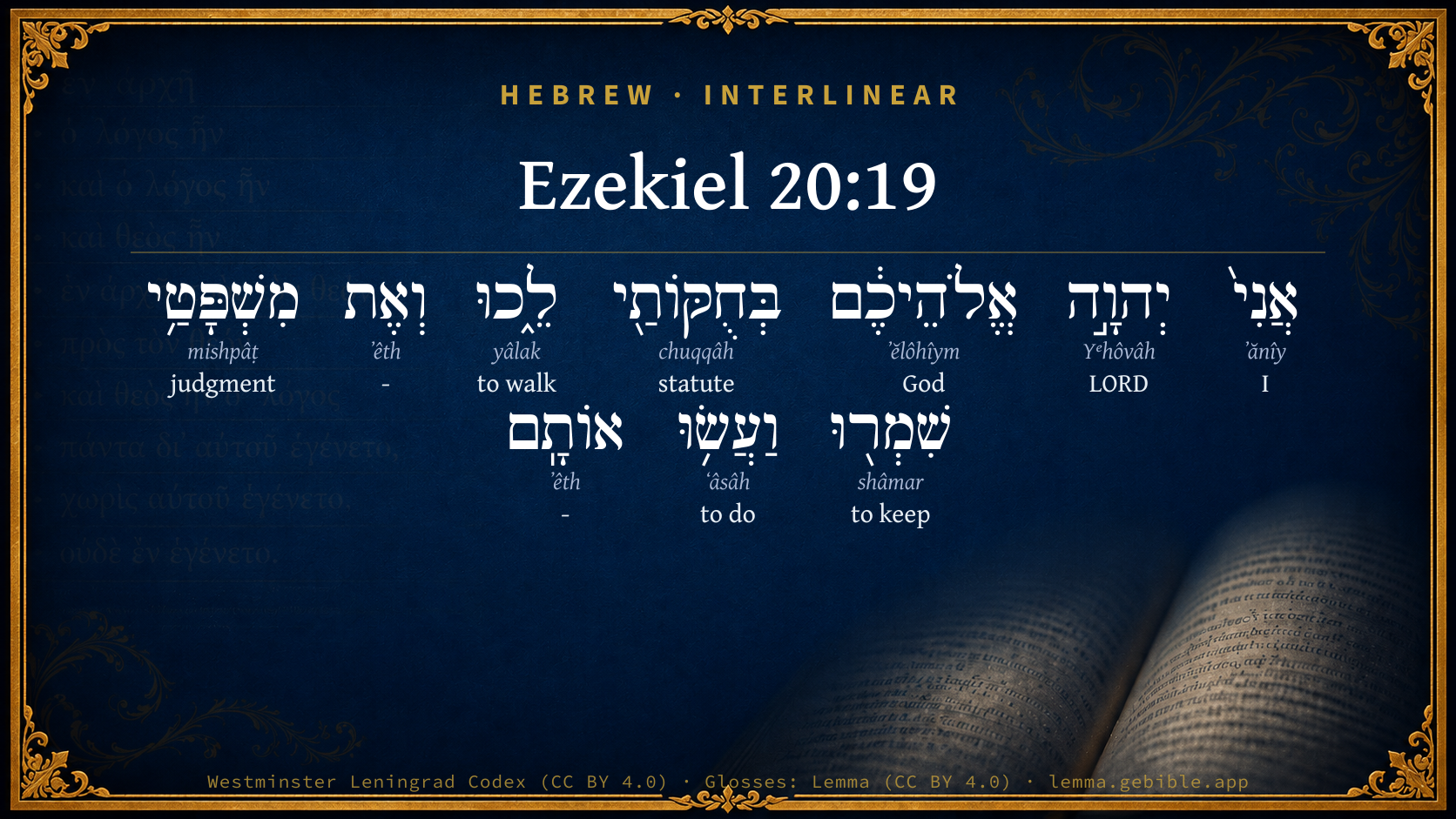
Hebrew (Westminster Leningrad Codex) Ezekiel 20:19 appears in the Hebrew Old Testament. The text above is from the Westminster Leningrad Codex. Each word links to its Strong’s number, a concise gloss, and parsing drawn from the Open Scriptures Hebrew Bible morphology. Click any word for its full Brown-Driver-Briggs (BDB) entry.
Download image
Cite this verse

Ezekiel 20:19 (World English Bible). Public Domain. Lemma interlinear Bible study tool, https://lemma.gebible.app/v/ezekiel/20/19.

Show BibTeX & RIS
BibTeX
RIS
English Translation
I am Yahweh your God: walk in my statutes, and keep my ordinances, and do them;
World English Bible · Public Domain
Download a study sheet

One document with this verse’s original text, its word-by-word gloss line, the meaning frame, cross-references with their text, attributed commentary, and full source and license credits — printable, and it pastes into notes with its structure intact.

This verse Autodidact and up

Study sheet (.html) Plain text (.txt)

A passage Seminary Student

Up to 50 verses in one chapter. A passage sheet keeps up to 6 commentary sources and 12 cross-references per verse, in the order this page ranks them, and says so on the sheet whenever that leaves anything out. Ask for a single verse and you get the Autodidact verse sheet above.

Everything on this page stays free to read, with no account — the sheet is a download of what is already on screen, not access to it.

Want to remove ads? Support Godless Engineer
Compare translations 3

The same verse in 3 English versions, stacked beneath the original-language interlinear above. Click any original word for its lexicon entry.

Each is an independent rendering of the whole verse — the interlinear is not word-aligned to these translations.

Highlighted words mark where these versions differ — a whole-verse word diff, not a word-by-word alignment.

  • World English Bible Public Domain
    I am Yahweh your God: walk in my statutes, and keep my ordinances, and do them;
  • King James Version Public Domain
    I am the LORD your God; walk in my statutes, and keep my judgments, and do them;
  • unfoldingWord Literal Text CC BY-SA 4.0
    I am Yahweh your God, walk in my statutes; keep my decrees and obey them.

unfoldingWord Literal Text — © unfoldingWord, licensed CC BY-SA 4.0. Word-aligned USFM3 via Door43 (git.door43.org/unfoldingWord/en_ult).

Versions to compare (up to 4)

3 of 4 selected

Show all 18 translations

Every available English version of this verse, each an independent rendering of the whole verse.

  • World English Bible Public Domain
    I am Yahweh your God: walk in my statutes, and keep my ordinances, and do them;
  • Berean Standard Bible Public Domain
    I am the LORD your God; walk in My statutes, keep My ordinances, and practice them.
  • Majority Standard Bible Public Domain
    I am the LORD your God; walk in My statutes, keep My ordinances, and practice them.
  • King James Version Public Domain
    I am the LORD your God; walk in my statutes, and keep my judgments, and do them;
  • American Standard Version (1901) Public Domain
    I am Jehovah your God: walk in my statutes, and keep mine ordinances, and do them;
  • Revised Version (1885) Public Domain
    I am the LORD your God; walk in my statutes, and keep my judgments, and do them:
  • Geneva Bible (1599) Public Domain
    I am the Lord your God: walke in my statutes, and keepe my iudgements and doe them,
  • Douay-Rheims (1899) Public Domain
    I am the Lord your God: walk ye in my statutes, and observe my judgments, and do them.
  • Young's Literal Translation Public Domain
    I `am' Jehovah your God, in My statutes walk, And My judgments observe, and do them,
  • Literal Standard Version CC BY-SA 4.0
    I [am] your God YHWH, walk in My statutes, || And observe My judgments, and do them,
  • Unlocked Literal Bible CC BY-SA 4.0
    I am Yahweh your God, walk in my statutes; keep my decrees and obey them.
  • unfoldingWord Literal Text CC BY-SA 4.0
    I am Yahweh your God, walk in my statutes; keep my decrees and obey them.
  • Darby Bible Public Domain
    I [am] Jehovah your God: walk in my statutes, and keep mine ordinances, and do them;
  • World Messianic Bible Public Domain
    I am the LORD your God. Walk in my statutes, keep my ordinances, and do them.
  • Webster's Bible Public Domain
    I am the LORD your God; walk in my statutes, and keep my judgments, and do them;
  • Free Bible Version CC BY-SA 4.0
    I am the Lord your God. Do what I tell you to do. Follow my regulations and make sure to practice them.
  • Bible in Basic English Public Domain
    I am the Lord your God; be guided by my rules and keep my orders and do them:
  • JPS Tanakh (1917) Public Domain
    I am the LORD your God; walk in My statutes, and keep Mine ordinances, and do them;

Literal Standard Version (2020), Covenant Press — licensed CC BY-SA 4.0. Text via the HelloAO Bible API (eBible.org). Unlocked Literal Bible (unfoldingWord) — licensed CC BY-SA 4.0. Text via the HelloAO Bible API (eBible.org). unfoldingWord Literal Text — © unfoldingWord, licensed CC BY-SA 4.0. Word-aligned USFM3 via Door43 (git.door43.org/unfoldingWord/en_ult). Free Bible Version, Dr. Jonathan Gallagher — licensed CC BY-SA 4.0. Text via the HelloAO Bible API (eBible.org).

Word by word

More ways to search: Search by grammar → Find every occurrence → Compare this word →

Practice this passage: Drill this verse → Learn its vocabulary →

בְּחֻקּוֹתַ֖י
chuqqâh
H2708
“in/at · statutes · my”
Preposition + Noun, Common, Both, Plural, Construct + Suffix, Personal, 1st Person, Common, Singular
Part of Speech
Preposition + Noun
Type
Common
Gender
Both
Number
Plural
State
Construct
Full BDB Definition

Origin: from H2706

TWOT: 728b

statute, ordinance, limit, enactment, something prescribed - statute
  1. אֲנִי֙ ʼănîy H589 “I” Pronoun, Personal, 1st Person, Common, Singular
  2. יְהוָ֣ה Yᵉhôvâh H3068 “LORD” Noun, Proper
  3. אֱלֹהֵיכֶ֔ם ʼĕlôhîym H430 “God(s) · your” Noun, Common, Masculine, Plural, Construct + Suffix, Personal, 2nd Person, Masculine, Plural
  4. לֵ֑כוּ yâlak H3212 “walk” Verb, Qal, Imperative, 2nd Person, Masculine, Plural
  5. וְאֶת ʼêth H853 “and · -” Conjunction + Particle, Direct Object
  6. מִשְׁפָּטַ֥י mishpâṭ H4941 “judgments · my” Noun, Common, Masculine, Plural, Construct + Suffix, Personal, 1st Person, Common, Singular
  7. שִׁמְר֖וּ shâmar H8104 “keep” Verb, Qal, Imperative, 2nd Person, Masculine, Plural
  8. וַעֲשׂ֥וּ ʻâsâh H6213 “and · do” Conjunction + Verb, Qal, Imperative, 2nd Person, Masculine, Plural
  9. אוֹתָֽם ʼêth H853 “- · them” Particle, Direct Object + Suffix, Personal, 3rd Person, Masculine, Plural

About this verse

These counts appear in no published source. They are computed here, from the morphology-tagged text and Lemma’s own curated glosses. What Lemma adds →

10
words
9
distinct lemmas
Prophets
section

Grammatical profile

  • 3 verbs
  • 4 nouns
  • 1 pronoun
  • 2 particles

Verb forms

  • לֵ֑כוּ Qal · Imperative
  • שִׁמְר֖וּ Qal · Imperative
  • וַעֲשׂ֥וּ Qal · Imperative

Hebrew & Septuagint length

In English translation the verse runs 16 words from the Hebrew and 17 from the Septuagint (LXX English) — closely comparable.

A rough comparison of the two English renderings, which tokenize alike — not a word-level alignment.

Word counts can differ between the Hebrew and the Greek without any difference in meaning — e.g. the Hebrew direct-object marker אֵת has no separate Greek word, and Greek often adds the article ὁ.

In the original languages it is 10 Hebrew tokens and 18 Greek tokens — but the two are counted differently (Hebrew bundles its prefixes and suffixes into one token; the Greek is in lemma form), so that isn’t a like-for-like length.

Cross-references

19

Topical passages linked to Ezekiel 20:19 in the Treasury of Scripture Knowledge — connected by theme and wording, ordered by reader-vote popularity; previews shown in the World English Bible.

  • Deuteronomy 5:32–6:8 You shall observe to do therefore as Yahweh your God has commanded you: you shall not turn aside to the right hand or to the left.
  • Psalms 105:45 That they might keep his statutes, And observe his laws. Praise Yah!
  • Jeremiah 3:22–23 Return, you backsliding children, I will heal your backsliding. Behold, we are come to you; for you are Yahweh our God.
  • Ezekiel 36:27 I will put my Spirit within you, and cause you to walk in my statutes, and you shall keep my ordinances, and do them.
  • Deuteronomy 12:1 These are the statutes and the ordinances which you shall observe to do in the land which Yahweh, the God of your fathers, has given you to possess it, all the days that you live on the earth.
  • Psalms 81:9–10 There shall be no strange god in you, Neither shall you worship any foreign god.
  • Ezekiel 11:20 that they may walk in my statutes, and keep my ordinances, and do them: and they shall be my people, and I will be their God.
  • Ezekiel 37:24 My servant David shall be king over them; and they all shall have one shepherd: they shall also walk in my ordinances, and observe my statutes, and do them.
  • Deuteronomy 5:6–7 "I am Yahweh your God, who brought you out of the land of Egypt, out of the house of bondage.
  • Deuteronomy 7:4–6 For he will turn away your son from following me, that they may serve other gods: so will the anger of Yahweh be kindled against you, and he will destroy you quickly.
  • Deuteronomy 8:1 All the commandment which I command you this day shall you observe to do, that you may live, and multiply, and go in and possess the land which Yahweh swore to your fathers.
  • Deuteronomy 10:1–12 At that time Yahweh said to me, Hew you two tables of stone like the first, and come up to me onto the mountain, and make an ark of wood.
  • Deuteronomy 11:1 Therefore you shall love Yahweh your God, and keep his charge, and his statutes, and his ordinances, and his commandments, always.
  • Psalms 19:7–11 Yahweh's law is perfect, restoring the soul. Yahweh's testimony is sure, making wise the simple.
  • Titus 2:11–14 For the grace of God has appeared, bringing salvation to all men,
  • Exodus 20:2–3 "I am Yahweh your God, who brought you out of the land of Egypt, out of the house of bondage.
  • Deuteronomy 4:1 Now, Israel, listen to the statutes and to the ordinances, which I teach you, to do them; that you may live, and go in and possess the land which Yahweh, the God of your fathers, gives you.
  • Deuteronomy 5:1 Moses called to all Israel, and said to them, Hear, Israel, the statutes and the ordinances which I speak in your ears this day, that you may learn them, and observe to do them.
  • Nehemiah 9:13–14 You came down also on Mount Sinai, and spoke with them from heaven, and gave them right ordinances and true laws, good statutes and commandments,

Cross-references courtesy of OpenBible.info (CC BY 4.0).

Hebrew and Greek witnesses Masoretic Hebrew ↔ Greek Septuagint

The same verse in the two great witnesses to the Old Testament, shown verse-for-verse.

These are two independent witnesses, not word-aligned to each other, and the Septuagint is shown in lemma (dictionary) form.

Hebrew Ezekiel 20:19 Masoretic · Westminster Leningrad Codex

אֲנִי֙ יְהוָ֣ה אֱלֹהֵיכֶ֔ם בְּחֻקּוֹתַ֖י לֵ֑כוּ וְאֶת מִשְׁפָּטַ֥י שִׁמְר֖וּ וַעֲשׂ֥וּ אוֹתָֽם

I am Yahweh your God: walk in my statutes, and keep my ordinances, and do them;

World English Bible · Public Domain

Greek LXX Ezekiel 20:19 Septuagint · lemma form

ἐγώ κύριος ὁ θεός σύ ἐν ὁ πρόσταγμα ἐγώ πορεύομαι καί ὁ δικαίωμα ἐγώ φυλάσσω καί ποιέω αὐτός

I am the Lord your God; walk in my commandments, and keep my ordinances, and do them;

LXX2012 (modern English Septuagint) · Public Domain

Hebrew: Westminster Leningrad Codex (CC BY 4.0). Greek: Septuagint (public domain); English from LXX2012 (modern English Septuagint) (Public Domain). How the Septuagint differs from the Hebrew →

Targum (Aramaic paraphrase)

1

The Targum is the ancient Jewish Aramaic paraphrase of the Hebrew Scriptures — an interpretive translation, not the Hebrew text itself. Onkelos (literal) and Pseudo-Jonathan (expansive) render the Torah, and Jonathan the Prophets. Coverage is partial: where no permissively-licensed English translation exists for a verse, only the Aramaic is shown. This is verse-level text, not a word-by-word alignment to the Hebrew.

  1. Targum Jonathan Prophets (Joshua–Malachi)
    אֲנָא יְיָ אֱלָהָכוֹן בִּקְיָמֵי הֲלִיכוּ וְיַת דִינֵי טָרוּ וַעֲבִידוּ יַתְהוֹן:

    (no public-domain English translation for this verse)

    Targum Jonathan — Aramaic: “Mikraot Gedolot” (public domain). English: “Sefaria Community Translation” (CC0 1.0 (public-domain dedication)); “London "Chaldee Paraphrase," 1871” (public domain). Text via Sefaria.

Commentary

Notes on Ezekiel 20:19 from classic Christian and Jewish commentators (each source and its license shown beneath its notes). The classic Christian expositions comment on the surrounding passage and are grouped to its opening verse, so a note may address several verses; the Jewish commentaries on the Tanakh (Rashi and others) are per-verse, so they appear only where the commentator wrote on this verse.

Lemma curates 59 commentaries, every one of them public domain or Creative Commons licensed, each selected and text-cleaned for this edition rather than reprinted as found. About our sources →

Trapp's Complete Commentary

John Trapp

Eze 20:19 I [am] the LORD your God; walk in my statutes, and keep my judgments, and do them;

Ver. 19. Walk in my statutes.] This is a surer and safer way. Lex, lux: "The commandment is a lamp, and the law is light." {Pro 6:23} Come, therefore, to this light, that your deeds may be made manifest that they are wrought in God. {Joh 3:21}

John Trapp, A Commentary or Exposition upon All the Books of the Old and New Testament (1647–1656) — public domain. Text from a community e-Sword module.

Jamieson, Fausset & Brown

Robert Jamieson, A. R. Fausset & David Brown

It is an indirect denial of God, and a robbing Him of His due, to add man's inventions to His precepts.

Jamieson, Fausset & Brown — Commentary Critical and Explanatory on the Whole Bible (1871) — public domain (CC PDM 1.0). Text via the HelloAO Bible API.

John Calvin's Commentaries

Let us proceed then. I, says he, am Jehovah your God; walk you in my statutes, and observe my judgments. God confirms the former sentence, and at the same time provides a remedy for all corruption’s when he says, walk you in my precepts, because I am your God: for by these words he claims as peculiarly his own what men commonly arrogate to themselves. They do not dare, indeed, to despoil God of his authority, but they carry themselves as his allies, and infect his law with their commentaries, as if it was not sufficient for complete and solid wisdom. Here, therefore, God pronounces himself to be the only lawgiver. If, therefore, I am your God, walk you in. my statutes. Hence it follows, that we indirectly deny God when we turn aside even a little from his law. The passage is remarkable, if we only estimate the Prophet’s language aright. For the two clauses must be read together, because I am your God, therefore walk you in precepts, and thus show that you are my people. But if they are not content with God’s precepts only, but mingle human comments with them, God indirectly teaches that he is not acknowledged, since they deprive him of a portion of his rights; for if God is one, he also is the only lawgiver. It follows —

John Calvin's Commentaries (1540-1563) — public domain. Text from the Calvin Translation Society English edition (1840s-50s) via the Christian Classics Ethereal Library (ccel.org). Calvin's coverage is partial (roughly two-thirds of the Bible); uncommented books and verses are honest gaps, never fabricated. The 19th-century editor's footnotes and remarks are omitted so the notes are faithfully Calvin's own voice.

John Gill's Exposition

I am the Lord your God,.... Not only that had made them and preserved them, but had chose them above all people to be his people; who had made a covenant with them, and had distinguished them by his favours from all others:

walk in my statutes, and keep my judgments, and do them; which he had given unto their fathers, and they had neglected and despised; those contained in the decalogue, and in the whole book of Deuteronomy, and elsewhere,

John Gill's Exposition of the Whole Bible (1746–1763) — public domain (CC PDM 1.0). Text via the HelloAO Bible API.

Matthew Poole's English Annotations

The Lord; the only God; idols, though your fathers’ idols, are no gods, therefore let them never be that to you which they are not, cannot be in themselves, the object of worship, and trust, and love.

Your God, by covenant, by redemption out of Egypt, by adoption, and giving you the law; therefore own me as such, by keeping mine ordinances and judgments to do them; I am most your Father.

Matthew Poole's English Annotations on the Holy Bible (1683–1685) — public domain. Text from a community e-Sword/MySword module.

Lesson kit

Teaching starters — assembled from the data on this page, not authored interpretation. Every prompt links to the verse data it draws on. Edit before teaching.

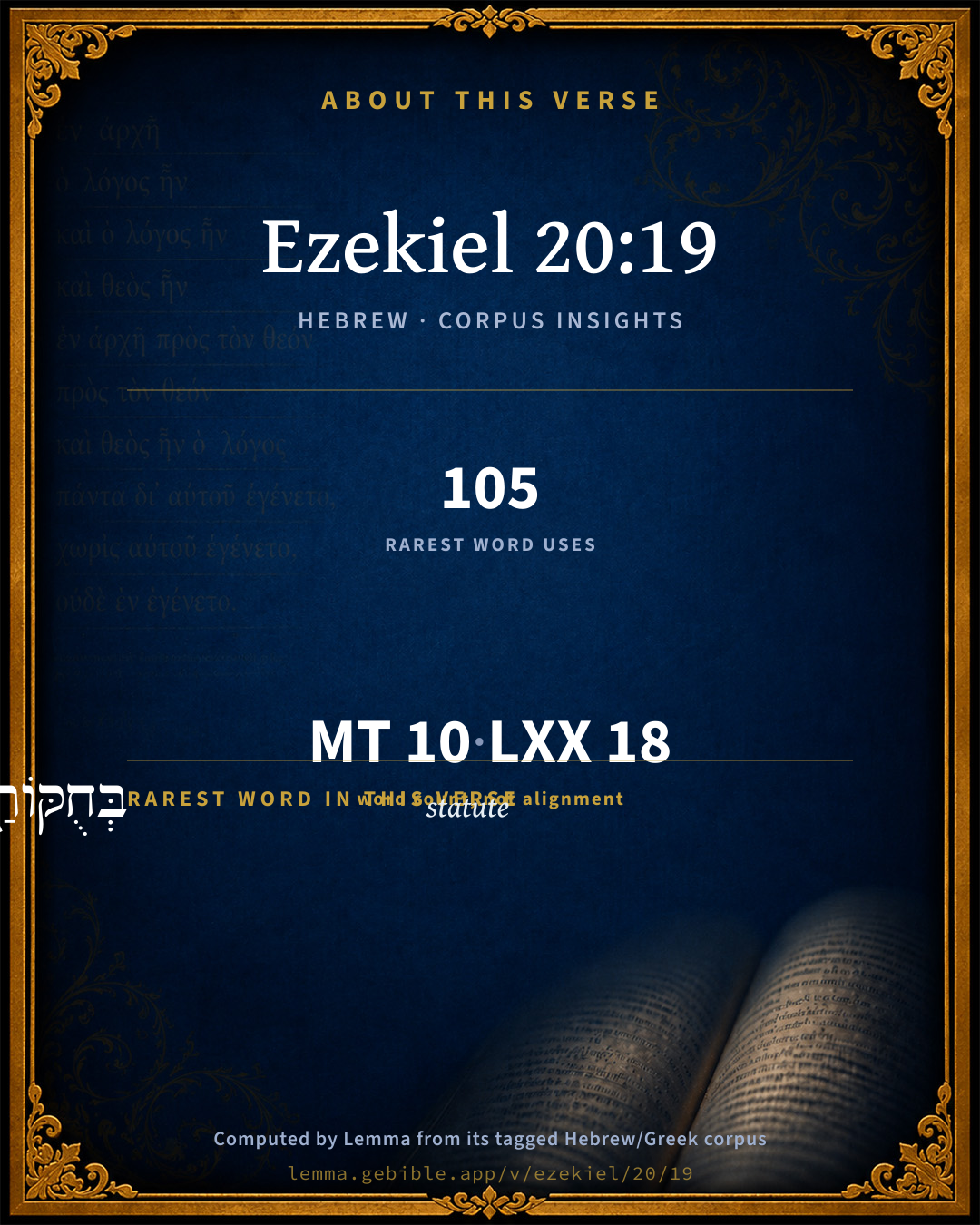
Ezekiel, in the Prophets, opens this verse with 10 words (9 distinct Hebrew lemmas). Its most distinctive word is chuqqâh (“statute”). A historical commentator’s framing appears above. Read the whole chapter for the surrounding context.

Discussion questions

  1. What does “statute” (chuqqâh) contribute to the verse as a whole?
  2. How does Deuteronomy 5:32–6:8, which shares this passage’s theme, read alongside this verse?
  3. These translations render this verse differently. What is at stake in choosing one wording over another?
  4. «לֵ֑כוּ» is a Qal Imperative verb. How does that grammatical form shape the action described?
  5. Compare how Trapp's Complete Commentary and Jamieson, Fausset & Brown read this verse. Where do they agree or differ?

Things to notice

Reading settings

Reading text

Shown beneath each verse's original-language words.

Old Testament
Old Testament edition

Read the OT as the Masoretic Hebrew (MT) or the Greek Septuagint (LXX).

English shown for the Greek Septuagint (in the Hebrew ↔ Greek comparison).

Comparing translations? Open the Compare panel on any verse page to stack up to four side by side.