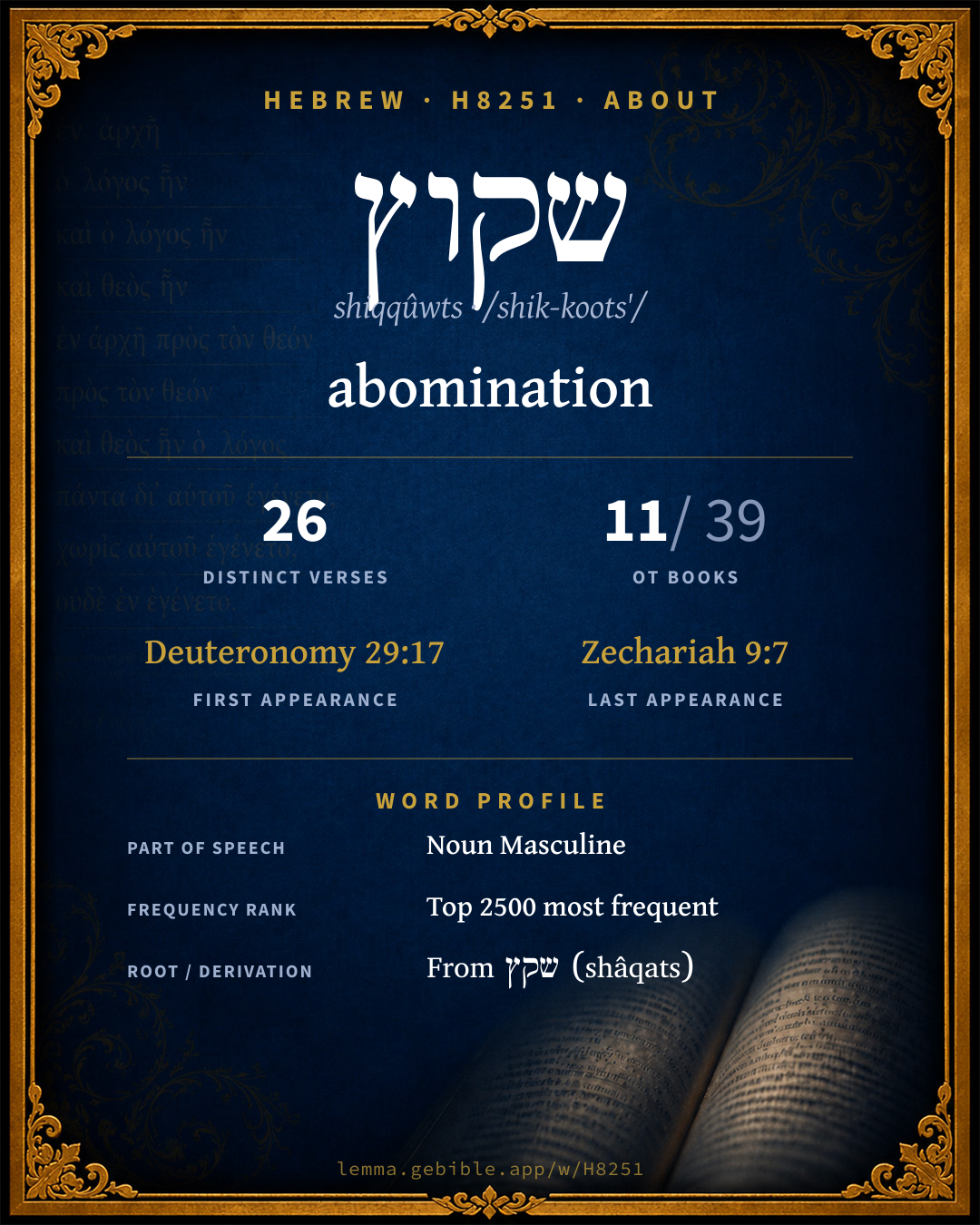
שִׁקּוּץ
abomination
Full lexicon entry — Brown-Driver-Briggs (BDB)
From Brown-Driver-Briggs (BDB)
Where this word appears
See every Construct-state word in the Hebrew Bible →
Grammar key — what these labels mean
Part of speech
- Noun
- A naming word — a person, place, thing, or idea.
Noun type
- Common
- A common noun — a general class of person, place, or thing (“king,” “city,” “water”), not a specific name.
State
- Construct
- A noun bound to a following noun in a possessive / “of” relationship (the construct chain).
- Absolute
- The independent form of a noun, not bound to a following word.
Gender
- Masculine
- Grammatically masculine.
Number
- Plural
- More than one (in Hebrew, generally three or more).
- Singular
- One.
Grammatical forms
- Noun, Common, Masculine, Plural, Construct 16 times (57%)
- Noun, Common, Masculine, Singular, Construct 5 times (18%)
- Noun, Common, Masculine, Plural, Absolute 5 times (18%)
- Noun, Common, Masculine, Singular, Absolute 2 times (7%)
Parsed forms decoded from the imported morphology (morphhb / Westminster Leningrad Codex — WLC text public domain, morphhb tagging CC BY 4.0), counted across 28 parsed occurrences — not distinct verses.
Every verse where H8251 appears — 26 distinct verses across 11 books. Click any verse to open its interlinear word-by-word view. Verse text shown in the World English Bible for context — . Each verse’s Hebrew form is shown with its reference; the English is not keyword-highlighted, since the data carries no word-level English alignment. Use “Compare translations” on any verse to read it across multiple English versions. This concordance covers the Hebrew Bible; Septuagint (Greek Old Testament) occurrences are not indexed here.
Deuteronomy 1 verse
1 Kings 2 verses
- 1 Kings 11:5 שִׁקֻּ֖ץ n c ms cs For Solomon went after Ashtoreth the goddess of the Sidonians, and after Milcom the abomination of the Ammonites.
- 1 Kings 11:7 שִׁקֻּ֣ץ שִׁקֻּ֖ץ n c ms cs n c ms cs Then did Solomon build a high place for Chemosh the abomination of Moab, on the mountain that is before Jerusalem, and for Molech the abomination of the children of Ammon.
2 Kings 2 verses
- 2 Kings 23:13 שִׁקֻּ֣ץ שִׁקֻּ֣ץ n c ms cs n c ms cs The high places that were before Jerusalem, which were on the right hand of the mountain of corruption, which Solomon the king of Israel had built for Ashtoreth the abomination of the Sidonians, and for Chemosh the abomination of Moab, and for Milcom the abomination of the children of Ammon, did the king defile.
- 2 Kings 23:24 הַ/שִּׁקֻּצִ֗ים ptcl def.art + n c mp Moreover those who had familiar spirits, and the wizards, and the teraphim, and the idols, and all the abominations that were seen in the land of Judah and in Jerusalem, did Josiah put away, that he might confirm the words of the law which were written in the book that Hilkiah the priest found in the house of Yahweh.
2 Chronicles 1 verse
Isaiah 1 verse
Jeremiah 5 verses
- Jeremiah 4:1 שִׁקּוּצֶ֛י/ךָ n c mp cs + sfx pers 2ms If you will return, Israel, says Yahweh, if you will return to me, and if you will put away your abominations out of my sight; then you shall not be removed;
- Jeremiah 7:30 שִׁקּֽוּצֵי/הֶ֗ם n c mp cs + sfx pers 3mp For the children of Judah have done that which is evil in my sight, says Yahweh: they have set their abominations in the house which is called by my name, to defile it.
- Jeremiah 13:27 שִׁקּוּצָ֑יִ/ךְ n c mp cs + sfx pers 2fs I have seen your abominations, even your adulteries, and your neighing, the lewdness of your prostitution, on the hills in the field. Woe to you, Jerusalem! you will not be made clean; how long shall it yet be?
- Jeremiah 16:18 שִׁקּֽוּצֵי/הֶם֙ n c mp cs + sfx pers 3mp First I will recompense their iniquity and their sin double, because they have polluted my land with the carcasses of their detestable things, and have filled my inheritance with their abominations.
- Jeremiah 32:34 שִׁקּֽוּצֵי/הֶ֗ם n c mp cs + sfx pers 3mp But they set their abominations in the house which is called by my name, to defile it.
Ezekiel 8 verses
- Ezekiel 5:11 שִׁקּוּצַ֖יִ/ךְ n c mp cs + sfx pers 2fs Therefore, as I live, says the Lord Yahweh, surely, because you have defiled my sanctuary with all your detestable things, and with all your abominations, therefore will I also diminish [you]; neither shall my eye spare, and I also will have no pity.
- Ezekiel 7:20 שִׁקּוּצֵי/הֶ֖ם n c mp cs + sfx pers 3mp As for the beauty of his ornament, he set it in majesty; but they made the images of their abominations [and] their detestable things therein: therefore have I made it to them as an unclean thing.
- Ezekiel 11:18 שִׁקּוּצֶ֛י/הָ n c mp cs + sfx pers 3fs They shall come there, and they shall take away all the detestable things of it and all the abominations of it from there.
- Ezekiel 11:21 שִׁקּוּצֵי/הֶ֛ם n c mp cs + sfx pers 3mp But as for them whose heart walks after the heart of their detestable things and their abominations, I will bring their way on their own heads, says the Lord Yahweh.
- Ezekiel 20:7 שִׁקּוּצֵ֤י n c mp cs I said to them, Cast you away every man the abominations of his eyes, and don't defile yourselves with the idols of Egypt; I am Yahweh your God.
- Ezekiel 20:8 שִׁקּוּצֵ֤י n c mp cs But they rebelled against me, and would not listen to me; they did not every man cast away the abominations of their eyes, neither did they forsake the idols of Egypt. Then I said I would pour out my wrath on them, to accomplish my anger against them in the midst of the land of Egypt.
- Ezekiel 20:30 שִׁקּוּצֵי/הֶ֖ם n c mp cs + sfx pers 3mp Therefore tell the house of Israel, Thus says the Lord Yahweh: Do you pollute yourselves after the manner of your fathers? and play you the prostitute after their abominations?
- Ezekiel 37:23 וּ/בְ/שִׁקּ֣וּצֵי/הֶ֔ם conj + prep + n c mp cs + sfx pers 3mp neither shall they defile themselves any more with their idols, nor with their detestable things, nor with any of their transgressions; but I will save them out of all their dwelling-places, in which they have sinned, and will cleanse them: so shall they be my people, and I will be their God.
Daniel 3 verses
- Daniel 9:27 שִׁקּוּצִים֙ n c mp He shall make a firm covenant with many for one week: and in the midst of the week he shall cause the sacrifice and the offering to cease; and on the wing of abominations [shall come] one who makes desolate; and even to the full end, and that determined, shall [wrath] be poured out on the desolate.
- Daniel 11:31 הַ/שִּׁקּ֥וּץ ptcl def.art + n c ms Forces shall stand on his part, and they shall profane the sanctuary, even the fortress, and shall take away the continual [burnt offering], and they shall set up the abomination that makes desolate.
- Daniel 12:11 שִׁקּ֣וּץ n c ms From the time that the continual [burnt offering] shall be taken away, and the abomination that makes desolate set up, there shall be one thousand two hundred ninety days.
Hosea 1 verse
Nahum 1 verse
Zechariah 1 verse
About this entry
At a glance — auto-summarized from this page’s data, not written by a person. Every figure links to its source below. This summary describes the numbers; it doesn’t interpret them.
שקוץ (shiqqûwts) is a Hebrew noun most often rendered “abomination.” It first appears in Deuteronomy 29:17. With 26 verses in 11 books, it is a moderately common word in the Hebrew Bible. It concentrates in Ezekiel, which alone accounts for 31% of its uses. It clusters with שקץ and שקץ under a shared root. The sections below give every sense, occurrence, and version rendering.
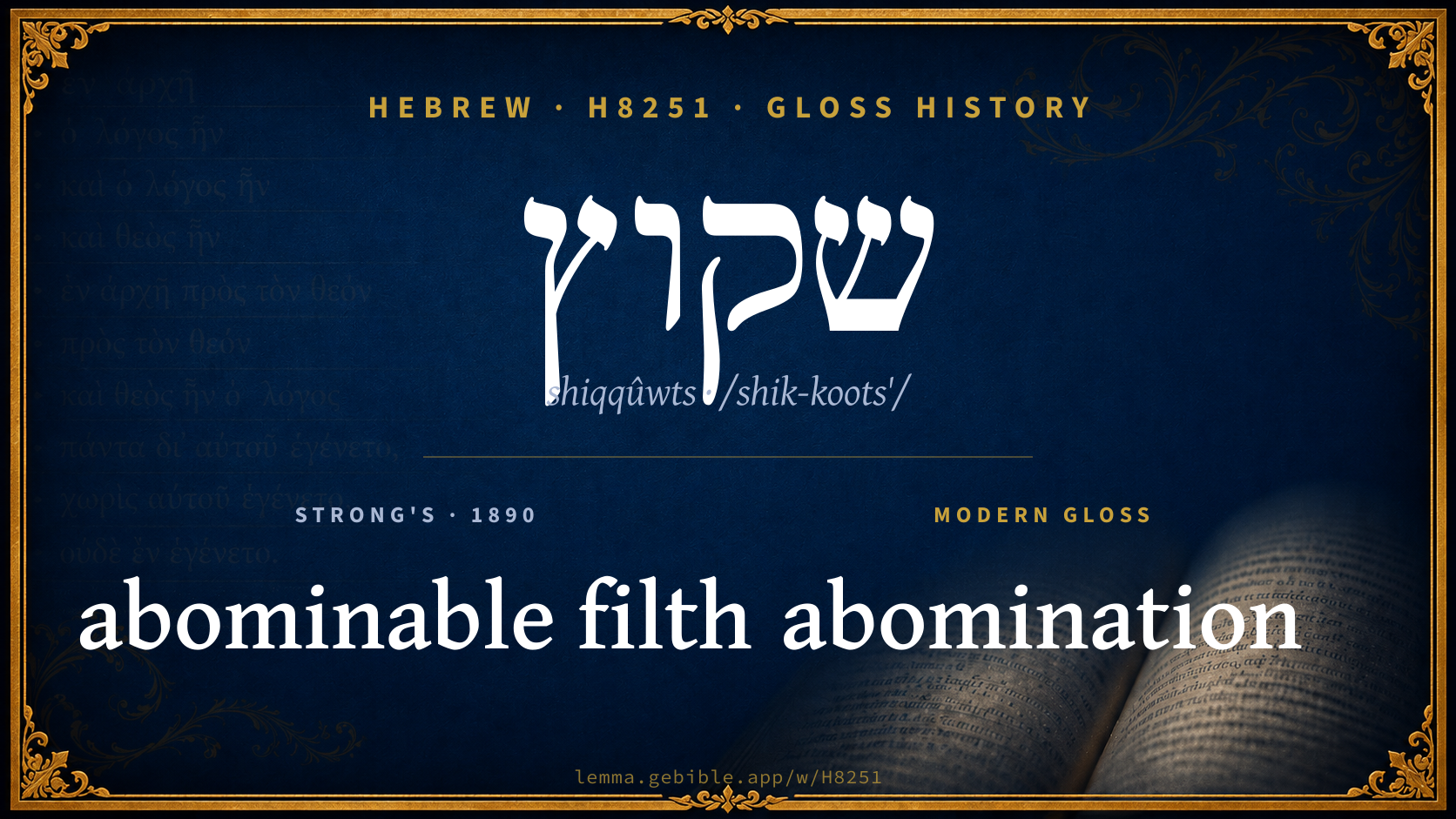
Gloss history
Strong's 1890 vs modern scholarship
About this word
Strong's H8251 catalogs a Hebrew word from the Hebrew Old Testament.
These counts are not copied from any lexicon or concordance. They are computed here, from the morphology-tagged Hebrew Old Testament. What Lemma adds →
- 26
- distinct verses
- The word appears in 26 distinct verses.
- 11 / 39
- OT books
- The word appears in 11 of 39 Old Testament books.
- #1,190
- by frequency
- Top 2500 most frequent Hebrew words (rank 1,190 of 8,640 Hebrew words by occurrence).
View all 26 occurrences in the concordance →
By section of the Old Testament
By traditional corpus
Conventional, traditional groupings — biblical authorship is debated, so this is a traditional corpus grouping, not an authorship claim. Each share is this word’s portion of its verses in that division of the Hebrew canon. Each figure is a share of the word’s 26 distinct verses.
- Prophets (Nevi'im) 21 verses · 81%
- Writings (Ketuvim) 4 verses · 15%
- Torah (Pentateuch) 1 verse · 4%
How translations render this word
Counts come from each version’s own published word-to-Strong’s tagging or interlinear alignment — an approximate guide to how each version renders this word, not a word-level alignment the data otherwise carries. Because each total is that version’s own tagged count, the per-version totals vary from one another and need not match the appearance or distinct-verse counts above. These counts may also differ from a printed concordance because Lemma counts each distinctly tagged rendering and does not collapse phrase taggings into a single head-word total. This is a fixed set of word-tagged versions (KJV, ASV, BSB, ULT) and does not change with the reading translation you choose elsewhere. Each version’s license is shown beside its name below (and on Sources).
- King James Version: Abominations 12×, Abomination 7×, Detestable things 3×
- American Standard Version: Abominations 11×, Abomination 5×, Detestable things 3×
- Berean Standard Bible: Abominations 9×, Abomination 8×, Detestable idols 5×
- unfoldingWord Literal Text: Abominations 7×, Detestable things 5×, Abomination of 3×
King James Version Public Domain
Renders H8251 across 28 tagged occurrences — most commonly:
Plus 6 renderings that appear only once — usually multi-word phrases or single function words the recovered tagging swept in, not distinct renderings.
American Standard Version Public Domain
Renders H8251 across 28 tagged occurrences — most commonly:
Plus 9 renderings that appear only once — usually multi-word phrases or single function words the recovered tagging swept in, not distinct renderings.
Berean Standard Bible Public Domain
Renders H8251 across 28 tagged occurrences — most commonly:
Plus 4 renderings that appear only once — usually multi-word phrases or single function words the recovered tagging swept in, not distinct renderings.
unfoldingWord Literal Text CC BY-SA 4.0
Renders H8251 across 29 tagged occurrences — most commonly:
Plus 8 renderings that appear only once — usually multi-word phrases or single function words the recovered tagging swept in, not distinct renderings.
Senses in BDB
The 1 sense BDB distinguishes for this word, in lexicon order (not ranked by frequency or importance). The full entry — with sub-senses — is in the Lexicon Entry tab.
- detestable thing or idol, abominable thing, abomination, idol, detested thing
Word origin
n.m. Dn 11:31 detested thing;—abs. שִׁקּוּץ Dn 11:31; 12:11, cstr. שִׁקֻּץ 1 K 11:5 +; pl. שִׁקּוּצִים 2 Ch 15:8, שִׁקֻּצִים 2 K 23:24; cstr. שִׁקּוּצֵי Ez 20:7, 8; sf. שִׁקּוּצֵיהֶם Je 16:18 +, etc.—detested thing, epith. of Isr. Ho 9:10 (si vera l.; not elsewhere bef. Dt); of filth Na 3:6; appar. of unclean food Zc 9:7 (as שֶׁקֶץ); of idols (often ‖ תּוֹעֵבָה, גִּלּוּל, etc.), Dt 29:16; 2 K 23:13, 24; Is 66:3; Je 4:1; 7:30 = 32:34; 13:27; 16:18; Ez 5:11; 7:20; 11:18, 21; 20:7, 8, 30; 37:23; of idolatrous practices Dn 9:27, but read prob. as 11:31 (so 𝔊 Θ), and כַּנּוֹ for כנף (v. Dr); שׁ׳ (םְ)שֹׁמֵם 11:31; 12:11 detested thing causing horror is the heathen altar erected in temple by Ant. Epiph., with (prob.) a statue of Zeus Olympios = (Ph.) בעלשמם lord of heaven; the prophet puts שִׁקּוּץ for בעל, and (םְ)שֹׁמֵם) for שָׁמַיִם; cf. NesZAW iv (1884), 248 CheOP 105 Dr Dn.
— Brown-Driver-Briggs (Oxford 1906, public domain), digitized via Sefaria, supplemented by the OpenScriptures HebrewLexicon (CC BY 4.0). See Sources.
Derived from שקץ (shâqats) (H8262) — to detest.
Jastrow Dictionary
A second Hebrew/Aramaic lexicon for comparison, covering Aramaic and post-biblical (Talmudic, Targumic, Midrashic) usage that the biblical-Hebrew BDB does not. Matched by lemma rather than by Strong’s number, so a lemma may carry more than one Jastrow headword (shown separately below), and the entries cover usage well beyond the Bible.
שִׁקּוּץ
- , v. sub שִׁיקּ׳.
A Dictionary of the Targumim, the Talmud Babli and Yerushalmi, and the Midrashic Literature (Marcus Jastrow; London, Luzac, 1903) — Public Domain. Digitized via Sefaria. Digitized via Sefaria. Full attribution on Sources.
Forms in the corpus
The 22 distinct written forms H8251 takes in the Hebrew Bible, most frequent first — each parse links to that state’s occurrences in the concordance. Hebrew forms include their vowel points and cantillation, so a single lemma takes many written forms.
Same root — word family
Other BDB entries built from the same root as H8251, grouped by Strong’s listed origin. These share a root / origin per the lexicon — not necessarily a shared meaning. Each links to that word’s own entry.
Derives from
Shares the same root
Compare all same-root words → They share a root, not necessarily a meaning.
Septuagint verse parallels
This word appears in 25 verses that also exist in the Greek Old Testament (Septuagint), out of the 26 Hebrew verses it occurs in. You can read those verses in Greek by switching the Old Testament edition to the Septuagint.
Read these verses in the Septuagint
- Deuteronomy 29:17
- 1 Kings 11:5
- 2 Kings 23:13
- 2 Chronicles 15:8
- Isaiah 66:3
- Jeremiah 4:1
- Ezekiel 5:11
- Daniel 9:27
- Hosea 9:10
- Nahum 3:6
- Zechariah 9:7
This is a verse-level parallel only — the same verses exist in both the Hebrew and Greek Old Testaments. No word-level Hebrew↔Greek correspondence is claimed: the data carries no such alignment, so no Greek word is shown as this Hebrew word’s translation. Coverage is not total — the Septuagint omits the deuterocanon and renumbers the Psalms, so some Hebrew verses have no direct Greek parallel.