
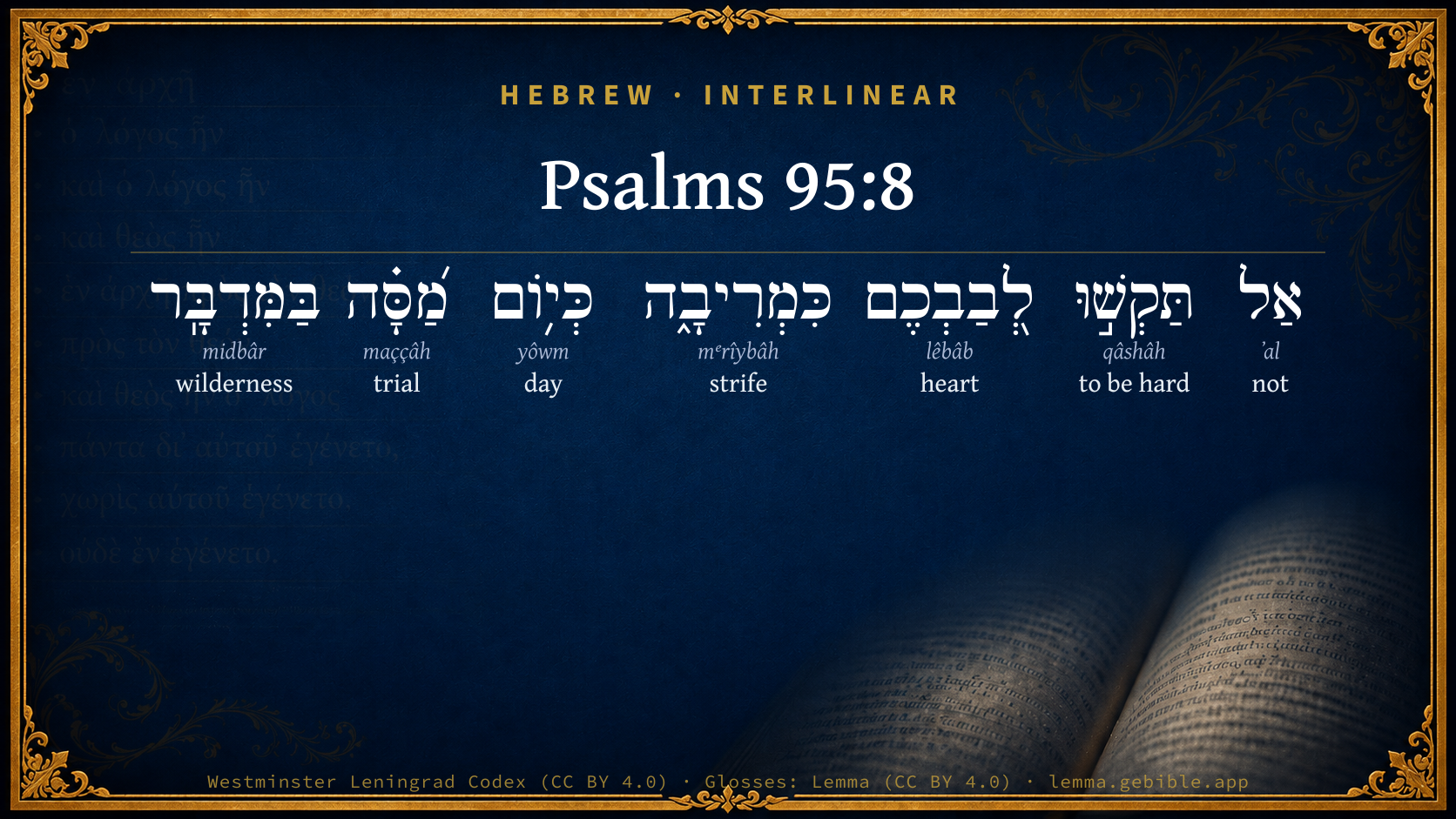
Psalms 95:8

Hebrew (Westminster Leningrad Codex) Psalms 95:8 appears in the Hebrew Old Testament. The text above is from the Westminster Leningrad Codex. Each word links to its Strong’s number, a concise gloss, and parsing drawn from the Open Scriptures Hebrew Bible morphology. Click any word for its full Brown-Driver-Briggs (BDB) entry.
Download image
Cite this verse

Psalms 95:8 (World English Bible). Public Domain. Lemma interlinear Bible study tool, https://lemma.gebible.app/v/psalms/95/8.

Show BibTeX & RIS
BibTeX
RIS
English Translation
Don't harden your heart, as at Meribah, As in the day of Massah in the wilderness,
World English Bible · Public Domain
Download a study sheet

One document with this verse’s original text, its word-by-word gloss line, the meaning frame, cross-references with their text, attributed commentary, and full source and license credits — printable, and it pastes into notes with its structure intact.

This verse Autodidact and up

Study sheet (.html) Plain text (.txt)

A passage Seminary Student

Up to 50 verses in one chapter. A passage sheet keeps up to 6 commentary sources and 12 cross-references per verse, in the order this page ranks them, and says so on the sheet whenever that leaves anything out. Ask for a single verse and you get the Autodidact verse sheet above.

Everything on this page stays free to read, with no account — the sheet is a download of what is already on screen, not access to it.

Want to remove ads? Support Godless Engineer
Compare translations 3

The same verse in 3 English versions, stacked beneath the original-language interlinear above. Click any original word for its lexicon entry.

Each is an independent rendering of the whole verse — the interlinear is not word-aligned to these translations.

Highlighted words mark where these versions differ — a whole-verse word diff, not a word-by-word alignment.

  • World English Bible Public Domain
    Don't harden your heart, as at Meribah, As in the day of Massah in the wilderness,
  • King James Version Public Domain
    Harden not your heart, as in the provocation, and as in the day of temptation in the wilderness:
  • unfoldingWord Literal Text CC BY-SA 4.0
    “Do not harden your heart, as Meribah, as the day of Massah in the wilderness,

unfoldingWord Literal Text — © unfoldingWord, licensed CC BY-SA 4.0. Word-aligned USFM3 via Door43 (git.door43.org/unfoldingWord/en_ult).

Versions to compare (up to 4)

3 of 4 selected

Show all 18 translations

Every available English version of this verse, each an independent rendering of the whole verse.

  • World English Bible Public Domain
    Don't harden your heart, as at Meribah, As in the day of Massah in the wilderness,
  • Berean Standard Bible Public Domain
    do not harden your hearts as you did at Meribah, in the day at Massah in the wilderness,
  • Majority Standard Bible Public Domain
    do not harden your hearts as you did at Meribah, in the day at Massah in the wilderness,
  • King James Version Public Domain
    Harden not your heart, as in the provocation, and as in the day of temptation in the wilderness:
  • American Standard Version (1901) Public Domain
    Harden not your heart, as at Meribah, As in the day of Massah in the wilderness;
  • Revised Version (1885) Public Domain
    Harden not your heart, as at Meribah, as in the day of Massah in the wilderness:
  • Geneva Bible (1599) Public Domain
    Harden not your heart, as in Meribah, and as in the day of Massah in the wildernesse.
  • Douay-Rheims (1899) Public Domain
    To day if you shall hear his voice, harden not your hearts:
  • Young's Literal Translation Public Domain
    Harden not your heart as `in' Meribah, As `in' the day of Massah in the wilderness,
  • Literal Standard Version CC BY-SA 4.0
    Do not harden your heart as [in] Meribah, || As [in] the day of Massah in the wilderness,
  • Unlocked Literal Bible CC BY-SA 4.0
    “Do not harden your heart, as at Meribah, or as on the day of Massah in the wilderness,
  • unfoldingWord Literal Text CC BY-SA 4.0
    “Do not harden your heart, as Meribah, as the day of Massah in the wilderness,
  • Darby Bible Public Domain
    Harden not your heart, as at Meribah, as [in] the day of Massah, in the wilderness;
  • World Messianic Bible Public Domain
    Don’t harden your heart, as at Meribah, as in the day of Massah in the wilderness,
  • Webster's Bible Public Domain
    Harden not your heart, as in the provocation, and as in the day of temptation in the wilderness:
  • Free Bible Version CC BY-SA 4.0
    don't have a hard-hearted attitude, “as you did at Meribah, as you did that day at Massah in the desert,
  • Bible in Basic English Public Domain
    Let not your hearts be hard, as at Meribah, as in the day of Massah in the waste land;
  • JPS Tanakh (1917) Public Domain
    'Harden not your heart, as at Meribah, as in the day of Massah in the wilderness;

Literal Standard Version (2020), Covenant Press — licensed CC BY-SA 4.0. Text via the HelloAO Bible API (eBible.org). Unlocked Literal Bible (unfoldingWord) — licensed CC BY-SA 4.0. Text via the HelloAO Bible API (eBible.org). unfoldingWord Literal Text — © unfoldingWord, licensed CC BY-SA 4.0. Word-aligned USFM3 via Door43 (git.door43.org/unfoldingWord/en_ult). Free Bible Version, Dr. Jonathan Gallagher — licensed CC BY-SA 4.0. Text via the HelloAO Bible API (eBible.org).

Word by word

More ways to search: Search by grammar → Find every occurrence → Compare this word →

Practice this passage: Drill this verse → Learn its vocabulary →

About this verse

These counts appear in no published source. They are computed here, from the morphology-tagged text and Lemma’s own curated glosses. What Lemma adds →

7
words
7
distinct lemmas
Wisdom
section

Notable vocabulary

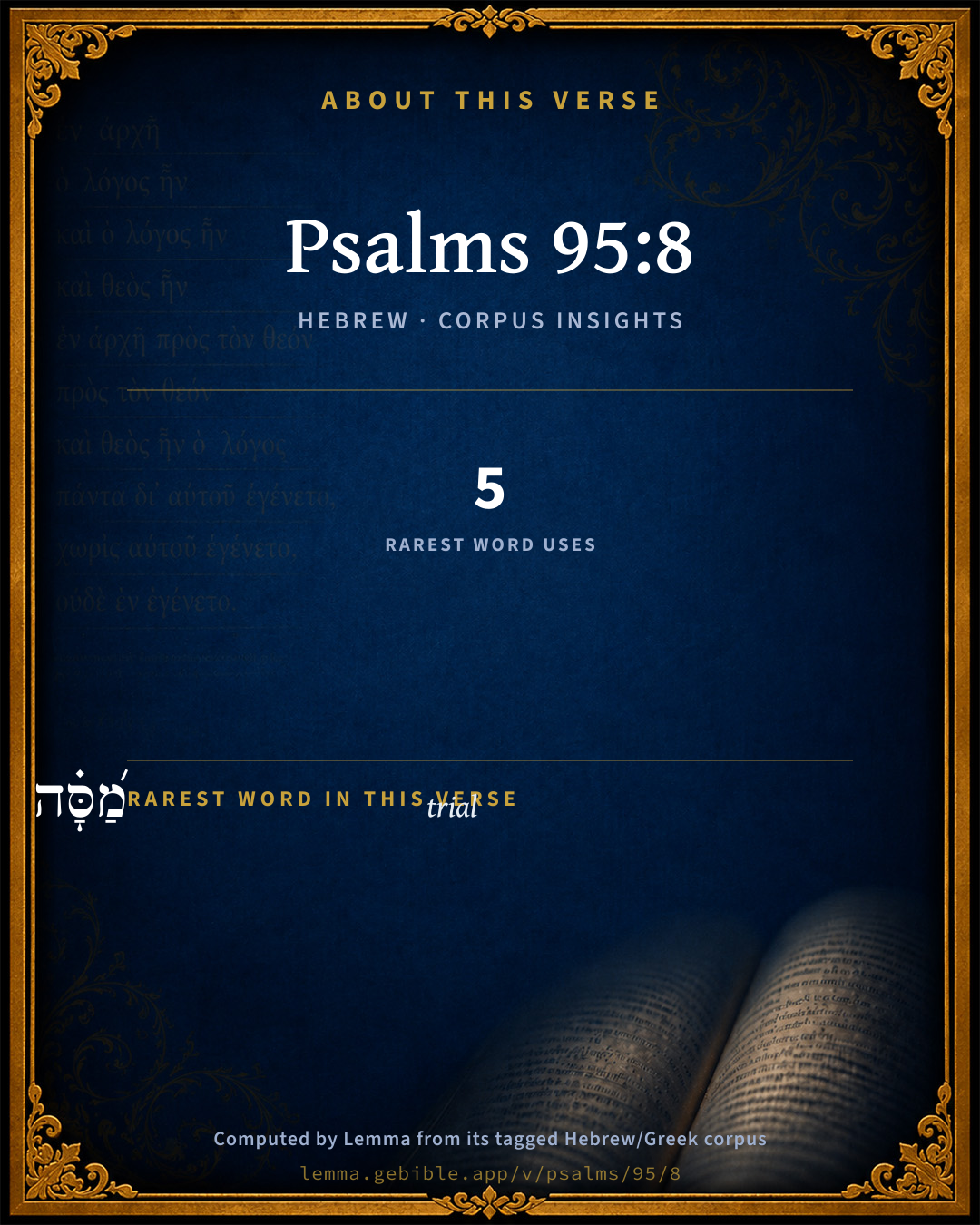
The rarest word here is מַ֝סָּ֗ה trial H4531 — appearing just 5 times in the whole Hebrew Bible.

Shared distinctive vocabulary

מַ֝סָּ֗ה trial H4531 occurs in 5 verses of the Hebrew Bible. Also found in:

Grammatical profile

  • 1 verb
  • 5 nouns
  • 1 particle

Verb forms

  • תַּקְשׁ֣וּ Hiphil · Jussive

Hebrew & Septuagint length

In English translation the verse runs 16 words from the Hebrew and 24 from the Septuagint (LXX English) — closely comparable.

A rough comparison of the two English renderings, which tokenize alike — not a word-level alignment.

Word counts can differ between the Hebrew and the Greek without any difference in meaning — e.g. the Hebrew direct-object marker אֵת has no separate Greek word, and Greek often adds the article ὁ.

Cross-references

18

Topical passages linked to Psalms 95:8 in the Treasury of Scripture Knowledge — connected by theme and wording, ordered by reader-vote popularity; previews shown in the World English Bible.

  • Exodus 17:7 He called the name of the place Massah, and Meribah, because the children of Israel quarreled, and because they tested Yahweh, saying, "Is Yahweh among us, or not?"
  • Hebrews 3:8–9 Don't harden your hearts, as in the provocation, Like as in the day of the trial in the wilderness,
  • Numbers 20:13 These are the waters of Meribah; because the children of Israel strove with Yahweh, and he was sanctified in them.
  • Numbers 14:11 Yahweh said to Moses, How long will this people despise me? and how long will they not believe in me, for all the signs which I have worked among them?
  • Numbers 14:22 because all those men who have seen my glory, and my signs, which I worked in Egypt and in the wilderness, yet have tempted me these ten times, and have not listened to my voice;
  • Hebrews 3:15–19 while it is said, "Today if you will hear his voice, Don't harden your hearts, as in the rebellion."
  • Deuteronomy 6:16 You shall not tempt Yahweh your God, as you tempted him in Massah.
  • 1 Samuel 6:6 Why then do you harden your hearts, as the Egyptians and Pharaoh hardened their hearts? When he had worked wonderfully among them, didn't they let the people go, and they departed?
  • Romans 2:5 But according to your hardness and unrepentant heart you are treasuring up for yourself wrath in the day of wrath, revelation, and of the righteous judgment of God;
  • Hebrews 12:25 See that you don't refuse him who speaks. For if they didn't escape when they refused him who warned on the Earth, how much more will we not escape who turn away from him who warns from heaven,
  • Jude 1:5 Now I desire to remind you, though you already know this, that the Lord, having saved a people out of the land of Egypt, afterward destroyed those who didn't believe.
  • Exodus 17:2 Therefore the people quarreled with Moses, and said, "Give us water to drink." Moses said to them, "Why do you quarrel with me? Why do you test Yahweh?"
  • Acts 19:9 But when some were hardened and disobedient, speaking evil of the Way before the multitude, he departed from them, and separated the disciples, reasoning daily in the school of Tyrannus.
  • Hebrews 3:13 but exhort one another day by day, so long as it is called "today;" lest any one of you be hardened by the deceitfulness of sin.
  • Exodus 8:15 But when Pharaoh saw that there was a respite, he hardened his heart, and didn't listen to them, as Yahweh had spoken.
  • Numbers 14:27 How long [shall I bear] with this evil congregation, that murmur against me? I have heard the murmurings of the children of Israel, which they murmur against me.
  • Deuteronomy 1:34–35 Yahweh heard the voice of your words, and was angry, and swore, saying,
  • Daniel 5:20 But when his heart was lifted up, and his spirit was hardened so that he dealt proudly, he was deposed from his kingly throne, and they took his glory from him:

Cross-references courtesy of OpenBible.info (CC BY 4.0).

Hebrew and Greek witnesses Masoretic Hebrew ↔ Greek Septuagint

The same verse in the two great witnesses to the Old Testament, shown verse-for-verse.

You’re reading Greek Psalm 94 (Hebrew Psalm 95). The Septuagint counts the superscription, so verse numbers can differ from the Hebrew — chapter-level alignment, not verse-by-verse. Numbering follows Rahlfs.

These are two independent witnesses, not word-aligned to each other, and the Septuagint is shown in lemma (dictionary) form.

Hebrew Psalms 95:8 Masoretic · Westminster Leningrad Codex

אַל תַּקְשׁ֣וּ לְ֭בַבְכֶם כִּמְרִיבָ֑ה כְּי֥וֹם מַ֝סָּ֗ה בַּמִּדְבָּֽר

Don't harden your heart, as at Meribah, As in the day of Massah in the wilderness,

World English Bible · Public Domain

Greek LXX Greek Psalm 94:8 Septuagint · lemma form

μή σκληρύνω ὁ καρδία σύ ὡς ἐν ὁ παραπικρασμός κατά ὁ ἡμέρα ὁ πειρασμός ἐν ὁ ἔρημος

To-day, if you⌃ will hear his voice, harden not your hearts, as in the provocation, according to the day of irritation in the wilderness:

LXX2012 (modern English Septuagint) · Public Domain

On this verse, The Cambridge Bible for Schools and Colleges discusses the Septuagint’s reading. Read the note in Commentary ↓

Hebrew: Westminster Leningrad Codex (CC BY 4.0). Greek: Septuagint (public domain); English from LXX2012 (modern English Septuagint) (Public Domain). How the Septuagint differs from the Hebrew →

Commentary

Notes on Psalms 95:8 from classic Christian and Jewish commentators (each source and its license shown beneath its notes). The classic Christian expositions comment on the surrounding passage and are grouped to its opening verse, so a note may address several verses; the Jewish commentaries on the Tanakh (Rashi and others) are per-verse, so they appear only where the commentator wrote on this verse.

Lemma curates 59 commentaries, every one of them public domain or Creative Commons licensed, each selected and text-cleaned for this edition rather than reprinted as found. About our sources →

Trapp's Complete Commentary

John Trapp

Psa 95:8 Harden not your heart, as in the provocation, [and] as [in] the day of temptation in the wilderness:

Ver. 8. Harden not your heart] By unbelief, and the deceitfulness of sin, Heb 3:12-13, which gradually affirms the heart against God.

As in the provocation] As your fathers did at Massah and Meribah; be not you as good at resisting the Holy Ghost as they were, Act 7:51.

John Trapp, A Commentary or Exposition upon All the Books of the Old and New Testament (1647–1656) — public domain. Text from a community e-Sword module.

The Treasury of David

Charles H. Spurgeon

Ver. 8. Harden not your heart. If ye will hear, learn to fear also. The sea and the land obey him, do not prove more obstinate than they!

"Yield to his love who round you now

The bands of a man would east."

We cannot soften our hearts, but we can harden them, and the consequences will be fatal. Today is too good a day to be profaned by the hardening of our hearts against our own mercies. While mercy reigns let not obduracy rebel. "As in the provocations, and as in the day of temptation in the wilderness" (or, "like Meribah, like the day of Massah in the wilderness"). Be not wilfully, wantonly, repeatedly, obstinately rebellious. Let the example of that unhappy generation serve as a beacon to you; do not repeat the offences which have already more than enough provoked the Lord. God remembers men's sins, and the more memorably so when they are committed by a favoured people, against frequent warnings, in defiance of terrible judgments, and in the midst of superlative mercies; such sins write their record in marble. Reader, this verse is for you, for you even if you can say, "He is our God, and we are the people of his pasture." Do not seek to turn aside the edge of the warning; thou hast good need of it, give good heed to it.

Ver. 8. Harden not your hearts. An old man, one day taking a child on his knee, entreated him to seek God now to pray to him, and to love him; when the child, looking up at him, asked, "But why do not you seek God?" The old man, deeply affected, answered, "I would, child; but my heart is hard my heart is hard." Arvine's Anecdotes.

Ver. 8. Harden not your heart. Heart is ascribed to reasonable creatures, to signify sometimes the whole soul, and sometimes the several faculties appertaining to the soul.

1. It is frequently put for the whole soul, and that for the most part when it is set alone; as where it is said, "Serve the Lord with all your heart", 1Sa 7:20.

2. For that principal part of the soul which is called the mind or understanding. "I gave my heart to know wisdom", Ec 1:17. In this respect darkness and blindness are attributed to the heart, Eph 6:18, Ro 1:21.

3. For the will: as when heart and soul are joined together, the two essential faculties of the soul are meant, namely, the mind and will: soul put for the mind, heart for the will "Serve the Lord with all your heart and with all your soul", De 6:13.

4. For the memory. "I have hid thy word in my heart", saith the prophet, Ps 119:11. The memory is that faculty wherein matters are laid up and hid.

5. For the conscience. It is said that "David's heart smote him", that is, his conscience, 1Sa 24:5 2Sa 24:10. Thus is heart taken, 1Jo 3:20-21.

6. For the affections: as where it is said, "Thou shalt love the Lord thy God with all thy heart, and with all thy soul, and with all thy mind", Mt 22:37. By the mind is meant the understanding faculty; by the soul, the will; by the heart, the affections.

Here in this text the heart is put for the whole soul, even for mind, will, and affections. For blindness of mind, stubbornness of will, and stupidity of affections go together. William Gouge.

Ver. 8. In Massahin Meribah. Our translators say, in the provocation, in the day of temptation. But the places were denominated by names taken from the transactions that occurred in them; and the introduction of those names gives more liveliness to the allusion. See to the same effect Ps 81:7; where the Bible translation retains the proper name. Richard Mant.

Ver. 8. Let us not fail to notice, that while it is the flock who speak in Ps 95:1-7, it is the Shepherd who takes up their expostulating words, and urges them home himself at Ps 95:8, to the end, using the argument which by the Holy Ghost is addressed to us also in Heb 3:7-19. There is something very powerful in this expostulation, when connected with the circumstances that give rise to it. In themselves, the burst of adoring love, and the full out pouring of affection in Ps 95:1-7 are irresistibly persuasive; but when (Ps 95:8) the voice of the Lord himself is heard (such a voice, using terms of vehement entreaty!) we cannot imagine expostulation carried further. Unbelief alone could resist this voice; blind, malignant unbelief alone could repel The flock, and then the Shepherd, inviting men now to enter the fold. Andrew A. Bonar.

Ver. 8-11.

1. Israel's fearful experiment in tempting God.

2. The awful result.

3. Let it not be tried again.

C.A. Davis.

Psalms 95:9*

p

Charles H. Spurgeon's The Treasury of David (1869–1885) — public domain. Psalms only. Text from a community e-Sword/MySword module.

Joseph Benson's Commentary

Psa 95:8-9. Harden not your heart — As if he had said, If ye will hear his voice, and profit by what you hear, then do not harden your hearts by obstinate unbelief and wilful disobedience, rebelling against the light, and resisting the Holy Ghost, and the clear discoveries which he makes of the truth of the gospel; as in the provocation — As you did in that bold and wicked contest in the wilderness. Hebrew, כמריבה, chimeribah, as in Meribah, which was the proper name of the place where this happened, and which was also called Massah, as appears from Exo 17:7, and Deu 33:8. As in the day of temptation — In the day when you tempted me. Or, as in the day of Massah, that is, when you were at Massah. When — Or, in which place, namely, in Meribah, or Massah, or the wilderness last mentioned, your fathers tempted me — Doubting of my power, and demanding new proofs of my presence among them, Exo 17:7, though they had had such extraordinary proofs of my presence and favour in their late deliverance at the Red sea, in my making the bitter waters sweet, and in sending them bread from heaven; and saw my works — Both my works of mercy, which gave them abundant cause to trust me, and my works of justice, for which they had reason to fear and stand in awe of me. Hebrew, my work, namely, that great and stupendous work of bringing my people out of Egypt with a strong hand; of conducting them safely through the Red sea into the wilderness, and of destroying the Egyptians.

Joseph Benson's Commentary on the Old and New Testaments (1811–1818) — public domain. Text from a community e-Sword module.

J. A. Alexander on Psalms

Joseph Addison Alexander

8. (Psa 95:8) Harden not your heart like Meribah, like the day of Massah in the wilderness. Be not wilfully and obstinately insensible. Your heart, in the singlar number, because the people are addressed as an ideal person. Like Meribah, i. e. as your fathers did at Meribah. Like the day of Massah, as they did at that period of your national history associated with the name of Massah. The reference is to Exo 17:7. The incident there recorded is here specified, for the sake of the significant names given to the place, Meribah (strife) and Massah (temptation). God himself is here abruptly introduced as speaking. See above, on Psa 46:10; Psa 75:2-3; Psa 87:4; Psa 91:14.

Joseph Addison Alexander, The Psalms Translated and Explained (1850) — public domain. Text from a community e-Sword module.

Tyndale Open Study Notes

Tyndale Open Resources

95:8-11 If people want to enter into the Lord’s rest, they need to respond immediately (see Heb 3:7–4:11).

95:8 To harden your hearts means to be stubborn and resist the Lord’s grace (see Num 20:2-13; see also Matt 13:3-23; John 12:37-43; Eph 4:17-32; Heb 3:6-19; 4:6-11).

Tyndale Open Study Notes — © Tyndale Open Resources, licensed CC BY-SA 4.0. Text via the HelloAO Bible API.

Geneva Bible (1599)

Geneva Bible translators

Or, in strife: whereof the place was so called.

By the contemning of God’s word.

Or, tentation, read Exod. 17:7.

Geneva Bible (1599) marginal notes — public domain. Text via Bolls.life.

John Calvin's Commentaries

8. Harden not your heart, as in Meribah The Psalmist, having extolled and commended the kindness of God their Shepherd, takes occasion, as they were stiffnecked and disobedient, to remind them of their duty, as his flock, which was to yield a pliable and meek submission; and the more to impress their minds, he upbraids them with the obstinacy of their fathers. The term מריבה, Meribah, may be used appellatively to mean strife or contention; but as the Psalmist evidently refers to the history contained in Exodus 17:2-7, I have preferred understanding it of the place — and so of מסה, Massah. In the second clause, however, the place where the temptation happened may be thought sufficiently described under the term wilderness, and should any read, according to the day of temptation (instead of Massah) in the wilderness, there can be no objection. Some would have it, that Massah and Meribah were two distinct places, but I see no ground to think so; and, in a matter of so little importance, we should not be too nice or curious. He enlarges in several expressions upon the hardness of heart evinced by the people, and, to produce the greater effect, introduces God himself as speaking. By hardness of heart, he no doubt means, any kind of contempt shown to the word of God, though there are many different kinds of it. We find that when proclaimed, it is heard by some in a cold and slighting manner; that some fastidiously put it away from them after they had received it; that others proudly reject it; while again there are men who openly vent their rage against it with despite and blasphemy. The Psalmist, in the one term which he has employed, comprehends all these defaulters, the careless — the fastidious — such as deride the word, and such as are actuated in their opposition to it by frenzy and passion. Before the heart can be judged soft and pliable to the hearing of God’s word, it is necessary that we receive it with reverence, and with a disposition to obey it. If it carry no authority and weight with it, we show that we regard him as no more than a mere man like ourselves; and here lies the hardness of our hearts, whatever may be the cause of it, whether simply carelessness, or pride, or rebellion. He has intentionally singled out the odious term here employed, to let us know what an execrable thing contempt of God’s word is; as, in the Law, adultery is used to denote all kinds of fornication and uncleanness, and murder all kinds of violence, and injury, hatreds, and enmities. Accordingly, the man who simply treats the word of God with neglect, and fails to obey it, is said here to have a hard and stony heart, although he may not be an open despiser. The attempt is ridiculous which the Papists have made to found upon this passage their favorite doctrine of the liberty of the will. We are to notice, in the first place, that all men’s hearts are naturally hard and stony; for Scripture does not speak of this as a disease peculiar to a few, but characteristic in general of all mankind, (Ezekiel 36:26.) It is an inbred pravity; still it is voluntary; we are not insensible in the same manner that stones are, and the man who will not suffer himself to be ruled by God’s word, makes that heart, which was hard before, harder still, and is convinced as to his own sense and feeling of obstinacy. The consequence by no means follows from this, that softness of heart — a heart flexible indifferently in either direction, is at our command. The will of man, through natural corruption, is wholly bent to evil; or, to speak more properly, is carried headlong into the commission of it. And yet every man, who disobeys God therein, hardens himself; for the blame of his wrong doing rests with none but himself.

John Calvin's Commentaries (1540-1563) — public domain. Text from the Calvin Translation Society English edition (1840s-50s) via the Christian Classics Ethereal Library (ccel.org). Calvin's coverage is partial (roughly two-thirds of the Bible); uncommented books and verses are honest gaps, never fabricated. The 19th-century editor's footnotes and remarks are omitted so the notes are faithfully Calvin's own voice.

Ellicott's Commentary for English Readers

(8) The mention of the guiding voice suggests to the poet to make God Himself address His people, and with this verse the Divine warning begins.

Provocation . . . temptation.—It is better to keep here the proper names Meribah and Massah (Exo_17:1-7; Num_20:13 : comp. Deu_33:8).

A Bible Commentary for English Readers, edited by Charles John Ellicott (1878–1897) — public domain. Text from a community e-Sword module.

The Cambridge Bible for Schools and Colleges

gen. ed. J. J. S. Perowne

8. Harden not your heart, as at Meribah,

As in the day of Massah in the wilderness (R.V.).

Meribah, Strife, and Massah, Temptation, were the names given to the scene of the murmuring at Rephidim at the beginning of the wandering (Exo_17:1-7); and the scene of the murmuring at Kadesh in the fortieth year was also called Meribah (Num_20:1-13). The A.V. follows the LXX and other Ancient Versions in translating the words, but they should certainly be retained as proper names. Cp. Deu_33:8; Psa_81:7.

8–11. Jehovah speaks, warning Israel not to repeat the sins of obstinacy and unbelief by which their ancestors provoked Him.

The Cambridge Bible for Schools and Colleges (gen. ed. J. J. S. Perowne; Cambridge University Press, 1878–1918) — public domain. Text from a community e-Sword module.

John Gill's Exposition

Harden not your hearts,.... Against Christ, against his Gospel, against all the light and evidence of it. There is a natural hardness of the heart, owing to the corruption of nature; and an habitual hardness, acquired by a constant continuance and long custom in sinning; and there is a judicial hardness, which God gives men up unto. There is a hardness of heart, which sometimes attends God's own people, through the deceitfulness of sin gaining upon them; of which, when sensible, they complain, and do well to guard against. Respect seems to be had here to the hardness of heart in the Jews in the times of Christ and his apostles, which the Holy Ghost foresaw, and here dehorts from; who, notwithstanding the clear evidence of Jesus being the Messiah, from prophecy, from miracles, from doctrines, from the gifts of the Spirit, &c. yet hardened their hearts against him, rebelled against light, and would not receive, but reject him:

as in the provocation; or "as at Meribah" (h); a place so called from the contention and striving of the people of Israel with the Lord and his servants; and when they provoked not only the meek man Moses to speak unadvisedly with his lips; but also the Lord himself by their murmurings, Exo 17:7 though this may respect their provocations in general in the wilderness; for they often provoked him by their unbelief, ingratitude, and idolatry; see Deu 9:8,

and as in the day of temptation in the wilderness; or "as in the day of Massah" (i); the time when they tempted him at Massah, so called from their tempting him by distrusting his power and presence among them, by disobeying his commands, and limiting the Holy One of Israel to time and means of deliverance; see Exo 17:7 and this being in the wilderness was an aggravation of their sin; they being just brought out of Egypt, and having had such a wonderful appearance of God for them, there and at the Red sea; and besides being in a place where their whole dependence must be upon God, where they could have nothing but what they had from him immediately, it was egregious folly as well as wickedness to provoke and tempt him.

(h) "sicut Meribah", Montanus; "sicut in Meriba", Musculus, Tigurine version, Gejerus, Michaelis, so Ainsworth. (i) "sicut die Massah", Montanus, Musculus, Tigurine version; "secundum diem Massah", Gejerus, Michaelis, so Ainsworth.

John Gill's Exposition of the Whole Bible (1746–1763) — public domain (CC PDM 1.0). Text via the HelloAO Bible API.

Albert Barnes' Notes on the Bible

Harden not your heart - See this verse explained in the notes at Heb 3:8.

As in the provocation ... - Margin, “contention.” The original is “Meribah.” See Exo 17:7, where the original words Meribah, rendered here “provocation,” and “Massah,” rendered here “temptation,” are retained in the translation.

Albert Barnes' Notes on the Bible (1834–1885) — public domain. Text from a community e-Sword/MySword module.

Matthew Poole's English Annotations

Harden not your heart, by wilful disobedience and obstinate unbelief, rebelling against the light, and resisting the Holy Ghost, and his clear discoveries of the truth of the gospel.

As in the provocation; as you did in that bold and wicked contest with God in the wilderness. Or,

as in Meribah, which was the proper name of the place where that happened, and which also was called Massah, as is evident from Exo 17:7; Deu 33:8.

As in the day of temptation; in the day in which you tempted me. Or, as in the day of Massah, i.e. when you were at Massah.

Matthew Poole's English Annotations on the Holy Bible (1683–1685) — public domain. Text from a community e-Sword/MySword module.

Whedon's Commentary on the Bible

Daniel D. Whedon

8. As in the provocation… as in the day of temptation—It is better to take “provocation” and “temptation” as proper names. The Hebrew simply reads: As Meribah, as the day of Massah, in the wilderness. The allusion is to Exo_17:7. “And he called the name of the place Massah and Meribah”—Temptation and Rebellion. The name “Meribah” was also afterward given to Kadesh, (Num_20:13; Num_27:14,) written fully, “Meribah-Kadesh,” Deu_32:51. These were noted instances of rebellion through unbelief, and are advanced here only as specimens of the disobedience of their forefathers in the desert, against which the people are here warned.

Daniel D. Whedon (gen. ed.), Commentary on the Old and New Testaments (1874–1909) — public domain. Text from a community e-Sword module.

The Pulpit Commentary

Harden not your heart, as in the provocation; rather, as at Meribah. (see Exo_17:2-7) And as in the day of temptation in the wilderness; rather, and as in the day of Massah. The children of Israel "tempted" God, and "chided" with Moses at Massah (or Meribah) in the wilderness, where water was first given them out of the rock. Their descendants are warned not to follow the example of their forefathers.

Divided feeling in man.

The psalmist assumes that they wish to hear God"s voice, and yet there is danger of their hardening their heart. That double feeling is constantly to be found in men. They are forever putting stumbling blocks in their own way. The head will often hinder the heart, and the heart will often hinder the head. Man is a single being, and he is his own true self only when all the forces of his nature act in harmony together. But man can make himself into a dual being, and start a strife within himself that will prove morally destructive. Illustrate by the devil possessed in the time of Christ. There was strife in the men. Their will pulled one way, the mastering will that was upon them pulled the other. Or take the modern case of delirium tremens. Here in our text we have the power which lies in man to hinder himself. He may "harden his heart," and so silence every high and noble desire he may feel. This hardening of the heart is always a man"s own act to begin with, and God"s act to finish with. A man sets himself upon resisting right impressions and persuasions; he finds it easier a second time and a third; he is hardening so that the persuasions have little effect, and God at last puts his seal on the hardening, and the persuasions roll off altogether.

I WHEN A MAN WANTS TO WORSHIP GOD, HE CAN HARDEN HIS HEART BY ENCOURAGING DOUBTS. Some one is ever ready to whisper, "Is there a God at all? If there is, is he really a good God? If he is good, might he not have done a great deal more for you?" Give room to such doubts, and all interest in worship will soon take to itself wings and flee away.

II WHEN A MAN WANTS TO WORSHIP GOD, HE CAN HARDEN HIS HEART BY MURMURINGS. Illustrate from the historical allusion to Meribah. (Exo_17:1-7) If anybody wants to murmur, he can easily find something to murmur about. There is a sunny side and a dark side to almost everything; and, if a man chooses, he can see only the dark side; and, if he does, he will surely spoil all desire for worship, all grounds for thanksgiving. R.T.

The sin of tempting God.

Tempting God is putting him to the test, as if you did not feel quite sure of him, and could not fully trust him. The idea of the word is "assay," "test," as the refiner does metals, or as the chemist or analyst may do to substances submitted to him. It is always implied that the man who proves the thing either does not know what it is or is uncertain about it. It is just that ignorance and uncertainty which God"s people never should have concerning him. It is that doubting God which makes all attempts to test and prove him altogether wrong. Take the case of Israel at Meribah, and show that, in view of the Divine deliverances, guidings, providings, and defendings, any attempt to prove whether God really cared for them, and could help them, was absolutely unworthy; it amounted, indeed, to an insult offered to their covenant King.

I PUTTING GOD TO THE PROOF MAY BE PERMISSIBLE. But the conditions are very clear. If a man wants to believe, and wants encouragement to faith, God will permit him to put him to the proof. This is illustrated, in a very different way, by the sign of the fleece asked by Gideon. The rightness or wrongness of asking the sign depended entirely on the state of Gideon"s mind and feeling. He wanted help to belief, so he may put God to the test. Circumstances may arise now which may allow of our proving God; but that work should never be attempted save at the utmost strain.

II PUTTING GOD TO THE PROOF IS GENERALLY UNPERMISSIBLE. Because generally it implies doubt of God"s power, or faithfulness, or mercy. See the mood of the Israelites; and see the spirit in which the scribes and Pharisees came, putting Jesus to the test. They did not want to believe in him. They wanted to get something which would encourage their unbelief. So Jesus refused, saying, "There shall no sign be given unto them." Keep right attitudes and moods of mind, and right relations with God, and then it will never come into our minds to attempt to put him to the test. R.T.

The Pulpit Commentary (1880–1919), ed. H.D.M. Spence-Jones & Joseph S. Exell — public domain. Text from a community e-Sword module.

John Wesley's Explanatory Notes

Harden not - By obstinate unbelief. Provocation - In that bold and wicked contest with God in the wilderness. Temptation - In the day in which you tempted me.

John Wesley, Explanatory Notes Upon the Whole Bible (1754–1765) — public domain. Text via the GEBible commentary corpus.

unfoldingWord translationNotes

Door43 World Missions Community

General Information:

Now the writer writes the words that Yahweh spoke.

harden your heart

"become stubborn"

Meribah, ... Massah

These are places in the desert that Moses named because the Israelites rebelled against God. (See: How to Translate Names and Assumed Knowledge and Implicit Information)

tested me ... tried me

These two phrases are both metaphors for the people seeing how much evil they could do before Yahweh would punish them. The phrases say basically the same thing and can be combined. AT: "tested me" or "wanted to see if they could do evil things without my punishing them ... tested whether I would continue to be patient with them" (See: Metaphor and Doublet)

my deeds

"the amazing things I had done"

translationWords

hard

heart

desert

ancestor

patient

works

unfoldingWord translationNotes — © Distant Shores Media and the Door43 World Missions Community, licensed CC BY-SA 4.0. Source: git.door43.org/Door43/en_tn.

Lesson kit

Teaching starters — assembled from the data on this page, not authored interpretation. Every prompt links to the verse data it draws on. Edit before teaching.

Psalms, in the Wisdom, opens this verse with 7 words (7 distinct Hebrew lemmas). Its most distinctive word is maççâh (“trial”). A historical commentator’s framing appears above. Read the whole chapter for the surrounding context.

Discussion questions

  1. What does “trial” (maççâh) contribute to the verse as a whole?
  2. Deuteronomy 4:34 shares the word «trial» with this verse. How do the two illuminate each other?
  3. These translations render this verse differently. What is at stake in choosing one wording over another?
  4. The verb «תַּקְשׁ֣וּ» is Hiphil Jussive. How does its form color the action?
  5. Reading how Trapp's Complete Commentary and The Treasury of David read this verse, where do the two commentators agree and where do they part?

Things to notice

Reading settings

Reading text

Shown beneath each verse's original-language words.

Old Testament
Old Testament edition

Read the OT as the Masoretic Hebrew (MT) or the Greek Septuagint (LXX).

English shown for the Greek Septuagint (in the Hebrew ↔ Greek comparison).

Comparing translations? Open the Compare panel on any verse page to stack up to four side by side.