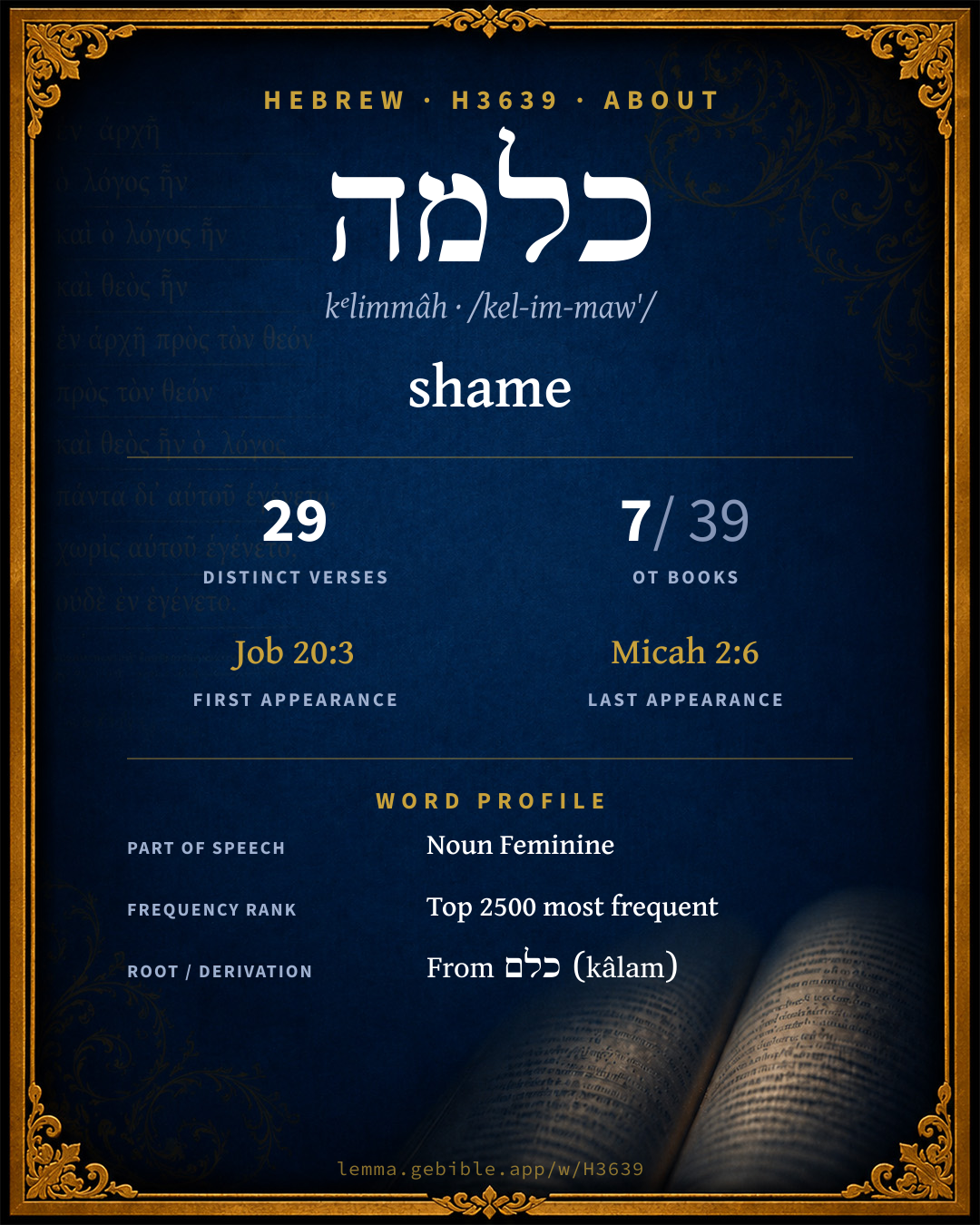
כְּלִמָּה
shame
also: disgrace, reproach, confusion, dishonour fuller range ↓
Full lexicon entry — Brown-Driver-Briggs (BDB)
From Brown-Driver-Briggs (BDB)
Where this word appears
See every Construct-state word in the Hebrew Bible →
Grammar key — what these labels mean
Part of speech
- Noun
- A naming word — a person, place, thing, or idea.
Noun type
- Common
- A common noun — a general class of person, place, or thing (“king,” “city,” “water”), not a specific name.
State
- Construct
- A noun bound to a following noun in a possessive / “of” relationship (the construct chain).
- Absolute
- The independent form of a noun, not bound to a following word.
Gender
- Feminine
- Grammatically feminine.
Number
- Singular
- One.
- Plural
- More than one (in Hebrew, generally three or more).
Grammatical forms
- Noun, Common, Feminine, Singular, Construct 18 times (60%)
- Noun, Common, Feminine, Singular, Absolute 10 times (33%)
- Noun, Common, Feminine, Plural, Absolute 2 times (7%)
Parsed forms decoded from the imported morphology (morphhb / Westminster Leningrad Codex — WLC text public domain, morphhb tagging CC BY 4.0), counted across 30 parsed occurrences — not distinct verses.
Every verse where H3639 appears — 29 distinct verses across 7 books. Click any verse to open its interlinear word-by-word view. Verse text shown in the World English Bible for context — . Each verse’s Hebrew form is shown with its reference; the English is not keyword-highlighted, since the data carries no word-level English alignment. Use “Compare translations” on any verse to read it across multiple English versions. This concordance covers the Hebrew Bible; Septuagint (Greek Old Testament) occurrences are not indexed here.
Job 1 verse
Psalms 7 verses
- Psalms 4:2 לִ֭/כְלִמָּה prep + n c fs You sons of men, how long shall my glory be turned into dishonor? Will you love vanity, and seek after falsehood? Selah.
- Psalms 35:26 וּ/כְלִמָּ֑ה conj + n c fs Let them be disappointed and confounded together who rejoice at my calamity. Let them be clothed with shame and dishonor who magnify themselves against me.
- Psalms 44:15 כְּלִמָּתִ֣/י n c fs cs + sfx pers 1cs All day long my dishonor is before me, And shame covers my face,
- Psalms 69:7 כְלִמָּ֣ה n c fs Because for your sake, I have borne reproach. Shame has covered my face.
- Psalms 69:19 וּ/כְלִמָּתִ֑/י conj + n c fs cs + sfx pers 1cs You know my reproach, my shame, and my dishonor. My adversaries are all before you.
- Psalms 71:13 וּ/כְלִמָּ֑ה conj + n c fs Let my accusers be disappointed and consumed. Let them be covered with disgrace and scorn who want to harm me.
- Psalms 109:29 כְּלִמָּ֑ה n c fs Let my adversaries be clothed with dishonor. Let them cover themselves with their own shame as with a robe.
Proverbs 1 verse
Isaiah 4 verses
- Isaiah 30:3 לִ/כְלִמָּֽה prep + n c fs Therefore shall the strength of Pharaoh be your shame, and the refuge in the shadow of Egypt your confusion.
- Isaiah 45:16 בַ/כְּלִמָּ֔ה prep det + n c fs They shall be disappointed, yes, confounded, all of them; they shall go into confusion together who are makers of idols.
- Isaiah 50:6 מִ/כְּלִמּ֖וֹת prep + n c fp I gave my back to the strikers, and my cheeks to those who plucked off the hair; I didn't hide my face from shame and spitting.
- Isaiah 61:7 וּ/כְלִמָּ֖ה conj + n c fs Instead of your shame [you shall have] double; and instead of dishonor they shall rejoice in their portion: therefore in their land they shall possess double; everlasting joy shall be to them.
Jeremiah 3 verses
- Jeremiah 3:25 כְּלִמָּתֵ/נוּ֒ n c fs cs + sfx pers 1cp Let us lie down in our shame, and let our confusion cover us; for we have sinned against Yahweh our God, we and our fathers, from our youth even to this day; and we have not obeyed the voice of Yahweh our God.
- Jeremiah 20:11 כְּלִמַּ֥ת n c fs cs But Yahweh is with me as an awesome mighty one: therefore my persecutors shall stumble, and they shall not prevail; they shall be utterly disappointed, because they have not dealt wisely, even with an everlasting dishonor which shall never be forgotten.
- Jeremiah 51:51 כְלִמָּ֖ה n c fs We are confounded, because we have heard reproach; confusion has covered our faces: for strangers are come into the sanctuaries of Yahweh's house.
Ezekiel 12 verses
- Ezekiel 16:52 כְלִמָּתֵ֗/ךְ כְלִמָּתֵ֔/ךְ n c fs cs + sfx pers 2fs n c fs cs + sfx pers 2fs You also, bear you your own shame, in that you have given judgment for your sisters; through your sins that you have committed more abominable than they, they are more righteous that you: yes, be also confounded, and bear your shame, in that you have justified your sisters.
- Ezekiel 16:54 כְלִמָּתֵ֔/ךְ n c fs cs + sfx pers 2fs that you may bear your own shame, and may be ashamed because of all that you have done, in that you are a comfort to them.
- Ezekiel 16:63 כְּלִמָּתֵ֑/ךְ n c fs cs + sfx pers 2fs that you may remember, and be confounded, and never open your mouth any more, because of your shame, when I have forgiven you all that you have done, says the Lord Yahweh.
- Ezekiel 32:24 כְלִמָּתָ֖/ם n c fs cs + sfx pers 3mp There is Elam and all her multitude round about her grave; all of them slain, fallen by the sword, who are gone down uncircumcised into the lower parts of the earth, who caused their terror in the land of the living, and have borne their shame with those who go down to the pit.
- Ezekiel 32:25 כְלִמָּתָ/ם֙ n c fs cs + sfx pers 3mp They have set her a bed in the midst of the slain with all her multitude; her graves are round about her; all of them uncircumcised, slain by the sword; for their terror was caused in the land of the living, and they have borne their shame with those who go down to the pit: he is put in the midst of those who are slain.
- Ezekiel 32:30 כְלִמָּתָ֖/ם n c fs cs + sfx pers 3mp There are the princes of the north, all of them, and all the Sidonians, who are gone down with the slain; in the terror which they caused by their might they are put to shame; and they lie uncircumcised with those who are slain by the sword, and bear their shame with those who go down to the pit.
- Ezekiel 34:29 כְּלִמַּ֥ת n c fs cs I will raise up to them a plantation for renown, and they shall be no more consumed with famine in the land, neither bear the shame of the nations any more.
- Ezekiel 36:6 כְּלִמַּ֥ת n c fs cs Therefore prophesy concerning the land of Israel, and tell the mountains and to the hills, to the watercourses and to the valleys, Thus says the Lord Yahweh: Behold, I have spoken in my jealousy and in my wrath, because you have borne the shame of the nations:
- Ezekiel 36:7 כְּלִמָּתָ֥/ם n c fs cs + sfx pers 3mp therefore thus says the Lord Yahweh: I have sworn, [saying], Surely the nations that are round about you, they shall bear their shame.
- Ezekiel 36:15 כְּלִמַּ֣ת n c fs cs neither will I let you hear any more the shame of the nations, neither shall you bear the reproach of the peoples any more, neither shall you cause your nation to stumble any more, says the Lord Yahweh.
- Ezekiel 39:26 כְּלִמָּתָ֔/ם n c fs cs + sfx pers 3mp They shall bear their shame, and all their trespasses by which they have trespassed against me, when they shall dwell securely in their land, and none shall make them afraid;
- Ezekiel 44:13 כְּלִמָּתָ֔/ם n c fs cs + sfx pers 3mp They shall not come near to me, to execute the office of priest to me, nor to come near to any of my holy things, to the things that are most holy; but they shall bear their shame, and their abominations which they have committed.
Micah 1 verse
About this entry
At a glance — auto-summarized from this page’s data, not written by a person. Every figure links to its source below. This summary describes the numbers; it doesn’t interpret them.
כלמה (kᵉlimmâh) is a Hebrew noun most often rendered “shame.” The King James Version usually renders it “shame,” while modern versions prefer “disgrace” (Berean Standard Bible) and “humiliation” (unfoldingWord Literal Text) — see the renderings breakdown. Spanning 29 verses in 7 books, it ranks among the moderately common words of the Hebrew Bible. Ezekiel dominates its distribution — 12 of 29 verses. Beyond its headline sense, its full sense range takes in “disgrace”, “reproach”, and “confusion”. The sections below give every sense, occurrence, and version rendering.
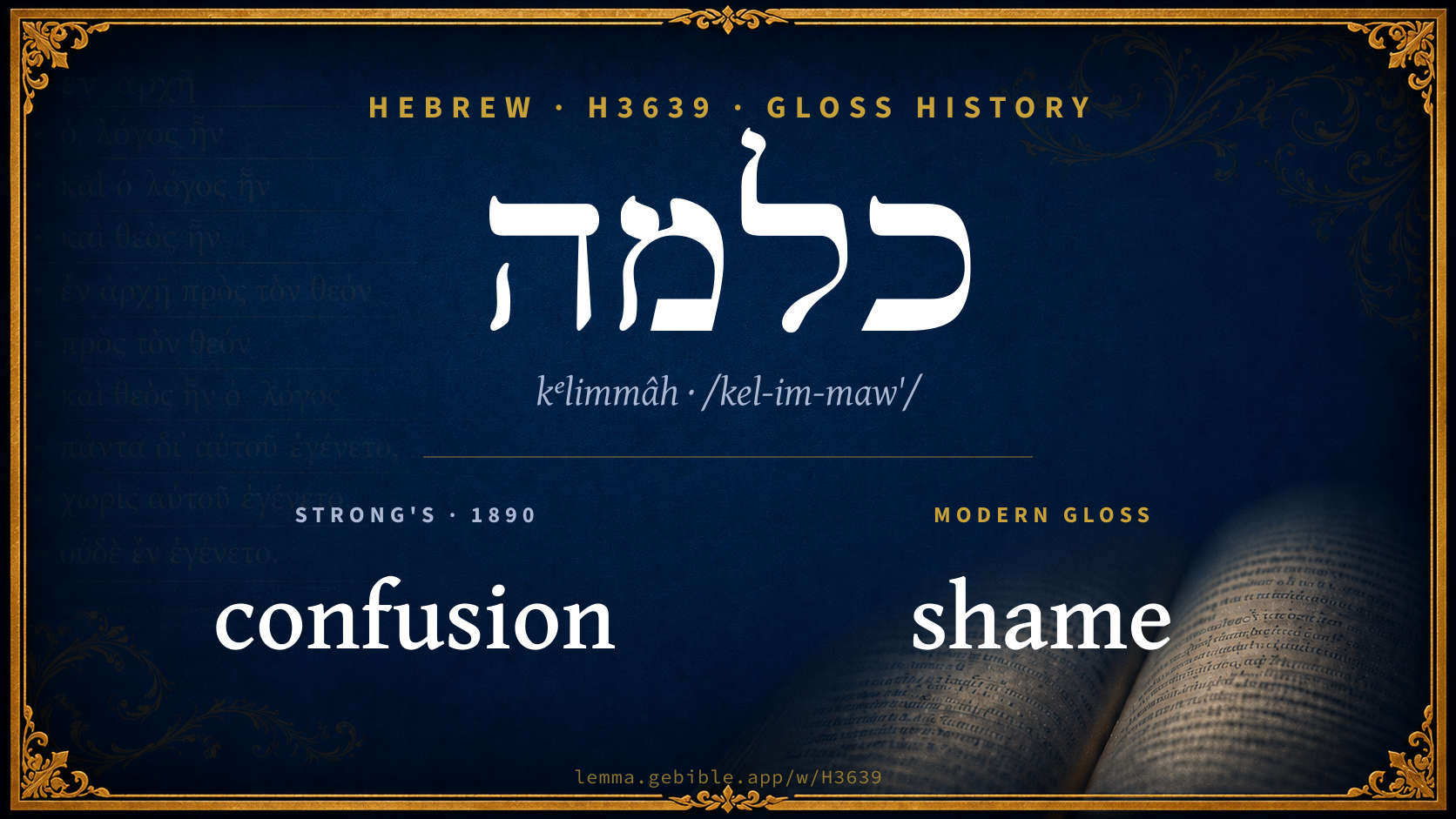
Gloss history
Strong's 1890 vs modern scholarship
About this word
Strong's H3639 catalogs a Hebrew word from the Hebrew Old Testament.
These counts are not copied from any lexicon or concordance. They are computed here, from the morphology-tagged Hebrew Old Testament. What Lemma adds →
- 29
- distinct verses
- The word appears in 29 distinct verses.
- 7 / 39
- OT books
- The word appears in 7 of 39 Old Testament books.
- #1,139
- by frequency
- Top 2500 most frequent Hebrew words (rank 1,139 of 8,640 Hebrew words by occurrence).
View all 29 occurrences in the concordance →
By section of the Old Testament
By traditional corpus
Conventional, traditional groupings — biblical authorship is debated, so this is a traditional corpus grouping, not an authorship claim. Each share is this word’s portion of its verses in that division of the Hebrew canon. Each figure is a share of the word’s 29 distinct verses.
- Prophets (Nevi'im) 20 verses · 69%
- Writings (Ketuvim) 9 verses · 31%
How translations render this word
Counts come from each version’s own published word-to-Strong’s tagging or interlinear alignment — an approximate guide to how each version renders this word, not a word-level alignment the data otherwise carries. Because each total is that version’s own tagged count, the per-version totals vary from one another and need not match the appearance or distinct-verse counts above. These counts may also differ from a printed concordance because Lemma counts each distinctly tagged rendering and does not collapse phrase taggings into a single head-word total. This is a fixed set of word-tagged versions (KJV, ASV, BSB, ULT) and does not change with the reading translation you choose elsewhere. Each version’s license is shown beside its name below (and on Sources).
- King James Version: Shame 17×, Confusion 6×, Dishonour 3×
- American Standard Version: Shame 11×, Dishonor 4×, Confusion 2×
- Berean Standard Bible: Disgrace 17×, Shame 3×, Reproach 2×
- unfoldingWord Literal Text: Humiliation 6×, Disgrace 4×, Own shame 4×
King James Version Public Domain
Renders H3639 across 30 tagged occurrences — most commonly:
Plus 2 renderings that appear only once — usually multi-word phrases or single function words the recovered tagging swept in, not distinct renderings.
American Standard Version Public Domain
Renders H3639 across 28 tagged occurrences — most commonly:
Plus 11 renderings that appear only once — usually multi-word phrases or single function words the recovered tagging swept in, not distinct renderings.
Berean Standard Bible Public Domain
Renders H3639 across 30 tagged occurrences — most commonly:
Plus 6 renderings that appear only once — usually multi-word phrases or single function words the recovered tagging swept in, not distinct renderings.
unfoldingWord Literal Text CC BY-SA 4.0
Renders H3639 across 30 tagged occurrences — most commonly:
Plus 11 renderings that appear only once — usually multi-word phrases or single function words the recovered tagging swept in, not distinct renderings.
Senses in the full BDB
What do BDB’s symbols mean?
BDB uses these scholarly abbreviations:
| Symbol | Meaning |
|---|---|
| 𝔊 | the Septuagint (the ancient Greek translation, LXX) |
| 𝔙 | the Vulgate (the Latin translation) |
| 𝔖 | the Syriac version (the Peshitta) |
| 𝔗 | the Targum (the Aramaic translation) |
| ψ | the Psalms |
| √ | root (the underlying root or stem) |
| ‖ | parallel passage (a synonymous or contrasted parallel) |
| † | the dagger: every passage where the word occurs is cited |
The 2 senses and sub-senses the full Brown-Driver-Briggs lexicon distinguishes for this word, in lexicon order (not ranked by frequency), with BDB’s own verbatim wording and sub-sense lettering. Shown in Hebrew script with BDB’s own scholarly abbreviations. The condensed entry is in the Lexicon Entry tab. See also the Forms in the corpus table below.
- 1. specif., insult, reproach, לֹא יִסַּג כ׳ Mi 2:6 reproaches do not cease; מוּסַר כְּלִמָּתִי Jb 20:3 = my beshaming (insulting) correction, i.e. the correction which insults me. e.g. Micah 2:6
- 2. in gen., reproach, ignominy, opp. כָּבוֹד ψ 4:3; הלך בַּכּ׳ Is 45:16 go into ignominy (+ בּוֹשׁ, נִכְלַם); often ‖ בֹּשֶׁת Is 30:3; 61:7 ψ 44:16, subj. of כִּסָּה Je 3:25 our ignominy covereth us, so under fig. of garment, after לָבַשׁ ψ 35:26 (+ בושׁ, חפר in v a), 109:29; ‖ חֶרְפָּה ψ 69:8 (subj. of כִּסְּתָה פָּנָ֑י), Je 51:51 (id.; בושׁ in ‖ cl.), ψ 71:13 (+ בושׁ in ‖ cl.); ‖ בֹּשֶׁת + חֶרְפָּה 69:20; ‖ אִוֶּלֶת Pr 18:13; ‖ רֹק Is 50:6; כ׳ עוֹלָם Je 20:11 (בושׁ in ‖ cl.); כְּלִמָּתֵךְ Ez 16:63 (id. ‖); often in Ezek. נשׂא כ׳ bear ignominy, Ez 16:52(×2), (‖ בושׁ), v 54 (נִכְלַם in ‖ cl.); 32:24, 25, 30 (all + אֶת־יוֹרְדֵי בוֹר with those who go down to the pit; ref. to ignominious death), 36:7; 39:26 (si vera l. = bear the humiliating sense of undeserved kindness from י׳; but txt. dub., Hi Co, q.v., [כ׳] נשׁו; Sm Da defend); נשׂא כְּלִמַּת הַגּוֹיִם, i.e. caused by the nations, 34:29; 36:6, also v 15 (‖ חֶרְפַּת עַמִּים), prob. also ψ 89:51 (read כְּלִמַּת, cf. VB Che Bae); וְנ׳ כְּלִמָּתָם וְתוֹעֲבוֹתָם אֲשֶׁר עָשׂוּ Ez 44:13. e.g. Psalms 4:3
Senses from the full Brown-Driver-Briggs lexicon (Brown, Driver, Briggs; Oxford 1906 — public domain), digitized via Sefaria, supplemented by the OpenScriptures HebrewLexicon (CC BY 4.0). Full attribution on Sources.
Word origin
n.f. insult, reproach, ignominy;—abs. כ׳ Is 45:16 + 9 times cstr. כְּלִמַּת Je 20:11 + 3 times; sf. כְּלִמָּתִי Jb 20:3 + 3 times, etc.; pl. כְּלִמּוֹת Mi 2:6; Is 50:6;—
— Brown-Driver-Briggs (Oxford 1906, public domain), digitized via Sefaria, supplemented by the OpenScriptures HebrewLexicon (CC BY 4.0). See Sources.
Derived from כלם (kâlam) (H3637) — to shame.
Forms in the corpus
The 23 distinct written forms H3639 takes in the Hebrew Bible, most frequent first — each parse links to that state’s occurrences in the concordance. Hebrew forms include their vowel points and cantillation, so a single lemma takes many written forms.
Same root — word family
Other BDB entries built from the same root as H3639, grouped by Strong’s listed origin. These share a root / origin per the lexicon — not necessarily a shared meaning. Each links to that word’s own entry.
Derives from
Derived from this word
Compare all same-root words → They share a root, not necessarily a meaning.
Septuagint verse parallels
This word appears in 24 verses that also exist in the Greek Old Testament (Septuagint), out of the 29 Hebrew verses it occurs in. You can read those verses in Greek by switching the Old Testament edition to the Septuagint.
Read these verses in the Septuagint
This is a verse-level parallel only — the same verses exist in both the Hebrew and Greek Old Testaments. No word-level Hebrew↔Greek correspondence is claimed: the data carries no such alignment, so no Greek word is shown as this Hebrew word’s translation. Coverage is not total — the Septuagint omits the deuterocanon and renumbers the Psalms, so some Hebrew verses have no direct Greek parallel.