
Psalms 77:12

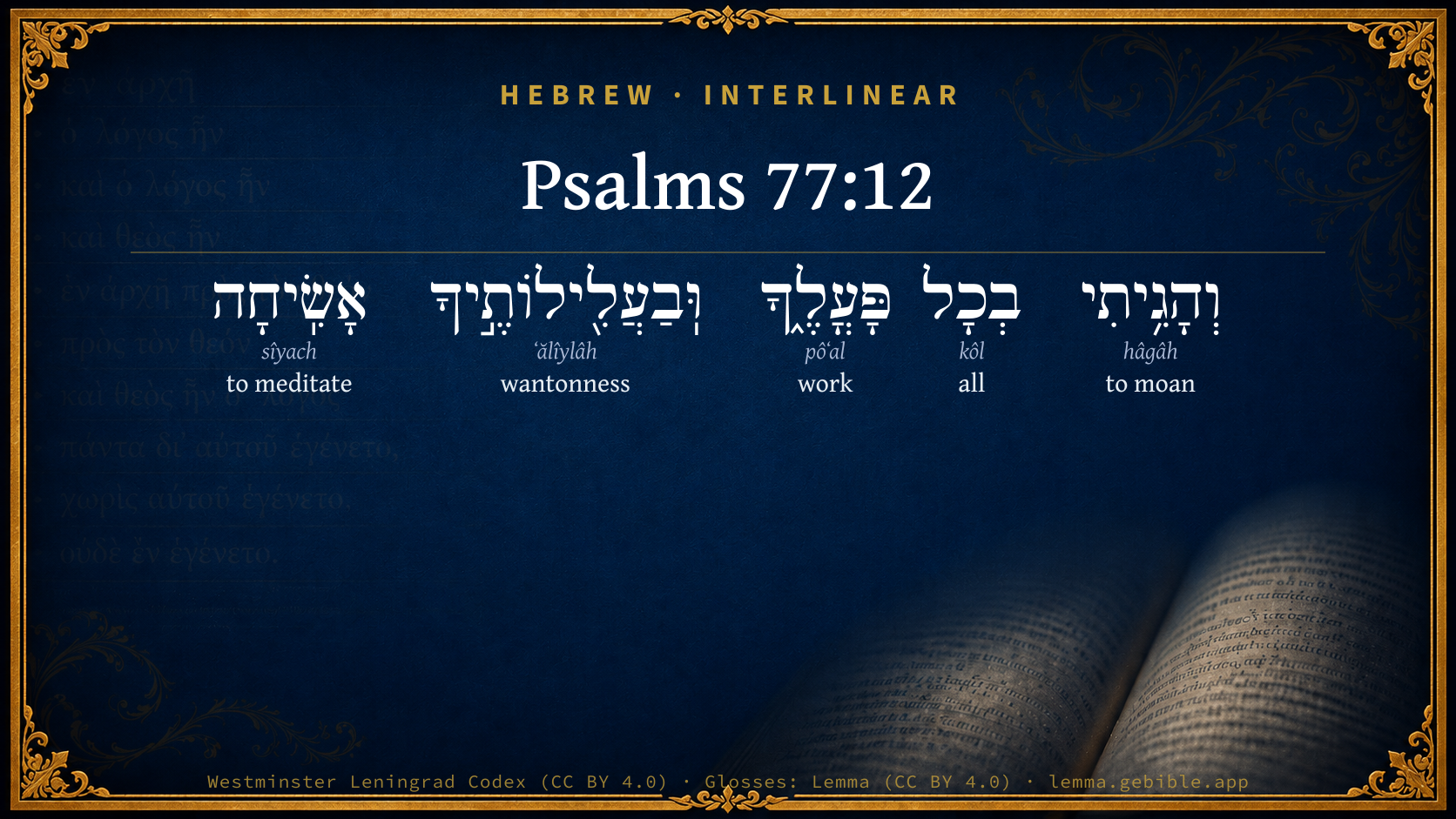
Hebrew (Westminster Leningrad Codex) Psalms 77:12 appears in the Hebrew Old Testament. The text above is from the Westminster Leningrad Codex. Each word links to its Strong’s number, a concise gloss, and parsing drawn from the Open Scriptures Hebrew Bible morphology. Click any word for its full Brown-Driver-Briggs (BDB) entry.
Download image
Cite this verse

Psalms 77:12 (World English Bible). Public Domain. Lemma interlinear Bible study tool, https://lemma.gebible.app/v/psalms/77/12.

Show BibTeX & RIS
BibTeX
RIS
English Translation
I will also meditate on all your work, And consider your doings.
World English Bible · Public Domain
Download a study sheet

One document with this verse’s original text, its word-by-word gloss line, the meaning frame, cross-references with their text, attributed commentary, and full source and license credits — printable, and it pastes into notes with its structure intact.

This verse Autodidact and up

Study sheet (.html) Plain text (.txt)

A passage Seminary Student

Up to 50 verses in one chapter. A passage sheet keeps up to 6 commentary sources and 12 cross-references per verse, in the order this page ranks them, and says so on the sheet whenever that leaves anything out. Ask for a single verse and you get the Autodidact verse sheet above.

Everything on this page stays free to read, with no account — the sheet is a download of what is already on screen, not access to it.

Want to remove ads? Support Godless Engineer
Compare translations 3

The same verse in 3 English versions, stacked beneath the original-language interlinear above. Click any original word for its lexicon entry.

Each is an independent rendering of the whole verse — the interlinear is not word-aligned to these translations.

Highlighted words mark where these versions differ — a whole-verse word diff, not a word-by-word alignment.

  • World English Bible Public Domain
    I will also meditate on all your work, And consider your doings.
  • King James Version Public Domain
    I will meditate also of all thy work, and talk of thy doings.
  • unfoldingWord Literal Text CC BY-SA 4.0
    And I will ponder on all your deeds, and on your works I will meditate.

unfoldingWord Literal Text — © unfoldingWord, licensed CC BY-SA 4.0. Word-aligned USFM3 via Door43 (git.door43.org/unfoldingWord/en_ult).

Versions to compare (up to 4)

3 of 4 selected

Show all 18 translations

Every available English version of this verse, each an independent rendering of the whole verse.

  • World English Bible Public Domain
    I will also meditate on all your work, And consider your doings.
  • Berean Standard Bible Public Domain
    I will reflect on all You have done and ponder Your mighty deeds.
  • Majority Standard Bible Public Domain
    I will reflect on all You have done and ponder Your mighty deeds.
  • King James Version Public Domain
    I will meditate also of all thy work, and talk of thy doings.
  • American Standard Version (1901) Public Domain
    I will meditate also upon all thy work, And muse on thy doings.
  • Revised Version (1885) Public Domain
    I will meditate also upon all thy work, and muse on thy doings.
  • Geneva Bible (1599) Public Domain
    I did also meditate all thy woorkes, and did deuise of thine actes, saying,
  • Douay-Rheims (1899) Public Domain
    I remembered the works of the Lord: for I will be mindful of thy wonders from the beginning.
  • Young's Literal Translation Public Domain
    And I have meditated on all Thy working, And I talk concerning Thy doings.
  • Literal Standard Version CC BY-SA 4.0
    And I have meditated on all Your working, || And I talk concerning Your doings.
  • Unlocked Literal Bible CC BY-SA 4.0
    I will ponder all your deeds and will reflect on them.
  • unfoldingWord Literal Text CC BY-SA 4.0
    And I will ponder on all your deeds, and on your works I will meditate.
  • Darby Bible Public Domain
    And I will meditate upon all thy work, and muse upon thy doings.
  • World Messianic Bible Public Domain
    I will also meditate on all your work, and consider your doings.
  • Webster's Bible Public Domain
    \\77:11\\I will remember the works of the LORD: surely I will remember thy wonders of old.
  • Free Bible Version CC BY-SA 4.0
    I will think about all you have accomplished; I will think deeply about how you have acted.
  • Bible in Basic English Public Domain
    I will give thought to all your work, while my mind goes over your acts of power.
  • JPS Tanakh (1917) Public Domain
    (77-13) I will meditate also upon all Thy work, and muse on Thy doings.'

Literal Standard Version (2020), Covenant Press — licensed CC BY-SA 4.0. Text via the HelloAO Bible API (eBible.org). Unlocked Literal Bible (unfoldingWord) — licensed CC BY-SA 4.0. Text via the HelloAO Bible API (eBible.org). unfoldingWord Literal Text — © unfoldingWord, licensed CC BY-SA 4.0. Word-aligned USFM3 via Door43 (git.door43.org/unfoldingWord/en_ult). Free Bible Version, Dr. Jonathan Gallagher — licensed CC BY-SA 4.0. Text via the HelloAO Bible API (eBible.org).

Word by word

More ways to search: Search by grammar → Find every occurrence → Compare this word →

Practice this passage: Drill this verse → Learn its vocabulary →

About this verse

These counts appear in no published source. They are computed here, from the morphology-tagged text and Lemma’s own curated glosses. What Lemma adds →

5
words
5
distinct lemmas
Wisdom
section

Notable vocabulary

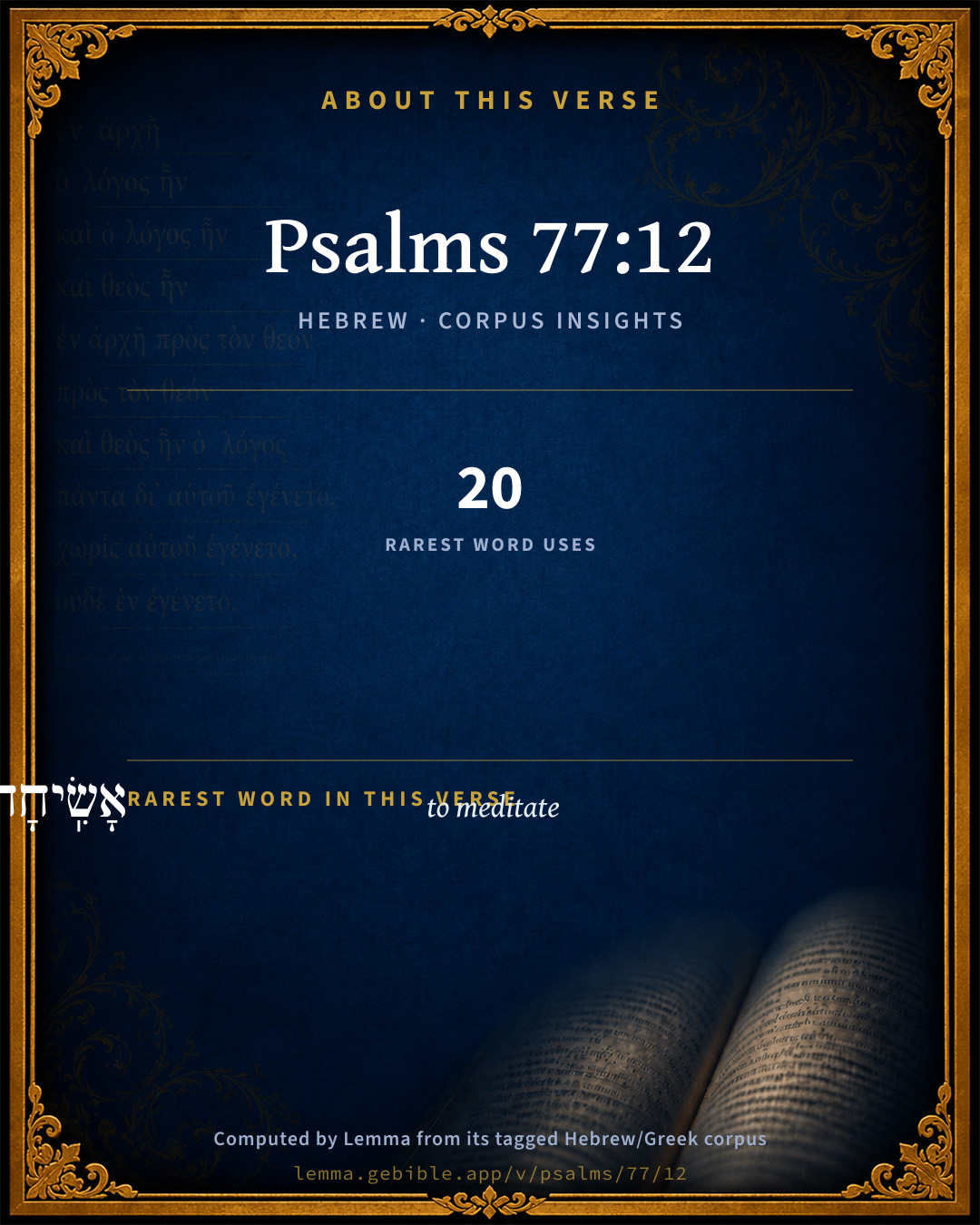
The rarest word here is אָשִֽׂיחָה to meditate H7878 — appearing just 20 times in the whole Hebrew Bible.

Shared distinctive vocabulary

אָשִֽׂיחָה to meditate H7878 occurs in 20 verses of the Hebrew Bible. Also found in:

Grammatical profile

  • 2 verbs
  • 3 nouns

Verb forms

  • וְהָגִ֥יתִי Qal · Sequential Perfect
  • אָשִֽׂיחָה Qal · Cohortative

Hebrew & Septuagint length

In English translation the verse runs 12 words from the Hebrew and 13 from the Septuagint (LXX English) — closely comparable.

A rough comparison of the two English renderings, which tokenize alike — not a word-level alignment.

Word counts can differ between the Hebrew and the Greek without any difference in meaning — e.g. the Hebrew direct-object marker אֵת has no separate Greek word, and Greek often adds the article ὁ.

Cross-references

8

Topical passages linked to Psalms 77:12 in the Treasury of Scripture Knowledge — connected by theme and wording, ordered by reader-vote popularity; previews shown in the World English Bible.

  • Psalms 71:24 My tongue will also talk about your righteousness all day long, For they are disappointed, and they are confounded, who want to harm me.
  • Psalms 145:11 They will speak of the glory of your kingdom, And talk about your power;
  • Deuteronomy 6:7 and you shall teach them diligently to your children, and shall talk of them when you sit in your house, and when you walk by the way, and when you lie down, and when you rise up.
  • Psalms 105:2 Sing to him, sing praises to him! Tell of all his marvelous works.
  • Psalms 104:34 Let your meditation be sweet to him. I will rejoice in Yahweh.
  • Psalms 143:5 I remember the days of old. I meditate on all your doings. I contemplate the work of your hands.
  • Psalms 145:4 One generation will commend your works to another, And will declare your mighty acts.
  • Luke 24:14–32 They talked with each other about all of these things which had happened.

Cross-references courtesy of OpenBible.info (CC BY 4.0).

Hebrew and Greek witnesses Masoretic Hebrew ↔ Greek Septuagint

The same verse in the two great witnesses to the Old Testament, shown verse-for-verse.

You’re reading Greek Psalm 76 (Hebrew Psalm 77). The Septuagint counts the superscription, so verse numbers can differ from the Hebrew — chapter-level alignment, not verse-by-verse. Numbering follows Rahlfs.

These are two independent witnesses, not word-aligned to each other, and the Septuagint is shown in lemma (dictionary) form.

Hebrew Psalms 77:12 Masoretic · Westminster Leningrad Codex

וְהָגִ֥יתִי בְכָל פָּעֳלֶ֑ךָ וּֽבַעֲלִ֖ילוֹתֶ֣יךָ אָשִֽׂיחָה

I will also meditate on all your work, And consider your doings.

World English Bible · Public Domain

Greek LXX Greek Psalm 76:12 Septuagint · lemma form

μιμνήσκω ὁ ἔργον κύριος ὅτι μιμνήσκω ἀπό ὁ ἀρχή ὁ θαυμάσιος σύ

And I will meditate on all your works, and will consider your doings.

LXX2012 (modern English Septuagint) · Public Domain

Hebrew: Westminster Leningrad Codex (CC BY 4.0). Greek: Septuagint (public domain); English from LXX2012 (modern English Septuagint) (Public Domain). How the Septuagint differs from the Hebrew →

Commentary

Notes on Psalms 77:12 from classic Christian and Jewish commentators (each source and its license shown beneath its notes). The classic Christian expositions comment on the surrounding passage and are grouped to its opening verse, so a note may address several verses; the Jewish commentaries on the Tanakh (Rashi and others) are per-verse, so they appear only where the commentator wrote on this verse.

Lemma curates 59 commentaries, every one of them public domain or Creative Commons licensed, each selected and text-cleaned for this edition rather than reprinted as found. About our sources →

Trapp's Complete Commentary

John Trapp

Psa 77:12 I will meditate also of all thy work, and talk of thy doings.

Ver. 12. I will meditate also of all thy works, and talk, &c.] {See Trapp on "Psa 45:1"}

John Trapp, A Commentary or Exposition upon All the Books of the Old and New Testament (1647–1656) — public domain. Text from a community e-Sword module.

The Biblical Illustrator

Joseph S. Exell

Psa_77:12

I will meditate also of all Thy work.

Meditation

I. Motives to meditation.

1. It is the proper occupation of the mind.

2. Our character in the sight of God depends on the character of our thoughts.

3. Meditation is essential to the success of Gods Word.

II. Subjects for meditation.

1. Gods existence and attributes.

2. His works.

3. His claims. Their comprehensiveness, their spirituality, their perpetual obligation. Our guilt in neglecting them.

4. Your future. (Evangelical Preacher.)

The need of meditation

In mere apprehension, whether through reading or hearing, there is little or no profit. The profit begins when that which is apprehended is so pondered as to become part and parcel of the mans inner nature. A man may run through a picture gallery so as to see every painting it contains, and to derive from the sight a certain amount of pleasure; but he alone profits by such an exhibition who pauses and studies each worthy work of art, and gathers ideas from it which enrich his mind, or learn lessons from it which refine his taste. It is the settling of milk, says an old writer, that makes it turn to cream, and it is the settling of truth in the mind that makes it turn to spiritual nutriment. (W. L. Alexander.)

The Biblical Illustrator, edited by Joseph S. Exell (c. 1880s–1900s) — public domain. Text from a community e-Sword module.

J. A. Alexander on Psalms

Joseph Addison Alexander

13. (Psa 77:12). And I will meditate of all thy work, and of thy doings will I muse. The original expression is not of but in them, as if implying a complete absorption of the thoughts and feeling in the object.

Joseph Addison Alexander, The Psalms Translated and Explained (1850) — public domain. Text from a community e-Sword module.

The Cambridge Bible for Schools and Colleges

gen. ed. J. J. S. Perowne

12. I will meditate also upon all thy work,

And muse on thy doings. (R.V.)

For work cp. Hab_3:2.

The Cambridge Bible for Schools and Colleges (gen. ed. J. J. S. Perowne; Cambridge University Press, 1878–1918) — public domain. Text from a community e-Sword module.

John Gill's Exposition

I will meditate also of all thy work,.... Or "works" (t), which were many; he desired not to forget any of them, but remember the multitude of his tender mercies, and not only call them to mind, but dwell upon them in his meditations and contemplations, in order to gain some relief by them under his present circumstances:

and talk of thy doings: for the good of others, and so for the glory of God, as well as to imprint them on his own mind, that they might not be forgotten by him; for all things that are talked of, and especially frequently, are better remembered, see Psa 145:4, the Targum is,

"I will meditate on all thy good works, and speak of the causes of thy wonders.''

(t) "de unoquoque opere tuo", Junius & Tremellius, Piscator.

John Gill's Exposition of the Whole Bible (1746–1763) — public domain (CC PDM 1.0). Text via the HelloAO Bible API.

Albert Barnes' Notes on the Bible

I will meditate also of all thy work - That is, with a view to learn thy real character; to see whether I am to be constrained by painful facts to cherish the thoughts which have given me such trouble, or whether I may not find reasons for cherishing more cheerful views of God.

And talk of thy doings - Or rather, “I will muse on thy doings” - for so the Hebrew word signifies. It is not conversation with others to which he refers; it is meditation - musing - calm contemplation - thoughtful meditation. He designed to reflect on the doings of God, and to ask what was the proper interpretation to be put on them in regard to his character. Thus we must, and may, judge of God, as we judge of our fellow-men. We may, we must, inquire what is the proper interpretation to be put on the events which occur under his administration, and form our opinions accordingly. The result of the psalmist’s reflections is stated in the following verses.

Albert Barnes' Notes on the Bible (1834–1885) — public domain. Text from a community e-Sword/MySword module.

The Treasury of David

Charles H. Spurgeon

Ver. 12. I will meditate also of all thy work. Sweet work to enter into Jehovah's work of grace, and there to lie down and ruminate, every thought being absorbed in the one precious subject.

And talk of thy doings. It is well that the overflow of the mouth should indicate the good matter which fills the heart. Meditation makes rich talking; it is to be lamented that so much of the conversation of professors is utterly barren, because they take no time for contemplation. A meditative man should be a talker, otherwise he is a mental miser, a mill which grinds corn only for the miller. The subject of our meditation should be choice, and then our task will be edifying; if we meditate on folly and affect to speak wisdom, our double mindedness will soon be known unto all men. Holy talk following upon meditation has a consoling power in it for ourselves as well as for those who listen, hence its value in the connection in which we find it in this passage.

Whole Psalm. Whenever, and by whomsoever, the Psalm may have been written, it clearly is individual, not national. It utterly destroys all the beauty, all the tenderness and depth of feeling in the opening portion, if we suppose that the people are introduced speaking in the first person. The allusions to the national history may indeed show that the season was a season of national distress, and that the sweet singer was himself bowed down by the burden of the time, and oppressed by woes which he had no power to alleviate; but it is his own sorrow, not the sorrow of others under which he sighs, and of which he has left the pathetic record. J. J. Stewart Perowne.

Ver. 12. Themes for thought and topics for conversation. Creation, Providence, Redemption, etc.

Psalms 77:13*

Charles H. Spurgeon's The Treasury of David (1869–1885) — public domain. Psalms only. Text from a community e-Sword/MySword module.

The Pulpit Commentary

I will meditate also of all thy work, and talk of thy doings; rather, as in the Revised Version, and muse on thy doings (comp. ver. 3).

The Pulpit Commentary (1880–1919), ed. H.D.M. Spence-Jones & Joseph S. Exell — public domain. Text from a community e-Sword module.

Lesson kit

Teaching starters — assembled from the data on this page, not authored interpretation. Every prompt links to the verse data it draws on. Edit before teaching.

Psalms, in the Wisdom, opens this verse with 5 words (5 distinct Hebrew lemmas). Its most distinctive word is sîyach (“to meditate”). A historical commentator’s framing appears above. Read the whole chapter for the surrounding context.

Discussion questions

  1. What does “to meditate” (sîyach) contribute to the verse as a whole?
  2. How does Judges 5:10, which shares the word «to meditate», read alongside this verse?
  3. These translations render this verse differently; the difference is in the English rendering, not the original. What questions does that raise?
  4. «וְהָגִ֥יתִי» is a Qal Sequential Perfect verb. How does that grammatical form shape the action described?
  5. Compare how Trapp's Complete Commentary and The Biblical Illustrator read this verse. Where do they agree or differ?

Things to notice

Reading settings

Reading text

Shown beneath each verse's original-language words.

Old Testament
Old Testament edition

Read the OT as the Masoretic Hebrew (MT) or the Greek Septuagint (LXX).

English shown for the Greek Septuagint (in the Hebrew ↔ Greek comparison).

Comparing translations? Open the Compare panel on any verse page to stack up to four side by side.