
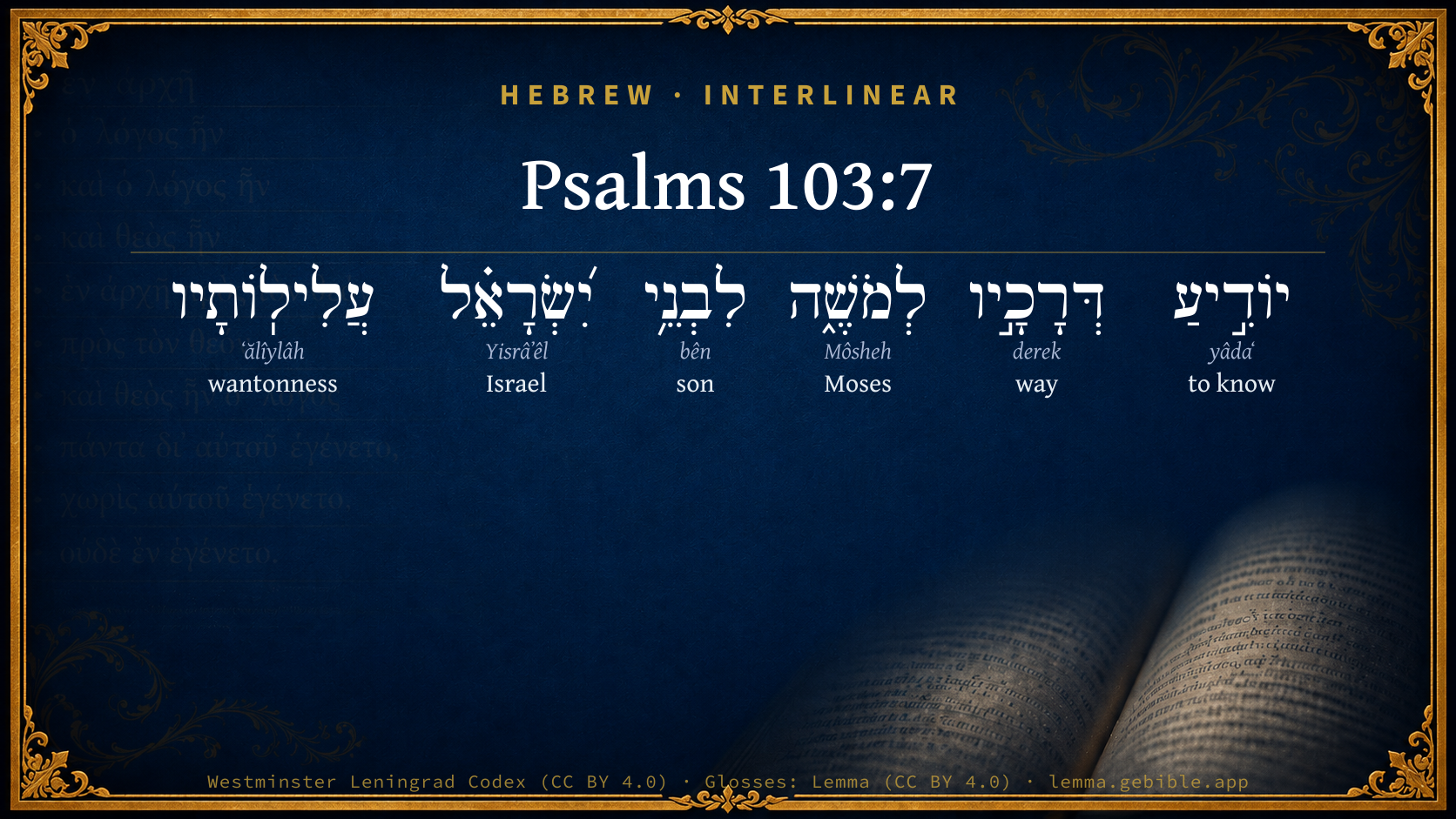
Psalms 103:7

Hebrew (Westminster Leningrad Codex) Psalms 103:7 appears in the Hebrew Old Testament. The text above is from the Westminster Leningrad Codex. Each word links to its Strong’s number, a concise gloss, and parsing drawn from the Open Scriptures Hebrew Bible morphology. Click any word for its full Brown-Driver-Briggs (BDB) entry.
Download image
Cite this verse

Psalms 103:7 (World English Bible). Public Domain. Lemma interlinear Bible study tool, https://lemma.gebible.app/v/psalms/103/7.

Show BibTeX & RIS
BibTeX
RIS
English Translation
He made known his ways to Moses, His deeds to the children of Israel.
World English Bible · Public Domain
Download a study sheet

One document with this verse’s original text, its word-by-word gloss line, the meaning frame, cross-references with their text, attributed commentary, and full source and license credits — printable, and it pastes into notes with its structure intact.

This verse Autodidact and up

Study sheet (.html) Plain text (.txt)

A passage Seminary Student

Up to 50 verses in one chapter. A passage sheet keeps up to 6 commentary sources and 12 cross-references per verse, in the order this page ranks them, and says so on the sheet whenever that leaves anything out. Ask for a single verse and you get the Autodidact verse sheet above.

Everything on this page stays free to read, with no account — the sheet is a download of what is already on screen, not access to it.

Want to remove ads? Support Godless Engineer
Compare translations 3

The same verse in 3 English versions, stacked beneath the original-language interlinear above. Click any original word for its lexicon entry.

Each is an independent rendering of the whole verse — the interlinear is not word-aligned to these translations.

Highlighted words mark where these versions differ — a whole-verse word diff, not a word-by-word alignment.

  • World English Bible Public Domain
    He made known his ways to Moses, His deeds to the children of Israel.
  • King James Version Public Domain
    He made known his ways unto Moses, his acts unto the children of Israel.
  • unfoldingWord Literal Text CC BY-SA 4.0
    He made known his ways to Moses, his deeds to the children of Israel.

unfoldingWord Literal Text — © unfoldingWord, licensed CC BY-SA 4.0. Word-aligned USFM3 via Door43 (git.door43.org/unfoldingWord/en_ult).

Versions to compare (up to 4)

3 of 4 selected

Show all 18 translations

Every available English version of this verse, each an independent rendering of the whole verse.

  • World English Bible Public Domain
    He made known his ways to Moses, His deeds to the children of Israel.
  • Berean Standard Bible Public Domain
    He made known His ways to Moses, His deeds to the people of Israel.
  • Majority Standard Bible Public Domain
    He made known His ways to Moses, His deeds to the people of Israel.
  • King James Version Public Domain
    He made known his ways unto Moses, his acts unto the children of Israel.
  • American Standard Version (1901) Public Domain
    He made known his ways unto Moses, His doings unto the children of Israel.
  • Revised Version (1885) Public Domain
    He made known his ways unto Moses, his doings unto the children of Israel.
  • Geneva Bible (1599) Public Domain
    He made his wayes knowen vnto Moses, and his workes vnto the children of Israel.
  • Douay-Rheims (1899) Public Domain
    He hath made his ways known to Moses: his wills to the children of Israel.
  • Young's Literal Translation Public Domain
    He maketh known His ways to Moses, To the sons of Israel His acts.
  • Literal Standard Version CC BY-SA 4.0
    He makes His ways known to Moses, || His acts to the sons of Israel.
  • Unlocked Literal Bible CC BY-SA 4.0
    He made known his ways to Moses, his deeds to the descendants of Israel.
  • unfoldingWord Literal Text CC BY-SA 4.0
    He made known his ways to Moses, his deeds to the children of Israel.
  • Darby Bible Public Domain
    He made known his ways unto Moses, his acts unto the children of Israel.
  • World Messianic Bible Public Domain
    He made known his ways to Moses, his deeds to the children of Israel.
  • Webster's Bible Public Domain
    He made known his ways to Moses, his acts to the children of Israel.
  • Free Bible Version CC BY-SA 4.0
    He explained his ways to Moses: he told the people of Israel what he was going to do.
  • Bible in Basic English Public Domain
    He gave knowledge of his way to Moses, and made his acts clear to the children of Israel.
  • JPS Tanakh (1917) Public Domain
    He made known His ways unto Moses, His doings unto the children of Israel.

Literal Standard Version (2020), Covenant Press — licensed CC BY-SA 4.0. Text via the HelloAO Bible API (eBible.org). Unlocked Literal Bible (unfoldingWord) — licensed CC BY-SA 4.0. Text via the HelloAO Bible API (eBible.org). unfoldingWord Literal Text — © unfoldingWord, licensed CC BY-SA 4.0. Word-aligned USFM3 via Door43 (git.door43.org/unfoldingWord/en_ult). Free Bible Version, Dr. Jonathan Gallagher — licensed CC BY-SA 4.0. Text via the HelloAO Bible API (eBible.org).

Word by word

More ways to search: Search by grammar → Find every occurrence → Compare this word →

Practice this passage: Drill this verse → Learn its vocabulary →

About this verse

These counts appear in no published source. They are computed here, from the morphology-tagged text and Lemma’s own curated glosses. What Lemma adds →

6
words
6
distinct lemmas
Wisdom
section

Notable vocabulary

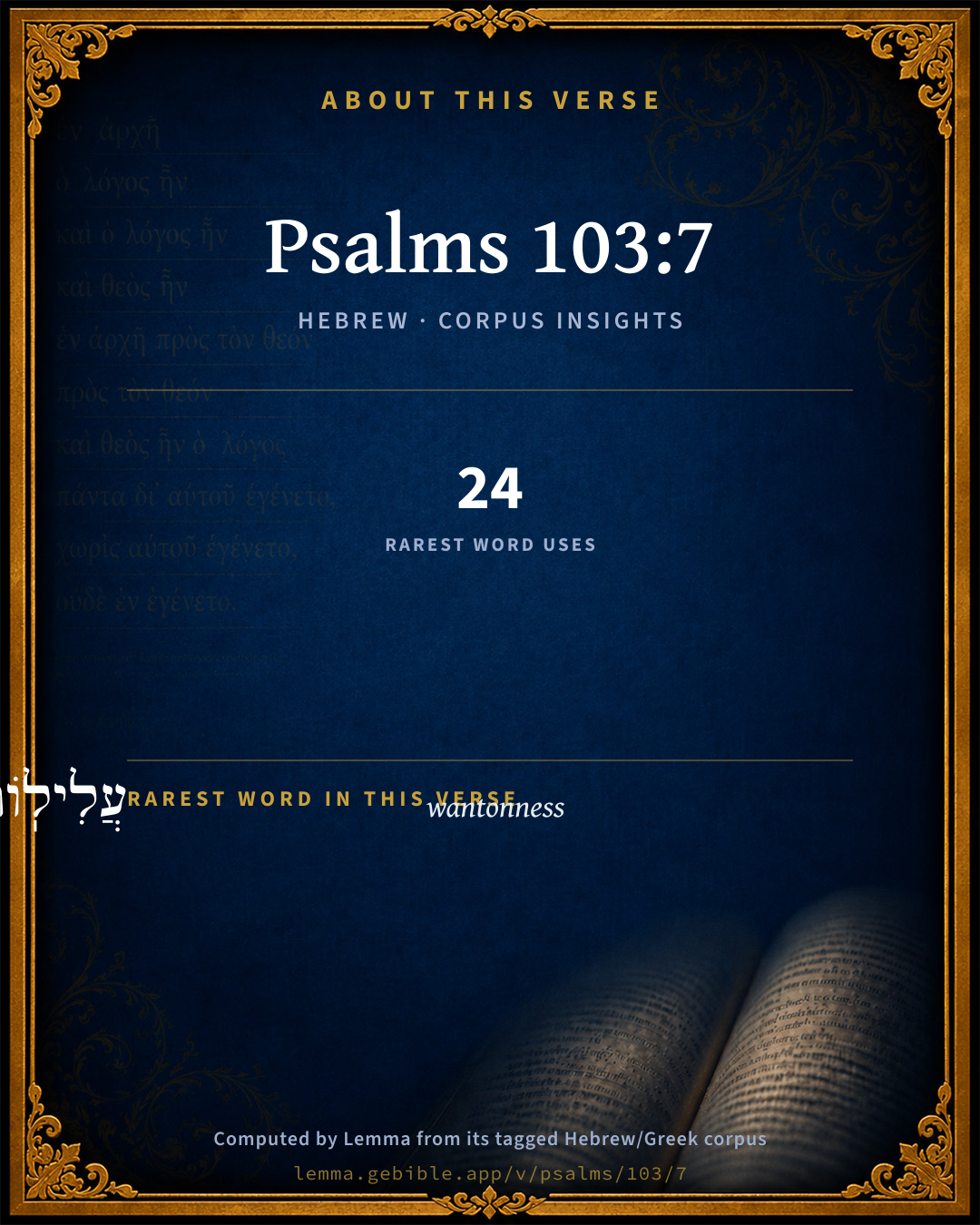
The rarest word here is עֲלִילֽוֹתָיו wantonness H5949 — appearing just 24 times in the whole Hebrew Bible.

Shared distinctive vocabulary

עֲלִילֽוֹתָיו wantonness H5949 occurs in 24 verses of the Hebrew Bible. Also found in:

Grammatical profile

  • 1 verb
  • 5 nouns

Verb forms

  • יוֹדִ֣יעַ Hiphil · Imperfect

Hebrew & Septuagint length

In English translation the verse runs 14 words from the Hebrew and 14 from the Septuagint (LXX English) — the same length.

A rough comparison of the two English renderings, which tokenize alike — not a word-level alignment.

Word counts can differ between the Hebrew and the Greek without any difference in meaning — e.g. the Hebrew direct-object marker אֵת has no separate Greek word, and Greek often adds the article ὁ.

Cross-references

18

Topical passages linked to Psalms 103:7 in the Treasury of Scripture Knowledge — connected by theme and wording, ordered by reader-vote popularity; previews shown in the World English Bible.

  • Exodus 33:13 Now therefore, if I have found favor in your sight, please show me now your ways, that I may know you, so that I may find favor in your sight: and consider that this nation is your people."
  • Psalms 147:19 He shows his word to Jacob; His statutes and his ordinances to Israel.
  • Psalms 78:11 They forgot his doings, His wondrous works that he had shown them.
  • Nehemiah 9:14 and made known to them your holy Sabbath, and commanded them commandments, and statutes, and a law, by Moses your servant,
  • Deuteronomy 34:10 There has not arisen a prophet since in Israel like Moses, whom Yahweh knew face to face,
  • Psalms 77:20 You led your people like a flock, By the hand of Moses and Aaron.
  • Psalms 99:7 He spoke to them in the pillar of cloud. They kept his testimonies, The statute that he gave them.
  • John 5:45–47 "Don't think that I will accuse you to the Father. There is one who accuses you, even Moses, on whom you have set your hope.
  • Exodus 19:8 All the people answered together, and said, "All that Yahweh has spoken we will do." Moses reported the words of the people to Yahweh.
  • Exodus 19:20 Yahweh came down on Mount Sinai, to the top of the mountain. Yahweh called Moses to the top of the mountain, and Moses went up.
  • Exodus 20:21 The people stayed at a distance, and Moses drew near to the thick darkness where God was.
  • Exodus 24:2–4 Moses alone shall come near to Yahweh, but they shall not come near, neither shall the people go up with him."
  • Psalms 78:5 For he established a testimony in Jacob, And appointed a law in Israel, Which he commanded our fathers, That they should make them known to their children;
  • Acts 7:35–60 "This Moses, whom they refused, saying, 'Who made you a ruler and a judge?'--God has sent him as both a ruler and a deliverer by the hand of the angel who appeared to him in the bush.
  • Numbers 12:7 My servant Moses is not so; he is faithful in all my house:
  • Psalms 105:26–45 He sent Moses, his servant, And Aaron, whom he had chosen.
  • Psalms 106:22 Wondrous works in the land of Ham, And awesome things by the Red Sea.
  • Isaiah 63:11–12 Then he remembered the days of old, Moses [and] his people, [saying], Where is he who brought them up out of the sea with the shepherds of his flock? where is he who put his holy Spirit in the midst of them?

Cross-references courtesy of OpenBible.info (CC BY 4.0).

Hebrew and Greek witnesses Masoretic Hebrew ↔ Greek Septuagint

The same verse in the two great witnesses to the Old Testament, shown verse-for-verse.

You’re reading Greek Psalm 102 (Hebrew Psalm 103). The Septuagint counts the superscription, so verse numbers can differ from the Hebrew — chapter-level alignment, not verse-by-verse. Numbering follows Rahlfs.

These are two independent witnesses, not word-aligned to each other, and the Septuagint is shown in lemma (dictionary) form.

Hebrew Psalms 103:7 Masoretic · Westminster Leningrad Codex

יוֹדִ֣יעַ דְּרָכָ֣יו לְמֹשֶׁ֑ה לִבְנֵ֥י יִ֝שְׂרָאֵ֗ל עֲלִילֽוֹתָיו

He made known his ways to Moses, His deeds to the children of Israel.

World English Bible · Public Domain

Greek LXX Greek Psalm 102:7 Septuagint · lemma form

γνωρίζω ὁ ὁδός αὐτός ὁ μωυσῆς ὁ υἱός ἰσραήλ ὁ θέλημα αὐτός

He made known his ways to Moses, his will to the children of Israel.

LXX2012 (modern English Septuagint) · Public Domain

Hebrew: Westminster Leningrad Codex (CC BY 4.0). Greek: Septuagint (public domain); English from LXX2012 (modern English Septuagint) (Public Domain). How the Septuagint differs from the Hebrew →

Commentary

Notes on Psalms 103:7 from classic Christian and Jewish commentators (each source and its license shown beneath its notes). The classic Christian expositions comment on the surrounding passage and are grouped to its opening verse, so a note may address several verses; the Jewish commentaries on the Tanakh (Rashi and others) are per-verse, so they appear only where the commentator wrote on this verse.

Lemma curates 59 commentaries, every one of them public domain or Creative Commons licensed, each selected and text-cleaned for this edition rather than reprinted as found. About our sources →

The Cambridge Bible for Schools and Colleges

gen. ed. J. J. S. Perowne

7, 8. Psa_103:7 a is a reminiscence of Moses’ prayer, “make known to me, I pray, thy ways” (Exo_33:13), and Psa_103:8 is quoted from the revelation of Jehovah’s character which was the answer to that prayer (Exo_34:6). It is often referred to, e.g. Psa_86:15; Psa_145:8; Joe_2:13; Neh_9:17; &c. God’s ‘ways’ and ‘doings’ here mean His methods of dealing with men, and this quotation gives a summary of them.

Render Psa_103:8,

Jehovah is full of compassion and gracious,

Slow to anger, and abundant in lovingkindness.

The Cambridge Bible for Schools and Colleges (gen. ed. J. J. S. Perowne; Cambridge University Press, 1878–1918) — public domain. Text from a community e-Sword module.

Trapp's Complete Commentary

John Trapp

Psa 103:7 He made known his ways unto Moses, his acts unto the children of Israel.

Ver. 7. He made known his ways unto Moses] Even right judgments, true laws, good statute and commandments, Neh 9:13-14. The Rabbis by ways here understand God’s attributes and properties (Middoth they call them), those thirteen proclaimed, Exo 34:1-35, after that Moses had prayed, Exo 33:13, "Show me thy ways"; and the next words favour this interpretation.

His acts to the children] His miracles in Egypt, and all along the wilderness, where they fed upon sacraments.

John Trapp, A Commentary or Exposition upon All the Books of the Old and New Testament (1647–1656) — public domain. Text from a community e-Sword module.

The Biblical Illustrator

Joseph S. Exell

Psa_103:7

He made known His ways unto Moses, His acts unto the children of Israel.

A twofold revelation, and a twofold attainment

I. A twofold Divine revelation. There is an obvious distinction between ways and acts. Acts are deeds; ways are methods. A mans acts are the results and representatives of his ways. A mans ways indicate the leading principle, spirit, and style of his life. His acts are not always consistent with his ways.

1. God reveals His ways. The universal, immutable, and eternal principles that guide Him in all His operations in the spiritual world are clearly laid down in the Book. The laws He gave to Moses reveal His ways, and so does the biography of His blessed Son in a still sublimer measure.

2. God reveals His acts. His acts are recorded in the Bible: creative acts--governing acts--redeeming acts--acts of justice and of mercy. His acts should be studied in order to reach the higher knowledge of His ways.

II. A twofold theological intelligence. Moses, on Sinai, received the eternal principles that regulate the Infinite in all His operations with man. The children of Israel down in the desert only saw His acts. They understood not the laws of His providence, and the grand purposes of His heart. There is a great distinction between these two kinds of knowledge.

1. One is far more profound than the other. The outward acts of God, as recorded in this Book, may be easily ascertained and detailed in fluent and accurate speech. But to understand His ways, to penetrate the region of principles, and to have an insight into the method of Divine operations, is a difficult work. This requires not only an inductive study of the Holy Book, but exalted feelings of devotion. The secrets of the Lord are with them that fear Him.

2. One is far more valuable than the other. It is more valuable to the possessor. The man who is only conversant with the mere acts of God will often be filled with confusion by providential events. One act will apparently contradict another, but he who understands the ways, the grand purposes and principles of God, will not be easily confused. It is more valuable, too, in qualifying us for usefulness. The man who is acquainted with mere details may repeat Bible anecdotes, and be popular. The man who has some knowledge of eternal principles can alone instruct souls.

3. One is far more uncommon than the other.

(1) In nature the millions observe the acts of God. They hear His thunder; they witness His lightning. They see His operations in heaving oceans and revolving worlds. But only one here and there understands His ways, and these are our men of science.

(2) In human history, numbers are conversant with the leading facts of human history. They know the acts of this statesman and that, this warrior and that, this nation and that; but the ways of God, the great principles with which He governs man are known only by a few--the philosophic historians.

(3) In redemption, the leading facts of Christs life are familiar to most in Christendom; but His ways, His grand principles, and sublime purposes, how few know anything about! (Homilist.)

Revelation by action

God has revealed Himself to man. Nothing can be more reasonable. Can it be that a supreme intelligence would create intelligent subjects of His government and children of His family, and have no further communication with them? Intelligence creating intelligence, revelation is inevitable. But how did God reveal Himself to man? When I was a very little child, I supposed that He had revealed Himself in a book, and that the self-revelation was limited to the book. I wish to insist that God, in revealing Himself to humanity, does not limit Himself to a book; but that God made known His ways unto individuals, His doings unto nations, and that His revelation was a revelation chiefly by action, a revelation on the plane of human activity, in vast historic unfoldings, through long centuries, on a colossal scale and with deep incisions. He did not write, He wrought. And man wrote. God wrought deeds to make words possible, to give significance to words; but His revelation was primarily a revelation in action. He made known His ways unto Moses. Glance for a moment at that wonderful scene recorded in the Book of Exodus, where Moses and Aaron appear before Pharaoh. Pharaoh demanded a sign, and Aaron, in obedience to Moses command, cast his rod upon the ground and it became a living serpent. At Pharaohs command his magicians cast their rods to the ground, and they became living serpents. But Aarons rod swallowed up their rods. And then began a series of marvellous deeds which made the people of Israel and the people of Egypt acknowledge that the finger of God was there. The outcome was that the children of Israel were delivered from bondage and taken into the wilderness, where through many years they were guided by the God who had delivered them. Thus God made known His ways unto Moses, His acts unto the children of Israel. From the Old Testament let us go to the New. Jesus Himself never wrote a book, a sermon, an essay. He went about doing good. His words were the explanation of the things He did, and the things that God did in nature and in providence. When John sent his disciples to Jesus, they asked the question, Art thou he that should come, or do we look for another? His first answer was--silence. Then He touched the eyes of the blind man, and he saw; He touched a lame man, and he walked; a leper, and he was cleansed; a deaf man, and he heard; and, pointing to the son of the widow of Nain, who the day before had been rescued from his bier and restored to his mother, He said, Go your way, and tell John what things ye have seen and heard: the blind receive their sight, the lame walk, the lepers are cleansed, and the deaf hear; the dead are raised up; the poor have good tidings preached to them. Thus He made known His ways, His doings to the children of men. As in the time of Moses and in the time of Jesus, so in all history has God manifested Himself as Lord of nature, who works His will on the material and with the forces He has created. And is He bound to any one mode or order of action because of the nature He has created? See the fountain breaking loose upon the top of the mountain, pouring forth its water! Following the laws of nature, these waters work their way through the yielding soil to the edge of the mountain, and then fall over in a succession of fine cascades to the plain below, where, winding their way through the sand, they join the river and pass to the sea. We say that this movement is a work of nature. Is there any other way of doing with the water that springs from the mountain than that which we have observed? Certainly. Even a man can do something other and better with this stream on the mountain. As proprietor of the land he proceeds to dig, regulate, guide, and carry for a mile along the brow of the hill the waters that break from the fountain. He then causes the stream to descend in waterfalls down the mountain-side, and then in artificial channels, crossed by rustic bridges, here and there, expanding into little lakelets, and now confined in narrow limits, he brings the stream to the river and to the Sea. Thus there are at least two ways of using the same elements in nature. Nature does one thing if left to herself. Mans ingenuity and power can make nature do another thing without violating a law of nature. Can God do with His own resources what man can do with Gods resources? And why should there not be action in the realm of human history that is not simply a product either of nature or of man? And why may we not encounter in the records of human history marvels of which we are compelled to say, Lo! God hath wrought this. I once listened to a rendition of a concerto by Rubinstein where Rubinstein himself took part. Before the artist himself appeared, Thomass orchestra delighted the great audience with Rubinsteins music. Although I did not see him I heard his music. After a little while he came in and took his place at the piano while his own music was going on. After a while he touched the keys himself; and, accompanying his own music rendered by other performers, he swept from the instrument strains of exquisite harmony that held the multitude spellbound. The same artist produced indirectly the music he had composed through the orchestra that rendered it, and directly through the instrument under his fingers. Can God do such things with His universe? Through all the ages His purposes have gone rolling on in harmony with His wisdom, in display of His power, in manifestation of His goodness; but there came a time when on the plains of Palestine One walked the earth, the incarnation of wisdom and love and power, and went about doing good to the children of men. In the light of this law of revelation by action, let us look at the life of Jesus. He came to reveal God to man that He might reveal man to himself. He did not come to startle our race by the wonders that He wrought. He did not come to depreciate nature as a revelation of God by simply showing that there were possibilities beyond nature. He did not come to stifle human research or to put a ban on human science and discourage human culture. He came to set forth before all the ages Gods holiness and love, the worth of man and his destiny and possibilities. See Him yonder hanging on that cross between heaven and earth, revealing by action Gods loathing of sin, His love of righteousness, and His boundless mercy. By His victory over death, as He emerged from the sepulchre, He demonstrated by action the power of the immortal life. By His ascent from the summit of Olivet into the visible heavens He revealed, as no literary or artistic production could ever have revealed, the fact of a realm of being beyond this. Reappearing in tongues of fire at Pentecost, He made known to men the fact of His presence and power on the earth for the ages to come. Thus He made known His ways and doings to humanity. In the light of this law of revelation by action let us look at the Scriptures. It is easy for us to fancy what a Divine book ought to be--how perfect and flawless, with no syllable in it that is not exact and Divine; a book completed in heaven and handed down to humanity. But this is not the Bible which we do have. We can easily see what would happen if the law of revelation by action through gradual processes be the Divine way of revelation. First, the Bible would be largely biographical; then, of course, historical; and gradually developed. It must be characterized by an all-pervading unity; there would be progressiveness in the unfolding of truth, and we should expect to get a fuller, larger, and worthier idea of God through Paul than through Moses, and through Pauls last writings than through Pauls earliest writings. If it was to be a revelation by action, it would take ages to produce it and ages to complete it. Its perpetuity would be guaranteed. It would be a trustworthy book if rightly interpreted. The human element would be present in it; for, if God revealed Himself through men, He would recognize the limitations of the man through whom He reveals Himself, and do the best He could with the material in hand, without violating the laws of nature or of man. In the light of this law of revelation by action let us look at the Christian life. When an individual soul receives the Divine truth and lives it out, he makes known to men by action the Divine truth he has received. Horace Bushnell has a great sermon entitled Every Mans Life a Plan of God. Chrysostom says, The true Shechinah is man. Give me a living man in whom God dwells, whose character is moulded by the Divine truth, whose spirit is possessed by the Divine Spirit, and whose life is under the Divine direction, and I will show you a version of the Scriptures that will be of immense value to the community in which that man dwells. You have read an essay about the sun. You have seen pictures of the sun, although artists are usually ingenious enough to give a landscape just before the sun rises or just after sunset. You have seen the sun reflected in a dewdrop as it trembles on the little twig. You have seen the sun embodied in the beauty of the flower. But there is still another embodiment of sunlight. It is when on a cold day I come to your house, and a man puts a huge piece of bituminous coal on the fire. Millions upon millions of years ago the sunlight was stored in that lump of coal, but now in your home it comes out again; and the flashing light, with its brightness and its warmth, is the old sunlight millions of years ago hidden, and now giving blessing to your household. So God by action has put into this book of Divine truth the energies of His grace. These in turn have been transferred by faith to the souls of earnest and obedient students, and they in their turn make known again by action the ways of God to men. The Christian is thus a living epistle, read and known of all men. Often in walking through the Palace of Versailles, where those fine historic paintings fill the wall, I have imagined the trembling of the canvas, and then the coming down to the floor of those pictured men and women, no longer dead, but living and walking as they did one hundred years ago and more. It is a great thing for people to get the ideas that are in the Book inwrought into personal character, so that ideas, growing into ideals, will become realities, and people whom you meet will seem more and more like the prophets and apostles of old. Thus may we walk among men, incarnations of the Divine truth, and work over again the works of God. Therefore, let Him have His way with you that He may make known to others through you His ways of grace, and power, and victory, and blessing. (J. H. Vincent.)

The Biblical Illustrator, edited by Joseph S. Exell (c. 1880s–1900s) — public domain. Text from a community e-Sword module.

J. A. Alexander on Psalms

Joseph Addison Alexander

7. (Psa 103:7) He makes known his ways to Moses, to the children of Israel his (mighty) deeds. The general statement of the fact in the preceding verse is now followed by the great historical example furnished in Jehovah's dealings with his people. This serves, not only to illustrate what was said before, but to shew that it was not a mere vague declaration of what God will do to all men, but a definite assertion of his purpose and his practice with respect to his own people. All the oppressed, to whom he grants or promises deliverance, are not mankind in general, without distinction or exception, but his own people when in that condition. The first clause contains an obvious allusion to the prayer of Moses, as recorded by himself, Exo 33:13, from which passage it appears that the ways of God, which he desired to know, were his modes of dealing with his people, or the course of his dispensations towards them. See above, on Psa 25:4; Psa 67:2. The knowledge thus imparted was experimental or afforded by experience. The parallelism between Moses and the Children of Israel shews that the latter were represented by the former. The last Hebrew word is one constantly applied to God's exploits or mighty deeds in behalf of Israel. See above, on Psa 9:11; Psa 78:11.

Joseph Addison Alexander, The Psalms Translated and Explained (1850) — public domain. Text from a community e-Sword module.

Tyndale Open Study Notes

Tyndale Open Resources

103:7-8 The Lord revealed himself to Moses in distinctive ways that ensured his relationship with his people (see Exod 34:6-7; Num 14:18).

Tyndale Open Study Notes — © Tyndale Open Resources, licensed CC BY-SA 4.0. Text via the HelloAO Bible API.

Geneva Bible (1599)

Geneva Bible translators

As to his chief minister, and next to his people.

Geneva Bible (1599) marginal notes — public domain. Text via Bolls.life.

Adam Clarke's Commentary

Verse 7. He made known his ways unto Moses] From the earliest part of our history he has been our protector and defence. His wonderful acts in behalf of the children of Israel are so many proofs of his mercy, power, and goodness; and so many reasons why we should now trust in him.

Adam Clarke's Commentary on the Bible (1810–1826) — public domain. Text from a community e-Sword/MySword module.

John Calvin's Commentaries

7 He hath made known his ways to Moses David now speaks in the name of the chosen people; and this he does very suitably, being led to it by the consideration of the benefits which God had bestowed upon himself. Convinced that it was only as a member of the Church that he had been enriched with so many blessings, he immediately carries back his contemplations to the common covenant made with the people of Israel. He, however, continues the same train of thought as in the preceding verse; for these ways, which he says had been shown to Moses, were nothing else than the deliverance wrought for the people until they entered the promised land. He selected this as an instance of God’s righteousness and judgment, surpassing all others, to prove that God always shows himself righteous in succoring those who are oppressed. But since this instance depended upon the Divine promise, he doubtless has an eye principally to it; his language implying that God’s righteousness was clearly demonstrated and seen in the history of the chosen people, whom he had adopted, and with whom he had entered into covenant. God is said to have made known his ways first to Moses, who was his servant and messenger, and afterwards to all the people. Moses is here represented as invested with the office to which he was Divinely appointed; for it was God’s will to be made known to the people by the hand and working of that distinguished man. The ways, then, and the doings of God, are his rising up with wonderful power to deliver the people, his leading them through the Red Sea, and his manifesting his presence with them by many signs and miracles. But as all this flowed from the free covenant, David exhorts himself and others to give thanks to God for having chosen them to be his peculiar people, and for enlightening their minds by the truths of his law. Man, without the knowledge of God, being the most miserable object that can be imagined, the discovery which God has been pleased to make to us in his Word, of his fatherly love, is an incomparable treasure of perfect happiness.

John Calvin's Commentaries (1540-1563) — public domain. Text from the Calvin Translation Society English edition (1840s-50s) via the Christian Classics Ethereal Library (ccel.org). Calvin's coverage is partial (roughly two-thirds of the Bible); uncommented books and verses are honest gaps, never fabricated. The 19th-century editor's footnotes and remarks are omitted so the notes are faithfully Calvin's own voice.

Ellicott's Commentary for English Readers

(7) Moses.—A direct reference to Exo_33:13.

A Bible Commentary for English Readers, edited by Charles John Ellicott (1878–1897) — public domain. Text from a community e-Sword module.

John Gill's Exposition

The Lord is merciful and gracious,.... So he made himself known to Moses, Exo 34:6, and so David found him to be, and therefore calls upon his soul to bless his name. God is "merciful" in the most tender and affectionate manner; he has bowels of mercy, which yearn towards his people, as those of a tender parent to its child, as the word signifies; his mercy is free, without any motive or merit in men to engage it; he delights in showing it; he constantly bestows it; it is the source of all good things; it is communicated through Christ; all mercies temporal and spiritual come by him; and this lays a foundation for faith and hope: and he is gracious, as appears in the eternal choice of his people to salvation; in providing a Saviour and a ransom for them; in giving all grace and the blessings of it to them in his Son; in giving him for them, and all things to them with him; in justifying them by his righteousness; in pardoning their sins for his sake; in taking them into his family; in regenerating, calling, preserving, and saving them:

slow to anger, or "longsuffering" (d); even to wicked men, to the vessels of wrath, to the old world, yea, to Jezebel, to whom he gave space to repent; which longsuffering being abused and despised, is an aggravation of condemnation: but rather here it intends God's longsuffering to his people, as before conversion, waiting till the time comes that he is gracious to them; and after conversion, notwithstanding their backslidings and revoltings; and this longsuffering is their salvation:

and plenteous in mercy; large and abundant in it, as appears by the various instances of it, and ways and methods in which he shows it; in election, in the covenant, in redemption, in regeneration, in pardon and eternal life; and by the abundance of it which he bestows on every one of his people; and by the vast numbers which do partake of it.

(d) "longanimis", V. L. Junius & Tremellius, Piscator, Cocceius.

John Gill's Exposition of the Whole Bible (1746–1763) — public domain (CC PDM 1.0). Text via the HelloAO Bible API.

Albert Barnes' Notes on the Bible

He made known his ways unto Moses - This is another ground of praise - that God had “revealed his will;” that this had been done in an indubitable manner to Moses; and that these revelations had been recorded by him for the instruction and guidance of his people. The word “ways” here means his laws; his methods of administration; the principles on which he governs mankind, and the conditions on which he will save people. There is no higher ground of gratitude to God than the fact that he has given a revelation to mankind.

His acts unto the children of Israel - His methods of doing things have been made known to them; and his acts - his interpositions - have been in their favor.

Albert Barnes' Notes on the Bible (1834–1885) — public domain. Text from a community e-Sword/MySword module.

Matthew Poole's English Annotations

His ways; either,

1. His laws, which are oft called God’s ways. Or,

2. The manner and methods of his dealings with men, and especially with his people, called in the next clause his

acts; his merciful and gracious nature and providence, which is particularly called God’s way, Exo 33:13, compared with Psa 103:18,19, and with Exo 34:6,7, and which is here described in the following verses.

His acts; his marvellous and gracious works.

Matthew Poole's English Annotations on the Holy Bible (1683–1685) — public domain. Text from a community e-Sword/MySword module.

The Treasury of David

Charles H. Spurgeon

Ver. 7. He made known his ways unto Moses. Moses was made to see the manner in which the Lord deals with men; he saw this at each of the three periods of his life, in the court, in retirement, and at the head of the tribes of Israel. To him the Lord gave specially clear manifestations of his dispensations and modes of ruling among mankind, granting to him to see more of God than had before been seen by mortal man, while he cornmaned with him upon the mount.

His acts unto the children of Israel. They saw less than Moses, for they beheld the deeds of God without understanding his method therein, yet this was much, very much, and might have been more if they had not been so perverse; the stint was not in the revelation, but in the hardness of their hearts. It is a great act of sovereign grace and condescending love when the Lord reveals himself to any people, and they ought to appreciate the distinguished favour shown to them. We, as believers in Jesus, know the Lord's ways of covenant grace, and we have by experience been made to see his acts of mercy towards us; how heartily ought we to praise our divine teacher, the Holy Spirit, who has made these things known to us, for had it not been for him we should have continued in darkness unto this day, "Lord, how is it that thou wilt manifest thyself unto us and not unto the world?" Why hast thou made us "of the election who have obtained it" while the rest are blinded?

Observe how prominent is the personality of God in all this gracious teaching"He made known." He did not leave Moses to discover truth for himself, but became his instructor. What should we ever know if he did not make it known? God alone can reveal himself. If Moses needed the Lord to make him know, how much more do we who are so much inferior to the great law-giver?

Ver. 7. He made known his ways unto Moses. When Moses went up to Mount Sinai and tarried there with God the space of forty days, we may well think that God in that time, revealed many secrets to him; and particularly "made known his ways; "(Ex 33:19); not only his ways in which he would have us to walk, but his ways in which he walks himself, and the course he holds in the government of worldly affairs; why he suffers the wicked to prosper, and why the godly to be oppressed. These "ways" of his he made known to Moses; to the children of Israel, only "his acts." He showed them his wonderful favours to themselves in the wilderness, and that was his righteousness; but he showed them not his ways, and the course he held in them: they saw only the events of things, they saw not the reasons of them, as Moses did. Sir Richard Baker.

Ver. 7.

1. God would have men know him.

2. He is his own revealer.

3. There are degrees in the revelation.

4. We may pray for increased knowledge of him.

Psalms 103:8*

Charles H. Spurgeon's The Treasury of David (1869–1885) — public domain. Psalms only. Text from a community e-Sword/MySword module.

Whedon's Commentary on the Bible

Daniel D. Whedon

7. His ways—God’s “ways,” or methods, in redemption. The allusion is to Exo_33:13. It was not an objective revelation merely, but such a series of manifestations as well, as illustrated at once both the principles and the fact of his salvation.

Daniel D. Whedon (gen. ed.), Commentary on the Old and New Testaments (1874–1909) — public domain. Text from a community e-Sword module.

The Pulpit Commentary

He made known his ways unto Moses. God"s ways are "past finding out" by man; (Rom_11:33) they must be "made known" to him. God made them known to Moses by the revelations which he gave him, especially those of Sinai. His acts unto the children of Israel. The rest of the Israelites were taught mainly by God"s "acts not that his words were concealed from them, but because "Segnius irritant animum demissa per aures, Quam quae sunt oculis subjecta fidelibus.

The Pulpit Commentary (1880–1919), ed. H.D.M. Spence-Jones & Joseph S. Exell — public domain. Text from a community e-Sword module.

Rashi

Rabbi Shlomo Yitzchaki (Rashi)

He makes His ways known He makes His ways known to Moses.

Rashi on the Tanakh — English translations: “The Judaica Press complete Tanach with Rashi, translated by A. J. Rosenberg” (CC BY 4.0); “Pentateuch with Rashi's commentary by M. Rosenbaum and A.M. Silbermann, 1929-1934” (public domain); “The Metsudah Tanach series, Lakewood, N.J” (CC BY 4.0); and “The Book of Joshua, Metsudah Publications, 1997” (CC BY 4.0). Text via Sefaria.

Lesson kit

Teaching starters — assembled from the data on this page, not authored interpretation. Every prompt links to the verse data it draws on. Edit before teaching.

Psalms, in the Wisdom, opens this verse with 6 words (6 distinct Hebrew lemmas). Its most distinctive word is ʻălîylâh (“wantonness”). A historical commentator’s framing appears above. Read the whole chapter for the surrounding context.

Discussion questions

  1. How does “wantonness” (ʻălîylâh) shape what this verse is saying?
  2. How does Deuteronomy 22:14, which shares the word «wantonness», read alongside this verse?
  3. These translations render this verse differently; the difference is in the English rendering, not the original. What questions does that raise?
  4. «יוֹדִ֣יעַ» is a Hiphil Imperfect verb. How does that grammatical form shape the action described?
  5. Compare how The Cambridge Bible for Schools and Colleges and Trapp's Complete Commentary read this verse. Where do they agree or differ?

Things to notice

Reading settings

Reading text

Shown beneath each verse's original-language words.

Old Testament
Old Testament edition

Read the OT as the Masoretic Hebrew (MT) or the Greek Septuagint (LXX).

English shown for the Greek Septuagint (in the Hebrew ↔ Greek comparison).

Comparing translations? Open the Compare panel on any verse page to stack up to four side by side.