Isaiah 17:4

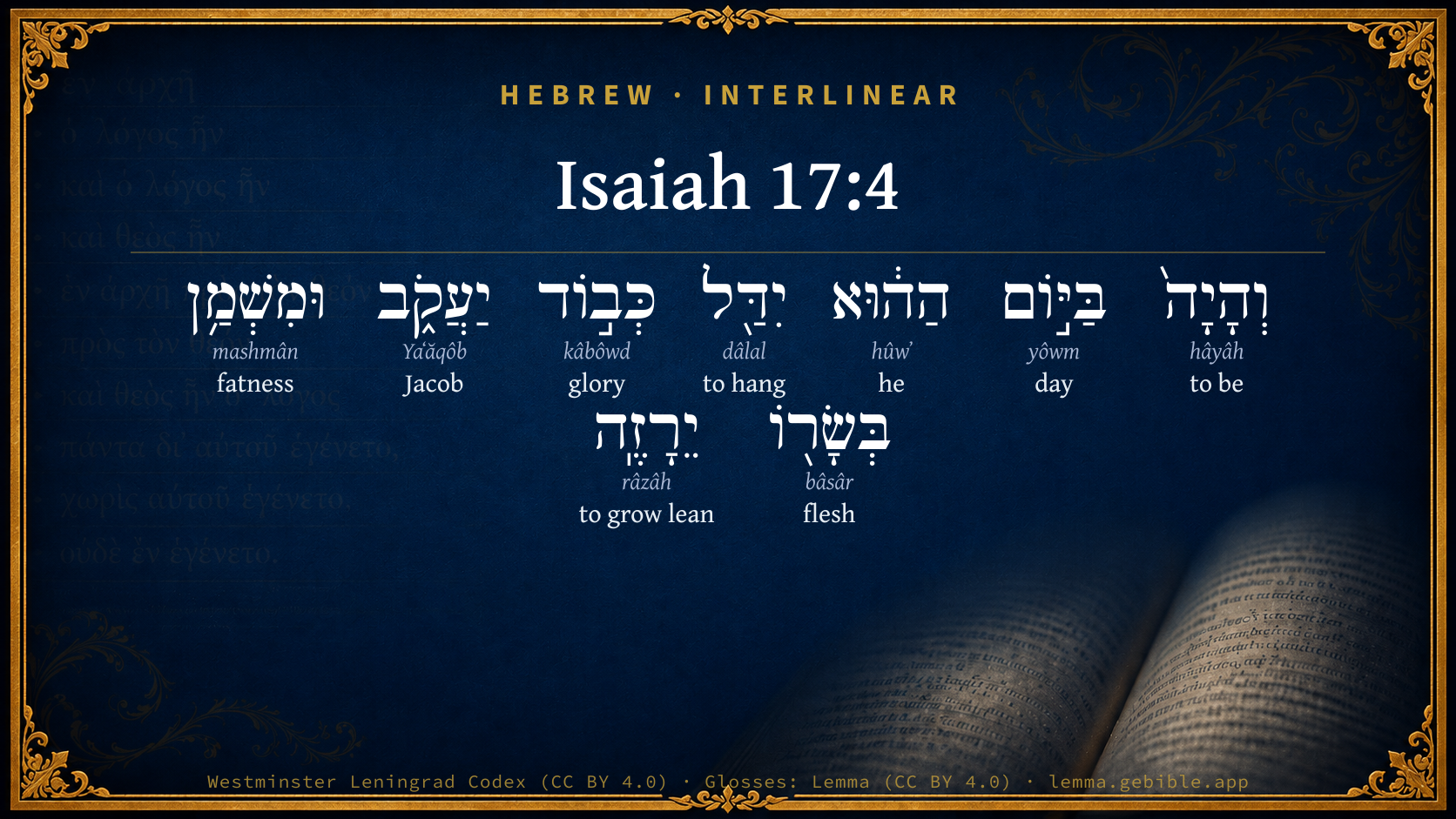
Hebrew (Westminster Leningrad Codex) Isaiah 17:4 appears in the Hebrew Old Testament. The text above is from the Westminster Leningrad Codex. Each word links to its Strong’s number, a concise gloss, and parsing drawn from the Open Scriptures Hebrew Bible morphology. Click any word for its full Brown-Driver-Briggs (BDB) entry.
Download image
Cite this verse

Isaiah 17:4 (World English Bible). Public Domain. Lemma interlinear Bible study tool, https://lemma.gebible.app/v/isaiah/17/4.

Show BibTeX & RIS
BibTeX
RIS
English Translation
It shall happen in that day, that the glory of Jacob shall be made thin, and the fatness of his flesh shall wax lean.
World English Bible · Public Domain
Highlights
  • 1 first appearance in the Hebrew Bible
Full analysis ↓
Download a study sheet

One document with this verse’s original text, its word-by-word gloss line, the meaning frame, cross-references with their text, attributed commentary, and full source and license credits — printable, and it pastes into notes with its structure intact.

This verse Autodidact and up

Study sheet (.html) Plain text (.txt)

A passage Seminary Student

Up to 50 verses in one chapter. A passage sheet keeps up to 6 commentary sources and 12 cross-references per verse, in the order this page ranks them, and says so on the sheet whenever that leaves anything out. Ask for a single verse and you get the Autodidact verse sheet above.

Everything on this page stays free to read, with no account — the sheet is a download of what is already on screen, not access to it.

Want to remove ads? Support Godless Engineer
Compare translations 3

The same verse in 3 English versions, stacked beneath the original-language interlinear above. Click any original word for its lexicon entry.

Each is an independent rendering of the whole verse — the interlinear is not word-aligned to these translations.

Highlighted words mark where these versions differ — a whole-verse word diff, not a word-by-word alignment.

  • World English Bible Public Domain
    It shall happen in that day, that the glory of Jacob shall be made thin, and the fatness of his flesh shall wax lean.
  • King James Version Public Domain
    And in that day it shall come to pass, that the glory of Jacob shall be made thin, and the fatness of his flesh shall wax lean.
  • unfoldingWord Literal Text CC BY-SA 4.0
    “And it will happen in that day, the glory of Jacob will become thin, and the fatness of his flesh will become lean.

unfoldingWord Literal Text — © unfoldingWord, licensed CC BY-SA 4.0. Word-aligned USFM3 via Door43 (git.door43.org/unfoldingWord/en_ult).

Versions to compare (up to 4)

3 of 4 selected

Show all 18 translations

Every available English version of this verse, each an independent rendering of the whole verse.

  • World English Bible Public Domain
    It shall happen in that day, that the glory of Jacob shall be made thin, and the fatness of his flesh shall wax lean.
  • Berean Standard Bible Public Domain
    “In that day the splendor of Jacob will fade, and the fat of his body will waste away,
  • Majority Standard Bible Public Domain
    “In that day the splendor of Jacob will fade, and the fat of his body will waste away,
  • King James Version Public Domain
    And in that day it shall come to pass, that the glory of Jacob shall be made thin, and the fatness of his flesh shall wax lean.
  • American Standard Version (1901) Public Domain
    And it shall come to pass in that day, that the glory of Jacob shall be made thin, and the fatness of his flesh shall wax lean.
  • Revised Version (1885) Public Domain
    And it shall come to pass in that day, that the glory of Jacob shall be made thin, and the fatness of his flesh shall wax lean.
  • Geneva Bible (1599) Public Domain
    And in that day the glorie of Iaakob shall be impouerished, and the fatnes of his flesh shalbe made leane.
  • Douay-Rheims (1899) Public Domain
    And it shall come to pass in that day, that the glory of Jacob shall be made thin, and the fatness of his flesh shall grow lean.
  • Young's Literal Translation Public Domain
    And it hath come to pass, in that day, Wax poor doth the honour of Jacob, And the fatness of his flesh doth wax lean.
  • Literal Standard Version CC BY-SA 4.0
    And it has come to pass in that day, || The glory of Jacob waxes poor, || And the fatness of his flesh waxes lean.
  • Unlocked Literal Bible CC BY-SA 4.0
    It will come about on that day that the glory of Jacob will become thin, and the fatness of his flesh will become lean.
  • unfoldingWord Literal Text CC BY-SA 4.0
    “And it will happen in that day, the glory of Jacob will become thin, and the fatness of his flesh will become lean.
  • Darby Bible Public Domain
    And in that day it shall come to pass, that the glory of Jacob shall be made thin, and the fatness of his flesh shall become lean.
  • World Messianic Bible Public Domain
    “It will happen in that day that the glory of Jacob will be made thin, and the fatness of his flesh will become lean.
  • Webster's Bible Public Domain
    And in that day it shall come to pass, that the glory of Jacob shall be diminished, and the fatness of his flesh shall become lean.
  • Free Bible Version CC BY-SA 4.0
    At that time the glory of Jacob will fade away; he will lose his strength.
  • Bible in Basic English Public Domain
    And it will be in that day that the glory of Jacob will be made small, and the strength of his body will become feeble.
  • JPS Tanakh (1917) Public Domain
    And it shall come to pass in that day, that the glory of Jacob shall be made thin, and the fatness of his flesh shall wax lean.

Literal Standard Version (2020), Covenant Press — licensed CC BY-SA 4.0. Text via the HelloAO Bible API (eBible.org). Unlocked Literal Bible (unfoldingWord) — licensed CC BY-SA 4.0. Text via the HelloAO Bible API (eBible.org). unfoldingWord Literal Text — © unfoldingWord, licensed CC BY-SA 4.0. Word-aligned USFM3 via Door43 (git.door43.org/unfoldingWord/en_ult). Free Bible Version, Dr. Jonathan Gallagher — licensed CC BY-SA 4.0. Text via the HelloAO Bible API (eBible.org).

Word by word

More ways to search: Search by grammar → Find every occurrence → Compare this word →

Practice this passage: Drill this verse → Learn its vocabulary →

יֵרָזֶֽה
râzâh
H7329
“to grow lean”
Verb, Niphal, Imperfect, 3rd Person, Masculine, Singular
Part of Speech
Verb
Stem
Niphal
Form
Imperfect
Person
3rd Person
Gender
Masculine
Number
Singular
Full BDB Definition

Origin: a primitive root

TWOT: 2139

to be or become or grow lean - (Qal) to make lean - (Niphal) to be made lean
  1. וְהָיָה֙ hâyâh H1961 “and · to be” Conjunction + Verb, Qal, Sequential Perfect, 3rd Person, Masculine, Singular
  2. בַּיּ֣וֹם yôwm H3117 “in/at the · day” Preposition, Determined + Noun, Common, Masculine, Singular, Absolute
  3. הַה֔וּא hûwʼ H1931 “the · he” Particle, Definite Article + Pronoun, Personal, 3rd Person, Masculine, Singular
  4. יִדַּ֖ל dâlal H1809 “to hang” Verb, Qal, Imperfect, 3rd Person, Masculine, Singular
  5. כְּב֣וֹד kâbôwd H3519 “glory of” Noun, Common, Both, Singular, Construct
  6. יַעֲקֹ֑ב Yaʻăqôb H3290 “Jacob” Noun, Proper
  7. וּמִשְׁמַ֥ן mashmân H4924 “and · fatness of” Conjunction + Noun, Common, Masculine, Singular, Construct
  8. בְּשָׂר֖וֹ bâsâr H1320 “flesh · his” Noun, Common, Masculine, Singular, Construct + Suffix, Personal, 3rd Person, Masculine, Singular

About this verse

These counts appear in no published source. They are computed here, from the morphology-tagged text and Lemma’s own curated glosses. What Lemma adds →

9
words
9
distinct lemmas
Prophets
section

Notable vocabulary

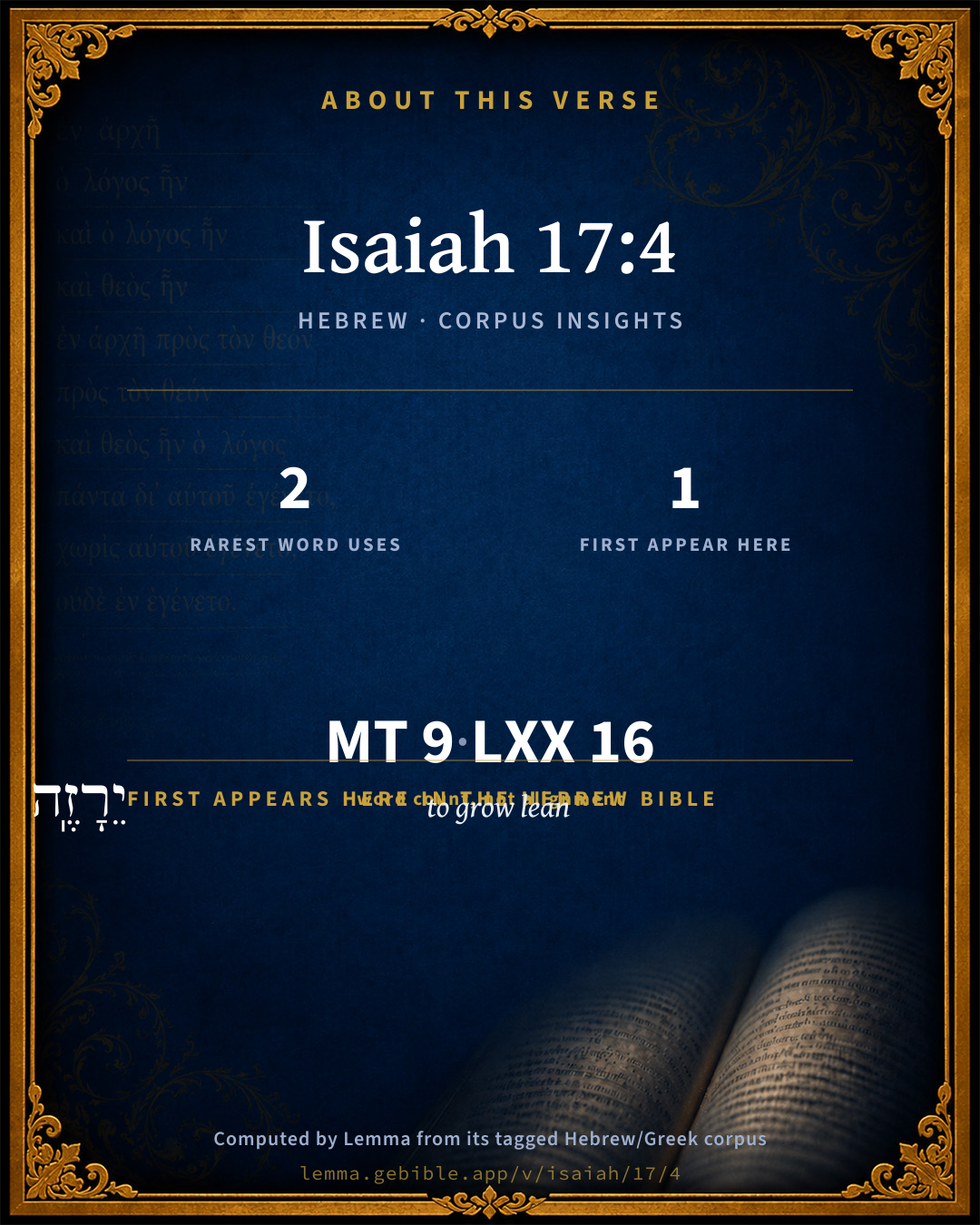
The rarest word here is יֵרָזֶֽה to grow lean H7329 — appearing just 2 times in the whole Hebrew Bible.

First appearance in Scripture

This word makes its first canonical appearance in the Hebrew Bible here:

  • יֵרָזֶֽה to grow lean H7329

Shared distinctive vocabulary

יֵרָזֶֽה to grow lean H7329 occurs in 2 verses of the Hebrew Bible. Also found in:

Grammatical profile

  • 3 verbs
  • 5 nouns
  • 1 pronoun

Verb forms

  • וְהָיָה֙ Qal · Sequential Perfect
  • יִדַּ֖ל Qal · Imperfect
  • יֵרָזֶֽה Niphal · Imperfect

Hebrew & Septuagint length

In English translation the verse runs 24 words from the Hebrew and 22 from the Septuagint (LXX English) — closely comparable.

A rough comparison of the two English renderings, which tokenize alike — not a word-level alignment.

Word counts can differ between the Hebrew and the Greek without any difference in meaning — e.g. the Hebrew direct-object marker אֵת has no separate Greek word, and Greek often adds the article ὁ.

In the original languages it is 9 Hebrew tokens and 16 Greek tokens — but the two are counted differently (Hebrew bundles its prefixes and suffixes into one token; the Greek is in lemma form), so that isn’t a like-for-like length.

Cross-references

9

Topical passages linked to Isaiah 17:4 in the Treasury of Scripture Knowledge — connected by theme and wording, ordered by reader-vote popularity; previews shown in the World English Bible.

  • Isaiah 10:16 Therefore will the Lord, Yahweh of Hosts, send among his fat ones leanness; and under his glory there shall be kindled a burning like the burning of fire.
  • Deuteronomy 32:15–27 But Jeshurun grew fat, and kicked: You have grown fat, you are grown thick, you are become sleek; Then he forsook God who made him, Lightly esteemed the Rock of his salvation.
  • Isaiah 9:8 The Lord sent a word into Jacob, and it has lighted on Israel.
  • Isaiah 9:21 Manasseh, Ephraim; and Ephraim, Manasseh; and they together shall be against Judah. For all this his anger is not turned away, but his hand is stretched out still.
  • Isaiah 10:4 They shall only bow down under the prisoners, and shall fall under the slain. For all this his anger is not turned away, but his hand is stretched out still.
  • Isaiah 24:13 For thus shall it be in the midst of the earth among the peoples, as the shaking of an olive tree, as the gleanings when the vintage is done.
  • Isaiah 24:16 From the uttermost part of the earth have we heard songs: Glory to the righteous. But I said, I pine away, I pine away, woe is me! the treacherous have dealt treacherously; yes, the treacherous have dealt very treacherously.
  • Ezekiel 34:20 Therefore thus says the Lord Yahweh to them: Behold, I, even I, will judge between the fat sheep and the lean sheep.
  • Zephaniah 2:11 Yahweh will be awesome to them, for he will famish all the gods of the land. Men will worship him, everyone from his place, even all the shores of the nations.

Cross-references courtesy of OpenBible.info (CC BY 4.0).

Hebrew and Greek witnesses Masoretic Hebrew ↔ Greek Septuagint

The same verse in the two great witnesses to the Old Testament, shown verse-for-verse.

These are two independent witnesses, not word-aligned to each other, and the Septuagint is shown in lemma (dictionary) form.

Hebrew Isaiah 17:4 Masoretic · Westminster Leningrad Codex

וְהָיָה֙ בַּיּ֣וֹם הַה֔וּא יִדַּ֖ל כְּב֣וֹד יַעֲקֹ֑ב וּמִשְׁמַ֥ן בְּשָׂר֖וֹ יֵרָזֶֽה

It shall happen in that day, that the glory of Jacob shall be made thin, and the fatness of his flesh shall wax lean.

World English Bible · Public Domain

Greek LXX Isaiah 17:4 Septuagint · lemma form

εἰμί ἐν ὁ ἡμέρα ἐκεῖνος ἔκλειψις ὁ δόξα ἰακώβ καί ὁ πίων ὁ δόξα αὐτός σείω

There shall be in that day a failure of the glory of Jacob, and the riches of his glory shall be shaken.

LXX2012 (modern English Septuagint) · Public Domain

Hebrew: Westminster Leningrad Codex (CC BY 4.0). Greek: Septuagint (public domain); English from LXX2012 (modern English Septuagint) (Public Domain). How the Septuagint differs from the Hebrew →

Targum (Aramaic paraphrase)

1

The Targum is the ancient Jewish Aramaic paraphrase of the Hebrew Scriptures — an interpretive translation, not the Hebrew text itself. Onkelos (literal) and Pseudo-Jonathan (expansive) render the Torah, and Jonathan the Prophets. Coverage is partial: where no permissively-licensed English translation exists for a verse, only the Aramaic is shown. This is verse-level text, not a word-by-word alignment to the Hebrew.

  1. Targum Jonathan Prophets (Joshua–Malachi)
    וִיהֵי בְּעִדָנָא הַהִיא יִמְאַךְ יְקָר יַעֲקֹב וְעוֹתֵר יְקָרֵיהּ יִגְלֵי:

    And it shall come to pass at that time, that the glory of Jacob shall be humbled, and the riches of his glory shall be carried away.

    Targum Jonathan — Aramaic: “Mikraot Gedolot” (public domain). English: “Sefaria Community Translation” (CC0 1.0 (public-domain dedication)); “London "Chaldee Paraphrase," 1871” (public domain). Text via Sefaria.

Commentary

Notes on Isaiah 17:4 from classic Christian and Jewish commentators (each source and its license shown beneath its notes). The classic Christian expositions comment on the surrounding passage and are grouped to its opening verse, so a note may address several verses; the Jewish commentaries on the Tanakh (Rashi and others) are per-verse, so they appear only where the commentator wrote on this verse.

Lemma curates 59 commentaries, every one of them public domain or Creative Commons licensed, each selected and text-cleaned for this edition rather than reprinted as found. About our sources →

Trapp's Complete Commentary

John Trapp

Isa 17:4 And in that day it shall come to pass, [that] the glory of Jacob shall be made thin, and the fatness of his flesh shall wax lean.

Ver. 4. The glory of Jacob shall be made thin.] Their multitudes wherein they gloried shall be greatly impaired.

And the fatness.] He shall be cast into a deadly consumption, know the consumption of a kingdom is poverty, and the death of it is loss of authority, saith Scultetus, wickedness being the root of its wretchedness, like as the causes of diseases are in the body itself.

John Trapp, A Commentary or Exposition upon All the Books of the Old and New Testament (1647–1656) — public domain. Text from a community e-Sword module.

Keil & Delitzsch

C. F. Keil & F. Delitzsch

Second turn: "And it comes to pass in that day, the glory of Jacob wastes away, and the fat of his flesh grows thin. And it will be as when a reaper grasps the stalks of wheat, and his arm mows off the ears; and it will be as with one who gathers together ears in the valley of Rephaim. Yet a gleaning remains from it, as at the olive-beating: two, three berries high up at the top; four, five in its, the fruit tree's, branches, saith Jehovah the God of Israel. At that day will man look up to his Creator, and his eyes will look to the Holy One of Israel. And he will not look to the altars, the work of his hands; and what his fingers have made he will not regard, neither the Astartes nor the sun-gods." This second turn does not speak of Damascus, but simply of Israel, and in fact of all Israel, the range of vision widening out from Israel in the more restricted sense, so as to embrace the whole. It will all disappear, with the exception of a small remnant; but the latter will return. Thus "a remnant will return," the law of Israel's history, which is here shown first of all in its threatening aspect, and then in its more promising one. The reputation and prosperity to which the two kingdoms were raised by Jeroboam II and Uzziah would pass away. Israel was ripe for judgment, like a field of corn for the harvest; and it would be as when a reaper grasps the stalks that have shot up, and cuts off the ears. קציר is not used elliptically for קציר אישׁ (Gesenius), nor is it a definition of time (Luzzatto), nor an accusative of the object (Knobel), but a noun formed like נביא, פליל, פריץ, and used in the sense of reaper (kōtzēr in other cases).

(Note: Instead of kâtzar (to cut off, or shorten), they now say kâratz in the whole of the land to the east of the Jordan, which gives the idea of sawing off - a much more suitable one where the Syrian sickle is used.)

The figure suggested here is more fully expanded in John 4 and Rev 14. Hardly a single one will escape the judgment: just as in the broad plain of Rephaim, which slopes off to the south-west of Jerusalem as far as Bethlehem, where it is covered with rich fields of wheat, the collectors of ears leave only one or two ears lying scattered here and there.

Nevertheless a gleaning of Israel ("in it," viz., in Jacob, Isa 17:4; Isa 10:22) will be left, just as when the branches of the olive tree, which have been already cleared with the hand, are still further shaken with a stick, there still remain a few olives upon the highest branch (two, three; cf., Kg2 9:32), or concealed under the foliage of the branches. "Its, the fruit tree's, branches:" this is an elegant expression, as, for example, in Pro 14:13; the carrying over of the ה to the second word is very natural in both passages (see Ges. 121, b). This small remnant will turn with stedfast gaze to the living God, as is becoming in man as such (hâ'âdâm), and not regard the idols as worthy of any look at all, at least of any reverential look. As hammânim are here images of the sun-god חמן בעל, which is well known from the Phoenician monuments,

(Note: See Levy, Phnizisches Wrterbuch (1864), p. 19; and Otto Strauss on Nahum, p. xxii. ss.)

'ashērim (for which we find, though more rarely, 'ashēroth) apparently signifies images of the moon-goddess. And the combination of "Baal, Asherah, and all the host of heaven" in Kg2 23:4, as well as the surname "queen of heaven" in Jer 7:18; Jer 44:18-19, appears to require this (Knobel). But the latest researches have proved that 'Ashērâh is rather the Semitic Aphrodite, and therefore the planet Venus, which was called the "little luck" (es-sa‛d el-as'gar)

(Note: See Krehl, Religion der vorislamischen Araber (1863), p. 11.)

by the Arabs, in distinction from Musteri (Jupiter),

(Note: This was the tutelar deity of Damascus; see Comm. on Job, Appendix.)

or "the great luck." And with this the name 'Asherah the "lucky" (i.e., the source of luck or prosperity) and the similar surname given to the Assyrian Istar agree;

(Note: "Ishtar," says Rawlinson in his Five Great Monarchies of the Ancient Eastern World, - a work which challenges criticism through its dazzling results - "Ishtar is the goddess who rejoices mankind, and her most common epithet is Amra, 'the fortunate' or 'the happy.' But otherwise her epithets are vague and general, insomuch that she is often scarcely distinguishable from Beltis (the wife of Bel-Nimrod)." Vid., vol. i. p. 175 (1862).)

for 'Asherah is the very same goddess as 'Ashtoreth, whose name is thoroughly Arian, and apparently signifies the star (Ved. stir = star; Zend. stare; Neo-Pers. sitâre, used chiefly for the morning star), although Rawlinson (without being able to suggest any more acceptable interpretation) speaks of this view as "not worthy of much attention."

(Note: The planet Venus, according to a Midrash relating to Gen 6:1-2, is 'Istehar transferred to the sky; and this is the same as Zuhare (see Geiger, Was hat Muhammed, etc. 1833, pp. 107-109).)

Thus Asherim is used to signify the bosquets (shrubberies) or trees dedicated to the Semitic Aphrodite (Deu 16:21; compare the verbs used to signify their removal, גדע, כרת, נתשׁ); but here it probably refers to her statues or images

(Note: The plural Ashtaroth, Hathors, which occurs upon Assyrian and Egyptian monuments, has a different meaning.)

(Kg2 21:7; compare the miphletzeth in Kg1 15:13, which is used to denote an obscene exhibition). For these images of the sun-god and of the goddess of the morning star, the remnant of Israel, that has been purified by the smelting furnace of judgment, has no longer any eye. Its looks are exclusively directed to the one true God of man. The promise, which here begins to dawn at the close of the second turn, is hidden again in the third, though only to break forth again in the fourth with double or triple intensity.

Keil & Delitzsch — Biblical Commentary on the Old Testament (1861–1891) — public domain (CC PDM 1.0). Text via the HelloAO Bible API. (Old Testament only.)

Lange's Commentary on the Holy Scriptures

ב) Ephraim (and Damascus) small and again great

Isa_17:4-8

4     And in that day it shall come to pass, that the glory of Jacob shall 2be made thin,

And the fatness of his flesh shall wax lean.

5     And it shall be 3as when the harvestman gathereth the corn,

And reapeth the ears with his arm;

And it shall be 4as he that gathereth ears in the valley of Rephaim.

6     5Yet gleaning grapes shall be left in it, as the shaking of an olive tree,

Two or three berries in the top of the uppermost bough,

Four or five 6in the outmost fruitful branches thereof,

Saith the Lord God of Israel.

7     At that day shall 7a man look to his Maker,

And his eyes shall 8have respect to the Holy One of Israel.

8     And he shall not 9look to the altars, the work of his hands,

Neither shall 10respect that which his fingers have made,

Either the 11groves or the 12images.

TEXTUAL AND GRAMMATICAL

Isa_17:4. משׁמן again only Isa_10:16.—רזה Niph. emaciari only here; comp. Isa_10:18.

Isa_17:5. קָמָה Isa_37:27.—וְהָיהָ “and it goes,” comp. Isa_13:14.—קָצִיר is difficult. The connection leads us first to expect the meaning “reaper,” and many take it so, letting קָצִיר be said metonymically for קוֹצֵר or אַנְשֵׁי קציר (Gesen.). Others take קָמָה in apposition with קָצִיר, or קָצִיר = “harvest time” (when the harvest time takes away the stalks. Ewald). קָצִיר may also be treated as accusative of time: “As one gathers stalks of grain in the harvest.” All of these explanations have a certain harshness. Against Delitzsch, who makes קציר=קוֹצֵר it may be objected: why does Isaiah use this very common word in a sense that it never has elsewhere, and for which sense there offered another word (קוֹצֵר Psa_29:7; Amo_9:13; Jer_9:21, and often) equally current? The same may be objected also to Gesenius and Ewald. To take קמה as apposition is harsh for the reason that then one of the two words would be superfluous. I therefore prefer to take קציר as accusative of time, and to regard the word as a substantive treated adverbially like other marks of time (בֹּקֶר, לַיְלָה, יום, etc., comp. Ewald, § 204 b).—Then the suffix of זרעו relates to the notion of reaper ideally present in קציר.

Ver 6. נֹקֶף again only Isa_14:13.—גרגר isἅπ. λεγ.—אמיר only here and Isa_17:9.—סָעִיף “branch.” again only Isa_27:10. The suffix in סעיפיה relates to ;זַיִת פֹּרִיָּה is in apposition with the suffix (in ramis ejus fecundae) with the signification of an adversative clause.

Isa_17:8. The אֲשֵׁרִים (אֲשֵׁרוֹתonly in Jdg_3:7; 2Ch_19:3; 2Ch_33:3) are in any case the images or symbols of Astarte, of the female principle, which had the form of στῆλαι, pillars set upright (from אָשַׁר rectum, erectum esse, according to Movers; perhaps, according to a statement of Herodotus II. 106, γυναικὸς αἰδοῖα were visible).

EXEGETICAL AND CRITICAL

1. Like one ties two threads into one knot, so the Prophet, Isa_17:3, has entwined in one another the of destiny of Damascus and Ephraim. It is true that in what follows there is nothing more said of Syria. But when it was said, Isa_17:3, that “the remnant of Syria” shall be like “the glory of Jacob,” and if now, Isa_17:4-8, the course of development of “the glory of Jacob” is portrayed as a prospective sinking to a minimum and then again as a mounting up to the most glorious nearness to God, is not the same course of life by implication prophesied of Syria? Therefore, Ephraim shall be reduced to almost nothing. The Prophet declares this in a threefold image. First he compares the destruction of Israel to the growing leanness of a fat man (Isa_17:4), second to the grain harvest, where the reaper with full arm, cuts and gathers the ears (Isa_17:5); third to the olive harvest where the fruits are beaten off the trees. But with this third figure he lets appear already in perspective a better time. The Prophet only indirectly intimates that the tree will be robbed of the chief part of its fruits. He lays the chief stress here on the gleaning: there remain hanging in the top and on the boughs some scattered fruit, that shall be beaten off by subsequent effort (Isa_17:6). Thus a remnant is left to Israel, and this remnant shall be converted: Shear-Jashub (Isa_10:20 sqq.). Notice with what art this address also is arranged. There is a crescendo and decrescendo of shadow, which gradually merges into light. In the first figure (Isa_17:4) the shadow still appears faint; in the second (Isa_17:5) it reaches its full extent; in the third (Isa_17:6) it yields unnoticed to the light. This light the Prophet depicts here in the first place from its subjective side, as a turning of the heart to God (Isa_17:7) and a turning away from idols (Isa_17:8). The objective salvation first appears in the fourth turn of his discourse (Isa_17:12-14).

2. And in that day—God of Israel.

Isa_17:4-6. “In that day” Isa_17:4, here refers to the time of judgment announced in Isa_17:2-3. “The glory of Jacob,” also refers back to Isa_17:3, where the same expression is employed with only the difference of Israel for Jacob, which seems to have a rhetorical reason (comp. Isa_9:7). Moreover the Prophet speaks here of Israel-Ephraim in a sense that declares what it has in common with Judah. For the grand outlines of that picture of the future that Isaiah draws here, comprehend equally the history of Judah and Ephraim. Moreover it must not be supposed that Isaiah has in mind only the political ruin that ensued, say after the shining reign of Jeroboam II. This growing lean embraces the entire time in which the Ten Tribes exist as a remnant. It therefore lasts still at the present time.

The second figure describes the same matter only in greater extent. It is presented in a measure as having three degrees. First, is called to mind how the reaper gathers the standing grain stalks; second, how then the other arm cuts off the ears; third, how the ears are gathered, and that in the valley of Rephaim, the fruitful plain that extends in a south-west direction from Jerusalem. Such a rich harvest shall the enemies hold in Ephraim; so thoroughly, therefore, shall Ephraim be emptied out, plundered. The “gathering of ears” mentioned in the second half of Isa_17:5, may mean the gathering proper for binding into sheaves (Gen_37:7); but it could mean, too, the gleaning of the ears left lying, as by the poor (Rth_2:2 sqq.). The former better suits the context, in as much as the latter notion appears in the following verse. In Isa_17:5 the whole work of the enemies is described, and that in two stages, that are indicated by the “and it shall be” prefixed, just as the battle and the booty form the two sharply distinguished occupations of the warrior,—The valley of Rephaim is mentioned in the Old Testament, Jos_15:8; Jos_18:16; 2Sa_15:18; 2Sa_15:22; 2Sa_23:13. Most persons conclude from our present passage that it was fruitful. Only Ewald [and Aben Ezra, J. A. A.], finds in the passage the notion of a “dry valley,” as he also takes מלקט in the sense of gleaning. At present, indeed, the valley is desert (comp. Knobel in loc.). Further statements see in Arnold’s article “Thäler in Palästina,” Herz. R. Encycl. xv. p. 614. [“Robinson speaks of it en passant, as the cultivated valley or plain of Rephaim (Palestine I. 323).” J. A. A.].—But (Isa_17:6) there is left on him, i.e., on Jacob (we would say “of him,” comp. Isa_10:22) a gleaning secundum percussionem or ad similitudinem percussionis oleae, that is two or three berries in the highest top. Four or five are beaten off with a stick from the branches, because they had not been brought down by the shaking. In the boughs, of course, more remain hanging, because they have greater extent than the tree-top. That is, it is declared, that although the tree is fruitful, yet only a few berries hang on it. Spite of its fruitfulness, it is now so empty that only a little is left for the gleaner. Thus, too, Israel, though now richly blessed, will be reduced to a minimum.

3. At that day—the images.

Isa_17:7-8). The little gleaning is the small remnant of Israel that plays so great a part in the divine economy of salvation, Isa_6:13; Isa_10:21; Rom_9:27; Rom_11:4 sq. In that day, i.e., when Israel shall be reduced to the small remnant, will the man look (Isa_22:4; Isa_31:1) to his Maker, the Holy One of Israel (comp. on Isa_1:4), but he will cast not one more look of fear and trust toward the idols. At last he sees that they are only the work of his own, of human hands (Isa_44:9 sqq.).—הָאָדָם “the man,” is never anywhere else specially used of Israel. The general expression is doubtless chosen because the Prophet declares what concerns not Israel alone, but essentially all mankind, and what especially is applicable to Syria, too, which all along is conceived of as united with Israel.

Two idols are mentioned by name, as those that were particularly worshipped by the idolatrous Israelites: אשׁרים and חמנים. (Isa_27:9). [“groves” and “images” Eng. Bib. Tr.].—Regarding the latter it has been ascertained, that thereby are meant the images of בַּעַל חַמָּז Baal-Hamon, Son_8:11, the Sun-god, the superior male god of the Phœnicians. The word, beside the present text, and Isa_27:9, occurs Lev_26:30; Eze_6:4; Eze_6:6; 2Ch_14:4; 2Ch_34:4; 2Ch_34:7. See further under Text. and Gram.—It is only doubtful whether אשׁרה signifies only the Astarte pillars, or the goddess herself, and the groves consecrated to her (Deu_16:21, comp. Gesenius, Thes. pag. 162 with Otto Strauss, Nahumi de Nin. vat. Prolegg. pag. 24). Moreover it is undecided whether Astarte (אַשְׁתֹּרֵת kindred to אֶסְתֵּר, ἀστήρ, “star”) signifies only the moon, or Vinus, the star of good fortune, or the entire heaven of night as distinguished from the domain of Baal, the heaven of day (comp. P. Cassel on Jdg_2:13; “Moon and stars, the luminaries of the heavens by night, are mingled in Astaroth; they are the sum total of the entire host of heaven.”)

Footnotes:

[2]be reduced.

[3]as one in harvest gathereth corn, and his arm reapeth the ears.

[4]as one gleaning ears.

[5]And gleanings shall, etc.

[6]in its, the fruit trees boughs.

[7]the man turn.

[8]look to.

[9]turn to.

[10]look to what his.

[11]Ashtaroth.

[12]Or, sun images.

Lange's Commentary on the Holy Scriptures (Critical, Doctrinal, and Homiletical), ed. John Peter Lange, English translation edited by Philip Schaff (1864–1880) — public domain. Text from a community e-Sword module.

Tyndale Open Study Notes

Tyndale Open Resources

17:4-11 The vision shifts from Damascus (17:1-3) to the northern kingdom of Israel; Damascus and Israel were allies in the war against Judah, and both were later destroyed by Assyria.

17:4 Israel’s glory will grow dim: God will judge all human pride. • Israel’s robust body will waste away like a person who is ill.

Tyndale Open Study Notes — © Tyndale Open Resources, licensed CC BY-SA 4.0. Text via the HelloAO Bible API.

Geneva Bible (1599)

Geneva Bible translators

Meaning, of the ten tribes, which boasted themselves of their nobility, prosperity, strength and multitude.

Geneva Bible (1599) marginal notes — public domain. Text via Bolls.life.

Jamieson, Fausset & Brown

Robert Jamieson, A. R. Fausset & David Brown

glory of Jacob--the kingdom of Ephraim and all that they rely on (Hos 12:2; Mic 1:5).

fatness . . . lean--(See on Isa 10:16).

Jamieson, Fausset & Brown — Commentary Critical and Explanatory on the Whole Bible (1871) — public domain (CC PDM 1.0). Text via the HelloAO Bible API.

Adam Clarke's Commentary

Verse 4. In that day] That is, says Kimchi, the time when the ten tribes of Israel, which were the glory of Jacob, should be carried into captivity.

Adam Clarke's Commentary on the Bible (1810–1826) — public domain. Text from a community e-Sword/MySword module.

Ellicott's Commentary for English Readers

(4) The glory of Jacob shall be made thin.—The word is the same as that rendered “impoverished” in Jdg_6:8. “Jacob” stands as commonly in the prophets, like Israel, for the northern kingdom, and the words point, therefore, to the downfall, or, adopting the prophet’s figurative language, the emaciation, of that kingdom.

A Bible Commentary for English Readers, edited by Charles John Ellicott (1878–1897) — public domain. Text from a community e-Sword module.

The Cambridge Bible for Schools and Colleges

gen. ed. J. J. S. Perowne

4. in that day] simultaneously with the judgment on Syria. the glory of Jacob] i.e. his might, his population, his prosperity, &c. (cf. Isa_17:3).

made thin] better, enfeebled. fatness … lean] cf. ch. Isa_10:16.

4–6. The fate of Ephraim, in three figures: wasting disease; the reaping of corn; the gathering of olives.

The Cambridge Bible for Schools and Colleges (gen. ed. J. J. S. Perowne; Cambridge University Press, 1878–1918) — public domain. Text from a community e-Sword module.

John Gill's Exposition

And in that day it shall come to pass,.... It being much about the same time that both kingdoms were destroyed by the Assyrians:

that the glory of Jacob shall be made thin; the same with Ephraim and Israel, the ten tribes, whose glory lay in the superior number of their tribes to Judah; in the multitude of their cities, and the inhabitants of them; but now would be thinned, by the vast numbers that should be carried captive:

and the fatness of his flesh shall wax lean: like a man in a consumption, that is become a mere skeleton, and reduced to skin and bones: the meaning is, that all their wealth and riches should be taken away; so the Targum,

"and the riches of his glory shall be carried away.''

John Gill's Exposition of the Whole Bible (1746–1763) — public domain (CC PDM 1.0). Text via the HelloAO Bible API.

Albert Barnes' Notes on the Bible

The glory of Jacob - “Jacob” is used here to denote the kingdom of Israel, or Samaria. The word ‘glory’ here denotes dignity, power; that on which they relied, and of which they boasted.

Shall be made thin - Shall be diminished, as a body wastes away by disease, and becomes feeble. The prophet sets forth the calamities of Ephraim by two figures; the first is that of a “body” that becomes emaciated by sickness, the other that of the harvest when all the fruits are gathered except a few in the upper branches Isa 17:5-6.

And the fatness his flesh shall wax lean - He shall become feeble, as a man does by wasting sickness. Chaldee, ‘The riches of his glory shall be removed.’

Albert Barnes' Notes on the Bible (1834–1885) — public domain. Text from a community e-Sword/MySword module.

Haydock's Catholic Bible Commentary

Lean. All the power of the kingdom shall fail, as in a mortal illness.

George Leo Haydock (1774–1849), Haydock's Catholic Family Bible and Commentary, 1859 edition — public domain. Excludes Psalms (Douay-Rheims chapter numbering differs from Protestant) and Deuterocanonical books (Catholic canon only).

Matthew Poole's English Annotations

Shall be made thin; or, shall be emptied, as this word is rendered, Isa 19:6.

Matthew Poole's English Annotations on the Holy Bible (1683–1685) — public domain. Text from a community e-Sword/MySword module.

Whedon's Commentary on the Bible

Daniel D. Whedon

4. The glory of Jacob — That of the ten tribes, to which the prophet now turns. This is humbled indeed, when the Assyrian power shall carry away its men in crowds.

Shall wax lean — Poor, attenuated, sick Israel! The Chaldee has it: “The riches of Israel shall be removed.”

Daniel D. Whedon (gen. ed.), Commentary on the Old and New Testaments (1874–1909) — public domain. Text from a community e-Sword module.

The Pulpit Commentary

Vers. 4-11. A DENUNCIATION OF WOE ON ISRAEL, COMBINED WITH THE PROMISE OF A REMNANT. Israel, having united herself with Syria to resist the Assyrians, will incur a similar fate. Her glory will decay, her population dwindle and almost disappear. Still there will be a few left, who, under the circumstances, will turn to God (ver. 7). But it will be too late for anything like a national recovery; the laud will remain "a desolation" on account of the past sins of its inhabitants (vers. 9-11).

The glory of Jacob shall be made thin. There is reason to believe that the deportation of the Israelites was gradual. Sargon, on taking Samaria for the first time, in B.C. 722, carried off no more than 27, 290 of the inhabitants (G. Smith, "Eponym Canon," p. 125). Over the remainder he appointed governors, and required them to pay the same taxation as before. About B.C. 715 he placed a number of Arabs in Samaria, probably deporting natives to make room for them (ibid., p. 128). The continuant of a remnant of Israelites in the land down to B.C. 625 is indicated by 2Ch_34:9. The fatness of his flesh shall wax lean. (comp. Isa_10:16) Depopulation is primarily intended; but there is, perhaps, also a more general reference to depression, wasting, and misery.

The Pulpit Commentary (1880–1919), ed. H.D.M. Spence-Jones & Joseph S. Exell — public domain. Text from a community e-Sword module.

J. A. Alexander on Isaiah

Joseph Addison Alexander

“And it shall be (or come to pass) in that day, the glory of Jacob shall be brought low (or made weak), and the fatness of his flesh shall be made lean.” This is an explanation of the comparison in the verse preceding. The remnant of Ephraim was to be like the glory of Israel; but how was that? This verse contains the answer. Glory, as before, includes all that constitutes the strength of a people, and is here contrasted with a state of weakness. The same idea is expressed in the last clause by the figure of emaciation.

Joseph Addison Alexander, The Prophecies of Isaiah (1846–1847; New York: Scribner, 1870–1878) — public domain. Text from a community e-Sword module.

unfoldingWord translationNotes

Door43 World Missions Community

It will come about

This phrase is used here to mark an important event that will happen. If your language has a way for doing this, you could consider using it here.

the glory of Jacob will become thin, and the fatness of his flesh will become lean

Here "Jacob" refers to the kingdom of Israel. Israel would no longer be glorious. Rather it would be weak and poor. (See: Metonymy and Metaphor)

It will be as when a harvester gathers the standing grain ... in the Valley of Rephaim

There will be nothing left in the land after God punishes the people of Israel. (See: Simile)

the Valley of Rephaim

This is a valley where people normally grew and harvested much food. (See: How to Translate Names)

translationWords

glory

Jacob

flesh

harvest

reap

grain

glean

unfoldingWord translationNotes — © Distant Shores Media and the Door43 World Missions Community, licensed CC BY-SA 4.0. Source: git.door43.org/Door43/en_tn.

Rashi

Rabbi Shlomo Yitzchaki (Rashi)

And the fatness of his flesh shall become emaciated Jonathan [renders]: And the wealth of his glory shall be exiled.

Rashi on the Tanakh — English translations: “The Judaica Press complete Tanach with Rashi, translated by A. J. Rosenberg” (CC BY 4.0); “Pentateuch with Rashi's commentary by M. Rosenbaum and A.M. Silbermann, 1929-1934” (public domain); “The Metsudah Tanach series, Lakewood, N.J” (CC BY 4.0); and “The Book of Joshua, Metsudah Publications, 1997” (CC BY 4.0). Text via Sefaria.

Ibn Ezra

Rabbi Abraham ibn Ezra

The glory of Israel shall be made thin. The numbers of Israel shall be greatly reduced by slaughter and captivity.

Ibn Ezra on the Tanakh — English translations: “Sefaria Community Translation” (CC0 1.0 (public-domain dedication)); “Yalkut, Sifsei Chachomim Chumash, Metsudah Publications, 2009” (CC BY 4.0); and “Commentary of Ibn Ezra on Isaiah - trans. by M. Friedlander, 1873” (public domain). Text via Sefaria.

Lesson kit

Teaching starters — assembled from the data on this page, not authored interpretation. Every prompt links to the verse data it draws on. Edit before teaching.

Isaiah, in the Prophets, opens this verse with 9 words (9 distinct Hebrew lemmas). Its most distinctive word is râzâh (“to grow lean”). A historical commentator’s framing appears above. Read the whole chapter for the surrounding context.

Discussion questions

  1. How does “to grow lean” (râzâh) shape what this verse is saying?
  2. This is the first place “to grow lean” appears in Scripture (first appears here). What does its debut here establish?
  3. How does Zephaniah 2:11, which shares the word «to grow lean», read alongside this verse?
  4. These translations render this verse differently. What is at stake in choosing one wording over another?
  5. «וְהָיָה֙» is a Qal Sequential Perfect verb. How does that grammatical form shape the action described?
  6. Compare how Trapp's Complete Commentary and Keil & Delitzsch read this verse. Where do they agree or differ?

Things to notice

Reading settings

Reading text

Shown beneath each verse's original-language words.

Old Testament
Old Testament edition

Read the OT as the Masoretic Hebrew (MT) or the Greek Septuagint (LXX).

English shown for the Greek Septuagint (in the Hebrew ↔ Greek comparison).

Comparing translations? Open the Compare panel on any verse page to stack up to four side by side.