
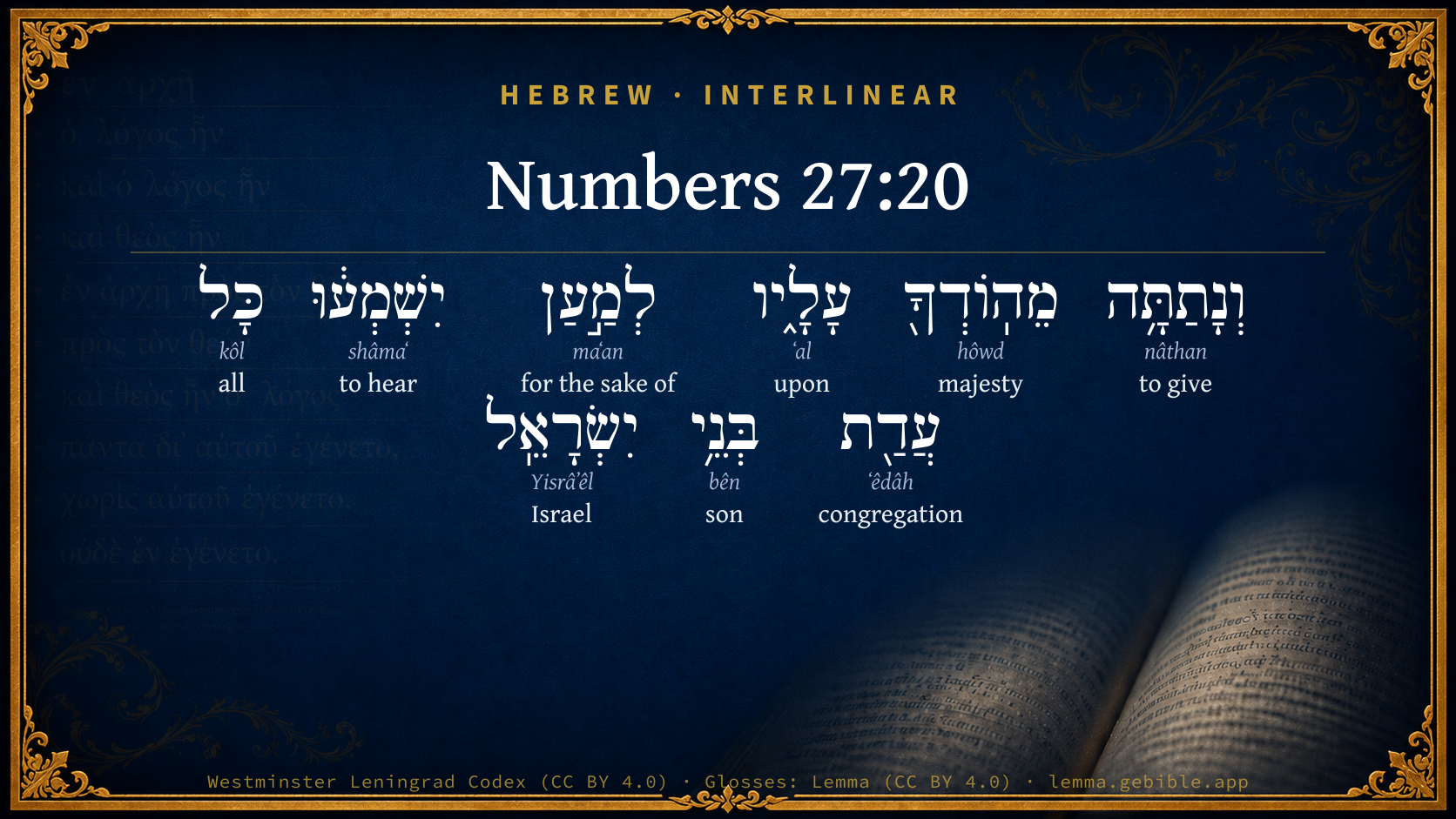
Numbers 27:20

Hebrew (Westminster Leningrad Codex) Numbers 27:20 appears in the Hebrew Old Testament. The text above is from the Westminster Leningrad Codex. Each word links to its Strong’s number, a concise gloss, and parsing drawn from the Open Scriptures Hebrew Bible morphology. Click any word for its full Brown-Driver-Briggs (BDB) entry.
Download image
Cite this verse

Numbers 27:20 (World English Bible). Public Domain. Lemma interlinear Bible study tool, https://lemma.gebible.app/v/numbers/27/20.

Show BibTeX & RIS
BibTeX
RIS
English Translation
You shall put of your honor on him, that all the congregation of the children of Israel may obey.
World English Bible · Public Domain
Highlights
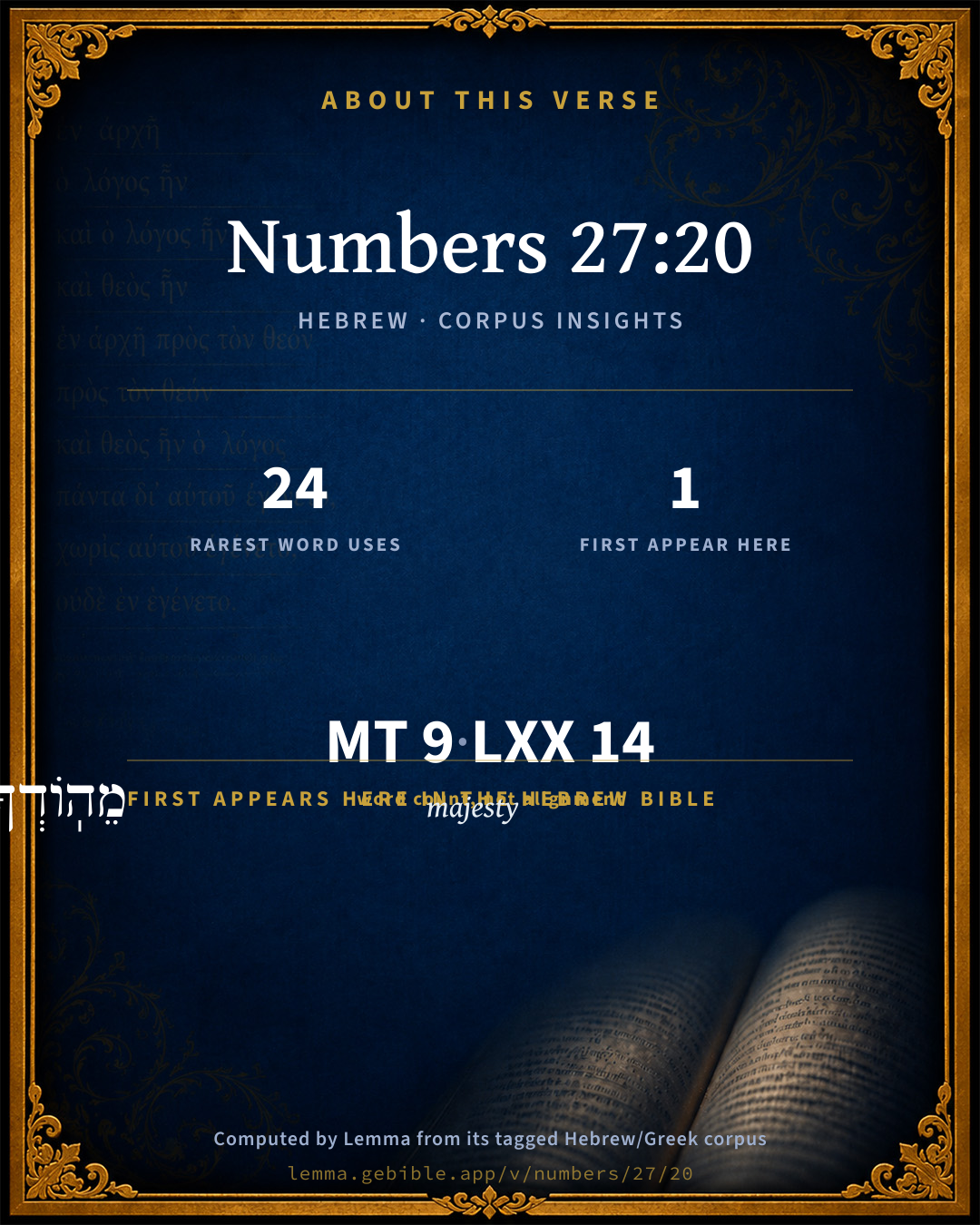
  • 1 first appearance in the Hebrew Bible
Full analysis ↓
Download a study sheet

One document with this verse’s original text, its word-by-word gloss line, the meaning frame, cross-references with their text, attributed commentary, and full source and license credits — printable, and it pastes into notes with its structure intact.

This verse Autodidact and up

Study sheet (.html) Plain text (.txt)

A passage Seminary Student

Up to 50 verses in one chapter. A passage sheet keeps up to 6 commentary sources and 12 cross-references per verse, in the order this page ranks them, and says so on the sheet whenever that leaves anything out. Ask for a single verse and you get the Autodidact verse sheet above.

Everything on this page stays free to read, with no account — the sheet is a download of what is already on screen, not access to it.

Want to remove ads? Support Godless Engineer
Compare translations 3

The same verse in 3 English versions, stacked beneath the original-language interlinear above. Click any original word for its lexicon entry.

Each is an independent rendering of the whole verse — the interlinear is not word-aligned to these translations.

Highlighted words mark where these versions differ — a whole-verse word diff, not a word-by-word alignment.

  • World English Bible Public Domain
    You shall put of your honor on him, that all the congregation of the children of Israel may obey.
  • King James Version Public Domain
    And thou shalt put some of thine honor upon him, that all the congregation of the children of Israel may be obedient.
  • unfoldingWord Literal Text CC BY-SA 4.0
    And you shall give some of your authority on him, so that all the congregation of the sons of Israel will hear.

unfoldingWord Literal Text — © unfoldingWord, licensed CC BY-SA 4.0. Word-aligned USFM3 via Door43 (git.door43.org/unfoldingWord/en_ult).

Versions to compare (up to 4)

3 of 4 selected

Show all 18 translations

Every available English version of this verse, each an independent rendering of the whole verse.

  • World English Bible Public Domain
    You shall put of your honor on him, that all the congregation of the children of Israel may obey.
  • Berean Standard Bible Public Domain
    Confer on him some of your authority, so that the whole congregation of Israel will obey him.
  • Majority Standard Bible Public Domain
    Confer on him some of your authority, so that the whole congregation of Israel will obey him.
  • King James Version Public Domain
    And thou shalt put some of thine honor upon him, that all the congregation of the children of Israel may be obedient.
  • American Standard Version (1901) Public Domain
    And thou shalt put of thine honor upon him, that all the congregation of the children of Israel may obey.
  • Revised Version (1885) Public Domain
    And thou shalt put of thine honour upon him, that all the congregation of the children of Israel may obey.
  • Geneva Bible (1599) Public Domain
    And giue him of thy glory, that all the Congregation of ye children of Israel may obey.
  • Douay-Rheims (1899) Public Domain
    And thou shalt give him precepts in the sight of all, and part of thy glory, that all the congregation of the children of Israel may hear him.
  • Young's Literal Translation Public Domain
    and hast put of thine honour upon him, so that all the company of the sons of Israel do hearken.
  • Literal Standard Version CC BY-SA 4.0
    and have put of your splendor on him, so that all the congregation of the sons of Israel listens.
  • Unlocked Literal Bible CC BY-SA 4.0
    You must put some of your authority on him, so that all the community of the people of Israel may obey him.
  • unfoldingWord Literal Text CC BY-SA 4.0
    And you shall give some of your authority on him, so that all the congregation of the sons of Israel will hear.
  • Darby Bible Public Domain
    And thou shalt put of thine honour upon him, that the whole assembly of the children of Israel may obey him.
  • World Messianic Bible Public Domain
    You shall give authority to him, that all the congregation of the children of Israel may obey.
  • Webster's Bible Public Domain
    And thou shalt put some of thy honor upon him, that all the congregation of the children of Israel may be obedient.
  • Free Bible Version CC BY-SA 4.0
    Hand over some of your authority to him so that all the Israelites will obey him.
  • Bible in Basic English Public Domain
    And put your honour on him, so that all the children of Israel may be under his authority.
  • JPS Tanakh (1917) Public Domain
    And thou shalt put of thy honour upon him, that all the congregation of the children of Israel may hearken.

Literal Standard Version (2020), Covenant Press — licensed CC BY-SA 4.0. Text via the HelloAO Bible API (eBible.org). Unlocked Literal Bible (unfoldingWord) — licensed CC BY-SA 4.0. Text via the HelloAO Bible API (eBible.org). unfoldingWord Literal Text — © unfoldingWord, licensed CC BY-SA 4.0. Word-aligned USFM3 via Door43 (git.door43.org/unfoldingWord/en_ult). Free Bible Version, Dr. Jonathan Gallagher — licensed CC BY-SA 4.0. Text via the HelloAO Bible API (eBible.org).

Word by word

More ways to search: Search by grammar → Find every occurrence → Compare this word →

Practice this passage: Drill this verse → Learn its vocabulary →

מֵהֽוֹדְךָ֖
hôwd
H1935
“from · majesty · your”
Preposition + Noun, Common, Masculine, Singular, Construct + Suffix, Personal, 2nd Person, Masculine, Singular
Part of Speech
Preposition + Noun
Type
Common
Gender
Masculine
Number
Singular
State
Construct
Full BDB Definition

Origin: from an unused root

TWOT: 482a

splendour, majesty, vigour
  1. וְנָתַתָּ֥ה nâthan H5414 “and · to give” Conjunction + Verb, Qal, Sequential Perfect, 2nd Person, Masculine, Singular
  2. עָלָ֑יו ʻal H5921 “upon · him” Preposition + Suffix, Personal, 3rd Person, Masculine, Singular
  3. לְמַ֣עַן maʻan H4616 “for the sake of” Preposition
  4. יִשְׁמְע֔וּ shâmaʻ H8085 “to hear” Verb, Qal, Imperfect, 3rd Person, Masculine, Plural
  5. כָּל kôl H3605 “all of” Noun, Common, Masculine, Singular, Construct
  6. עֲדַ֖ת ʻêdâh H5712 “congregation of” Noun, Common, Feminine, Singular, Construct
  7. בְּנֵ֥י bên H1121 “sons of” Noun, Common, Masculine, Plural, Construct
  8. יִשְׂרָאֵֽל Yisrâʼêl H3478 “Israel” Noun, Proper

About this verse

These counts appear in no published source. They are computed here, from the morphology-tagged text and Lemma’s own curated glosses. What Lemma adds →

9
words
9
distinct lemmas
Pentateuch
section

Notable vocabulary

The rarest word here is מֵהֽוֹדְךָ֖ majesty H1935 — appearing just 24 times in the whole Hebrew Bible.

First appearance in Scripture

This word makes its first canonical appearance in the Hebrew Bible here:

  • מֵהֽוֹדְךָ֖ majesty H1935

Shared distinctive vocabulary

מֵהֽוֹדְךָ֖ majesty H1935 occurs in 24 verses of the Hebrew Bible. Also found in:

Grammatical profile

  • 2 verbs
  • 5 nouns
  • 2 prepositions

Verb forms

  • וְנָתַתָּ֥ה Qal · Sequential Perfect
  • יִשְׁמְע֔וּ Qal · Imperfect

Hebrew & Septuagint length

In English translation the verse runs 19 words from the Hebrew and 18 from the Septuagint (LXX English) — closely comparable.

A rough comparison of the two English renderings, which tokenize alike — not a word-level alignment.

Word counts can differ between the Hebrew and the Greek without any difference in meaning — e.g. the Hebrew direct-object marker אֵת has no separate Greek word, and Greek often adds the article ὁ.

In the original languages it is 9 Hebrew tokens and 14 Greek tokens — but the two are counted differently (Hebrew bundles its prefixes and suffixes into one token; the Greek is in lemma form), so that isn’t a like-for-like length.

Cross-references

9

Topical passages linked to Numbers 27:20 in the Treasury of Scripture Knowledge — connected by theme and wording, ordered by reader-vote popularity; previews shown in the World English Bible.

  • Joshua 1:16–18 They answered Joshua, saying, All that you have commanded us we will do, and wherever you send us we will go.
  • 1 Samuel 10:9 It was so, that when he had turned his back to go from Samuel, God gave him another heart: and all those signs happened that day.
  • Numbers 11:17 I will come down and talk with you there: and I will take of the Spirit which is on you, and will put it on them; and they shall bear the burden of the people with you, that you not bear it yourself alone.
  • Numbers 11:28–29 Joshua the son of Nun, the minister of Moses, one of his chosen men, answered, My lord Moses, forbid them.
  • 1 Samuel 10:6 and the Spirit of Yahweh will come mightily on you, and you shall prophesy with them, and shall be turned into another man.
  • 2 Kings 2:9–10 It happened, when they had gone over, that Elijah said to Elisha, Ask what I shall do for you, before I am taken from you. Elisha said, please let a double portion of your spirit be on me.
  • 2 Kings 2:15 When the sons of the prophets who were at Jericho over against him saw him, they said, The spirit of Elijah does rest on Elisha. They came to meet him, and bowed themselves to the ground before him.
  • 1 Chronicles 29:23 Then Solomon sat on the throne of Yahweh as king instead of David his father, and prospered; and all Israel obeyed him.
  • 1 Chronicles 29:25 Yahweh magnified Solomon exceedingly in the sight of all Israel, and bestowed on him such royal majesty as had not been on any king before him in Israel.

Cross-references courtesy of OpenBible.info (CC BY 4.0).

Hebrew and Greek witnesses Masoretic Hebrew ↔ Greek Septuagint

The same verse in the two great witnesses to the Old Testament, shown verse-for-verse.

These are two independent witnesses, not word-aligned to each other, and the Septuagint is shown in lemma (dictionary) form.

Hebrew Numbers 27:20 Masoretic · Westminster Leningrad Codex

וְנָתַתָּ֥ה מֵהֽוֹדְךָ֖ עָלָ֑יו לְמַ֣עַן יִשְׁמְע֔וּ כָּל עֲדַ֖ת בְּנֵ֥י יִשְׂרָאֵֽל

You shall put of your honor on him, that all the congregation of the children of Israel may obey.

World English Bible · Public Domain

Greek LXX Numbers 27:20 Septuagint · lemma form

καί δίδωμι ὁ δόξα σύ ἐπί αὐτός ὅπως ἄν εἰςἀκούω αὐτός ὁ υἱός ἰσραήλ

And you shall put of your glory upon him, that the children of Israel may listen to him.

LXX2012 (modern English Septuagint) · Public Domain

On this verse, Whedon's Commentary on the Bible discusses the Septuagint’s reading. Read the note in Commentary ↓

Hebrew: Westminster Leningrad Codex (CC BY 4.0). Greek: Septuagint (public domain); English from LXX2012 (modern English Septuagint) (Public Domain). How the Septuagint differs from the Hebrew →

Targum (Aramaic paraphrase)

2

The Targum is the ancient Jewish Aramaic paraphrase of the Hebrew Scriptures — an interpretive translation, not the Hebrew text itself. Onkelos (literal) and Pseudo-Jonathan (expansive) render the Torah, and Jonathan the Prophets. Coverage is partial: where no permissively-licensed English translation exists for a verse, only the Aramaic is shown. This is verse-level text, not a word-by-word alignment to the Hebrew.

  1. Targum Onkelos Torah (Genesis–Deuteronomy)
    וְתִתֵּן מִזִיוָךְ עֲלוֹהִי בְּדִיל דִי יְקַבְּלוּן מִנֵיהּ כָּל כְּנִשְׁתָּא דִבְנֵי יִשְׂרָאֵל

    (no public-domain English translation for this verse)

    Targum Onkelos — Aramaic: “Onkelos Genesis” (public domain); “Onkelos Exodus” (public domain); “Onkelos Leviticus” (public domain); “Onkelos Numbers” (public domain); “Onkelos Deuteronomy” (public domain). English: “Sefaria Community Translation” (CC0 1.0 (public-domain dedication)); “J.W. Etheridge. The Targums of Onkelos and Jonathan Ben Uzziel on the Pentateuch. London: Longmans, Green, 1862” (public domain). Text via Sefaria.

  2. Targum Pseudo-Jonathan Torah (Genesis–Deuteronomy)
    וְתִתֵּן מִזִיו יְקָרָךְ עֲלוֹי מִן בִּגְלַל דִי יְקַבְּלוּן מִינֵיהּ כָּל כְּנִשְׁתָּא דִבְנֵי יִשְרָאֵל

    And thou shalt confer a ray of thy brightness upon him, that all the congregation of the sons of Israel may be obedient to him.

    Targum Pseudo-Jonathan — Aramaic: “Targum Jonathan on Genesis” (public domain); “Targum Jonathan on Exodus” (public domain); “Targum Jonathan on Leviticus” (public domain); “Targum Jonathan on Numbers” (public domain); “Targum Jonathan on Deuteronomy” (public domain). English: “The Targum of Jonathan ben Uzziel, trans. J. W. Etheridge, London, 1862” (public domain). Text via Sefaria.

Commentary

Notes on Numbers 27:20 from classic Christian and Jewish commentators (each source and its license shown beneath its notes). The classic Christian expositions comment on the surrounding passage and are grouped to its opening verse, so a note may address several verses; the Jewish commentaries on the Tanakh (Rashi and others) are per-verse, so they appear only where the commentator wrote on this verse.

Lemma curates 59 commentaries, every one of them public domain or Creative Commons licensed, each selected and text-cleaned for this edition rather than reprinted as found. About our sources →

Joseph Benson's Commentary

Num 27:20. Put some of thine honour upon him — That is, communicate some of thy authority to him at present; no longer use him as a servant, but as a brother, and as thy associate in the government. This was enjoined in order that the people, being used to obey him while Moses lived, might do it afterward the more cheerfully.

Joseph Benson's Commentary on the Old and New Testaments (1811–1818) — public domain. Text from a community e-Sword module.

Tyndale Open Study Notes

Tyndale Open Resources

27:20-21 Joshua assumed only some of Moses’ authority. Moses had face-to-face contact with God (12:6-8; Deut 34:10-12), but Joshua had only indirect access to revelation, since he had to consult with Eleazar the priest on important matters (Num 27:21; cp. Exod 28:30; Lev 8:8). Israel would keep military and spiritual leadership separate hereafter.

Tyndale Open Study Notes — © Tyndale Open Resources, licensed CC BY-SA 4.0. Text via the HelloAO Bible API.

Geneva Bible (1599)

Geneva Bible translators

Commend him to the people as meet for the office and appointed by God.

Geneva Bible (1599) marginal notes — public domain. Text via Bolls.life.

Jamieson, Fausset & Brown

Robert Jamieson, A. R. Fausset & David Brown

Thou shalt put some of thine honour upon him--In the whole history of Israel there arose no prophet or ruler in all respects like unto Moses till the Messiah appeared, whose glory eclipsed all. But Joshua was honored and qualified in an eminent degree, through the special service of the high priest, who asked counsel for him after the judgment of Urim before the Lord.

Next: Numbers Chapter 28

Jamieson, Fausset & Brown — Commentary Critical and Explanatory on the Whole Bible (1871) — public domain (CC PDM 1.0). Text via the HelloAO Bible API.

Adam Clarke's Commentary

Verse 20. And thou shalt put, &c.] מחודך mechodecha, of thine honour or authority upon him. Thou shalt show to the whole congregation that thou hast associated him with thyself in the government of the people.

Adam Clarke's Commentary on the Bible (1810–1826) — public domain. Text from a community e-Sword/MySword module.

The Cambridge Bible for Schools and Colleges

gen. ed. J. J. S. Perowne

20. thou shalt put some of thy majesty upon him] The subst. denotes visible splendour and dignity. No man could be thought worthy to receive the whole of Moses’ majesty; but Joshua was to receive enough of it to make the people honour and obey him. Cf. Num_11:17.

The Cambridge Bible for Schools and Colleges (gen. ed. J. J. S. Perowne; Cambridge University Press, 1878–1918) — public domain. Text from a community e-Sword module.

John Gill's Exposition

And he shall stand before Eleazar the priest,.... This was for the honour of God, whose priest Eleazar was, and whose oracle was consulted by him; for it is said (z), the high priest did not come into the presence of the king but when he pleased; and he did not stand before him, but the king stood before the high priest, as it is said, "and before Eleazar the priest shall he stand"; though it is commanded the high priest to honour the king, and to rise up and stand when he comes unto him; and the king does not stand before him, but when he consults for him by the judgment of Urim; and his posture seems to be different from other persons that consulted; for the same writer (a) observes, in answer to a question,"how do they consult? the priest stands, and his face is before the ark, and he that consults is behind him, and his face to the back of the priest;''whereas here Joshua stood before the priest, and so any king or supreme governor:

who shall ask counsel for him after the judgment of Urim before the Lord: of the Urim and Thummim which were in the breastplate of judgment, and of consultation by them; see Gill on Exo 28:30 and from this place the Jews (b) infer that consultation was not made by them for a private person, but for a king, or for one the congregation stood in need of:

at his word shall they go out, and at his word shall they come in; go out to war, and return from it, or do any service enjoined them; that is, either at the word of the Lord, or rather at the word of Eleazar the priest, declaring the will of God, which comes to much the same sense; or at the word of Joshua, directed by the high priest, according to the oracle of God; and he being under such direction, the people could never do amiss in obeying him, or be in any fear or danger of being led wrong by him; but he is mentioned in the next clause, as included in those that went out, and came in:

both he, and all the children of Israel with him, even all the congregation; which Maimonides (c) interprets thus, "he", this is the king; "and all the children of Israel", this is the anointed for war, or he whom the congregation hath need of; "and all the congregation", these are the great sanhedrim, or seventy elders.

(z) Maimon. Hilchot Melachim, c. 2. sect. 5. (a) Maimon. Hilchot Cele Hamikdash, c. 10. sect. 11. (b) Misn. Yoma, c. 7. sect. 5. Maimon. Cele Hamikdash, c. 10. sect. 12. (c) lbid.

John Gill's Exposition of the Whole Bible (1746–1763) — public domain (CC PDM 1.0). Text via the HelloAO Bible API.

Albert Barnes' Notes on the Bible

Of thine honor - i. e., of thy dignity and authority (compare Num 11:17, Num 11:28). Joshua was constituted immediately vice-leader under Moses, by way of introduction to his becoming chief after Moses’ death.

Albert Barnes' Notes on the Bible (1834–1885) — public domain. Text from a community e-Sword/MySword module.

Haydock's Catholic Bible Commentary

Precepts, to accept of this office, (Calmet) and to discharge it with integrity. (Haydock) --- Glory, not that which shone on the face of Moses, as Onkelos would have it, but all the marks of distinction due to a chief magistrate, (Calmet) the insignia of his office. See Exodus xviii. 21. (Salien) --- Treat him with respect, as your successor. (Menochius) --- Let him henceforward commence to exercise his authority before you, that all the people may hear and obey him. (Sararius) (Tirinus)

George Leo Haydock (1774–1849), Haydock's Catholic Family Bible and Commentary, 1859 edition — public domain. Excludes Psalms (Douay-Rheims chapter numbering differs from Protestant) and Deuterocanonical books (Catholic canon only).

Matthew Poole's English Annotations

Thou shalt not now use him as a servant, as thou hast done, but as a brother and thy partner in the government, showing respect to him, and causing others to do so, and thou shalt impart to him the ensigns and evidences of thy own authority, whatsoever they be. Some understand this honour of those spiritual endowments which did adorn Moses, which Moses was now to confer upon him. But this Joshua had before, for in him was the spirit, Num 26:18; and he received a further measure of the spirit by Moses’s laying on of hands, from both which this honour is distinguished; and, had he meant this, he would not have expressed it in so dark and doubtful a phrase, but have called it a putting not of honour, but of the spirit, upon him, as it is called, Num 11:17. And seeing the word

honour here may very well be properly understood, why should we run to figurative significations?

Matthew Poole's English Annotations on the Holy Bible (1683–1685) — public domain. Text from a community e-Sword/MySword module.

Whedon's Commentary on the Bible

Daniel D. Whedon

20, 21.

Put some… honour upon him — “The eminence and authority of Moses were not to be entirely transferred to Joshua, for they were bound up with his own person alone, (Num_12:6-8,) but only so much of it as he needed for the discharge of the duties of his office. Joshua was to be neither the lawgiver nor the absolute governor of Israel, but to be placed under the judgment of Urim with which Eleazar was intrusted so far as the supreme decision of the affairs of Israel was concerned.” — Keil and Delitzsch.

Who shall ask — Eleazar shall ask God for Joshua. But the Septuagint reads “and they shall ask him,” that is, Joshua and the princes shall ask Eleazar, “the judgment of manifestations.”

Of Urim — Abridged from Urim and Thummim. See Lev_8:8, and Jos_1:1, notes.

At his word — Grammatically, either the Lord’s or Eleazar’s; probably the latter, by virtue of the oracle placed in his keeping. Ordinarily, the priest’s mouth and Jehovah’s. See 1Sa_23:9-12. It is a rule among Hebrew doctors not to ask counsel by the priest who speaketh not by the Holy Spirit and the divine majesty residing in him.

Daniel D. Whedon (gen. ed.), Commentary on the Old and New Testaments (1874–1909) — public domain. Text from a community e-Sword module.

The Pulpit Commentary

Put some of thine honour upon him, or, "some of thy dignity" ( Septuagint, dwseiv thv doxhv sou ep auton .

The Pulpit Commentary (1880–1919), ed. H.D.M. Spence-Jones & Joseph S. Exell — public domain. Text from a community e-Sword module.

John Wesley's Explanatory Notes

Put some of thine honour - Thou shalt not now use him as a servant, but as a brother and thy partner in the government, that the people being used to obey him while Moses lived, might do it afterward the more cheerfully.

John Wesley, Explanatory Notes Upon the Whole Bible (1754–1765) — public domain. Text via the GEBible commentary corpus.

unfoldingWord translationNotes

Door43 World Missions Community

General Information:

Yahweh continues speaking to Moses about Joshua.

You must put some of your authority on him

Here Yahweh speaks of Moses giving some of his authority to Joshua as if it were an article of clothing that he could put on him. AT: "You should give him some of your authority" or "Let him decide what the people should do" (See: Metaphor)

Urim

This was a sacred stone that the High Priest wore on his chest plate. He used it to determine God's will. (See: Translate Unknowns)

It will be at his command that the people will go out and come in

This means that Joshua will have authority to command the movements of the community of Israel. "Going out" and "coming in" are two opposite commands used to emphasize that he will have full command over their movements. AT: "He will command the community's movements" (See: Merism)

both he and all the people of Israel with him, the whole community

Both of these phrases mean the same thing, and they are used together for emphasis. AT: "both he and the entire nation of Israel" (See: Parallelism)

translationWords

authority

Israel

obey

will of God

unfoldingWord translationNotes — © Distant Shores Media and the Door43 World Missions Community, licensed CC BY-SA 4.0. Source: git.door43.org/Door43/en_tn.

Rashi

Rabbi Shlomo Yitzchaki (Rashi)

ונתתה מהודך עליו AND THOU SHALT PUT SOME OF THY GLORY UPON HIM — This refers to the shining of the skin of his countenance (see Exodus 34:29—30).

מהודך SOME OF THY GLORY, and not all thy glory; consequently we learn from this: Moses’ face beamed like the sun, Joshua's face only like the moon (Sifrei Bamidbar 140:2; Bava Batra 75a).

למען ישמעו כל עדת ישראל THAT ALL THE CONGREGATION OF THE CHILDREN OF ISRAEL SHOULD BE OBEDIENT TO HIM — that they should comport themselves towards him with respect and reverence, in the same way as they comport themselves towards you (cf. Yalkut Shimoni on Torah 776).

Rashi on the Tanakh — English translations: “The Judaica Press complete Tanach with Rashi, translated by A. J. Rosenberg” (CC BY 4.0); “Pentateuch with Rashi's commentary by M. Rosenbaum and A.M. Silbermann, 1929-1934” (public domain); “The Metsudah Tanach series, Lakewood, N.J” (CC BY 4.0); and “The Book of Joshua, Metsudah Publications, 1997” (CC BY 4.0). Text via Sefaria.

Sforno

Rabbi Ovadia Sforno

Bestow some of your radiance. The radiance of kingship; give him some authority in your lifetime so that they will begin to act towards Yehoshua with honor.

So that the entire community of Bnei Yisroel will hear. The reason for the appointment in their eyes and the giving of radiance in your lifetime is so the entire community (עדה), which is the Sanhedrin and the elders, will listen to Yehoshua.

Sforno on the Tanakh — English translation: “Yalkut, Sifsei Chachomim Chumash, Metsudah Publications, 2009” (CC BY 4.0). Text via Sefaria.

Ibn Ezra

Rabbi Abraham ibn Ezra

Bestow some of your radiance. To give him honor before the entire people of Israel. So that the entire community of Bnei Yisroel will hear. For they already believe in you, and when they see you honor him they will honor him as well, because they will follow your deeds.

Ibn Ezra on the Tanakh — English translations: “Sefaria Community Translation” (CC0 1.0 (public-domain dedication)); “Yalkut, Sifsei Chachomim Chumash, Metsudah Publications, 2009” (CC BY 4.0); and “Commentary of Ibn Ezra on Isaiah - trans. by M. Friedlander, 1873” (public domain). Text via Sefaria.

Lesson kit

Teaching starters — assembled from the data on this page, not authored interpretation. Every prompt links to the verse data it draws on. Edit before teaching.

Numbers, in the Pentateuch, opens this verse with 9 words (9 distinct Hebrew lemmas). Its most distinctive word is hôwd (“majesty”). A historical commentator’s framing appears above. Read the whole chapter for the surrounding context.

Discussion questions

  1. How does “majesty” (hôwd) shape what this verse is saying?
  2. This is the first place “majesty” appears in Scripture (first appears here). What does its debut here establish?
  3. How does 1 Chronicles 16:27, which shares the word «majesty», read alongside this verse?
  4. These translations render this verse differently. What is at stake in choosing one wording over another?
  5. «וְנָתַתָּ֥ה» is a Qal Sequential Perfect verb. How does that grammatical form shape the action described?
  6. Compare how Joseph Benson's Commentary and Tyndale Open Study Notes read this verse. Where do they agree or differ?

Things to notice

Reading settings

Reading text

Shown beneath each verse's original-language words.

Old Testament
Old Testament edition

Read the OT as the Masoretic Hebrew (MT) or the Greek Septuagint (LXX).

English shown for the Greek Septuagint (in the Hebrew ↔ Greek comparison).

Comparing translations? Open the Compare panel on any verse page to stack up to four side by side.