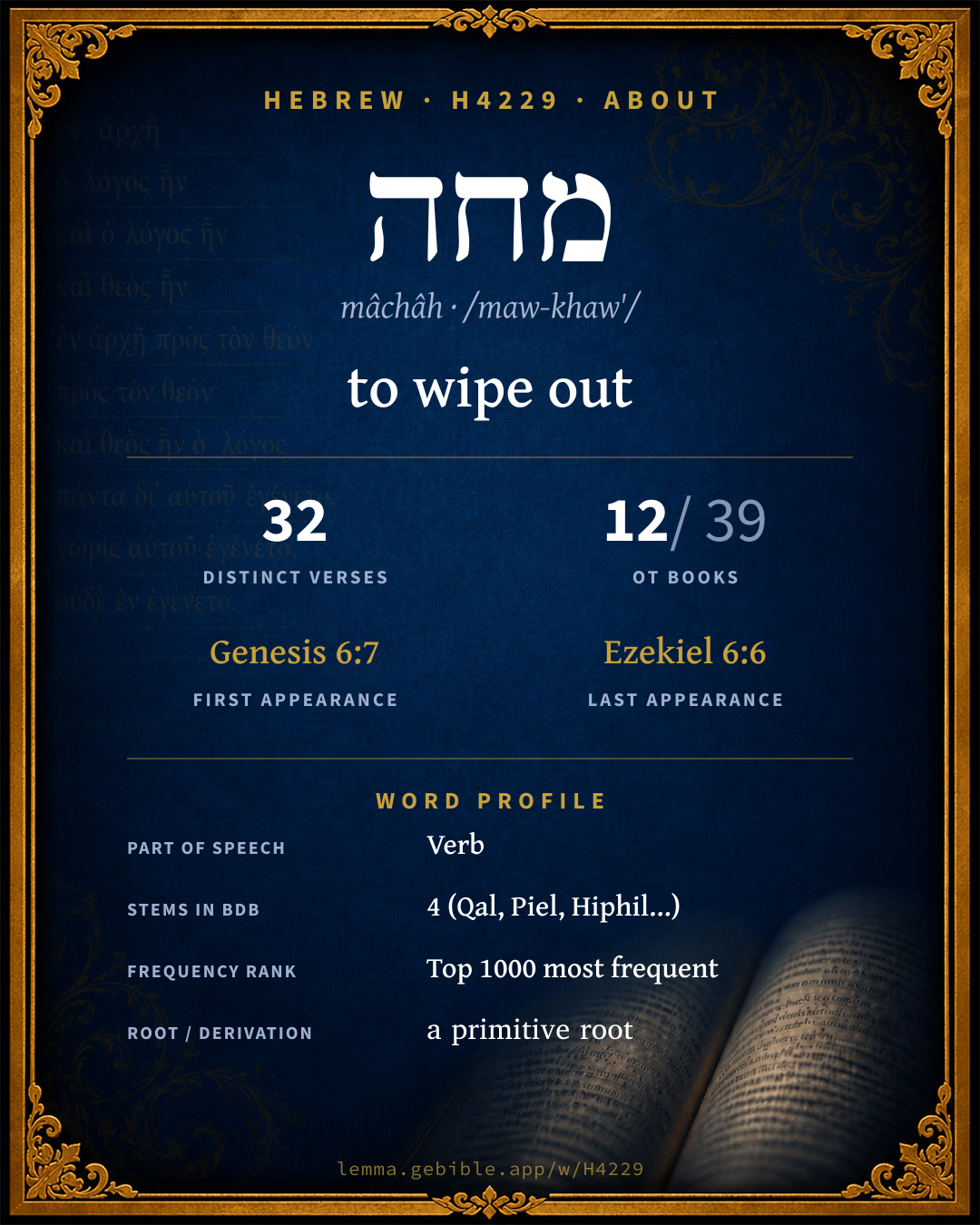
מָחָה
to wipe out
‘to wipe out’ is one of 3 main senses fuller range ↓
Full lexicon entry — Brown-Driver-Briggs (BDB)
From Brown-Driver-Briggs (BDB)
Where this word appears
See every Qal verb in the Hebrew Bible →
Grammar key — what these labels mean
Part of speech
- Verb
- An action or state-of-being word.
Stem
- Qal
- The basic, simple active stem — the plain form of the verb (“he wrote”). Here: ‘wipe’
- Niphal
- Usually the simple passive or reflexive of the Qal (“he was written”).
- Hiphil
- The causative active stem (“he caused / brought about”).
- Pual
- The passive counterpart of the Piel.
Form
- Sequential Perfect
- A perfect with prefixed waw continuing a preceding imperfect or command (waw-consecutive perfect).
- Imperfect
- An incomplete, ongoing, or future action (“he will / would write”).
- Jussive
- A third- or second-person volitional form expressing wish or command (“let him write”).
- Imperative
- A direct command (“write!”).
- Sequential Imperfect
- An imperfect with prefixed waw — the standard past-narrative form (waw-consecutive imperfect).
- Cohortative
- A first-person volitional form expressing wish or resolve (“let me / let us write”).
- Perfect
- A completed action or state — Hebrew marks aspect (completeness) more than strict tense (“he wrote”).
- Infinitive Construct
- A bound verbal noun, frequently with prepositions (“to write / in writing”).
- Participle Passive
- A verbal adjective expressing action received (“written”).
- Infinitive Absolute
- An unbound verbal noun, often intensifying or standing in for a finite verb.
- Participle Active
- A verbal adjective expressing ongoing or characteristic action (“writing / one who writes”).
State
- Absolute
- The independent form of a noun, not bound to a following word.
Person
- 3rd Person
- The one spoken about (“he / she / it / they”).
- 2nd Person
- The one addressed (“you”).
- 1st Person
- The speaker (“I / we”).
Gender
- Masculine
- Grammatically masculine.
- Feminine
- Grammatically feminine.
- Common
- Either gender — not distinguished for this form.
Number
- Singular
- One.
- Plural
- More than one (in Hebrew, generally three or more).
Grammatical forms 24 distinct
- Verb, Qal, Sequential Perfect, 3rd Person, Masculine, Singular 4 times (11%)
- Verb, Niphal, Imperfect, 3rd Person, Masculine, Singular 3 times (8%)
- Verb, Qal, Imperfect, 1st Person, Common, Singular 3 times (8%)
- Verb, Qal, Imperative, 2nd Person, Masculine, Singular 3 times (8%)
- Verb, Niphal, Jussive, 3rd Person, Feminine, Singular 2 times (6%)
- Verb, Hiphil, Jussive, 2nd Person, Masculine, Singular 2 times (6%)
- Verb, Qal, Perfect, 1st Person, Common, Singular 2 times (6%)
- Verb, Niphal, Sequential Perfect, 3rd Person, Common, Plural 1 time (3%)
+16 more forms (16 occurrences)
Parsed forms decoded from the imported morphology (morphhb / Westminster Leningrad Codex — WLC text public domain, morphhb tagging CC BY 4.0), counted across 36 parsed occurrences — not distinct verses.
Every verse where H4229 appears — 32 distinct verses across 12 books. Click any verse to open its interlinear word-by-word view. Verse text shown in the World English Bible for context — . Each verse’s Hebrew form is shown with its reference; the English is not keyword-highlighted, since the data carries no word-level English alignment. Use “Compare translations” on any verse to read it across multiple English versions. This concordance covers the Hebrew Bible; Septuagint (Greek Old Testament) occurrences are not indexed here.
Genesis 3 verses
- Genesis 6:7 אֶמְחֶ֨ה Qal impf 1cs Yahweh said, "I will destroy man whom I have created from the surface of the ground; man, along with animals, creeping things, and birds of the sky; for I am sorry that I have made them."
- Genesis 7:4 וּ/מָחִ֗יתִי conj + Qal pf 1cs In seven days, I will cause it to rain on the earth for forty days and forty nights. Every living thing that I have made, I will destroy from the surface of the ground."
- Genesis 7:23 וַ/יִּ֜מַח וַ/יִּמָּח֖וּ conj + Qal wimpf 3ms conj + Niphal wimpf 3mp Every living thing was destroyed that was on the surface of the ground, including man, cattle, creeping things, and birds of the sky. They were destroyed from the earth. Only Noah was left, and those who were with him in the ark.
Exodus 3 verses
- Exodus 17:14 מָחֹ֤ה אֶמְחֶה֙ Qal inf.abs Qal impf 1cs Yahweh said to Moses, "Write this for a memorial in a book, and rehearse it in the ears of Joshua: that I will utterly blot out the memory of Amalek from under the sky."
- Exodus 32:32 מְחֵ֣/נִי Qal impv 2ms + sfx pers 1cs Yet now, if you will, forgive their sin-- and if not, please blot me out of your book which you have written."
- Exodus 32:33 אֶמְחֶ֖/נּוּ Qal impf 1cs + sfx pers 3ms Yahweh said to Moses, "Whoever has sinned against me, him will I blot out of my book.
Numbers 2 verses
- Numbers 5:23 וּ/מָחָ֖ה conj + Qal wpf 3ms "The priest shall write these curses in a book, and he shall blot them out into the water of bitterness.
- Numbers 34:11 וּ/מָחָ֛ה conj + Qal wpf 3ms and the border shall go down from Shepham to Riblah, on the east side of Ain; and the border shall go down, and shall reach to the side of the sea of Chinnereth eastward;
Deuteronomy 4 verses
- Deuteronomy 9:14 וְ/אֶמְחֶ֣ה conj + Qal coh 1cs let me alone, that I may destroy them, and blot out their name from under the sky; and I will make of you a nation mightier and greater than they.
- Deuteronomy 25:6 יִמָּחֶ֥ה Niphal impf 3ms It shall be, that the firstborn whom she bears shall succeed in the name of his brother who is dead, that his name not be blotted out of Israel.
- Deuteronomy 25:19 תִּמְחֶה֙ Qal impf 2ms Therefore it shall be, when Yahweh your God has given you rest from all your enemies round about, in the land which Yahweh your God gives you for an inheritance to possess it, that you shall blot out the memory of Amalek from under the sky; you shall not forget.
- Deuteronomy 29:20 וּ/מָחָ֤ה conj + Qal wpf 3ms Yahweh will not pardon him, but then the anger of Yahweh and his jealousy will smoke against that man, and all the curse that is written in this book shall lie on him, and Yahweh will blot out his name from under the sky.
Judges 1 verse
2 Kings 2 verses
- 2 Kings 14:27 לִ/מְחוֹת֙ prep + Qal inf.cs Yahweh didn't say that he would blot out the name of Israel from under the sky; but he saved them by the hand of Jeroboam the son of Joash.
- 2 Kings 21:13 וּ/מָחִ֨יתִי יִמְחֶ֤ה מָחָ֔ה conj + Qal wpf 1cs Qal impf 3ms Qal pf 3ms I will stretch over Jerusalem the line of Samaria, and the plummet of the house of Ahab; and I will wipe Jerusalem as a man wipes a dish, wiping it and turning it upside down.
Nehemiah 2 verses
- Nehemiah 4:5 תִּמָּחֶ֑ה Niphal juss 3fs and don't cover their iniquity, and don't let their sin be blotted out from before you; for they have provoked [you] to anger before the builders.
- Nehemiah 13:14 תֶּ֣מַח Hiphil juss 2ms Remember me, my God, concerning this, and don't wipe out my good deeds that I have done for the house of my God, and for the observances of it.
Psalms 6 verses
- Psalms 9:5 מָ֝חִ֗יתָ Qal pf 2ms You have rebuked the nations. You have destroyed the wicked. You have blotted out their name forever and ever.
- Psalms 51:1 מְחֵ֣ה Qal impv 2ms Have mercy on me, God, according to your loving kindness. According to the multitude of your tender mercies, blot out my transgressions.
- Psalms 51:9 מְחֵֽה Qal impv 2ms Hide your face from my sins, And blot out all of my iniquities.
- Psalms 69:28 יִ֭מָּחֽוּ Niphal impf 3mp Let them be blotted out of the book of life, And not be written with the righteous.
- Psalms 109:13 יִמַּ֥ח Niphal impf 3ms Let his posterity be cut off. In the generation following let their name be blotted out.
- Psalms 109:14 תִּמָּֽח Niphal juss 3fs Let the iniquity of his fathers be remembered by Yahweh. Don't let the sin of his mother be blotted out.
Proverbs 3 verses
- Proverbs 6:33 תִמָּחֶֽה Niphal impf 3fs He will get wounds and dishonor. His reproach will not be wiped away.
- Proverbs 30:20 וּ/מָ֣חֲתָה conj + Qal wpf 3fs So is the way of an adulterous woman: She eats and wipes her mouth, And says, 'I have done nothing wrong.'
- Proverbs 31:3 לַֽ/מְח֥וֹת prep + Hiphil inf.cs Don't give your strength to women, Nor your ways to that which destroys kings.
Isaiah 4 verses
- Isaiah 25:6 מְמֻ֣חָיִ֔ם Pual ptcp.pass mp In this mountain will Yahweh of Hosts make to all peoples a feast of fat things, a feast of wines on the lees, of fat things full of marrow, of wines on the lees well refined.
- Isaiah 25:8 וּ/מָחָ֨ה conj + Qal wpf 3ms He has swallowed up death forever; and the Lord Yahweh will wipe away tears from off all faces; and the reproach of his people will he take away from off all the earth: for Yahweh has spoken it.
- Isaiah 43:25 מֹחֶ֥ה Qal ptcp.act ms I, even I, am he who blots out your transgressions for my own sake; and I will not remember your sins.
- Isaiah 44:22 מָחִ֤יתִי Qal pf 1cs I have blotted out, as a thick cloud, your transgressions, and, as a cloud, your sins: return to me; for I have redeemed you.
Jeremiah 1 verse
Ezekiel 1 verse
About this entry
At a glance — auto-summarized from this page’s data, not written by a person. Every figure links to its source below. This summary describes the numbers; it doesn’t interpret them.
At its core, מחה (mâchâh) means “to wipe out.” Across 4 stems, its meaning turns on the binyan (Qal, Piel). It appears 32 verses across 12 books of the Hebrew Bible, among its moderately common vocabulary. Scripture first uses it in Genesis 6:7. It clusters with מח, מחי and מחויאל under a shared root. Each statement above links to its evidence; the full detail follows below.
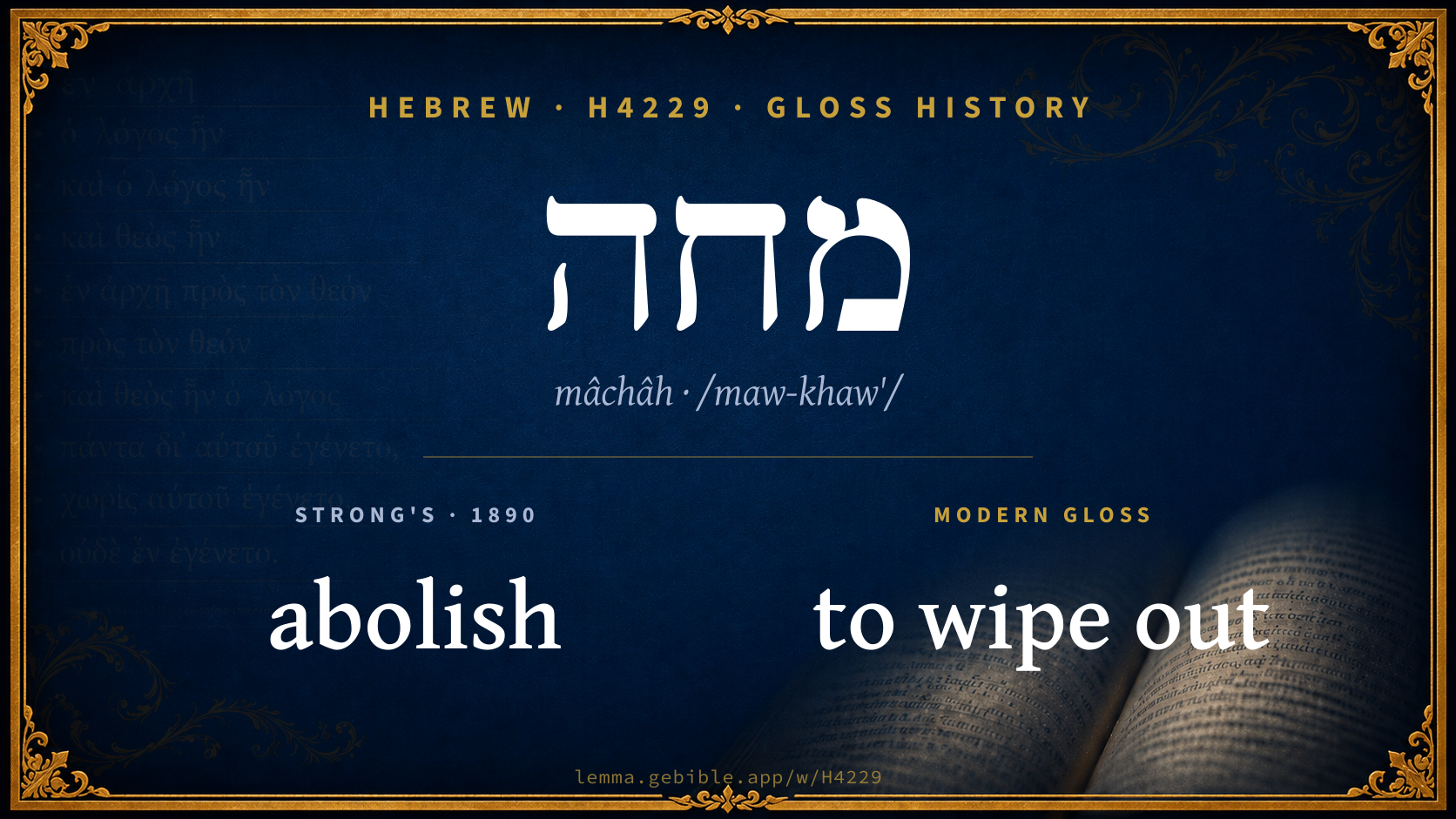
Gloss history
Strong's 1890 vs modern scholarship
About this word
Strong's H4229 catalogs a Hebrew word from the Hebrew Old Testament.
These counts are not copied from any lexicon or concordance. They are computed here, from the morphology-tagged Hebrew Old Testament. What Lemma adds →
- 32
- distinct verses
- The word appears in 32 distinct verses.
- 12 / 39
- OT books
- The word appears in 12 of 39 Old Testament books.
- #990
- by frequency
- Top 1000 most frequent Hebrew words (rank 990 of 8,640 Hebrew words by occurrence).
View all 32 occurrences in the concordance →
Most concentrated in
- Psalms 6 verses 19%
- Deuteronomy 4 verses 13%
- Isaiah 4 verses 13%
By section of the Old Testament
By traditional corpus
Conventional, traditional groupings — biblical authorship is debated, so this is a traditional corpus grouping, not an authorship claim. Each share is this word’s portion of its verses in that division of the Hebrew canon. Each figure is a share of the word’s 32 distinct verses.
- Torah (Pentateuch) 12 verses · 38%
- Writings (Ketuvim) 11 verses · 34%
- Prophets (Nevi'im) 9 verses · 28%
How translations render this word
Counts come from each version’s own published word-to-Strong’s tagging or interlinear alignment — an approximate guide to how each version renders this word, not a word-level alignment the data otherwise carries. Because each total is that version’s own tagged count, the per-version totals vary from one another and need not match the appearance or distinct-verse counts above. These counts may also differ from a printed concordance because Lemma counts each distinctly tagged rendering and does not collapse phrase taggings into a single head-word total. This is a fixed set of word-tagged versions (KJV, ASV, BSB, ULT) and does not change with the reading translation you choose elsewhere. Each version’s license is shown beside its name below (and on Sources).
BDB lists this Strong’s number as 5 distinct words (homographs). Each count above pools all of them and is not split by sense — see the Senses section below. A low-frequency rendering may belong to a different one of those words, not the primary meaning.
- King James Version†: Blot out 4×, Be blotted out 3×
- American Standard Version†: Be blotted out 3×, Blot out 3×
- Berean Standard Bible†: Blot out 5×, Be blotted out 4×, I will blot out 2×
- unfoldingWord Literal Text†: Be wiped out 4×, Do 3×, Will 3×
King James Version Public Domain
Renders H4229 across 36† tagged occurrences — most commonly:
Plus 29 renderings that appear only once — usually multi-word phrases or single function words the recovered tagging swept in, not distinct renderings.
American Standard Version Public Domain
Renders H4229 across 36† tagged occurrences — most commonly:
Plus 30 renderings that appear only once — usually multi-word phrases or single function words the recovered tagging swept in, not distinct renderings.
Berean Standard Bible Public Domain
Renders H4229 across 33† tagged occurrences — most commonly:
Plus 22 renderings that appear only once — usually multi-word phrases or single function words the recovered tagging swept in, not distinct renderings. Not rendered by a distinct English word in 3 further occurrences.
unfoldingWord Literal Text CC BY-SA 4.0
Renders H4229 across 50† tagged occurrences — most commonly:
Plus 27 renderings that appear only once — usually multi-word phrases or single function words the recovered tagging swept in, not distinct renderings.
12 senses and sub-senses in the full BDB
Hebrew verbs can shift meaning by stem (binyan): Qal is the basic action, Niphal is often passive or reflexive, Piel often intensifies or makes it factitive, and Hiphil is typically causative. The senses below are grouped under the stem BDB assigns to each. This entry also uses Pual (the passive of Piel).
What do BDB’s symbols mean?
BDB uses these scholarly abbreviations:
| Symbol | Meaning |
|---|---|
| 𝔊 | the Septuagint (the ancient Greek translation, LXX) |
| 𝔙 | the Vulgate (the Latin translation) |
| 𝔖 | the Syriac version (the Peshitta) |
| 𝔗 | the Targum (the Aramaic translation) |
| ψ | the Psalms |
| √ | root (the underlying root or stem) |
| ‖ | parallel passage (a synonymous or contrasted parallel) |
| † | the dagger: every passage where the word occurs is cited |
The 12 senses and sub-senses the full Brown-Driver-Briggs lexicon distinguishes for this word, in lexicon order (not ranked by frequency), with BDB’s own verbatim wording and sub-sense lettering. Shown in Hebrew script with BDB’s own scholarly abbreviations. The condensed entry is in the Lexicon Entry tab. See also the Forms in the corpus table below.
מחה I strike, only = clap (the hand) (Aramaic form of II. מָחָה q.v.)
Qal
- Impf. 3 mpl. only fig., of joy of inanimate things before י׳: נְהָרוֹת יִמְחֲאוּ־כָ֑ף ψ 98:8; וְכָל־עֲצֵי הַשָּׂדֶה יִמְחֲאוּ־כָֽף ׃ Is 55:12.— e.g. Psalms 98:8
Piel
- Inf. cstr. sf. id., of exultation over foe יַעַן מַחְאֲךָ יָד Ez 25:6 (‖ וְרַקְעֲךָ בְּרָ֑גֶל). e.g. Ezekiel 25:6
מחה II wipe, wipe out (NH id.
Qal
- Pf. 3 ms. מָחָה Nu 5:23 + 3 times 3 fs. מָֽחֲתָה Pr 30:20 + 4 times Pf.; Impf. יִמְחֶה 2 K 21:13; וַיִּמַח (Baer; var. וַיִּמַּח) Gn 7:23; 1 s. sf. אֶמְחֶנּוּ Ex 32:33; + 4 times Impf.; Imv. מְחֵה ψ 51:3, 11; sf. מְחֵנִי Ex 32:32; Inf. abs. מָחֹה Ex 17:14; cstr. לִמְחוֹת 2 K 14:27; Pt. מֹחֶה Is 43:25; fpl. (לְ)מֹחוֹת Pr 31:3 (Ges Fl Nö De Str for MT לַמְחוֹת);— e.g. Numbers 5:23
- 1. wipe, the mouth Pr 30:20; tears from (מעל) the face Is 25:8; written curse, into the water (אל־מים) for drinking Nu 5:23 (P); Moses’ name from the book (מספר) of God Ex 32:32, 33 (J); וּמָחִיתִי אֶת־יְרוּשָׁלַם כַּאֲשֶׁר יִמְחֶה אֶת־הַצַּלַּחַת מָחָה וְהָפַךְ עַל־פָּנֶיהָ 2 K 21:13 and I will wipe Jerusalem as one wipeth a dish,—he doth wipe and turn it (but read prob. מָחֹה וְהָפֹךְ) upside down. e.g. Proverbs 30:20
- 2. blot out = obliterate from the memory, מִתַּחַת הַשָּׁמַיִם from under heaven e.g. the name Dt 9:14; 29:19 2 K 14:27; the remembrance Ex 17:14(×2) (J), Dt 25:19; the name for ever ψ 9:6; transgressions (פשׁע; no more remembered by God against sinner) ψ 51:3 Is 43:25; 44:22; עָון ψ 51:11. e.g. Deuteronomy 9:14
- 3. blot out = exterminate, כל־היקום all existing things Gn 7:23 (J) and mankind, מֵעַל פְּנֵי הָאֲדָמָה Gn 6:7; 7:4 (J); מֹחוֹת מְלָכִין Pr 31:3 (with the text-change, v. supr.) = destroyers of kings (i.e. impure women), but expression strange and dubious. Niph. Pf. 3 mpl. נִמְחוּ Ez 6:6; Impf. יִמָּחֶה Dt 25:6 Ju 21:17; יִמַּח ψ 109:13; 3 fs. תִּמָּ֑ח ψ 109:14; + 4 times Impf.;— e.g. Genesis 7:23
- 4. be wiped out מִסֵּפֶר חַיִּים ψ 69:29. e.g. Psalms 69:29
- 5. be blotted out, מִיִּשְׂרָאֵל of a name Dt 25:6, a tribe Ju 21:17; name (‖ posterity) ψ 109:13; from memory, of sins Ne 3:37 ψ 109:14; reproach, Pr 6:33. e.g. Deuteronomy 25:6
- 6. be exterminated, מִן־הָאָרֶץ Gn 7:23 (J); of idolatrous works of Israel Ez 6:6. e.g. Genesis 7:23
Hiphil
- . Impf. 2 ms. תֶּ֫מַח Ne 13:14; תֶּ֑מְחִי Je 18:23 (but tone suggests תֶּ֫מַח cf. Ges§ 75. R. 17; Gie reads Qal and doubts Hiph. altogether); Inf. לַמְחוֹת Pr 31:3 (= לְהַמְחוֹת but see Qal 3);—blot out, from the memory; pious acts Ne 13:14; sins Je 18:23. e.g. Nehemiah 13:14
מחה III strike (Aramaic מְחָא (ii), ܡܚܳܐ
Qal
- Pf. 3 ms. consec., וּמָחָה עַל־כֶּתֶף וגו׳ Nu 34:11 (P) and the border shall strike upon (reach unto) the shoulder of the sea of Chinnereth (> Di al. der. from I. מָחָה rub along by, brush past, skirt). e.g. Numbers 34:11
מחה IV denom. only
Pual
- Pt. מְמֻחָיִם (Ges§ 75. R. 13) in phr. שְׁמָנִים מ׳ Is 25:6 fat pieces full of marrow. e.g. Isaiah 25:6
Senses from the full Brown-Driver-Briggs lexicon (Brown, Driver, Briggs; Oxford 1906 — public domain), digitized via Sefaria, supplemented by the OpenScriptures HebrewLexicon (CC BY 4.0). Full attribution on Sources.
Word origin
I. vb. strike, only = clap (the hand) (Aramaic form of II. מָחָה q.v.);—
I. vb. wipe, wipe out (NH id.; Arabic مَحَا, efface, erase, cancel, obliterate; Aramaic מְחָא (i), cf. Ph. למחת according to stroke = exactly HoffmPh. Inschr., Abh. GGW. xxxvi. May 1889, 9).—
II. vb. strike (Aramaic מְחָא (ii), ܡܚܳܐ; according to L GeiUrspr. d. Spr. 416 LagSem. i. 26, BN 142 NöZMG xxxii, 1878, 409 weakened from ܡܚܰܥ = مخض, Heb. מָחַץ q.v., cf. Dr§ 178 n.; Assyrian maḫû = crush, oppress, DlHWB 396);—
IV. vb. denom. only
— Brown-Driver-Briggs (Oxford 1906, public domain), digitized via Sefaria, supplemented by the OpenScriptures HebrewLexicon (CC BY 4.0). See Sources.
Origin: a primitive root
Jastrow Dictionary
A second Hebrew/Aramaic lexicon for comparison, covering Aramaic and post-biblical (Talmudic, Targumic, Midrashic) usage that the biblical-Hebrew BDB does not. Matched by lemma rather than by Strong’s number, so a lemma may carry more than one Jastrow headword (shown separately below), and the entries cover usage well beyond the Bible.
מָחָה
- , v. מחי
A Dictionary of the Targumim, the Talmud Babli and Yerushalmi, and the Midrashic Literature (Marcus Jastrow; London, Luzac, 1903) — Public Domain. Digitized via Sefaria. Digitized via Sefaria. Full attribution on Sources.
Forms in the corpus
The 35 distinct written forms H4229 takes in the Hebrew Bible, most frequent first — each parse links to that stem’s occurrences in the concordance. Hebrew forms include their vowel points and cantillation, so a single lemma takes many written forms.
Same root — word family
Other BDB entries built from the same root as H4229, grouped by Strong’s listed origin. These share a root / origin per the lexicon — not necessarily a shared meaning. Each links to that word’s own entry.
Derived from this word
Proper names from this root
People and places named from this root — a name, not an additional meaning of the word.
Compare all same-root words → Showing 4 of 5 — not the complete family. 2 of the same-root words are proper names (people or places). They share a root, not necessarily a meaning.
Septuagint verse parallels
This word appears in 27 verses that also exist in the Greek Old Testament (Septuagint), out of the 32 Hebrew verses it occurs in. You can read those verses in Greek by switching the Old Testament edition to the Septuagint.
Read these verses in the Septuagint
- Genesis 6:7
- Exodus 17:14
- Numbers 5:23
- Deuteronomy 9:14
- Judges 21:17
- 2 Kings 14:27
- Psalms 9:5
- Proverbs 6:33
- Isaiah 25:6
- Jeremiah 18:23
- Ezekiel 6:6
This is a verse-level parallel only — the same verses exist in both the Hebrew and Greek Old Testaments. No word-level Hebrew↔Greek correspondence is claimed: the data carries no such alignment, so no Greek word is shown as this Hebrew word’s translation. Coverage is not total — the Septuagint omits the deuterocanon and renumbers the Psalms, so some Hebrew verses have no direct Greek parallel.