
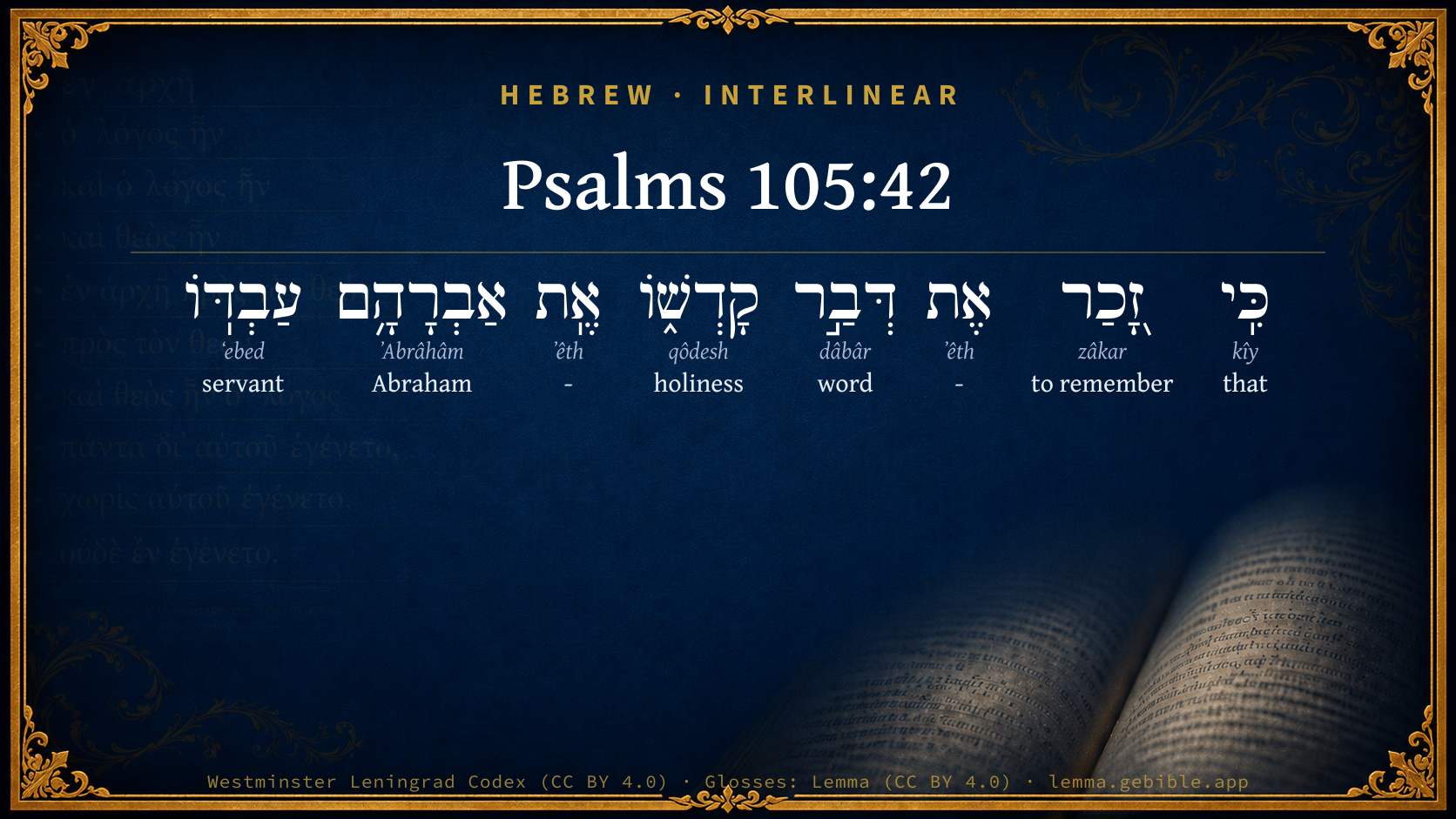
Psalms 105:42

Hebrew (Westminster Leningrad Codex) Psalms 105:42 appears in the Hebrew Old Testament. The text above is from the Westminster Leningrad Codex. Each word links to its Strong’s number, a concise gloss, and parsing drawn from the Open Scriptures Hebrew Bible morphology. Click any word for its full Brown-Driver-Briggs (BDB) entry.
Download image
Cite this verse

Psalms 105:42 (World English Bible). Public Domain. Lemma interlinear Bible study tool, https://lemma.gebible.app/v/psalms/105/42.

Show BibTeX & RIS
BibTeX
RIS
English Translation
For he remembered his holy word, And Abraham, his servant.
World English Bible · Public Domain
Download a study sheet

One document with this verse’s original text, its word-by-word gloss line, the meaning frame, cross-references with their text, attributed commentary, and full source and license credits — printable, and it pastes into notes with its structure intact.

This verse Autodidact and up

Study sheet (.html) Plain text (.txt)

A passage Seminary Student

Up to 50 verses in one chapter. A passage sheet keeps up to 6 commentary sources and 12 cross-references per verse, in the order this page ranks them, and says so on the sheet whenever that leaves anything out. Ask for a single verse and you get the Autodidact verse sheet above.

Everything on this page stays free to read, with no account — the sheet is a download of what is already on screen, not access to it.

Want to remove ads? Support Godless Engineer
Compare translations 3

The same verse in 3 English versions, stacked beneath the original-language interlinear above. Click any original word for its lexicon entry.

Each is an independent rendering of the whole verse — the interlinear is not word-aligned to these translations.

Highlighted words mark where these versions differ — a whole-verse word diff, not a word-by-word alignment.

  • World English Bible Public Domain
    For he remembered his holy word, And Abraham, his servant.
  • King James Version Public Domain
    For he remembered his holy promise, and Abraham his servant.
  • unfoldingWord Literal Text CC BY-SA 4.0
    For he remembered the word of his holiness with Abraham his servant.

unfoldingWord Literal Text — © unfoldingWord, licensed CC BY-SA 4.0. Word-aligned USFM3 via Door43 (git.door43.org/unfoldingWord/en_ult).

Versions to compare (up to 4)

3 of 4 selected

Show all 18 translations

Every available English version of this verse, each an independent rendering of the whole verse.

  • World English Bible Public Domain
    For he remembered his holy word, And Abraham, his servant.
  • Berean Standard Bible Public Domain
    For He remembered His holy promise to Abraham His servant.
  • Majority Standard Bible Public Domain
    For He remembered His holy promise to Abraham His servant.
  • King James Version Public Domain
    For he remembered his holy promise, and Abraham his servant.
  • American Standard Version (1901) Public Domain
    For he remembered his holy word, `And' Abraham his servant.
  • Revised Version (1885) Public Domain
    For he remembered his holy word, and Abraham his servant.
  • Geneva Bible (1599) Public Domain
    For he remembred his holy promise to Abraham his seruant,
  • Douay-Rheims (1899) Public Domain
    Because he remembered his holy word, which he had spoken to his servant Abraham.
  • Young's Literal Translation Public Domain
    For He hath remembered His holy word, With Abraham His servant,
  • Literal Standard Version CC BY-SA 4.0
    For He has remembered His holy word, || With His servant Abraham,
  • Unlocked Literal Bible CC BY-SA 4.0
    For he called to mind his holy promise that he made to Abraham his servant.
  • unfoldingWord Literal Text CC BY-SA 4.0
    For he remembered the word of his holiness with Abraham his servant.
  • Darby Bible Public Domain
    For he remembered his holy word, [and] Abraham his servant;
  • World Messianic Bible Public Domain
    For he remembered his holy word, and Abraham, his servant.
  • Webster's Bible Public Domain
    For he remembered his holy promise, and Abraham his servant.
  • Free Bible Version CC BY-SA 4.0
    For he remembered his holy promise to his servant Abraham.
  • Bible in Basic English Public Domain
    For he kept in mind his holy word, and Abraham, his servant.
  • JPS Tanakh (1917) Public Domain
    For He remembered His holy word unto Abraham His servant;

Literal Standard Version (2020), Covenant Press — licensed CC BY-SA 4.0. Text via the HelloAO Bible API (eBible.org). Unlocked Literal Bible (unfoldingWord) — licensed CC BY-SA 4.0. Text via the HelloAO Bible API (eBible.org). unfoldingWord Literal Text — © unfoldingWord, licensed CC BY-SA 4.0. Word-aligned USFM3 via Door43 (git.door43.org/unfoldingWord/en_ult). Free Bible Version, Dr. Jonathan Gallagher — licensed CC BY-SA 4.0. Text via the HelloAO Bible API (eBible.org).

Word by word

More ways to search: Search by grammar → Find every occurrence → Compare this word →

Practice this passage: Drill this verse → Learn its vocabulary →

About this verse

These counts appear in no published source. They are computed here, from the morphology-tagged text and Lemma’s own curated glosses. What Lemma adds →

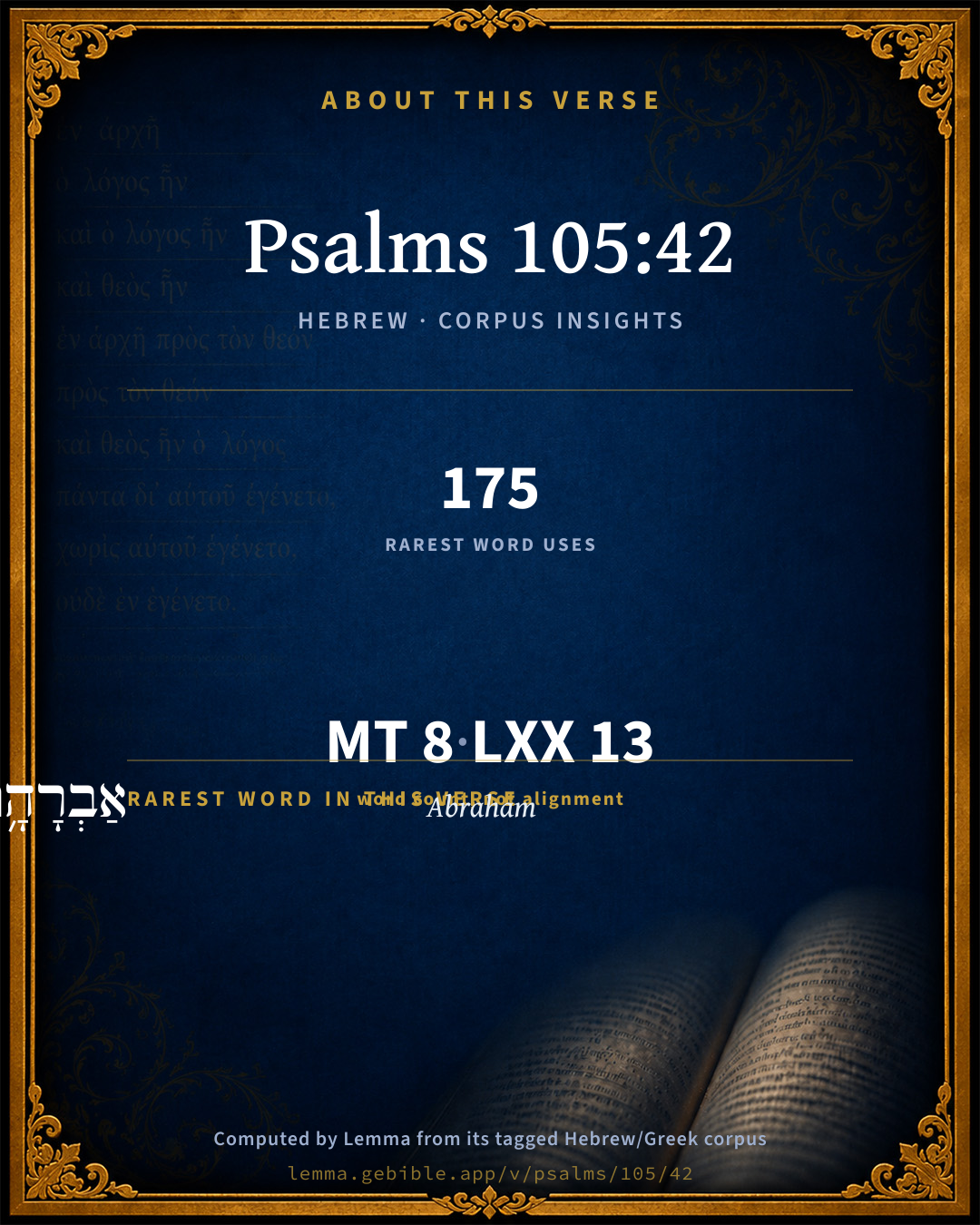
8
words
7
distinct lemmas
Wisdom
section

Grammatical profile

  • 1 verb
  • 4 nouns
  • 1 conjunction
  • 2 particles

Verb forms

  • זָ֭כַר Qal · Perfect

Hebrew & Septuagint length

In English translation the verse runs 10 words from the Hebrew and 13 from the Septuagint (LXX English) — closely comparable.

A rough comparison of the two English renderings, which tokenize alike — not a word-level alignment.

Word counts can differ between the Hebrew and the Greek without any difference in meaning — e.g. the Hebrew direct-object marker אֵת has no separate Greek word, and Greek often adds the article ὁ.

In the original languages it is 8 Hebrew tokens and 13 Greek tokens — but the two are counted differently (Hebrew bundles its prefixes and suffixes into one token; the Greek is in lemma form), so that isn’t a like-for-like length.

Cross-references

11

Topical passages linked to Psalms 105:42 in the Treasury of Scripture Knowledge — connected by theme and wording, ordered by reader-vote popularity; previews shown in the World English Bible.

  • Exodus 2:24 God heard their groaning, and God remembered his covenant with Abraham, with Isaac, and with Jacob.
  • Luke 1:72–73 To show mercy towards our fathers, To remember his holy covenant,
  • Genesis 12:7 Yahweh appeared to Abram, and said, "I will give this land to your seed." He built an altar there to Yahweh, who appeared to him.
  • Luke 1:54–55 He has given help to Israel, his servant, that he might remember mercy,
  • Genesis 13:14–17 Yahweh said to Abram, after Lot was separated from him, "Now, lift up your eyes, and look from the place where you are, northward and southward and eastward and westward,
  • Exodus 32:13 Remember Abraham, Isaac, and Israel, your servants, to whom you swore by your own self, and said to them, 'I will multiply your seed as the stars of the sky, and all this land that I have spoken of I will give to your seed, and they shall inherit it forever.'"
  • Micah 7:20 You will give truth to Jacob, and mercy to Abraham, As you have sworn to our fathers from the days of old.
  • Genesis 15:13–14 He said to Abram, "Know for sure that your seed will live as foreigners in a land that is not theirs, and will serve them. They will afflict them four hundred years.
  • Deuteronomy 9:5 Not for your righteousness, or for the uprightness of your heart, do you go in to possess their land; but for the wickedness of these nations Yahweh your God does drive them out from before you, and that he may establish the word which Yahweh swore to your fathers, to Abraham, to Isaac, and to Jacob.
  • Deuteronomy 9:27 Remember your servants, Abraham, Isaac, and Jacob; don't look to the stubbornness of this people, nor to their wickedness, nor to their sin,
  • Psalms 105:8–11 He has remembered his covenant forever, The word which he commanded to a thousand generations,

Cross-references courtesy of OpenBible.info (CC BY 4.0).

Hebrew and Greek witnesses Masoretic Hebrew ↔ Greek Septuagint

The same verse in the two great witnesses to the Old Testament, shown verse-for-verse.

You’re reading Greek Psalm 104 (Hebrew Psalm 105). The Septuagint counts the superscription, so verse numbers can differ from the Hebrew — chapter-level alignment, not verse-by-verse. Numbering follows Rahlfs.

These are two independent witnesses, not word-aligned to each other, and the Septuagint is shown in lemma (dictionary) form.

Hebrew Psalms 105:42 Masoretic · Westminster Leningrad Codex

כִּֽי זָ֭כַר אֶת דְּבַ֣ר קָדְשׁ֑וֹ אֶֽת אַבְרָהָ֥ם עַבְדּֽוֹ

For he remembered his holy word, And Abraham, his servant.

World English Bible · Public Domain

Greek LXX Greek Psalm 104:42 Septuagint · lemma form

ὅτι μιμνήσκω ὁ λόγος ὁ ἅγιος αὐτός ὁ πρός ἀβραάμ ὁ δοῦλος αὐτός

For he remembered his holy word, which he promised to Abraam his servant.

LXX2012 (modern English Septuagint) · Public Domain

Hebrew: Westminster Leningrad Codex (CC BY 4.0). Greek: Septuagint (public domain); English from LXX2012 (modern English Septuagint) (Public Domain). How the Septuagint differs from the Hebrew →

Commentary

Notes on Psalms 105:42 from classic Christian and Jewish commentators (each source and its license shown beneath its notes). The classic Christian expositions comment on the surrounding passage and are grouped to its opening verse, so a note may address several verses; the Jewish commentaries on the Tanakh (Rashi and others) are per-verse, so they appear only where the commentator wrote on this verse.

Lemma curates 59 commentaries, every one of them public domain or Creative Commons licensed, each selected and text-cleaned for this edition rather than reprinted as found. About our sources →

Trapp's Complete Commentary

John Trapp

Psa 105:42 For he remembered his holy promise, [and] Abraham his servant.

Ver. 42. For he remembered his holy promise] Holy, that is, firm, and inviolable, Heb. the word of his holiness, that is, his sacred and gracious engagement, whereby he had made himself a voluntary debtor to Abraham’s posterity.

And Abraham his servant] To whom he had passed his promise four hundred and thirty years before. Nullum tempus occurrit regi.

John Trapp, A Commentary or Exposition upon All the Books of the Old and New Testament (1647–1656) — public domain. Text from a community e-Sword module.

Joseph Benson's Commentary

Psa 105:42-45. For he remembered his holy promise — They were unworthy and unthankful, yet he did these great things in their favour because he remembered his covenant, Psa 105:8, and his holy promise, and would not suffer one iota or tittle of it to fall to the ground. Therefore he brought forth his people with joy — Rejoicing greatly that God had so wonderfully appeared for them, and delivered them from that state of cruel and intolerable bondage, under which they had so long groaned; and his chosen with gladness — Hebrew, ברנה, berinnah, with shouting, or singing, to see the difference he made between them and the Egyptians; who were drowned in the Red sea, while they were conducted safe through it on dry land. And he gave them the lands of the heathen — Put them in possession of the country which he had promised them, many centuries before they existed, casting out seven nations to make room for them in that land. And they inherited the labour of the people — The fruits of their labour; the towns and cities which they had builded, and the vineyards and oliveyards which they had planted. That they might observe his statutes, &c. — He put them in possession of Canaan, not that they might live in luxury and pleasure, in ease and honour, and be conspicuous and glorious among the nations; not that they should regard Canaan as their paradise, and look no further; but that, being rescued from their enemies, formed into a people, placed under God’s immediate government and protection, and settled in peace and plenty, they might improve the opportunity thus afforded them of serving the Lord their God, in a due attendance upon all his ordinances, and a diligent keeping of all his commandments; and of securing to themselves, through the obedience of faith, an inheritance in an other country, that is to say, a heavenly. “And let all the children of the faithful Abraham,” says Dr. Horne, “whose lot hath fallen in a land flowing with milk and honey upon earth, reflect that God hath given them riches, and the leisure which riches procure, not for the purpose of indulging and corrupting themselves and others, but that they may glorify him, benefit their neighbours, and save their own souls; that they may observe his statutes, and keep his laws. Israel was delivered by Moses, and the church redeemed by Christ, that God might purify to himself a peculiar people, zealous of good works, Tit 2:14.”

Joseph Benson's Commentary on the Old and New Testaments (1811–1818) — public domain. Text from a community e-Sword module.

J. A. Alexander on Psalms

Joseph Addison Alexander

42. (Psa 105:42) Because he remembered his holy word with Abraham his servant. This brings us back to the statement in ver. 8, 9 (Psa 105:8-9), in proof of which this long array of facts has been presented. Nothing of all this would have taken place if God had been forgetful of his covenant. This covenant is here meant by his holy word, which is therefore followed by the preposition with, as in Exo 9:24, where the covenant is expressly mentioned.

Joseph Addison Alexander, The Psalms Translated and Explained (1850) — public domain. Text from a community e-Sword module.

Tyndale Open Study Notes

Tyndale Open Resources

105:42-45 The story of redemption is also the story of the Lord’s faithfulness.

Tyndale Open Study Notes — © Tyndale Open Resources, licensed CC BY-SA 4.0. Text via the HelloAO Bible API.

Geneva Bible (1599)

Geneva Bible translators

Which he confirmeth to the posterity, in whom after a sort the dead live and enjoy the promises.

Geneva Bible (1599) marginal notes — public domain. Text via Bolls.life.

John Calvin's Commentaries

42. For he remembered his holy promise The Psalmist again mentions the cause why God dealt so graciously with that people, and sustained them so tenderly, namely, that he might fulfill his promise; for he had entered into a covenant with Abraham, engaging to be the God of his seed. Nor did the prophets without cause teach so carefully as we find them doing, that the free covenant is the fountain whence the deliverance, and the continual welfare of the people flowed. Thereby the grace of God became better known, since what took place, so far from happening upon the sudden, and without anticipation, was only the fulfillment of what he had promised four hundred years before. God then, for ages previous to this, gave the light of his word of promise, that his grace and truth might be brought the more distinctly into view. For this reason the prophet again repeats, that God was not led from some new cause to deliver his people, but that his design in doing so was to prove the faithfulness of his covenant, and to give it effect; just as if a man should dig up from the ground a treasure which he had buried in it. Nor is it to be doubted, that the prophet aimed at leading the faith of his countrymen still farther, — that his object was that their posterity might be persuaded beyond all doubt, that as God had then proved, in the experience of that generation, the sure and substantial truth of his promise delivered many hundred years before, so he would not be to them otherwise than their fathers had found him to be in times past. Accordingly, he signalises this promise by the epithet, holy, intimating, that after the death of Abraham it retained its virtue and efficacy unimpaired. God had spoken it to Abraham; but the force of the covenant died not with him. God continued to show himself faithful towards the posterity of the patriarch.

John Calvin's Commentaries (1540-1563) — public domain. Text from the Calvin Translation Society English edition (1840s-50s) via the Christian Classics Ethereal Library (ccel.org). Calvin's coverage is partial (roughly two-thirds of the Bible); uncommented books and verses are honest gaps, never fabricated. The 19th-century editor's footnotes and remarks are omitted so the notes are faithfully Calvin's own voice.

The Cambridge Bible for Schools and Colleges

gen. ed. J. J. S. Perowne

42. The Psalmist returns to his theme, Psa_105:8. Faithfulness to His promise was God’s motive for redeeming Israel.

his holy promise] Lit., his holy word (Psa_105:8): the sacred promise which cannot be broken.

and Abraham his servant] Or, with A. his servant (Psa_105:9). Cp. Exo_2:24. But the A.V. may be right.

The Cambridge Bible for Schools and Colleges (gen. ed. J. J. S. Perowne; Cambridge University Press, 1878–1918) — public domain. Text from a community e-Sword module.

John Gill's Exposition

And he brought forth his people with joy,.... Or "therefore" (f), in consequence of his promise, and the remembrance of it, he brought Israel out of Egypt with great joy to them, they coming out with so much health and wealth; having their liberty, and in hope of shortly being settled in a land flowing with milk and honey. And

his chosen with gladness: or "singing" (g); especially when they had got through the Red sea, their enemies drowned, and they quite clear of them, Exo 15:1. And when they are called "his chosen", this opens another source of those blessings to them, not only the promise and covenant of God, but their election of God, which was free and sovereign, to choose them above all people; not because they were better or more than others, but because he loved them; and hence he did all the above things for them. In like manner when God's elect are in the effectual calling, brought out of bondage to liberty, out of darkness to light, out of an horrible pit, and have their feet set on a rock; are brought to Christ and into his church, and have a place and a name there; it is with exceeding great joy and gladness to them; and to the church above shall they at last be brought with everlasting joy on their heads, Isa 35:10.

(f) "ideo adduxit", Junius & Tremellius, Michaelis. (g) "in ovatione", Montanus; "cum jubilo", Tigurine version, Michaelis; "cum cantu", Junius & Tremellius, Piscator, Cocceius.

John Gill's Exposition of the Whole Bible (1746–1763) — public domain (CC PDM 1.0). Text via the HelloAO Bible API.

Albert Barnes' Notes on the Bible

For he remembered ... - He was faithful to his promise made to Abraham, and did not forget his descendants in the hour of need. This is the statement made in Psa 105:8-9; and to illustrate and confirm the faithfulness of God, this reference is made to the history of the Hebrew people. See the notes at those verses.

Albert Barnes' Notes on the Bible (1834–1885) — public domain. Text from a community e-Sword/MySword module.

Matthew Poole's English Annotations

Or rather, with (as this particle is oft used)

Abraham; made with or to Abraham.

Matthew Poole's English Annotations on the Holy Bible (1683–1685) — public domain. Text from a community e-Sword/MySword module.

The Treasury of David

Charles H. Spurgeon

Ver. 42. For he remembered his holy promise, and Abraham his servant. Here is the secret reason for all this grace. The covenant and he for whose sake it was made are ever on the heart of the Most High. He remembered his people because he remembered his covenant. He could not violate that gracious compact for it was sacred to him, "his holy promise." A holy God must keep his promise holy. In our case the Lord's eye is upon his beloved Son, and his engagements with him. On our behalf, and this is the source and well ahead of those innumerable favours which enrich us in all our wanderings through this life's wilderness.

Ver. 42

1. The grand sourcethe rock opened.

2. The liberal stream"gushed out".

3. The continued law"in dry places".

Psalms 105:43*

Charles H. Spurgeon's The Treasury of David (1869–1885) — public domain. Psalms only. Text from a community e-Sword/MySword module.

Whedon's Commentary on the Bible

Daniel D. Whedon

42. This and the following verses form the conclusion of the psalm.

He remembered—These wonders were in fulfilment of God’s covenant with Abraham, (Psa_105:8-11,) and in reward of the patriarch’s fidelity.

Daniel D. Whedon (gen. ed.), Commentary on the Old and New Testaments (1874–1909) — public domain. Text from a community e-Sword module.

The Pulpit Commentary

For he remembered his holy promise, and Abraham; i.e. his covenant with Abraham to bring his seed into the Holy Land. His servant (comp. ver. 6).

The Pulpit Commentary (1880–1919), ed. H.D.M. Spence-Jones & Joseph S. Exell — public domain. Text from a community e-Sword module.

Rashi

Rabbi Shlomo Yitzchaki (Rashi)

For He remembered The Holy One, blessed be He, [remembered] His holy word, which was with Abraham His servant, which He promised him (Gen. 15:14, 17): “and afterwards they will go out with many possessions...and a fourth generation will return here.”

Rashi on the Tanakh — English translations: “The Judaica Press complete Tanach with Rashi, translated by A. J. Rosenberg” (CC BY 4.0); “Pentateuch with Rashi's commentary by M. Rosenbaum and A.M. Silbermann, 1929-1934” (public domain); “The Metsudah Tanach series, Lakewood, N.J” (CC BY 4.0); and “The Book of Joshua, Metsudah Publications, 1997” (CC BY 4.0). Text via Sefaria.

Lesson kit

Teaching starters — assembled from the data on this page, not authored interpretation. Every prompt links to the verse data it draws on. Edit before teaching.

Psalms, in the Wisdom, opens this verse with 8 words (7 distinct Hebrew lemmas). Its most distinctive word is ʼAbrâhâm (“Abraham”). A historical commentator’s framing appears above. Read the whole chapter for the surrounding context.

Discussion questions

  1. How does “Abraham” (ʼAbrâhâm) shape what this verse is saying?
  2. Exodus 2:24 shares this passage’s theme. How do the two illuminate each other?
  3. The translations on this page render this verse differently — a whole-verse word diff, not a word-by-word alignment. What might account for the different wordings?
  4. The verb «זָ֭כַר» is Qal Perfect. How does its form color the action?
  5. Reading how Trapp's Complete Commentary and Joseph Benson's Commentary read this verse, where do the two commentators agree and where do they part?

Things to notice

Reading settings

Reading text

Shown beneath each verse's original-language words.

Old Testament
Old Testament edition

Read the OT as the Masoretic Hebrew (MT) or the Greek Septuagint (LXX).

English shown for the Greek Septuagint (in the Hebrew ↔ Greek comparison).

Comparing translations? Open the Compare panel on any verse page to stack up to four side by side.