
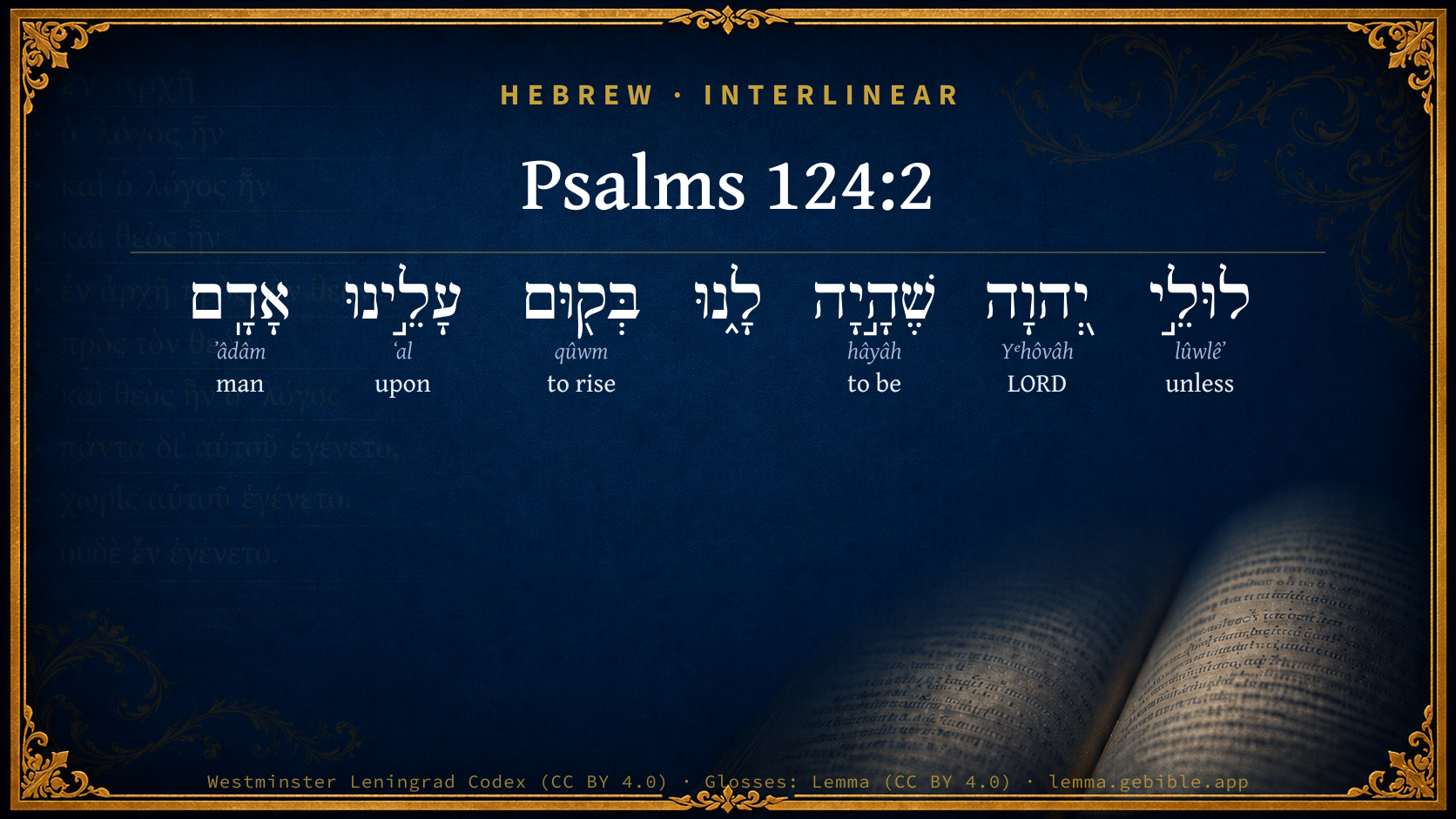
Psalms 124:2

Hebrew (Westminster Leningrad Codex) Psalms 124:2 appears in the Hebrew Old Testament. The text above is from the Westminster Leningrad Codex. Each word links to its Strong’s number, a concise gloss, and parsing drawn from the Open Scriptures Hebrew Bible morphology. Click any word for its full Brown-Driver-Briggs (BDB) entry.
Download image
Cite this verse

Psalms 124:2 (World English Bible). Public Domain. Lemma interlinear Bible study tool, https://lemma.gebible.app/v/psalms/124/2.

Show BibTeX & RIS
BibTeX
RIS
English Translation
If it had not been Yahweh who was on our side, When men rose up against us;
World English Bible · Public Domain
Download a study sheet

One document with this verse’s original text, its word-by-word gloss line, the meaning frame, cross-references with their text, attributed commentary, and full source and license credits — printable, and it pastes into notes with its structure intact.

This verse Autodidact and up

Study sheet (.html) Plain text (.txt)

A passage Seminary Student

Up to 50 verses in one chapter. A passage sheet keeps up to 6 commentary sources and 12 cross-references per verse, in the order this page ranks them, and says so on the sheet whenever that leaves anything out. Ask for a single verse and you get the Autodidact verse sheet above.

Everything on this page stays free to read, with no account — the sheet is a download of what is already on screen, not access to it.

Want to remove ads? Support Godless Engineer
Compare translations 3

The same verse in 3 English versions, stacked beneath the original-language interlinear above. Click any original word for its lexicon entry.

Each is an independent rendering of the whole verse — the interlinear is not word-aligned to these translations.

Highlighted words mark where these versions differ — a whole-verse word diff, not a word-by-word alignment.

  • World English Bible Public Domain
    If it had not been Yahweh who was on our side, When men rose up against us;
  • King James Version Public Domain
    If it had not been the LORD who was on our side, when men rose up against us:
  • unfoldingWord Literal Text CC BY-SA 4.0
    if not Yahweh who was for us when man rose up against us,

unfoldingWord Literal Text — © unfoldingWord, licensed CC BY-SA 4.0. Word-aligned USFM3 via Door43 (git.door43.org/unfoldingWord/en_ult).

Versions to compare (up to 4)

3 of 4 selected

Show all 18 translations

Every available English version of this verse, each an independent rendering of the whole verse.

  • World English Bible Public Domain
    If it had not been Yahweh who was on our side, When men rose up against us;
  • Berean Standard Bible Public Domain
    if the LORD had not been on our side when men attacked us,
  • Majority Standard Bible Public Domain
    if the LORD had not been on our side when men attacked us,
  • King James Version Public Domain
    If it had not been the LORD who was on our side, when men rose up against us:
  • American Standard Version (1901) Public Domain
    If it had not been Jehovah who was on our side, When men rose up against us;
  • Revised Version (1885) Public Domain
    If it had not been the LORD who was on our side, when men rose up against us:
  • Geneva Bible (1599) Public Domain
    If the Lord had not bene on our side, when men rose vp against vs,
  • Douay-Rheims (1899) Public Domain
    Behold as the eyes of the servants are on the hands of their masters, As the eyes of the handmaid are on the hands of her mistress: so are our eyes unto the Lord our God, until he have mercy on us.
  • Young's Literal Translation Public Domain
    Save `for' Jehovah -- who hath been for us, In the rising up of man against us,
  • Literal Standard Version CC BY-SA 4.0
    If YHWH had not been for us, || In the rising up of man against us,
  • Unlocked Literal Bible CC BY-SA 4.0
    “if it had not been Yahweh who was on our side when men rose up against us,
  • unfoldingWord Literal Text CC BY-SA 4.0
    if not Yahweh who was for us when man rose up against us,
  • Darby Bible Public Domain
    If it had not been Jehovah who was for us, when men rose up against us,
  • World Messianic Bible Public Domain
    if it had not been the LORD who was on our side, when men rose up against us,
  • Webster's Bible Public Domain
    If it had not been the LORD who was on our side, when men rose up against us:
  • Free Bible Version CC BY-SA 4.0
    If the Lord hadn't been for us, what would have happened when people came and attacked us?
  • Bible in Basic English Public Domain
    If it had not been the Lord who was on our side, when men came up against us;
  • JPS Tanakh (1917) Public Domain
    'If it had not been the LORD who was for us, when men rose up against us,

Literal Standard Version (2020), Covenant Press — licensed CC BY-SA 4.0. Text via the HelloAO Bible API (eBible.org). Unlocked Literal Bible (unfoldingWord) — licensed CC BY-SA 4.0. Text via the HelloAO Bible API (eBible.org). unfoldingWord Literal Text — © unfoldingWord, licensed CC BY-SA 4.0. Word-aligned USFM3 via Door43 (git.door43.org/unfoldingWord/en_ult). Free Bible Version, Dr. Jonathan Gallagher — licensed CC BY-SA 4.0. Text via the HelloAO Bible API (eBible.org).

Word by word

More ways to search: Search by grammar → Find every occurrence → Compare this word →

Practice this passage: Drill this verse → Learn its vocabulary →

About this verse

These counts appear in no published source. They are computed here, from the morphology-tagged text and Lemma’s own curated glosses. What Lemma adds →

7
words
6
distinct lemmas
Wisdom
section

Notable vocabulary

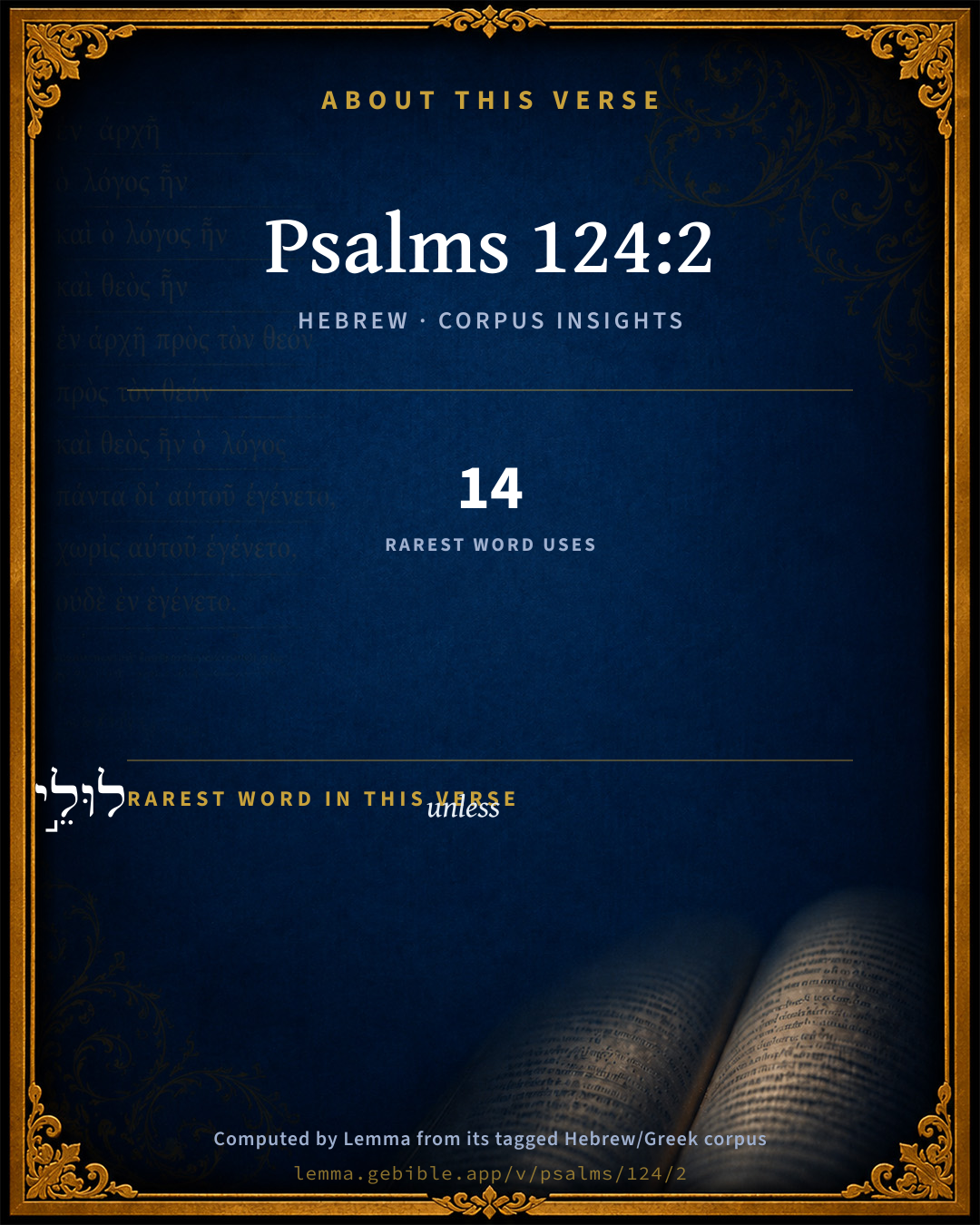
The rarest word here is לוּלֵ֣י unless H3884 — appearing just 14 times in the whole Hebrew Bible.

Shared distinctive vocabulary

לוּלֵ֣י unless H3884 occurs in 14 verses of the Hebrew Bible. Also found in:

Grammatical profile

  • 2 verbs
  • 2 nouns
  • 2 prepositions
  • 1 conjunction

Verb forms

  • שֶׁהָ֣יָה Qal · Perfect
  • בְּק֖וּם Qal · Infinitive Construct

Hebrew & Septuagint length

In English translation the verse runs 17 words from the Hebrew and 17 from the Septuagint (LXX English) — the same length.

A rough comparison of the two English renderings, which tokenize alike — not a word-level alignment.

Word counts can differ between the Hebrew and the Greek without any difference in meaning — e.g. the Hebrew direct-object marker אֵת has no separate Greek word, and Greek often adds the article ὁ.

Cross-references

6

Topical passages linked to Psalms 124:2 in the Treasury of Scripture Knowledge — connected by theme and wording, ordered by reader-vote popularity; previews shown in the World English Bible.

  • Psalms 22:12–13 Many bulls have surrounded me. Strong bulls of Bashan have encircled me.
  • Psalms 22:16 For dogs have surrounded me. A company of evil-doers have enclosed me. They pierced my hands and my feet.
  • Psalms 37:32 The wicked watches the righteous, And seeks to kill him.
  • Psalms 3:1 Yahweh, how my adversaries have increased! Many are those who rise up against me.
  • Psalms 21:1–2 The king rejoices in your strength, Yahweh! How greatly he rejoices in your salvation!
  • Numbers 16:2–3 and they rose up before Moses, with certain of the children of Israel, two hundred fifty princes of the congregation, called to the assembly, men of renown;

Cross-references courtesy of OpenBible.info (CC BY 4.0).

Hebrew and Greek witnesses Masoretic Hebrew ↔ Greek Septuagint

The same verse in the two great witnesses to the Old Testament, shown verse-for-verse.

You’re reading Greek Psalm 123 (Hebrew Psalm 124). The Septuagint counts the superscription, so verse numbers can differ from the Hebrew — chapter-level alignment, not verse-by-verse. Numbering follows Rahlfs.

These are two independent witnesses, not word-aligned to each other, and the Septuagint is shown in lemma (dictionary) form.

Hebrew Psalms 124:2 Masoretic · Westminster Leningrad Codex

לוּלֵ֣י יְ֭הוָה שֶׁהָ֣יָה לָ֑נוּ בְּק֖וּם עָלֵ֣ינוּ אָדָֽם

If it had not been Yahweh who was on our side, When men rose up against us;

World English Bible · Public Domain

Greek LXX Greek Psalm 123:2 Septuagint · lemma form

εἰ μή ὅτι κύριος εἰμί ἐν ἐγώ ἐν ὁ ἐπι ἀναἵστημι ἄνθρωπος ἐπί ἐγώ

if it had not been that the Lord was among us, when men rose up against us;

LXX2012 (modern English Septuagint) · Public Domain

Hebrew: Westminster Leningrad Codex (CC BY 4.0). Greek: Septuagint (public domain); English from LXX2012 (modern English Septuagint) (Public Domain). How the Septuagint differs from the Hebrew →

Commentary

Notes on Psalms 124:2 from classic Christian and Jewish commentators (each source and its license shown beneath its notes). The classic Christian expositions comment on the surrounding passage and are grouped to its opening verse, so a note may address several verses; the Jewish commentaries on the Tanakh (Rashi and others) are per-verse, so they appear only where the commentator wrote on this verse.

Lemma curates 59 commentaries, every one of them public domain or Creative Commons licensed, each selected and text-cleaned for this edition rather than reprinted as found. About our sources →

Trapp's Complete Commentary

John Trapp

Psa 124:2 If [it had not been] the LORD who was on our side, when men rose up against us:

Ver. 2. When men rose] Monsters rather; but such as think themselves the only men alive, and us the only slaves and zanies.

John Trapp, A Commentary or Exposition upon All the Books of the Old and New Testament (1647–1656) — public domain. Text from a community e-Sword module.

J. A. Alexander on Psalms

Joseph Addison Alexander

2. (Psa 124:2) If (it had) not (been) Jehovah who was for us, in the rising up of man against us. What was left unfinished in the first verse, as a mere suggestion of the Psalmist's theme, is now repeated, for the purpose of being carried out. This is one of the rhetorical resumptions, which some modern critics hold to be thedegrees, from which these fifteen psalms derived their common designation. With this verse compare Psa 56:11.

Joseph Addison Alexander, The Psalms Translated and Explained (1850) — public domain. Text from a community e-Sword module.

John Calvin's Commentaries

2. But for Jehovah who was on our side. It is not without cause that he twice repeats the same sentence. So long as we are in danger our fear is immoderate; but no sooner are we delivered than we lessen the greatness of our calamity, and Satan, deceiving us by this artifice, leads us to obscure the grace of God. Since then, after having been wonderfully preserved by the Lord, we for the most part devise all sorts of imaginary circumstances, in order to efface from our minds the remembrance of his grace, David, by introducing the people as struck with amazement, purposely dwells upon the amplification of the danger. In these words a bridle is put upon us, to keep us meditating upon our dangers, lest the sense of God’s grace should vanish from our minds. The common translation, Had not the Lord been on our side, does not sufficiently express David’s meaning; for he affirms that the deliverance and the salvation of the people proceeded from nothing else than God’s succor, and at the same time shows that this succor was both certain and evident. Two things then are here to be distinctly noticed; first, that the Lord had been at hand to afford aid to his servants, and had taken their part; and secondly, that being already in a desperate condition, they could not by help from any other quarter, or in another manner, have escaped from danger. Thus we are taught, that men then only ascribe the glory of their preservation to God, when they are persuaded of his being so favourably inclined towards them as to defend them and maintain them safe. In the second clause there is extolled in high terms the infinite power of God, of which he had given abundant proof in delivering the people, to teach us that such a manner of preserving does not belong to man. By the noun אדם, adam, which when it is collective signifies men in general, David seems to denote a vast number of enemies. The people of God, as if he had said, had not to contend merely against a few men, or against one nation, but were assailed by almost the whole world; it being abundantly manifest that all mankind were the enemies of the Jews.

John Calvin's Commentaries (1540-1563) — public domain. Text from the Calvin Translation Society English edition (1840s-50s) via the Christian Classics Ethereal Library (ccel.org). Calvin's coverage is partial (roughly two-thirds of the Bible); uncommented books and verses are honest gaps, never fabricated. The 19th-century editor's footnotes and remarks are omitted so the notes are faithfully Calvin's own voice.

Ellicott's Commentary for English Readers

(2) If it had not been.—For this motto of the covenant, see Psa_94:17.

Men.—Better, man. In this use of the general term, we must, as Reuss points out, see an indication of the time of composition of the psalm. One who could so speak of the whole world as separated into two parts (Jews and heathen), discloses a sense of isolation and exclusiveness which brings us far down from the time of the prophets. They, indeed, spoke of it as the ideal of the future. This psalmist regards it as an accomplished fact.

A Bible Commentary for English Readers, edited by Charles John Ellicott (1878–1897) — public domain. Text from a community e-Sword module.

The Cambridge Bible for Schools and Colleges

gen. ed. J. J. S. Perowne

2. men] Rather man; as contrasted with God Who was our help. Cp. Psa_66:12; Psa_56:11; Psa_118:6.

rose up] Conspiring to fight against us, Neh_4:8. Cp. Psa_3:1; Psa_54:3.

The Cambridge Bible for Schools and Colleges (gen. ed. J. J. S. Perowne; Cambridge University Press, 1878–1918) — public domain. Text from a community e-Sword module.

John Gill's Exposition

If it had not been the Lord who was on our side,.... This he repeats both for the confirmation of it, and to excite the attention of the Israelites to it; as well as to observe that it was not once only, but again and again, many times the Lord appeared to be on their side. The Targum renders it,

"the Word of the Lord;''

the essential Word, the Son of God; and so in Psa 123:1, in the king's Bible;

when men rose up against us; wicked men; though no hard epithet is given in the text, however just. The enemies of God's people are only called "men" by them, to show their meekness and patience; it is in the singular number, "when man rose up"; hence Aroma interprets it of Pharaoh king of Egypt; and R. Obadiah of Haman: but it might be better interpreted of the man of sin, the man of the earth; who, at the head of his antichristian party, has rose up against the saints, oppressed them, and threatened them with utter ruin, Th2 2:4. Though it is best to understand it of a body of men; of men not mean, but mighty; not few, but numerous; and who united as one man against the people of God, and rose up against them in an hostile manner; being full of enmity to them, and bent upon their ruin.

John Gill's Exposition of the Whole Bible (1746–1763) — public domain (CC PDM 1.0). Text via the HelloAO Bible API.

Albert Barnes' Notes on the Bible

If it had not been the Lord who was on our side - Repeating the idea, since the mind was full of it, and carrying the thought forward. This is one of the instances of an ascent of thought in these psalms, from which it has been supposed that the title “Songs of Degrees” was given to this collection. See, however, Introduction to Psa 120:1-7.

When men rose up against us - When we were assailed by our enemies. On what occasion this occurred, it is now impossible to determine.

Albert Barnes' Notes on the Bible (1834–1885) — public domain. Text from a community e-Sword/MySword module.

The Treasury of David

Charles H. Spurgeon

Ver. 2. If it had not been the Lord who was on our side, when men rose up against us. When all men combined, and the whole race of men seemed set upon stamping out the house of Israel, what must have happened if the covenant Lord had not interposed? When they stirred themselves, and combined to make an assault upon our quietude and safety, what should we have done in their rising if the Lord had not also risen? No one who could or would help was near, but the bare arm of the Lord sufficed to preserve his own against all the leagued hosts of adversaries. There is no doubt as to our deliverer, we cannot ascribe our salvation to any second cause, for it would not have been equal to the emergency; nothing less than omnipotence and omniscience could have wrought our rescue. We set every other claimant on one side, and rejoice because the Lord was on our side.

Ver. 2. If it had not been the LORD, etc. This repetition is not in vain. For whilst we are in danger, our fear is without measure; but when it is once past, we imagine it to have been less than it was indeed. And this is the delusion of Satan to diminish and obscure the grace of God. David therefore with this repetition stirreth up the people to more thankfulness unto God for his gracious deliverance, and amplifies the dangers which they had passed. Whereby we are taught how to think of our troubles and afflictions past, lest the sense and feeling of God's grace vanish out of our minds. Martin Luther.

Ver. 2. Men rose up against us. It may seem strange that these wicked and wretched enemies, monsters rather than men, should be thus moderately spoken of, and have no other name than this of men given them, which of all others they least deserved, as having in them nothing of man but outward show and shape, being rather beasts, yea, devils in the form and fashion of men, than right men. But hereby the church would show that she did leave the further censuring of them unto God their righteous Judge; and would also further amplify their wickedness, who being men, did yet in their desires and dispositions bewray a more than beastly immanity and inhumanity. Daniel Dyke (1614?) in "Comfortable Sermons upon the 124th Psalme, "1617.

Ver. 2,3.

1. To swallow us alivethe desire of our wrathful enemies.

2. To save us alivethe work of our faithful God.

Psalms 124:3*

Charles H. Spurgeon's The Treasury of David (1869–1885) — public domain. Psalms only. Text from a community e-Sword/MySword module.

Whedon's Commentary on the Bible

Daniel D. Whedon

2. When men rose up against—The idea is that of a sudden rising, an open and hostile uprising.

Daniel D. Whedon (gen. ed.), Commentary on the Old and New Testaments (1874–1909) — public domain. Text from a community e-Sword module.

The Pulpit Commentary

If it had not been the Lord who was on our side, when men rose up against us. The "rising" intended may have been that of Saul and his aiders and abettors, or that of the Ammonites and Syrians, (2Sa_10:6-8) or that of Absalom and his partisans. (2Sa_15:2-13)

Vers. 2-4. Jehovah"s effective resistance.

Perowne thinks that the figures of these verses remind of the earlier deliverance from Egypt. "The Egyptians did " rise up" against them. Pharaoh and his chariots and his horsemen followed hard after them, and did seem as if about to swallow them up, when they were entangled in the wilderness. The waves of the Red Sea overwhelming their enemies might have suggested naturally the figure by which the might of those enemies was itself compared to swelling waters." An estimate of the tone of the psalm, however, leads us to recognize suddenness as the characteristic of the calamity indicated. The waters suggested are rather those of a sudden mountain flood raging down one of the dried wadies, carrying all before it, but passing as swiftly as it came the "spate" or "scaith" of mountain districts. If the sea is to be thought of, it is as suddenly swept up by high tide and strong wind, and lunging furiously against the rocks, so long as the strength of the tide continues. We may therefore more hopefully look at the experiences of the returned exiles, and find that the calamity in the mind of the psalmist was the sudden, fanatical, and desperate outburst of enmity on the part of Sanballat and his associates. That was a temporary trouble, but it was very intense, and almost overbearing and overwhelming while it lasted.

I JEHOVAH"S RESISTANCE MAY BE A PERMISSION. It need not be confounded with a prevention. God does not always save men by taking their enemies, or the schemes of their enemies, away. He does not turn back the floods. He lets them flow on just the same. He may not even remove the feeling and the fear which the floods produce. We should never lose the confidence that, if our enemies are in the floods, God is much more in the floods. They may seem to work our enemy"s purpose; they really do work out God"s purpose. Divine permissions are the signs of Divine wisdom and love. And this St. Paul had to learn.

II JEHOVAH"S RESISTANCE MAY BE A PRESERVATION. Only the shakable, ill-founded things are swept down by the mountain spate. The house founded on the rock makes effective resistance. And that is what God did for the returned exiles held them safe through that time of strain and storm. God in our circumstances we often find it very difficult to trace; God for us we may always see clearly; and that guarantees preservation. R.T.

The Pulpit Commentary (1880–1919), ed. H.D.M. Spence-Jones & Joseph S. Exell — public domain. Text from a community e-Sword module.

Lesson kit

Teaching starters — assembled from the data on this page, not authored interpretation. Every prompt links to the verse data it draws on. Edit before teaching.

Psalms, in the Wisdom, opens this verse with 7 words (6 distinct Hebrew lemmas). Its most distinctive word is lûwlêʼ (“unless”). A historical commentator’s framing appears above. Read the whole chapter for the surrounding context.

Discussion questions

  1. How does “unless” (lûwlêʼ) shape what this verse is saying?
  2. How does Genesis 31:42, which shares the word «unless», read alongside this verse?
  3. These translations render this verse differently. What is at stake in choosing one wording over another?
  4. «שֶׁהָ֣יָה» is a Qal Perfect verb. How does that grammatical form shape the action described?
  5. Compare how Trapp's Complete Commentary and J. A. Alexander on Psalms read this verse. Where do they agree or differ?

Things to notice

Reading settings

Reading text

Shown beneath each verse's original-language words.

Old Testament
Old Testament edition

Read the OT as the Masoretic Hebrew (MT) or the Greek Septuagint (LXX).

English shown for the Greek Septuagint (in the Hebrew ↔ Greek comparison).

Comparing translations? Open the Compare panel on any verse page to stack up to four side by side.