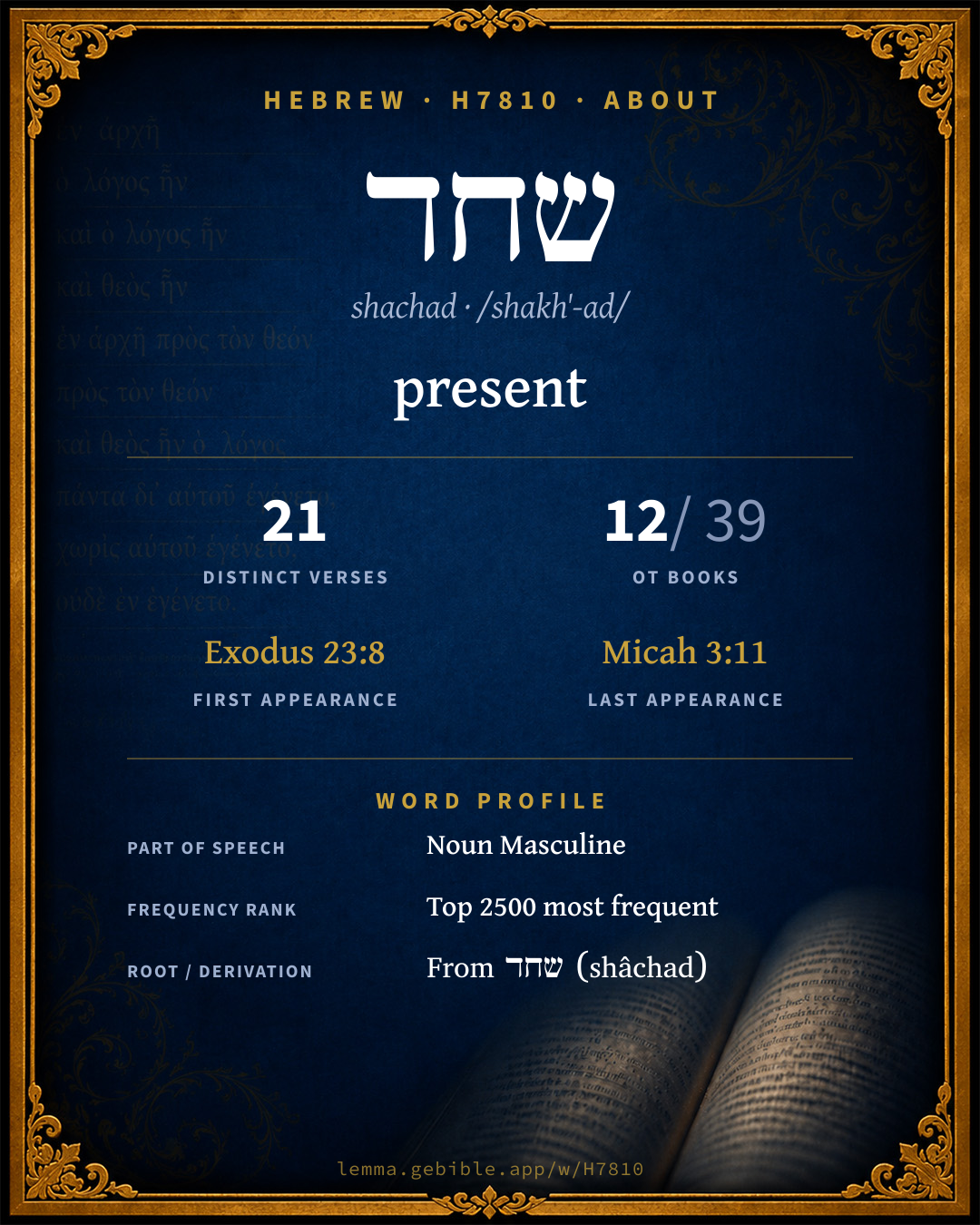
שֹׁ֫חַד
present
Full lexicon entry — Brown-Driver-Briggs (BDB)
From Brown-Driver-Briggs (BDB)
Where this word appears
Grammar key — what these labels mean
Part of speech
- Noun
- A naming word — a person, place, thing, or idea.
Noun type
- Common
- A common noun — a general class of person, place, or thing (“king,” “city,” “water”), not a specific name.
State
- Absolute
- The independent form of a noun, not bound to a following word.
Gender
- Masculine
- Grammatically masculine.
Number
- Singular
- One.
Every verse where H7810 appears — 21 distinct verses across 12 books. Click any verse to open its interlinear word-by-word view. Verse text shown in the World English Bible for context — . Each verse’s Hebrew form is shown with its reference; the English is not keyword-highlighted, since the data carries no word-level English alignment. Use “Compare translations” on any verse to read it across multiple English versions. This concordance covers the Hebrew Bible; Septuagint (Greek Old Testament) occurrences are not indexed here.
Exodus 1 verse
Deuteronomy 3 verses
- Deuteronomy 10:17 שֹֽׁחַד n c ms For Yahweh your God, he is God of gods, and Lord of lords, the great God, the mighty, and the awesome, who doesn't regard persons, nor takes reward.
- Deuteronomy 16:19 שֹׁ֔חַד הַ/שֹּׁ֗חַד n c ms ptcl def.art + n c ms You shall not wrest justice: you shall not respect persons; neither shall you take a bribe; for a bribe does blind the eyes of the wise, and pervert the words of the righteous.
- Deuteronomy 27:25 שֹׁ֔חַד n c ms Cursed be he who takes a bribe to kill an innocent person. All the people shall say, Amen.
1 Samuel 1 verse
1 Kings 1 verse
2 Kings 1 verse
2 Chronicles 1 verse
Job 1 verse
Psalms 2 verses
Proverbs 4 verses
- Proverbs 6:35 שֹֽׁחַד n c ms He won't regard any ransom, Neither will he rest content, though you give many gifts.
- Proverbs 17:8 הַ֭/שֹּׁחַד ptcl def.art + n c ms A bribe is a precious stone in the eyes of him who gives it; Wherever he turns, he prospers.
- Proverbs 17:23 שֹׁ֣חַד n c ms A wicked man receives a bribe in secret, To pervert the ways of justice.
- Proverbs 21:14 וְ/שֹׁ֥חַד conj + n c ms A gift in secret pacifies anger; And a bribe in the cloak, strong wrath.
Isaiah 4 verses
- Isaiah 1:23 שֹׁ֔חַד n c ms Your princes are rebellious, and companions of thieves. Everyone loves bribes, and follows after rewards. They don't judge the fatherless, Neither does the cause of the widow come to them.
- Isaiah 5:23 שֹׁ֑חַד n c ms Who acquit the guilty for a bribe, But deny justice for the innocent!
- Isaiah 33:15 בַּ/שֹּׁ֔חַד prep det + n c ms He who walks righteously, and speaks blamelessly; he who despises the gain of oppressions, who shakes his hands from taking a bribe, who stops his ears from hearing of blood, and shuts his eyes from looking on evil:
- Isaiah 45:13 בְ/שֹׁ֔חַד prep + n c ms I have raised him up in righteousness, and I will make straight all his ways: he shall build my city, and he shall let my exiles go free, not for price nor reward, says Yahweh of Hosts.
Ezekiel 1 verse
Micah 1 verse
About this entry
At a glance — auto-summarized from this page’s data, not written by a person. Every figure links to its source below. This summary describes the numbers; it doesn’t interpret them.
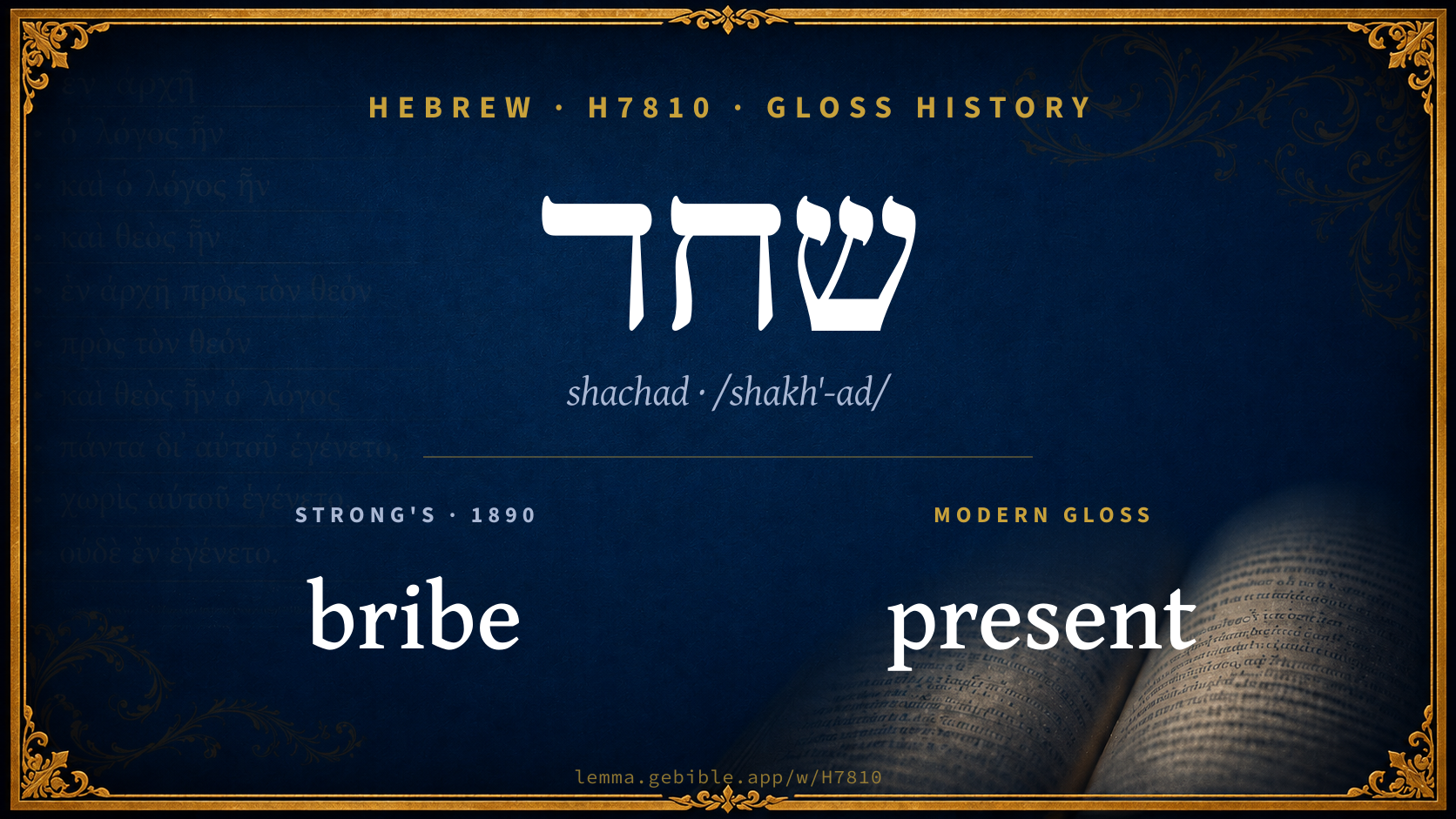
שחד (shachad) is a Hebrew noun most often rendered “present.” Its English rendering has broadened — “reward” classically, “bribe” (Berean Standard Bible) in modern versions; see the renderings breakdown. The Hebrew Bible uses it across 21 verses — uncommon. It first appears in Exodus 23:8. The sections below give every sense, occurrence, and version rendering.
Gloss history
Strong's 1890 vs modern scholarship
About this word
Strong's H7810 catalogs a Hebrew word from the Hebrew Old Testament.
These counts are not copied from any lexicon or concordance. They are computed here, from the morphology-tagged Hebrew Old Testament. What Lemma adds →
- 21
- distinct verses
- The word appears in 21 distinct verses.
- 12 / 39
- OT books
- The word appears in 12 of 39 Old Testament books.
- #1,368
- by frequency
- Top 2500 most frequent Hebrew words (rank 1,368 of 8,640 Hebrew words by occurrence).
View all 21 occurrences in the concordance →
Most concentrated in
- Proverbs 4 verses 19%
- Isaiah 4 verses 19%
- Deuteronomy 3 verses 14%
By section of the Old Testament
By traditional corpus
Conventional, traditional groupings — biblical authorship is debated, so this is a traditional corpus grouping, not an authorship claim. Each share is this word’s portion of its verses in that division of the Hebrew canon. Each figure is a share of the word’s 21 distinct verses.
- Prophets (Nevi'im) 9 verses · 43%
- Writings (Ketuvim) 8 verses · 38%
- Torah (Pentateuch) 4 verses · 19%
How translations render this word
Counts come from each version’s own published word-to-Strong’s tagging or interlinear alignment — an approximate guide to how each version renders this word, not a word-level alignment the data otherwise carries. Because each total is that version’s own tagged count, the per-version totals vary from one another and need not match the appearance or distinct-verse counts above. These counts may also differ from a printed concordance because Lemma counts each distinctly tagged rendering and does not collapse phrase taggings into a single head-word total. This is a fixed set of word-tagged versions (KJV, ASV, BSB, ULT) and does not change with the reading translation you choose elsewhere. Each version’s license is shown beside its name below (and on Sources).
- King James Version: Reward 7×, Gift 6×, Gifts 4×
- American Standard Version: Bribe 9×, Bribes 4×, Reward 3×
- Berean Standard Bible: Bribe 13×, Bribes 4×, Gift 2×
- unfoldingWord Literal Text: Bribe 17×
King James Version Public Domain
Renders H7810 across 23 tagged occurrences — most commonly:
Plus 3 renderings that appear only once — usually multi-word phrases or single function words the recovered tagging swept in, not distinct renderings.
American Standard Version Public Domain
Renders H7810 across 22 tagged occurrences — most commonly:
Plus 4 renderings that appear only once — usually multi-word phrases or single function words the recovered tagging swept in, not distinct renderings.
Berean Standard Bible Public Domain
Renders H7810 across 22 tagged occurrences — most commonly:
Plus 3 renderings that appear only once — usually multi-word phrases or single function words the recovered tagging swept in, not distinct renderings. Not rendered by a distinct English word in 1 further occurrence.
unfoldingWord Literal Text CC BY-SA 4.0
Renders H7810 across 26 tagged occurrences — most commonly:
Plus 9 renderings that appear only once — usually multi-word phrases or single function words the recovered tagging swept in, not distinct renderings.
Senses in BDB
The 1 sense BDB distinguishes for this word, in lexicon order (not ranked by frequency or importance). The full entry — with sub-senses — is in the Lexicon Entry tab.
- present, bribe
Word origin
n.m. present, specif. bribe;—שׁ׳ abs. Is 1:23 + 22 times;—bribe, usually to pervert justice, obj. of לָקַח Ex 23:8a (E), = Dt 16:19a; Dt 10:17; 1 S 8:3; 2 Ch 19:7 ψ 15:5; Pr 17:23; + inf., take bribe to do something, Dt 27:25; Ez 22:12; אָהַב שׁ׳ Is 1:23; cf. also 5:23; 33:15 Ex 23:8b (E) = Dt 16:19b, Mi 3:11 ψ 26:10; Pr 17:8; 21:14; אָהֳלֵי־שׁ׳ Jb 15:34, i.e. abode of bribe-givers; שׁ׳ Pr 6:35 (‖ כֹּפֶר) is hush-money, or (poss.) legal compensation (cf. Toy); שׁ׳ elsewhere (c. שָׁלַח) of bribing king to take sides 1 K 15:19; 2 K 16:8, cf. Is 45:13 (‖ מְחִיר).
— Brown-Driver-Briggs (Oxford 1906, public domain), digitized via Sefaria, supplemented by the OpenScriptures HebrewLexicon (CC BY 4.0). See Sources.
Derived from שחד (shâchad) (H7809) — to give.
Jastrow Dictionary
A second Hebrew/Aramaic lexicon for comparison, covering Aramaic and post-biblical (Talmudic, Targumic, Midrashic) usage that the biblical-Hebrew BDB does not. Matched by lemma rather than by Strong’s number, so a lemma may carry more than one Jastrow headword (shown separately below), and the entries cover usage well beyond the Bible.
שְׁחַד
- (v. שׁוֹחַד) to win the favor of, bribe. Targ. Ez. XVI, 33. Targ. Job VI, 22.
- same. Snh. 43ᵇ שַחוּדֵי שַׁחֲדֵיה במילי he (Joshua) won him (Achan) over with persuasive words.
A Dictionary of the Targumim, the Talmud Babli and Yerushalmi, and the Midrashic Literature (Marcus Jastrow; London, Luzac, 1903) — Public Domain. Digitized via Sefaria. Digitized via Sefaria. Full attribution on Sources.
Forms in the corpus
The 15 distinct written forms H7810 takes in the Hebrew Bible, most frequent first — each parse links to that state’s occurrences in the concordance. Hebrew forms include their vowel points and cantillation, so a single lemma takes many written forms.
| Form | Parsing | Example | Uses |
|---|---|---|---|
| שֹֽׁחַד | Noun, Common, Masculine, Singular, Absolute | Deuteronomy 10:17 | 5 |
| שֹׁ֔חַד | Noun, Common, Masculine, Singular, Absolute | Deuteronomy 16:19 | 4 |
| וְ/שֹׁ֥חַד | Noun, Common, Masculine, Singular, Absolute | Proverbs 21:14 | 2 |
| בְ/שֹׁ֔חַד | Noun, Common, Masculine, Singular, Absolute | Isaiah 45:13 | 1 |
| בְּ/שֹׁ֣חַד | Noun, Common, Masculine, Singular, Absolute | Micah 3:11 | 1 |
| בַּ/שֹּׁ֔חַד | Noun, Common, Masculine, Singular, Absolute | Isaiah 33:15 | 1 |
| הַ/שֹּׁ֗חַד | Noun, Common, Masculine, Singular, Absolute | Deuteronomy 16:19 | 1 |
| הַ/שֹּׁ֨חַד֙ | Noun, Common, Masculine, Singular, Absolute | Exodus 23:8 | 1 |
| הַ֭/שֹּׁחַד | Noun, Common, Masculine, Singular, Absolute | Proverbs 17:8 | 1 |
| וְ/שֹׁ֖חַד | Noun, Common, Masculine, Singular, Absolute | Exodus 23:8 | 1 |
| שֹׁ֑חַד | Noun, Common, Masculine, Singular, Absolute | Isaiah 5:23 | 1 |
| שֹׁ֣חַד | Noun, Common, Masculine, Singular, Absolute | Proverbs 17:23 | 1 |
| שֹׁ֥חַד | Noun, Common, Masculine, Singular, Absolute | Ezekiel 22:12 | 1 |
| שֹׁ֨חַד֙ | Noun, Common, Masculine, Singular, Absolute | 1 Kings 15:19 | 1 |
| שֹּֽׁחַד | Noun, Common, Masculine, Singular, Absolute | Psalms 26:10 | 1 |
Septuagint verse parallels
This word appears in 21 verses that also exist in the Greek Old Testament (Septuagint), out of the 21 Hebrew verses it occurs in. You can read those verses in Greek by switching the Old Testament edition to the Septuagint.
Read these verses in the Septuagint
- Exodus 23:8
- Deuteronomy 10:17
- 1 Samuel 8:3
- 1 Kings 15:19
- 2 Kings 16:8
- 2 Chronicles 19:7
- Job 15:34
- Psalms 15:5
- Proverbs 6:35
- Isaiah 1:23
- Ezekiel 22:12
- Micah 3:11
This is a verse-level parallel only — the same verses exist in both the Hebrew and Greek Old Testaments. No word-level Hebrew↔Greek correspondence is claimed: the data carries no such alignment, so no Greek word is shown as this Hebrew word’s translation. Coverage is not total — the Septuagint omits the deuterocanon and renumbers the Psalms, so some Hebrew verses have no direct Greek parallel.