
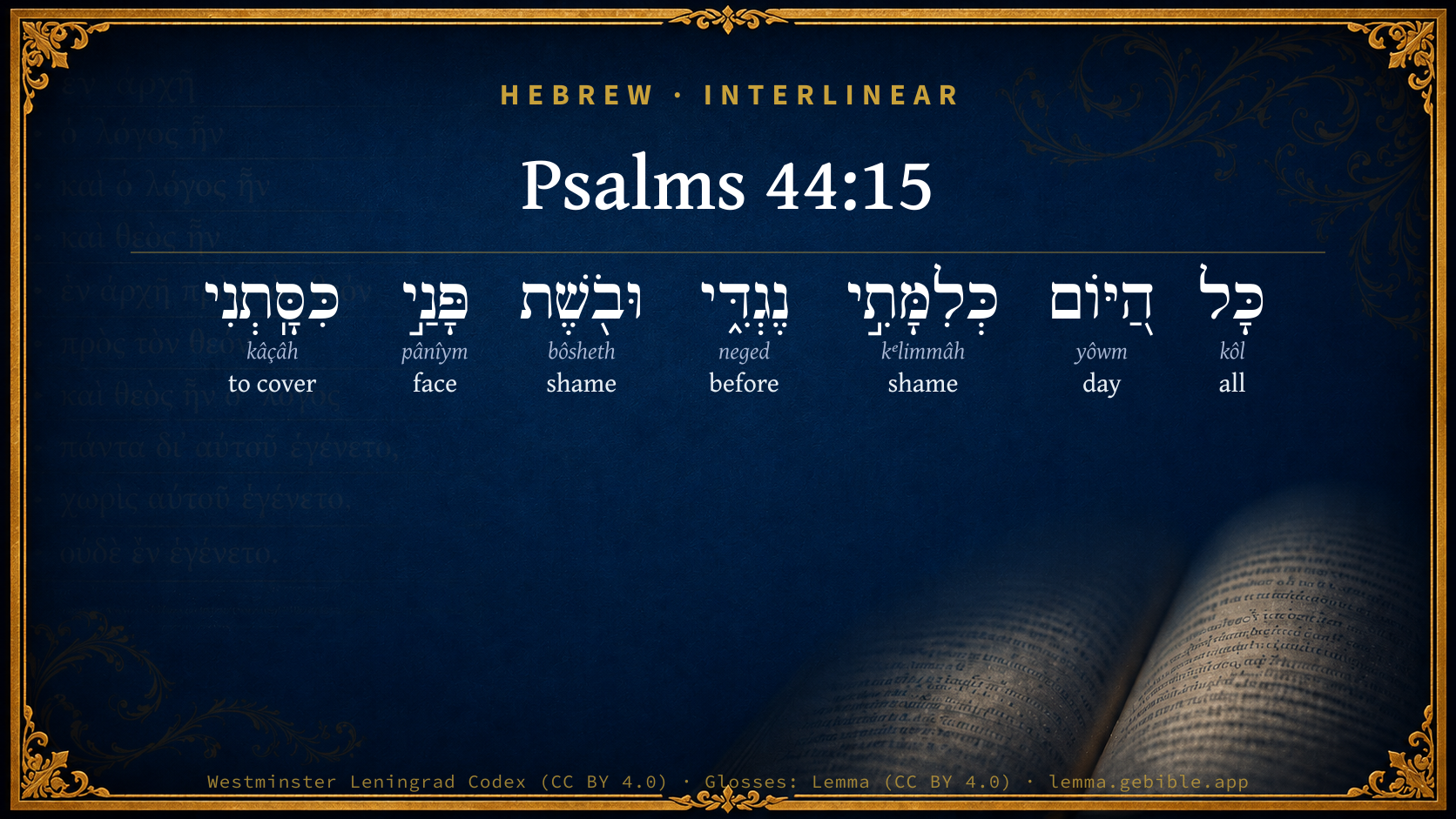
Psalms 44:15

Hebrew (Westminster Leningrad Codex) Psalms 44:15 appears in the Hebrew Old Testament. The text above is from the Westminster Leningrad Codex. Each word links to its Strong’s number, a concise gloss, and parsing drawn from the Open Scriptures Hebrew Bible morphology. Click any word for its full Brown-Driver-Briggs (BDB) entry.
Download image
Cite this verse

Psalms 44:15 (World English Bible). Public Domain. Lemma interlinear Bible study tool, https://lemma.gebible.app/v/psalms/44/15.

Show BibTeX & RIS
BibTeX
RIS
English Translation
All day long my dishonor is before me, And shame covers my face,
World English Bible · Public Domain
Download a study sheet

One document with this verse’s original text, its word-by-word gloss line, the meaning frame, cross-references with their text, attributed commentary, and full source and license credits — printable, and it pastes into notes with its structure intact.

This verse Autodidact and up

Study sheet (.html) Plain text (.txt)

A passage Seminary Student

Up to 50 verses in one chapter. A passage sheet keeps up to 6 commentary sources and 12 cross-references per verse, in the order this page ranks them, and says so on the sheet whenever that leaves anything out. Ask for a single verse and you get the Autodidact verse sheet above.

Everything on this page stays free to read, with no account — the sheet is a download of what is already on screen, not access to it.

Want to remove ads? Support Godless Engineer
Compare translations 3

The same verse in 3 English versions, stacked beneath the original-language interlinear above. Click any original word for its lexicon entry.

Each is an independent rendering of the whole verse — the interlinear is not word-aligned to these translations.

Highlighted words mark where these versions differ — a whole-verse word diff, not a word-by-word alignment.

  • World English Bible Public Domain
    All day long my dishonor is before me, And shame covers my face,
  • King James Version Public Domain
    My confusion is continually before me, and the shame of my face hath covered me,
  • unfoldingWord Literal Text CC BY-SA 4.0
    All of the day my disgrace before me, and the shame of my face covers me,

unfoldingWord Literal Text — © unfoldingWord, licensed CC BY-SA 4.0. Word-aligned USFM3 via Door43 (git.door43.org/unfoldingWord/en_ult).

Versions to compare (up to 4)

3 of 4 selected

Show all 18 translations

Every available English version of this verse, each an independent rendering of the whole verse.

  • World English Bible Public Domain
    All day long my dishonor is before me, And shame covers my face,
  • Berean Standard Bible Public Domain
    All day long my disgrace is before me, and shame has covered my face,
  • Majority Standard Bible Public Domain
    All day long my disgrace is before me, and shame has covered my face,
  • King James Version Public Domain
    My confusion is continually before me, and the shame of my face hath covered me,
  • American Standard Version (1901) Public Domain
    All the day long is my dishonor before me, And the shame of my face hath covered me,
  • Revised Version (1885) Public Domain
    All the day long is my dishonour before me, and the shame of my face hath covered me,
  • Geneva Bible (1599) Public Domain
    My confusion is dayly before me, and the shame of my face hath couered me,
  • Douay-Rheims (1899) Public Domain
    Thou hast made us a byword among the Gentiles: a shaking of the head among the people.
  • Young's Literal Translation Public Domain
    All the day my confusion `is' before me, And the shame of my face hath covered me.
  • Literal Standard Version CC BY-SA 4.0
    All the day my confusion [is] before me, || And the shame of my face has covered me.
  • Unlocked Literal Bible CC BY-SA 4.0
    All the day long my dishonor is before me, and the shame of my face has covered me
  • unfoldingWord Literal Text CC BY-SA 4.0
    All of the day my disgrace before me, and the shame of my face covers me,
  • Darby Bible Public Domain
    All the day my confusion is before me, and the shame of my face hath covered me,
  • World Messianic Bible Public Domain
    All day long my dishonor is before me, and shame covers my face,
  • Webster's Bible Public Domain
    \\44:14\\Thou makest us a by-word among the heathen, a shaking of the head among the people.
  • Free Bible Version CC BY-SA 4.0
    We are humiliated all day long; we hold our heads in shame,
  • Bible in Basic English Public Domain
    My downfall is ever before me, and I am covered with the shame of my face;
  • JPS Tanakh (1917) Public Domain
    (44-16) All the day is my confusion before me, and the shame of my face hath covered me,

Literal Standard Version (2020), Covenant Press — licensed CC BY-SA 4.0. Text via the HelloAO Bible API (eBible.org). Unlocked Literal Bible (unfoldingWord) — licensed CC BY-SA 4.0. Text via the HelloAO Bible API (eBible.org). unfoldingWord Literal Text — © unfoldingWord, licensed CC BY-SA 4.0. Word-aligned USFM3 via Door43 (git.door43.org/unfoldingWord/en_ult). Free Bible Version, Dr. Jonathan Gallagher — licensed CC BY-SA 4.0. Text via the HelloAO Bible API (eBible.org).

Word by word

More ways to search: Search by grammar → Find every occurrence → Compare this word →

Practice this passage: Drill this verse → Learn its vocabulary →

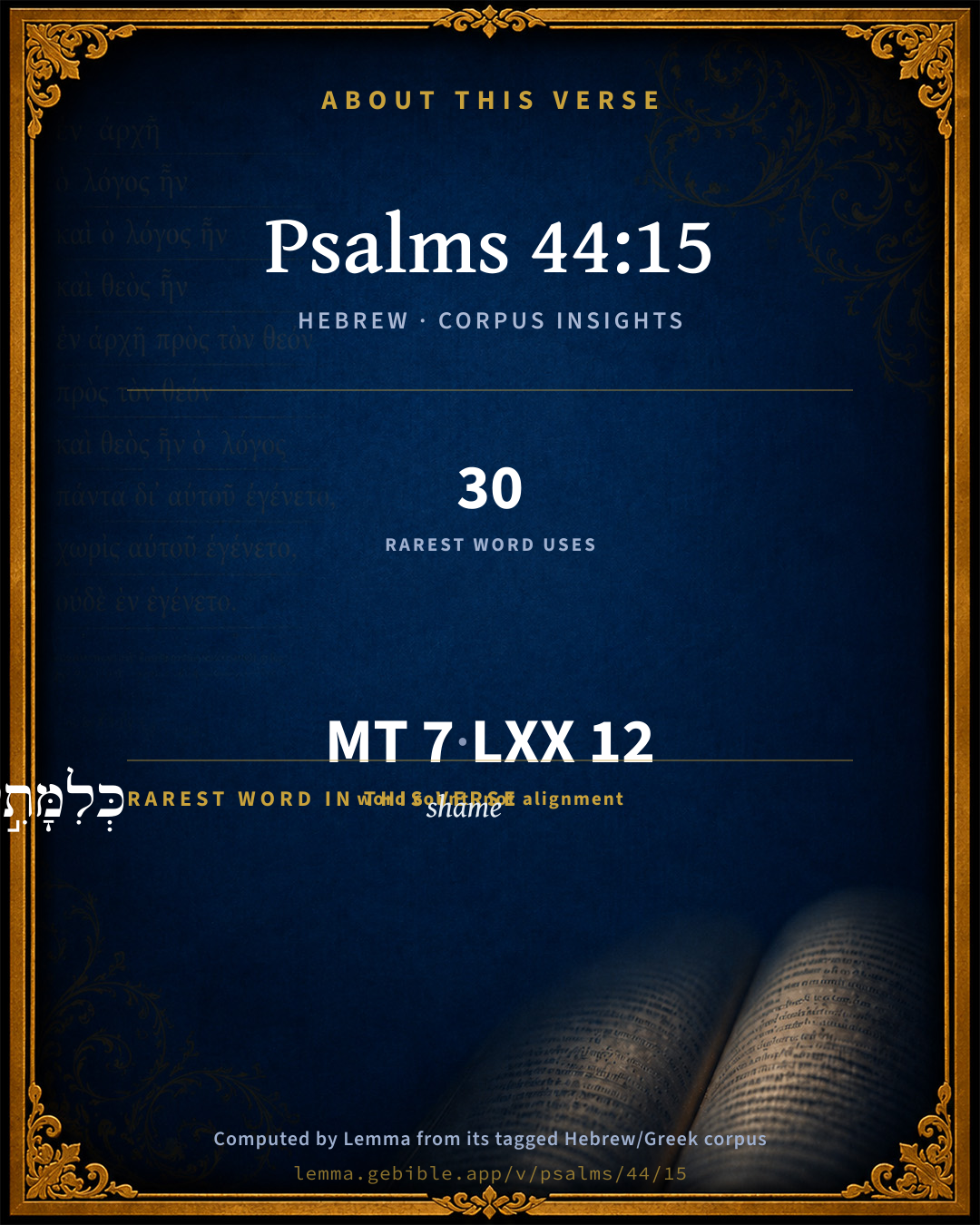
About this verse

These counts appear in no published source. They are computed here, from the morphology-tagged text and Lemma’s own curated glosses. What Lemma adds →

7
words
7
distinct lemmas
Wisdom
section

Shared distinctive vocabulary

כְּלִמָּתִ֣י shame H3639 occurs in 29 verses of the Hebrew Bible. Also found in:

Grammatical profile

  • 1 verb
  • 5 nouns
  • 1 preposition

Verb forms

  • כִּסָּֽתְנִי Piel · Perfect

Hebrew & Septuagint length

In English translation the verse runs 13 words from the Hebrew and 17 from the Septuagint (LXX English) — closely comparable.

A rough comparison of the two English renderings, which tokenize alike — not a word-level alignment.

Word counts can differ between the Hebrew and the Greek without any difference in meaning — e.g. the Hebrew direct-object marker אֵת has no separate Greek word, and Greek often adds the article ὁ.

In the original languages it is 7 Hebrew tokens and 12 Greek tokens — but the two are counted differently (Hebrew bundles its prefixes and suffixes into one token; the Greek is in lemma form), so that isn’t a like-for-like length.

Cross-references

8

Topical passages linked to Psalms 44:15 in the Treasury of Scripture Knowledge — connected by theme and wording, ordered by reader-vote popularity; previews shown in the World English Bible.

  • Psalms 69:7 Because for your sake, I have borne reproach. Shame has covered my face.
  • Joshua 7:7–9 Joshua said, Alas, Lord Yahweh, why have you at all brought this people over the Jordan, to deliver us into the hand of the Amorites, to cause us to perish? would that we had been content and lived beyond the Jordan!
  • 2 Chronicles 32:21 Yahweh sent an angel, who cut off all the mighty men of valor, and the leaders and captains, in the camp of the king of Assyria. So he returned with shame of face to his own land. When he was come into the house of his god, those who came forth from his own bowels killed him there with the sword.
  • Psalms 71:13 Let my accusers be disappointed and consumed. Let them be covered with disgrace and scorn who want to harm me.
  • Jeremiah 51:51 We are confounded, because we have heard reproach; confusion has covered our faces: for strangers are come into the sanctuaries of Yahweh's house.
  • Ezra 9:6 and I said, my God, I am ashamed and blush to lift up my face to you, my God; for our iniquities are increased over our head, and our guiltiness is grown up to the heavens.
  • Psalms 89:45 You have shortened the days of his youth. You have covered him with shame. Selah.
  • Jeremiah 3:25 Let us lie down in our shame, and let our confusion cover us; for we have sinned against Yahweh our God, we and our fathers, from our youth even to this day; and we have not obeyed the voice of Yahweh our God.

Cross-references courtesy of OpenBible.info (CC BY 4.0).

Hebrew and Greek witnesses Masoretic Hebrew ↔ Greek Septuagint

The same verse in the two great witnesses to the Old Testament, shown verse-for-verse.

You’re reading Greek Psalm 43 (Hebrew Psalm 44). The Septuagint counts the superscription, so verse numbers can differ from the Hebrew — chapter-level alignment, not verse-by-verse. Numbering follows Rahlfs.

These are two independent witnesses, not word-aligned to each other, and the Septuagint is shown in lemma (dictionary) form.

Hebrew Psalms 44:15 Masoretic · Westminster Leningrad Codex

כָּל הַ֭יּוֹם כְּלִמָּתִ֣י נֶגְדִּ֑י וּבֹ֖שֶׁת פָּנַ֣י כִּסָּֽתְנִי

All day long my dishonor is before me, And shame covers my face,

World English Bible · Public Domain

Greek LXX Greek Psalm 43:15 Septuagint · lemma form

τίθημι ἐγώ εἰς παραβολή ἐν ὁ ἔθνος κίνησις κεφαλή ἐν ὁ λαός

All the day my shame is before me, and the confusion of my face has covered me,

LXX2012 (modern English Septuagint) · Public Domain

Hebrew: Westminster Leningrad Codex (CC BY 4.0). Greek: Septuagint (public domain); English from LXX2012 (modern English Septuagint) (Public Domain). How the Septuagint differs from the Hebrew →

Commentary

Notes on Psalms 44:15 from classic Christian and Jewish commentators (each source and its license shown beneath its notes). The classic Christian expositions comment on the surrounding passage and are grouped to its opening verse, so a note may address several verses; the Jewish commentaries on the Tanakh (Rashi and others) are per-verse, so they appear only where the commentator wrote on this verse.

Lemma curates 59 commentaries, every one of them public domain or Creative Commons licensed, each selected and text-cleaned for this edition rather than reprinted as found. About our sources →

Trapp's Complete Commentary

John Trapp

Psa 44:15 My confusion [is] continually before me, and the shame of my face hath covered me,

Ver. 15. My confusion is continually before me] Heb. All the day long, or every day; so as that there is neither hope of better nor place of worse.

John Trapp, A Commentary or Exposition upon All the Books of the Old and New Testament (1647–1656) — public domain. Text from a community e-Sword module.

Joseph Benson's Commentary

Psa 44:15-16. My confusion is continually before me — I cannot open my eyes but the tokens of our disgrace present themselves before me; and the shame of my face hath covered me — These things have made me so ashamed, that I do not willingly show my face. For the voice of him that reproacheth and blasphemeth — I can hear nothing but reproachful words against us, and blasphemous words against thee and thy religion, for our sakes; which is intolerable to me; by reason of the enemy and avenger — That insolent enemy, whose very countenance is full of disdain and scorn, and threatens further mischief to us, as being the executioner, both of thy vengeance and his own upon us, and who persecutes us with despiteful hatred and great cruelty.

Joseph Benson's Commentary on the Old and New Testaments (1811–1818) — public domain. Text from a community e-Sword module.

J. A. Alexander on Psalms

Joseph Addison Alexander

16. (Psa 44:15). All the day my disgrace is before me, and shame my face has covered. It is before me so that I cannot fail to see it or lose sight of it. See above, Psa 38:18 (17). Shame is here represented as a covering, as in Jeremiah 25, but perhaps with special reference to the suffusion of the face with blushes, as in Psa 69:8 (7).

Joseph Addison Alexander, The Psalms Translated and Explained (1850) — public domain. Text from a community e-Sword module.

Geneva Bible (1599)

Geneva Bible translators

I dare not lift up my head for shame.

Geneva Bible (1599) marginal notes — public domain. Text via Bolls.life.

Jamieson, Fausset & Brown

Robert Jamieson, A. R. Fausset & David Brown

shame of . . . face--blushes in disgrace.

Jamieson, Fausset & Brown — Commentary Critical and Explanatory on the Whole Bible (1871) — public domain (CC PDM 1.0). Text via the HelloAO Bible API.

John Calvin's Commentaries

15 My reproach is daily before me. The Hebrew words כלהיום, col-hayom, mean all the day, and denote long continuance: but they may be understood in two ways, either for the whole or entire day, from morning to evening, or for continued succession of days. According to either of these interpretations, the meaning is, that there is no end to their misfortunes. As to the change of the number from the plural to the singular, it is not at all inconsistent that what is spoken in the name of the Church should be uttered, as it were, in the person of one man. The reason is added why they were so overwhelmed with shame, that they dared not to lift up their eyes and their face, namely, because they had no respite, but were incessantly subjected to the insolence and reproach of their enemies. Had they been allowed to hide themselves in some corner, they might have endured, as well as they were able, their calamities in secret; but when their enemies openly derided them with the greatest insolence, it served to redouble the wound inflicted upon them. They, therefore, complain that their calamities had accumulated to such an extent, that they were forced unceasingly to hear blasphemies and bitter reproaches. They describe their enemies by the epithet avengers, a term which, among the Hebrews, denotes barbarity and cruelty, accompanied with pride, as we have remarked on the 8th Psalm

John Calvin's Commentaries (1540-1563) — public domain. Text from the Calvin Translation Society English edition (1840s-50s) via the Christian Classics Ethereal Library (ccel.org). Calvin's coverage is partial (roughly two-thirds of the Bible); uncommented books and verses are honest gaps, never fabricated. The 19th-century editor's footnotes and remarks are omitted so the notes are faithfully Calvin's own voice.

Ellicott's Commentary for English Readers

(15) The shame.—Better take the face as a second object—shame hath covered me as to my face, i.e., covered my face. Though the record of the facts of a sad reality, these verses have also the value of a prophecy sadder still. Twenty centuries of misery are summed up in these few lines, which have been most literally repeated,

“By the torture, prolonged from age to age,

By the infamy, Israel’s heritage;

By the Ghetto’s plague, by the garb’s disgrace,

By the badge of shame, by the felon’s place.”

R. BROWNING: Holy Cross Day.

A Bible Commentary for English Readers, edited by Charles John Ellicott (1878–1897) — public domain. Text from a community e-Sword module.

The Cambridge Bible for Schools and Colleges

gen. ed. J. J. S. Perowne

15. My confusion &c.] Render with R.V., All the day long is my dishonour before me, as in Psa_44:8; Psa_44:22; Psa_44:9. My disgrace is perpetually staring me in the face. Cp. Psa_38:17.

the shame of my face &c.] Shame is said to cover or clothe a man (Job_8:22; Psa_35:26; Psa_69:7; Psa_132:18); and the shame of my face is an emphatic synonym for my shame, inasmuch as the sense of shame betrays itself in the countenance. Cp. Ezr_9:6 ff; Jer_7:19; Dan_9:7-8.

The Cambridge Bible for Schools and Colleges (gen. ed. J. J. S. Perowne; Cambridge University Press, 1878–1918) — public domain. Text from a community e-Sword module.

John Gill's Exposition

My confusion is continually before me,.... Meaning that which is the occasion of it;

and the shame of my face hath covered me; not by reason of sin, which is often the cause of confusion and shame in God's people; see Jer 3:25; but on account of what follows.

John Gill's Exposition of the Whole Bible (1746–1763) — public domain (CC PDM 1.0). Text via the HelloAO Bible API.

Albert Barnes' Notes on the Bible

My confusion is continually before me - My shame; the conviction and the evidence of my disgrace is constantly present with me. Literally, “all the day my shame is before me.” That is, the evidences of disgrace, defeat, and disaster; render everywhere around him, and he could not conceal them from himself. The psalmist here is represented as the head of the people, and expresses the sense of disgrace which the sovereign era people would feel in a time of national calamity; identifying himself with the people, he speaks of the national disgrace as his own.

And the shame of my face - The shame that is manifested on the countenance when we blush.

Hath covered me - That is, I am suffused with the evidence of my shame; or, as we sometimes say, “he blushed all over.” The blush, however - that special rush of blood manifesting itself through the skin - which constitutes the evidence of shame, is confined to the face and the neck; an arrangement which none can explain, except on the supposition that there is a God; that he is a moral governor; and that, as it was designed that the body should be covered or clothed, he meant that the evidence of guilt should manifest itself on the parts of the person which are most exposed to view, or where others could see it. The idea here is, that he could not conceal the proofs of his shame and disgrace; he was compelled to exhibit them to all around.

Albert Barnes' Notes on the Bible (1834–1885) — public domain. Text from a community e-Sword/MySword module.

Matthew Poole's English Annotations

Before me; before the eyes of my mind and body too. They vilify me, not only behind my back, but even before my face.

The shame of my face hath covered me, i.e. I am filled with shame of my face on every side, being ashamed to show my face in any place or company.

Matthew Poole's English Annotations on the Holy Bible (1683–1685) — public domain. Text from a community e-Sword/MySword module.

The Treasury of David

Charles H. Spurgeon

Ver. 15. My confusion is continually before me. The poet makes himself the representative of his nation, and declares his own constant distress of soul. He is a man of ill blood who is unconcerned for the sorrows of the church of which he is a member, or the nation of which he is a citizen; the better the heart the greater its sympathy. And the shame of my face hath covered me. One constant blush, like a crimson mantle, covered him both before God and man; he felt before God that the divine desertion was well deserved, and before man, that he and his people were despicable indeed now that heavenly help was gone. It is well for a nation when there still exist in it men who lay to heart its sin and shame. God will have pity on his chastened ones, and it is a pledge thereof when he sends us choice ministers, men of tenderness, who make the people's case their own.

Ver. 15. My confusion in continually before me. When the visible church is visited with sad calamities, the true members thereof are partakers of the trouble, and sorrow, and shame of that condition. David Dickson.

Ver. 15. Confessions of a penitent.

Psalms 44:16*

Charles H. Spurgeon's The Treasury of David (1869–1885) — public domain. Psalms only. Text from a community e-Sword/MySword module.

The Pulpit Commentary

My confusion is continually before me, and the shame of my face hath covered me (see the comment on ver. 9).

The Pulpit Commentary (1880–1919), ed. H.D.M. Spence-Jones & Joseph S. Exell — public domain. Text from a community e-Sword module.

unfoldingWord translationNotes

Door43 World Missions Community

my dishonor is before me

The writer speaks of his dishonor as if it were an object that is always in front of him for him to see. The phrase means that he is always thinking about his dishonor. AT: "I think about my dishonor" (See: Metaphor)

the shame of my face has covered me

The writer speaks of his shame as if it is an object that covers him like a blanket would cover him. AT: "the shame of my face has overwhelmed me" (See: Metaphor)

the shame of my face

"the shame that shows on my face." This refers to his facial expressions that his shame causes.

because of the voice of him who rebukes and insults

Here the words "the voice" represents the person insulting him. AT: "because of what the person says who rebukes and insults me" (See: Synecdoche)

rebukes and insults

These words have similar meanings and emphasize the harsh nature of what this person says. (See: Doublet)

translationWords

dishonor

shame

face

voice

rebuke

avenge

covenant

unfoldingWord translationNotes — © Distant Shores Media and the Door43 World Missions Community, licensed CC BY-SA 4.0. Source: git.door43.org/Door43/en_tn.

Lesson kit

Teaching starters — assembled from the data on this page, not authored interpretation. Every prompt links to the verse data it draws on. Edit before teaching.

Psalms, in the Wisdom, opens this verse with 7 words (7 distinct Hebrew lemmas). Its most distinctive word is kᵉlimmâh (“shame”). A historical commentator’s framing appears above. Read the whole chapter for the surrounding context.

Discussion questions

  1. The word kᵉlimmâh carries the sense “shame.” How does it shape the verse?
  2. Job 20:3 shares the word «shame» with this verse. How do the two illuminate each other?
  3. These translations render this verse differently; the difference is in the English rendering, not the original. What questions does that raise?
  4. The verb «כִּסָּֽתְנִי» is Piel Perfect. How does its form color the action?
  5. Reading how Trapp's Complete Commentary and Joseph Benson's Commentary read this verse, where do the two commentators agree and where do they part?

Things to notice

Reading settings

Reading text

Shown beneath each verse's original-language words.

Old Testament
Old Testament edition

Read the OT as the Masoretic Hebrew (MT) or the Greek Septuagint (LXX).

English shown for the Greek Septuagint (in the Hebrew ↔ Greek comparison).

Comparing translations? Open the Compare panel on any verse page to stack up to four side by side.