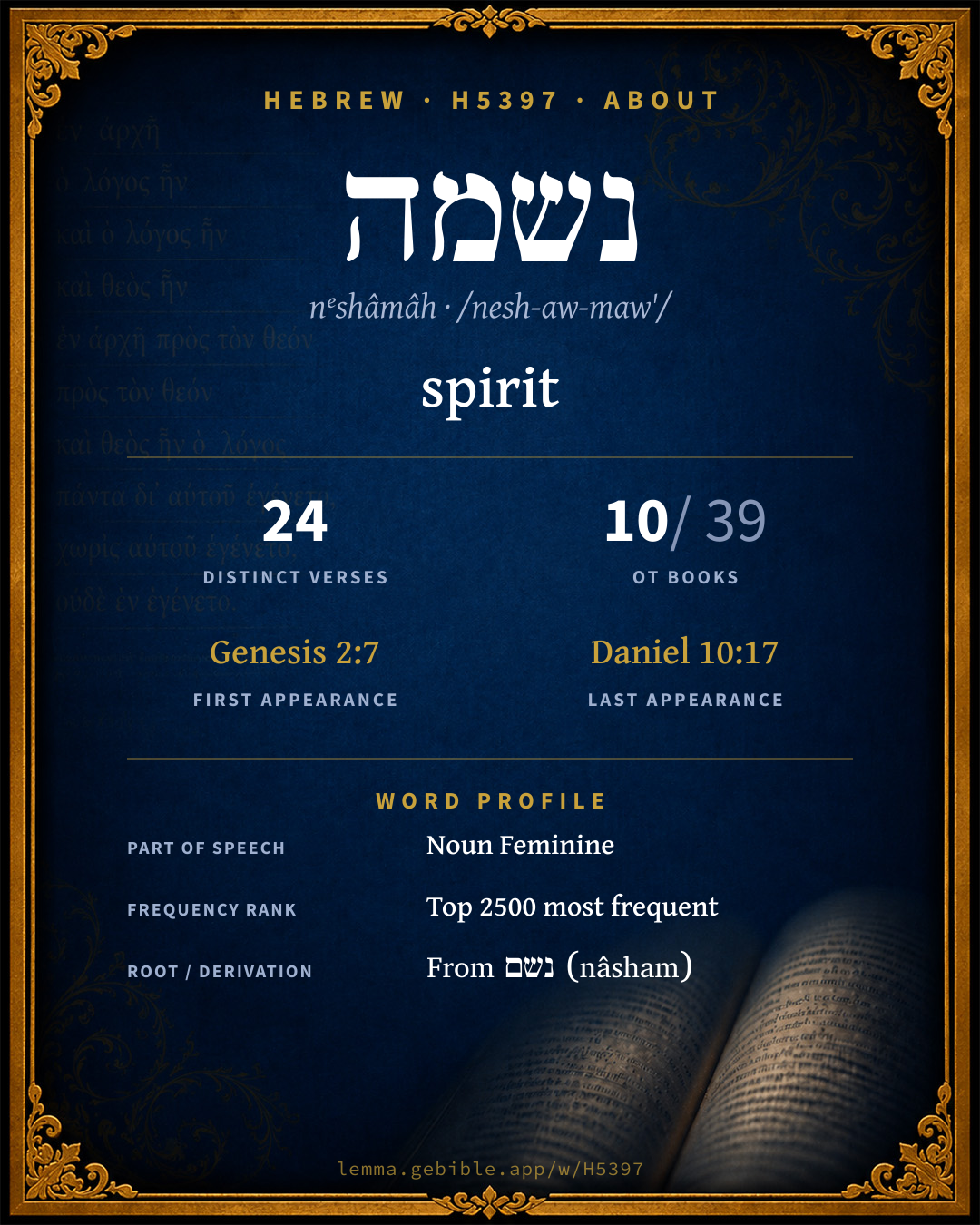
נְשָׁמָה
spirit
‘spirit’ is one of 5 main senses fuller range ↓
Full lexicon entry — Brown-Driver-Briggs (BDB)
From Brown-Driver-Briggs (BDB)
Where this word appears
See every Construct-state word in the Hebrew Bible →
Grammar key — what these labels mean
Part of speech
- Noun
- A naming word — a person, place, thing, or idea.
Noun type
- Common
- A common noun — a general class of person, place, or thing (“king,” “city,” “water”), not a specific name.
State
- Absolute
- The independent form of a noun, not bound to a following word.
- Construct
- A noun bound to a following noun in a possessive / “of” relationship (the construct chain).
Gender
- Feminine
- Grammatically feminine.
Number
- Singular
- One.
- Plural
- More than one (in Hebrew, generally three or more).
Grammatical forms
- Noun, Common, Feminine, Singular, Construct 13 times (54%)
- Noun, Common, Feminine, Singular, Absolute 10 times (42%)
- Noun, Common, Feminine, Plural, Absolute 1 time (4%)
Parsed forms decoded from the imported morphology (morphhb / Westminster Leningrad Codex — WLC text public domain, morphhb tagging CC BY 4.0), counted across 24 parsed occurrences — not distinct verses.
Every verse where H5397 appears — 24 distinct verses across 10 books. Click any verse to open its interlinear word-by-word view. Verse text shown in the World English Bible for context — . Each verse’s Hebrew form is shown with its reference; the English is not keyword-highlighted, since the data carries no word-level English alignment. Use “Compare translations” on any verse to read it across multiple English versions. This concordance covers the Hebrew Bible; Septuagint (Greek Old Testament) occurrences are not indexed here.
Genesis 2 verses
Deuteronomy 1 verse
Joshua 3 verses
- Joshua 10:40 הַ/נְּשָׁמָה֙ ptcl def.art + n c fs So Joshua struck all the land, the hill-country, and the South, and the lowland, and the slopes, and all their kings: he left none remaining, but he utterly destroyed all that breathed, as Yahweh, the God of Israel, commanded.
- Joshua 11:11 נְשָׁמָ֑ה n c fs They struck all the souls who were therein with the edge of the sword, utterly destroying them; there was none left who breathed: and he burnt Hazor with fire.
- Joshua 11:14 נְשָׁמָֽה n c fs All the spoil of these cities, and the cattle, the children of Israel took for a prey to themselves; but every man they struck with the edge of the sword, until they had destroyed them, neither left they any who breathed.
2 Samuel 1 verse
1 Kings 2 verses
- 1 Kings 15:29 נְשָׁמָ֛ה n c fs It happened that, as soon as he was king, he struck all the house of Jeroboam: he didn't leave to Jeroboam any who breathed, until he had destroyed him; according to the saying of Yahweh, which he spoke by his servant Ahijah the Shilonite;
- 1 Kings 17:17 נְשָׁמָֽה n c fs It happened after these things, that the son of the woman, the mistress of the house, fell sick; and his sickness was so sore, that there was no breath left in him.
Job 7 verses
- Job 4:9 מִ/נִּשְׁמַ֣ת prep + n c fs cs By the breath of God they perish, By the blast of his anger are they consumed.
- Job 26:4 וְ/נִשְׁמַת conj + n c fs cs To whom have you uttered words? Whose spirit came forth from you?
- Job 27:3 נִשְׁמָתִ֣/י n c fs cs + sfx pers 1cs (For the length of my life is still in me, And the spirit of God is in my nostrils);
- Job 32:8 וְ/נִשְׁמַ֖ת conj + n c fs cs But there is a spirit in man, And the breath of the Almighty gives them understanding.
- Job 33:4 וְ/נִשְׁמַ֖ת conj + n c fs cs The Spirit of God has made me, And the breath of the Almighty gives me life.
- Job 34:14 וְ֝/נִשְׁמָת֗/וֹ conj + n c fs cs + sfx pers 3ms If he set his heart on himself, If he gathered to himself his spirit and his breath;
- Job 37:10 מִ/נִּשְׁמַת prep + n c fs cs By the breath of God, ice is given, And the breadth of the waters is frozen.
Psalms 2 verses
Proverbs 1 verse
Isaiah 4 verses
- Isaiah 2:22 נְשָׁמָ֖ה n c fs Stop trusting in man, whose breath is in his nostrils; For of what account is he?
- Isaiah 30:33 נִשְׁמַ֤ת n c fs cs For a Topheth is prepared of old; yes, for the king it is made ready; he has made it deep and large; the pile of it is fire and much wood; the breath of Yahweh, like a stream of sulfur, does kindle it.
- Isaiah 42:5 נְשָׁמָה֙ n c fs Thus says God Yahweh, he who created the heavens, and stretched them forth; he who spread abroad the earth and that which comes out of it; he who gives breath to the people on it, and spirit to those who walk therein:
- Isaiah 57:16 וּ/נְשָׁמ֖וֹת conj + n c fp For I will not contend forever, neither will I be always angry; for the spirit would faint before me, and the souls who I have made.
Daniel 1 verse
About this entry
At a glance — auto-summarized from this page’s data, not written by a person. Every figure links to its source below. This summary describes the numbers; it doesn’t interpret them.
“spirit” is the headline sense of the Hebrew noun נשמה (nᵉshâmâh). Carrying more than one sense, it rewards its full sense range. It appears 24 verses across 10 books of the Hebrew Bible, among its uncommon vocabulary. More than a quarter of its appearances fall in Job. Scripture first uses it in Genesis 2:7. For the data behind this summary, explore the sense tree and the renderings breakdown below.
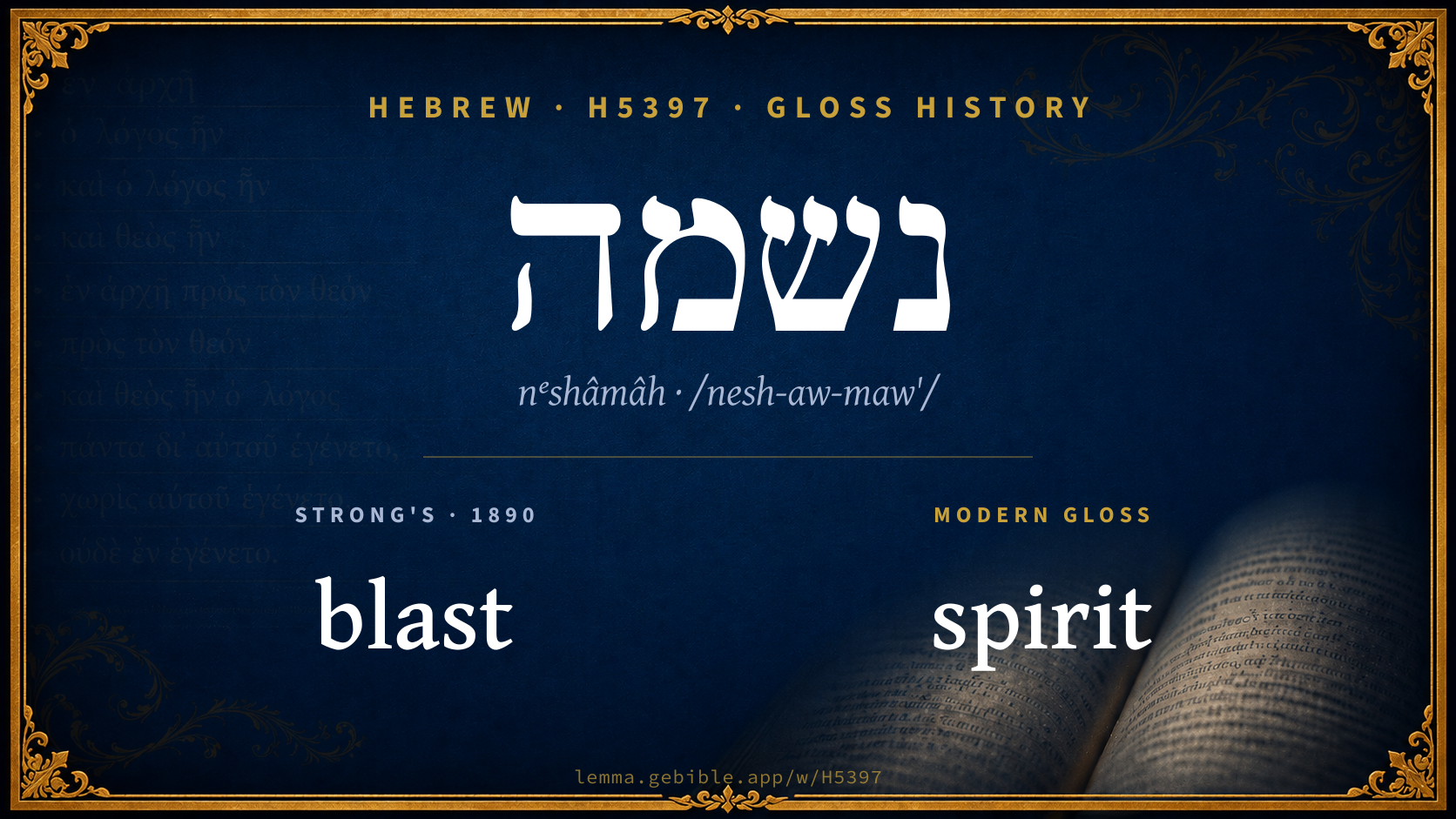
Gloss history
Strong's 1890 vs modern scholarship
About this word
Strong's H5397 catalogs a Hebrew word from the Hebrew Old Testament.
These counts are not copied from any lexicon or concordance. They are computed here, from the morphology-tagged Hebrew Old Testament. What Lemma adds →
- 24
- distinct verses
- The word appears in 24 distinct verses.
- 10 / 39
- OT books
- The word appears in 10 of 39 Old Testament books.
- #1,327
- by frequency
- Top 2500 most frequent Hebrew words (rank 1,327 of 8,640 Hebrew words by occurrence).
View all 24 occurrences in the concordance →
By section of the Old Testament
By traditional corpus
Conventional, traditional groupings — biblical authorship is debated, so this is a traditional corpus grouping, not an authorship claim. Each share is this word’s portion of its verses in that division of the Hebrew canon. Each figure is a share of the word’s 24 distinct verses.
- Writings (Ketuvim) 11 verses · 46%
- Prophets (Nevi'im) 10 verses · 42%
- Torah (Pentateuch) 3 verses · 13%
How translations render this word
Counts come from each version’s own published word-to-Strong’s tagging or interlinear alignment — an approximate guide to how each version renders this word, not a word-level alignment the data otherwise carries. Because each total is that version’s own tagged count, the per-version totals vary from one another and need not match the appearance or distinct-verse counts above. These counts may also differ from a printed concordance because Lemma counts each distinctly tagged rendering and does not collapse phrase taggings into a single head-word total. This is a fixed set of word-tagged versions (KJV, ASV, BSB, ULT) and does not change with the reading translation you choose elsewhere. Each version’s license is shown beside its name below (and on Sources).
- King James Version: Breath 8×, Blast 3×, Spirit 2×
- American Standard Version: Breath 7×, Me 3×, Blast 2×
- Berean Standard Bible: Breath 11×, Breathed 4×, Blast 2×
- unfoldingWord Literal Text: Breath 7×, Breath of 6×, Breathing thing 3×
King James Version Public Domain
Renders H5397 across 24 tagged occurrences — most commonly:
Plus 11 renderings that appear only once — usually multi-word phrases or single function words the recovered tagging swept in, not distinct renderings.
American Standard Version Public Domain
Renders H5397 across 24 tagged occurrences — most commonly:
Plus 10 renderings that appear only once — usually multi-word phrases or single function words the recovered tagging swept in, not distinct renderings.
Berean Standard Bible Public Domain
Renders H5397 across 24 tagged occurrences — most commonly:
Plus 5 renderings that appear only once — usually multi-word phrases or single function words the recovered tagging swept in, not distinct renderings.
unfoldingWord Literal Text CC BY-SA 4.0
Renders H5397 across 25 tagged occurrences — most commonly:
Plus 7 renderings that appear only once — usually multi-word phrases or single function words the recovered tagging swept in, not distinct renderings.
Senses in the full BDB
What do BDB’s symbols mean?
BDB uses these scholarly abbreviations:
| Symbol | Meaning |
|---|---|
| 𝔊 | the Septuagint (the ancient Greek translation, LXX) |
| 𝔙 | the Vulgate (the Latin translation) |
| 𝔖 | the Syriac version (the Peshitta) |
| 𝔗 | the Targum (the Aramaic translation) |
| ψ | the Psalms |
| √ | root (the underlying root or stem) |
| ‖ | parallel passage (a synonymous or contrasted parallel) |
| † | the dagger: every passage where the word occurs is cited |
The 4 senses and sub-senses the full Brown-Driver-Briggs lexicon distinguishes for this word, in lexicon order (not ranked by frequency), with BDB’s own verbatim wording and sub-sense lettering. Shown in Hebrew script with BDB’s own scholarly abbreviations. The condensed entry is in the Lexicon Entry tab. See also the Forms in the corpus table below.
- 1. breath of God as hot wind kindling a flame Is 30:33; as destroying wind 2 S 22:16 = ψ 18:16, Jb 4:9; as cold wind producing ice Jb 37:10; as creative, giving breath to man Jb 32:8; 33:4. e.g. Isaiah 30:33
- 2. breath of man 1 K 17:17 Is 42:5 Jb 27:3 Dn 10:17; breath of life נשׁמת חיים Gn 2:7 (J); cf. נִשְׁמַת רוּחַ חַיִּים Gn 7:22 (J); as breathed in by God it is God’s breath in man Jb 33:4; 34:14; and is characteristic of man אדם אשׁר נשׁמה באפו Is 2:22 man in whose nostrils is but a breath (gloss). e.g. 1 Kings 17:17
- 3. syn. of נֶפֶשׁ in נפשׁ כָּל־נְשָׁמָה every breathing thing Dt 20:16 Jos 11:11, 14 1 K 15:29; כָּל־הַנְּשָׁמָה Jos 10:40 ψ 150:6; נְשָׁמוֹת Is 57:16. e.g. Deuteronomy 20:16
- 4. spirit of man, ‖ רוּחַ, נֵר י׳ נ׳ אָדָם Pr 20:27 the spirit of man is a lamp of י׳; cf. Jb 26:4. e.g. Proverbs 20:27
Senses from the full Brown-Driver-Briggs lexicon (Brown, Driver, Briggs; Oxford 1906 — public domain), digitized via Sefaria, supplemented by the OpenScriptures HebrewLexicon (CC BY 4.0). Full attribution on Sources.
Word origin
n.f. breath;—נ׳ Dt 20:16 + 9 times; cstr. נִשְׁמַת (cf. LagBN 82) Gn 2:7 + 10 times; sf. נִשְׁמָתִי Jb 27:3; נִשְׁמָתוֹ Jb 34:14; pl. נְשָׁמוֹת Is 57:16;—
— Brown-Driver-Briggs (Oxford 1906, public domain), digitized via Sefaria, supplemented by the OpenScriptures HebrewLexicon (CC BY 4.0). See Sources.
Derived from נשם (nâsham) (H5395) — to pant.
Jastrow Dictionary
A second Hebrew/Aramaic lexicon for comparison, covering Aramaic and post-biblical (Talmudic, Targumic, Midrashic) usage that the biblical-Hebrew BDB does not. Matched by lemma rather than by Strong’s number, so a lemma may carry more than one Jastrow headword (shown separately below), and the entries cover usage well beyond the Bible.
נְשָׁמָה
- preced.) breath, spirit, soul. Gen. R. s. 14, end, v. נֶפֶשׁ. Snh. 52ᵃ, a. e. שריפת נ׳ וגוף וכ׳ burning of the breath of life while the body remains intact. Y. Gitt. VII, beg. 48ᶜ בחזקת שהנ׳ תלויה בו under the presumption that he is still alive. Y. B. Kam. VII, end, 6ᵃ דבר שהנ׳ תלויה בו a part of an animal’s body the removal of which results in death; a. fr.—Pl. נְשָׁמוֹת. Yeb. 62ᵃ, a. e., v. גּוּף II. Sabb. 152ᵇ נִשְׁמוֹתָן של צדיקים (not נשמתן) the souls of the righteous; a. fr.
A Dictionary of the Targumim, the Talmud Babli and Yerushalmi, and the Midrashic Literature (Marcus Jastrow; London, Luzac, 1903) — Public Domain. Digitized via Sefaria. Digitized via Sefaria. Full attribution on Sources.
Forms in the corpus
The 20 distinct written forms H5397 takes in the Hebrew Bible, most frequent first — each parse links to that state’s occurrences in the concordance. Hebrew forms include their vowel points and cantillation, so a single lemma takes many written forms.
Same root — word family
Other BDB entries built from the same root as H5397, grouped by Strong’s listed origin. These share a root / origin per the lexicon — not necessarily a shared meaning. Each links to that word’s own entry.
Derives from
Shares the same root
Derived from this word
Compare all same-root words → They share a root, not necessarily a meaning.
Septuagint verse parallels
This word appears in 22 verses that also exist in the Greek Old Testament (Septuagint), out of the 24 Hebrew verses it occurs in. You can read those verses in Greek by switching the Old Testament edition to the Septuagint.
Read these verses in the Septuagint
- Genesis 2:7
- Deuteronomy 20:16
- Joshua 10:40
- 2 Samuel 22:16
- 1 Kings 15:29
- Job 4:9
- Psalms 18:15
- Isaiah 30:33
- Daniel 10:17
This is a verse-level parallel only — the same verses exist in both the Hebrew and Greek Old Testaments. No word-level Hebrew↔Greek correspondence is claimed: the data carries no such alignment, so no Greek word is shown as this Hebrew word’s translation. Coverage is not total — the Septuagint omits the deuterocanon and renumbers the Psalms, so some Hebrew verses have no direct Greek parallel.