
Galatians 5:20

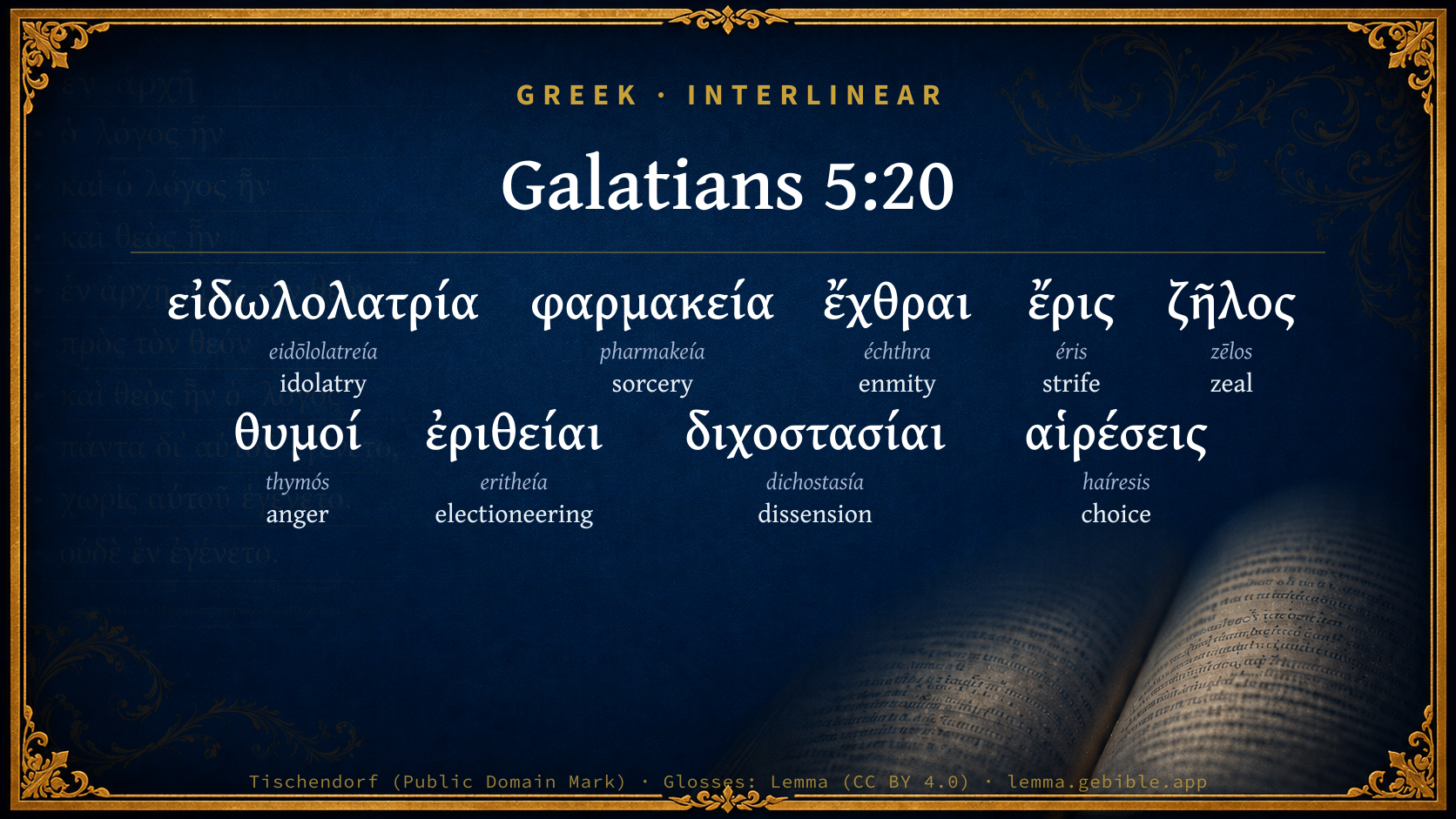
Greek (Tischendorf 8th ed.) Galatians 5:20 appears in the Greek New Testament. The text above is from the Tischendorf 8th edition. Each word links to its Strong’s number and a concise gloss. Click any word for its full Thayer’s Greek Lexicon entry.
Download image
Cite this verse

Galatians 5:20 (World English Bible). Public Domain. Lemma interlinear Bible study tool, https://lemma.gebible.app/v/galatians/5/20.

Show BibTeX & RIS
BibTeX
RIS
English Translation
idolatry, sorcery, hatred, strife, jealousies, outbursts of anger, rivalries, divisions, heresies,
World English Bible · Public Domain
Highlights
  • 1 first appearance in the Greek New Testament
Full analysis ↓
Download a study sheet

One document with this verse’s original text, its word-by-word gloss line, the meaning frame, cross-references with their text, attributed commentary, and full source and license credits — printable, and it pastes into notes with its structure intact.

This verse Autodidact and up

Study sheet (.html) Plain text (.txt)

A passage Seminary Student

Up to 50 verses in one chapter. A passage sheet keeps up to 6 commentary sources and 12 cross-references per verse, in the order this page ranks them, and says so on the sheet whenever that leaves anything out. Ask for a single verse and you get the Autodidact verse sheet above.

Everything on this page stays free to read, with no account — the sheet is a download of what is already on screen, not access to it.

Want to remove ads? Support Godless Engineer
Compare translations 3

The same verse in 3 English versions, stacked beneath the original-language interlinear above. Click any original word for its lexicon entry.

Each is an independent rendering of the whole verse — the interlinear is not word-aligned to these translations.

Highlighted words mark where these versions differ — a whole-verse word diff, not a word-by-word alignment.

  • World English Bible Public Domain
    idolatry, sorcery, hatred, strife, jealousies, outbursts of anger, rivalries, divisions, heresies,
  • King James Version Public Domain
    Idolatry, witchcraft, hatred, variance, emulations, wrath, strife, seditions, heresies,
  • unfoldingWord Literal Text CC BY-SA 4.0
    idolatry, sorcery, hostilities, strife, jealousy, outbursts of anger, selfish ambition, divisions, factions,

unfoldingWord Literal Text — © unfoldingWord, licensed CC BY-SA 4.0. Word-aligned USFM3 via Door43 (git.door43.org/unfoldingWord/en_ult).

Versions to compare (up to 4)

3 of 4 selected

Show all 19 translations

Every available English version of this verse, each an independent rendering of the whole verse.

  • World English Bible Public Domain
    idolatry, sorcery, hatred, strife, jealousies, outbursts of anger, rivalries, divisions, heresies,
  • Berean Standard Bible Public Domain
    idolatry and sorcery; hatred, discord, jealousy, and rage; rivalries, divisions, factions,
  • Majority Standard Bible Public Domain
    idolatry and sorcery; hostilities, quarrels, jealousies, and rage; rivalries, divisions, factions,
  • King James Version Public Domain
    Idolatry, witchcraft, hatred, variance, emulations, wrath, strife, seditions, heresies,
  • American Standard Version (1901) Public Domain
    idolatry, sorcery, enmities, strife, jealousies, wraths, factions, divisions, parties,
  • Revised Version (1885) Public Domain
    idolatry, sorcery, enmities, strife, jealousies, wraths, factions, divisions, heresies,
  • Geneva Bible (1599) Public Domain
    Idolatrie, witchcraft, hatred, debate, emulations, wrath, contentions, seditions, heresies,
  • Douay-Rheims (1899) Public Domain
    Idolatry, witchcrafts, enmities, contentions, emulations, wraths, quarrels, dissensions, sects,
  • Young's Literal Translation Public Domain
    idolatry, witchcraft, hatred, strifes, emulations, wraths, rivalries, dissensions, sects,
  • Literal Standard Version CC BY-SA 4.0
    idolatry, witchcraft, enmities, strife, jealousy, wraths, rivalries, dissensions, sects,
  • Unlocked Literal Bible CC BY-SA 4.0
    idolatry, sorcery, hostilities, strife, jealousy, outbursts of anger, rivalry, dissension, divisions,
  • unfoldingWord Literal Text CC BY-SA 4.0
    idolatry, sorcery, hostilities, strife, jealousy, outbursts of anger, selfish ambition, divisions, factions,
  • Darby Bible Public Domain
    idolatry, sorcery, hatred, strifes, jealousies, angers, contentions, disputes, schools of opinion,
  • World Messianic Bible Public Domain
    idolatry, sorcery, hatred, strife, jealousies, outbursts of anger, rivalries, divisions, heresies,
  • Webster's Bible Public Domain
    Idolatry, witchcraft, hatred, variance, emulations, wrath, strife, seditions, heresies,
  • Free Bible Version CC BY-SA 4.0
    idolatry, sorcery, hatred, rivalry, jealousy, anger, selfish ambition, dissension, heresy,
  • Bible in Basic English Public Domain
    Worship of images, use of strange powers, hates, fighting, desire for what another has, angry feelings, attempts to get the better of others, divisions, false teachings,
  • Text-Critical English NT CC BY 4.0
    idolatry, sorcery, hostilities, quarrels, jealousies, fits of rage, selfish ambitions, dissensions, factions,
  • Tyndale New Testament (1534) Public Domain
    ydolatrye witchecraft hatred variaunce zele wrath stryfe sedicion sectes

Literal Standard Version (2020), Covenant Press — licensed CC BY-SA 4.0. Text via the HelloAO Bible API (eBible.org). Unlocked Literal Bible (unfoldingWord) — licensed CC BY-SA 4.0. Text via the HelloAO Bible API (eBible.org). unfoldingWord Literal Text — © unfoldingWord, licensed CC BY-SA 4.0. Word-aligned USFM3 via Door43 (git.door43.org/unfoldingWord/en_ult). Free Bible Version, Dr. Jonathan Gallagher — licensed CC BY-SA 4.0. Text via the HelloAO Bible API (eBible.org).

Word by word

More ways to search: Search by grammar → Find every occurrence → Compare this word →

Practice this passage: Drill this verse → Learn its vocabulary →

About this verse

These counts appear in no published source. They are computed here, from the morphology-tagged text and Lemma’s own curated glosses. What Lemma adds →

9
words
9
distinct lemmas
Pauline Epistles
section

Notable vocabulary

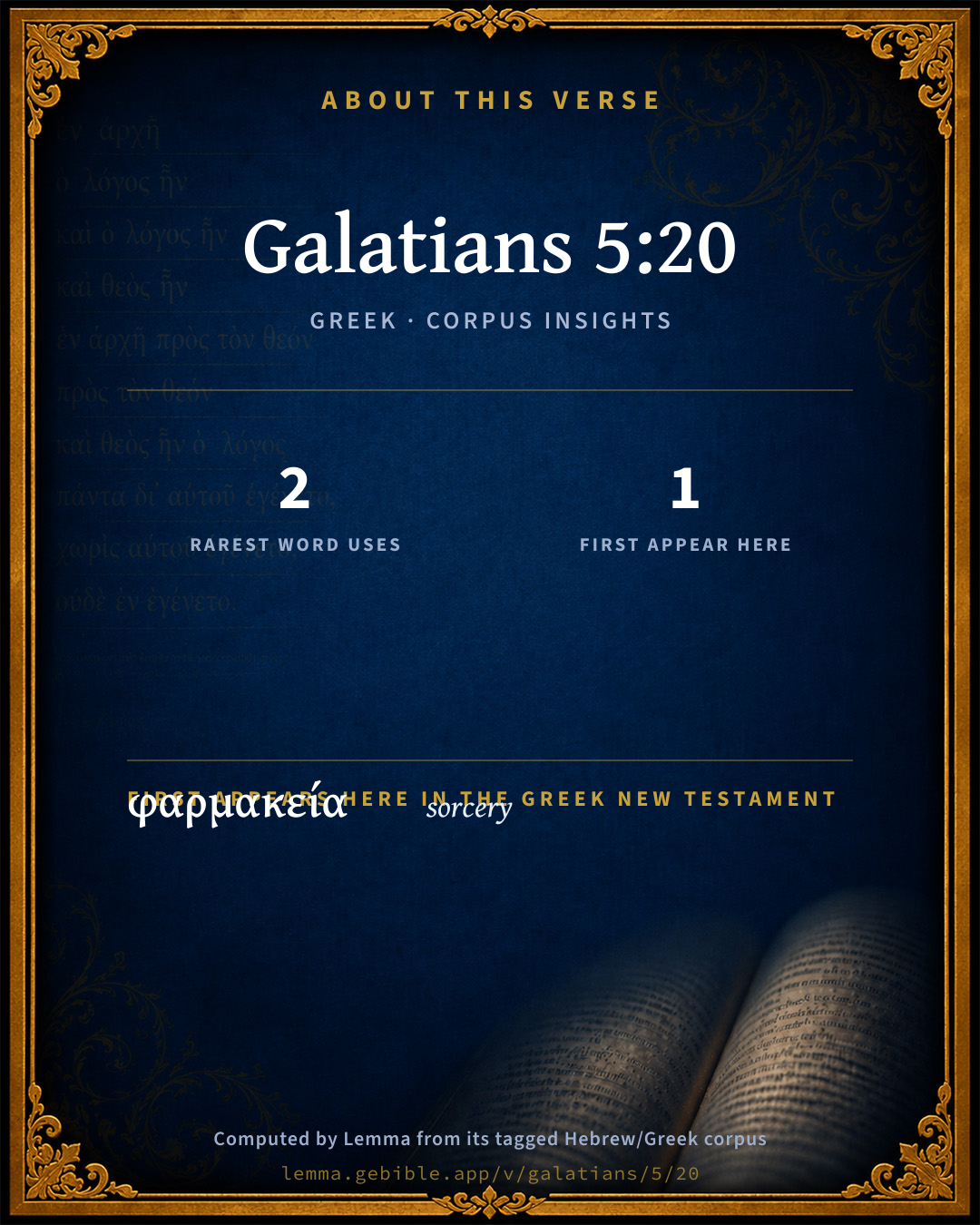
The rarest word here is διχοστασίαι dissension G1370 — appearing just 2 times in the whole Greek New Testament.

First appearance in Scripture

This word makes its first canonical appearance in the Greek New Testament here:

  • φαρμακεία sorcery G5331

Shared distinctive vocabulary

διχοστασίαι dissension G1370 occurs in 2 verses of the Greek New Testament. Also found in:
Cross-references

12

Topical passages linked to Galatians 5:20 in the Treasury of Scripture Knowledge — connected by theme and wording, ordered by reader-vote popularity; previews shown in the World English Bible.

  • 1 Corinthians 11:19 For there also must be factions among you, that those who are approved may be revealed among you.
  • Titus 3:10 Avoid a factious man after a first and second warning;
  • Revelation 21:8 But for the cowardly, unbelieving, sinners, abominable, murderers, sexually immoral, sorcerers, idolaters, and all liars, their part is in the lake that burns with fire and sulfur, which is the second death."
  • 2 Corinthians 11:19 For you bear with the foolish gladly, being wise.
  • Acts 8:9–11 But there was a certain man, Simon by name, who used to practice sorcery in the city, and amazed the people of Samaria, making himself out to be some great one,
  • 1 Chronicles 10:13–14 So Saul died for his trespass which he committed against Yahweh, because of the word of Yahweh, which he didn't keep; and also because he asked counsel of one who had a familiar spirit, to inquire [thereby],
  • Deuteronomy 18:10 There shall not be found with you anyone who makes his son or his daughter to pass through the fire, one who uses divination, one who practices sorcery, or an enchanter, or a sorcerer,
  • Acts 16:16–19 It happened, as we were going to prayer, that a certain girl having a spirit of divination met us, who brought her masters much gain by fortune telling.
  • 1 Samuel 15:23 For rebellion is as the sin of witchcraft, and stubbornness is as idolatry and teraphim. Because you have rejected the word of Yahweh, he has also rejected you from being king.
  • 2 Chronicles 33:6 He also made his children to pass through the fire in the valley of the son of Hinnom; and he practiced sorcery, and used enchantments, and practiced sorcery, and dealt with those who had familiar spirits, and with wizards: he worked much evil in the sight of Yahweh, to provoke him to anger.
  • Ezekiel 22:18 Son of man, the house of Israel is become dross to me: all of them are brass and tin and iron and lead, in the midst of the furnace; they are the dross of silver.
  • 2 Peter 2:1 But there also arose false prophets among the people, as among you also there will be false teachers, who will secretly bring in destructive heresies, denying even the Master who bought them, bringing on themselves swift destruction.

Cross-references courtesy of OpenBible.info (CC BY 4.0).

Commentary

Notes on Galatians 5:20 from classic Christian and Jewish commentators (each source and its license shown beneath its notes). The classic Christian expositions comment on the surrounding passage and are grouped to its opening verse, so a note may address several verses; the Jewish commentaries on the Tanakh (Rashi and others) are per-verse, so they appear only where the commentator wrote on this verse.

Lemma curates 59 commentaries, every one of them public domain or Creative Commons licensed, each selected and text-cleaned for this edition rather than reprinted as found. About our sources →

Albert Barnes' Notes on the Bible

Witchcraft - Pretending to witchcraft. The apostle does not vouch for the actual existence of witchcraft; but he says that what was known as such was a proof of the corrupt nature of man, and was one of the fruits of it. No one can doubt it. It was a system of imposture and falsehood throughout; and nothing is a better demonstration of the depravity of the human heart than an extended and systematized attempt to impose on mankind. The word which is used here (φαρμακεία pharmakeia, whence our word “pharmacy,” from φάρμακον pharmakon, a medicine, poison, magic potion) means, properly, the preparing and giving of medicine. Then it means also poisoning, and also magic art, or enchantment; because in savage nations pharmacy or medicine consisted much in magical incantations. Thence it means sorcery or enchantment, and it is so used uniformly in the New Testament. It is used only in Gal 5:20; Rev 9:21; Rev 18:23; Rev 21:8. Some have supposed that it means poisoning here, a crime often practiced; but the more correct interpretation is, to refer it to the black art, or to pretensions to witchcraft, and the numerous delusions which have grown out of it, as a striking illustration of the corrupt and depraved nature of man.

Hatred - Greek: “hatreds,” in the plural. Antipathies, and lack of love, producing contentions and strifes.

Variance - Contentions; see the note at Rom 1:29.

Emulations - (ζήλοι zēloi). In a bad sense, meaning heart-burning, or jealousy, or perhaps inordinate ambition. The sense is ardor or zeal in a bad cause, leading to strife, etc.

Wrath - This also is plural in the Greek (θυμοὶ thumoi), meaning passions, “bursts of anger;” see the note at 2Co 12:20.

Strife - Also plural in the Greek; see the note at 2Co 12:20

Seditions - See the note at Rom 16:17.

Heresies - See the note at Act 5:17; 1Co 11:19.

Albert Barnes' Notes on the Bible (1834–1885) — public domain. Text from a community e-Sword/MySword module.

Tyndale Open Study Notes

Tyndale Open Resources

5:20 Idolatry, the worship of false gods, was common in Galatia and was often accompanied by sorcery (see Acts 19:19; cp. 1 Sam 15:23; Rev 9:21; 18:23; 21:8; 22:15) and sexual immorality (cp. 1 Cor 6:9, 15-20). • Hostility arises from angry pride rather than the Spirit’s humility and love (Gal 5:22-23). • Quarreling refers not to standing up for what is right, but to stirring up discord and looking for a fight (1 Cor 3:3; 2 Cor 12:20; 1 Tim 6:4; Titus 3:9). Those who are guided by the Holy Spirit seek to speak the truth in love with a peacemaking attitude (Gal 5:22; Eph 4:15; 2 Tim 2:23-26). • Jealousy (Greek zēlos, “zeal”) has both a positive sense (“passionate commitment”) and, as here, a negative one (“intense desire for another’s things”); cp. Jas 3:14-16. • Outbursts of anger (or fits of rage) contrast with self-control (Gal 5:23; see, e.g., Acts 19:28; 2 Cor 12:20; 1 Tim 3:3; Titus 1:7). • Selfish ambition (or Selfishness) is the antithesis of Christian love (cp. Rom 2:8; Phil 2:3; Jas 3:14, 16). • Division (Greek haireseis, “heresies, factions, sects”) refers to people using differing beliefs or practices to divide the community (cp. 1 Cor 11:17-19; 2 Pet 2:1-3).

Tyndale Open Study Notes — © Tyndale Open Resources, licensed CC BY-SA 4.0. Text via the HelloAO Bible API.

Bengel's Gnomon

Johann Albrecht Bengel

Gal 5:20. Φαρμακεία) See LXX., Exo 7:11, and in many other passages. That Paul is not speaking here of natural poisoning by potions, but of magic, is evident from this, that he joins it not with murder, but with idolatry. Comp. Rev 21:8, note.—διχοστασίαι, seditions) respecting civil affairs.—αἱρέσεις, heresies) respecting sacred things: 1Co 11:19.

Gal 5:20-21. Ζῆλοι—φθόνοι, emulations [jealousies]—envyings) Both emulation [jealousy] and envy are dissatisfied with the advantages enjoyed by another;—emulation [jealousy], for the sake of the man’s own advantage; envy, even without any advantage to the person himself.—ἐριθεῖαι) This differs from ἔρεις: ἔρις, Hader, quarrel, dispute; ἐριθεία, Triitz, brawling, defiance. ἐριθεία implies a wish to be greater, ἔρις wishes at least not to be less.[53]—πρόλεγω, I tell you before) before the event.—ὑμῖν, to you) The maintainers of justification by works are often careless.[54]

[53] Engl. Vers. renders it weakly strife, and ἔρις previously (or ἔρεις, Rec. Text in oppos. to AB), variance. Wahl derives ἐριθεία from ἔριθος, a man who does bodily work for pay: and explains it, the utmost envy shut up in the breast, and a proneness to scheming plots. Here ἐριθεῖαι will thus be factions, and the bad artifices of the factious.—ED.

[54] τὰ τοιαῦτα, such things) If any man is guilty, not indeed of all those things, but at least of some or one of them, he has lost the kingdom of God.—V.g.

Bengel's Gnomon of the New Testament — English translation (T&T Clark, Edinburgh, 1860) — public domain. Text from a community e-Sword module.

Meyer's Critical & Exegetical Commentary

Heinrich August Wilhelm Meyer

Gal_5:20. Εἰδωλολατρεία] is not to be considered as a species of the sins of lust (Olshausen); a view against which may be urged the literal sense of the word, and also the circumstance that unchastity was only practised in the case of some of the heathen rites. It is to be taken in its proper sense as idolatry. Living among Gentiles, Gentile Christians were not unfrequently seduced to idolatry, to which the sacrificial feasts readily gave occasion. Comp. on 1Co_5:11.

φαρμακεία] may here mean either poison-mingling (Plat. Legg. viii. p. 845 E; Polyb. vi. 13. 4, xl. 3. 7; comp. φαρμακός, Dem. 794. 4) or sorcery (Exo_7:11; Exo_7:22; Exo_8:3; Isa_47:9; Isa_47:12; Rev_9:21; Rev_18:23; Rev_21:8; Wis_12:4; Wis_18:13; comp. φάρμακα, Herod. iii. 85; φαρμακεύειν, Herod. vii. 114). The latter interpretation is to be preferred (with Luther, Grotius, Estius, Koppe, Winer, Usteri, Schott, de Wette, Ewald, Wieseler, Hofmann, and others), partly on account of the combination with εἰδωλολατρεία (comp. Deu_18:10 ff.; Exo_22:18), partly because φόνοι occurs subsequently. Sorcery was very prevalent, especially in Asia (Act_19:19). To understand it, with Olshausen, specially of love-incantations, is arbitrary and groundless, since the series of sins of lust is closed with ἀσέλγεια.

The particulars which follow as far as φόνοι stand related as special manifestations to the more general ἔχθραι. On the plural, comp. Herod. vii. 145; Xen. Mem. i. 2. 10.

ζῆλος, Rom_13:13; jealousy, 1Co_3:3, 2Co_12:20, Jam_3:16.

The distinction between θυμός and ὀργή is, that ὀργή denotes the wrath in itself, and θυμός, the effervescence of it, exasperation. Hence in Rev_16:19; Rev_19:15, we have. θυμὸς τῆς ὀργῆς. See on Rom_2:8.

ἐριθεῖαι] self-seeking party-cabals. See on Rom_2:8; 2Co_12:20.

διχοστασίαι, αἱρέσεις] divisions, factions (comp. 1Co_11:18 f.). On αἵρεσις in this signification, which occurs only in later writers (1Co_11:19; Act_24:5; Act_24:14), see Wetstein, II. p. 147 f. Comp. αἱρετιστής, partisan, Polyb. i. 79. 9, ii. 38. 7. Observe how Paul, having the circumstances of the Galatians in view, has multiplied especially the designations of dispeace. Comp. Soph. O. C. 1234 f. According to 1Co_3:3 also, these phenomena are works of the flesh.

Meyer — Critical and Exegetical Commentary on the New Testament — English translation by Peter Christie, edited by Frederick Crombie (T&T Clark, 1880) — public domain. Text from a community e-Sword module.

Expositor's Greek Testament

ed. W. Robertson Nicoll

Gal 5:20 . ζῆλος . See note on Gal 4:17 . ἐριθίαι . The apparent derivation of this word from ἔριθος ( a hireling ) points to mercenary motives. The Apostle elsewhere associates it with jealousy, envy and vainglory, and contrasts it with sincerity, union and love. It denotes, probably, selfish intrigues. αἱρέσεις . This term is used in the N.T. to designate any religious sect or party, e.g. , the Pharisees, Sadducees, Nazarenes (as the Jews designated Christians).

The Expositor's Greek Testament, edited by W. Robertson Nicoll (1897–1910) — public domain. Text from a community e-Sword module.

Jamieson, Fausset & Brown

Robert Jamieson, A. R. Fausset & David Brown

witchcraft--sorcery; prevalent in Asia (Act 19:19; compare Rev. 21).

hatred--Greek, "hatreds."

variance--Greek, "strife"; singular in the oldest manuscripts.

emulations--in the oldest manuscripts, singular--"emulation," or rather, "jealousy"; for the sake of one's own advantage. "Envyings" (Gal 5:21) are even without advantage to the person himself [BENGEL].

wrath--Greek, plural, "passionate outbreaks" [ALFORD].

strife--rather as Greek, "factions," "cabals"; derived from a Greek root, meaning "a worker for hire": hence, unworthy means for compassing ends, factious practices.

seditions--"dissensions," as to secular matters.

heresies--as to sacred things (see on Co1 11:19). Self-constituted parties; from a Greek root, to choose. A schism is a more recent split in a congregation from a difference of opinion. Heresy is a schism become inveterate [AUGUSTINE, Con. Crescon. Don., 2,7].

Jamieson, Fausset & Brown — Commentary Critical and Explanatory on the Whole Bible (1871) — public domain (CC PDM 1.0). Text via the HelloAO Bible API.

Adam Clarke's Commentary

Verse 20. Idolatry] Worshipping of idols; frequenting idol festivals; all the rites of Bacchus, Venus, Priapus, c., which were common among the Gentiles.

Witchcraft] φαρμακεια, from φαρμακον, a drug or poison because in all spells and enchantments, whether true or false, drugs were employed. As a drug, φαρμακον, might either be the means of removing an evil, or inflicting one, etymologists have derived it from φερον ακος, bringing ease, or φερον αχος, bringing pain. So spells and incantations were used sometimes for the restoration of the health; at others, for the destruction of an enemy. Sometimes, these φαρμακα were used to procure love; at other times, to produce hatred.

Hatred] εχθραι. Aversions and antipathies, when opposed to brotherly love and kindness.

Variance] ερεις. Contentions, where the principle of hatred proceeds to open acts; hence contests, altercations, lawsuits, and disputes in general.

Emulations] ζηλοι. Envies or emulations; that is strife to excel at the expense of another; lowering others to set up one's self; unholy zeal, fervently adopting a bad cause, or supporting a good one by cruel means. Inquisitions, pretending to support true religion by torturing and burning alive those who both profess and practise it.

Wrath] θυμοι. Turbulent passions, disturbing the harmony of the mind, and producing domestic and civil broils and disquietudes.

Strife] επιθειαι. Disputations, janglings, logomachics, or strife about words.

Seditions] διχοστασιαι. Divisions into separate factions; parties, whether in the Church or state.

Heresies] αιρεσεις. Factions; parties in the Church separating from communion with each other, and setting up altar against altar. The word, which is harmless in itself, is here used in a bad sense. In stead of αιρεσεις the Slavonic has σκανδαλα, scandals, offences or stumbling-blocks.

Adam Clarke's Commentary on the Bible (1810–1826) — public domain. Text from a community e-Sword/MySword module.

Ellicott's Commentary for English Readers

(20) Idolatry.—When the Christian is warned against idolatry, it is not, of course, systematic idolatry that is meant, but that occasional compliance with idolatrous customs—taking part in the idol feasts, or eating of things offered to idols—which he might easily be led into by his intercourse with his heathen neighbours.

Witchcraft.—Sorcery, or magic. It would seem that practices of this kind were especially common in Asia Minor. In Act_19:19 we read that at Ephesus, “many of them which used curious arts brought their books together and burned them before all men;” and there is other evidence to the same effect.

Variance.—Strife, or contention.

Emulations.—Singular and plural are somewhat strangely mixed throughout the list. There is a division of authorities as to the reading in the case of this word. It seems probable, upon the whole, that the singular is right—emulation, or jealousy. “Wrath,” on the other hand, should be wraths—i.e., ebullitions or outbreaks of wrath. (See the Note on Rom_2:8.)

Strife.—This appears to be a mistake in the Authorised version. The word was supposed to be connected with that translated “variance” above, and the two words received the same translation indifferently. The word ereis, which is here translated “variance,” is rendered by “strife” in Rom_13:13, 1Co_3:3, Php_1:15, 1Ti_6:4; on the other hand, the word eritheia is rendered by “strife” here and in 2Co_12:20, Php_2:3, Jas_3:14-16. It is rendered by “contention” in Rom_2:8 (“them that are contentious”) and Php_1:16. The true derivation of this latter word is, however, something quite different: it is to be sought in a word meaning “a day-labourer.” Hence we get the senses—(1) labour for hire; (2) interested canvassing for office; (3) a spirit of factious partisanship; factiousness. (This word, too, is really in the plural.)

Seditions, heresies.—Rather, divisions, parties. The Authorised version has too special and technical a sound, as if the first related to factions in the State, and the second in the Church. This is not really so. The two words are distinguished from each other, as the lighter and more aggravated forms of division: the first. divisions; the second, divisions organised into parties.

A Bible Commentary for English Readers, edited by Charles John Ellicott (1878–1897) — public domain. Text from a community e-Sword module.

The Cambridge Bible for Schools and Colleges

gen. ed. J. J. S. Perowne

20, 21. The second class of sins are those which concern religion—idolatry and sorcery, or witchcraft. The word ‘idolatry’ is probably to be understood here in its literal sense, the worship of false deities, and not in the metaphorical and wider sense in which it is employed by St Paul, e.g. Eph_5:5, a passage which is, however, strikingly parallel to this. Comp. Col_3:5; 1Co_5:11. The connexion with ‘sorceries’, as in Rev_21:8, seems to limit the meaning to the superstitious worship of the heathen.

The word rendered ‘witchcraft’ originally meant ‘the use of drugs’, then, in a bad sense, ‘poisoning’. Those who ‘used curious arts’ (Act_19:19) combined demonology or witchcraft with the use of drugs as philtres, &c. For an illustration of this compare the well-known 5th Epode of Horace.

The next eight ‘works of the flesh’ are those which are directly opposed to love of our neighbour or Christian charity. Translate, ‘enmities, strife, rivalry, angers, factions, divisions, sects, envyings’. The first four of these are enumerated in the same order, 2Co_12:20.

heresies] Rendered rightly ‘sects’ by Wiclif, Tyndale, and Cranmer, and also in the Rhemish N. T. The Vulgate has ‘sectæ’. It means the formation of ‘distinct and organized parties’—a further development of ‘divisions’; see 1Co_11:18. It is applied to the Sadducees, Act_5:17; to the Pharisees, Act_15:5; to the Nazarenes, Act_24:5.

murders] Possibly this should be omitted with R.V. There is an alliteration between the Greek words rendered ‘envyings, murders’, which is lost in a translation. They occur together Rom_1:29. See the reference to Jerome in note on Gal_5:19-21.

drunkenness, revellings] Probably no better rendering can be found for the latter of these words. In Classical Greek it is used of those nightly revellings in which the wealthier young men indulged, when after an evening spent in debauchery they disturbed the quiet of the streets by ribald songs and noisy violence. Readers of the Spectator will remember that such ‘revellings’ were common enough in London at the beginning of the last century to provoke the rebuke of the moralist: Spectator, No. 324; Macaulay, Hist. c. 111. p. 360. Drunkenness may be secret, or it may result in orgies or riot. Eph_5:18.

and such like] = ‘such things’ in the following clause. The catalogue, terribly large as it is, does not specify every form of working under which the flesh manifests itself. ‘Man is very far gone from original righteousness, and is of his own nature inclined to evil, so that the flesh lusteth always contrary to the Spirit’. Art. ix.

I tell you before … in time past] In respect of which I forewarn you, even as I forewarned you, when I was present with you.

they which do] R.V. who practise. Exclusion from the Kingdom of Heaven is denounced not against all who have at any time committed any of these sins (for who then can be saved?) but against all who remain impenitent, and who do not ‘through the Spirit mortify the deeds of the body’. In two other Epistles (1Co_6:9-10; Eph_5:5), St Paul uses nearly the same terms as to the sins which disinherit a man from ‘the Kingdom of God’. The Kingdom is not the visible Church, in which the tares and the wheat grow together: neither is it the Gospel dispensation—a sense in which it is sometimes used, e.g. Mat_3:2; Luk_7:28—but that Kingdom for whose Advent we pray in the Lord’s Prayer, which has been the hope of loyal hearts from early days, the theme of Psalmist and Prophet, the vision of the beloved disciple in Patmos—not heaven, though ‘of heaven’, not earth, though ‘on the earth’—the Kingdom prepared from the foundation of the world for the beloved of the Father, the adopted ‘sons and daughters of the Lord Almighty’.

The Cambridge Bible for Schools and Colleges (gen. ed. J. J. S. Perowne; Cambridge University Press, 1878–1918) — public domain. Text from a community e-Sword module.

John Gill's Exposition

Envyings..... Uneasy distressing tortures of the mind, grieving at the good of others, that any should be in an equal, or in a better condition than themselves:

murders, destroying of men's lives, which is often the consequence of the above evils:

drunkenness; excess in drinking of wine or strong drink, whereby the stomach is overcharged, the mind is intoxicated, and the body enfeebled and unable to perform its office; this is often the source of many, or all of the works of the flesh before mentioned:

revellings; excess in feed, nocturnal riotings in eating, drinking, dancing, singing, chambering and wantonness. The Syriac version renders it, "lascivious singing"; and the Arabic version, "songs" which are a part of the nightly revels: and such like which are of the same nature and kind; so the apostle shuts up the account, it being too tedious to give an enumeration of all the works of the flesh; nor was it necessary, judgment may be made of the rest by these; nor might it be so proper, since the carnal heart is but the more pleased with, and irritated by, the mention of evil things:

of the which I tell you before: before the judge comes and the awful judgment proceeds, when these will all be made manifest, and every man will be judged according to his works: this the apostle did, as putting them in mind of the evil nature of these things, and assuring them of the bad consequences that would follow, if grace prevented not:

as I have also told you in time past; when he first preached among them, and warned them to flee from the wrath to come; he then laid before them the evil nature of these things, the dreadful effects of them, and showed that there was no salvation from them, but by Christ:

and that they which do such things, shall not inherit the kingdom of God; by which is meant the heavenly glory, called a "kingdom", because of the grandeur and magnificence of that state; and "of God", because it is of his preparing and giving, what he calls his own to by his grace, and puts them into the possession of and where he reigns and will reign for ever, and show forth the glory of his majesty: this is possessed in way of inheritance, which shows it to be a bequest of our heavenly Father's, a free grace gift of his, and not to be obtained by the works of the law, or merits of men; but what belongs, and is peculiar to the children of God, who are so by adopting grace: now they that do such works of the flesh as before enumerated; that is, that live in the commission of these things, whose whole lives are employed in such work, living and dying in such a state, without repentance towards God and faith in Christ, shall never enjoy eternal life and happiness; though such who have done these things, being brought to a sense of them, and to the blood and righteousness of Christ for pardon and justification, for life and salvation; such, notwithstanding the works of the flesh done by them, shall, through the free grace of God, and the propitiatory sacrifice of Christ, inherit the kingdom and glory of God.

John Gill's Exposition of the Whole Bible (1746–1763) — public domain (CC PDM 1.0). Text via the HelloAO Bible API.

Trapp's Complete Commentary

John Trapp

20 Idolatry, witchcraft, hatred, variance, emulations, wrath, strife, seditions, heresies,

Ver. 20. Idolatry] This is fitly set after those fleshly sins, as commonly accompanied with them, 1Co 10:7-8. Sir Walter Raleigh knew what he said, that were he to choose a religion for licentious liberty and lasciviousness, he would choose the Popish religion.

John Trapp, A Commentary or Exposition upon All the Books of the Old and New Testament (1647–1656) — public domain. Text from a community e-Sword module.

Matthew Poole's English Annotations

Idolatry; either the worshipping of the creature for God, or the worshipping of God in and by the creature, as by images, &c.

Witchcraft; the product of compacts with the devil; by virtue of which, the persons so contracting are assisted by the power of evil spirits to produce effects beside the ordinary course and order of nature, and for the most part mischievous to others. And not these gross crimes only are the fruits of the flesh, but also abiding

hatred of our brethren in our hearts, enmities to others, as the word signifieth. The result of which are,

variance; men’s quarrellings and contendings one with another for little or no cause:

emulations; people’s endeavouring to hinder others of such good things as they see them desirous of:

wrath; heats and immoderate passions of men one against another:

strife; a continual readiness and proneness to quarrelling:

seditions; dividing into parties, which in the state is called sedition, in the church, schism:

heresies; that is, differing and false opinions in the grand doctrine of religion.

Matthew Poole's English Annotations on the Holy Bible (1683–1685) — public domain. Text from a community e-Sword/MySword module.

Whedon's Commentary on the Bible

Daniel D. Whedon

20. Wicked supernaturalisms are two.

Idolatry—Worship of fictitious deities.

Witchcraft—Or sorcery, the use of spells, charms, herbs, and manipulations, to produce preternatural effects. These were based partly in falsehood, partly in preternatural power over the nervous system, and partly in demoniac agency. Their whole was adverse to God and religion. Modern spiritualism is unquestionably a development of the same thing. Where experiments are made for scientific purposes, to bring out and publish to the world the truth in the case, a proper thing is done; but the truly devilish indulgence in these secret workings results in all the base consequences for which both the Old Testament and the New condemns them.

“It is a striking coincidence, if nothing more, that sorceries were condemned by a very stringent canon of the Council of Ancyra, the capital of Galatia, about A.D. 314.”—Lightfoot.

Now follow nine vices of the malign nature.

Hatred—The general opposite of love, and so generally including all the rest of the nine. These follow in a degree of climax ending in murder.

Variance—Predisposition to dissent, even without self-interest.

Emulations—Strife for selfish ascendency.

Wrath—Selfish strife carried to an angry pitch.

Strife— Cliques and cabals angrily maintained.

Seditions—Rather, strife developed into distinct and hostile parties, becoming permanent in heresies, which are not doctrinal errors, but separations into hostile organizations.

Daniel D. Whedon (gen. ed.), Commentary on the Old and New Testaments (1874–1909) — public domain. Text from a community e-Sword module.

The Pulpit Commentary

Idolatry, witchcraft (eijdwlolatreia farmakeia); idolatry, sorcery. These two form a second group sins of irreligion; and such as would be likely greatly to beset new converts from idolatry. We may compare, "in respect to the former, the temptations which the apostle recognizes the danger of in the case of the Corinthians (1 Corinthians rift. and 10.). "Sorcery." The word farmakeia, originally denoting the use of drugs merely, means, sometimes, their use for poisoning; but this sense would not be very suitable here. But the nouns farmakov, farmakeuv, and farmakeia, like veneficus and veneficium in Latin, are also often used with reference to the employment of drugs in charms and incantations; and thence of tie employment of black arts in general magic, sorcery, witchcraft; cf. Rev_9:21 Rev_21:8 Rev_22:15; where the Authorized Version gives "sorceries," "sorcerers;" and in the Septuagint,; Exo_7:11, 22 8:18 (Authorized Version, "magicians") Isa_47:9, 12 ("enchantments"). See also mageuwn mageiav ("sorceries"), Act_8:9, Act_8:11. The claim to the possession of such powers, common at Act_19:19; ntev, 2Ti_3:13, go and rife, perhaps, universally among heathens, certainly so in the Roman empire round the Mediterranean, had no doubt been a snare also to the Galatians. Bishop Lightfoot adverts to a very stringent canon of the Council of Ancyra (the capital of Galatia), A.D. 314, condemning farmakeiai. It may be doubted whether the apostle himself would regard, or had reason to regard, pretensions to such supernatural arts as merely delusive or superstitious.

Experiences such as that recorded incqrai Act_16:16-18, would hardly permit him to do so. Hatred, variance, emulations, wrath, strife, seditious, heresies (e eriv Receptus, ereiv, zhloi qumoi, ejriqeiai dicostasiai aiJreseiv); enmities, strife, jealousies, wraths, factions, divisions, heresies (or, parties). This third group, to which belongs also the envyings (fqonoi), together with the probably not genuine murders (fonoi) of the next verse, is bound together by the common characteristic of malignity. This vice of our nature, so inveterate in our fallen state the antithesis to the love which is the essence of goodness is, strangely enough as it at first sight seems, most readily stimulated into rancour by differences in religion. As at this very same time at Corinth, so here in Galatia likewise, the "flesh" displayed its malignity in "jealousy, strife, and divisions (zhlov kai eriv kaiai)," originating from this cause. (1Co_3:3) "Emnities;" manifestations of aversion openly displaying itself. "Strife;" the outward mutual conflict of persons animated with such sentiments. The plural number of ereiv, strifes, given by the Textus Receptus, as well as, perhaps, the plural of zhloi, jealousies, which not improbably should also be read in the singular, zhlov, jealousy, may have owed its introduction by the copyists to the plural number of ecqrai, which is not questioned. The precise import of zhlov, rendered "jealousy," is not easily determined. It is spoken of as a virtue in Joh_2:17, "the zeal of thine house;" Rom_10:2, "zeal for God;" Php_3:6, "touching zeal, persecuting the Church;" 2Co_7:7, "your fervent mind or, "your zeal" for me;" ibid., ver. 11, "what zeal" But in perhaps all these cases, the ardent favouring of what is good is thought of as either ready to take, or actually taking, the aspect of boiling resentment against its assailants; thus also, Heb_10:27 ("fiery indignation," Authorized Version) literally, "zeal of fire." So in Gal_1:14, "zealous;" comp.; Exo_20:5, Qeov, "jealous God" (Authorized Version) Hebrews el qanna To this line of meaning is to be referred lou." Act_5:17, "filled with indignation (zh) In another class of passages the word denotes a wrong state of feeling, where in the Authorized Version it is uniformly rendered "envy" or "envying." These are, Act_13:45 (Revised Version, "jealousy") where it surely means the resentment which the Jews felt at the supposed invasion of their own theocratic prerogatives. In the remaining passages of the New Testament in which it occurs it is linked either with "strife," as it is here; namely, Rom_13:13; 1Co_3:3; 2Co_12:20; or with ejriqei as 3:14, 16. In these passages there does not seem any reason on the face of them for supposing that it means "envy," that is, grudging to another some advantage; this in Greek is fqonov. A more probable view is that zhlov denotes eagerness to find in another some ground for hot resentment against him. Perhaps we have no single equivalent word in our language, "jealousy" being the nearest approach. In the Epistle of Clement of Rome to the Corinthians, ch. 4-6, we have a long list of instances given of persons who have suffered through being objects of zhlov: in many of them "envy," or "rivalry," would seem to be the more prominent notion in the word; but in others it appears to mean rather "jealousy;" in some the same as in Act_5:17 or Act_13:45. The next word qumoi, wraths, denotes violent ebullitions of passionate anger; the plural pointing to different occasions prompting such. The following term, ejriqeiai (rendered "factious"), was formerly imagined to be etymologically connected with eriv, strife a notion which is now generally abandoned. The verb from which it is derived, ejriqeuw, is to act the part of an eriqov, day-labourer, the noun signifying "labour for hire;" then, scheming or intriguing for a post of employment; and next, "party-action," "the contentious spirit of faction., In the New Testament it occurs six times besides here. in Rom_2:8, toiv deav (Authorized Version, "them who are contentious") it appears to denote those who set themselves in factious opposition to the truth, the apostle having no doubt especially in his eye Jewish gainsayers of the gospel. Inav," Php_1:16, "some preach Christ ejx ejriqei) it points to factious opposition to Christ"s divinely appointed heralds. Inan," (Php_2:3, "let nothing be done kat ejriqei) the same sense of factious opposition to others is quite suitable. In the remaining passages, 2Co_12:20, where zhloi qumoi) ejriqeiai, come together as they do here, and Jam_3:14-16, where, as above noted, it is coujoined with zhlon, the notion of "factiousness," or "faction," perfectly satisfies the context. In the present passage the plural, ejriqeiai, denotes factious feelings roused on behalf of this cause and that; such sentiments as are likely to eventuate in dicostasi) divisions, that is, more distinctly formed parties "standing apart" from each other; whilst these again culminate in aiJreseiv. The noun dicostasiai, occurs also in 1Co_3:3, where they are spoken of as indicative of a fleshly mind. and inndala Rom_16:17, "Mark them which cause divisions and (ska) occasions of stumbling." We may regard this word as standing in the same relation to aiJreseiv as the scismata, divisions," or "schisms," do which are mentioned inseiv), 1Co_11:18," When ye come together in the Church, I hear that divisions exist among you; and I partly believe it; for there must be also heresies among you." In endeavouring to ascertain the exact import of this last word (aiJre) "heresies," we must first ascertain the sense in which airesiv was currently used before it was employed to describe phenomena appearing in the Church. The proper sense of choice" was in this word often limited to the specific sense of choice of views," particularly in philosophy or religion; that is, it meant "ways of thinking;" and then, by an easy transition, "those who followed a particular way of thinking school of thought." Thus it occurs in Dionysius of Halicarnassus, "De Dora. et Arist.," 7, etc. (see Liddell and Scott). This sense was so current in Dionysius"s time as to appear in Latin in the contemporary writings of Cicero; thus, in "Protein. Parad.," Cicero writes, "Care in ea est haeresi sc. the Stoic, quae nullum sequitur florem orationis;" "Ad Famil.," 15:16; "Ad Att.," 14:14. Similarly Vitruvius writes, "Prier.," 5, "Pythagorae haeresin sequi." It is not always easy to discriminate whether the "school of thought" so designated means the way of thinking itself or the set of men who held it. In this sense the word is used in the New Testament. Thus Act_5:17, "the high priest and all they that were with him, which is the heresy (airesiv) of the Sadducees;" where it means the sect, and not their views. So again Act_15:5, "certain of those of the heresy of the Pharisees;" ibid., 24.5, "ringleader of the heresy of the Nazaraeans," where Tertullus plainly meant those who held the views of the Nazaraeans, and not the views themselves. But, on the other hand, in the same chapter St. Paul in his reply (ver. 14), when he says, "After the way which they call a heresy, so serve I the God of our fathers," evidently uses the term as applying to "the Way" itself, (comp. Act_9:2) and not to the people who followed it. In Act_26:5, "after the straitest heresy of our religion (qrhskei) I lived a Pharisee," the word may be taken either way in Act_28:22. "concerning this heresy, it is known to us that everywhere it is spoken against," it seems, of the two, to be rather the more obvious way to take it of "what Paul thought," than of the persons so thinking. If, however, it be taken of persons, it is of course to be taken of them as holding and representing such views. in 2Pe_2:1, "false teachers, who shall privily bring in heresies of perdition," the qualifying genitive, "of perdition," would seem to favour our understanding the "heresies" of the doctrines of these false teachers, rather than of the parties following their teaching. On the whole review of these passages, it is of the utmost importance to note the manner in which, in Act_24:14, etc., St. Paul treats Tertullus"s application of the term to the Christian faith. "I confess," he says, "that after the way which they call airesiv, so serve I the God of our fathers, believing all things which are according to the Law, and which are written in the prophets: having hope towards God, which these also themselves look for, that there shall be a resurrection, both of the just and unjust." In thus speaking, the apostle repudiates the application of the term airesiv to the Christian faith; not, however, on the ground that the term denoted a flagrantly erroneous and vicious form of doctrine; for there is nothing to show that this was the idea which Tertullus meant to convey to Felix"s mind, in so designating either Christians or their faith: what, indeed, should Felix care about the soundness or unsoundness of their doctrines? The apostle rather repudiates the term, because, as signifying" choice," it implied that the views referred to were adopted on the prompting of individual opinion or liking. That it was not this, he shows by referring partly to the broad basis of Divine revelation in general as propounding the doctrine of the resurrection, which lay at the foundation of the Christian faith; and partly to the fact that his accusers themselves admitted that doctrine. Christians believed that Jesus was raised from the dead, not because they "chose" to think so, but because God"s Word taught them so to believe. We are thus landed at the conclusion that, antecedently to its introduction into the language of the Church, the term airesiv denoted a school of thought or a set of opinions; sometimes the opinions them-solves; sometimes the people holding them; but that it was understood to do so with reference to points on which there did not appear to be any decisive authority to determine men"s convictions, and respecting which, therefore, men might choose their own opinions as they thought themselves best able, This conclusion will help us to understand its import in 1Co_11:19, in the passage before us, and in 2Pe_2:1, as well as the passage innqrwpov Tit_3:10, Tit_3:11, in which the case of "a man that is an heretic (a aiJretikov)" is dealt with. It is clear, from Gal_1:6-9, that the apostle regarded the "gospel" which had been delivered to the world (Jud_1:3) by himself and his fellow-apostles, as being a revelation so certain and authoritative that any teacher introducing doctrine seriously infringing upon its substantial import would subject himself to the extreme malediction of God. The whole tenor of this Epistle shows that its author considered the Churches of Galatia as at this very time in danger of either producing from their own bosom, or else admitting from the teaching of others, doctrine which would be thus fatally subversive of the truth. Was it not, then, extremely probable that, when here enumerating, with an especial eye to the case of the Churches he was addressing, "the works of the flesh," which would cut off those who gave themselves up to their practice from the inheritance of the kingdom of God, he would specify this particular "work" of propounding, or embracing when propounded by others, doctrine which should vitally deprave the truth which God had revealed? Any doctrine which thus tampered with the gospel would, of course, be a airesiv views of men"s own devising and "choosing." The term, as has been seen, might also describe a body of adherents to such false doctrine. But in the passage before us, in which the works of the flesh are recited, and not the doers of such works, the term must describe, not persons, but acts acts, that is, of conceiving or propounding in the Church views subversive of the gospel, and gathering adherents to such views; such adherents would, among Christians, form a airesiv antagonistic to the doctrine of Christ received in the Church. "Caballings" and "divisions," ejriqeiai and dicostasiai, might arise among Christians who still held fast to the substance of the gospel; fatal to the spiritual life, it might be, of those indulging in them; but yet essentially different from "heresies," because not involving departure from the faith once for all delivered to the saints, or conscious rebellion against the accredited organs of revelation. Here the apostle has in view the more hateful phenomena, of man-conceived dogmas taking the place of God"s gospel dogmas so alien to the gospel that adherents to them would be marked among Christians as forming "sects," which in their spiritual genesis were apart from the Church and incapable of being amalgamated with it. For the Church is the product of the truth, "the Word of God" (1Pe_1:23-25; Jam_1:18) whilst these "sects" are products of merely human notions or even of "doctrines of devils". (1Ti_4:1; cf. Col_2:8, Col_2:19) That same Judaizing spirit which was now working among the Churches of Galatia proved, very early indeed, largely prolific of such "heresies," especially in Asia Minor; those "heresies" in particular which are known by the name of Gnostic. The apostle knew that such evils were coming, and it is certain that he anticipated their development with dread (see the later First Epistle to Timothy (4.); the eontemporaneous First Epistle to Corinth; (1Co_11:18) the earlier Second Epistle to the Thessalonians (2.); (Act_20:29, Act_20:30) not without cause, as history shows; for in truth it was only after a terrible, indeed an internecine conflict, that the Church in the second and third centuries succeeded in treading this serpent-brood underfoot. By the time that St. Paul deputed Titus to take the oversight of the Churches of Crete, "heresies" were so far developed that he is careful to direct Titus (Tit_3:10, Tit_3:11) how to deal with any man who attached himself to them (anqrwpon aiJretikon). He is to admonish him once and again; if the warning proved fruitless, he was thenceforward to decline having anything to do with him (paraitou); for that he might be sure that, being such, he was already completely wrenched off from vital union with the body of Christ (ejxestraptai), and was doing what was wrong, "selfcondemned; either (that is) condemned by the very nature of his proceeding, or condemned in his own consciousness. It seems that the apostle regards the simple fact of his giving himself to a heresy" as proving all this; for he makes no reference to any ether pravity shown by the offender; he has an eye, evidently, to the consideration that the man who forsakes the teaching of Christ, given through his accredited organs, to follow a airesiv, knows that he does so; knows that he is no longer "holding the Head", (Col_2:19) but is following a mere "tradition of men" (ibid., S). With such a one Titus had no common ground. It is of prime importance in estimating the nature of this "work of the flesh," with a practical view to our present circumstances, that we bear in mind this feature of it that it is a relinquishment, a conscious relinquishment of the teaching of Christ, a breaking off from "the Head." The above view is precisely that given by Tertullian, "De Prsescriptionibus Haereticorum," 6. Bishop Lightfoot, in his Introduction to his Commentary on this Epistle, pp. 30, 31, writes thus: It is not idle, as it might seem at, first sight, to follow the stream of history beyond the horizon of the apostolic age. The fragmentary notices of its subsequent career reflect some light on the temper and disposition of the Galatian Church in St. Paul"s day. To Catholic writers of a later date, indeed, the failings of its infancy seemed to be so faithfully reproduced in its mature age, that they invested the apostle"s rebuke with a prophetic import. Asia Minor was the nursery of heresy: and of all the Asiatic Churches it was nowhere so rife as in Galatia. The Galatian capital Ancyra was the stronghold of the Montanist revival, which lingered on for more than two centuries, splitting into diverse sects, each distinguished by some fantastic or minute ritual observance. Here, too, were to be found Ophites, Manicheans, sectarians of all kinds."

The Pulpit Commentary (1880–1919), ed. H.D.M. Spence-Jones & Joseph S. Exell — public domain. Text from a community e-Sword module.

John Wesley's Explanatory Notes

Idolatry, witchcraft - That this means witchcraft, strictly speaking, (not poisoning,) appears from its being joined with the worship of devil-gods, and not with murder. This is frequently and solemnly forbidden in the Old Testament. To deny therefore that there is, or ever was, any such thing, is, by plain consequence, to deny the authority both of the Old and New Testament. Divisions - In domestic or civil matters. Heresies are divisions in religious communities.

John Wesley, Explanatory Notes Upon the Whole Bible (1754–1765) — public domain. Text via the GEBible commentary corpus.

Luther on Galatians

Martin Luther

see notes on vs 19

Martin Luther — Commentary on the Epistle to the Galatians (1535), English translation by Theodore Graebner (Zondervan, 1939) — public domain (U.S. copyright not renewed). Text from a community e-Sword module.

McGarvey & Pendleton's Commentaries

J. W. McGarvey

idolatry, sorcery, enmities, strife, jealousies, wraths, factions, divisions, parties,

J. W. McGarvey (with Philip Y. Pendleton), Commentaries on the New Testament (The Fourfold Gospel, 1914; Acts; and the epistles) — public domain. Text from a community e-Sword/MySword module.

The People's New Testament

B. W. Johnson

20. Witchcraft. Sorcery or magic, whether a superstition or deception, was prevalent in all the ancient world. See notes on Acts 19:19.

B. W. Johnson's The People's New Testament with Notes (1889–1891) — public domain. Electronic text from the Christian Classics Ethereal Library (CCEL) ThML edition.

Cambridge Greek Testament for Schools and Colleges

20. ἔρις אABD* syrPesh. ἔρεις Text. Rec. with CDbcG etc. latt. syrHarcl. Westcott and Hort margin.

ζῆλος BDgrGgr*syrPesh., ζῆλοι Text. Rec. with אCDbc etc. vulg. syrHarcl., Westcott and Hort margin.

20. εἰδωλολατρία. The connexion of immorality with heathen worship readily leads St Paul to mention idolatry.

φαρμακία, “sorcery.” The use of drugs not as medicines but as media in magic; veneficia Vulg. So in Exo 7:11 al. of the “enchantments” whereby the Egyptian magicians performed their wonders. Cf. Rev 9:21; Rev 18:23. Lightfoot points out the “striking coincidence, if nothing more,” that sorcery was condemned at the Council of Ancyra, the capital of North Galatia, about A.D. 314. For the connexion of such magic with idolatry see Rev 21:8.

ἔχθραι. Even if St Paul had the threefold grouping of these various faults in his mind (vide supra) “sorcery,” as often directed against persons, would readily suggest ἔχθραι. The plural occurs here only in the New Testament. On the ascending scale of the faults as far as φθόνοι see Lightfoot.

ἔρις, “dissension.” See notes on Textual Criticism. On the var. lect. ἔρεις, not ἔριδες, 1Co 1:11, see Win.-Schm. § 9. 8.

ζῆλος, “rivalry.” With ἔρις in Rom 13:13 and, also with θυμοί, in 2Co 12:20.

θυμοί, “ ‘wraths,’ a more passionate form of ἔρις,” Lightfoot.

ἐριθίαι, not “factions,” with the connotation of the vice of the followers of a party, but “ambitions,” “rivalries,” the vice of a leader of a party created for his own pride. Derived from ἔριθος, “hireling,” it acquired the meaning of bribery and winning over followers, and so of seeking followers (cf. Php 1:17). See Hort’s important note on Jas 3:14.

διχοστασίαι, “divisions.” Rom 16:17; 1Ma 3:29[144]. Not so permanent as αἱρέσεις. In the parallel passage, 2Co 12:20, ἀκαταστασίαι (“tumults”).

[144] Is affixed it means that all the passages are mentioned where the word occurs in the Greek Bible.

αἱρέσεις. So too stronger than σχίσματα in 1Co 11:18-19. The word seems to denote not only external separation, but internal in aim and purpose, mind and heart. It thus readily suggests φθόνοι. A still stronger use of αἵρεσις is found in 2Pe 2:1, where see Bigg’s note. See also Moulton and Milligan in Expositor, VII. 5, 1908, p. 171.

Cambridge Greek Testament for Schools and Colleges (Cambridge University Press, 1896; 21 vols, various authors incl. Carr, Maclear, Plummer, Farrar, Lumby, Moule, M. R. James, Simcox) — public domain. Text from a community e-Sword module.

Alford’s Greek Testament

Henry Alford

20.] εἰδωλ., in its proper meaning of idolatry: not, as Olsh., ‘sins of lust,’ because of the unclean orgies of idolatry.

φαρμ., either ‘poisonings,’ or ‘sorceries.’ The latter is preferable, as more frequently its sense in the LXX and N. T. (reff.), and because (Mey.) Asia was particularly addicted to sorceries (Act 19:19).

θυμοί] passionate outbreaks. θυμὸς μέν ἐστι πρόσκαιρος, ὀργὴ δὲ πολυχρόνιος μνησικακία, Ammonius. διαφέρει δὲ θυμὸς ὀργῆς, τῷ θυμὸν μὲν εἶναι ὀργὴν ἀναθυμιωμένην κ. ἔτι ἐκκαιομένην, ὀργὴν δὲ ὄρεξιν ἀντιτιμωρήσεως. Orig. sel. in Psa_2, vol. ii. 541: both cited by Trench, Syn. p. 146.

ζῆλος, jealousy (in bad sense)—reff.

ἐριθεῖαι] not ‘strife,’ as E. V. and commonly, in error: see note on Rom 2:8,—but cabals, unworthy compassings of selfish ends.

Wetst. N. T. ii. p. 147, traces in a note the later meanings of αἵρεσις. Here διχοστ., divisions, seems to lead to αἱρέσ., parties, composed of those who have chosen their self-willed line and adhere to it. Trench quotes Aug. (cont. Crescon. Don. ii. 7 (9), vol. ix. p. 471): “Schisma est recens congregationis ex aliquâ sententiarum diversitate dissensio: hæresis autem schisma inveteratum.” But we must not think of an ecclesiastical meaning only, or chiefly here.

Henry Alford, The Greek Testament (1849–1861) — public domain. Text from a community e-Sword module.

Vincent's Word Studies in the New Testament

Marvin R. Vincent

Witchcraft [φαρμακια] . Or sorcery. Elsewhere only Revelation 18 23. From farmakon a drug. In LXX, see Exo 7:11; Wisd. 12 4; Isa 47:9. Comp. Act 19:19, perierga curious arts, note.

Wrath [θυμοι] . Lit. wraths. See on Joh 3:36.

Strife [εριθιαι] . More correctly, factions. From eriqov a hired servant. Eriqia is, primarily, labor for hire (see Tob. 2 11), and is applied to those who serve in official positions for hire or for other selfish purposes,; and, in order to gain their ends, promote party spirit or faction. Seditions [διχοστασιαι] . Better, divisions. Only here and Rom 16:17. Once in LXX, 1 Macc. 3 29.

Heresies [αιρεσεις] . In Paul only here and 1Co 11:19. See on 2Pe 2:1. Parties, into which divisions crystallize.

Marvin R. Vincent, Word Studies in the New Testament (1887–1900) — public domain. Text from a community e-Sword/MySword module.

Lesson kit

Teaching starters — assembled from the data on this page, not authored interpretation. Every prompt links to the verse data it draws on. Edit before teaching.

Galatians, in the Pauline Epistles, opens this verse with 9 words (9 distinct Greek lemmas). Its most distinctive word is dichostasía (“dissension”). A historical commentator’s framing appears above. Read the whole chapter for the surrounding context.

Discussion questions

  1. The word dichostasía carries the sense “dissension.” How does it shape the verse?
  2. This is the first place “sorcery” appears in Scripture (first appears here). What does its debut here establish?
  3. How does Romans 16:17, which shares the word «dissension», read alongside this verse?
  4. The translations on this page render this verse differently — a whole-verse word diff, not a word-by-word alignment. What might account for the different wordings?
  5. Compare how Albert Barnes' Notes on the Bible and Tyndale Open Study Notes read this verse. Where do they agree or differ?

Things to notice

  • 1 word makes its first canonical appearance in Scripture here.
  • These translations choose different wording for 18 words in this verse.
  • 9 distinct Greek lemmas span 9 words in this verse.

Reading settings

Reading text

Shown beneath each verse's original-language words.

Old Testament
Old Testament edition

Read the OT as the Masoretic Hebrew (MT) or the Greek Septuagint (LXX).

English shown for the Greek Septuagint (in the Hebrew ↔ Greek comparison).

Comparing translations? Open the Compare panel on any verse page to stack up to four side by side.