Ephesians 4:23

Greek (Tischendorf 8th ed.) Ephesians 4:23 appears in the Greek New Testament. The text above is from the Tischendorf 8th edition. Each word links to its Strong’s number and a concise gloss. Click any word for its full Thayer’s Greek Lexicon entry.
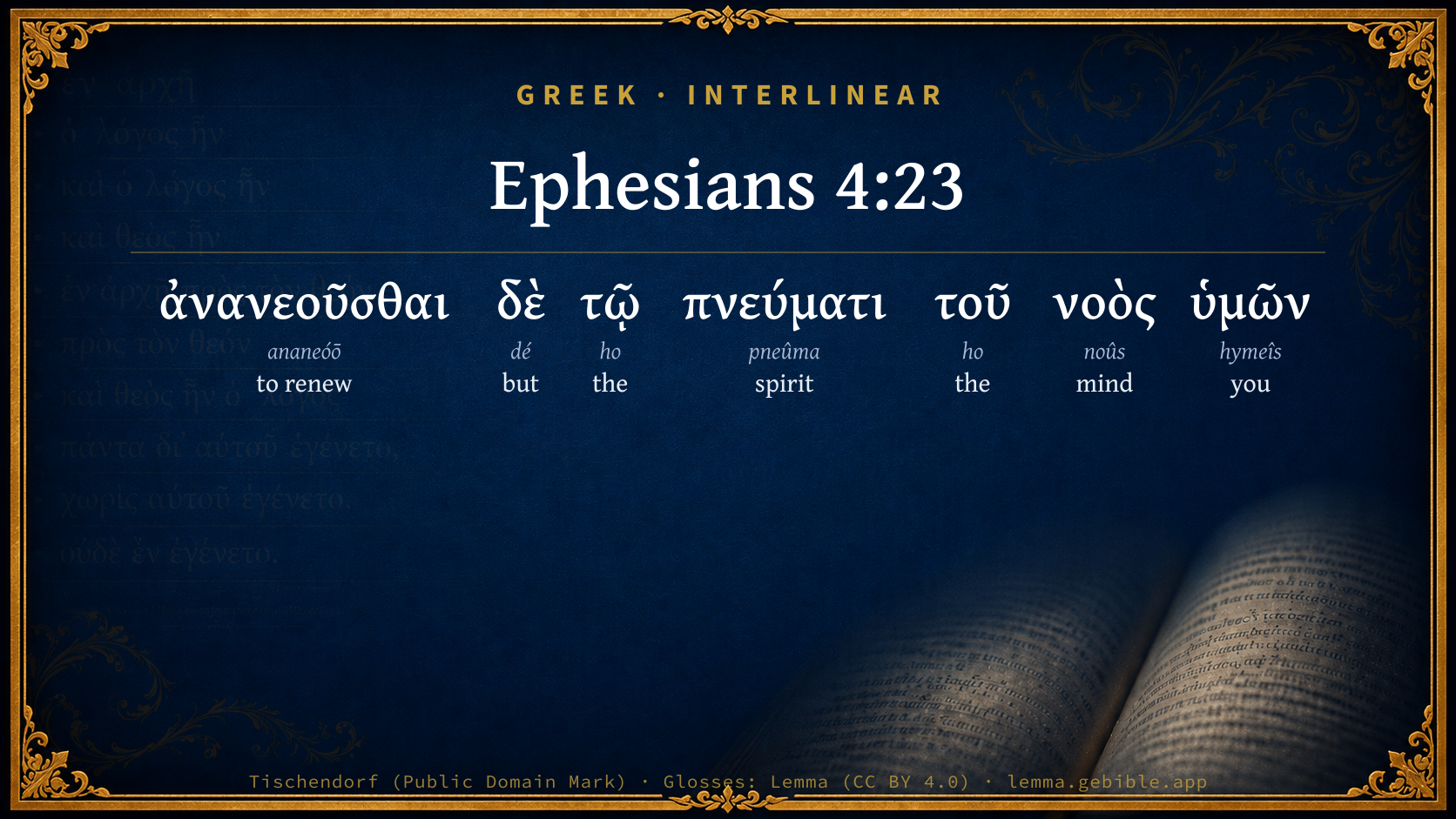
Download image
Cite this verse

Ephesians 4:23 (World English Bible). Public Domain. Lemma interlinear Bible study tool, https://lemma.gebible.app/v/ephesians/4/23.

Show BibTeX & RIS
BibTeX
RIS
English Translation
and that you be renewed in the spirit of your mind,
World English Bible · Public Domain
Highlights
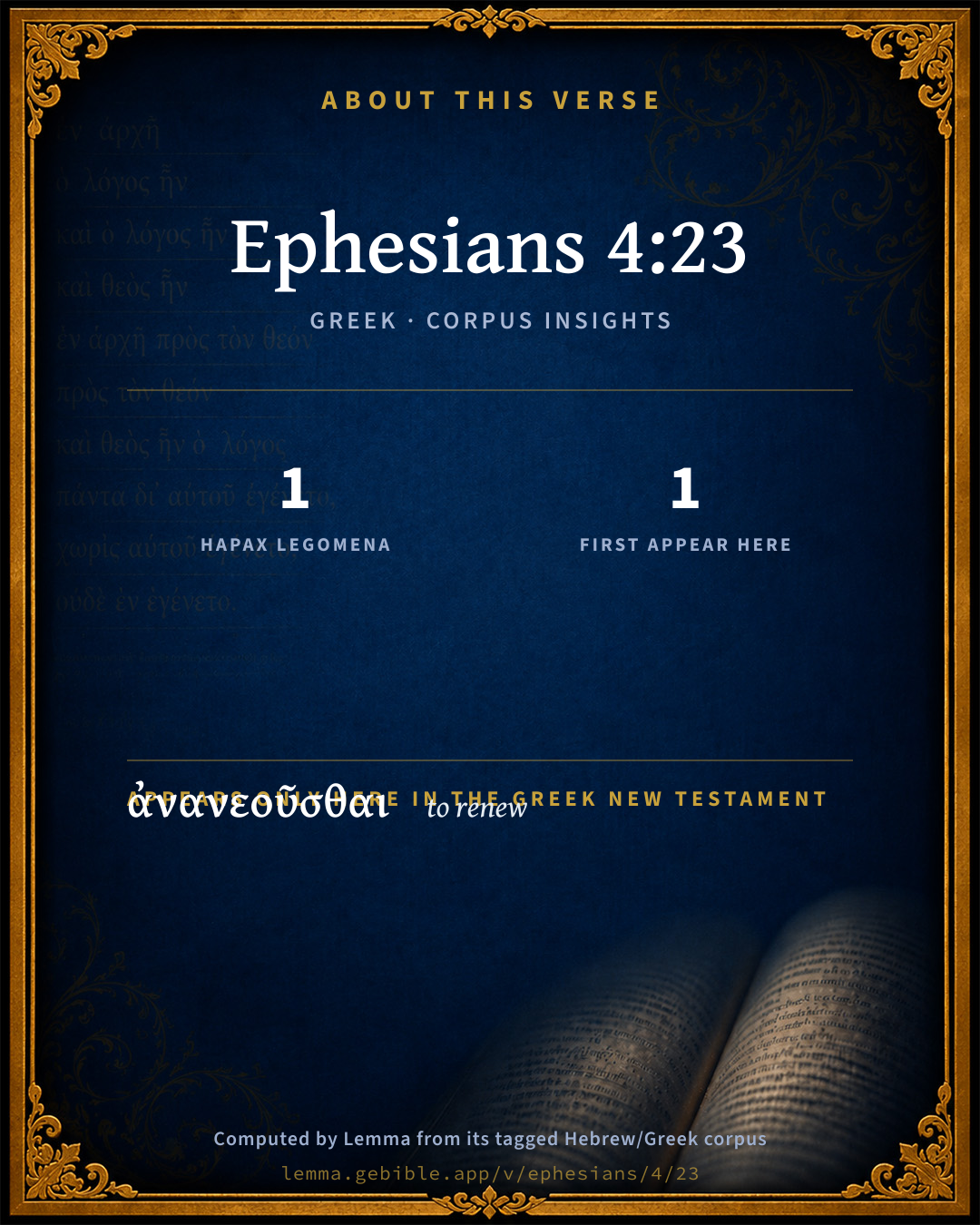
  • 1 hapax legomenon — only here in the Greek New Testament
  • 1 first appearance in the Greek New Testament
Full analysis ↓
Download a study sheet

One document with this verse’s original text, its word-by-word gloss line, the meaning frame, cross-references with their text, attributed commentary, and full source and license credits — printable, and it pastes into notes with its structure intact.

This verse Autodidact and up

Study sheet (.html) Plain text (.txt)

A passage Seminary Student

Up to 50 verses in one chapter. A passage sheet keeps up to 6 commentary sources and 12 cross-references per verse, in the order this page ranks them, and says so on the sheet whenever that leaves anything out. Ask for a single verse and you get the Autodidact verse sheet above.

Everything on this page stays free to read, with no account — the sheet is a download of what is already on screen, not access to it.

Want to remove ads? Support Godless Engineer
Compare translations 3

The same verse in 3 English versions, stacked beneath the original-language interlinear above. Click any original word for its lexicon entry.

Each is an independent rendering of the whole verse — the interlinear is not word-aligned to these translations.

Highlighted words mark where these versions differ — a whole-verse word diff, not a word-by-word alignment.

  • World English Bible Public Domain
    and that you be renewed in the spirit of your mind,
  • King James Version Public Domain
    And be renewed in the spirit of your mind;
  • unfoldingWord Literal Text CC BY-SA 4.0
    and to be renewed in the spirit of your minds,

unfoldingWord Literal Text — © unfoldingWord, licensed CC BY-SA 4.0. Word-aligned USFM3 via Door43 (git.door43.org/unfoldingWord/en_ult).

Versions to compare (up to 4)

3 of 4 selected

Show all 19 translations

Every available English version of this verse, each an independent rendering of the whole verse.

  • World English Bible Public Domain
    and that you be renewed in the spirit of your mind,
  • Berean Standard Bible Public Domain
    to be renewed in the spirit of your minds;
  • Majority Standard Bible Public Domain
    to be renewed in the spirit of your minds;
  • King James Version Public Domain
    And be renewed in the spirit of your mind;
  • American Standard Version (1901) Public Domain
    and that ye be renewed in the spirit of your mind,
  • Revised Version (1885) Public Domain
    and that ye be renewed in the spirit of your mind,
  • Geneva Bible (1599) Public Domain
    And be renued in the spirit of your minde,
  • Douay-Rheims (1899) Public Domain
    And be renewed in the spirit of your mind:
  • Young's Literal Translation Public Domain
    and to be renewed in the spirit of your mind,
  • Literal Standard Version CC BY-SA 4.0
    and to be renewed in the spirit of your mind,
  • Unlocked Literal Bible CC BY-SA 4.0
    You were taught to be renewed in the spirit of your minds,
  • unfoldingWord Literal Text CC BY-SA 4.0
    and to be renewed in the spirit of your minds,
  • Darby Bible Public Domain
    and being renewed in the spirit of your mind;
  • World Messianic Bible Public Domain
    and that you be renewed in the spirit of your mind,
  • Webster's Bible Public Domain
    And be renewed in the Spirit of your mind;
  • Free Bible Version CC BY-SA 4.0
    Let yourselves be remade spiritually and mentally,
  • Bible in Basic English Public Domain
    And be made new in the spirit of your mind,
  • Text-Critical English NT CC BY 4.0
    to be renewed in the spirit of your minds,
  • Tyndale New Testament (1534) Public Domain
    and be ye renued in the sprete of youre myndes

Literal Standard Version (2020), Covenant Press — licensed CC BY-SA 4.0. Text via the HelloAO Bible API (eBible.org). Unlocked Literal Bible (unfoldingWord) — licensed CC BY-SA 4.0. Text via the HelloAO Bible API (eBible.org). unfoldingWord Literal Text — © unfoldingWord, licensed CC BY-SA 4.0. Word-aligned USFM3 via Door43 (git.door43.org/unfoldingWord/en_ult). Free Bible Version, Dr. Jonathan Gallagher — licensed CC BY-SA 4.0. Text via the HelloAO Bible API (eBible.org).

Word by word

More ways to search: Search by grammar → Find every occurrence → Compare this word →

Practice this passage: Drill this verse → Learn its vocabulary →

About this verse

These counts appear in no published source. They are computed here, from the morphology-tagged text and Lemma’s own curated glosses. What Lemma adds →

7
words
6
distinct lemmas
Pauline Epistles
section

Notable vocabulary

1 hapax legomenon — a word that appears only here in the entire Greek New Testament:

  • ἀνανεοῦσθαι to renew G365

First appearance in Scripture

This word makes its first canonical appearance in the Greek New Testament here:

  • ἀνανεοῦσθαι to renew G365

Shared distinctive vocabulary

νοὸς mind G3563 occurs in 22 verses of the Greek New Testament. Also found in:

Repetition

A word recurs within this verse:

Cross-references

10

Topical passages linked to Ephesians 4:23 in the Treasury of Scripture Knowledge — connected by theme and wording, ordered by reader-vote popularity; previews shown in the World English Bible.

  • Romans 12:2 Don't be conformed to this world, but be transformed by the renewing of your mind, so that you may prove what is the good, well-pleasing, and perfect will of God.
  • Romans 8:6 For the mind of the flesh is death, but the mind of the Spirit is life and peace;
  • Psalms 51:10 Create in me a clean heart, O God. Renew a right spirit within me.
  • Colossians 3:10 and have put on the new man, that is being renewed in knowledge after the image of his Creator,
  • 1 Peter 1:13 Therefore, prepare your minds for action, be sober and set your hope fully on the grace that will be brought to you at the revelation of Jesus Christ--
  • Ezekiel 36:26 A new heart also will I give you, and a new spirit will I put within you; and I will take away the stony heart out of your flesh, and I will give you a heart of flesh.
  • Titus 3:5 not by works of righteousness, which we did ourselves, but according to his mercy, he saved us, through the washing of regeneration and renewing by the Holy Spirit,
  • Ezekiel 18:31 Cast away from you all your transgressions, in which you have transgressed; and make you a new heart and a new spirit: for why will you die, house of Israel?
  • Ephesians 2:10 For we are his workmanship, created in Christ Jesus for good works, which God prepared before that we would walk in them.
  • Ezekiel 11:19 I will give them one heart, and I will put a new spirit within you; and I will take the stony heart out of their flesh, and will give them a heart of flesh;

Cross-references courtesy of OpenBible.info (CC BY 4.0).

Commentary

Notes on Ephesians 4:23 from classic Christian and Jewish commentators (each source and its license shown beneath its notes). The classic Christian expositions comment on the surrounding passage and are grouped to its opening verse, so a note may address several verses; the Jewish commentaries on the Tanakh (Rashi and others) are per-verse, so they appear only where the commentator wrote on this verse.

Lemma curates 59 commentaries, every one of them public domain or Creative Commons licensed, each selected and text-cleaned for this edition rather than reprinted as found. About our sources →

The Biblical Illustrator

Joseph S. Exell

Eph_4:23

And be renewed in the spirit of your mind

Renewal in the spirit of the mind

The renewal takes place not simply in the mind, but in the spirit of it.

It is the special seat of renewal. The mind remains as before, both in its intellectual and emotional structure--in its memory and judgment, imagination and perception. These powers do not in themselves need renewal, and regeneration brings neither new faculties nor susceptibilities. The organism of the mind survives as it was, but the spirit which inhabits and governs it is entirely changed. The ruling and motive power is renovated. The memory, for example, still exercises its former functions, but on a very different class of subjects; the judgment still discharging its old office, is occupied among a new set of themes and ideas; and love retaining all its ardour, attaches itself to objects quite in contrast with those of its earlier preference, and pursuit. The change is not in mind psychologically, either in its essence or in its operation, neither is it in mind, as if it were a superficial change of opinion, either on points of doctrine or of practice; but it is in the spirit of the mind, in that which gives mind both its bent and its materials of thought. It is not simply in the spirit, as if it lay there in dim and mystic quietude; but it is in the spirit of the mind, in the power which, when changed itself, radically alters the entire sphere and business of the inner mechanism. (J. Eadie, D. D.)

The progressive renewal

It is only living things that grow; and all living things do grow. Be it the lichen that clings to the rook, or the eagle that has her nest on its craggy shelf, or man that rends its heart with powder and draws the gold from its bowels--from the germ out of which they spring, they grow onwards to maturity; in the words of my text, they increase more and more. These words are as true of spiritual as of natural life. According to heathen fables, Minerva the goddess of wisdom and daughter of Jupiter, sprung full-grown and full-armed from her fathers head. No man thus comes from the hand of the Holy Spirit, in sudden, mature, perfect saintship. There is nothing in the spiritual world which resembles this: no, nor even what the natural world presents in the development of the insect tribes. During their last and perfect stage, in the condition, as it is called, of the imago, be their life long or short, they undergo no increase. So soon as the green worm that once crawled on the ground and fed on garbage, bursting its coffin shell, comes forth, a creature with silken wings, to roam in the sunny air, to sleep by night on a bed of flowers, and by day banquet on their nectar, it grows no mere--neither larger nor wiser; its flight and faculties being as perfect on the day of what may be called its new birth, as when, touched by early frosts or drowned in rain, it dies. Here, indeed, we have a symbol of the resurrection body as it shall step from the tomb; in beauty perfect, in growth mature; to undergo henceforth, and through eternal ages, neither change nor decay. It is otherwise with the renewed soul. Before it, in righteousness, and knowledge, and true holiness, stretches a field of illimitable progress--upwards and onwards to what it shall be forever approaching, yet never reach, the throne of God. (T. Guthrie, D. D.)

The new and the old nature

There are a great many men who are like one of my roses. I bought a Gloire de Dijon. It was said to be one of the few ever-blooming roses. It was grafted on a manetti stalk--a kind of dog rose, a rampant and enormous grower, and a very good stalk to graft fine roses on. I planted it. It throve the first part of the summer, and the last part of the summer it grew with great vigour; and I quite gloried when the next spring came, in my Gloire de Dijon. It had wood enough to make twenty such roses as these finer varieties usually have; and I was in the amplitude of triumph. I said, My soil suits it exactly in this climate; and I will write an article for the Monthly Gardener, and tell what luck I have had with it. He I waited and waited and waited till it blossomed; and behold! it was one of these worthless, quarter-of-a-dollar, single-blossomed roses. And when I came to examine it I found that it was grafted, and that there was a little bit of a graft down near the ground, and that it was the manetti sprout that had grown to such a prodigious size. Now, I have seen a great many people converted, in whom the conversion did not grow, but the old nature did. (H. W. Beecher.)

Renewal more than repair

A builder was called in to repair some houses. The contract stated that any doors, window sashes, etc., which should be renewed would be paid for. The work proceeded, certain door panels, window frames, and sashes proved to be imperfect and decayed. The defective panels, beadings, and pieces of framing were made good. In due course the painting, graining, and finishing work was completed. I was present when the work underwent examination. The builders account had been rendered, and an item appeared of so many pounds for renewing doors, sashes, etc. Certainly not, said the architect on being appealed to; to repair is one thing, to renew quite another. In vain the builder expostulated. How well I remember the architects words--No, sir, your contract comprehends all repairs. Go and get your dictionary and see what the word renew means. Had you taken away the old doors and window sashes, and brought new ones, we would have paid you for them. Such in the meaning of the terms of your contract, and no amount of repairing will renew that which is old. (Henry Varley.)

The Biblical Illustrator, edited by Joseph S. Exell (c. 1880s–1900s) — public domain. Text from a community e-Sword module.

Bengel's Gnomon

Johann Albrecht Bengel

Eph 4:23. Τῷ πνεύματι τοῦ νοὸς, in the spirit of the mind) 1Co 14:14. The spirit is the inmost part of the mind.

Bengel's Gnomon of the New Testament — English translation (T&T Clark, Edinburgh, 1860) — public domain. Text from a community e-Sword module.

Meyer's Critical & Exegetical Commentary

Heinrich August Wilhelm Meyer

Eph_4:23. Positive side of that which is truth in Jesus: that ye, on the other hand, become renewed in the spirit of your reason.

ἀνανεοῦσθαι] passive, not middle (renew yourselves, Luther), since the middle has an active sense (1Ma_12:1; Thuc. v. 18, 43; Polyb. vii. 3. 1, and often). The renewal is Gods work through the Holy Spirit (Rom_8:1 f.; Tit_3:5), and without it one is no true Christian (Rom_8:9; Gal_5:15), consequently there can be no mention of ἀλήθεια ἐν τῷ Ἰησοῦ. Respecting the distinction between ἀνανεόω (only here in the N.T.) and ἀνακαινόω, recentare and renovare, as also respecting ἀνα, which does not refer to the restitution of human nature, as it was before the fall, but denotes the recentare in reference to the previous (corrupt) state, see on Col_3:10.

τῷ πνεύματι τοῦ νοὸς ὑμῶν] The genitive is at any rate that of the subject; for instead of simply saying τῷ πνεύματι ὑμῶν,[241] Paul makes use of the more precise designation in the text. But the τῷ πνεύματι may be either instrumental or dative of reference. In the former case, however, we should, with Oecumenius, Castalio, and others, including Ch. F. Fritzsche in his Nov. Opusc. p. 244 f., and Fritzsche, ad Rom. II. p. 28, have to understand the Holy Spirit, who has His seat in the νοῦς of the man on whom He is bestowed, and through whom (dative) the ἀνακαίνωσις τοῦ νοός, Rom_12:2, is effected, so that now the old ματαιότης of the νοῦς (Eph_4:17) no longer occurs, and the καινότης, which, on the other hand, has set in (Rom_4:4), is a καινότης τοῦ πνεύματος. Comp. Tit_3:5. But, in opposition to this view, we may urge, first, that the Holy Spirit bestowed on man is never in the N.T. designated in such a way that man appears as the subject of the Spirit (thus never: τὸ πνεῦμα ὑμῶν and the like, or as here: τὸ πνεῦμα τοῦ νοὸς ὑμῶν); and secondly, that it was the object of the apostle to put forward the aspect of the moral self-activity of the Christian life, and hence, he had no occasion expressly to introduce the point, which, moreover, was obvious of itself: through the Holy Spirit. Accordingly, there remains as the right explanation only the usual one (dative of reference), according to which the πνεῦμα is the human spirit, different from the divine (Rom_8:16). Consequently: in respect of the spirit of your νοῦς, that is, of the spirit by which your νοῦς is governed. The πνεῦμα, namely, is the higher life-principle in man, the moral power akin to God in him, the seat of moral self-consciousness and of moral self-determination. This πνεῦμα, which forms the moral personality of man, the Ego of his higher ζωή turned towards God, has as the organ of its vital exerciseas the faculty of its moral operationthe νοῦς, that is, the reason in its ethical quality and activity (comp. on Rom_7:23), and puts the νοῦς[242] at the service of the divine will (Rom_7:25), in an assent to the moral practice of this divine will revealed in the law and a hatred of the contrary (Rom_7:14 ff.). But, since this Ego of the higher life, the substratum of the inward manthe πνεῦμα, in which the νοῦς has its support and its determining agentis under the preponderant strength of the power of sin in the flesh non-free, bound, and weak, so that man under the fleshly-psychical influence of the natural character drawing him to sin becomes liable to the slavery of immoral habit, the πνεῦμα τοῦ νοός needed renewal unto moral freedom and might, which consecration of power it receives in regeneration by means of the Holy Spirit, in which case, however, even the regenerate has always to contend against the σάρξ still remaining in him, but contends victoriously under the guidance of the divine πνεῦμα (Gal_5:16-18).

[241] He might have written, as in Rom_12:2, merely τῷ νοῒ ὑμῶν; but his conception here penetrates deeper, namely, to the fountainhead of the vital activity of the νοῦς, to the inner agent and mover in that activity.

[242] Bengel excellently puts it: Spiritu mentis: 1Co_14:14, Spiritus est intimum mentis. Delitzsch consequently errs (Psychol, p. 184) in thinking that expositors have here neglected to seek instruction from 1Co_14:14.

Meyer — Critical and Exegetical Commentary on the New Testament — English translation by Peter Christie, edited by Frederick Crombie (T&T Clark, 1880) — public domain. Text from a community e-Sword module.

Expositor's Greek Testament

ed. W. Robertson Nicoll

Eph 4:23 . ἀνανεοῦσθαι δέ : and that ye be renewed . For ἀνανεοῦσθαι a few MSS. ( [446] 2 17, 47, etc.) and some Versions (Syr., Copt., Vulg.) read ἀνανεοῦσθε , while δέ is omitted by [447] . In such connections δέ expresses both addition and contrast . It introduces a statement connected with the foregoing but giving the other side of that. Here it is the positive change which must follow the putting off . As the middle of this verb has the active sense, ἀνανεοῦσθαι must be taken as passive here, = “be renewed,” not “renew yourselves” (Luth.). The verb expresses a spiritual change, a transformation from old to new. Whether it also conveys the idea of restoration to a former or a primal state is doubtful, so many compounds with ἀνά ( ἀναπληροῦν , ἀνακοινοῦν , ἀνισοῦν , ἀνιεροῦν , etc.) expressing nothing more than change . For the supposed distinction between ἀνανεοῦσθαι as expressing renovation , making new, or giving a fresh beginning, and ἀνακαινοῦσθαι as referring to regeneration or change of nature, see Haupt and Ell. in loc. , and Meyer on Col 3:10 . τῷ πνεύματι τοῦ νοὸς ὑμῶν : in the spirit of your mind . The position of the ὑμῶν gives it a measure of emphasis, “ your mind,” “the mind that is in you ,” unless it be taken (with Haupt) to be placed last because it qualifies not the νοὸς only but the whole idea in τῷ πνεύματι τοῦ νοός . This difficult sentence has been understood to refer to the Holy Spirit , the νοός being dealt with as some form of the poss. gen. or the gen. subj. , and the πνεύματι as dat. instr. Thus the sense would be “renewed by the Holy Spirit bestowed on , or possessed by , your mind” (Œc., Theophy., Bull, Waterland, Fritz., etc.). This proceeds on the NT doctrine that it is by the Spirit of God that we are regenerated or renewed. But it leaves the point of the addition of τοῦ νοός obscure. This ancient interpretation has been adopted by some recent exegetes with certain modifications. Thus Ellicott is of opinion that the πνεύματι refers not to the Holy Spirit distinctly and separately as the Divine Agent, but to that Spirit as united with the human spirit . In this way he thinks the poss. gen. is in point, and the introduction of the νοός accounted for as the receptaculum of the πνεῦμα . But, while it is true that it is often difficult to say whether the regenerated mind of man or the Divine Spirit is particularly in view in the Pauline use of πνεῦμα , there seems to be no case in which the NT speaks of the Holy Spirit as man’s Spirit, or attaches to πνεῦμα in the sense of the Divine Spirit any such defining term as ὑμῶν or τοῦ νοὸς ὑμῶν . Nor can it be said that πνεῦμα , in the sense of the Divine Spirit in union with man’s spirit, has anywhere else any such designation as the one in the text. Nor, again, does the interpretation which turns upon this idea of union between God’s Spirit and our spirit, and not simply on the indwelling of the Divine Spirit in us, really account in any satisfactory way for the νοός . It is necessary, therefore, to take πνεῦμα here as = our spirit, and that as at once distinguished from and related to the νοῦς . The πνεῦμα , then, appears to be the higher faculty in man, the faculty that makes him most akin to God, the organ of his spiritual life and his fellowship with God, under the bondage of sin by nature, but set free from that and made fit for the purposes of the Divine life by the Holy Spirit. The νοῦς ( cf. on Eph 4:17 above) is the faculty of understanding, feeling, and determining, distinguished by Paul from the πνεῦμα (1Co 14:14 ), represented as capable of approving the law, but incapable of withstanding the motions of sin (Rom 7:23 ), and itself the subject or seat of renewal ( ἀνακαίνωσις , Rom 12:2 ). Further the regenerate human spirit and the Divine Spirit are described as distinct and yet co-operant (Rom 8:16 ). Here then the πνεύματι must be taken not as the instrumental dative (for renewal does not take effect by means of our spirit), but as the dat. of ref. , and the νοός will be the gen. subj. Thus the sense becomes “renewed in respect of the spirit by which your mind is governed” (Mey.), that is, in respect of the spiritual faculty, the moral personality whose organ is the mind or reason. Some, holding by the interpretation of πνεῦμα as our spirit, take the νοός to be the gen. of appos. ( e.g. , August., de Trin. , xiv., 16, spiritus quae mens vocatur ), or the part. gen. , = “the governing spirit of your mind” (De Wette). But the above construction is better, and it is the one adopted substantially by the AV and the other old English Versions, the RV, Mey., Haupt, Abb., and most commentators.

[446] Codex Claromontanus (sæc. vi.), a Græco-Latin MS. at Paris, edited by Tischendorf in 1852.

[447] Codex Augiensis (sæc. ix.), a Græco-Latin MS., at Trinity College, Cambridge, edited by Scrivener in 1859. Its Greek text is almost identical with that of G, and it is therefore not cited save where it differs from that MS. Its Latin version, f, presents the Vulgate text with some modifications.

The Expositor's Greek Testament, edited by W. Robertson Nicoll (1897–1910) — public domain. Text from a community e-Sword module.

Hodge's Commentary on Romans, Ephesians & First Corinthians

Charles Hodge

Eph_4:23

In this and the following verse we have the positive part of sanctification which is expressed by renewing and putting on the new man. The verb ἀνανεοῦσθαι, to be made new, is passive. This renewal is always represented as the work of God. We are his workmanship created in Christ Jesus unto good works, Eph_2:10. It is therefore called a renewing of the Holy Ghost. Tit_3:5. Both these phrases to be renewed and to put on the new man may express either the instantaneous act of regeneration, or the gradual work of sanctification. Thus in Rom_12:2, we are exhorted not to be conformed to the world, but to be transformed by the renewing of the mind. So in this place, and in the parallel passage in Col_3:9, Col_3:10, these terms express the whole process by which the soul is restored to the image of God. It is a process of renewal from the beginning to the end. The apostle says, his inner man is renewed day by day. 2Co_4:16.

The distinction between νέος, young, new as to origin; and καινός, fresh, bright, unused, new as to nature or character, is generally preserved in the New Testament. Thus in Mat_9:17, οἶνον νέον εἰς ἀσκοὺς καινούς, recent, or newly made wine into fresh bottles. Μνημεῖον καινὸν, new sepulcher, i.e. one which had not been used, however long it may have been prepared. Hence καινός, is an epithet of excellence. In the passage Until I drink it new with you in the kingdom of God, Mar_14:25, the word is καινός, not νὲον. The same idea is implied in all the expressions, new creature, new heavens, new commandment, new name, new Jerusalem, etc., etc. In all these cases the word is καινός. The same distinction properly belongs to the derivatives of these words; ἀνανεόω is to make νὲον. and ἀνακαινίζω, ἀνακαινόω, is to make καινός. Hence when reference is had to the renewal of the soul, which is a change for the better, the words used are always the derivatives of καινός, except in this passage. See Rom_12:2; 2Co_4:16; Col_3:10; Tit_3:5. Still as what is νέος is also καινός, as freshness, vigor and beauty are the attributes of youth, the same thing may be designated by either term. The soul as renewed is, therefore, called in this passage καινός ἆνθρωπος and νέος ἆνθρωπος in Col_3:10; and the spiritual change which in Col_3:10, is expressed by ἀνακαινόω and in Rom_12:2, and Tit_3:5, by ἀνακαίνωσις, is here expressed by ἀνανεόω.

The subject of this renewal, that as to which men are to be made new, is expressed in the clause τῷ πνεύματι τοῦ νοὸς ὑμῶν, i.e. as to the spirit of your mind. This combination is unexampled. Grotius says: Spiritus mentis est ipsa mens; as Augustine before him had said: Spiritum mentis dicere voluit eum spiritum, quae mens vocatur. But here spirit and mind are distinguished. The spirit of a man is not that spirit which is a man; but which man has. Others take the word spirit here to be temper, disposition. Renewed as to the temper of your mind. This is a very unusual, if not doubtful meaning of the word in the New Testament. Others, again, say that the word spirit means the Holy Spirit, and that the passage should be rendered, by the Spirit which is in your mind. But this is impossible. The spirit of the mind is here as plainly distinguished from the Spirit of God as in Rom_8:16, where the Spirit of God is said to bear witness with our spirit.

It may be remarked in reference to this phrase:

1. That although the passage in Rom_12:2, renewal of your mind, obviously expresses the same general idea as is here expressed by saying, renewed as to the spirit of the mind, it does not follow that mind and spirit of the mind, mean exactly the same thing. The one expression is general, the other precise and definite.

2. The words πνεῦμα, νοῦς, καρδία, ψυχή, spirit, mind, heart, soul, are used in Scripture both for the whole immaterial and immortal element of our nature, that in which our personality resides; and also for that element under some one of its modes of manifestation, sometimes for one mode and sometimes for another; as νοῦς sometimes designates the soul as intelligent and sometimes the soul as feeling.

3. Though this is true, yet predominantly one of these terms designates one, and another a different mode of manifestation; as νοῦς, the understanding, καρδία, the feelings, ψυχή, the seat of sensation.

4. Of these terms πνεῦμα is the highest. It means breath, wind, invisible power, life. The idea of power cannot be separated from the term; τὸ πνεῦμα ἐστι τὸ ζωοποιοῦν. Joh_6:63.

It is, therefore, applied to God, to the Holy Ghost, to angels,, to Satan, to demons, to the soul of man. The spirit of the world, 1Co_2:12, is the controlling, animating principle of the world, that which makes it what ii is. The spirit of the mind therefore is its interior life; that of which the νοῦς, καρδία, ψυχή, are the modes of manifestation. That, therefore, which needs to be renewed, is not merely outward habits or modes of life; not merely transient tempers or dispositions, but the interior principle of life which lies back of all that is outward, phenomenal. or transient.

Charles Hodge — Commentary on Romans (1835), First Corinthians (1857), and Ephesians (1856) — public domain. Text from a community e-Sword module.

Geneva Bible (1599)

Geneva Bible translators

Where there ought to have been the greatest force of reason, there is the greatest corruption of all which wasteth all things.

Geneva Bible (1599) marginal notes — public domain. Text via Bolls.life.

Jamieson, Fausset & Brown

Robert Jamieson, A. R. Fausset & David Brown

be renewed--The Greek (ananeousthai) implies "the continued renewal in the youth of the new man." A different Greek word (anakainousthai) implies "renewal from the old state."

in the spirit of your mind--As there is no Greek for "in," which there is at Eph 4:17, "in the vanity of their mind," it is better to translate, "By the Spirit of your mind," that is, by your new spiritual nature; the restored and divinely informed leading principle of the mind. The "spirit" of man in New Testament is only then used in its proper sense, as worthy of its place and governing functions, when it is one spirit with the Lord. The natural, or animal man, is described as "not having the Spirit" (Jde 1:19) [ALFORD]. Spirit is not in this sense attributed to the unregenerate (Th1 5:23).

Jamieson, Fausset & Brown — Commentary Critical and Explanatory on the Whole Bible (1871) — public domain (CC PDM 1.0). Text via the HelloAO Bible API.

Adam Clarke's Commentary

Verse 23. And be renewed in the spirit of your mind] Their old mode of living was to be abandoned; a new one to be assumed. The mind is to be renovated; and not only its general complexion, but the very spirit of it; all its faculties and powers must be thoroughly, completely, and universally renewed. Plautus uses a similar expression describing deep distress, and answerable to our phrase innermost soul: -

Paupertas, pavor territat mentem animi.

Poverty and dread alarm my innermost soul.

Epid., l. 519.

Adam Clarke's Commentary on the Bible (1810–1826) — public domain. Text from a community e-Sword/MySword module.

John Calvin's Commentaries

23. And be renewed. The second part of the rule for a devout and holy life is to live, not in our own spirit, but in the Spirit of Christ. But what is meant by — the spirit of your mind? I understand it simply to mean, — Be renewed, not only with respect to the inferior appetites or desires, which are manifestly sinful, but with respect also to that part of the soul which is reckoned most noble and excellent. And here again, he brings forward to view that Queen which philosophers are accustomed almost to adore. There is an implied contrast between the spirit of our mind and the Divine and heavenly Spirit, who produces in us another and a new mind. How much there is in us that is sound or uncorrupted may be easily gathered from this passage, which enjoins us to correct chiefly the reason or mind, in which we are apt to imagine that there is nothing but what is virtuous and deserves commendation.

John Calvin's Commentaries (1540-1563) — public domain. Text from the Calvin Translation Society English edition (1840s-50s) via the Christian Classics Ethereal Library (ccel.org). Calvin's coverage is partial (roughly two-thirds of the Bible); uncommented books and verses are honest gaps, never fabricated. The 19th-century editor's footnotes and remarks are omitted so the notes are faithfully Calvin's own voice.

Ellicott's Commentary for English Readers

(23) And be renewed in the spirit of your mind.—The word translated “renewed” is not the same as the word “new” below. It is properly “to be made young again,” and the process of recovery is described as the natural effect of putting off the decrepitude of the old man, and the decay engendered by fleshly lusts. The effect is seen in “the spirit of the mind”—that is, “in the spiritual nature of the inner man.” The “spirit” of man is the mind or inner man, considered in its true relation as quickened and sustained by the Spirit of God. (See Romans 8, and especially Eph_4:16.) We note, in Col_2:18, the opposite condition of “the mind of the flesh,” in those who do not “hold the Head.” This spirit is spoken of as regaining its undying youth, as it were, naturally, when “the muddy vesture of decay” is cast off.

A Bible Commentary for English Readers, edited by Charles John Ellicott (1878–1897) — public domain. Text from a community e-Sword module.

The Cambridge Bible for Schools and Colleges

gen. ed. J. J. S. Perowne

23. be renewed] A present infinitive in the Gr. The idea is thus of progress and growth, the antithesis to the “corrupting” just above. The decisive fact of new position in and connexion with Christ was to result, and was resulting, in an ever developed spiritual experience, with its ever new disclosures both of need and of grace. Cp. 2Co_4:16.—We may paraphrase the clause (on the principle explained in the first note on Eph_4:22), “and with regard to your being renewed.”

in the spirit of your mind.] I.e., practically, “in your spiritual life and faculty, coming out in the phase of thought and understanding,” as distinct from e.g. the phase of emotion. “Spirit” can scarcely here refer to the Holy Ghost; and it cannot bear the vague modern sense of “sentiment,” or the like. It is the human spirit, as the substratum, so to speak, of every activity of the “inner man,” and now specially of the activity which sees and grasps truth (“your mind”). See above, last note on Eph_4:17.—The Gr. may be rendered “by the spirit of your mind,” as the instrument, or avenue, used by the Eternal Spirit in the process of renewal. And cp. Rom_12:2 for a good parallel. But usage is on the whole in favour of the rendering “in,” in the sense of “with reference to.”

The Cambridge Bible for Schools and Colleges (gen. ed. J. J. S. Perowne; Cambridge University Press, 1878–1918) — public domain. Text from a community e-Sword module.

John Gill's Exposition

Wherefore putting away lying,.... Which is one of the deeds of the old man, and a branch of the former conversation agreeable to him: a lie is a voluntary disagreement of the mind and speech, with a design to deceive; it is to speak that which is false, contrary to truth shining in the mind; and it is spoken knowingly and willingly, and with a design to impose upon others; hence a man may speak what is false, and not be a liar, if he does not know it to be so; and hence parables, fables, tropes, figures, hyperboles, &c. are not lies, because they are not used to deceive, but to illustrate and enforce truth: there are several sorts of lies; there is an officious lie, which is told for the service of others, but this is not lawful; for evil is not to be done, that good may come of it; and a man may as well tell a lie to serve himself, as another; and any other sin by the same rule may be allowed of, and tolerated; besides, it is not lawful to lie for God, and therefore not for a creature: and there is a jocose lie; this ought not to be encouraged; all appearance of evil should be abstained from; every idle word must be accounted for; and hereby also an evil habit of lying may be acquired: and there is a lie which is in itself directly hurtful, and injurious; as is every false thing, said with a design to deceive: and there are religious lies, and liars; some practical ones, as those who do not sincerely worship God, and who are dissolute in their lives, and their practice is not according to their profession; and there are others who are guilty of doctrinal lies, as antichrist and his followers, who are given up to believe a lie; and such who deny the deity, incarnation, Messiahship, work, office, grace, righteousness, and sacrifice of Christ; and who profess themselves to be Christians, and are not: the springs and causes of lying are a corrupt heart and the lusts of it, which prompt unto it; such as covetousness, malice, and the fear of men; and also a tempting devil, the father of lies; and who is a lying spirit, in the hearts and mouths of men; this is a vice which ought to be put away, especially by professors of religion; the effects of it are sad; it brings infamy, disgrace, and discredit, upon particular persons; and has brought judgments upon nations, where it has in general obtained; and has been the cause of corporeal diseases and death; and even makes men liable to the lake of fire and brimstone, which is the second death: it is a sin exceeding sinful; it is a breach of God's law; an aping of the devil; it is against the light of nature, and is destructive of civil society, and very abominable in the sight of God: wherefore

speak every man truth with his neighbour; both with respect to civil and religious affairs, in common conversation, in trade and business, and in all things relating to God and men:

for we are members one of another; as men, are all of one blood, descended from one man, and so are related one to another; and as in civil society, belong to one body politic; and in a religious sense, members of the same mystical body, the church; of which Christ, who is the truth itself, is the head; and therefore should not attempt to deceive one another by lying, since there is such a near relation and close union of one to another.

John Gill's Exposition of the Whole Bible (1746–1763) — public domain (CC PDM 1.0). Text via the HelloAO Bible API.

Trapp's Complete Commentary

John Trapp

23 And be renewed in the spirit of your mind;

Ver. 23. In the spirit of your mind] That is, in the most inward and subtle parts of the soul, the bosom and bottom, the vis vivifica, and very quintessence of it. This he calls elsewhere the wisdom of the flesh, Rom 8:7, that carnal reason, that, like an old beldam, is the mother and nurse of those fleshly lusts that fight against the soul.

John Trapp, A Commentary or Exposition upon All the Books of the Old and New Testament (1647–1656) — public domain. Text from a community e-Sword module.

Albert Barnes' Notes on the Bible

And be renewed - That is, it is necessary that a man who has been following these should become a new man; see the notes on Joh 3:3 ff., compare the notes on 2Co 4:16. The word used here - ἀνανεόω ananeoō - does not occur elsewhere in the New Testament; but it has the same meaning as the word used in 2Co 4:16, and Col 3:10. It means to make new, and is descriptive of the work of regeneration. This was addressed to the church, and to those whom Paul regarded as Christians; and we learn from this:

(1) That it is necessary that man should be “renewed” in order to be saved.

(2) That it is proper to exhort Christians to be renewed. They need renovated strength every day.

(3) That it is a matter of “obligation” to be renewed. People are “bound” thus to be renovated, And,

(4) That they have sufficient natural ability to change from the condition of the old to that of the “new” man, or they could not be exhorted to it.

(See the supplementary Rom 8:7, note; Gal 5:17, note.)

In the spirit of your mind - In your temper; your heart; your nature.

Albert Barnes' Notes on the Bible (1834–1885) — public domain. Text from a community e-Sword/MySword module.

Matthew Poole's English Annotations

And be renewed; viz. more and more, being already renewed in part.

In the spirit of your mind; i.e. in your mind which is a spirit: see 1Th 5:23; 2Ti 4:22. He means the superior powers of the soul, where regeneration begins, and which the philosophers magnified so much, and thought so pure.

Matthew Poole's English Annotations on the Holy Bible (1683–1685) — public domain. Text from a community e-Sword/MySword module.

Whedon's Commentary on the Bible

Daniel D. Whedon

23. And be renewed—Connected as an infinitive verb with the infinitive put off, in last verse, and governed by taught in Eph_4:21; taught to put off and to be renewed, and, Eph_4:24, to put on. And not only are these verbs in the infinitive, but it is important to note they are in the present tense, and thereby express a continuous process: that is, taught to be putting off, and to be being renewed, and to be putting on the new man. This process looks to its absolute completion in the day of redemption, Eph_4:30. Spirit of your mind, Not temper of your mind. The word mind, here, is the same word as in Eph_4:17, where see note. Of the Gentile mind the occupant is vanity; of yours, should be Christ’s Spirit. The sense, then, is: Be ye renewed by the Spirit, that is, the indwelling occupant of your higher mind, the divine Spirit, which has expelled the former tenant, vanity.

Daniel D. Whedon (gen. ed.), Commentary on the Old and New Testaments (1874–1909) — public domain. Text from a community e-Sword module.

The Pulpit Commentary

And that ye be renewed in the spirit of your mind. Between the first and second practical change, derived from being taught by Christ, the apostle inserts this counsel applicable to both. This renewal is the work of the Holy Spirit; how, then, can it be the subject of an exhortation to us? In this sense, that we are to prize, long for, encourage, watch, this work of the Holy Spirit, feeling it to be most vital and essential, not to be neglected without awful sin and danger. Usually the Holy Spirit works in us by stirring up our spirit to desire and endeavor after holiness; to resist these strivings of the Spirit, or even to be indifferent to them, is a deadly and most dangerous sin.

The Pulpit Commentary (1880–1919), ed. H.D.M. Spence-Jones & Joseph S. Exell — public domain. Text from a community e-Sword module.

John Wesley's Explanatory Notes

The spirit of your mind - The very ground of your heart.

John Wesley, Explanatory Notes Upon the Whole Bible (1754–1765) — public domain. Text via the GEBible commentary corpus.

The People's New Testament

B. W. Johnson

23. And be renewed. That is, be made new by having a new mind, or spirit. See Rom. 12:2.

B. W. Johnson's The People's New Testament with Notes (1889–1891) — public domain. Electronic text from the Christian Classics Ethereal Library (CCEL) ThML edition.

unfoldingWord translationNotes

Door43 World Missions Community

to be renewed in the spirit of your minds

This may be translated with an active form. AT: "to allow God to change your attitudes and thoughts" or "to allow God to give you new attitudes and thoughts" (See: Active or Passive)

to put on the new man that is created in the image of God

Paul is speaking of moral qualities as if they were pieces of clothing. AT: "to live your new life, which is created in the image of God" or "to start living in the new way because you were created in the image of God" (See: Metaphor)

in true righteousness and holiness

"truly righteous and holy"

translationWords

spirit

mind

righteous

holy

true

unfoldingWord translationNotes — © Distant Shores Media and the Door43 World Missions Community, licensed CC BY-SA 4.0. Source: git.door43.org/Door43/en_tn.

Cambridge Greek Testament for Schools and Colleges

23. ἀνανεοῦσθαι δὲ τῷ πνεύματι τοῦ νοὸς ὑμῶν, ‘be made young again in the spirit of your mind.’ Notice the present. The process of renewal is continuous. Notice also the characteristically Pauline thought of the newness of life to which the Gospel gives access. In O.T. the thought is found in Isa 40:31; cf. Psa 103:5. Besides the prophecies of the new Covenant (Jer 31:31) and of the new Heaven and the new Earth (Isaiah 65), the closest parallel would seem to be the new Heart (Eze 36:26) and the new Spirit (Eze 11:19). In the Gospel our Lord speaks of the new wine and the fresh wineskins—of the new Covenant in His blood, and of the new Commandment. In St Paul we have ‘the new Creation’ (2Co 5:17; Gal 6:15) and the newness of Life into which we pass at baptism. It is coupled with λουτρὸν παλιγγενεσίας in Tit 3:5. The thought is closely connected with the thought of ‘being born again’ or ‘begotten again’ in Joh 3:3; 1Pe 1:3; 1Pe 1:23 (cf. Hort in loc.). But here and in Col 3:10 the stress is laid on a continuous process which is dependent at every point on the consent of our wills.

τῷ πνεύματι τοῦ νοὸς ὑμῶν. Cf. Eph 4:17: ‘in the spirit of your mind.’ Dat. local not instr. νοῦς in N.T. is almost confined to St Paul (22 times), Lk (1), Apoc. (2). It is rare in LXX. for לב or לבב (6 times). It is ‘the organ of moral thinking and knowing’ (see Delitzsch, Bib. Psych.). As it is the seat of the deepest corruption (cf. Eph 4:17; Rom 1:28), so the renewal must begin there. Cf. Rom 7:25; Rom 12:2. ‘The spirit of the mind’ is an unique phrase. It must mean the spiritual root or ground out of which the conscious mind springs, ‘intimum mentis,’ Bengel.

Cambridge Greek Testament for Schools and Colleges (Cambridge University Press, 1896; 21 vols, various authors incl. Carr, Maclear, Plummer, Farrar, Lumby, Moule, M. R. James, Simcox) — public domain. Text from a community e-Sword module.

Alford’s Greek Testament

Henry Alford

23.] and undergo renewal (both should be marked,—the gradual process implied in the present, and the passive character of the verb. Of this latter there can be no doubt: the middle ἀνανεοῦσθαι having always an active force: so we have ἀνανεοῦσθαι τ. συμμαχίαν, Polyb. xxiii. 1. 5: see many more examples in the Lex. Polybianum, and in Harl.’s note here: and we have even, in Autonin. iv. 3 (Harl.), ἀνανέου σεαυτόν. Stier’s arguments in favour of the middle sense seem to me to be misplaced. ἐνδύσασθαι is middle, but that refers to a direct definite reflexive act; whereas the process here insisted on is one carried on by the Spirit of God, not by themselves. And it is not to the purpose to ask, as Stier does, ‘How can the Apostle say and testify by way of exhortation, that they should be renewed as they ought to walk?’ for we have perpetually this seeming paradox, of God’s work encouraged or checked by man’s cooperation or counteraction. The distinction between ἀνακαίνωσις and ἀνανέωσις is not (as Olsh.) beside the purpose here, but important. The reference in καινός (novus) to the objective is prominent, in νέος (recens) to the subjective. The καινός is used as opposed to the former self; the νέος, as regards the new nature and growth in it: cf. Col 3:10, τὸν νέον, τὸν ἀνακαινούμενον. Thus in Rom 12:2 it would not be said μεταμορφ. τῇ ἀνανεώσει τ. νοός, because it is not by nor in the ἀνανέωσις, but by or in the ἀνακαίνωσις, that the μεταμορφ. takes place. Whereas here, where a process of growing up in the state of ἀνακαίνωσις is in question, ἀνανεοῦσθαι is properly used. ἀνακαινοῦσθαι is more ‘renewal from the age of the old man;’ ἀνανεοῦσθαι, ‘renewal in the youth of the new man.’ See Tittmann, Syn. p. 60 ff.) by (though (see more below) the expression τῷ πν. τοῦ νοὸς ὑμ. stands contrasted with ἐν ματαιότητι τοῦ νοὸς αὐτῶν, ver. 17, yet the omission of ἐν here serves to mark that not merely the sphere in which, but the agency by which, is now adduced) the Spirit of your (emphatic) mind (the expression is unusual, and can only be understood by reference to the N. T. meaning of πνεῦμα, as applied to men. First, it is clearly here not exclusively nor properly ‘the Holy Spirit of God,’ because it is called τὸ πν. τοῦ νοὸς ὑμῶν. It is a πνεῦμα, in some sense belonging to, not merely indwelling in, ὑμεῖς. The fact is, that in the N. T. the πνεῦμα of man is only then used ‘sensu proprio,’ as worthy of its place and governing functions, when it is one Spirit with the Lord. We read of no πνεῦμα παλαιόν: the πνευματικός is necessarily a man dwelt in by the Spirit of God: the ψυχικός is the ‘animal’ man led by the ψυχή, and πνεῦμα μὴ ἔχων, Jud 1:19. Thus then the disciples of Christ are ἀνανεούμενοι, undergoing a process of renewal in the life of God, by the agency of the πνεῦμα of their minds, the restored and divinely-informed leading principle of their νοῦς, just as the children of the world are walking in the ματαιότης of their minds. νοῦς, see above, ver. 17),

Henry Alford, The Greek Testament (1849–1861) — public domain. Text from a community e-Sword module.

International Critical Commentary

23. ἀνανεοῦσθαι. Passive, not middle, for the middle of this verb is always used transitively, in an active signification. Nor would it be Pauline to represent the renewal as springing from the man himself. Compare also ἀνακαινούμενον, Col 3:10.

It may be questioned whether ἀνα- here implies restoration to a former state, as is generally assumed. In classical writers ἀνανεοῦσθαι means “to restore”; but then the object expresses the original state, etc., which is thus brought into force or existence again, ἀν. ὅρκους, φιλίαν, etc. That is not the sense here, or in Col 3:10, of ἀνακαινοῦσθαι. Here the object is ὑμᾶς, and the meaning is, not that ye are to be brought out of a state of suspended existence, but that ye are to be changed so as to become νεοί. What ἀνα- implies, therefore, is simply change, and the meaning of the verb is to be illustrated by that of similar compounds of verbs derived from adjectives, where these adjectives would express the result of the action of the verbs. Such are: ἀνισόω, “to equalise”; ἀναπληρόω, “to fill”; ἀνακοινόω “to communicate”; ἀνιερόω, “to consecrate,” i.e. to make ἴσος, πληρής,κοινός, Ἱερός.

τῷ πνεύματι τοῦ νοὸς ὑμῶν. This is understood of the Holy Spirit by Oecumenius and Theophylact, followed by Fritzsche, Ellicott, and others (the genitive being thus possessive), the “(Divine) Spirit united with the human πνεῦμα, with which the νοῦς as subject is endued, and of which it is the receptaculum.” But this would be entirely without parallel. The Holy Spirit is never called τὸ πνεῦμα ὑμῶν or τοῦ νοὸς ὑμῶν, nor, indeed, does it seem possible that it should be so designated. The spirit of the νοῦς of a man must be the man’s spirit. πνεῦμα, in the sense of the Holy Spirit, is sometimes followed by a characterising genitive “of holiness,” “of adoption,” or, again, “of Christ,” “of God”; never “of us,” or “of you.” This interpretation is particularly out of place if ἀνανεοῦσθαι is taken as depending on ἐδιδάχθητε. Bengel’s interpretation is doubtless the correct one, “spiritus est intimum mentis,” the higher principle of life. In Rom_7. we see νοῦς pronouncing approval of the law, but unable to resist the motions of sin, for it has no motive power. In ch. 8. we see the πνεῦμα inspired by God, and we have a description of the man who is ἀνανεούμενος τῷ πνεύματι τοῦ νοὸς αὐτοῦ. For the distinction between νοῦς and πνεῦμα compare, further, 1Co 14:14, τὸ πνεῦμά μου προσεύχεται, ὁ δὲ νοῦς μου ἄκαρπός ἐστι. The expression here used is thus quite in harmony with St. Paul’s usage elsewhere. But in Rom 12:2 the νοῦς is said to be renewed, μεταμορφοῦσθε τῇ ἀνακαινώσει τοῦ νοός.

International Critical Commentary — older volumes (1896–1929), various authors — public domain. Text from a community e-Sword module.

Vincent's Word Studies in the New Testament

Marvin R. Vincent

In the spirit of your mind [τω πνευματι του νοος υμων] . The spirit is the human spirit, having its seat in and directing the mind. In the New Testament the Holy Spirit is never designated so as that man appears as the subject of the Spirit. We have Spirit of adoption, of holiness, of God, but never Holy Spirit of man. Furthermore, the apostle 's object is to set forth the moral self - activity of the christian life. Hence pneuma spirit, is here the higher life - principle in man by which the human reason, viewed on its moral side - the organ of moral thinking and knowing is informed. The renewal takes place, not in the mind, but in the spirit of it. "The change is not in mind psychologically, either in its essence or in its operation; and neither is it in the mind as if it were a superficial change of opinion either on points of doctrine or practice : but it is in the spirit of the mind; in that which gives mind both its bent and its materials of thought. It is not simply in the spirit as if it lay there in dim and mystic quietude; but it is in the spirit of the mind; in the power which, when changed itself, radically alters the entire sphere and business of the inner mechanism" (Eadie).

Marvin R. Vincent, Word Studies in the New Testament (1887–1900) — public domain. Text from a community e-Sword/MySword module.

Lesson kit

Teaching starters — assembled from the data on this page, not authored interpretation. Every prompt links to the verse data it draws on. Edit before teaching.

Ephesians, in the Pauline Epistles, opens this verse with 7 words (6 distinct Greek lemmas). Its most distinctive word is ananeóō (“to renew”). A historical commentator’s framing appears above. Read the whole chapter for the surrounding context.

Discussion questions

  1. What does “to renew” (ananeóō) contribute to the verse as a whole?
  2. 1 word here appears nowhere else in the Greek New Testament. Why might the author reach for such rare wording?
  3. This is the first place “to renew” appears in Scripture (first appears here). What does its debut here establish?
  4. How does Luke 24:45, which shares the word «mind», read alongside this verse?
  5. What does the repetition of “the” (2× in this one verse) do in this verse?
  6. The translations on this page render this verse differently — a whole-verse word diff, not a word-by-word alignment. What might account for the different wordings?
  7. Compare how The Biblical Illustrator and Bengel's Gnomon read this verse. Where do they agree or differ?

Things to notice

  • 1 word in this verse appears nowhere else in the Greek New Testament.
  • 1 word makes its first canonical appearance in Scripture here.
  • These translations choose different wording for 3 words in this verse.
  • “the” occurs 2× in this single verse.
  • 6 distinct Greek lemmas span 7 words in this verse.

Reading settings

Reading text

Shown beneath each verse's original-language words.

Old Testament
Old Testament edition

Read the OT as the Masoretic Hebrew (MT) or the Greek Septuagint (LXX).

English shown for the Greek Septuagint (in the Hebrew ↔ Greek comparison).

Comparing translations? Open the Compare panel on any verse page to stack up to four side by side.