2 Timothy 2:7

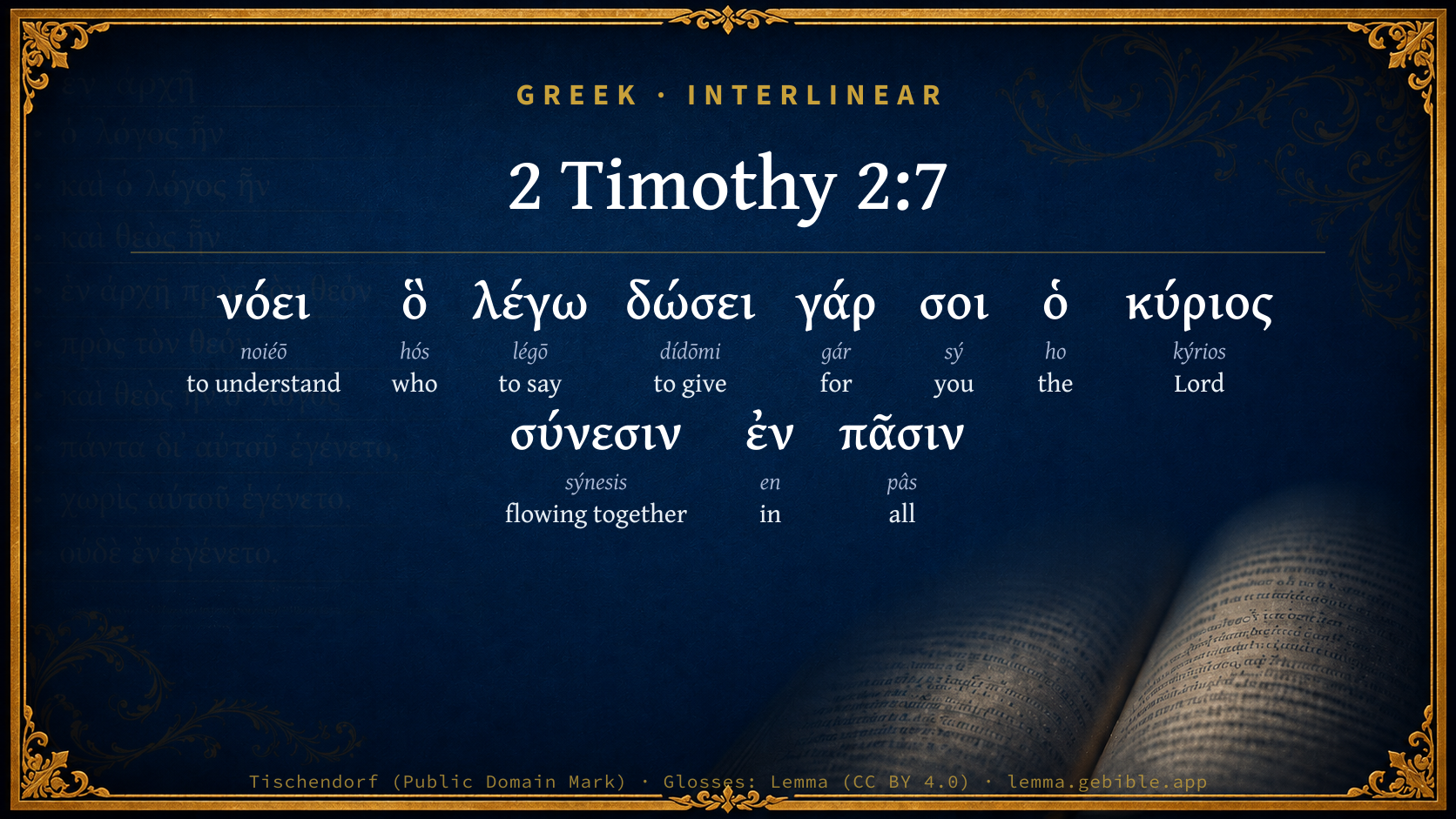
Greek (Tischendorf 8th ed.) 2 Timothy 2:7 appears in the Greek New Testament. The text above is from the Tischendorf 8th edition. Each word links to its Strong’s number and a concise gloss. Click any word for its full Thayer’s Greek Lexicon entry.
Download image
Cite this verse

2 Timothy 2:7 (World English Bible). Public Domain. Lemma interlinear Bible study tool, https://lemma.gebible.app/v/2-timothy/2/7.

Show BibTeX & RIS
BibTeX
RIS
English Translation
Consider what I say, and may the Lord give you understanding in all things.
World English Bible · Public Domain
Download a study sheet

One document with this verse’s original text, its word-by-word gloss line, the meaning frame, cross-references with their text, attributed commentary, and full source and license credits — printable, and it pastes into notes with its structure intact.

This verse Autodidact and up

Study sheet (.html) Plain text (.txt)

A passage Seminary Student

Up to 50 verses in one chapter. A passage sheet keeps up to 6 commentary sources and 12 cross-references per verse, in the order this page ranks them, and says so on the sheet whenever that leaves anything out. Ask for a single verse and you get the Autodidact verse sheet above.

Everything on this page stays free to read, with no account — the sheet is a download of what is already on screen, not access to it.

Want to remove ads? Support Godless Engineer
Compare translations 3

The same verse in 3 English versions, stacked beneath the original-language interlinear above. Click any original word for its lexicon entry.

Each is an independent rendering of the whole verse — the interlinear is not word-aligned to these translations.

Highlighted words mark where these versions differ — a whole-verse word diff, not a word-by-word alignment.

  • World English Bible Public Domain
    Consider what I say, and may the Lord give you understanding in all things.
  • King James Version Public Domain
    Consider what I say; and the Lord give thee understanding in all things.
  • unfoldingWord Literal Text CC BY-SA 4.0
    Think about what I am saying, for the Lord will give you understanding in everything.

unfoldingWord Literal Text — © unfoldingWord, licensed CC BY-SA 4.0. Word-aligned USFM3 via Door43 (git.door43.org/unfoldingWord/en_ult).

Versions to compare (up to 4)

3 of 4 selected

Show all 19 translations

Every available English version of this verse, each an independent rendering of the whole verse.

  • World English Bible Public Domain
    Consider what I say, and may the Lord give you understanding in all things.
  • Berean Standard Bible Public Domain
    Consider what I am saying, for the Lord will give you insight into all things.
  • Majority Standard Bible Public Domain
    Consider what I am saying, for the Lord will give you insight into all things.
  • King James Version Public Domain
    Consider what I say; and the Lord give thee understanding in all things.
  • American Standard Version (1901) Public Domain
    Consider what I say; for the Lord shall give thee understanding in all things.
  • Revised Version (1885) Public Domain
    Consider what I say; for the Lord shall give thee understanding in all things.
  • Geneva Bible (1599) Public Domain
    Consider what I say: and the Lord giue thee vnderstanding in all things:
  • Douay-Rheims (1899) Public Domain
    Understand what I say: for the Lord will give thee in all things understanding.
  • Young's Literal Translation Public Domain
    be considering what things I say, for the Lord give to thee understanding in all things.
  • Literal Standard Version CC BY-SA 4.0
    be considering what things I say, for the LORD gives to you understanding in all things.
  • Unlocked Literal Bible CC BY-SA 4.0
    Think about what I am saying, for the Lord will give you understanding in everything.
  • unfoldingWord Literal Text CC BY-SA 4.0
    Think about what I am saying, for the Lord will give you understanding in everything.
  • Darby Bible Public Domain
    Think of what I say, for the Lord will give thee understanding in all things.
  • World Messianic Bible Public Domain
    Consider what I say, and may the Lord give you understanding in all things.
  • Webster's Bible Public Domain
    Consider what I say; and the Lord give thee understanding in all things.
  • Free Bible Version CC BY-SA 4.0
    Think about what I'm telling you. The Lord will help you to understand all this.
  • Bible in Basic English Public Domain
    Give thought to what I say; for the Lord will give you wisdom in all things.
  • Text-Critical English NT CC BY 4.0
    Think about what I am saying. May the Lord give yoʋ understanding in everything.
  • Tyndale New Testament (1534) Public Domain
    Consyder what I saye. The lorde geve the vnderstondynge in all thynges.

Literal Standard Version (2020), Covenant Press — licensed CC BY-SA 4.0. Text via the HelloAO Bible API (eBible.org). Unlocked Literal Bible (unfoldingWord) — licensed CC BY-SA 4.0. Text via the HelloAO Bible API (eBible.org). unfoldingWord Literal Text — © unfoldingWord, licensed CC BY-SA 4.0. Word-aligned USFM3 via Door43 (git.door43.org/unfoldingWord/en_ult). Free Bible Version, Dr. Jonathan Gallagher — licensed CC BY-SA 4.0. Text via the HelloAO Bible API (eBible.org).

Word by word

More ways to search: Search by grammar → Find every occurrence → Compare this word →

Practice this passage: Drill this verse → Learn its vocabulary →

About this verse

These counts appear in no published source. They are computed here, from the morphology-tagged text and Lemma’s own curated glosses. What Lemma adds →

11
words
11
distinct lemmas
Pauline Epistles
section

Notable vocabulary

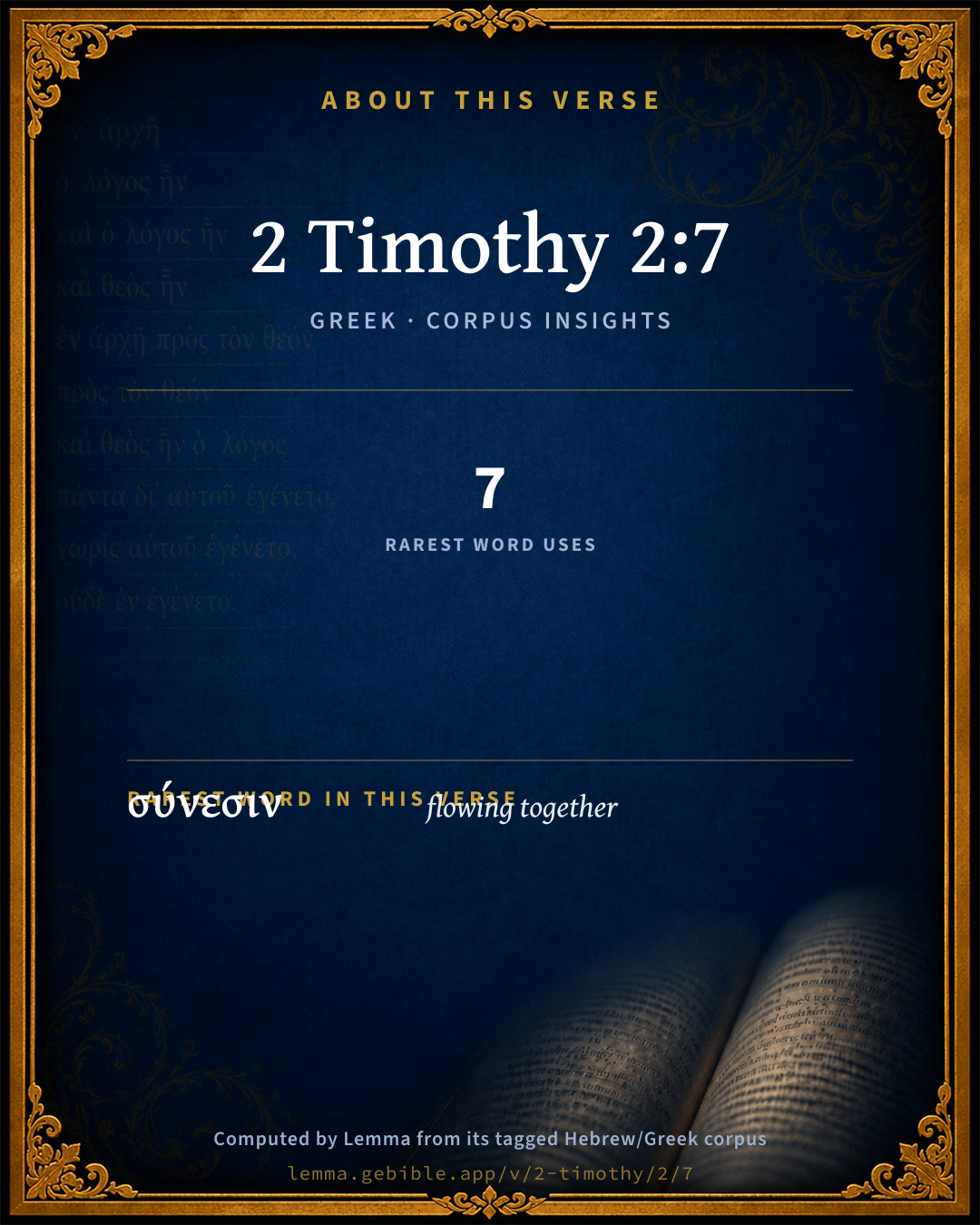
The rarest word here is σύνεσιν flowing together G4907 — appearing just 7 times in the whole Greek New Testament.

Shared distinctive vocabulary

σύνεσιν flowing together G4907 occurs in 7 verses of the Greek New Testament. Also found in:

Cross-references

38

Topical passages linked to 2 Timothy 2:7 in the Treasury of Scripture Knowledge — connected by theme and wording, ordered by reader-vote popularity; previews shown in the World English Bible.

  • James 1:5 But if any of you lacks wisdom, let him ask of God, who gives to all liberally and without reproach; and it will be given to him.
  • 1 John 5:20 We know that the Son of God has come, and has given us an understanding, that we know him who is true, and we are in him who is true, in his Son Jesus Christ. This is the true God, and eternal life.
  • Genesis 41:38–39 Pharaoh said to his servants, "Can we find such a one as this, a man in whom is the Spirit of God?"
  • Luke 24:45 Then he opened their minds, that they might understand the Scriptures.
  • Proverbs 2:3–6 Yes, if you call out for discernment, And lift up your voice for understanding;
  • John 14:26 But the Counselor, the Holy Spirit, whom the Father will send in my name, he will teach you all things, and will remind you of all that I said to you.
  • Ephesians 1:17–18 that the God of our Lord Jesus Christ, the Father of glory, may give to you a spirit of wisdom and revelation in the knowledge of him;
  • Luke 21:15 for I will give you a mouth and wisdom which all your adversaries will not be able to withstand or to contradict.
  • John 16:13 However when he, the Spirit of truth, has come, he will guide you into all truth, for he will not speak from himself; but whatever he hears, he will speak. He will declare to you things that are coming.
  • Colossians 1:9 For this cause, we also, since the day we heard this, don't cease praying and making requests for you, that you may be filled with the knowledge of his will in all spiritual wisdom and understanding,
  • 1 Timothy 4:15 Be diligent in these things. Give yourself wholly to them, that your progress may be revealed to all.
  • James 3:17 But the wisdom that is from above is first pure, then peaceful, gentle, reasonable, full of mercy and good fruits, without partiality, and without hypocrisy.
  • Psalms 119:125 I am your servant. Give me understanding, That I may know your testimonies.
  • Proverbs 24:32 Then I saw, and considered well. I saw, and received instruction:
  • Isaiah 28:26 For his God does instruct him aright, [and] does teach him.
  • Daniel 1:17 Now as for these four youths, God gave them knowledge and skill in all learning and wisdom: and Daniel had understanding in all visions and dreams.
  • Acts 7:10 and delivered him out of all his afflictions, and gave him favor and wisdom before Pharaoh, king of Egypt. He made him governor over Egypt and all his house.
  • 1 Corinthians 12:8 For to one is given through the Spirit the word of wisdom, and to another the word of knowledge, according to the same Spirit;
  • Philippians 4:8 Finally, brothers, whatever things are true, whatever things are honorable, whatever things are just, whatever things are pure, whatever things are lovely, whatever things are of good report; if there is any virtue, and if there is any praise, think about these things.
  • Hebrews 3:1 Therefore, holy brothers, partakers of a heavenly calling, consider the Apostle and High Priest of our confession, Jesus;
  • Hebrews 7:4 Now consider how great this man was, to whom even Abraham, the patriarch, gave a tenth out of the best spoils.
  • Hebrews 12:3 For consider him who has endured such contradiction of sinners against himself, that you don't grow weary, fainting in your souls.
  • Hebrews 13:7 Remember your leaders, men who spoke to you the word of God, and considering the results of their conduct, imitate their faith.
  • Exodus 36:1–2 "Bezalel and Oholiab shall work with every wise-hearted man, in whom Yahweh has put wisdom and understanding to know how to work all the work for the service of the sanctuary, according to all that Yahweh has commanded."
  • Numbers 27:16–17 Let Yahweh, the God of the spirits of all flesh, appoint a man over the congregation,
  • Deuteronomy 4:39 Know therefore this day, and lay it to your heart, that Yahweh he is God in heaven above and on the earth beneath; there is none else.
  • Deuteronomy 32:29 Oh that they were wise, that they understood this, That they would consider their latter end!
  • 1 Chronicles 22:12 May Yahweh give you discretion and understanding, and put you in charge of Israel; that so you may keep the law of Yahweh your God.
  • 1 Chronicles 29:19 and give to Solomon my son a perfect heart, to keep your commandments, your testimonies, and your statutes, and to do all these things, and to build the palace, for which I have made provision.
  • 2 Chronicles 1:8–12 Solomon said to God, You have shown great loving kindness to David my father, and have made me king in his place.
  • Psalms 64:9 All mankind shall be afraid. They shall declare the work of God, And shall wisely ponder what he has done.
  • Psalms 119:73 Your hands have made me and formed me. Give me understanding, that I may learn your commandments.
  • Psalms 119:144 Your testimonies are righteous forever. Give me understanding, that I may live.
  • Psalms 143:8–9 Cause me to hear your loving kindness in the morning, For I trust in you. Cause me to know the way in which I should walk, For I lift up my soul to you.
  • Isaiah 5:12 The harp, lyre, tambourine, and flute, with wine, are at their feasts; But they don't regard the work of Yahweh, Neither have they considered the operation of his hands.
  • Isaiah 1:3 The ox knows his owner, And the donkey his master's crib; But Israel doesn't know, My people don't consider.
  • Luke 9:44 "Let these words sink into your ears, for the Son of Man will be delivered up into the hands of men."
  • James 3:15 This wisdom is not that which comes down from above, but is earthly, sensual, and demonic.

Cross-references courtesy of OpenBible.info (CC BY 4.0).

Commentary

Notes on 2 Timothy 2:7 from classic Christian and Jewish commentators (each source and its license shown beneath its notes). The classic Christian expositions comment on the surrounding passage and are grouped to its opening verse, so a note may address several verses; the Jewish commentaries on the Tanakh (Rashi and others) are per-verse, so they appear only where the commentator wrote on this verse.

Lemma curates 59 commentaries, every one of them public domain or Creative Commons licensed, each selected and text-cleaned for this edition rather than reprinted as found. About our sources →

The Biblical Illustrator

Joseph S. Exell

2Ti_2:7

Consider what I say, and the Lord give thee understanding.

Reflection aids discernment

The better rendering gives, For the Lord will give thee. This gives also a better meaning: Make the effort to reflect; for if thou do, the Lord will give thee the discernment which thou needest. (E. H. Plumptre, D. D.)

Enlightenment aids personal application of truth

De Wette and others object to this verse, that it is impossible to suppose that St. Paul would imagine Timotheus so dull of apprehension as not to comprehend such obvious metaphors. But they have missed the sense of the verse, which is not meant to enlighten the understanding of Timotheus as to the meaning of the metaphors, but as to the personal application of them. (Conybeare and Howson.)

Consideration

I. Consideration is a duty to be practised.

1. For hath not God given man a discoursive faculty? What creature but he hath understanding, the angels only excepted? Were it not vanity to have an eye, and close it? an ear, and stop it? a hand, and not move it? And is it not wickedness to bare a faculty of discourse and not employ it? And wherein better than in consideration?

2. The life of man differs little from a beast without consideration? This soundly lessons those that approve of it but never practise it. Will you hear how they excuse, clear themselves?

(1) It is a difficult duty. Grant it be so, what then? Is it to be rejected? But what hard things dost thou use for the love of this world? Take thou the like pains in this profitable action.

(2) But I want time. Wonderful! Did God ever command a duty and allow no time to effect it? What! None to consider? to confer with thy Father? Lay thy hand upon thy mouth--say no more; for, for what end is the Sabbath?

(3) I have no convenient place. Imitate David, commune with thyself in bed. But my children cry. Then with Isaac, to the field; Hannah, to the Temple; or get thee to some garden, solitary mount, as did thy Master.

(4) I cannot bring my mind to it. Is it so with thee as thou sayest? Be the more humbled for it, and make that matter of consideration. Set thou thyself about this necessary duty; it shall recompense all thy painstaking. And--

(a) Wouldst thou love God? Then consider how He hath chosen thee, redeemed thee, given thee a being in these glorious days of the gospel, conferred on thee many earthly favours. Consider the many sins He hath pardoned, prevented; the evils spiritual, corporal, He hath removed; the petitions He hath granted; and of what great things thou art assured.

(b) Is thy faith feeble? Consider the depth of Gods mercy, the firmness of His promise, the might of His power, the unchangeableness of His nature. Shall not these relieve thee?

(c) Art thou impatient? Do afflictions overlade thee? Consider the greatness of thy sins, whereby thou hast deserved far worse evils. Think, and think often, that they come from the hand of thy heavenly Father; how He hath an eye to thy weakness, that they shall not exceed thy ability; and at their departure, like an overflowing rivers rich mud, leave a blessing behind them.

(d) And what external action can, without consideration, be well discharged? Did magistrates take up their minds, exercise themselves in this duty, would it not make them resolute for the execution of their function?

(e) Can ministers preach and neglect this action?

(f) Why do men hear much, understand little, and practise nothing? It is want of consideration. The most run to Gods house, as travellers to an inn, hear the Word as some well-told tale, not knowing, like that rude company, for what end they came together.

(g) In a word, consideration will give us matter of prayer, and kindle the little spark of grace within us, put us in mind of our vow in baptism, and provoke us to perform it--yea, all our promises.

II. GODS WORD IS TO RE CONSIDERED.

1. For the Authors sake. Is it not the Book of God?

2. And is not the matter holy, just, good?

3. What admirable effects will it work? David hereby became wiser than his teachers--a man according to Gods own heart.

III. Exhortation is to be seconded with prayer,

IV. God giveth man understanding,

V. Men of much knowledge may better their understanding. Knowledge in a threefold respect may be increased--

1. In the faculty.

2. In the object.

3. In the medium of it.

VI. In all divine truths we are to have understanding. Had not Moses a pattern of the Tabernacle--to a broom, a snuffer, a curtain-ring? Shall we, then, be ignorant of any one principle in the whole frame of religion? (J. Barlow, D. D.)

On hearing the Word

I. Show in what manner we are to hear the word.

1. Consider well the matter or import of what is spoken.

2. Attend to the truth and propriety of what is delivered.

3. Consider the weight and importance of what is delivered.

4. Consider the personal concern you have in the truths delivered.

II. The motives which should induce us well to consider what we hear.

1. Think in whose Name the ministers of the gospel speak, and whose Person they represent.

2. Consider the great end they aim at in their ministrations.

3. By the Word that we hear we shall be judged at the last day. (B. Beddome, M. A.)

The young invited to consider

I. I begin by calling your attention to a thought which you should never have wholly absent from your minds- namely, for what purpose has life been given you? For what other purpose than to prepare for eternity, by loving and serving your Creator now, that you may serve and enjoy Him for ever?

II. From this thought, then, which I beg you seriously to lay to heart, consider what provision God has made for your attaining this glorious end of your being.

III. And this introduces another thought of vast importance. Consider, then, what I say, as to the fitting period for making this surrender of yourselves to God. When should it be done? Our answer is, it cannot be done too early.

IV. Consider the happiness of a life thus early given to god, to be spent in His service, to end in His glory. (J. Haslegrave, M. A.)

Consideration

Consideration is the bed where the incorruptible seed is sown, and on the ground thus prepared the Sun of Righteousness doth shine, and by His warmth produces in the soul all manner of pleasant fruits. (Anthony Horneck.)

Men need instruction

A mans understanding is very much like a window. The sun-light is all of one colour; but all the light that goes through the window is not. Sometimes the audience have a scarf of yellow running over them, sometimes one of blue, and sometimes one of red, according as the window is painted. Mans reason being like a painted window, the light that goes through it and falls upon his conscience is bizarre, grotesque, wrinkled, bent, or distorted. I have known men whose understanding had in it hideous saints, crowned monsters, apocalyptic visions, and what not--things that took the colours which were painted on the window of that reason. It is very important, therefore, that men should be instructed. (H. W. Beecher.)

Gods teaching

When the Prince of Wales landed at Portsmouth, after his tour in India, I was in the crowd with my little boys; and as the Prince and his Princess and children drove past, I lifted my younger boy on my shoulder, and this enabled him to see better and further than the tallest person around us. So those whom God teaches and helps will discern better and further than those who just look out for themselves, or merely get information from others. (H. R. Burton.)

Instruction from God

When a sceptic once went to a Christian minister to have his doubts and difficulties solved, the minister asked, Have you gone and asked God, the fountain of light and the source of all wisdom, for the solution of your difficulties? On the perplexed mans replying he had not, the minister declined to try and assist him out of his perplexities till he had attended to this necessary and important duty. When we ask wisdom as well as light and instruction from God, He will give us mental and spiritual capacities, to prepare us for rightly apprehending truths; and He will also give us sufficient opportunities for gaining wisdom, and then aid and prosper us in our effort to acquire it. Wisdom is to knowledge like what the engineer is to the locomotive--a director, a controller, and a manager. Religion is the highest wisdom of all. (See Pro_4:7; Deu_32:29; Psa_90:12; Pro_2:6; Jam_1:5.) (H. R. Burton.)

Thinking of Christ

Dr. Cullis tells, in one of his reports, of an aged Christian who, lying on his death-bed in the Consumptives Home, was asked the cause of his perfect peace, in a state of such extreme weakness that he was often entirely unconscious of all around him. He replied, When I am able to think, I think of Jesus; and when I am unable to think of Him, I know He is thinking of me.

Remembrance of Christ

There is no Christianity where there is no loving remembrance of Christ. If your contact with Him has not made Him your friend, whom you can by no possibility forget, you have missed the best result of your introduction to Him. It makes one think meanly of the chief butler that such a personality as Josephs had not more deeply impressed him--that everything he heard and saw among the courtiers did not make him say to himself: There is a friend of mine in the prison hard by, that for beauty, wisdom, and vivacity would more than match the finest of you all. And it says very little for us if we can have known anything of Christ without seeing that in Him we have what is nowhere else, and without finding that He has become the necessity of our life, to whom we turn at every point. (Marcus Dods, D. D.)

The Biblical Illustrator, edited by Joseph S. Exell (c. 1880s–1900s) — public domain. Text from a community e-Sword module.

Bengel's Gnomon

Johann Albrecht Bengel

2Ti 2:7. Νόει) attend to, consider, what I say: σύνεσις, understanding, is of the divine gift; νοεῖν, to consider, is the part of a well-minded man. Paul says this, if you compare 2Ti 2:6 with 2Ti 2:5. If the husbandman (Timothy) hath (or shall have) laboured, then first he ought (he is entitled) to partake of the fruits (in which the resurrection of Christ abounds, 2Ti 2:8; 2Ti 2:11-12); but if this were the whole meaning of Paul, he would have said, τὸν μεταληψόμενον δεῖ κοπιᾷν. Therefore from this seventh verse we may gather that a thought rather different is involved in this expression, which amounts to this:—Paul trained the mind of Timothy, 2Ti 1:6; therefore fruits are chiefly due to him from Timothy. In this view, Paul does not openly require, as is necessary in addressing dull men, but by amphibology and enigma, that Timothy should ingenuously acknowledge and perform the duty; and this he does by three comparisons taken from the employment of the soldier, the wrestler, the husbandman.—δῴη γὰρ σοι, for may the Lord give to thee) The meaning is, He will give; there is thus a connection between consider and for; but affection adds the modus or ἧθος [see Append. on “Modalis Sermo.” Here the imperative mood expresses the feeling].—ὁ Κύριος, the Lord) Christ.—ἐν πᾶσι, in all things) He had already given him understanding in many things: this being taken for granted, Paul says, May He give it in all things.

Bengel's Gnomon of the New Testament — English translation (T&T Clark, Edinburgh, 1860) — public domain. Text from a community e-Sword module.

Meyer's Critical & Exegetical Commentary

Heinrich August Wilhelm Meyer

2Ti_2:7. As he has been expressing his exhortations in figurative gnomes, Paul thus continues: νόει, ὃ λέγω] which does not refer immediately to the thoughts expressed, as Heydenreich, Matthies, and others think, but to the form of expression. It does not mean, therefore: lay these exhortations to heart, but: mark or understand what I say (de Wette); comp. Mat_24:15; Eph_3:4; Eph_3:20; so, too, Hofmann, only that he for no sufficient reason refers the words merely to the last sentence. Plitt is of opinion that the apostle is intending thereby to give a quite general warning against misconceptions; but this would be an arbitrary disturbance of the connection of ideas.

To this exhortation Paul confidently adds that God will not fail to bestow on Timothy understanding in this and all other points; γάρ here, as elsewhere, is a particle of explanation.

ἐν πᾶσι belongs to this verse, and not, as Sam. Battier thinks, to the following one.

Meyer — Critical and Exegetical Commentary on the New Testament — English translation by Peter Christie, edited by Frederick Crombie (T&T Clark, 1880) — public domain. Text from a community e-Sword module.

Expositor's Greek Testament

ed. W. Robertson Nicoll

2Ti 2:7 . νόει ὃ λέγω : Intellige quae dico (Vulg.), Grasp the meaning , cautionary and encouraging, of these three similes. Cf. “I speak as to wise men; judge ye what I say” (1Co 10:15 ), and the use of the verb in 1Ti 1:7 .

δώσει , κ . τ . λ .: If you have not sufficient wisdom to follow my argument, “ask of God, who giveth to all men liberally” (Jas 1:5 ).

μνημόνευε Ἰησοῦν Χριστὸν Δαυείδ : These words form rather the conclusion of the preceding paragraph than the beginning of a new one. St. Paul in pressing home his lesson, passes from figures of speech to the great concrete example of suffering followed by glory. And as he has, immediately before, been laying stress on the certainty of reward, he gives a prominent place to ἐγηγερμένον ἐκ νεκρῶν . Jesus Christ, of the seed of David, “Himself man” (1Ti 2:5 ), is the ideal soldier, athlete, and field-labourer; yet One who can be an example to us. It is not the resurrection as a doctrinal fact (A.V.) that St. Paul has in mind, but the resurrection as a personal experience of Jesus Christ, the reward He received, His being “crowned with glory and honour, because of the suffering of death” (Heb 2:9 ). It is not τὸν Ἰησοῦν καὶ τὴν ἀνάστασιν (Act 17:18 ), but Ἰησοῦν ἐγηγερμένον , the perfect (as in 1Co 15:4 ; 1Co 15:12-14 ; 1Co 15:16-17 ; 1Co 15:20 ) preserving the notion of the permanent significance of that personal experience of Jesus. In the other passage, Rom 1:3 , in which St. Paul distinctly alludes to our Lord’s human ancestry, the phrase τοῦ γενομένου ἐκ σπέρματος Δαυεὶδ has a directly historical and polemical intention, as expressing and emphasising the human nature of Christ in antithesis to His Divinity. Here ἐκ σπερμ . Δ . merely expresses the fact of His humanity. We cannot affirm with certainty that the phrase has the Messianic import that Son of David has in the Gospels.

κατὰ τὸ εὐαγγέλιόν μου : The Gospel preached by me . See reff., and τὸ εὐ . τὸ εὐαγγελισθὲν ὑπʼ ἐμοῦ (Gal 1:11 ; 1Co 15:1 ), which of course is identical in substance with τὸ εὐ .… ὃ ἐπιστεύθην ἐγώ (1Ti 1:11 ). The verity both of Christ’s humanity and of His resurrection was emphasised in the Gospel preached by St. Paul. This is brought out by the punctuation of R.V.

The Expositor's Greek Testament, edited by W. Robertson Nicoll (1897–1910) — public domain. Text from a community e-Sword module.

Geneva Bible (1599)

Geneva Bible translators

All these things cannot be understood, and much less practiced, unless we ask of God and he gives us understanding.

Geneva Bible (1599) marginal notes — public domain. Text via Bolls.life.

Jamieson, Fausset & Brown

Robert Jamieson, A. R. Fausset & David Brown

Consider the force of the illustrations I have given from the soldier, the contender in the games, and the husbandmen, as applying to thyself in thy ministry.

and the Lord give, &c.--The oldest manuscripts read, "for the Lord will give thee understanding." Thou canst understand my meaning so as personally to apply it to thyself; for the Lord will give thee understanding when thou seekest it from Him "in all things." Not intellectual perception, but personal appropriation of the truths metaphorically expressed, was what he needed to be given him by the Lord.

Jamieson, Fausset & Brown — Commentary Critical and Explanatory on the Whole Bible (1871) — public domain (CC PDM 1.0). Text via the HelloAO Bible API.

Adam Clarke's Commentary

Verse 7. Consider what I say] Apply my metaphors and similitudes in a proper manner.

And the Lord give thee understanding] But instead of δωη, may he give, ACDEFG, several others, besides versions and fathers, have δωσει he will give. Consider thou properly, and God will give thee a proper understanding of all things that concern thy own peace, and the peace and prosperity of his Church. Think as well as read.

Adam Clarke's Commentary on the Bible (1810–1826) — public domain. Text from a community e-Sword/MySword module.

John Calvin's Commentaries

7 Understand what I say He added this, not on account of the obscurity of the comparisons which he has set forth, but that Timothy himself might ponder, how much more excellent is the warfare under the direction of Christ, and how much more abundant the reward; for, when we have studied it incessantly, we scarcely arrive at a full knowledge of it.

The Lord give thee understanding in all things The prayer, which now follows, is added by way of correction. Because our minds do not easily rise to that “incorruptible crown” (1 Corinthians 9:25) of the life to come, Paul betakes himself to God, to “give understanding” to Timothy. And hence we infer, that not less are we taught in vain, if the Lord do not open our understandings, than the commandments would be given in vain, if he did not impart strength to perform them. For who could have taught better than Paul? And yet, in order that he may teach with any advantage, he prays that God may train his disciple.

John Calvin's Commentaries (1540-1563) — public domain. Text from the Calvin Translation Society English edition (1840s-50s) via the Christian Classics Ethereal Library (ccel.org). Calvin's coverage is partial (roughly two-thirds of the Bible); uncommented books and verses are honest gaps, never fabricated. The 19th-century editor's footnotes and remarks are omitted so the notes are faithfully Calvin's own voice.

Ellicott's Commentary for English Readers

(7) Consider what I say; and the Lord give thee understanding in all things.—The older authorities read here will give; also instead of “and the Lord,” the translation should be, for the Lord. Thus the sentence should run: for the Lord will give thee understanding in all things. Some difficulty has been found in explaining exactly why, when we look at the foregoing words, Timothy should be so specially charged to consider St. Paul’s words here, and why the declaration respecting “understanding in all things” was made in this particular place. Theophylact suggested because the preceding exhortations were in the form of metaphors, “he spake all things in an enigmatical form:” but surely these metaphors were the reverse of obscure, and did not seem to need for their comprehension any special enlightenment; if then we refer the words of this verse exclusively to what precedes, it will be best to understand the charge of St. Paul, “Consider what I say,” &c., as directing Timothy’s attention to the personal application of each of the pictures, or metaphors. It seems, however, that the words “Consider,” &c., while referring to what he had said, belong also to the far weightier words he was about to write in the next sentence (2Ti_2:8). He is in this chapter exhorting Timothy to be strong in the faith in the face of many troubles. He has instanced to him earthly examples to show how success, even here, depends on enduring perseverance, and is now passing on to set before him other and far higher inducements for him “to be strong;” and between the first set of arguments and the second he bids him “Consider what I say” (part has been said, but yet other and deeper things are to follow). God will five him power to grasp their meaning in all their depth.

A Bible Commentary for English Readers, edited by Charles John Ellicott (1878–1897) — public domain. Text from a community e-Sword module.

The Cambridge Bible for Schools and Colleges

gen. ed. J. J. S. Perowne

7. Consider what I say] ‘Apply the parable’; for our Lord—the Great Teacher of parables—shall give thee understanding. The ms. authority requires the future indicative instead of aorist optative. The verb belonging to our substantive here ‘understanding’ is used by our Lord in Mat_13:51, after all His parables of the kingdom of heaven, ‘Have ye understood all these things?’ and the corresponding adjective in Mat_15:16 ‘And Peter answered and said unto Him, Declare unto us the parable. And He said, Are ye also even yet without understanding?’

The Cambridge Bible for Schools and Colleges (gen. ed. J. J. S. Perowne; Cambridge University Press, 1878–1918) — public domain. Text from a community e-Sword module.

John Gill's Exposition

Consider what I say,.... The advice given by the apostle to Timothy, to be strong in the grace of Christ; to commit the doctrines of the Gospel to faithful and able men; and to endure hardness for the sake of it: as also the characters which he bore as a soldier, a runner in a race, or a wrestler, and an husbandman; and therefore must not expect ease and rest, but war, difficulties, toil, and labour; and likewise under what titles Christ was to be regarded; as his General, and Captain of salvation, that commanded him; as the righteous Judge, that held the prize and crown for which he was running; and the chief Shepherd, who would reward all his labours; and moreover, the glorious reward of grace itself, he might expect, as eternal life, when he had fought the good fight the crown of righteousness, when he had finished his course, or run his race; and a crown of glory that fades not away, when the chief Shepherd should appear: and by putting him upon the consideration of these things, he suggests, that they were matters of moment and importance, and would be of great use to him in assisting and encouraging his faith, amidst all trials and exercises; and whereas they were expressed in figurative terms, taken from the soldier, the runner in a race, and the husbandman, they might not at first view be so easy to be understood; and therefore he would have him think of them, and meditate upon them, and weigh them in his mind; as well as he would not have him take things upon trust from him, but examine them whether they were right or not; though he doubted not but that they would be found to be agreeable to the standard of truth: wherefore he prays as follows,

and the Lord give thee understanding in all things; in all the above things, and in all others; in all the doctrines and mysteries of grace, and in all the rules of conduct in life. No man has of himself an understanding in spiritual things; this is the gift of God; and where it is given there is need of an increase of it, and always of such a prayer for it. The Alexandrian copy, Vulgate Latin, and Arabic versions, read, "the Lord will give thee", &c, and so the words are a promise, an encouragement to Timothy, to consider well of these things; for he might assure himself, that, in so doing, God would give him more understanding in them.

John Gill's Exposition of the Whole Bible (1746–1763) — public domain (CC PDM 1.0). Text via the HelloAO Bible API.

Trapp's Complete Commentary

John Trapp

7 Consider what I say; and the Lord give thee understanding in all things.

Ver. 7. Consider what I say] Apply to thyself these forementioned similes, and so buckle close to thy business.

And the Lord give thee] Unless God open Hagar’s eyes, she cannot see the fountain that is hard by. Rebecca cooks the venison, but Isaac only blesseth.

John Trapp, A Commentary or Exposition upon All the Books of the Old and New Testament (1647–1656) — public domain. Text from a community e-Sword module.

Albert Barnes' Notes on the Bible

Consider what I say; - see the notes at 1Ti 4:15. The sense is “Think of the condition of the soldier, and the principles on which he is enlisted; think of the aspirant for the crown in the Grecian games; think of the farmer, patiently toiling in the prospect of the distant harvest; and then go to your work with a similar spirit.” These things are worth attention. When the minister of the gospel thinks of his hardships, of his struggles against an evil world, and of his arduous and constant discouraging toil, let him think of the soldier, of the man who struggles for this world’s honors, and of the patient farmer - AND be content. How patiently do they bear all, and yet for what inferior rewards!

And the Lord give thee understanding in all things - Enable you to see the force of these considerations, and to apply them to your own case. Such are often the discouragements of the ministry; so prone is the mind to despondency, that we need the help of the Lord to enable us to apply the most obvious considerations, and to derive support from the most plain and simple truths and promises.

Albert Barnes' Notes on the Bible (1834–1885) — public domain. Text from a community e-Sword/MySword module.

Haydock's Catholic Bible Commentary

The Lord will give thee understanding.[4] In some Greek copies, may he give thee. (Witham)

===============================

[BIBLIOGRAPHY]

Dabit, Greek: dosei, which Dr. Wells prefers, though in more Greek copies be found Greek: don, det.

George Leo Haydock (1774–1849), Haydock's Catholic Family Bible and Commentary, 1859 edition — public domain. Excludes Psalms (Douay-Rheims chapter numbering differs from Protestant) and Deuterocanonical books (Catholic canon only).

Matthew Poole's English Annotations

Consider what I say; weigh these things with thyself in thy own thoughts.

And the Lord give thee understanding in all things; but thou wilt not effectually understand them without a Divine influence, opening thy mind to a comprehension of them, and thy heart to a reception of all these things, and all other things which it is reasonable for thee to know and understand.

Matthew Poole's English Annotations on the Holy Bible (1683–1685) — public domain. Text from a community e-Sword/MySword module.

Whedon's Commentary on the Bible

Daniel D. Whedon

7. Consider—A cautionary hint, not based upon the difficulty of interpreting the above figures, but upon the weightiness of the meaning they embrace. Hence they are to be revolved in the highest region of mind, and transformed into permanent principle of action.

Understanding—The highest intuitive penetration, the deepest spiritual insight, in all things of divine truth and ministerial management.

Daniel D. Whedon (gen. ed.), Commentary on the Old and New Testaments (1874–1909) — public domain. Text from a community e-Sword module.

The Pulpit Commentary

For the Lord shall give for and the Lord give, A.V Consider what I say. The apostle"s lessons had been given in parables or similitudes. He therefore begs Timothy to note them well, lest the application to himself should escape him, suggesting further that he should seek the necessary wisdom and understanding from God. So our Lord, at the end of the parables recorded in Matthew 13., says to his disciples in ver. 51, "Have ye understood all these things?" and elsewhere, "He that hath ears to hear, let him hear." Understanding (sunesin); one of the special gifts of the Spirit Isa_11:2, LXX; see. (Col_1:9 Col_2:2)

The Pulpit Commentary (1880–1919), ed. H.D.M. Spence-Jones & Joseph S. Exell — public domain. Text from a community e-Sword module.

Fairbairn on Ezekiel, Jonah & the Pastoral Epistles

Patrick Fairbairn

Ver. 7. Understand what I say—so the verb (νόει) properly means, Lat. intellige—not simply consider, or observe; and it was said with reference to the figurative language employed in the immediately preceding verses. “For since it was a parabolical mode of speech, it was necessary that he (Timothy) should be stirred up to search into the meaning of the hidden sense” (Theodoret). And he couples with the exhortation an expression of confidence that the requisite assistance would be given from above: for the Lord will give thee discernment in all things. The correct reading seems to be δώσει, not δῴη, having the support of א, A, C, D, F, with the Latin and Cop. versions; and the thing which the apostle expresses his confidence would be given to Timothy is σύνεσιν ἐν πᾶσιν, a complete understanding in all things—such an exact and comprehensive knowing as “grasps the connection, with its grounds and consequences” (Beck)—or a clear and intelligent discernment. Combining thus personal application with the assurance of divine grace, the apostle virtually said to Timothy, “Seek, and ye shall find.”

Patrick Fairbairn — An Exposition of Ezekiel (1851), Jonah (1849), and The Pastoral Epistles (1874) — public domain. Text from a community e-Sword module.

The People's New Testament

B. W. Johnson

7–10. Consider what I say. Reflect, and take in its meaning.

B. W. Johnson's The People's New Testament with Notes (1889–1891) — public domain. Electronic text from the Christian Classics Ethereal Library (CCEL) ThML edition.

Cambridge Greek Testament for Schools and Colleges

7. ὅ. So א*ACGP &c.; ἅ, the reading of the rec. text, is supported by אcD2EKL, the Latin and the Bohairic versions; it is probably an explanatory correction.

δώσει. This has the preponderance of authorities in its favour, viz. אAC*D2EG, the Latin and the Bohairic versions. δῴη, the reading of the rec. text, is probably a reminiscence of ch. 2Ti 1:16; 2Ti 1:18; it is supported by CcKLP &c.

7. νόει δ λέγω. Understand what I say, sc. what has just been said about the hardness which the ‘good soldier’ of Christ must face. νοέω seems to mean ‘understand’ or ‘grasp the meaning of’ (as in 1Ti 1:7) rather than ‘consider’; though no doubt attention is a necessary condition of understanding.

δώσει γάρ σοι κ.τ.λ., for the Lord, sc. Christ, will give thee understanding in all things. See critical note on δώσει, and cp. for σύνεσις Eph 3:4; Col 1:9; σύνεσις is the faculty of ‘right judgement’ and is defined by Aristotle (Eth. Nic. VI. 10) as consisting ἐν τῷ χρῇσθαι τῇ δόξῃ ἐπὶ τὸ κρίνειν περὶ τούτων, περὶ ὧν ἡ φρόνησίς ἐστιν, ἄλλου λέγοντος, καὶ κρίνειν καλῶς.

Cambridge Greek Testament for Schools and Colleges (Cambridge University Press, 1896; 21 vols, various authors incl. Carr, Maclear, Plummer, Farrar, Lumby, Moule, M. R. James, Simcox) — public domain. Text from a community e-Sword module.

Alford’s Greek Testament

Henry Alford

7.] Understand (νοῖεν … “ist die innerlich tiefe, sittlich ernste Verstandesthätigkeit.” Beck, Biblische Seelenlehre, p. 56. It is the preparatory step to συνιέναι,—id. ib. note, and p. 59,—which is “ein den Zusammenhang mit seinen Grunden und Folgen begreifendes Erkennen”) what I say (ἐπεὶ οὖν τὰ παραδείγματα ἔθηκε τὸ τῶν στρατιωτῶν κ. ἀθλητῶν κ. γεωργῶν, καὶ πάντα ἁπλῶς αἰνιγματωδῶς … ἐπήγαγε, νόει ἃ λέγω, Chrys.: so also Thdrt., all.: not as Calv., who denies the above, “hoc non addidit propter similitudinum obscuritatem, sed ut ipse suggereret Timotheo quanto præstantior sit sub Christi auspiciis militia, et quanto amplior merces:” this would not agree with σύνεσιν δώσει): for the Lord (Christ) shall give thee thorough understanding (on σύνεσις, see citation from Beck above) in all things (i.e. thou art well able to penetrate the meaning and bearing of what I say: for thou art not left to thyself, but hast the wisdom which is of Christ to guide thee. There is perhaps a slight intimation that he might apply to this fountain of wisdom more than he did:—‘the Lord, if thou seekest it from Him’).

Henry Alford, The Greek Testament (1849–1861) — public domain. Text from a community e-Sword module.

International Critical Commentary

7. νόευ] cf. Mar 13:14, Eph 3:4, Rev 13:9; and for the appeal, 1Co 10:15, κρίνατε ὑμεῖς ὅ φημι. δώσει; cf. Jas 1:5. Ign. ad Polyc. 1, αἰτοῦ σύνεσιν πλείονα ἧς ἔχεις. He does not think it wise to explain his allusion too explicitly. Verbum sapienti.

International Critical Commentary — older volumes (1896–1929), various authors — public domain. Text from a community e-Sword module.

Vincent's Word Studies in the New Testament

Marvin R. Vincent

Consider [νοει] . Better, understand.

And the Lord give thee understanding [δωσει γαρ ο κυριος συνεσιν] . More correctly, for the Lord shall give. 134 For sunesin understanding, see on Mr 12:33; Luk 2:47; Col 1:9.

Marvin R. Vincent, Word Studies in the New Testament (1887–1900) — public domain. Text from a community e-Sword/MySword module.

Lesson kit

Teaching starters — assembled from the data on this page, not authored interpretation. Every prompt links to the verse data it draws on. Edit before teaching.

2 Timothy, in the Pauline Epistles, opens this verse with 11 words (11 distinct Greek lemmas). Its most distinctive word is sýnesis (“flowing together”). A historical commentator’s framing appears above. Read the whole chapter for the surrounding context.

Discussion questions

  1. What does “flowing together” (sýnesis) contribute to the verse as a whole?
  2. How does Mark 12:33, which shares the word «flowing together», read alongside this verse?
  3. The translations on this page render this verse differently — a whole-verse word diff, not a word-by-word alignment. What might account for the different wordings?
  4. Compare how The Biblical Illustrator and Bengel's Gnomon read this verse. Where do they agree or differ?

Things to notice

Reading settings

Reading text

Shown beneath each verse's original-language words.

Old Testament
Old Testament edition

Read the OT as the Masoretic Hebrew (MT) or the Greek Septuagint (LXX).

English shown for the Greek Septuagint (in the Hebrew ↔ Greek comparison).

Comparing translations? Open the Compare panel on any verse page to stack up to four side by side.