1 Thessalonians 5:7

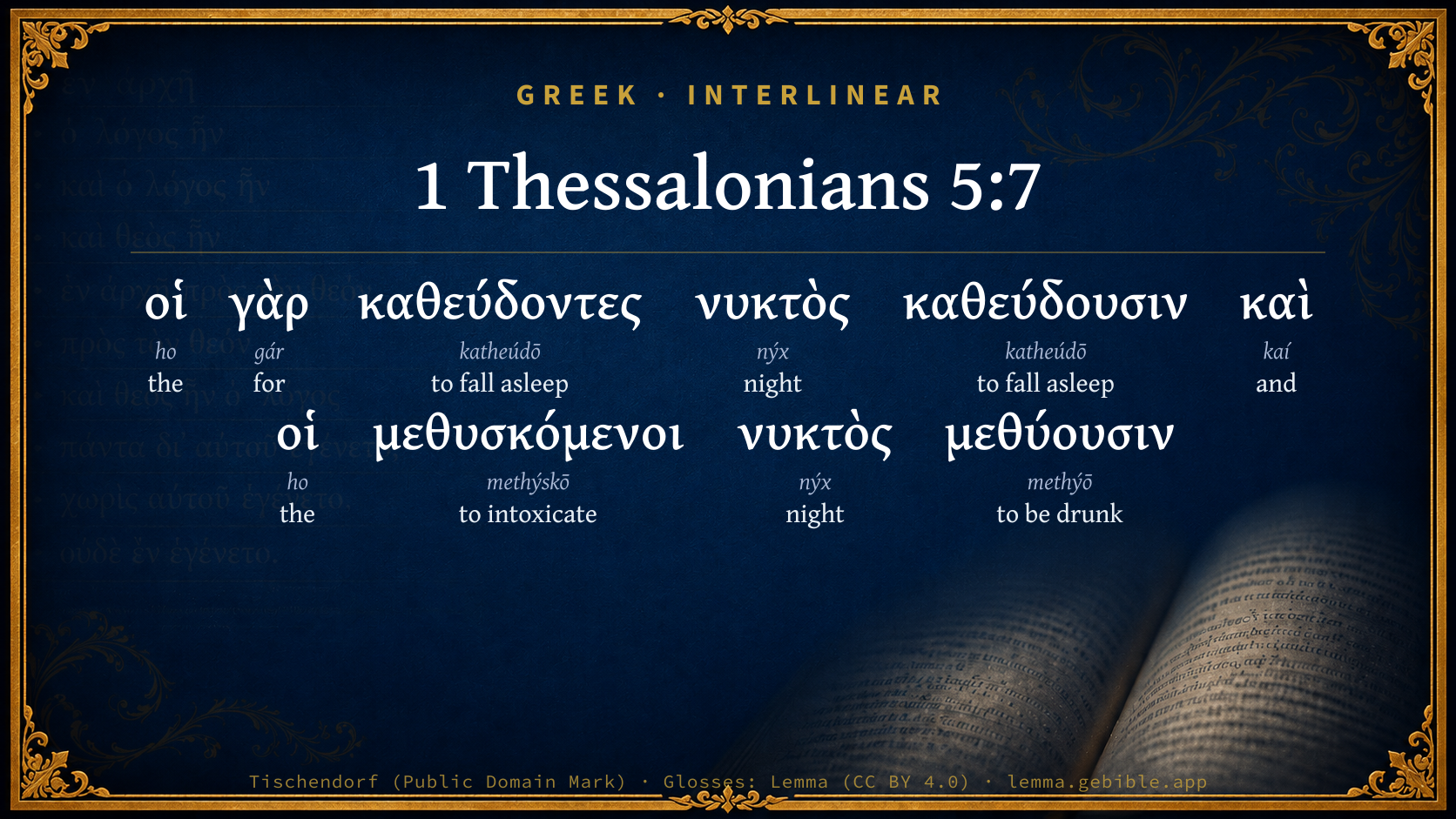
Greek (Tischendorf 8th ed.) 1 Thessalonians 5:7 appears in the Greek New Testament. The text above is from the Tischendorf 8th edition. Each word links to its Strong’s number and a concise gloss. Click any word for its full Thayer’s Greek Lexicon entry.
Download image
Cite this verse

1 Thessalonians 5:7 (World English Bible). Public Domain. Lemma interlinear Bible study tool, https://lemma.gebible.app/v/1-thessalonians/5/7.

Show BibTeX & RIS
BibTeX
RIS
English Translation
For those who sleep, sleep in the night, and those who are drunken are drunken in the night.
World English Bible · Public Domain
Download a study sheet

One document with this verse’s original text, its word-by-word gloss line, the meaning frame, cross-references with their text, attributed commentary, and full source and license credits — printable, and it pastes into notes with its structure intact.

This verse Autodidact and up

Study sheet (.html) Plain text (.txt)

A passage Seminary Student

Up to 50 verses in one chapter. A passage sheet keeps up to 6 commentary sources and 12 cross-references per verse, in the order this page ranks them, and says so on the sheet whenever that leaves anything out. Ask for a single verse and you get the Autodidact verse sheet above.

Everything on this page stays free to read, with no account — the sheet is a download of what is already on screen, not access to it.

Want to remove ads? Support Godless Engineer
Compare translations 3

The same verse in 3 English versions, stacked beneath the original-language interlinear above. Click any original word for its lexicon entry.

Each is an independent rendering of the whole verse — the interlinear is not word-aligned to these translations.

Highlighted words mark where these versions differ — a whole-verse word diff, not a word-by-word alignment.

  • World English Bible Public Domain
    For those who sleep, sleep in the night, and those who are drunken are drunken in the night.
  • King James Version Public Domain
    For they that sleep sleep in the night; and they that be drunken are drunken in the night.
  • unfoldingWord Literal Text CC BY-SA 4.0
    For the ones sleeping sleep at night, and the ones getting drunk get drunk at night.

unfoldingWord Literal Text — © unfoldingWord, licensed CC BY-SA 4.0. Word-aligned USFM3 via Door43 (git.door43.org/unfoldingWord/en_ult).

Versions to compare (up to 4)

3 of 4 selected

Show all 19 translations

Every available English version of this verse, each an independent rendering of the whole verse.

  • World English Bible Public Domain
    For those who sleep, sleep in the night, and those who are drunken are drunken in the night.
  • Berean Standard Bible Public Domain
    For those who sleep, sleep at night; and those who get drunk, get drunk at night.
  • Majority Standard Bible Public Domain
    For those who sleep, sleep at night; and those who get drunk, get drunk at night.
  • King James Version Public Domain
    For they that sleep sleep in the night; and they that be drunken are drunken in the night.
  • American Standard Version (1901) Public Domain
    For they that sleep sleep in the night: and they that are drunken are drunken in the night.
  • Revised Version (1885) Public Domain
    For they that sleep sleep in the night; and they that be drunken are drunken in the night.
  • Geneva Bible (1599) Public Domain
    For they that sleepe, sleepe in the night, and they that be drunken, are drunken in the night.
  • Douay-Rheims (1899) Public Domain
    For they that sleep, sleep in the night; and they that are drunk, are drunk in the night.
  • Young's Literal Translation Public Domain
    for those sleeping, by night do sleep, and those making themselves drunk, by night are drunken,
  • Literal Standard Version CC BY-SA 4.0
    for those sleeping, sleep by night, and those making themselves drunk, are drunken by night,
  • Unlocked Literal Bible CC BY-SA 4.0
    For those who sleep do so at night, and those who get drunk do so at night.
  • unfoldingWord Literal Text CC BY-SA 4.0
    For the ones sleeping sleep at night, and the ones getting drunk get drunk at night.
  • Darby Bible Public Domain
    for they that sleep sleep by night, and they that drink drink by night;
  • World Messianic Bible Public Domain
    For those who sleep, sleep in the night; and those who are drunk are drunk in the night.
  • Webster's Bible Public Domain
    For they that sleep, sleep in the night; and they that are drunken, are drunken in the night.
  • Free Bible Version CC BY-SA 4.0
    For it's during the night that people sleep; and it's at night that they get drunk.
  • Bible in Basic English Public Domain
    For those who are sleeping do so in the night; and those who are the worse for drink are so in the night;
  • Text-Critical English NT CC BY 4.0
    For those who sleep, sleep at night; and those who get drunk, get drunk at night.
  • Tyndale New Testament (1534) Public Domain
    For they that slepe slepe in the nyght: and they that be dronken are dronken in the nyght.

Literal Standard Version (2020), Covenant Press — licensed CC BY-SA 4.0. Text via the HelloAO Bible API (eBible.org). Unlocked Literal Bible (unfoldingWord) — licensed CC BY-SA 4.0. Text via the HelloAO Bible API (eBible.org). unfoldingWord Literal Text — © unfoldingWord, licensed CC BY-SA 4.0. Word-aligned USFM3 via Door43 (git.door43.org/unfoldingWord/en_ult). Free Bible Version, Dr. Jonathan Gallagher — licensed CC BY-SA 4.0. Text via the HelloAO Bible API (eBible.org).

Word by word

More ways to search: Search by grammar → Find every occurrence → Compare this word →

Practice this passage: Drill this verse → Learn its vocabulary →

About this verse

These counts appear in no published source. They are computed here, from the morphology-tagged text and Lemma’s own curated glosses. What Lemma adds →

10
words
7
distinct lemmas
Pauline Epistles
section

Notable vocabulary

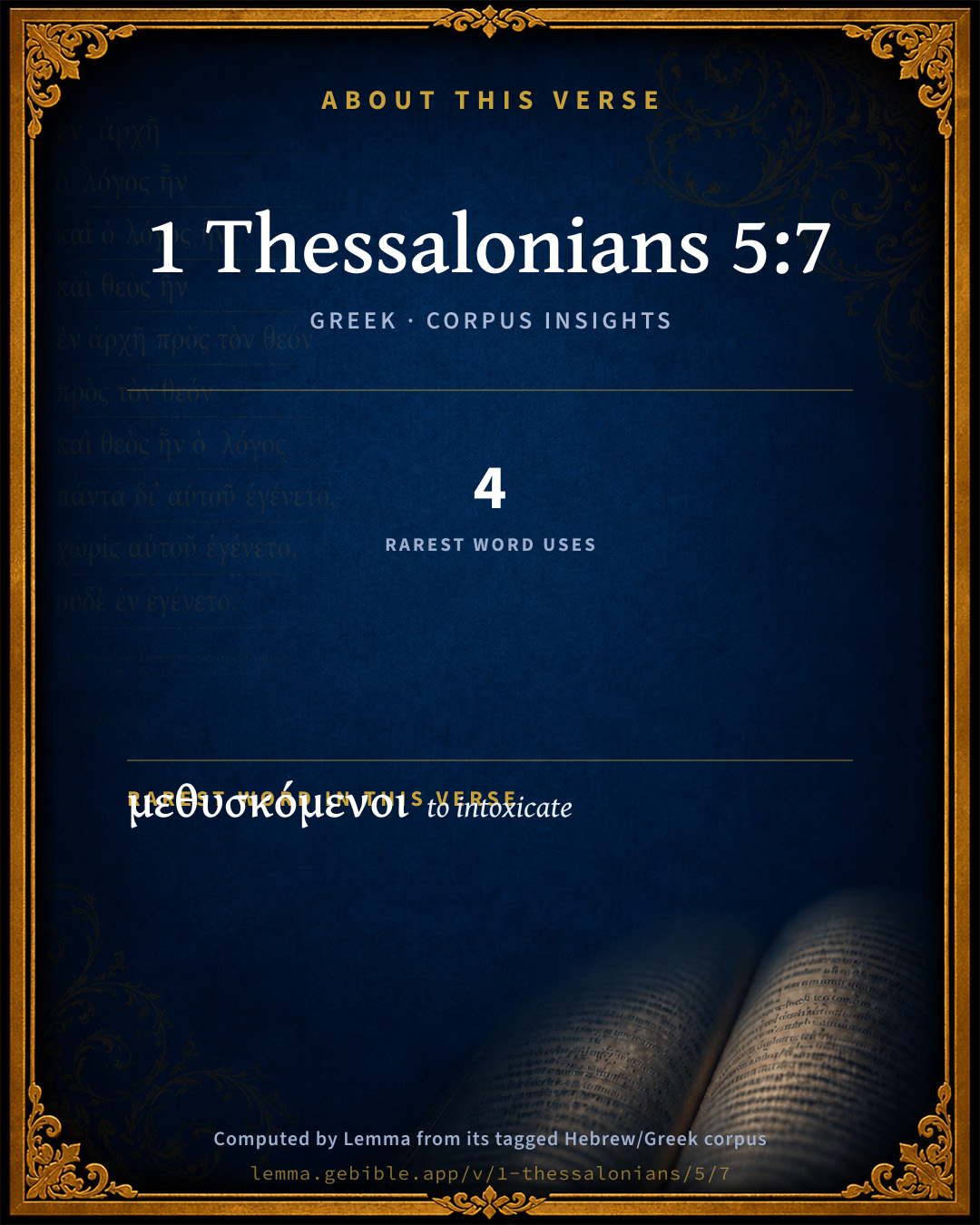
The rarest word here is μεθυσκόμενοι to intoxicate G3182 — appearing just 4 times in the whole Greek New Testament.

Shared distinctive vocabulary

μεθυσκόμενοι to intoxicate G3182 occurs in 4 verses of the Greek New Testament. Also found in:

Repetition

Words recur within this verse:

  • καθεύδοντες to fall asleep G2518 ×2
  • νυκτὸς night G3571 ×2
  • οἱ the G3588 ×2

Cross-references

12

Topical passages linked to 1 Thessalonians 5:7 in the Treasury of Scripture Knowledge — connected by theme and wording, ordered by reader-vote popularity; previews shown in the World English Bible.

  • Romans 13:13 Let us walk properly, as in the day; not in reveling and drunkenness, not in sexual promiscuity and lustful acts, and not in strife and jealousy.
  • 1 Corinthians 15:34 Wake up righteously, and don't sin, for some have no knowledge of God. I say this to your shame.
  • 2 Peter 2:13 receiving the wages of unrighteousness; people who count it pleasure to revel in the day-time, spots and blemishes, reveling in their deceit while they feast with you;
  • Acts 2:15 For these aren't drunken, as you suppose, seeing it is only the third hour of the day.
  • Daniel 5:4–5 They drank wine, and praised the gods of gold, and of silver, of brass, of iron, of wood, and of stone.
  • Proverbs 23:29–35 Who has woe? Who has sorrow? Who has strife? Who has complaints? Who has needless bruises? Who has bloodshot eyes?
  • Isaiah 21:4–5 My heart flutters, horror has frightened me; the twilight that I desired has been turned into trembling to me.
  • Luke 21:34–35 "So be careful, or your hearts will be loaded down with carousing, drunkenness, and cares of this life, and that day will come on you suddenly.
  • Ephesians 5:14 Therefore he says, "Awake, you who sleep, and arise from the dead, and Christ will shine on you."
  • 1 Samuel 25:36–37 Abigail came to Nabal; and, behold, he held a feast in his house, like the feast of a king; and Nabal's heart was merry within him, for he was very drunken: therefore she told him nothing, less or more, until the morning light.
  • Job 4:13 In thoughts from the visions of the night, When deep sleep falls on men,
  • Job 33:15 In a dream, in a vision of the night, When deep sleep falls on men, In slumbering on the bed;

Cross-references courtesy of OpenBible.info (CC BY 4.0).

Commentary

Notes on 1 Thessalonians 5:7 from classic Christian and Jewish commentators (each source and its license shown beneath its notes). The classic Christian expositions comment on the surrounding passage and are grouped to its opening verse, so a note may address several verses; the Jewish commentaries on the Tanakh (Rashi and others) are per-verse, so they appear only where the commentator wrote on this verse.

Lemma curates 59 commentaries, every one of them public domain or Creative Commons licensed, each selected and text-cleaned for this edition rather than reprinted as found. About our sources →

The Biblical Illustrator

Joseph S. Exell

1Th_5:7

They that sleep sleep in the night, and they that be drunken are drunken in the night

A manifold drunkenness

The drunkenness here spoken of is not that from wine only, but that also which comes of all vices.

For riches and the desire of wealth is a drunkenness of the soul, and so carnal lust; and every sin you can name is a drunkenness of the soul. On what account, then, has he called vice sleep? Because, in the first place, the vicious man is inactive with respect to virtue; again, because he sees every thing as a vision; he views nothing in its true light, but is full of dreams and oftentimes of unreasonable actions; and if he sees anything good he has no firmness. Such is the present life. It is full of dreams and fantasy. Riches are a dream, and glory, and everything of that sort. He who sleeps sees not things that are and have a real subsistence, but things that are not he fancies as things that are. Such is vice and the life that is passed in vice. It sees not things that are, but things that are fleeting and fly away, and that soon. (Chrysostom.)

The Christian view of drunkenness

In Thessalonica Paul had his first experience of an European rabble. The Jews employed the tactics by which every sinking cause has fought for life. Lewd fellows of the baser sort who were not unaccustomed to the sight of the world turned upside down, loungers confused oftener than not with drink, and could be bought for any shameful purpose, children of the darkness and the night, set the city in an uproar. There is no need to further describe these birds of evil omen; the scum and the froth are the same everywhere and all time through. But these miserable creatures were not always so. The wildest of that mob was once a happy, innocent child. Some of them eventually came to be children of the light. And such may every drunkard become through Christ.

I. The assertion which Paul makes. Drunken in the night.

1. The words were probably meant to be taken literally. Man goeth forth to his work and to his labour until the evening. There is little drunkenness till then. Between this and midnight the work is done (Rom_13:13).

2. But they were also meant to bear a figurative application. The night was the whole life of the world, of the nation, of the man, until Christ rose like a glorious sun (1Pe_4:3).

(1) Explain the mystery that a habit so degrading should from the earliest time have obtained so firm a hold. What originates drunkenness? Night, says Paul, in the intellectual and moral nature. Pauls method, and that of the gospel, differs from that of many temperance advocates in going deeper. Get rid of drunkenness, urges the reformer, and you will get rid of most of your crimes. Get rid of the night, says Paul, and you will get rid of drunkenness.

(2) What night? The night of ignorance, says one--let the man be taught; the night of discomfort--give the man a happy home; of solitude--find the man companions; of dullness--furnish wholesome excitement; of idleness--keep the man employed. Well, these are shadows of the night, but not night itself. Pauls night is that of Christlessness. Without God and hope in the world. Jesus said, I am the Light of the world, etc. (Joh_8:12).

(3) There is one thing which the prince of darkness cannot do when attacked in his citadel of drunkenness. If you say that education will cure this evil, he will take the intellectual powers and stimulate them into fascinating play by the wine cup. He can furnish the public house with comfort, provide companionships, give excitement, and keep the hands busy. Try every weapon, but remember that the public house will catch the cue and point them at your own heart. But there is one power to which the devil will not appeal, and that is Christ (1Jn_3:8).

II. The appeal which Paul urges. Let us who are of the day be sober.

1. Paul was addressing Christians. A line was then drawn, clear cut, between the believer and the unbeliever. Now things have got somewhat mixed. The sad truth that we have to face is that it is an easier thing for thousands around us to grow up in drunken than in sober habits. Your free library may not be open on Sunday, but by command of government your public houses must. Whatever weight your legislation has ever the first day of the week is in favour of drunkenness rather than intelligence. Moreover, you cannot choose your neighbours or keep your children from contamination. Count and contrast the public houses and sanctuaries; which has the need of bell, ritual, sensational element to attract to its services lewd fellows of the baser sort? In one large town in England 10 percent go to a place of worship once a week, and 25 percent go every day to the public house.

2. Under the deep conviction that this vice must be grappled with, barriers are built behind which the young and tempted may find shelter. The pledge, guild, league, and society are all to be honoured. But they are nothing to the Christian for his own sake. He has higher ground to occupy. He dreads not so much breaking his bond as sinning against God. Christ outweighs every other consideration.

3. High ground this. Yes, and we dare not lower it. Prove that drunkenness is profitable to the National Exchequer, that it is a characteristic of the best workman, that it is the fashion, which are all dead against the evidence; but I am not careful to answer in this matter. The end of life is not an overflowing exchequer, a ready hand, an entrance into society. What shall it profit a man? etc. The drunkard is degraded, unsafe; therefore bind him with pledges and securities. But I look beyond the present, beyond the beggared home, the loathsome death, to something worse--damnation. In that city where there is no night there is no drunkard. Conclusion: Here is a message for all mankind (1Th_5:9-10). (T. H. Pattison.)

Prayer against drunkenness

Dr. MCosh tells the story of a negro who prayed earnestly that he and his coloured brethren might be preserved from what he called their upsettin sins. Brudder, said one of his friends at the close of the meeting, you aint got de hang of dat ar word. Its besetting, not upsetting. Brudder, replied the other, if dats so, its so. But I was prayin de Lord to save us from the sin of intoxification, and if dat aint a upsettin sin, I dunno what am.

The Biblical Illustrator, edited by Joseph S. Exell (c. 1880s–1900s) — public domain. Text from a community e-Sword module.

Joseph Benson's Commentary

1Th 5:7-11. For they that sleep, sleep in the night, &c. — Night is the time for sleep, and they that are guilty of drunkenness, gluttony, and other vices of intemperance, generally choose to hide them under the cover of darkness; and if we were still in the night of heathenish ignorance, and in a state of spiritual blindness and unbelief, our insensibility of divine things, our unwatchfulness, sloth, and indolence would have some excuse: but being of the day — And brought out of darkness into Christian and marvellous light, we have none: let us, therefore, be sober — That is, temperate, chaste, holy, and wakeful, as νηφωμεν signifies; putting on the breast-plate of faith and love — As a defence of the heart, the seat of the passions; and for a helmet — Which will defend the head, the seat of reason; the hope of final, eternal salvation. The breast and head being particularly exposed in battle, and wounds in these parts being extremely dangerous, the ancients carefully defended them by armour, to which the apostle here compares the Christian virtues of faith, love, and hope. In the parallel passage, Eph 6:14, the expression, instead of the breast- plate of faith and love, is the breast-plate of righteousness; to show that the righteousness of a Christian consists in faith and love: a breast-plate which, being of a truly heavenly fabric, will, if put on, and not afterward put off, render the heart, the seat of the affections, invulnerable. The apostle’s meaning, stripped of the metaphor, is this: That, to defend our affections against the impressions of outward and sensible objects, nothing is so effectual as faith in Christ, and in the declarations and promises of his gospel, and love to God and man. The head being the seat of those thoughts and imaginations, on which the affections and passions in a great measure depend, it must be of great importance to defend it against the entrance of such thoughts and imaginations as have any tendency to excite bad affections or carnal desires. But for that purpose, nothing is better than to have the head so filled with the glorious hope of the salvation offered to us in the gospel, as to exclude all vain thoughts, imaginations, and expectations whatever. This hope therefore is most properly and elegantly termed the Christian’s helmet. This exhortation to the Thessalonian believers teaches us that the sons of light must not only watch but fight. See note on Eph 6:11-18.

For God hath not appointed us to wrath — As he hath the finally impenitent, unbelieving, and disobedient: for the design of God in sending his Son was not to condemn but to save the world; and therefore they who are appointed to wrath, are only such as through impenitence, unbelief, and disobedience, reject him and his gospel; but to obtain salvation — Present and eternal; by faith in our Lord Jesus Christ — Who hath procured it for all true persevering believers, whose faith worketh by love; and will assuredly at length bestow it upon them; of which he hath given us full proof, in that he not only became incarnate, and subjected himself to the infirmities of our flesh, and to the many burdens and sufferings of this mortal life, for our sakes, but even died in ignominy and torture on the cross for us; that whether we wake or sleep, live or die, we should live together with him — In other words, That while we live, and when we die, the life and happiness of our immortal souls should be secure in a union with him, which death itself shall not be able to dissolve. Some interpret the expression, whether we wake or sleep, as signifying, “whether Christ come in the night, when we are sleeping on our beds, or in the day, when we are awake and busy in the pursuit of our common affairs.” But, as Doddridge has properly observed, since sleeping had just before been put for death, it seems more natural to interpret this clause as speaking of the state of believers, whether alive or dead: and then it must be considered as containing a direct proof of the life of the soul while the body is sleeping in the grave. “God forbid,” adds that pious divine, “that any should understand these words as intimating that Christ’s death is intended to secure our salvation, whether we take a watchful care of it or not. Yet, alas! the generality of Christians (so called) live as if that were the genuine and only interpretation.” Wherefore comfort yourselves together — Παρακαλειτε αλληλους comfort, or exhort one another, under the various afflictions of life, and edify — Εις τον ενα, each the other; in Christian knowledge and holiness, or endeavour to promote the work of grace in one another; even as also I know ye do — How well would it be, if professing Christians in general would emulate the character which the apostle gives to these believers at Thessalonica, if, “entering into each other’s true interests, as Chandler observes, they would banish from their conversation that calumny, slander, folly, and flattery which engross so much of this short transitory life, and by discoursing of things of substantial worth, endeavour to fortify each other against the snares of life, and those innumerable temptations which lie in wait to ruin us. With what comfort should we meet each other at the great day, were we, on that occasion, able to recollect that in general we had managed our conversation to our mutual advantage? For we should then be sensible that in some measure we owe our glory to our concern for, and fidelity to, each other. Besides, the remembrance of this would enlarge the love of the saints to each other in the future state.”

Joseph Benson's Commentary on the Old and New Testaments (1811–1818) — public domain. Text from a community e-Sword module.

Tyndale Open Study Notes

Tyndale Open Resources

5:7 Sleep refers to moral indifference (5:6), and drunk is a metaphor for those who do not exercise self-control; they will be surprised by the day of the Lord (5:4; Matt 24:48-51).

Tyndale Open Study Notes — © Tyndale Open Resources, licensed CC BY-SA 4.0. Text via the HelloAO Bible API.

Bengel's Gnomon

Johann Albrecht Bengel

1Th 5:7. Μεθυσκόμενοι—μεθύουσιν, those who are drunken, are drunken) Μεθύσκομαι denotes the act, μεθύω, the state or habit; so in καθεύδοντες—καθεύδουσι, the Ploce[29] is apparent. For first, ΚΑΘΕΎΔΟΝΤΕς has the inchoative power, falling into sleep; then καθεύδουσι expresses continuance, they go on in sleep.—νυκτὸς) in the night time, for the most part. Even constant somnolency and drunkenness render the very night worse. Such persons are averse (shrink) from the day.

[29] The figure by which the same word is twice put, once in the simple sense, next to express an attribute of it. Append.—ED.

Bengel's Gnomon of the New Testament — English translation (T&T Clark, Edinburgh, 1860) — public domain. Text from a community e-Sword module.

Meyer's Critical & Exegetical Commentary

Heinrich August Wilhelm Meyer

1Th_5:7. A reason for the exhortation in 1Th_5:6 by a reference to the practice of the outward life.

νυκτὸς μεθύουσιν] refers to the known custom of devoting the evening and the night for debauchery.

μεθύσκεσθαι is entirely synonymous with μεθύειν. It is not to be assumed that the change of the verb is intentional, in order to denote with the first the act of getting drunk, and with the second the state of being so (Macknight); since, as also the analogy of the first half of the sentence proves, the progress of the discourse is contained in the addition of νυκτός, and accordingly only the idea already expressed in μεθυσκόμενοι is again taken up by μεθύουσιν. The view of Baumgarten-Crusius, repeated by Koch and Hofmann, that 1Th_5:7 is to be understood in a figurative sense (comp. already Chrysostom and Oecumenius), and that Paul intends to say: A want of spiritual life (καθεύδειν) and immorality (μεθύσκεσθαι) belong to the state of darkness (νυκτός), thus not to you, is logically and grammatically impossible, since νυκτός, on account of the same verbs as subjects and predicates, can only contain a designation of time. In order to justify the above interpretation, οἱ γὰρ καθεύδοντες καὶ (οἱ) μεθυσκόμενοι νυκτός εἰσιν would require to have been written.

Meyer — Critical and Exegetical Commentary on the New Testament — English translation by Peter Christie, edited by Frederick Crombie (T&T Clark, 1880) — public domain. Text from a community e-Sword module.

Expositor's Greek Testament

ed. W. Robertson Nicoll

1Th 5:7 . Cf. Plutarch, De Iside . vi., Οἶνον δὲ οἱ μὲν ἐν Ἥλιου πόλει θεραπεύοντες τὸν θεὸν οὐκ εἰσφέρουσιν τοπαράπαν εἰς τὸ ἱερόν , ὡς οὐ προσῆκον ἡμέρας πίνειν , τοῦ κυρίου καὶ βασιλέως ἐφορῶντος .

The Expositor's Greek Testament, edited by W. Robertson Nicoll (1897–1910) — public domain. Text from a community e-Sword module.

Jamieson, Fausset & Brown

Robert Jamieson, A. R. Fausset & David Brown

This verse is to be taken in the literal sense. Night is the time when sleepers sleep, and drinking men are drunk. To sleep by day would imply great indolence; to be drunken by day, great shamelessness. Now, in a spiritual sense, "we Christians profess to be day people, not night people; therefore our work ought to be day work, not night work; our conduct such as will bear the eye of day, and such has no need of the veil of night" [EDMUNDS], (Th1 5:8).

Jamieson, Fausset & Brown — Commentary Critical and Explanatory on the Whole Bible (1871) — public domain (CC PDM 1.0). Text via the HelloAO Bible API.

Adam Clarke's Commentary

Verse 7. For they that sleep] Sleepers and drunkards seek the night season; so the careless and the profligate persons indulge their evil propensities, and avoid all means of instruction; they prefer their ignorance to the word of God's grace, and to the light of life. There seems to be here an allusion to the opinion mentioned under 1Th 5:4, to which the reader is requested to refer. It may be remarked, also, that it was accounted doubly scandalous, even among the heathen, to be drunk in the day time. They who were drunken were drunken in the night.

Adam Clarke's Commentary on the Bible (1810–1826) — public domain. Text from a community e-Sword/MySword module.

Ellicott's Commentary for English Readers

(7) They that sleep. . . .—As the connection of sleep with night has already been sufficiently worked out, and is not touched upon again in 1Th_5:8, the first clause seems only to be inserted for the sake of bringing out the second, and to justify the sudden introduction of the words, “and be sober.” It may thus be paraphrased: “I say, ‘and be sober too,’ for as they that sleep in the night, so they that be drunken are drunken in the night.” It is implied that the streets even of heathen Thessalonica were seldom affronted with the common English spectacle of drunken men by daylight; while among the Jews it was proof positive of sobriety to say, “It is but the third hour of the day” (Act_2:15). In St. Cyprian’s time, Christians were known from other men because their breath smelt of wine in the early morning through attending the Blessed Sacrament (Epistle lxiii. 15): no heathens would have touched wine by that time.

A Bible Commentary for English Readers, edited by Charles John Ellicott (1878–1897) — public domain. Text from a community e-Sword module.

The Cambridge Bible for Schools and Colleges

gen. ed. J. J. S. Perowne

7. For they that sleep sleep in the night; and they that be drunken are drunken in the night] The “sons of day” must be wakeful and sober, for the opposite conditions belong to night and are proper to its children. To be drunken by day was a monstrous and almost unheard-of thing (comp. Act_2:15). Negligence and wantonness have no place in those who belong to “the day.”

These words look beyond their literal sense, as “sober” in 1Th_5:6. Drunkenness signifies the condition of a soil besotted and enslaved by evil. We catch here another echo of our Lord’s warnings: “Lest haply your hearts be overcharged with surfeiting and drunkenness and cares of this life, and that day come upon you suddenly as a snare” (Luk_21:34; comp. 1Th_5:3 above; also Luk_12:45-46; and Rom_13:13). Thus dawn surprises guilty revellers.

The Cambridge Bible for Schools and Colleges (gen. ed. J. J. S. Perowne; Cambridge University Press, 1878–1918) — public domain. Text from a community e-Sword module.

John Gill's Exposition

For they that sleep, sleep in the night,.... The night is the usual season for sleep, and sleep is only for such who are in darkness, and are children of the night; and not proper to be indulged by such who are children of the day, and of the light:

and they that be drunken, are drunken in the night; drunkenness is a work of darkness, and therefore men given to excessive drinking love darkness rather than light, and choose the night for their purpose. To be drunk at noon is so shameful and scandalous, that men who love the sin, and indulge themselves in it, take the night season for it; and equally shameful it is, that enlightened persons should be inebriated, either with the cares of this life, or with an over weening opinion of themselves.

John Gill's Exposition of the Whole Bible (1746–1763) — public domain (CC PDM 1.0). Text via the HelloAO Bible API.

Trapp's Complete Commentary

John Trapp

7 For they that sleep sleep in the night; and they that be drunken are drunken in the night.

Ver. 7. Are drunk in the night] But now, alas, drunkenness is become a noonday devil. Once Peter’s argument (saith Mr Harris) was more than probable, "These men are not drunk, for it is but the third hour of the day." Now men are grown such husbands as that by that time they will return their stocks, and have their brains crowing before day.

John Trapp, A Commentary or Exposition upon All the Books of the Old and New Testament (1647–1656) — public domain. Text from a community e-Sword module.

Albert Barnes' Notes on the Bible

For they that sleep, sleep in the night - Night is the time for sleep. The day is the time for action, and in the light of day people should be employed. Night and sleep are made for each other, and so are the day and active employment. The meaning here is, that it is in accordance with the character of those who are of the night, that is, sinners, to be sunk in stupidity and carnal security, as if they were asleep; but for the children of the day, that is, for Christians, it is no more appropriate to be inactive than it is for people to sleep in the daytime. “It is not to be wondered at that wicked people are negligent and are given to vice, for they are ignorant of the will of God. Negligence in doing right, and corrupt morals, usually accompany ignorance.” Rosenmuller.

And they that be drunken, are drunken in the night - The night is devoted by them to revelry and dissipation. It is in accordance with the usual custom in all lands and times, that the night is the usual season for riot and revelry. The leisure, the darkness, the security from observation, and the freedom from the usual toils and cares of life, have caused those hours usually to be selected for indulgence in intemperate eating and drinking. This was probably more particularly the case among the ancients than with us, and much as drunkenness abounded, it was much more rare to see a man intoxicated in the day-time than it is now. To be drunk then in the day-time was regarded as the greatest disgrace. See Polyb. Exc. Leg. 8, and Apul. viii., as quoted by Wetstein; compare Act 2:15 note; Isa 5:11 note. The object of the apostle here is, to exhort Christians to be sober and temperate, and the meaning is, that it is as disgraceful for them to indulge in habits of revelry, as for a man to be drunk in the day-time. The propriety of this exhortation, addressed to Christians, is based on the fact that intoxication was hardly regarded as a crime, and, surrounded as they were with those who freely indulged in drinking to excess, they were then, as they are now, exposed to the danger of disgracing their religion. The actions of Christians ought always to be such that they may be performed in open day and in the view of all the world. Other people seek the cover of the night to perform their deeds; the Christian should do nothing which may not be done under the full blaze of day.

Albert Barnes' Notes on the Bible (1834–1885) — public domain. Text from a community e-Sword/MySword module.

Matthew Poole's English Annotations

The apostle enforceth the former duties of watchfulness and sobriety from the consideration of their present state. They that sleep choose the night to sleep in, and they that would be drunk choose the night for it: drunkenness being so shameful a vice, especially in the apostles’ time, that men were ashamed to be seen drunk in the day-time; see Act 2:15; Eph 5:12,13; and in ancient times they had their feasts in the night. Ye therefore that are not in the night of your former ignorance, ought neither to be found in the sleep of security nor in the sin of drunkenness, whereby may be meant also any kind of intemperance; for a man may be drunk, and not with wine, Isa 29:9; drunk with pleasure, with cares, with sensual love and desires, with passion, and by spiritual judgments upon the soul, Isa 29:10.

Matthew Poole's English Annotations on the Holy Bible (1683–1685) — public domain. Text from a community e-Sword/MySword module.

Whedon's Commentary on the Bible

Daniel D. Whedon

7. Sleep… night—Doubly true. The body sleeps in natural night, the soul sleeps in the night of the soul. But in these words it is the physical that is adduced in illustration of the mental.

Drunken in the night—Among the Greeks and Romans revelry and drunkenness were the order by night, but to be drunken by day is mentioned as the height of profligacy. The historian Polybius records it as a signal dishonour of one that he became so given to inebriation that “even by day he was often conspicuous to his friends, drunk.” And so 2Pe_2:13, furnishes the trait, “They that count it pleasure to riot in the daytime.”

Daniel D. Whedon (gen. ed.), Commentary on the Old and New Testaments (1874–1909) — public domain. Text from a community e-Sword module.

The Pulpit Commentary

For; the reason of this exhortation. They that sleep, sleep in the night; and they that are drunken are drunken in the night. Here not to be taken in a metaphorical sense, but a simple statement of fact what occurs in ordinary experience. The night is the season in which sleep and drunkenness usually occur; whereas the day is the season of watchfulness, sobriety, and work. Both heathen and Jews considered it as eminently disgraceful for a man to be seen drunken in the day-time. Hence, when the Jews accused the believers on the day of Pentecost with being filled with new wine, Peter answered, "We are not drunken, as ye suppose, seeing it is but the third hour of the day". (Act_2:15)

The Pulpit Commentary (1880–1919), ed. H.D.M. Spence-Jones & Joseph S. Exell — public domain. Text from a community e-Sword module.

John Wesley's Explanatory Notes

They usually sleep and are drunken in the night - These things do not love the light.

John Wesley, Explanatory Notes Upon the Whole Bible (1754–1765) — public domain. Text via the GEBible commentary corpus.

McGarvey & Pendleton's Commentaries

J. W. McGarvey

For they that sleep sleep in the night; and they that are drunken are drunken in the night .

J. W. McGarvey (with Philip Y. Pendleton), Commentaries on the New Testament (The Fourfold Gospel, 1914; Acts; and the epistles) — public domain. Text from a community e-Sword/MySword module.

The People's New Testament

B. W. Johnson

7. They that sleep, sleep in the night. Hence, Christians who are of the day, should be wakeful and watching. They that be drunken, are drunken in the night. In most countries they are ashamed to be seen intoxicated, and hence choose the night. In the East it is so. Peter thought the fact that it was day, and only nine o'clock, was proof that the scenes of Pentecost were not due to wine (Acts 2:15).

B. W. Johnson's The People's New Testament with Notes (1889–1891) — public domain. Electronic text from the Christian Classics Ethereal Library (CCEL) ThML edition.

Cambridge Greek Testament for Schools and Colleges

7. The υἱοὶ ἡμέρας must be γρηγοροῦντες and νήφοντες, for the opposite conditions belong to the σκότος and are proper to its children: οἱ γὰρ καθεύδοντες νυκτὸς καθεύδουσιν, καὶ οἱ μεθυσκόμενοι νυκτὸς μεθύουσιν, for those that sleep, sleep by night, and those who get drunk are drunken by night,—day is no time for such indulgences. To be drunk by day was a monstrous, unheard-of thing (Act 2:15). “Μεθύσκομαι notat actum, μεθύω statum vel habitum” (Bengel); for the former—“to make oneself drunk,” sich betrinken—cf. Luk 12:45, Eph 5:18; for the latter, Act 2:15, Rev 17:6. The genitive of time is partitive, signifying a whole within which something happens or is done: νυκτός, by night; but νυκτί, at night; νύκτα, through the night, all night (Luk 21:37; Act 26:7). The verse is an adage, adduced in its literal sense.

Cambridge Greek Testament for Schools and Colleges (Cambridge University Press, 1896; 21 vols, various authors incl. Carr, Maclear, Plummer, Farrar, Lumby, Moule, M. R. James, Simcox) — public domain. Text from a community e-Sword module.

Alford’s Greek Testament

Henry Alford

7.] Explanation of the assertion regarding οἱ λοιποί above from the common practice of men. There is no distinction, as Macknight pretends, between μεθυσκόμενοι and μεθύουσιν (‘the former denoting the act of getting drunk, the latter the state of being so’), but they are synonymous, answering to καθεύδοντες and καθεύδουσιν. Nor are the expressions to be taken in a spiritual sense, as Chrys., al. (μέθην ἐνταῦθά φησιν, οὐ τὴν ἀπὸ τοῦ οἴνου μόνον, ἀλλὰ καὶ τὴν ἀπὸ πάντων τῶν κακῶν: ‘Spiritual sleep and intoxication belong to the state of darkness,’ Baum.-Crus.-): the repetition of the same verbs as subjects and predicates (Lün.) shews that νυκτός is merely a designation of time, and to be taken literally.

Henry Alford, The Greek Testament (1849–1861) — public domain. Text from a community e-Sword module.

International Critical Commentary

7. οἱ γὰρ καθεύδοντες κτλ The exhortation to vigilance and sobriety is illustrated by a fact of observation familiar to the readers (cf. Rom 13:11 ff). “Those who sleep (usually) sleep at night (νυκτό; cf. 2:9) and those who get drunk (usually) are drunk at night.” These habits, characteristic of those who are not sons of day and sons of light, are mentioned, not without reference to the temptations to which all Christians, including the readers, are exposed.

The distinction between μεθύσκεσθα “get drunk” (Eph 5:18, Luk 12:45, Pro 23:31) and μεθύει (B reads μεθύοντε) “be drunk” (1Co 11:21, cf. ὁ μεθύω Job 12:25, Isa 19:14, Isa 24:20, etc.) is doubted by Ell. Lft. and others. Since Paul does not say οἱ καθεύδοντες νυκτός εἰσιν κτλ. “the sleepers belong to night,” etc., it is improbable that v. 7 is figurative (see Lün.). Schmiedel would exscind v. 7 as a marginal note, and v. 8a as a connecting link inserted by a later reader.

International Critical Commentary — older volumes (1896–1929), various authors — public domain. Text from a community e-Sword module.

Vincent's Word Studies in the New Testament

Marvin R. Vincent

Be drunken [μεθυσκομενοι] . Lit. who are made drunk or get drunk. See on Joh 2:10. In N. T. always of intoxication. In LXX, the Hebrews shekar strong drink is several times rendered by mequsma; Jud 13:4, 7; 1Sa 1:11, 15.

Marvin R. Vincent, Word Studies in the New Testament (1887–1900) — public domain. Text from a community e-Sword/MySword module.

Lesson kit

Teaching starters — assembled from the data on this page, not authored interpretation. Every prompt links to the verse data it draws on. Edit before teaching.

1 Thessalonians, in the Pauline Epistles, opens this verse with 10 words (7 distinct Greek lemmas). Its most distinctive word is methýskō (“to intoxicate”). A historical commentator’s framing appears above. Read the whole chapter for the surrounding context.

Discussion questions

  1. The word methýskō carries the sense “to intoxicate.” How does it shape the verse?
  2. How does Luke 12:45, which shares the word «to intoxicate», read alongside this verse?
  3. What does the repetition of “to fall asleep” (2× in this one verse) do in this verse?
  4. These translations render this verse differently. What is at stake in choosing one wording over another?
  5. Compare how The Biblical Illustrator and Joseph Benson's Commentary read this verse. Where do they agree or differ?

Things to notice

  • These translations choose different wording for 7 words in this verse.
  • “to fall asleep” occurs 2× in this single verse.
  • 7 distinct Greek lemmas span 10 words in this verse.

Reading settings

Reading text

Shown beneath each verse's original-language words.

Old Testament
Old Testament edition

Read the OT as the Masoretic Hebrew (MT) or the Greek Septuagint (LXX).

English shown for the Greek Septuagint (in the Hebrew ↔ Greek comparison).

Comparing translations? Open the Compare panel on any verse page to stack up to four side by side.