
1 Chronicles 6:2

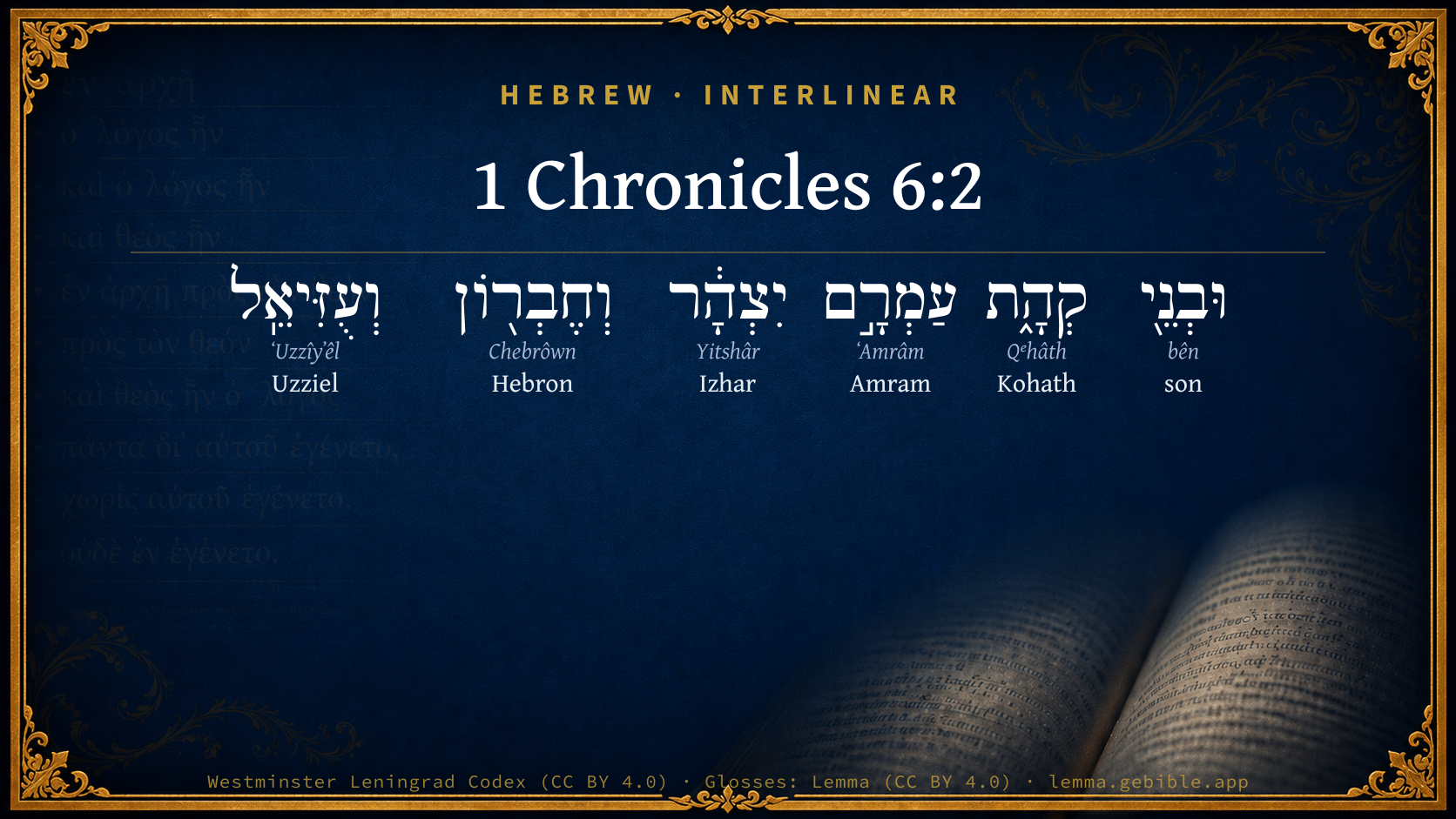
Hebrew (Westminster Leningrad Codex) 1 Chronicles 6:2 appears in the Hebrew Old Testament. The text above is from the Westminster Leningrad Codex. Each word links to its Strong’s number, a concise gloss, and parsing drawn from the Open Scriptures Hebrew Bible morphology. Click any word for its full Brown-Driver-Briggs (BDB) entry.
Download image
Cite this verse

1 Chronicles 6:2 (World English Bible). Public Domain. Lemma interlinear Bible study tool, https://lemma.gebible.app/v/1-chronicles/6/2.

Show BibTeX & RIS
BibTeX
RIS
English Translation
The sons of Kohath: Amram, Izhar, and Hebron, and Uzziel.
World English Bible · Public Domain
Download a study sheet

One document with this verse’s original text, its word-by-word gloss line, the meaning frame, cross-references with their text, attributed commentary, and full source and license credits — printable, and it pastes into notes with its structure intact.

This verse Autodidact and up

Study sheet (.html) Plain text (.txt)

A passage Seminary Student

Up to 50 verses in one chapter. A passage sheet keeps up to 6 commentary sources and 12 cross-references per verse, in the order this page ranks them, and says so on the sheet whenever that leaves anything out. Ask for a single verse and you get the Autodidact verse sheet above.

Everything on this page stays free to read, with no account — the sheet is a download of what is already on screen, not access to it.

Want to remove ads? Support Godless Engineer
Compare translations 3

The same verse in 3 English versions, stacked beneath the original-language interlinear above. Click any original word for its lexicon entry.

Each is an independent rendering of the whole verse — the interlinear is not word-aligned to these translations.

Highlighted words mark where these versions differ — a whole-verse word diff, not a word-by-word alignment.

  • World English Bible Public Domain
    The sons of Kohath: Amram, Izhar, and Hebron, and Uzziel.
  • King James Version Public Domain
    And the sons of Kohath; Amram, Izhar, and Hebron, and Uzziel.
  • unfoldingWord Literal Text CC BY-SA 4.0
    And the sons of Kohath: Amram, Izhar and Hebron and Uzziel.

unfoldingWord Literal Text — © unfoldingWord, licensed CC BY-SA 4.0. Word-aligned USFM3 via Door43 (git.door43.org/unfoldingWord/en_ult).

Versions to compare (up to 4)

3 of 4 selected

Show all 18 translations

Every available English version of this verse, each an independent rendering of the whole verse.

  • World English Bible Public Domain
    The sons of Kohath: Amram, Izhar, and Hebron, and Uzziel.
  • Berean Standard Bible Public Domain
    The sons of Kohath: Amram, Izhar, Hebron, and Uzziel.
  • Majority Standard Bible Public Domain
    The sons of Kohath: Amram, Izhar, Hebron, and Uzziel.
  • King James Version Public Domain
    And the sons of Kohath; Amram, Izhar, and Hebron, and Uzziel.
  • American Standard Version (1901) Public Domain
    And the sons of Kohath: Amram, Izhar, and Hebron, and Uzziel.
  • Revised Version (1885) Public Domain
    And the sons of Kohath; Amram, Izhar, and Hebron, and Uzziel.
  • Geneva Bible (1599) Public Domain
    And the sonnes of Kohath, Amram, Izhar, and Hebron, and Vzziel.
  • Douay-Rheims (1899) Public Domain
    The sons of Caath: Amram, Isaar, Hebron, and Oziel.
  • Young's Literal Translation Public Domain
    And the sons of Kohath; Amram, Izhar, and Hebron, and Uzziel.
  • Literal Standard Version CC BY-SA 4.0
    And the sons of Kohath: Amram, Izhar, and Hebron, and Uzziel.
  • Unlocked Literal Bible CC BY-SA 4.0
    The sons of Kohath were Amram, Izhar, Hebron, and Uzziel.
  • unfoldingWord Literal Text CC BY-SA 4.0
    And the sons of Kohath: Amram, Izhar and Hebron and Uzziel.
  • Darby Bible Public Domain
    And the sons of Kohath: Amram, Jizhar, and Hebron, and Uzziel.
  • World Messianic Bible Public Domain
    The sons of Kohath: Amram, Izhar, Hebron, and Uzziel.
  • Webster's Bible Public Domain
    And the sons of Kohath; Amram, Izhar, and Hebron, and Uzziel.
  • Free Bible Version CC BY-SA 4.0
    The sons of Kohath: Amram, Izhar, Hebron, and Uzziel.
  • Bible in Basic English Public Domain
    And the sons of Kohath: Amram, Izhar, Hebron, and Uzziel.
  • JPS Tanakh (1917) Public Domain
    (5-28) And the sons of Kohath: Amram, Izhar, and Hebron, and Uzziel.

Literal Standard Version (2020), Covenant Press — licensed CC BY-SA 4.0. Text via the HelloAO Bible API (eBible.org). Unlocked Literal Bible (unfoldingWord) — licensed CC BY-SA 4.0. Text via the HelloAO Bible API (eBible.org). unfoldingWord Literal Text — © unfoldingWord, licensed CC BY-SA 4.0. Word-aligned USFM3 via Door43 (git.door43.org/unfoldingWord/en_ult). Free Bible Version, Dr. Jonathan Gallagher — licensed CC BY-SA 4.0. Text via the HelloAO Bible API (eBible.org).

Word by word

More ways to search: Search by grammar → Find every occurrence → Compare this word →

Practice this passage: Drill this verse → Learn its vocabulary →

About this verse

These counts appear in no published source. They are computed here, from the morphology-tagged text and Lemma’s own curated glosses. What Lemma adds →

6
words
6
distinct lemmas
Historical
section

Notable vocabulary

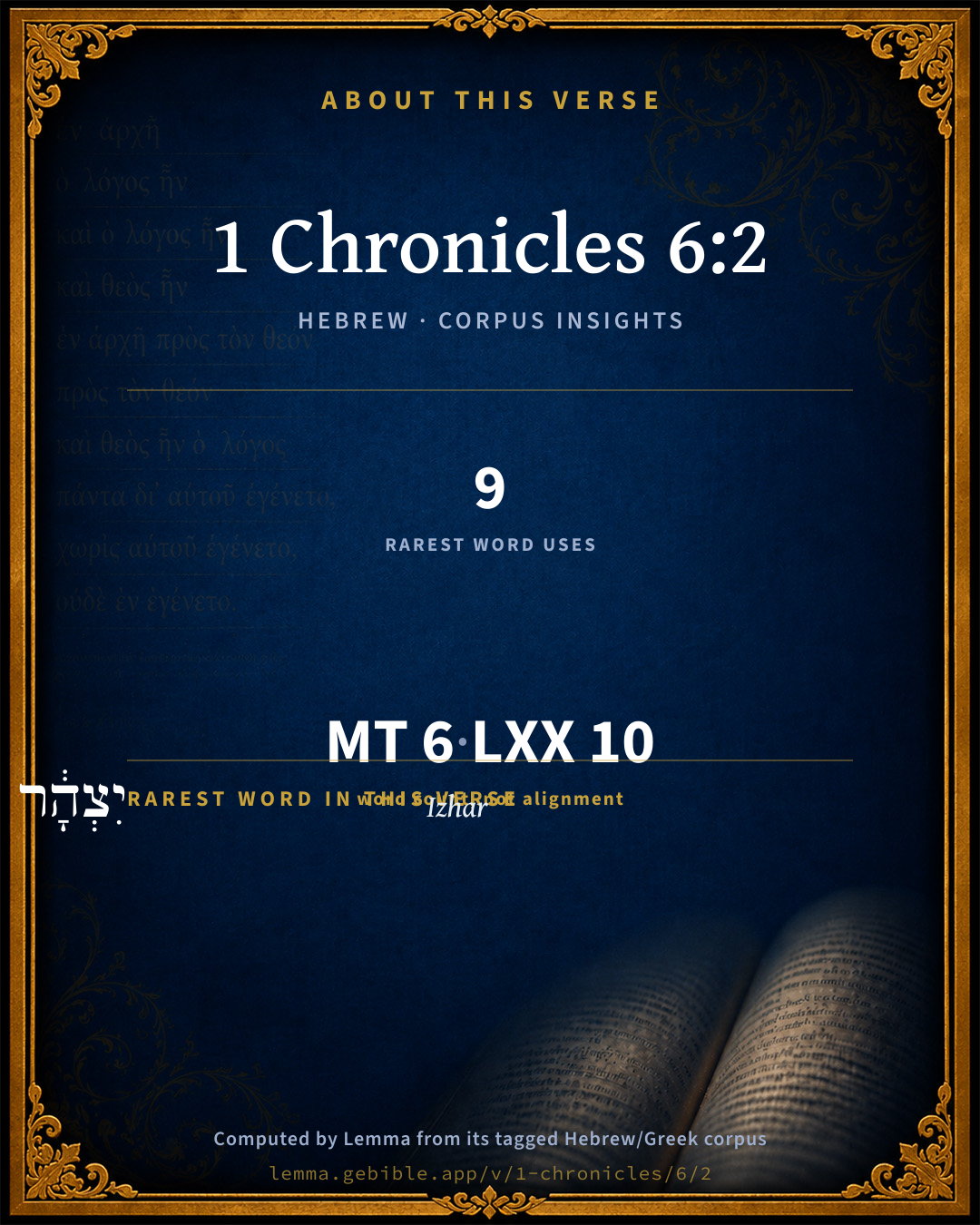
The rarest word here is יִצְהָ֔ר Izhar H3324 — appearing just 9 times in the whole Hebrew Bible.

Shared distinctive vocabulary

יִצְהָ֔ר Izhar H3324 occurs in 9 verses of the Hebrew Bible. Also found in:

Grammatical profile

  • 6 nouns

Hebrew & Septuagint length

In English translation the verse runs 10 words from the Hebrew and 11 from the Septuagint (LXX English) — closely comparable.

A rough comparison of the two English renderings, which tokenize alike — not a word-level alignment.

Word counts can differ between the Hebrew and the Greek without any difference in meaning — e.g. the Hebrew direct-object marker אֵת has no separate Greek word, and Greek often adds the article ὁ.

In the original languages it is 6 Hebrew tokens and 10 Greek tokens — but the two are counted differently (Hebrew bundles its prefixes and suffixes into one token; the Greek is in lemma form), so that isn’t a like-for-like length.

Cross-references

3

Topical passages linked to 1 Chronicles 6:2 in the Treasury of Scripture Knowledge — connected by theme and wording, ordered by reader-vote popularity; previews shown in the World English Bible.

  • Exodus 6:18 The sons of Kohath: Amram, and Izhar, and Hebron, and Uzziel; and the years of the life of Kohath were one hundred thirty-three years.
  • Exodus 6:21–24 The sons of Izhar: Korah, and Nepheg, and Zichri.
  • 1 Chronicles 23:12 The sons of Kohath: Amram, Izhar, Hebron, and Uzziel, four.

Cross-references courtesy of OpenBible.info (CC BY 4.0).

Hebrew and Greek witnesses Masoretic Hebrew ↔ Greek Septuagint

The same verse in the two great witnesses to the Old Testament, shown verse-for-verse.

These are two independent witnesses, not word-aligned to each other, and the Septuagint is shown in lemma (dictionary) form.

Hebrew 1 Chronicles 6:2 Masoretic · Westminster Leningrad Codex

וּבְנֵ֖י קְהָ֑ת עַמְרָ֣ם יִצְהָ֔ר וְחֶבְר֖וֹן וְעֻזִּיאֵֽל

The sons of Kohath: Amram, Izhar, and Hebron, and Uzziel.

World English Bible · Public Domain

Greek LXX 1 Chronicles 6:2 Septuagint · lemma form

καί οὗτος ὁ ὄνομα ὁ υἱός γεδσων λοβενι καί σεμεϊ

And the sons of Caath; Ambram, and Issaar, Chebron, and Oziel.

LXX2012 (modern English Septuagint) · Public Domain

On this verse, The Pulpit Commentary discusses the Septuagint’s reading. Read the note in Commentary ↓

Hebrew: Westminster Leningrad Codex (CC BY 4.0). Greek: Septuagint (public domain); English from LXX2012 (modern English Septuagint) (Public Domain). How the Septuagint differs from the Hebrew →

Commentary

Notes on 1 Chronicles 6:2 from classic Christian and Jewish commentators (each source and its license shown beneath its notes). The classic Christian expositions comment on the surrounding passage and are grouped to its opening verse, so a note may address several verses; the Jewish commentaries on the Tanakh (Rashi and others) are per-verse, so they appear only where the commentator wrote on this verse.

Lemma curates 59 commentaries, every one of them public domain or Creative Commons licensed, each selected and text-cleaned for this edition rather than reprinted as found. About our sources →

Tyndale Open Study Notes

Tyndale Open Resources

6:2-15 After the Exile, the community of Judea, for whom Chronicles was written, needed to establish unequivocally the legitimate ancestry of the priests. This genealogy of Kohath established continuity between the ancestors known from the Pentateuch and the later high priests down to the exile of Judah in 586 BC; other records connected the priests following the Exile with this line (see Ezra 3:2; 7:1-6; Hag 1:1). Not all who served as high priest were included in this listing.

Tyndale Open Study Notes — © Tyndale Open Resources, licensed CC BY-SA 4.0. Text via the HelloAO Bible API.

The Cambridge Bible for Schools and Colleges

gen. ed. J. J. S. Perowne

2. the sons of Kohath] So Exo_6:18.

The Cambridge Bible for Schools and Colleges (gen. ed. J. J. S. Perowne; Cambridge University Press, 1878–1918) — public domain. Text from a community e-Sword module.

John Gill's Exposition

And the sons of Kohath; Amram, Izhar, and Hebron, and Uzziel,.... Given in the same order as in Exo 6:18; see Gill on Exo 6:18.

.

1 Chronicles 6:3

ch1 6:3

ch1 6:3

ch1 6:3And the children of Amram, Aaron, and Moses, and Miriam,.... Very memorable persons: Aaron was the high priest, Moses the prophet and lawgiver, and Miriam a prophetess, see Mic 6:4,

the sons also of Aaron, Nadab and Abihu, Eleazar and Ithamar; the two first were destroyed by fire from heaven for offering strange fire, Lev 10:1 and the third succeeded his father in the high priesthood; the line of which is drawn from Aaron through him unto the Babylonish captivity, from hence to the end of the fifteenth verse, where it ends: Jehozadak is the same with Josedech, Hag 1:1 who went young into Babylon, and whose son Joshua, born in the captivity, came out of it on the proclamation of Cyrus, Ezr 2:2. According to Josephus (e), and other Jewish writers (f), in the times of Uzzi, Ch1 6:6 the priesthood was translated into the family of Ithamar, of which Eli was the first high priest; where it continued to the times of Solomon, when it was restored to Zadok, of the line of Eleazar. It is particularly observed of Azariah, Ch1 6:10 that he it was that executed the priest's office in the temple built by Solomon; not that he was the first that officiated in it, that was Zadok; but this seems to be Azariah, who was the high priest in the times of Uzziah, who opposed him when he would have offered incense in the temple, Ch2 26:17, which may be the reason why he is so particularly taken notice of here; though some think this is to be understood of Johanan, the father of Azariah, supposed to the same with Jehoiada, who, in the times of Athaliah, was the instrument of preserving both church and state, Kg2 11:4, the temple in which he ministered is described as built by Solomon, because at the time of the writing of this there was another temple built, or building, by Zerubbabel.

(e) Antiqu. l. 5. c. 11. sect. 5. (f) Juchasin, fol. 136. 1.

John Gill's Exposition of the Whole Bible (1746–1763) — public domain (CC PDM 1.0). Text via the HelloAO Bible API.

Haydock's Catholic Bible Commentary

Isaar, or Aminadab, ver. 22.

George Leo Haydock (1774–1849), Haydock's Catholic Family Bible and Commentary, 1859 edition — public domain. Excludes Psalms (Douay-Rheims chapter numbering differs from Protestant) and Deuterocanonical books (Catholic canon only).

Matthew Poole's English Annotations

Izhar, called also 1Ch 6:22; compare Exo 6:21.

Matthew Poole's English Annotations on the Holy Bible (1683–1685) — public domain. Text from a community e-Sword/MySword module.

The Pulpit Commentary

The second son, Kohath, rather Kehath (thq), Hebrew, and so Septuagint and Vulgate), is at once singled out, in order to get at the priest line. He was one of the travellers with Jacob into Egypt, was probably about twenty years the junior of Joseph, lived thirty years after his death, and attained the age of one hundred and thirty-three years, after a residence in Egypt of about one hundred and fifteen years in all. The Kohathites are expressly mentioned in their sacred duties in the time of David, (1Ch_15:5-8) and in the time of Hezekiah. (2Ch_29:12-14) The four sons of Kohath are next instanced, in order to get another step nearer the clear beginning of the priest line. This is done in the person of the oldest brother, Amram, who became father of Aaron and Moses and Miriam.

The Pulpit Commentary (1880–1919), ed. H.D.M. Spence-Jones & Joseph S. Exell — public domain. Text from a community e-Sword module.

Keil & Delitzsch

C. F. Keil & F. Delitzsch

And the sons of Kohath; Amram, Izhar, and Hebron, and Uzziel,.... Given in the same order as in Exo 6:18; see Gill on Exo 6:18.

.

1 Chronicles 6:3

ch1 6:3

ch1 6:3

ch1 6:3And the children of Amram, Aaron, and Moses, and Miriam,.... Very memorable persons: Aaron was the high priest, Moses the prophet and lawgiver, and Miriam a prophetess, see Mic 6:4,

the sons also of Aaron, Nadab and Abihu, Eleazar and Ithamar; the two first were destroyed by fire from heaven for offering strange fire, Lev 10:1 and the third succeeded his father in the high priesthood; the line of which is drawn from Aaron through him unto the Babylonish captivity, from hence to the end of the fifteenth verse, where it ends: Jehozadak is the same with Josedech, Hag 1:1 who went young into Babylon, and whose son Joshua, born in the captivity, came out of it on the proclamation of Cyrus, Ezr 2:2. According to Josephus (e), and other Jewish writers (f), in the times of Uzzi, Ch1 6:6 the priesthood was translated into the family of Ithamar, of which Eli was the first high priest; where it continued to the times of Solomon, when it was restored to Zadok, of the line of Eleazar. It is particularly observed of Azariah, Ch1 6:10 that he it was that executed the priest's office in the temple built by Solomon; not that he was the first that officiated in it, that was Zadok; but this seems to be Azariah, who was the high priest in the times of Uzziah, who opposed him when he would have offered incense in the temple, Ch2 26:17, which may be the reason why he is so particularly taken notice of here; though some think this is to be understood of Johanan, the father of Azariah, supposed to the same with Jehoiada, who, in the times of Athaliah, was the instrument of preserving both church and state, Kg2 11:4, the temple in which he ministered is described as built by Solomon, because at the time of the writing of this there was another temple built, or building, by Zerubbabel.

(e) Antiqu. l. 5. c. 11. sect. 5. (f) Juchasin, fol. 136. 1.

Keil & Delitzsch — Biblical Commentary on the Old Testament (1861–1891) — public domain (CC PDM 1.0). Text via the HelloAO Bible API. (Old Testament only.)

Lesson kit

Teaching starters — assembled from the data on this page, not authored interpretation. Every prompt links to the verse data it draws on. Edit before teaching.

1 Chronicles, in the Historical, opens this verse with 6 words (6 distinct Hebrew lemmas). Its most distinctive word is Yitshâr (“Izhar”). A historical commentator’s framing appears above. Read the whole chapter for the surrounding context.

Discussion questions

  1. What does “Izhar” (Yitshâr) contribute to the verse as a whole?
  2. How does Exodus 6:18, which shares the word «Izhar», read alongside this verse?
  3. Compare how Tyndale Open Study Notes and The Cambridge Bible for Schools and Colleges read this verse. Where do they agree or differ?

Things to notice

Reading settings

Reading text

Shown beneath each verse's original-language words.

Old Testament
Old Testament edition

Read the OT as the Masoretic Hebrew (MT) or the Greek Septuagint (LXX).

English shown for the Greek Septuagint (in the Hebrew ↔ Greek comparison).

Comparing translations? Open the Compare panel on any verse page to stack up to four side by side.