
Song of Solomon 6:8

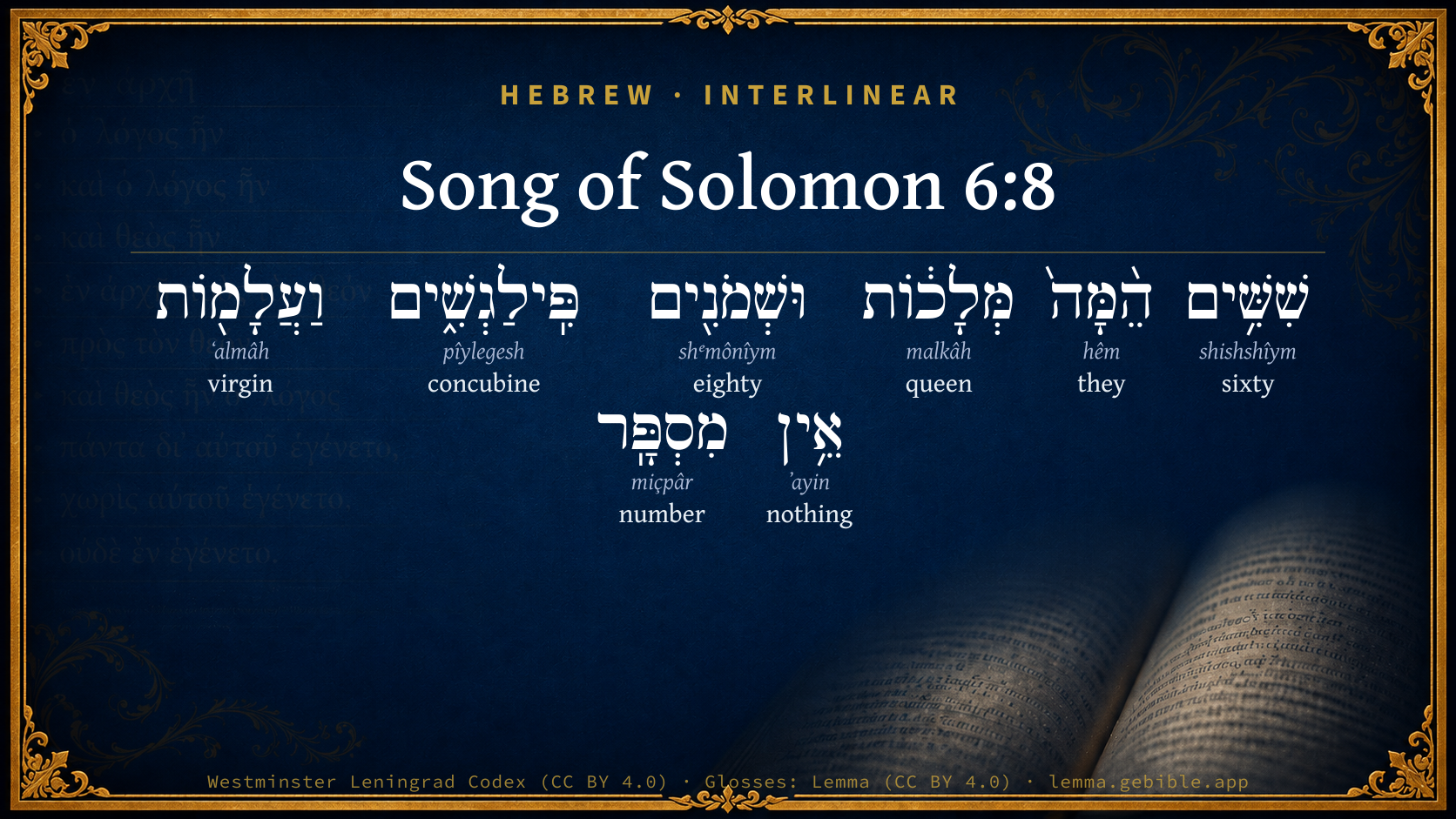
Hebrew (Westminster Leningrad Codex) Song of Solomon 6:8 appears in the Hebrew Old Testament. The text above is from the Westminster Leningrad Codex. Each word links to its Strong’s number, a concise gloss, and parsing drawn from the Open Scriptures Hebrew Bible morphology. Click any word for its full Brown-Driver-Briggs (BDB) entry.
Download image
Cite this verse

Song of Solomon 6:8 (World English Bible). Public Domain. Lemma interlinear Bible study tool, https://lemma.gebible.app/v/song-of-solomon/6/8.

Show BibTeX & RIS
BibTeX
RIS
English Translation
There are sixty queens, eighty concubines, And virgins without number.
World English Bible · Public Domain
Download a study sheet

One document with this verse’s original text, its word-by-word gloss line, the meaning frame, cross-references with their text, attributed commentary, and full source and license credits — printable, and it pastes into notes with its structure intact.

This verse Autodidact and up

Study sheet (.html) Plain text (.txt)

A passage Seminary Student

Up to 50 verses in one chapter. A passage sheet keeps up to 6 commentary sources and 12 cross-references per verse, in the order this page ranks them, and says so on the sheet whenever that leaves anything out. Ask for a single verse and you get the Autodidact verse sheet above.

Everything on this page stays free to read, with no account — the sheet is a download of what is already on screen, not access to it.

Want to remove ads? Support Godless Engineer
Compare translations 3

The same verse in 3 English versions, stacked beneath the original-language interlinear above. Click any original word for its lexicon entry.

Each is an independent rendering of the whole verse — the interlinear is not word-aligned to these translations.

Highlighted words mark where these versions differ — a whole-verse word diff, not a word-by-word alignment.

  • World English Bible Public Domain
    There are sixty queens, eighty concubines, And virgins without number.
  • King James Version Public Domain
    There are threescore queens, and fourscore concubines, and virgins without number.
  • unfoldingWord Literal Text CC BY-SA 4.0
    Sixty they, queens, and eighty concubines, and marriageable women without number.

unfoldingWord Literal Text — © unfoldingWord, licensed CC BY-SA 4.0. Word-aligned USFM3 via Door43 (git.door43.org/unfoldingWord/en_ult).

Versions to compare (up to 4)

3 of 4 selected

Show all 18 translations

Every available English version of this verse, each an independent rendering of the whole verse.

  • World English Bible Public Domain
    There are sixty queens, eighty concubines, And virgins without number.
  • Berean Standard Bible Public Domain
    There are sixty queens and eighty concubines, and maidens without number,
  • Majority Standard Bible Public Domain
    There are sixty queens and eighty concubines, and maidens without number,
  • King James Version Public Domain
    There are threescore queens, and fourscore concubines, and virgins without number.
  • American Standard Version (1901) Public Domain
    There are threescore queens, and fourscore concubines, And virgins without number.
  • Revised Version (1885) Public Domain
    There are threescore queens, and fourscore concubines, and virgins without number.
  • Geneva Bible (1599) Public Domain
    But my doue is alone, and my vndefiled, she is the onely daughter of her mother, and shee is deare to her that bare her: the daughters haue seene her and counted her blessed: euen the Queenes and the concubines, and they haue praised her.
  • Douay-Rheims (1899) Public Domain
    One is my dove, my perfect one is but one, she is the only one of her mother, the chosen of her that bore her. The daughters saw her, and declared her most blessed: the queens and concubines, and they praised her.
  • Young's Literal Translation Public Domain
    Sixty are queens, and eighty concubines, And virgins without number.
  • Literal Standard Version CC BY-SA 4.0
    Sixty are queens, and eighty concubines, || And virgins without number.
  • Unlocked Literal Bible CC BY-SA 4.0
    There are sixty queens, eighty concubines, and young women without number.
  • unfoldingWord Literal Text CC BY-SA 4.0
    Sixty they, queens, and eighty concubines, and marriageable women without number.
  • Darby Bible Public Domain
    There are threescore queens, and fourscore concubines, And virgins without number:
  • World Messianic Bible Public Domain
    There are sixty queens, eighty concubines, and virgins without number.
  • Webster's Bible Public Domain
    There are sixty queens, and eighty concubines, and virgins without number.
  • Free Bible Version CC BY-SA 4.0
    There may be sixty queens and eighty concubines, and countless more women,
  • Bible in Basic English Public Domain
    There are sixty queens, and eighty servant-wives, and young girls without number.
  • JPS Tanakh (1917) Public Domain
    There are threescore queens, and fourscore concubines, and maidens without number.

Literal Standard Version (2020), Covenant Press — licensed CC BY-SA 4.0. Text via the HelloAO Bible API (eBible.org). Unlocked Literal Bible (unfoldingWord) — licensed CC BY-SA 4.0. Text via the HelloAO Bible API (eBible.org). unfoldingWord Literal Text — © unfoldingWord, licensed CC BY-SA 4.0. Word-aligned USFM3 via Door43 (git.door43.org/unfoldingWord/en_ult). Free Bible Version, Dr. Jonathan Gallagher — licensed CC BY-SA 4.0. Text via the HelloAO Bible API (eBible.org).

Word by word

More ways to search: Search by grammar → Find every occurrence → Compare this word →

Practice this passage: Drill this verse → Learn its vocabulary →

About this verse

These counts appear in no published source. They are computed here, from the morphology-tagged text and Lemma’s own curated glosses. What Lemma adds →

8
words
8
distinct lemmas
Wisdom
section

Notable vocabulary

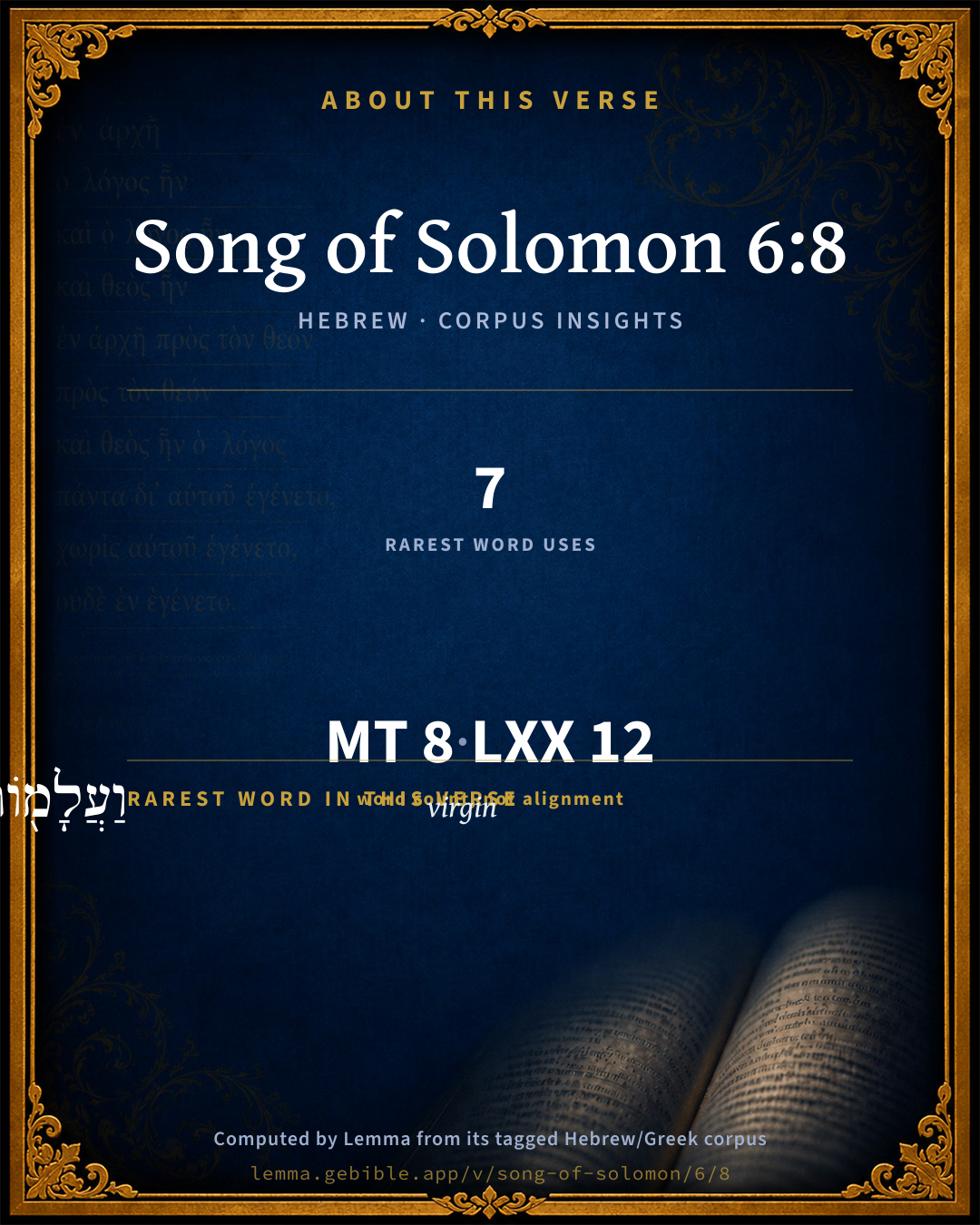
The rarest word here is וַעֲלָמ֖וֹת virgin H5959 — appearing just 7 times in the whole Hebrew Bible.

Shared distinctive vocabulary

וַעֲלָמ֖וֹת virgin H5959 occurs in 7 verses of the Hebrew Bible. Also found in:

Grammatical profile

  • 4 nouns
  • 2 adjectives
  • 1 pronoun
  • 1 particle

Hebrew & Septuagint length

In English translation the verse runs 10 words from the Hebrew and 44 from the Septuagint (LXX English) — the Septuagint runs noticeably longer here. See the side-by-side →

A rough comparison of the two English renderings, which tokenize alike — not a word-level alignment.

Word counts can differ between the Hebrew and the Greek without any difference in meaning — e.g. the Hebrew direct-object marker אֵת has no separate Greek word, and Greek often adds the article ὁ.

In the original languages it is 8 Hebrew tokens and 12 Greek tokens — but the two are counted differently (Hebrew bundles its prefixes and suffixes into one token; the Greek is in lemma form), so that isn’t a like-for-like length.

Cross-references

6

Topical passages linked to Song of Solomon 6:8 in the Treasury of Scripture Knowledge — connected by theme and wording, ordered by reader-vote popularity; previews shown in the World English Bible.

  • Psalms 45:14 She shall be led to the king in embroidered work. The virgins, her companions who follow her, shall be brought to you.
  • 1 Kings 11:3 He had seven hundred wives, princesses, and three hundred concubines; and his wives turned away his heart.
  • 1 Kings 11:1 Now king Solomon loved many foreign women, together with the daughter of Pharaoh, women of the Moabites, Ammonites, Edomites, Sidonians, and Hittites;
  • 2 Chronicles 11:21 Rehoboam loved Maacah the daughter of Absalom above all his wives and his concubines: (for he took eighteen wives, and sixty concubines, and became the father of twenty-eight sons and sixty daughters.)
  • Psalms 45:9 Kings' daughters are among your honorable women. At your right hand the queen stands in gold of Ophir.
  • Revelation 7:9 After these things I looked, and behold, a great multitude, which no man could number, out of every nation and of all tribes, peoples, and languages, standing before the throne and before the Lamb, dressed in white robes, with palm branches in their hands.

Cross-references courtesy of OpenBible.info (CC BY 4.0).

Hebrew and Greek witnesses Masoretic Hebrew ↔ Greek Septuagint

The same verse in the two great witnesses to the Old Testament, shown verse-for-verse.

Here the Septuagint runs noticeably longer than the Hebrew — LXX2012 (modern English Septuagint) 44 words vs World English Bible 10. A rough length comparison of the two English translations, not a word-level alignment — read both below.

These are two independent witnesses, not word-aligned to each other, and the Septuagint is shown in lemma (dictionary) form.

Hebrew Song of Solomon 6:8 Masoretic · Westminster Leningrad Codex

שִׁשִּׁ֥ים הֵ֨מָּה֙ מְּלָכ֔וֹת וּשְׁמֹנִ֖ים פִּֽילַגְשִׁ֑ים וַעֲלָמ֖וֹת אֵ֥ין מִסְפָּֽר

There are sixty queens, eighty concubines, And virgins without number.

World English Bible · Public Domain

Greek LXX Song of Solomon 6:8 Septuagint · lemma form

ἑξήκοντα εἰμί βασίλισσα καί ὀγδοήκοντα παλλακή καί νεᾶνις ὅς οὐ εἰμί ἀριθμός

My dove, my perfect one is one; she is the only one of her mother; she is the choice of her that bore her. The daughters saw her, and the queens will pronounce her blessed, yes, and the concubines, and they will praise her.

LXX2012 (modern English Septuagint) · Public Domain

Hebrew: Westminster Leningrad Codex (CC BY 4.0). Greek: Septuagint (public domain); English from LXX2012 (modern English Septuagint) (Public Domain). How the Septuagint differs from the Hebrew →

Commentary

Notes on Song of Solomon 6:8 from classic Christian and Jewish commentators (each source and its license shown beneath its notes). The classic Christian expositions comment on the surrounding passage and are grouped to its opening verse, so a note may address several verses; the Jewish commentaries on the Tanakh (Rashi and others) are per-verse, so they appear only where the commentator wrote on this verse.

Lemma curates 59 commentaries, every one of them public domain or Creative Commons licensed, each selected and text-cleaned for this edition rather than reprinted as found. About our sources →

Trapp's Complete Commentary

John Trapp

Son 6:8 There are threescore queens, and fourscore concubines, and virgins without number.

Ver. 8. There are threescore queens, and fourscore, &c.] Or as some read it, hypothetically, Be there sixty queens, and eighty concubines, which were secondary wives - usurary, the lawyers call them, that had right to the bed, but no rule in the family - and virgins, or waiting gentle women without number; although there be of other sorts never so many, yet "My dove," albeit but one, is an "only one," and beloved accordingly. {see Jer 31:20} For the allegory here - some go one way to work, some another. Let there be never so great a number, saith one, of peoples and nations, of churches and assemblies, which challenge my name and love, and perhaps by their outward prosperities may seem to plead much interest in me, and much worth in themselves, yet "My dove," &c. Others think, that by "queens" are meant true believers; by "concubines," hypocrites and formal professors; and by "virgins," profane persons, that have not yet so much as a form of godliness. The first are the fewest, and the last are the greatest number. Lastly, There are those who make "queens," "concubines," and "virgins," to signify three different sorts or degrees of true Christians in the Catholic Church, which yet is but one. Some have made but small progress in piety; these are compared to "virgins," and are the far greater in number: Some are got further onward, and are of better proof; these are like "concubines," and do exceed the "queens" in number; quo enim perfectiores, eo pauciores. Some again are eminent and eximious Christians; these are queens, and have more close communion with Christ: and to this highest degree we must all aspire and endeavour, striving to perfection. Nature, art, grace, do all proceed from less perfect to more perfect. We read in Scripture of a Christian’s conception, {Gal 4:19} birth, {1Pe 1:23; 1Pe 2:2} childhood, {1Co 3:1-2 1Jn 2:13} youth, or well grown age, {Eph 4:13} old age. {Act 21:16} Mnason was a gray-headed experienced Christian, a father. {1Jn 2:13} All must exact of themselves a daily growth, and be still bringing forth fruit in their old age, {Psa 92:13-14} so shall the king take pleasure still in their beauty; so shall he one day set them upon his right hand, as place of dignity and safety, in gold of Ophir. {Psa 45:9; Psa 45:11}

John Trapp, A Commentary or Exposition upon All the Books of the Old and New Testament (1647–1656) — public domain. Text from a community e-Sword module.

The Biblical Illustrator

Joseph S. Exell

Son_6:8

There are threescore queens.

Womans rights

So Solomon, by one stroke, sets forth the imperial character of a true Christian woman. She is not a slave, not a hireling, not a subordinate; but a queen: and in my text Solomon sees sixty of these helping to make up the royal pageant of Jesus.

I. Woman has the special and superlative right of blessing and comforting the sick. The Lord God who sent Miss Dix into the Virginia hospitals, and Florence Nightingale into the Crimea, and the Maid of Saragossa to appease the wounds of the battlefield, has equipped wife, mother, and daughter, for this delicate but tremendous mission.

II. Woman has a superlative right to take care of the poor.

III. It is womans specific right to comfort under the stress of dire disaster.

IV. It is womans right to bring to us the kingdom of hearten.

V. One of the specific rights of women is, through the grace of christ, finally to reach heaven. O, what a multitude of women in heaven I Mary, Christs mother, in heaven; Elizabeth Fry in heaven; Charlotte Elizabeth in heaven; the mother of Augustine in heaven; the Countess of Huntingdon--who sold her splendid jewels to build chapels--in heaven; while a great many others who have never been heard of on earth, or known but little, have gone into the rest and peace of heaven. What a rest! (T. De Witt Talmage.)

The Biblical Illustrator, edited by Joseph S. Exell (c. 1880s–1900s) — public domain. Text from a community e-Sword module.

Joseph Benson's Commentary

Son 6:8-9. There are threescore queens — A certain number for an uncertain. The sense seems to be this: there are many beautiful queens and concubines in the world, in the courts of princes, but none of them is to be compared with my spouse. My undefiled is but one — The only beloved of my soul, my only spouse. The only one of her mother — She is as dear and as precious to me as only children use to be to their parents, and especially to their mothers. The daughters saw her — Called virgins, Son 6:8. They praised her — As more beautiful and worthy than themselves.

Joseph Benson's Commentary on the Old and New Testaments (1811–1818) — public domain. Text from a community e-Sword module.

Tyndale Open Study Notes

Tyndale Open Resources

6:8-9 If the Song were an allegory of the Lord’s love for his people, it would provide a very weak parallel, since Solomon’s excesses in marrying do a poor job of picturing God’s love and faithfulness (see 1 Kgs 11:1-13). • sixty queens: Many of Solomon’s wives were obtained by marrying into international treaties (see 1 Kgs 11:1-3, 8). • Concubines were wives who had secondary status, lower than a wife but higher than a slave. Concubines were acquired by war, debt repayment, or purchase. • In the anthology view, the reference to queens and concubines simply means that the woman herself is more desirable than all other women.

Tyndale Open Study Notes — © Tyndale Open Resources, licensed CC BY-SA 4.0. Text via the HelloAO Bible API.

Adam Clarke's Commentary

Verse 8. There are threescore queens] Though there be sixty queens, and eighty concubines, or secondary wives, and virgins innumerable, in my harem, yet thou, my dove, my undefiled, art אצת achath, ONE, the ONLY ONE, she in whom I delight beyond all.

Adam Clarke's Commentary on the Bible (1810–1826) — public domain. Text from a community e-Sword/MySword module.

Ellicott's Commentary for English Readers

(8) There are threescore queens.—Presumably a description of Solomon’s harem (from comp. with Son_8:11-12), though the numbers are far more sober than in 1Ki_11:3. Probably the latter marks a later form of the traditions of the grand scale on which everything at the court of the monarch was conducted, and this, though a poetic, is a truer version of the story of his loves. The conjunction of alamôth with concubines, pilageshîm (comp. παλλακή, pellex), decides for translating it puellœ rather than virgines.

A Bible Commentary for English Readers, edited by Charles John Ellicott (1878–1897) — public domain. Text from a community e-Sword module.

The Cambridge Bible for Schools and Colleges

gen. ed. J. J. S. Perowne

8. This is evidently a description of a hareem, and it can only be Solomon’s own. The word translated are here is somewhat anomalous, and Budde would substitute ‘to Solomon are.’ But this is a much more moderate hareem than the account of Solomon’s given in the historical books would lead us to expect, e.g. 1Ki_11:3, where we read of 700 wives and 300 concubines. Solomon being here the speaker, it is natural that he should in his present circumstances minimise the size of his establishment, and veil it under the vague last phrase.

queens] These are wives of royal birth.

concubines] Heb. pîlaghshîm, plur. of pîlegesh or pillegesh, appears in Greek as πάλλαξ, παλλακή, and is probably there a loan word from the Semitic peoples. But the derivation is unknown. Oettli says that as the king speaks here, he witnesses against Delitzsch’s idea that he was united in marriage to the Shulammite in ch. Son_5:1, by using the word tammâthî, ‘my undefiled’; but that is surely to press the word too far. Marriage was not regarded as impairing a woman’s purity.

virgins] The word used here, ‘ǎlâmôth, does not necessarily mean ‘virgins,’ but young women of marriageable age. Consequently, either subordinate members of the hareem, or young women not yet, but about to be, taken into it are intended.

The Cambridge Bible for Schools and Colleges (gen. ed. J. J. S. Perowne; Cambridge University Press, 1878–1918) — public domain. Text from a community e-Sword module.

Matthew Poole's English Annotations

Threescore queens, and fourscore concubines; a certain number for an uncertain. The sense seems to be this, There are many beautiful queens and concubines in the world, in the courts of princes, and particularly in Solomon’s court; but none of them is to be compared with my spouse, and my heart is set upon none of them, but only upon my spouse, as the following verse declareth. Or the queens and concubines may note the particular congregations which are called by Christ’s name, and the virgins may signify the particular believers or professors; all which do make up one catholic church, as it follows. See Poole "Psa 45:10", See Poole "Psa 45:14", See Poole "Psa 45:15". Virgins; either,

1. Which wait upon the queens and concubines. Or,

2. Which were reserved as a nursery, out of which queens and concubines were to be taken.

Matthew Poole's English Annotations on the Holy Bible (1683–1685) — public domain. Text from a community e-Sword/MySword module.

Whedon's Commentary on the Bible

Daniel D. Whedon

8. There are — Better, I have there, pointing to the women’s apartments of his palace. The King here alludes to his harem. Threescore queens, etc.

— Stating the numbers of its inmates in general and representative terms, equivalent to many, very many. The exact numbers are given — three hundred wives and seven hundred concubines — in 1Ki_11:3. These hapless beauties, by a policy of luxury which in the end proved disastrous, were selected to form a galaxy to brighten and adorn the court, and minister to the pride and passion of the King. But he affirms that this one, on whom his eye is newly set, is —

“Fair as a star when only one

Is shining in the sky.”

Daniel D. Whedon (gen. ed.), Commentary on the Old and New Testaments (1874–1909) — public domain. Text from a community e-Sword module.

The Pulpit Commentary

Vers. 8, 9. There are three score queens, and four score concubines, and virgins without number. My dove, my undefiled is but one; she is the only one of her mother, she is the choice one of her that bare her. The daughters saw her, and called her blessed; yea, the queens and the concubines, and they praised her. The account given us of Solomon"s harem in 1Ki_11:3 represents the number as much larger. Is not that because the time referred to in the poem was early in the reign? The words are an echo of what we read in Pro_31:28 and Gen_30:13. Perhaps the general meaning is merely to celebrate the surpassing beauty of the new bride. But there certainly is a special stress laid on her purity and innocence. There is no necessity to seek for any exact interpretation of the queens and concubines. They represent female beauty in its variety. The true Church is in closer relation to the Bridegroom than all the rest of the world. Even in the heathen and unconverted world there is a revelation of the Word, or, as the ancient Fathers of the Church said, a Logov spermatikov . He was then as light, though the darkness comprehended him not. The perfection of the true bride of the Lamb will be acknowledged even by those who are not professedly Christian.

The Pulpit Commentary (1880–1919), ed. H.D.M. Spence-Jones & Joseph S. Exell — public domain. Text from a community e-Sword module.

John Wesley's Explanatory Notes

Threescore - A certain number for an uncertain. The sense seems to be this, there are many beautiful queens and concubines in the world, in the courts of princes, but none of them is to be compared with my spouse.

John Wesley, Explanatory Notes Upon the Whole Bible (1754–1765) — public domain. Text via the GEBible commentary corpus.

unfoldingWord translationNotes

Door43 World Missions Community

There are sixty queens, eighty concubines ... young women without number

These numbers are to be large, then larger, and then beyond counting. AT: "There are 60 queens, 80 concubines ... more young women than anyone could count" or "There are many queens, even more concubines, and more young women than anyone could count" (See: Numbers and Idiom)

My dove

The Israelites considered doves beautiful birds with pleasant voices. The man thinks the woman's face and voice are beautiful. If calling a woman a "dove" would be offensive, you could leave out the metaphor. See how you translated this in Song of Songs 2:14. AT: "You beautiful woman" (See: Metaphor)

my undefiled

"my perfect one" or "my faithful one" or "my innocent one." See how you translated this in Song of Songs 5:2.

the only daughter of her mother

This is an exaggeration. AT: "her mother's special daughter" or "completely different from her mother's other daughters" (See: Hyperbole and Generalization)

the woman who bore her

"the woman who gave birth to her." This phrase refers to her mother.

young women ... queens ... concubines

the women spoken of in verse 8

called her blessed

"said that things had gone especially well for her"

translationWords

queen

concubine

dove

call

bless

praise

unfoldingWord translationNotes — © Distant Shores Media and the Door43 World Missions Community, licensed CC BY-SA 4.0. Source: git.door43.org/Door43/en_tn.

Rashi

Rabbi Shlomo Yitzchaki (Rashi)

There are sixty queens Abraham and his descendants (Song Zuta). The sons of Keturah are sixteen. Ishmael and his sons are thirteen. Isaac and his sons are three. The sons of Jacob are twelve. The sons of Esau are sixteen, thus totaling sixty. And if you say that Timna should be excluded because she was a woman, then count Abraham in the number.

and eighty concubines Noah and his sons until Abraham, all the generations of those who left the Ark (Song Zuta)—you will find them to be eighty. And just as the queens, who are the kings’ wives, are superior in greatness to the concubines, so were Abraham and his descendants of great esteem, and superior in their esteem over everyone, as you will see. Hagar was the daughter of kings [and became Sarah’s maidservant (Gen. Rabbah 45:1)]. Timna was the daughter of rulers and became Esau’s concubine (ibid. 82:15), and Scripture says (Gen. 14: 17): “to the Valley of Shaveh (שָׁוֶה), etc.” They all unanimously (הֻשְווּ) resolved to make Abraham king over them.

and innumerable maidens All these were divided into many families.

Rashi on the Tanakh — English translations: “The Judaica Press complete Tanach with Rashi, translated by A. J. Rosenberg” (CC BY 4.0); “Pentateuch with Rashi's commentary by M. Rosenbaum and A.M. Silbermann, 1929-1934” (public domain); “The Metsudah Tanach series, Lakewood, N.J” (CC BY 4.0); and “The Book of Joshua, Metsudah Publications, 1997” (CC BY 4.0). Text via Sefaria.

Lesson kit

Teaching starters — assembled from the data on this page, not authored interpretation. Every prompt links to the verse data it draws on. Edit before teaching.

Song of Solomon, in the Wisdom, opens this verse with 8 words (8 distinct Hebrew lemmas). Its most distinctive word is ʻalmâh (“virgin”). The Greek Septuagint runs longer here. A historical commentator’s framing appears above. Read the whole chapter for the surrounding context.

Discussion questions

  1. The word ʻalmâh carries the sense “virgin.” How does it shape the verse?
  2. How does Genesis 24:43, which shares the word «virgin», read alongside this verse?
  3. The Septuagint runs longer here than the Hebrew. What might account for the difference?
  4. These translations render this verse differently. What is at stake in choosing one wording over another?
  5. Compare how Trapp's Complete Commentary and The Biblical Illustrator read this verse. Where do they agree or differ?

Things to notice

Reading settings

Reading text

Shown beneath each verse's original-language words.

Old Testament
Old Testament edition

Read the OT as the Masoretic Hebrew (MT) or the Greek Septuagint (LXX).

English shown for the Greek Septuagint (in the Hebrew ↔ Greek comparison).

Comparing translations? Open the Compare panel on any verse page to stack up to four side by side.