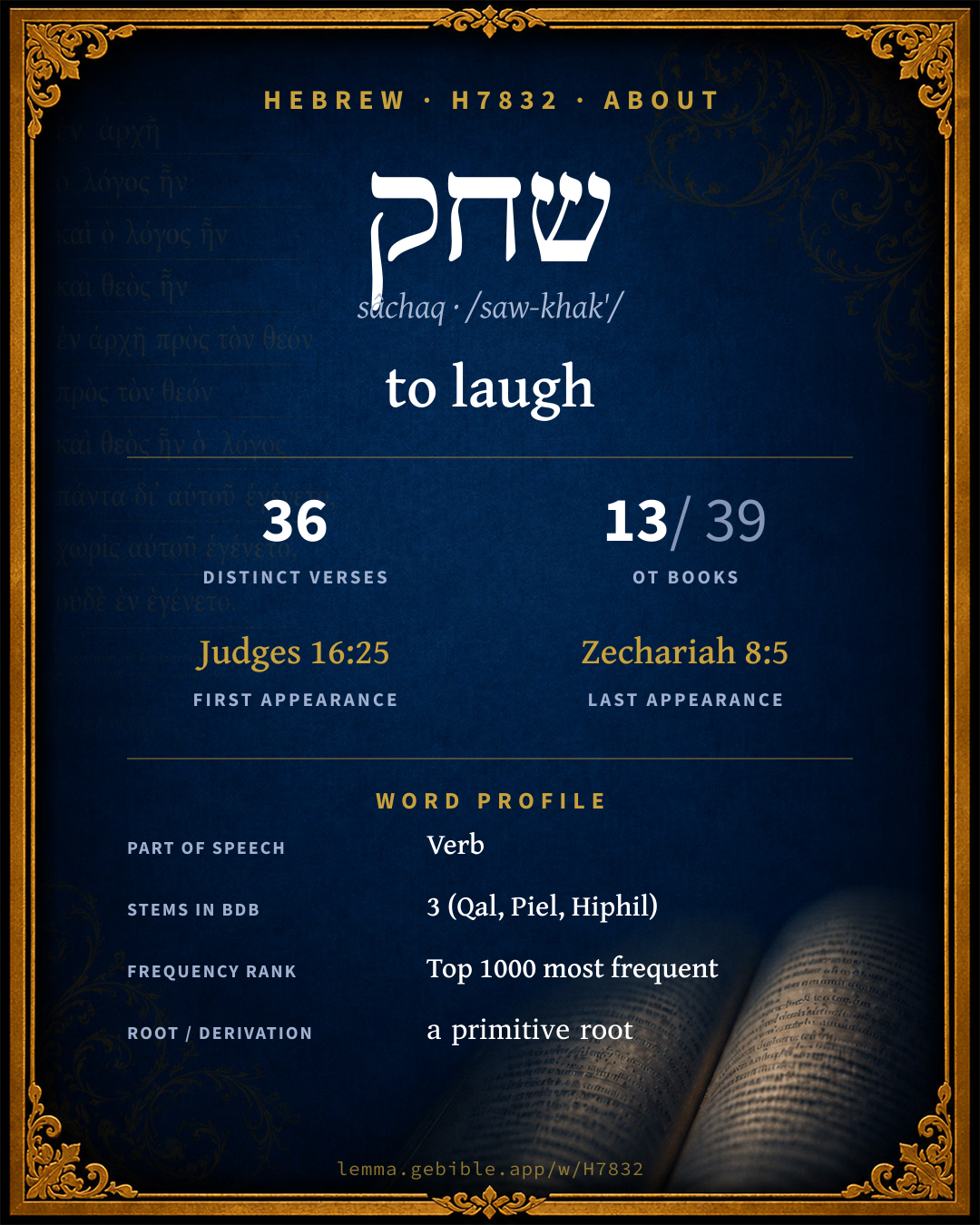
שָׂחַק
to laugh
also: play, mock fuller range ↓
Full lexicon entry — Brown-Driver-Briggs (BDB)
From Brown-Driver-Briggs (BDB)
Where this word appears
See every Qal verb in the Hebrew Bible →
Grammar key — what these labels mean
Part of speech
- Verb
- An action or state-of-being word.
Stem
- Piel
- An intensive or resultative active stem. Here: ‘make sport’
- Qal
- The basic, simple active stem — the plain form of the verb (“he wrote”). Here: ‘laugh at’
- Hiphil
- The causative active stem (“he caused / brought about”).
Form
- Participle Active
- A verbal adjective expressing ongoing or characteristic action (“writing / one who writes”).
- Imperfect
- An incomplete, ongoing, or future action (“he will / would write”).
- Infinitive Construct
- A bound verbal noun, frequently with prepositions (“to write / in writing”).
- Perfect
- A completed action or state — Hebrew marks aspect (completeness) more than strict tense (“he wrote”).
- Sequential Perfect
- A perfect with prefixed waw continuing a preceding imperfect or command (waw-consecutive perfect).
- Sequential Imperfect
- An imperfect with prefixed waw — the standard past-narrative form (waw-consecutive imperfect).
State
- Absolute
- The independent form of a noun, not bound to a following word.
Person
- 3rd Person
- The one spoken about (“he / she / it / they”).
- 1st Person
- The speaker (“I / we”).
- 2nd Person
- The one addressed (“you”).
Gender
- Masculine
- Grammatically masculine.
- Feminine
- Grammatically feminine.
- Common
- Either gender — not distinguished for this form.
Number
- Plural
- More than one (in Hebrew, generally three or more).
- Singular
- One.
18 distinct verses where H7832 appears in the Qal stem, across 7 books. Filtered view — show all forms. Click any verse to open its interlinear word-by-word view. Verse text shown in the World English Bible for context — . Each verse’s Hebrew form is shown with its reference; the English is not keyword-highlighted, since the data carries no word-level English alignment. Use “Compare translations” on any verse to read it across multiple English versions. This concordance covers the Hebrew Bible; Septuagint (Greek Old Testament) occurrences are not indexed here.
Judges 1 verse
Job 7 verses
- Job 5:22 תִּשְׂחָ֑ק Qal impf 2ms At destruction and famine you shall laugh, Neither shall you be afraid of the animals of the earth.
- Job 29:24 אֶשְׂחַ֣ק Qal impf 1cs I smiled on them when they had no confidence. They didn't reject the light of my face.
- Job 30:1 שָֽׂחֲק֣וּ Qal pf 3cp "But now those who are younger than I, have me in derision, Whose fathers I would have disdained to put with my sheep dogs.
- Job 39:7 יִ֭שְׂחַק Qal impf 3ms He scorns the tumult of the city, Neither hears he the shouting of the driver.
- Job 39:18 תִּֽשְׂחַ֥ק Qal impf 3fs When she lifts up herself on high, She scorns the horse and his rider.
- Job 39:22 יִשְׂחַ֣ק Qal impf 3ms He mocks at fear, and is not dismayed; Neither does he turn back from the sword.
- Job 41:29 וְ֝/יִשְׂחַ֗ק conj + Qal impf 3ms Clubs are counted as stubble. He laughs at the rushing of the javelin.
Psalms 4 verses
- Psalms 2:4 יִשְׂחָ֑ק Qal impf 3ms He who sits in the heavens will laugh. The Lord will have them in derision.
- Psalms 37:13 יִשְׂחַק Qal impf 3ms The Lord will laugh at him, For he sees that his day is coming.
- Psalms 52:6 יִשְׂחָֽקוּ Qal impf 3mp The righteous also will see it, and fear, And laugh at him, saying,
- Psalms 59:8 תִּשְׂחַק Qal impf 2ms But you, Yahweh, laugh at them. You scoff at all the nations.
Proverbs 3 verses
- Proverbs 1:26 אֶשְׂחָ֑ק Qal impf 1cs I also will laugh at your disaster. I will mock when calamity overtakes you;
- Proverbs 29:9 וְ֝/שָׂחַ֗ק conj + Qal wpf 3ms If a wise man goes to court with a foolish man, The fool rages or scoffs, and there is no peace.
- Proverbs 31:25 וַ֝/תִּשְׂחַ֗ק conj + Qal wimpf 3fs Strength and dignity are her clothing. She laughs at the time to come.
Ecclesiastes 1 verse
Lamentations 1 verse
Habakkuk 1 verse
About this entry
At a glance — auto-summarized from this page’s data, not written by a person. Every figure links to its source below. This summary describes the numbers; it doesn’t interpret them.
The Hebrew verb שחק centers on the idea of “to laugh.” Its earliest occurrence is Judges 16:25. It turns up in 36 verses across 13 books, a moderately common footprint. The word gravitates to Job (25%), then Proverbs and Psalms. Read the stem: it spans 3 stems, including Qal and Piel. Dig into 36-verse concordance and the renderings breakdown below.
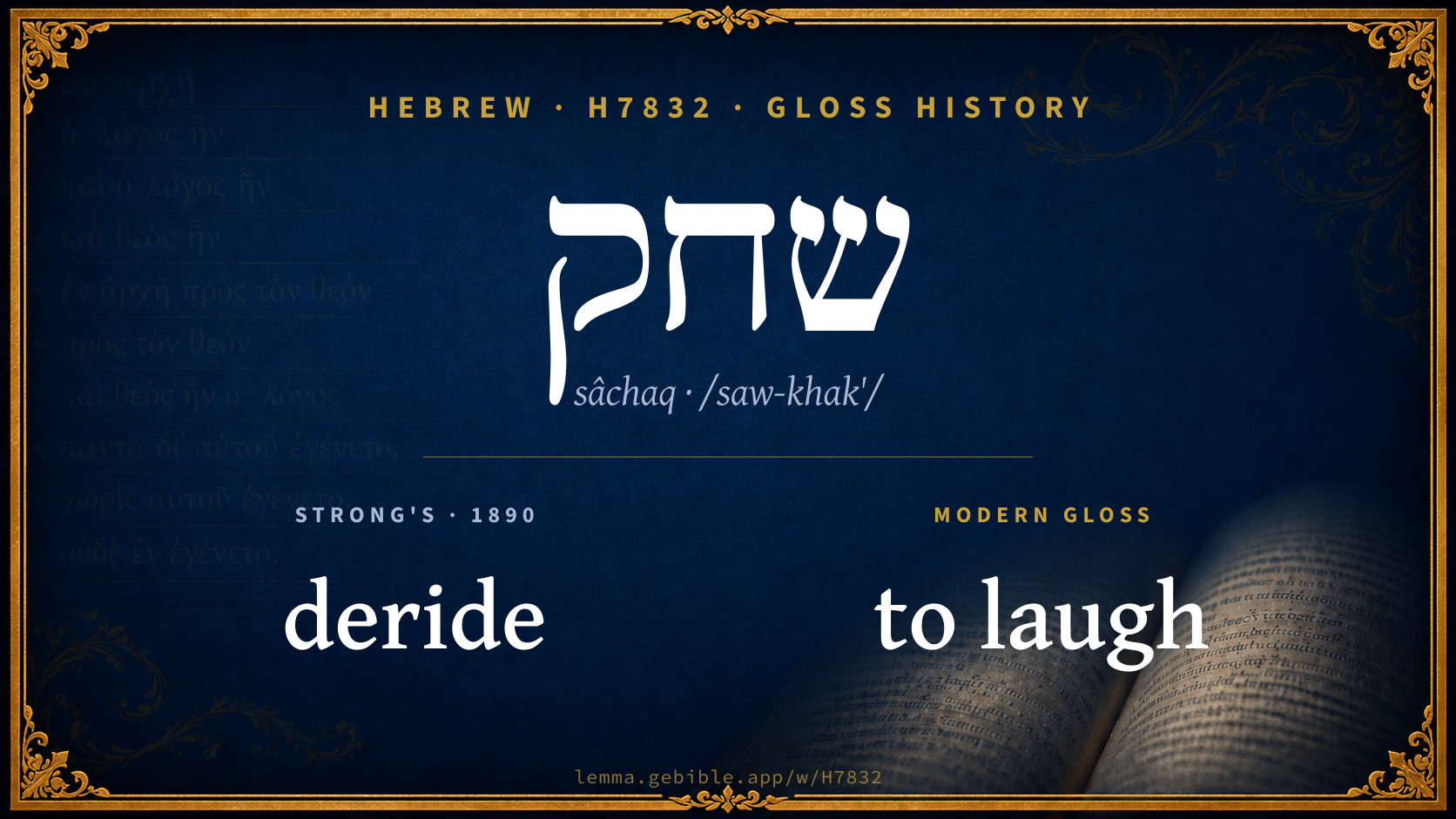
Gloss history
Strong's 1890 vs modern scholarship
About this word
Strong's H7832 catalogs a Hebrew word from the Hebrew Old Testament.
These counts are not copied from any lexicon or concordance. They are computed here, from the morphology-tagged Hebrew Old Testament. What Lemma adds →
- 36
- distinct verses
- The word appears in 36 distinct verses.
- 13 / 39
- OT books
- The word appears in 13 of 39 Old Testament books.
- #990
- by frequency
- Top 1000 most frequent Hebrew words (rank 990 of 8,640 Hebrew words by occurrence).
View all 36 occurrences in the concordance →
By section of the Old Testament
By traditional corpus
Conventional, traditional groupings — biblical authorship is debated, so this is a traditional corpus grouping, not an authorship claim. Each share is this word’s portion of its verses in that division of the Hebrew canon. Each figure is a share of the word’s 36 distinct verses.
- Writings (Ketuvim) 25 verses · 69%
- Prophets (Nevi'im) 11 verses · 31%
How translations render this word
Counts come from each version’s own published word-to-Strong’s tagging or interlinear alignment — an approximate guide to how each version renders this word, not a word-level alignment the data otherwise carries. Because each total is that version’s own tagged count, the per-version totals vary from one another and need not match the appearance or distinct-verse counts above. These counts may also differ from a printed concordance because Lemma counts each distinctly tagged rendering and does not collapse phrase taggings into a single head-word total. This is a fixed set of word-tagged versions (KJV, ASV, BSB, ULT) and does not change with the reading translation you choose elsewhere. Each version’s license is shown beside its name below (and on Sources).
- King James Version: Play 3×, Shall laugh 3×, Make merry 2×
- American Standard Version: Make merry 3×, Played 2×, Playing 2×
- Berean Standard Bible: Laugh 3×, He laughs 2×, Laughing 2×
- unfoldingWord Literal Text: Laughs 6×, Laugh 4×, Play 3×
King James Version Public Domain
Renders H7832 across 36 tagged occurrences — most commonly:
Plus 22 renderings that appear only once — usually multi-word phrases or single function words the recovered tagging swept in, not distinct renderings.
American Standard Version Public Domain
Renders H7832 across 35 tagged occurrences — most commonly:
Plus 24 renderings that appear only once — usually multi-word phrases or single function words the recovered tagging swept in, not distinct renderings.
Berean Standard Bible Public Domain
Renders H7832 across 36 tagged occurrences — most commonly:
Plus 25 renderings that appear only once — usually multi-word phrases or single function words the recovered tagging swept in, not distinct renderings.
unfoldingWord Literal Text CC BY-SA 4.0
Renders H7832 across 36 tagged occurrences — most commonly:
Plus 17 renderings that appear only once — usually multi-word phrases or single function words the recovered tagging swept in, not distinct renderings.
9 senses and sub-senses in the full BDB
Hebrew verbs can shift meaning by stem (binyan): Qal is the basic action, Niphal is often passive or reflexive, Piel often intensifies or makes it factitive, and Hiphil is typically causative. The senses below are grouped under the stem BDB assigns to each.
What do BDB’s symbols mean?
BDB uses these scholarly abbreviations:
| Symbol | Meaning |
|---|---|
| 𝔊 | the Septuagint (the ancient Greek translation, LXX) |
| 𝔙 | the Vulgate (the Latin translation) |
| 𝔖 | the Syriac version (the Peshitta) |
| 𝔗 | the Targum (the Aramaic translation) |
| ψ | the Psalms |
| √ | root (the underlying root or stem) |
| ‖ | parallel passage (a synonymous or contrasted parallel) |
| † | the dagger: every passage where the word occurs is cited |
The 9 senses and sub-senses the full Brown-Driver-Briggs lexicon distinguishes for this word, in lexicon order (not ranked by frequency), with BDB’s own verbatim wording and sub-sense lettering. Shown in Hebrew script with BDB’s own scholarly abbreviations. The condensed entry is in the Lexicon Entry tab. See also the Forms in the corpus table below.
Qal
- Pf. 3 ms. וְשׂ׳ consec. Pr 29:9; 3 pl. שָֽׂחֲקוּ La 1:7; Jb 30:1; Impf. 3 ms. יִשְׂחַק Jb 39:7 +, etc.; Inf. cstr. שְׂחוֹק Ju 16:27; Ec 3:4;— e.g. Proverbs 29:9
- 1.
- a. laugh at, usually in contempt, derision, c. עַל pers. Jb 30:1 ψ 52:8; עַל rei La 1:7; c. ל pers. God subj. ψ 37:13; 59:9 (‖ לָעַג); c. ל rei vel pers. = have no fear of, Hb 1:10; Jb 5:22; Pr 31:25, also, fig., of noble animals Jb 39:7, 18, 22; 41:21; abs., Pr 29:9 (opp. רָגַז), of י׳ ψ 2:4 (‖ לָעַג), of wisdom Pr 1:26 (ב temp.; ‖ id.). e.g. Job 30:1
- b. c. אֶל pers., appar. of friendly laugh Jb 29:24; in gen. Ec 3:4 (opp. בָּכָה). e.g. Job 29:24
- 2. sport, play, Ju 16:27. e.g. Judges 16:27
Piel
- Pf. 1 s. וְשִׂחַקְתִּ֫י 1 S 6:21; Impf. 3 ms. וַיְשַׂחֶק־ Ju 16:25, etc.; Inf. cstr. לְשַׂחֶק־ ψ 104:26; Pt. מְשַׂחֵק Pr 26:19; 1 Ch 15:29, f. מְשַׂחֶ֫קֶת Pr 8:30, 31; pl. מְשַׂחֲקִים 2 S 6:5 +, מְשַׂחֲקוֹת 1 S 18:7;— e.g. 1 Samuel 6:21
- 1. make sport, Ju 16:25 (ל pers.) 2 S 2:14 (לִפְנֵי pers.; in tournament), Pr 8:30 (לִפְנֵי), v 31 (ב loc.). e.g. Judges 16:25
- 2. jest, Pr 26:19. e.g. Proverbs 26:19
- 3. play: incl. instr. music, singing and dancing 1 S 18:7, c. לִפְנֵי י׳ 2 S 6:5 (ב instr.), = 1 Ch 13:8, 2 S 6:21 1 Ch 15:29 (+ מְרַקֵּד); of merry-making Je 15:17 (‖ עָלַז), 30:19; 31:4; of children’s sport Zc 8:5; of beasts Jb 40:20 ψ 104:26; of man, play with (ב) crocod. Jb 40:29. e.g. 1 Samuel 18:7
Hiphil
- (declar.) Pt. pl. מַשְׂחִיקִים 2 Ch 30:10 they uttered mockery עֲלֵיהֶם (‖ מַלְעִגִים). e.g. 2 Chronicles 30:10
Senses from the full Brown-Driver-Briggs lexicon (Brown, Driver, Briggs; Oxford 1906 — public domain), digitized via Sefaria, supplemented by the OpenScriptures HebrewLexicon (CC BY 4.0). Full attribution on Sources.
Word origin
vb. laugh (‖ צהק, q.v.; NH שָׂחַק, סָחַק; Ethiopic ሠሐቀ: );—
— Brown-Driver-Briggs (Oxford 1906, public domain), digitized via Sefaria, supplemented by the OpenScriptures HebrewLexicon (CC BY 4.0). See Sources.
Origin: a primitive root
Jastrow Dictionary
A second Hebrew/Aramaic lexicon for comparison, covering Aramaic and post-biblical (Talmudic, Targumic, Midrashic) usage that the biblical-Hebrew BDB does not. Matched by lemma rather than by Strong’s number, so a lemma may carry more than one Jastrow headword (shown separately below), and the entries cover usage well beyond the Bible.
שָׂחַק
- to be bright; to laugh, jest, play. Tosef. B. Kam. II, 2 ס׳ בין הבקר וכ׳ ed. Zuck. (Var. צחבין, צהבין, read: צחק בין) if he (the ox) sported among the herd three times (doing no harm). Deut. R. s. 3, end ראה … שׂוֹחַקַת לעבד the king saw her smile at one of his servants. Y. Kidd. III, 63ᵈ מימי לא ש׳ וכ׳ never did a person have his sport with me, except this man. Tanḥ. Naso 5 באותו שבפנים שָׂחַקְתָּ אבל … לִשְׂחוֹק thou didst fool him (the watchman) that was inside, but thou canst not fool me. Der. Er. Zuṭṭa ch. V ולא בוכה בין השׂוֹחֲקִים ולא שׂוֹחֵק וכ׳ nor should one weep among those who laugh, nor laugh among those who weep; a. fr.—Trnsf. (of fingers) to be spread, opp. עצב. Succ. 7ᵃ טפח שוחק (Ms. M. a. Ar. ס׳); Erub. 3ᵇ שׂוֹחֲקוֹת, v. אַמָּה; a. e.
- same. Tanḥ. l. c. באישך את מְשַׂחֶקֶת וכ׳ thou canst fool thy husband, but thou canst not fool me. Ib. ואני יושב ומְשַׂחֵק על וכ׳ but I sit laughing at my creatures. Tosef. Keth. IX, 2 מְסַחֵק הוא בה ed. Zuck. (Var. מְצַ׳) he may laugh at her (and take the sham sale seriously); (Keth. 79ᵃ רצה מצחק), v. פִּיסְטִין. Tanḥ. Noah 5 והיו משחקין ממנו they laughed at him (Noah). Ber. 7ᵇ, a. e. השעה משחקת לו the hour smiles on him, i.e. he is in luck; a. fr.
- to cause to laugh, lead to sport. Gen. R. s. 22 אם בא … להַשְׂחִיקְךָ שמחהו וכ׳ if thy inclination comes to incite thee to merriment, rejoice it with words of the Law; Yalk. Is. 296.
שַׂחַק
- , v. שְׂחוֹק
שָׁחַק
- (b. h.) to rub, grind, pound. Midr. Till. to Ps. XVIII ולמה … שחקים שהן שׁוֹחֲקִין אלו באלו why are the clouds named sh’ḥaḳim? Because they rub against one another. Gen. R. s. 13, a. e., v. שַׁחַק II. Bets. II, 8 שוחקין את הפלפלין וכ׳ you may grind pepper on the pepper-mill (on the Holy Day). Y. Ber. VI, 10ᵃ top שְׁחָקָן וכ׳ if he mashed them (the turnips), he must say the benediction &c., opp. אם בעיינן הן if they are in their natural shape; a. fr.—[Yalk. Cant. 988 שחק, v. שָׁחַץ.]—Part. pass. שָׁחוּק; f. שְׁחוּקָה; pl. שְׁחוּקִים, שְׁחוּקִין; שְׁחוּקוֹת a) ground, pounded, mashed. Y. Ber. l. c. ויין לאו ש׳ הוא is wine not a product gained by pounding?; ib. ופת לאו ש׳ היא is not bread a product &c.?; ib. שאר … אע"פ שש׳ הן וכ׳ all other things, although produced by pounding (like olive-oil &c.) are ritually treated as if in their natural state; a. e.—b) (cmp. שָׁחַף) lean, meagre. Y. Dem. II, beg. 22ᵇ שחוקה היא (R. S. to Dem. II, 1 שְׁחִיקָא ch.) the fig of Bozrah is stunted.
- 1. same; same; part. pass. מְשׁוּחָק; pl. מְשׁוּחָקִים, מְשׁוּחָקִין rubbed, worn-out, threadbare. Tosef. Men. I, 8; Zeb. 18ᵃ, v. רָשַׁל; ib. 18ᵇ; a. e.
- 2. to curse the memory of a person, v. next w.
- to be ground. Ab. d’R. N. ch. I נִשְׁחֲקוּ עצמותיו his bones were ground, i.e. his memory is cursed, v. next w.
שְׁחַק
- Targ. O. Ex. XXX, 36.—Y. Sabb. VII, 10ᵃ bot. ההן דש׳ תומא he that grinds garlic. Ib. 10ᵇ bot. B. Bath. 146ᵃ שַׁחְקֵי, v. מַרְגְּנִיתָא; a. fr.—Midr. Sam. ch. I, v. infra.—Part. pass. שְׁחִיק.—ש׳ טמיא, v. טַמְיָא; (in Hebr. dict.) ש׳ עצמות. Gen. R. s. 49, beg.; a. e.—Y. Sabb. VI, 8ᵃ top הוות רגליה שחקה (read: שְׁחִיקָא) his foot was sore from rubbing.—Y. Dem. II, beg. 22ᵇ שחיקא (R. S. to Dem. II, 1), v. שָׁחַק
- to mention the name of a dead person with the imprecation שחיק טמיא (his bones be ground), to curse. Lev. R. s. 32, end מדכרין ומְשַׁחְקִין there are those whose names are mentioned with a curse, opp. ומניחין, v. נוּחַ h.; Yalk. Ex. 411 (Hebr.) מזכירין ומְשַׁחֲקִים; Tanḥ. Vayaḳhel 4; Ex. R. s. 48 (mixed dict.) מדכרין ומשחקים; Midr. Sam. ch. I ושָׁחְקִין (Pe.).
שַׁחַק I
- (preced.), pl. שְחָקִים, שְׁחָקִין worn garments, thin clothes. Sifra Thazr., Neg., Par. 4, ch. XV בקרחתו אלו הש׳ ‘in its baldness’ (Lev. XIII, 55), that means old clothes (whose nap is worn off). Keth. V, 8 אין נותנין לה … ולא ש׳ וכ׳ we must not give her new garments for summer and worn-out (thin) garments for winter; ib. והש׳ שלה and the discarded garments remain hers; v. בְּלָאוֹת. Zeb. 18ᵇ; a. e. e.g. Leviticus 13:55
שַׁחַק II
- [dust,]; pl. שְׁחָקִים clouds, heaven, sh’ḥaḳim, name of one of the seven heavens. Ḥag. 12ᵇ ש׳ שבו רחיים וכ׳ it is named sh’ḥaḳim, for in it stands a mill and grinds manna for the righteous. Gen. R. s. 13 למה … ש׳ שהן שוחקין וכ׳ why are they (the clouds) called sh’ḥaḳim? Because they grind the water … like a stomach (grinding the food); Tanḥ. Mick. 1; Koh. R. to I, 7. Ib. איכן … בש׳, v. נָזַל. Midr. Till. to Ps. XVIII, v. שָׁחַק; a. e.
שַׁחַק
- Targ. Ps. LXXXIX, 38.—Pl. שְׁחָקיָּא, שְׁחָקִין, שְׁחָקֵי. Ib. 7 (ed. Wil. שַׁחֲקֵי). Ib. LXXVII, 18. Targ. Job XXXVI, 28; a. e.
A Dictionary of the Targumim, the Talmud Babli and Yerushalmi, and the Midrashic Literature (Marcus Jastrow; London, Luzac, 1903) — Public Domain. Digitized via Sefaria. Digitized via Sefaria. Full attribution on Sources.
Forms in the corpus
The 35 distinct written forms H7832 takes in the Hebrew Bible, most frequent first — each parse links to that stem’s occurrences in the concordance. Hebrew forms include their vowel points and cantillation, so a single lemma takes many written forms.
Same root — word family
Other BDB entries built from the same root as H7832, grouped by Strong’s listed origin. These share a root / origin per the lexicon — not necessarily a shared meaning. Each links to that word’s own entry.
Derived from this word
Compare all same-root words → They share a root, not necessarily a meaning.
Septuagint verse parallels
This word appears in 35 verses that also exist in the Greek Old Testament (Septuagint), out of the 36 Hebrew verses it occurs in. You can read those verses in Greek by switching the Old Testament edition to the Septuagint.
Read these verses in the Septuagint
- Judges 16:25
- 1 Samuel 18:7
- 2 Samuel 2:14
- 1 Chronicles 13:8
- 2 Chronicles 30:10
- Job 5:22
- Psalms 2:4
- Proverbs 1:26
- Ecclesiastes 3:4
- Jeremiah 15:17
- Lamentations 1:7
- Habakkuk 1:10
This is a verse-level parallel only — the same verses exist in both the Hebrew and Greek Old Testaments. No word-level Hebrew↔Greek correspondence is claimed: the data carries no such alignment, so no Greek word is shown as this Hebrew word’s translation. Coverage is not total — the Septuagint omits the deuterocanon and renumbers the Psalms, so some Hebrew verses have no direct Greek parallel.