
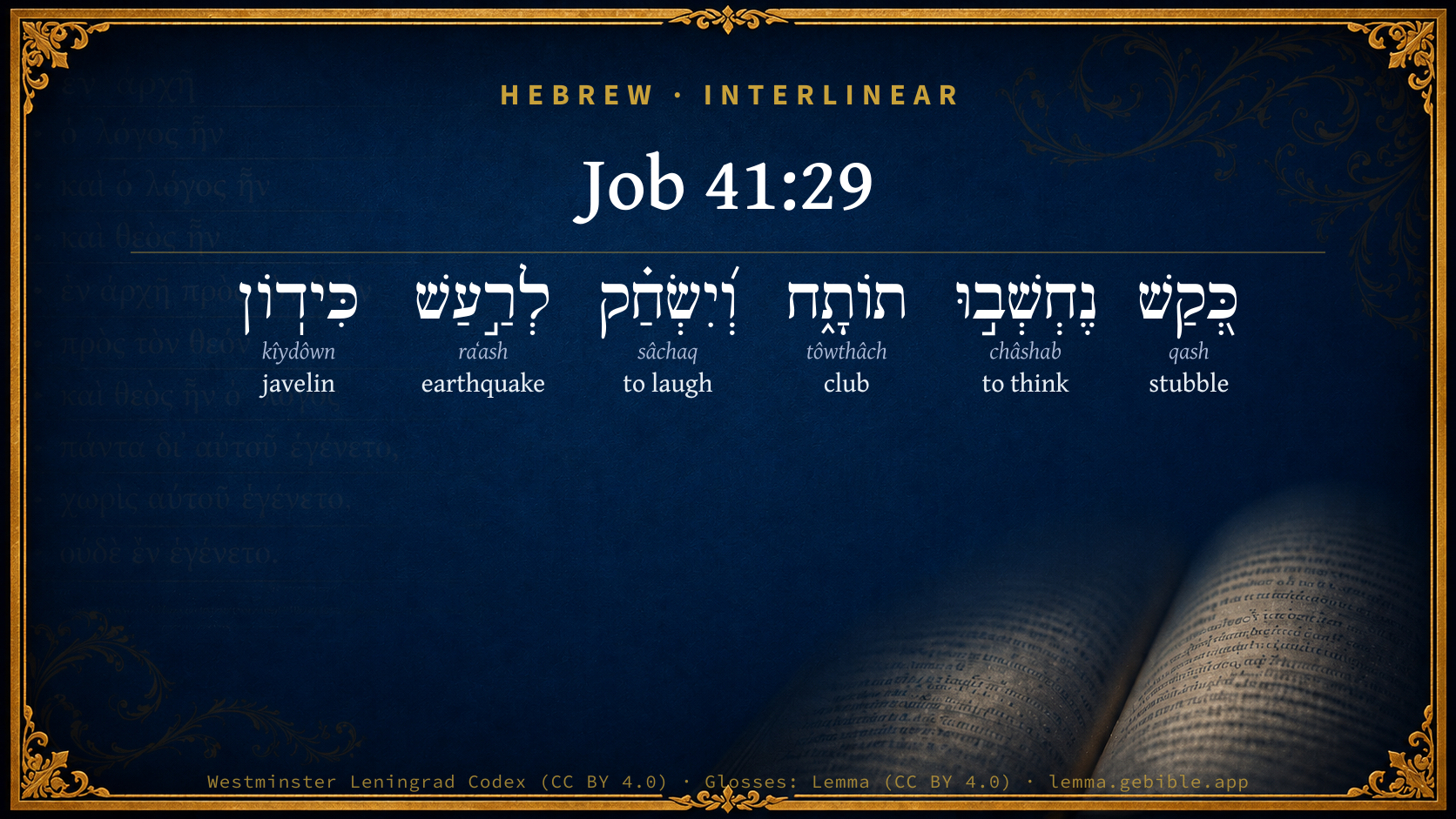
Job 41:29

Hebrew (Westminster Leningrad Codex) Job 41:29 appears in the Hebrew Old Testament. The text above is from the Westminster Leningrad Codex. Each word links to its Strong’s number, a concise gloss, and parsing drawn from the Open Scriptures Hebrew Bible morphology. Click any word for its full Brown-Driver-Briggs (BDB) entry.
Download image
Cite this verse

Job 41:29 (World English Bible). Public Domain. Lemma interlinear Bible study tool, https://lemma.gebible.app/v/job/41/29.

Show BibTeX & RIS
BibTeX
RIS
English Translation
Clubs are counted as stubble. He laughs at the rushing of the javelin.
World English Bible · Public Domain
Highlights
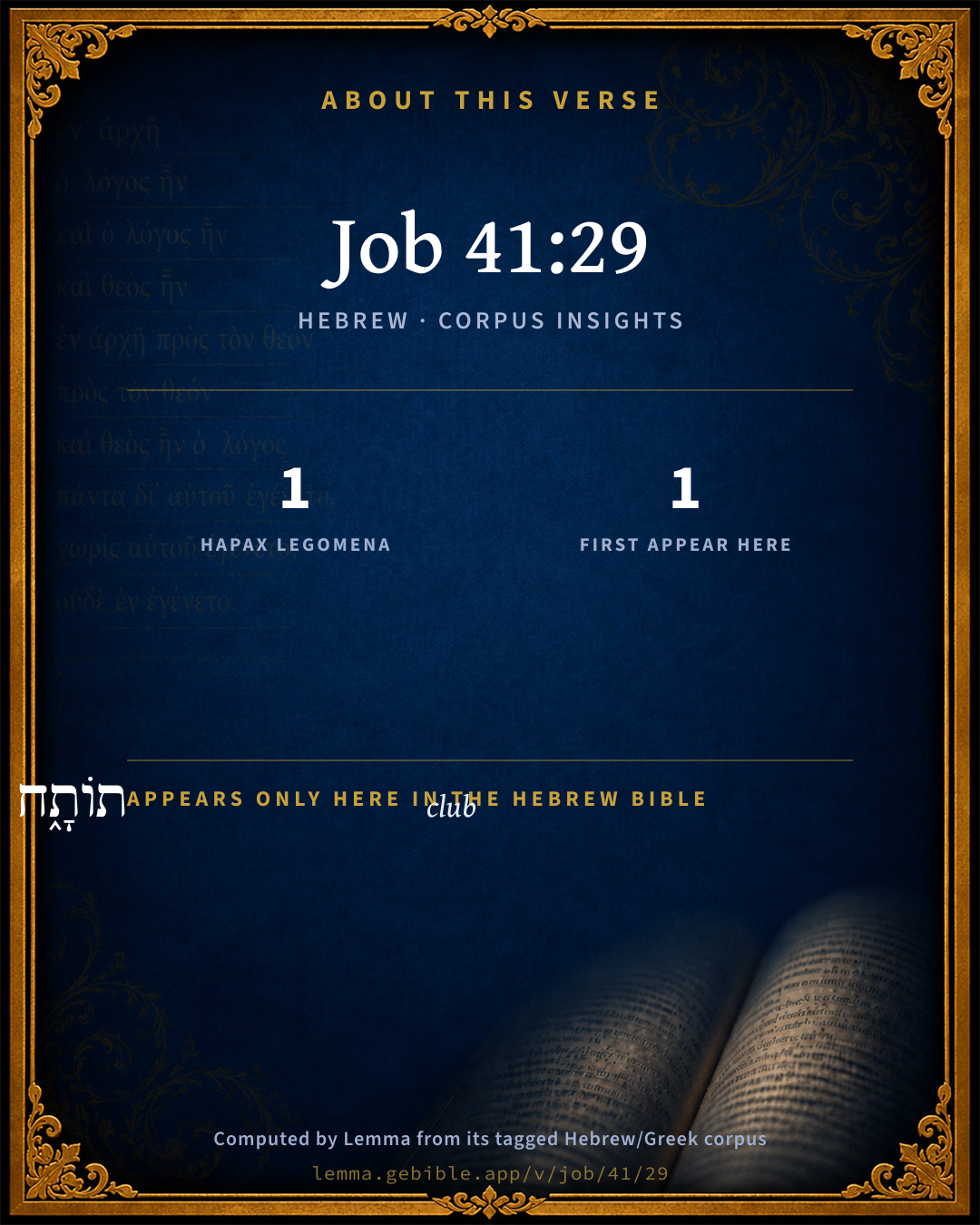
  • 1 hapax legomenon — only here in the Hebrew Bible
  • 1 first appearance in the Hebrew Bible
Full analysis ↓
Download a study sheet

One document with this verse’s original text, its word-by-word gloss line, the meaning frame, cross-references with their text, attributed commentary, and full source and license credits — printable, and it pastes into notes with its structure intact.

This verse Autodidact and up

Study sheet (.html) Plain text (.txt)

A passage Seminary Student

Up to 50 verses in one chapter. A passage sheet keeps up to 6 commentary sources and 12 cross-references per verse, in the order this page ranks them, and says so on the sheet whenever that leaves anything out. Ask for a single verse and you get the Autodidact verse sheet above.

Everything on this page stays free to read, with no account — the sheet is a download of what is already on screen, not access to it.

Want to remove ads? Support Godless Engineer
Compare translations 3

The same verse in 3 English versions, stacked beneath the original-language interlinear above. Click any original word for its lexicon entry.

Each is an independent rendering of the whole verse — the interlinear is not word-aligned to these translations.

Highlighted words mark where these versions differ — a whole-verse word diff, not a word-by-word alignment.

  • World English Bible Public Domain
    Clubs are counted as stubble. He laughs at the rushing of the javelin.
  • King James Version Public Domain
    Darts are counted as stubble: he laugheth at the shaking of a spear.
  • unfoldingWord Literal Text CC BY-SA 4.0
    Clubs are regarded as chaff, and it laughs at the rattling of a spear.

unfoldingWord Literal Text — © unfoldingWord, licensed CC BY-SA 4.0. Word-aligned USFM3 via Door43 (git.door43.org/unfoldingWord/en_ult).

Versions to compare (up to 4)

3 of 4 selected

Show all 14 translations

Every available English version of this verse, each an independent rendering of the whole verse.

  • World English Bible Public Domain
    Clubs are counted as stubble. He laughs at the rushing of the javelin.
  • Berean Standard Bible Public Domain
    A club is regarded as straw, and he laughs at the sound of the lance.
  • Majority Standard Bible Public Domain
    A club is regarded as straw, and he laughs at the sound of the lance.
  • King James Version Public Domain
    Darts are counted as stubble: he laugheth at the shaking of a spear.
  • American Standard Version (1901) Public Domain
    Clubs are counted as stubble: He laugheth at the rushing of the javelin.
  • Revised Version (1885) Public Domain
    Clubs are counted as stubble: he laugheth at the rushing of the javelin.
  • Young's Literal Translation Public Domain
    As stubble have darts been reckoned, And he laugheth at the shaking of a javelin.
  • Literal Standard Version CC BY-SA 4.0
    Darts have been reckoned as stubble, || And he laughs at the shaking of a javelin.
  • Unlocked Literal Bible CC BY-SA 4.0
    Clubs are regarded as straw; he laughs at the whirring flight of a spear.
  • unfoldingWord Literal Text CC BY-SA 4.0
    Clubs are regarded as chaff, and it laughs at the rattling of a spear.
  • Darby Bible Public Domain
    Clubs are counted as stubble; he laugheth at the shaking of a javelin.
  • World Messianic Bible Public Domain
    Clubs are counted as stubble. He laughs at the rushing of the javelin.
  • Free Bible Version CC BY-SA 4.0
    Clubs are also treated like stubble; it laughs at the sound made by flying spears.
  • JPS Tanakh (1917) Public Domain
    (41-21) Clubs are accounted as stubble; he laugheth at the rattling of the javelin.

Literal Standard Version (2020), Covenant Press — licensed CC BY-SA 4.0. Text via the HelloAO Bible API (eBible.org). Unlocked Literal Bible (unfoldingWord) — licensed CC BY-SA 4.0. Text via the HelloAO Bible API (eBible.org). unfoldingWord Literal Text — © unfoldingWord, licensed CC BY-SA 4.0. Word-aligned USFM3 via Door43 (git.door43.org/unfoldingWord/en_ult). Free Bible Version, Dr. Jonathan Gallagher — licensed CC BY-SA 4.0. Text via the HelloAO Bible API (eBible.org).

Word by word

More ways to search: Search by grammar → Find every occurrence → Compare this word →

Practice this passage: Drill this verse → Learn its vocabulary →

About this verse

These counts appear in no published source. They are computed here, from the morphology-tagged text and Lemma’s own curated glosses. What Lemma adds →

6
words
6
distinct lemmas
Wisdom
section

Notable vocabulary

1 hapax legomenon — a word that appears only here in the entire Hebrew Bible:

  • תוֹתָ֑ח club H8455

First appearance in Scripture

This word makes its first canonical appearance in the Hebrew Bible here:

  • תוֹתָ֑ח club H8455

Shared distinctive vocabulary

כִּידֽוֹן javelin H3591 occurs in 8 verses of the Hebrew Bible. Also found in:

Grammatical profile

  • 2 verbs
  • 4 nouns

Verb forms

  • נֶחְשְׁב֣וּ Niphal · Perfect
  • וְ֝יִשְׂחַ֗ק Qal · Imperfect

Cross-references

1

Topical passages linked to Job 41:29 in the Treasury of Scripture Knowledge — connected by theme and wording, ordered by reader-vote popularity; previews shown in the World English Bible.

  • 2 Chronicles 26:14 Uzziah prepared for them, even for all the host, shields, and spears, and helmets, and coats of mail, and bows, and stones for slinging.

Cross-references courtesy of OpenBible.info (CC BY 4.0).

Hebrew and Greek witnesses Masoretic Hebrew ↔ Greek Septuagint

The same verse in the two great witnesses to the Old Testament, shown verse-for-verse.

These are two independent witnesses, not word-aligned to each other, and the Septuagint is shown in lemma (dictionary) form.

Hebrew Job 41:29 Masoretic · Westminster Leningrad Codex

כְּ֭קַשׁ נֶחְשְׁב֣וּ תוֹתָ֑ח וְ֝יִשְׂחַ֗ק לְרַ֣עַשׁ כִּידֽוֹן

Clubs are counted as stubble. He laughs at the rushing of the javelin.

World English Bible · Public Domain

Hebrew: Westminster Leningrad Codex (CC BY 4.0). Greek: Septuagint (public domain); English from a public-domain English Septuagint. How the Septuagint differs from the Hebrew →

Commentary

Notes on Job 41:29 from classic Christian and Jewish commentators (each source and its license shown beneath its notes). The classic Christian expositions comment on the surrounding passage and are grouped to its opening verse, so a note may address several verses; the Jewish commentaries on the Tanakh (Rashi and others) are per-verse, so they appear only where the commentator wrote on this verse.

Lemma curates 59 commentaries, every one of them public domain or Creative Commons licensed, each selected and text-cleaned for this edition rather than reprinted as found. About our sources →

Trapp's Complete Commentary

John Trapp

Job 41:29 Darts are counted as stubble: he laugheth at the shaking of a spear.

Ver. 29. Darts are counted as stubble] When any thing in the decrees or decretals likes not the pope, he sets pales, that is, stubble, upon it; or Hoc non credo: so doth this leviathan upon all kinds of weapons; he slights them. The word here rendered darts is as strange as the weapon it signifieth is to us unknown, lapides ballistic, an engine whereby great stones were thrown against walls or towers (as now cannon balls), to make a breach in them. Catapulta, aries vel simile aliquod tormentum. Be they what they will, the whale fears them not, no, though they were as terrible to others as those two great pieces of ordinance cast by Alphonsus, duke of Ferrara; the one whereof he called the earthquake, the other grandiabolo, the great devil.

John Trapp, A Commentary or Exposition upon All the Books of the Old and New Testament (1647–1656) — public domain. Text from a community e-Sword module.

Jamieson, Fausset & Brown

Robert Jamieson, A. R. Fausset & David Brown

Darts--rather, "clubs"; darts have been already mentioned (Job 41:26).

Jamieson, Fausset & Brown — Commentary Critical and Explanatory on the Whole Bible (1871) — public domain (CC PDM 1.0). Text via the HelloAO Bible API.

Adam Clarke's Commentary

Verse 29. Darts are counted as stubble] All these verses state that he cannot be wounded by any kind of weapon, and that he cannot be resisted by any human strength.

A young crocodile, seen by M. Maillet, twelve feet long, and which had not eaten a morsel for thirty-five days, its mouth having been tied all that time, was nevertheless so strong, that with a blow of its tail it overturned a bale of coffee, and five or six men, with the utmost imaginable ease! What power then must lodge in one twenty feet long, well fed, and in health!

Adam Clarke's Commentary on the Bible (1810–1826) — public domain. Text from a community e-Sword/MySword module.

Ellicott's Commentary for English Readers

(29) Darts.—Rather, clubs.

A Bible Commentary for English Readers, edited by Charles John Ellicott (1878–1897) — public domain. Text from a community e-Sword module.

The Cambridge Bible for Schools and Colleges

gen. ed. J. J. S. Perowne

29. darts are counted] Rather, clubs.

The Cambridge Bible for Schools and Colleges (gen. ed. J. J. S. Perowne; Cambridge University Press, 1878–1918) — public domain. Text from a community e-Sword module.

John Gill's Exposition

Sharp stones are under him,.... And yet give him no pain nor uneasiness;

he spreadeth sharp pointed things upon the mire; and makes his bed of them and lies upon them; as sharp stones, as before, shells of fishes, broken pieces of darts, arrows, and javelins thrown at him, which fall around him: this does not so well agree with the crocodile, the skin of whose belly is soft and thin; wherefore dolphins plunge under it and cut it with a thorn, as Pliny (h) relates, or with spiny fins (i); but with the whale, which lies among hard rocks and sharp stones, and large cutting pieces of ice, as in the northern seas.

(h) Nat. Hist. l. 8. c. 25. (i) Sandys's Travels, l. 2. p. 78.

John Gill's Exposition of the Whole Bible (1746–1763) — public domain (CC PDM 1.0). Text via the HelloAO Bible API.

Albert Barnes' Notes on the Bible

Darts are counted as stubble - The word rendered “darts” (תותח tôthâch) occurs nowhere else in the Scriptures. It is from יתח, obsolete root, “to beat with a club.” The word here probably means clubs. Darts and spears are mentioned before, and the object seems to be to enumerate all the usual, instruments of attack. The singular is used here with a plural verb in a collective sense.

Albert Barnes' Notes on the Bible (1834–1885) — public domain. Text from a community e-Sword/MySword module.

Matthew Poole's English Annotations

So far is he from fearing it, and fleeing from it, that he scorns and defies it.

Matthew Poole's English Annotations on the Holy Bible (1683–1685) — public domain. Text from a community e-Sword/MySword module.

Whedon's Commentary on the Bible

Daniel D. Whedon

29. Darts — Thothahh. Either clubs, battle axe, or bludgeon. (Furst.) The like meaning of the same word in the Arabic favours the first of these definitions. The boomerang, or club-stick, (now called lissan, tongue,) was much in use among the ancient Egyptian soldiers, and, in close combat, was really a formidable weapon, as the experience of modern times sufficiently testifies. It was about two and a half feet long, and made of hard acacia wood. See Wilkinson, Anc. Egyptians, (P.A., i, p. 365.)

The spear — The kidhon (javelin) or spear was borne upon the shoulder, as in the case of Goliath, (1Sa_17:6-7,) and was in common use among the Babylonians and Persians. Jer_6:23; Jer_50:42.

Daniel D. Whedon (gen. ed.), Commentary on the Old and New Testaments (1874–1909) — public domain. Text from a community e-Sword module.

The Pulpit Commentary

Darts are counted as stubble; rather, the club is counted as stubble. Maces, either of hard wood or of metal, were used by the Assyrians ("Ancient Monarchies," vol. 2. p. 64). They had heavy heads, and were quite as effective weapons as either swords or spears. If a strong man could have succeeded in dealing a blow with one on the head of a crocodile, it would probably have proved fatal; but intending assailants were doubtless charged, and scattered "as stubble," before they could find opportunity to strike. He laugheth at the shaking of a spear; rather, at the rushing of the javelin (see the Revised Version).

The Pulpit Commentary (1880–1919), ed. H.D.M. Spence-Jones & Joseph S. Exell — public domain. Text from a community e-Sword module.

Lesson kit

Teaching starters — assembled from the data on this page, not authored interpretation. Every prompt links to the verse data it draws on. Edit before teaching.

Job, in the Wisdom, opens this verse with 6 words (6 distinct Hebrew lemmas). Its most distinctive word is tôwthâch (“club”). A historical commentator’s framing appears above. Read the whole chapter for the surrounding context.

Discussion questions

  1. What does “club” (tôwthâch) contribute to the verse as a whole?
  2. 1 word here appears nowhere else in the Hebrew Bible. Why might the author reach for such rare wording?
  3. This is the first place “club” appears in Scripture (first appears here). What does its debut here establish?
  4. How does Joshua 8:18, which shares the word «javelin», read alongside this verse?
  5. The translations on this page render this verse differently — a whole-verse word diff, not a word-by-word alignment. What might account for the different wordings?
  6. «נֶחְשְׁב֣וּ» is a Niphal Perfect verb. How does that grammatical form shape the action described?
  7. Compare how Trapp's Complete Commentary and Jamieson, Fausset & Brown read this verse. Where do they agree or differ?

Things to notice

  • 1 word in this verse appears nowhere else in the Hebrew Bible.
  • 1 word makes its first canonical appearance in Scripture here.
  • These translations choose different wording for 13 words in this verse.
  • 6 distinct Hebrew lemmas span 6 words in this verse.

Reading settings

Reading text

Shown beneath each verse's original-language words.

Old Testament
Old Testament edition

Read the OT as the Masoretic Hebrew (MT) or the Greek Septuagint (LXX).

English shown for the Greek Septuagint (in the Hebrew ↔ Greek comparison).

Comparing translations? Open the Compare panel on any verse page to stack up to four side by side.